









Bajaj Auto Share Price Rises After Q1 Profit Jumps 14%—What It Means for Investors
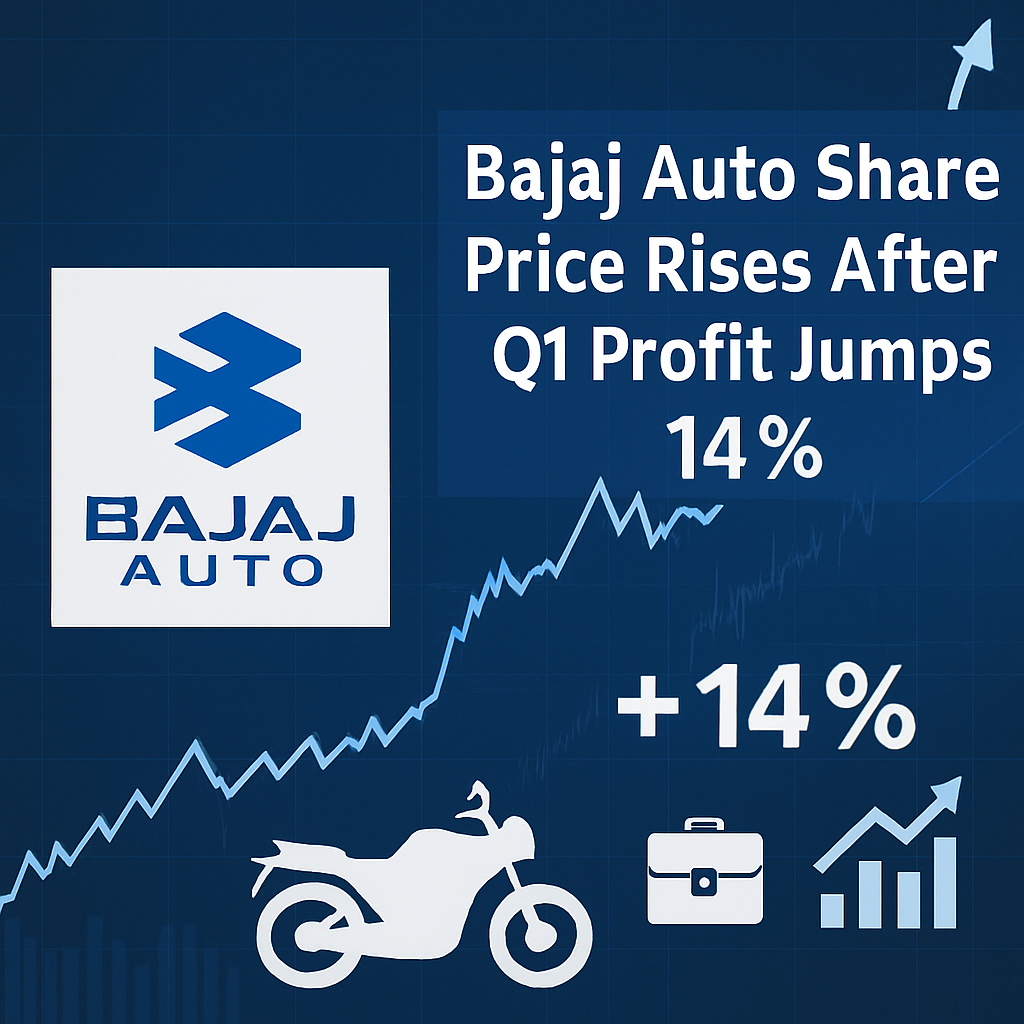
Bajaj Auto reported a robust 14% YoY rise in Q1 profits, driving its share price upward. Here’s a full analysis of performance drivers, analyst views, and what to expect next.
Table of Contents
Introduction
Bajaj Auto Limited reported its first quarter results for the financial year 2025-26 on August 6, 2025, showing growth across key financial metrics. The company’s consolidated profit after tax reached ₹2,210.44 crore for the quarter ended June 30, 2025, representing a 13.84% increase compared to ₹1,942 crore in the corresponding quarter of the previous year.
Revenue from operations stood at ₹13,133.35 crore during Q1 FY26, up 10% from ₹11,939 crore in the same period last year. The company sold 11.11 lakh units during the quarter, marginally higher than 11.02 lakh units in Q1 FY25.
As of September 17, 2025, Bajaj Auto shares traded at ₹9,074.10 on the National Stock Exchange. This analysis examines the quarterly financial performance, operational metrics, market positioning, and sector context based on publicly available information from stock exchanges and official company disclosures.
Q1 FY26 Financial Performance Overview
Profit and Revenue Analysis
Bajaj Auto’s consolidated net profit of ₹2,210.44 crore for Q1 FY26 reflected improved operational efficiency and favorable market conditions. The year-over-year profit growth of 13.84% outpaced revenue growth, indicating margin expansion during the quarter.
Total revenue from operations increased 10% to ₹13,133.35 crore. This growth reflected demand across domestic and export markets, supported by the company’s product portfolio spanning motorcycles and three-wheelers.
The higher profit growth compared to revenue increase suggested benefits from operating leverage, cost management measures, and possibly favorable product mix. Quarterly results typically show seasonal variations, making year-over-year comparisons more meaningful than sequential quarter analysis.
Volume Performance
Total vehicle sales reached 11.11 lakh units in Q1 FY26, representing 1% growth over 11.02 lakh units in Q1 FY25. The modest volume increase contrasted with stronger revenue growth, indicating potential average selling price improvement.
Domestic motorcycle sales and export performance contributed to overall volumes. The company maintains significant presence in both two-wheeler and three-wheeler commercial vehicle segments across markets.
Volume trends reflect competitive dynamics, seasonal demand patterns, and economic conditions in key markets. Price realization improvements can offset modest volume growth to drive revenue expansion.
Margin Indicators
While specific EBITDA margin data requires reference to detailed quarterly presentations, the profit growth exceeding revenue growth indicates operational efficiency gains. Factors influencing margins include raw material costs, product mix, manufacturing efficiency, and pricing strategies.
The two-wheeler and commercial vehicle industry faces input cost pressures from commodities like steel, aluminum, and electronic components. Companies manage these through procurement strategies, hedging, and selective price increases.
Premium product sales typically carry higher margins than entry-level segments. Bajaj Auto’s focus on 150cc-plus motorcycles and commercial vehicle leadership position influence overall profitability.
Stock Performance and Market Valuation
Current Trading Metrics
Bajaj Auto shares traded at ₹9,074.10 on September 17, 2025, according to the available data. The stock’s market capitalization stood at approximately ₹2,53,359 crore, positioning it among major automotive sector companies on Indian exchanges.
The stock demonstrated a six-month return of 20.85% as per the reference data. The 52-week range showed high of ₹12,800-plus and low of ₹7,088.25, indicating significant price movement during the period.
Book value multiple of 7.20 times suggested market valuation premium to net worth, common for established profitable companies with growth prospects. Dividend yield stood at 2.30%, providing income component alongside capital appreciation potential.
Post-Results Market Response
Stock prices typically react to quarterly results based on performance relative to analyst expectations and management guidance. The Q1 FY26 results announcement on August 6, 2025 provided updated information for market participants.
Trading volumes often increase following major corporate announcements as investors reassess positions. Price movements depend on multiple factors beyond single quarter results including sector trends, macroeconomic conditions, and broader market sentiment.
Institutional and retail investor participation influences stock liquidity and price discovery. Foreign institutional investors (FIIs) and domestic institutional investors (DIIs) hold significant stakes in large-cap automotive stocks.
Valuation Considerations
Automotive sector valuations consider revenue growth visibility, profitability trends, return on capital employed, and competitive positioning. Cyclical industry characteristics influence valuation multiples across market cycles.
Comparison with historical trading ranges provides context for current price levels. Factors like export revenue mix, premium segment exposure, and electric vehicle transition plans affect investor assessment.
Market capitalization relative to annual revenues and profits indicates investor expectations. Premium valuations typically reflect growth prospects, competitive advantages, and execution capabilities.
Business Segment Analysis
Two-Wheeler Operations
Bajaj Auto operates across motorcycle segments with particular strength in 150cc-plus categories. The Pulsar brand represents a key franchise in domestic markets, while the partnership with KTM provides access to premium segments.
Motorcycle demand depends on economic growth, income levels, credit availability, and fuel prices. Urban and rural market dynamics differ based on infrastructure, income patterns, and vehicle usage.
Competition in the two-wheeler industry remains intense with multiple established players and new entrants. Market share movements reflect product launches, pricing strategies, and brand positioning.
Three-Wheeler Segment
The company holds leadership position in India’s three-wheeler commercial vehicle market. These vehicles serve urban and rural transport needs including passenger and cargo applications.
Three-wheeler demand correlates with economic activity, urbanization, and commercial transport requirements. Replacement cycles and fleet operator economics influence purchase decisions.
Recent years have seen increasing focus on electric three-wheelers driven by emission regulations and operating cost considerations. Bajaj Auto participates in this transition through product development initiatives.
Export Markets
Bajaj Auto maintains substantial export presence across multiple geographies including Africa, Latin America, and Asia. Export revenues represent significant portion of total sales, providing geographic diversification.
Different markets present varying competitive landscapes, regulatory requirements, and customer preferences. Local partnerships and distribution networks support market penetration.
Currency fluctuations affect export revenue realization in rupee terms. Companies employ hedging strategies to manage foreign exchange risks on international operations.
Competitive Landscape Analysis
Industry Structure
India’s two-wheeler industry features several major manufacturers including Hero MotoCorp, Honda Motorcycle and Scooter India, TVS Motor Company, and Bajaj Auto. Market positions vary by segment, geography, and product category.
The three-wheeler commercial vehicle segment shows different competitive dynamics with Bajaj Auto, Piaggio, and smaller manufacturers competing for market share.
Industry growth rates depend on economic conditions, with premium segments often outpacing mass market categories. Electrification trends introduce new competitive dynamics and potential entrants.
Comparative Financial Performance
Industry peer comparison provides context for evaluating company-specific results. Key metrics include revenue growth, profitability margins, market share trends, and return ratios.
Quarterly Performance Comparison (Q1 FY26 estimates)
| Company | Net Profit Growth (YoY) | Revenue Growth (YoY) | Market Cap (approx) |
|---|---|---|---|
| Bajaj Auto | 13.84% | 10% | ₹2,53,359 crore |
| Hero MotoCorp | ~8-9% | ~6-7% | ₹1,85,000+ crore |
| TVS Motor Company | ~5-6% | ~4-5% | ₹95,000+ crore |
Note: Peer company figures represent approximate industry data for comparative purposes
Performance differences reflect various factors including segment exposure, geographic mix, product positioning, and operational efficiency.
Competitive Positioning
Bajaj Auto’s differentiation includes export market strength, premium segment presence through KTM partnership, and commercial vehicle leadership. These factors influence competitive dynamics and growth trajectory.
Brand strength, distribution reach, product quality reputation, and after-sales service affect market positioning. Customer loyalty and repeat purchase rates vary across manufacturers.
Technology capabilities, manufacturing efficiency, and supply chain management contribute to competitive advantages. Research and development investments support future product competitiveness.
Sector Trends and Market Dynamics
Two-Wheeler Industry Outlook
The Indian two-wheeler market has experienced cyclical patterns influenced by economic conditions, monsoons affecting rural demand, and credit availability. Recent years showed recovery from pandemic-related disruptions.
Premiumization trend drives growth in higher-displacement motorcycles and feature-rich products. Rising disposable incomes enable upgrades from entry-level segments.
Urbanization creates demand for personal mobility while infrastructure development improves vehicle usability. Government policies around vehicle scrapping and emission norms influence replacement demand.
Regulatory Environment
Emission standards continue evolving with BS-VI norms implemented recently. Future regulations may drive further technology improvements and compliance investments.
Safety regulations including mandatory ABS (anti-lock braking system) and other features affect product specifications and costs. Consumer safety awareness influences purchasing decisions.
Electric vehicle policies including incentives under FAME (Faster Adoption and Manufacturing of Electric Vehicles) scheme affect industry transition pace. State-level policies show variations in support measures.
Technology Transitions
Electric vehicle adoption in two-wheelers gains momentum in scooter and low-speed segments initially. Battery costs, charging infrastructure, and range considerations influence adoption rates.
Connected vehicle features including smartphone integration and telematics become increasingly common. Digital features attract younger buyers and enable new service models.
Manufacturing automation and Industry 4.0 technologies improve productivity and quality. Supply chain digitization enhances efficiency and responsiveness.
Financial Ratio Analysis
Profitability Metrics
Net profit margin represents profit as percentage of revenue, indicating overall profitability after all expenses. Industry margins vary based on segment mix, scale efficiencies, and cost structures.
Return on equity (ROE) measures profit generation relative to shareholder funds. Higher ROE indicates efficient capital utilization, though industry capital intensity influences appropriate benchmarks.
Return on capital employed (ROCE) assesses returns on total capital deployed in business. This metric helps evaluate operating performance independent of capital structure.
Liquidity and Leverage
Current ratio and quick ratio assess short-term financial health through ability to meet immediate obligations. Automotive manufacturers typically maintain healthy liquidity positions.
Debt-to-equity ratio indicates financial leverage with implications for risk profile and cost of capital. Lower leverage provides flexibility for investments and shields against cyclical downturns.
Interest coverage ratio measures ability to service debt obligations from operating profits. Adequate coverage ensures financial stability across business cycles.
Efficiency Measures
Asset turnover ratios indicate revenue generation efficiency from deployed assets. Manufacturing businesses require significant fixed assets influencing these metrics.
Working capital management affects cash flow cycles. Inventory turnover, receivables collection, and payables management optimize working capital requirements.
Days of inventory, receivables, and payables provide insight into operational efficiency and cash conversion cycles. Industry norms vary based on business models.
Risk Factors and Considerations
Market Risks
Automotive industry cyclicality creates volume fluctuations across economic cycles. Demand correlates with GDP growth, employment conditions, and consumer confidence.
Competition intensity affects pricing power and market share stability. New product launches and competitive actions require continuous strategic responses.
Regional concentration in specific markets creates exposure to localized economic conditions or regulatory changes. Geographic diversification mitigates but doesn’t eliminate such risks.
Operational Risks
Supply chain disruptions from semiconductor shortages, logistics issues, or supplier problems can constrain production. Recent years demonstrated supply chain vulnerability.
Raw material price volatility affects input costs and margin stability. Commodity price movements require procurement strategies and periodic price adjustments.
Manufacturing execution including quality control, productivity, and cost management determines operational success. Scale economies and capacity utilization influence unit economics.
Regulatory and Policy Risks
Emission norm transitions require technology investments and potentially affect product competitiveness. Compliance timelines and stringency impact industry participants differently.
Import duty changes, taxation policies, and subsidy programs affect industry economics. Policy shifts create uncertainties requiring business adaptability.
Electric vehicle mandates or aggressive targets could accelerate transition timelines beyond current pace. Established manufacturers need strategies balancing traditional and electric portfolios.
Technology Disruption
Electric vehicle transition represents fundamental technology shift requiring new capabilities, investments, and partnerships. Companies face execution risks during transition.
Battery technology evolution affects electric vehicle viability and cost competitiveness. Dependence on battery supply chain creates new strategic considerations.
Autonomous vehicle technologies and mobility services could disrupt traditional ownership models over longer term. Strategic positioning for future mobility scenarios becomes relevant.
Growth Drivers and Opportunities
Product Development
New model launches refresh product portfolios and attract customers. Innovation in design, features, and performance maintains competitiveness.
Segment expansion into adjacent categories or price points captures broader market opportunities. Portfolio breadth enables serving diverse customer needs.
Premium product development targets growing affluent consumer segment willing to pay for superior quality and features. Margin expansion accompanies successful premiumization.
Market Expansion
Export market development provides growth beyond domestic market constraints. Establishing presence in new geographies diversifies revenue sources.
Rural market penetration drives volumes in underserved areas as infrastructure improves and incomes rise. Distribution network expansion enables market access.
Commercial vehicle applications including last-mile logistics and urban transport present opportunities. Evolving urban mobility needs create new use cases.
Electric Vehicle Transition
Electric scooter and motorcycle segments offer growth opportunities as ecosystem develops. Early position establishment could provide competitive advantages.
Chetak electric scooter represents Bajaj Auto’s entry in electric two-wheeler market. Product performance and market acceptance determine commercial success.
Electric three-wheeler applications especially for commercial use provide electrification avenue with favorable economics. Operating cost savings appeal to fleet operators.
Operational Improvements
Manufacturing efficiency initiatives reduce per-unit costs through automation, lean practices, and scale benefits. Cost competitiveness supports pricing strategies.
Supply chain optimization including vendor development and strategic sourcing improves reliability and costs. Vertical integration decisions balance control versus flexibility.
After-sales service enhancement builds customer satisfaction and loyalty. Service network quality influences brand perception and repeat purchases.
Analyst Perspectives and Market Views
Brokerage Recommendations
Financial analysts covering Bajaj Auto issue research reports with recommendations and target prices based on fundamental analysis. Views incorporate financial performance, industry outlook, and company strategy assessment.
Various brokerages maintain coverage with ratings ranging from buy to hold depending on valuation, growth prospects, and risk assessment. Target prices reflect expectations for 12-18 month horizon.
Consensus estimates aggregate multiple analyst views providing market sentiment indication. Variations in projections reflect different assumptions about key business drivers.
Investment Considerations
Equity research evaluates companies across growth prospects, profitability sustainability, competitive positioning, and management quality. Valuation assessment compares metrics against historical ranges and peer group.
Risk-reward analysis weighs potential returns against identified risk factors. Suitable investment horizon and portfolio allocation depend on individual circumstances.
Different investor categories including growth investors, value investors, and income-focused investors apply varying criteria for investment decisions. Risk tolerance influences appropriate position sizing.
Market Sentiment Indicators
Institutional ownership patterns indicate professional investor confidence. Changes in holdings by mutual funds, insurance companies, and foreign investors signal sentiment shifts.
Trading volumes and price momentum provide short-term sentiment indicators. Technical analysis examines price patterns though fundamental factors drive long-term value.
Analyst upgrades or downgrades following results announcements or strategic developments influence near-term trading. Market reactions incorporate new information into prices.
Electric Vehicle Strategy
Current Offerings
Bajaj Auto re-entered electric two-wheeler market with Chetak electric scooter leveraging heritage brand name. Product positioning targets urban commuters seeking premium electric option.
Specifications including range, charging time, and features compete with other electric scooter offerings. Pricing strategy balances premium positioning with market acceptance.
Distribution through existing dealer network provides sales and service infrastructure. Electric vehicle service requirements differ from conventional products requiring training and equipment.
Future Plans
Electric vehicle roadmap likely includes additional models across segments and price points. Portfolio expansion addresses broader market while spreading development costs.
Battery technology decisions including in-house development versus partnerships affect cost structure and supply security. Cell chemistry choices influence performance and longevity.
Charging infrastructure partnerships or investments may support customer convenience. Home charging remains primary option though public infrastructure development continues.
Strategic Implications
Electric vehicle transition timeline affects investment requirements and returns from traditional product lines. Balancing both portfolios requires careful resource allocation.
Competitive landscape in electric vehicles includes established manufacturers and new startups. Early positioning versus fast-follower strategies present strategic choices.
Regulatory support through subsidies and incentives influences business case economics. Policy stability and long-term visibility enable better planning.
Macroeconomic Context
Economic Growth Impact
GDP growth correlates with vehicle demand through income effects and business activity. Economic recovery following pandemic supported automotive sector revival.
Inflation affects consumer purchasing power and raw material costs simultaneously. Interest rate responses to inflation influence vehicle financing costs.
Employment conditions especially in organized sector impact two-wheeler demand. Job security and income growth enable discretionary purchases.
Monetary Policy Effects
Reserve Bank of India policy rates influence lending rates for vehicle loans. Lower interest rates improve affordability through reduced EMI (equated monthly installment) burden.
Liquidity conditions in banking system affect credit availability. Easy financing supports vehicle purchases especially for middle-income buyers.
Currency movements against major trading currencies affect export realizations and import costs. Rupee depreciation benefits exporters in rupee revenue terms.
Fiscal Policy Measures
Government spending on infrastructure creates economic activity supporting commercial vehicle demand. Highway development improves vehicle utility and promotes purchases.
Direct benefit transfers and rural development programs boost rural incomes potentially supporting two-wheeler demand in these markets.
Tax policies including GST rates on vehicles and fuel affect overall ownership costs. Policy changes influence buyer behavior and demand timing.
Future Outlook and Projections
Near-Term Prospects
Upcoming quarters will reveal sustaining power of Q1 FY26 growth rates. Seasonal patterns typically show variations across quarters requiring year-over-year assessment.
Festive season demand traditionally boosts automotive sales volumes. September-November period represents peak selling season in India.
Management guidance during earnings calls provides forward-looking perspectives. Commentary on demand trends, input costs, and strategic priorities guides expectations.
Medium-Term Expectations
Two-wheeler market structural growth driven by urbanization and income growth provides industry tailwind. Market share performance depends on product competitiveness and execution.
Export market development could contribute increasing revenue proportion. Success in international markets requires consistent product quality and brand building.
Electric vehicle portfolio expansion represents medium-term strategic priority. Commercial success determines financial contribution from this segment.
Long-Term Considerations
India’s vehicle penetration rates remain low compared to developed markets, indicating long-term growth runway. Economic development over decades supports sustained industry growth.
Technology transitions including electrification and connectivity reshape automotive landscape. Companies successfully navigating transitions build long-term competitive positions.
Sustainability considerations increasingly influence business strategies and consumer preferences. Environmental credentials become differentiating factors.
Investment Framework and Approach
Fundamental Analysis
Company evaluation requires examining financial performance, competitive position, management quality, and growth prospects. Historical track record provides insights into execution capabilities.
Industry analysis assesses structural attractiveness, growth drivers, and competitive dynamics. Position within industry value chain and relative market power matter.
Valuation analysis compares current metrics against historical ranges, peer group, and growth expectations. Multiple valuation approaches provide triangulation.
Portfolio Considerations
Sector allocation in diversified portfolios balances exposure across industries. Automotive sector typically represents specific percentage based on overall strategy.
Position sizing depends on conviction level, risk assessment, and portfolio constraints. Concentration limits prevent excessive single-stock exposure.
Rebalancing discipline maintains target allocations as market movements create deviations. Systematic approach removes emotional decision-making.
Risk Management
Stop-loss levels or portfolio rules limit downside from individual positions. Risk management frameworks define acceptable loss thresholds.
Diversification across companies, sectors, and market capitalizations reduces portfolio volatility. Correlation analysis optimizes diversification benefits.
Regular monitoring of holdings ensures awareness of developments affecting investment thesis. Willingness to reassess positions when circumstances change protects capital.
Summary and Key Takeaways
Bajaj Auto’s Q1 FY26 results showed consolidated profit growth of 13.84% to ₹2,210.44 crore with revenue increasing 10% to ₹13,133.35 crore. Volume growth of 1% to 11.11 lakh units was modest compared to value growth.
The company maintains significant presence in domestic motorcycles especially premium segments and three-wheeler commercial vehicles. Export markets contribute substantial revenue share providing geographic diversification.
Stock performance reflected financial results and broader sector sentiment. Market capitalization of approximately ₹2,53,359 crore positioned Bajaj Auto among major automotive sector companies.
Industry dynamics include demand recovery, premiumization trends, competitive intensity, and technology transitions toward electric vehicles. Regulatory environment continues evolving with emission and safety standards.
Investment considerations balance growth prospects, competitive positioning, and risk factors. Suitable holding period and allocation depend on individual circumstances and portfolio strategy.
Future quarters will demonstrate sustaining power of growth trends. Management execution on strategic priorities including electric vehicle development will influence long-term trajectory.
Frequently Asked Questions
What were Bajaj Auto’s key financial results for Q1 FY26?
Bajaj Auto reported consolidated profit after tax of ₹2,210.44 crore for Q1 FY26 ended June 30, 2025, representing 13.84% year-over-year growth from ₹1,942 crore in Q1 FY25. Revenue from operations reached ₹13,133.35 crore, up 10% from ₹11,939 crore in the corresponding previous quarter. The company sold 11.11 lakh units during Q1 FY26 compared to 11.02 lakh units in Q1 FY25, indicating 1% volume growth. The results were announced on August 6, 2025, as per stock exchange filings.
What is the current Bajaj Auto share price and market valuation?
As of September 17, 2025, Bajaj Auto shares traded at ₹9,074.10 on the National Stock Exchange according to available market data. The company’s market capitalization stood at approximately ₹2,53,359 crore. Over the preceding six months, the stock showed returns of 20.85%. The 52-week trading range indicated high of ₹12,800-plus and low of ₹7,088.25. The stock traded at 7.20 times book value and offered dividend yield of 2.30% based on current price.
How does Bajaj Auto compare with other two-wheeler manufacturers?
Bajaj Auto competes with Hero MotoCorp, Honda Motorcycle and Scooter India, and TVS Motor Company in India’s two-wheeler market. Bajaj Auto’s Q1 FY26 profit growth of 13.84% and revenue growth of 10% positioned the company favorably compared to industry averages. The company differentiates through premium segment strength, significant export presence, and commercial vehicle leadership. Market capitalization of ₹2,53,359 crore placed Bajaj Auto among the larger automotive companies. Comparative performance depends on segment exposure, geographic mix, and operational efficiency.
What are the growth drivers for Bajaj Auto going forward?
Growth drivers include domestic two-wheeler market expansion supported by economic growth and urbanization, premiumization trend favoring higher-displacement motorcycles where Bajaj Auto holds strength, export market development across Africa, Latin America and Asia, commercial three-wheeler demand linked to economic activity, and electric vehicle opportunity through Chetak platform and future products. Product portfolio refresh through new launches, operational efficiency improvements, and strategic initiatives in technology and distribution support growth prospects. Success depends on execution capabilities and market conditions.
What risks should investors consider regarding Bajaj Auto?
Key risks include automotive industry cyclicality affecting demand during economic slowdowns, intense competition impacting market share and pricing power, raw material price volatility influencing margins, supply chain disruptions constraining production, regulatory changes requiring compliance investments, technology transition risks in electric vehicle development, currency fluctuations affecting export realizations, and changing consumer preferences. Geographic revenue concentration in specific markets creates exposure to regional factors. Electric vehicle transition requires substantial investments with uncertain return timelines. Investors should evaluate risk tolerance and investment horizon appropriately.
What is Bajaj Auto’s strategy for electric vehicles?
Bajaj Auto participates in electric vehicle market through Chetak electric scooter targeting urban premium segment. The company likely plans portfolio expansion across segments and price points. Strategy involves leveraging existing dealer network for distribution while building electric-specific service capabilities. Battery technology decisions between in-house development and partnerships affect competitiveness and supply security. Electric three-wheeler applications present opportunities given commercial use economics. Success depends on product acceptance, cost competitiveness as battery prices decline, charging infrastructure development, and effective capital allocation between traditional and electric portfolios.
How does Bajaj Auto’s export business contribute to overall performance?
Export markets represent significant portion of Bajaj Auto’s revenue providing geographic diversification beyond domestic dependence. The company maintains presence across multiple countries in Africa, Latin America, and Asia through local partnerships and distribution networks. Export operations benefit from rupee depreciation against trading currencies while facing competition from local and international manufacturers. Product customization for regional preferences and compliance with local regulations enable market penetration. Export growth depends on economic conditions in destination markets, competitive positioning, and execution of market development strategies. Currency hedging manages foreign exchange risks.
What are analyst views and target prices for Bajaj Auto stock?
Financial analysts covering Bajaj Auto issue research reports with recommendations ranging from buy to hold based on fundamental analysis. Target prices vary across brokerages reflecting different assumptions about growth rates, margins, and valuation multiples. The specific targets mentioned in source material included ranges from ₹11,500 to ₹12,200 implying potential upside from current levels. Analyst views incorporate quarterly performance assessment, industry outlook, competitive positioning evaluation, and management strategy analysis. Investors should review multiple analyst reports, understand underlying assumptions, and conduct independent analysis before making investment decisions. Targets represent estimates subject to revision based on new information.
About the Author
Nueplanet
Financial Markets Analyst
Nueplanet analyzes Indian equity markets with focus on automotive sector, quarterly earnings, and industry trends. Nueplanet provides factual analysis based on official sources including stock exchange filings, company announcements, regulatory disclosures, and government data.
Expertise Areas:
- Automotive sector coverage
- Quarterly results analysis
- Industry trend assessment
- Financial metrics evaluation
Editorial Standards:
- Information sourced from official channels including BSE, NSE, SEBI, and company filings
- Factual reporting without investment recommendations
- Transparent methodology and source citations
- Regular content updates reflecting latest developments
Approach: Content presents publicly available information in accessible format to help readers understand corporate developments, industry dynamics, and market movements. Analysis maintains objectivity without promotional intent or affiliate relationships.
For corrections or additional information, readers may contact through official publication channels.
About This Publication
Mission: Providing factual analysis of Indian financial markets based on verified official sources. Content covers company earnings, sector trends, market movements, and policy developments.
Source Framework:
- Stock exchange filings (BSE, NSE)
- Company quarterly results and annual reports
- SEBI regulatory disclosures
- Reserve Bank of India data and reports
- Ministry of Finance announcements
- Industry association reports
Editorial Process: Financial data verification against official sources before publication. Cross-referencing of company-specific information with regulatory filings. Updates incorporated when material new information becomes available.
Independence Statement: Content produced independently without compensation from covered companies. No business relationships with entities mentioned in analysis. Objective presentation of publicly available information.
Reader Guidance: Articles provide information and context but do not constitute investment advice or recommendations. Readers must conduct independent research and consult qualified financial advisors for investment decisions. Market investments involve risks including capital loss.
Publication Date: August 06, 2025
Last Updated: August 06, 2025
Content Category: Quarterly Results Analysis
Sources: NSE, BSE, Company Filings, Public Financial Data
Disclaimer: This article presents factual information based on publicly available data and does not constitute investment advice. Stock investments carry risks including potential capital loss. Past performance does not guarantee future results. Readers should conduct thorough research and consult qualified financial advisors before making investment decisions. Information accuracy depends on source data and timing of publication.
Helpful Resources
Latest Posts:
- Zee Business Live: 8th Pay Commission Update—Revised Salary Matrix Explained
- Suzlon Energy Share Price Surges Amidst Positive Sectoral Outlook
- Airtel Share Price Soars as Q1 Results Show 43% Jump in Net Profit
- Transrail Share Price Surges as Net Profit Jumps 104.52% in June 2025 Quarter
- UMANG App: Your One-Stop Platform for Government Services
Tag
Bajaj Auto Share
Related Posts












Post Comment