









Zomato Eternal Q1 Results: Strong Performance Fuels Optimism for Future Growth
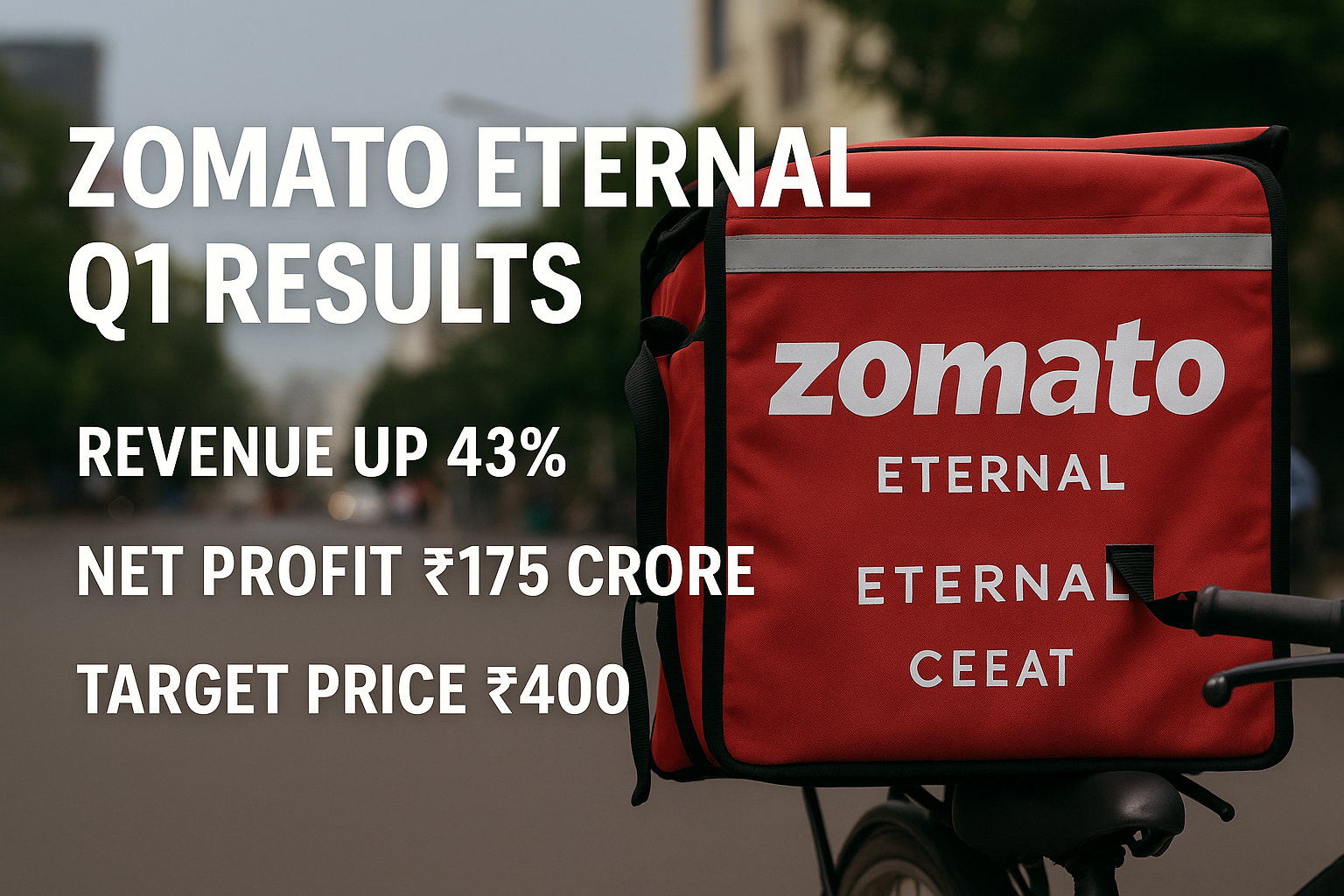
Zomato Eternal delivered robust Q1 results, boosting investor confidence with strong growth in revenue and profitability. Here is an in-depth analysis of the results, market reaction, and future outlook for Zomato and Eternal shares.
Table of Contents
Published: July 22, 2025 | Last Updated: July 22, 2025
Zomato Limited reported its first quarter financial results for fiscal year 2026, showing significant revenue expansion alongside strategic investments that affected near-term profitability. The food delivery and quick commerce platform posted consolidated revenue from operations of ₹7,167 crore for Q1 FY26, representing a 70 percent increase compared to ₹4,206 crore recorded in the corresponding quarter of the previous fiscal year. The company’s net profit stood at ₹25 crore for the quarter, compared to ₹253 crore in Q1 FY25, reflecting ongoing investments in business expansion and market positioning.
Following the earnings announcement, Zomato’s shares traded with significant interest on stock exchanges. The company’s market capitalization reflected investor assessment of the quarterly performance and strategic direction. This analysis examines the financial metrics, business segment performance, and market implications of Zomato’s Q1 FY26 results based on regulatory disclosures and stock exchange filings.
Overview of Zomato’s Q1 FY26 Financial Performance
Consolidated Financial Metrics
Zomato’s quarterly financial statements filed with stock exchanges provide detailed breakdowns of operational performance across business segments. The consolidated revenue from operations reached ₹7,167 crore in Q1 FY26, marking substantial growth from the year-ago period. This revenue expansion occurred across the company’s food delivery platform, quick commerce operations through Blinkit, and business-to-business food supply division Hyperpure.
The company’s net profit declined to ₹25 crore from ₹253 crore year-over-year, representing a 90 percent decrease. Financial disclosures indicate this profit trajectory reflects investments in customer acquisition, technology infrastructure, geographic expansion, and competitive positioning across business segments. Operating expenses increased in proportion to revenue growth and strategic investment priorities.
Zomato’s financial statements show the company spent approximately ₹1.04 to generate each rupee of revenue during the quarter. This cost-to-revenue ratio indicates the investment intensity of the company’s current growth phase. Technology platforms in expansion phases often demonstrate similar patterns where near-term profitability moderates to establish market position and operational infrastructure.
Revenue Growth Drivers and Analysis
The 70 percent year-over-year revenue increase stemmed from multiple factors across Zomato’s business portfolio. Food delivery operations expanded through increased order volumes, higher average order values, and geographic market penetration. Quick commerce segment Blinkit contributed to consolidated revenue through grocery and essentials delivery. Hyperpure’s business-to-business food supply operations added substantially to overall revenue growth.
Order frequency metrics indicate customer engagement levels increased during the quarter. The company’s gross order value, representing total transaction value across platforms, grew significantly year-over-year. Platform commission rates, delivery fees, and advertising revenues from restaurant partners comprised primary revenue streams for the food delivery segment.
Technology investments enabled operational scaling to accommodate higher transaction volumes without proportional infrastructure cost increases. The company’s logistics network expanded to serve additional geographic markets and fulfill increased delivery demand. These operational capabilities supported revenue growth while maintaining service level standards.
Business Segment Performance Analysis
Food Delivery Platform Operations
Zomato’s core food delivery business demonstrated continued expansion in Q1 FY26. The platform connects consumers with restaurants through mobile applications and web interfaces, facilitating food ordering and home delivery. Revenue from this segment includes restaurant commissions, customer delivery charges, and advertising fees from restaurant partners.
Net order value (NOV) for the company’s business-to-consumer operations grew 55 percent year-over-year to ₹20,183 crore in Q1 FY26. This metric represents the total value of orders placed through the platform before discounts and cancellations. The growth indicates both new customer acquisition and increased ordering frequency from existing users.
Average order values showed variation across geographic markets and customer segments. Metropolitan markets typically demonstrate higher average order values compared to tier-two and tier-three cities. The company’s pricing strategies, restaurant partner mix, and promotional activities influence order value trends.
Customer acquisition costs represent significant expenditure for digital platforms in competitive markets. Zomato’s marketing expenses during the quarter reflected efforts to attract new users and increase platform engagement. The relationship between customer acquisition costs and customer lifetime value determines long-term unit economics for the business model.
Hyperpure B2B Food Supply Division
Hyperpure, Zomato’s business-to-business food and restaurant supplies vertical, recorded revenue of ₹2,295 crore in Q1 FY26, representing 89 percent growth compared to ₹1,212 crore in Q1 FY25. This division supplies raw materials, ingredients, and supplies to restaurants, cloud kitchens, and food service establishments.
The B2B segment operates on different margin structures compared to consumer-facing businesses. Hyperpure generates revenue through product markups on supplies sold to restaurant partners. The division’s value proposition includes quality assurance, reliable delivery schedules, and consolidated sourcing that simplifies procurement for food service establishments.
Geographic expansion during the quarter added new cities to Hyperpure’s service network. The division’s growth correlates with India’s restaurant industry expansion and increasing preference for organized supply chain solutions. Cloud kitchen proliferation and quick service restaurant growth create demand for reliable ingredient supply partners.
Supply chain infrastructure investments support Hyperpure’s operational scaling. The division maintains warehousing facilities, cold storage capabilities, and delivery logistics for temperature-sensitive food products. These infrastructure requirements create barriers to entry but require significant capital deployment.
Quick Commerce Operations (Blinkit)
Zomato’s quick commerce segment operates through Blinkit, acquired by the company in previous fiscal periods. This division focuses on rapid delivery of groceries, daily essentials, and other products typically within 10-20 minute timeframes. The business model relies on dark stores (micro-warehouses) positioned in dense urban areas for quick fulfillment.
Quick commerce represents a capital-intensive business model requiring dense dark store networks and inventory investments. Operating expenses include real estate costs for dark stores, inventory carrying costs, delivery fleet expenses, and technology infrastructure. The segment’s profitability trajectory depends on achieving sufficient order density per dark store to cover fixed costs.
Competitive dynamics in quick commerce involve multiple well-funded players competing for market share. Customer acquisition and retention require promotional spending and competitive pricing. The industry structure features network effects where higher order density improves unit economics through fixed cost absorption.
Management commentary in earnings disclosures addressed quick commerce investment priorities and profitability outlook. Analyst reports following the results noted that losses in the quick commerce segment appeared to be stabilizing, indicating progress toward improved unit economics.
Financial Analysis and Key Metrics
Profitability and Margin Structure
Zomato’s Q1 FY26 profit decline to ₹25 crore reflects deliberate strategic choices regarding investment allocation. The company’s earnings before interest, taxes, depreciation, and amortization (EBITDA) margins compressed due to increased spending on growth initiatives. Operating leverage potential exists as the business scales and investment intensity moderates.
Gross margins vary significantly across business segments. Food delivery typically operates on thin margins due to competitive dynamics and high logistics costs. Hyperpure may demonstrate different margin profiles depending on product mix and supplier arrangements. Quick commerce faces margin pressure from intense competition and infrastructure requirements.
The company’s cost structure includes both variable costs that scale with order volumes and fixed costs related to technology infrastructure and corporate overhead. Variable costs encompass delivery partner payouts, customer discounts, and payment processing fees. Fixed costs include technology team salaries, office expenses, and depreciation.
Financial modeling for platform businesses typically emphasizes cash flow generation and return on invested capital alongside reported profitability. Zomato’s ability to convert revenues into cash flow depends on working capital management, capital expenditure requirements, and business mix evolution.
Balance Sheet and Capital Position
Zomato’s balance sheet position influences its capacity to sustain investment spending during the growth phase. The company’s cash and cash equivalents, combined with other liquid investments, provide financial resources for operational needs and strategic initiatives. Adequate liquidity supports competitive positioning in capital-intensive market segments.
Debt levels and leverage ratios indicate the company’s financial risk profile. Technology platforms often operate with minimal debt, relying primarily on equity financing. Zomato’s capital structure decisions balance cost of capital considerations with financial flexibility requirements.
Working capital management affects cash flow generation. The quick commerce business requires inventory investments that tie up working capital. Payment cycles with restaurant partners and customers influence operating cash flow timing. Efficient working capital management improves capital efficiency and reduces external financing needs.
Return on equity measures how efficiently the company generates profits from shareholder capital. During high-growth investment phases, return ratios may temporarily compress before improving as investments mature and scale benefits materialize.
Market Capitalization and Valuation Context
Zomato’s market capitalization on stock exchanges reflects investor assessment of the company’s future cash flow generation potential. The stock’s trading pattern following Q1 results indicated market participants’ interpretation of the financial performance and strategic outlook. Shares traded at upper circuit limit on the day following results announcement, suggesting strong buying interest.
Valuation multiples for technology platforms typically include price-to-sales ratios given profitability variability during growth phases. Comparable companies in food delivery and quick commerce globally provide benchmarking references. Market participants compare growth rates, margin trajectories, and market position when assessing relative valuations.
Analyst price targets reflect expectations for revenue growth sustainability, margin improvement potential, and competitive position strength. Multiple brokerage firms updated their views on Zomato following the quarterly results, with several raising target prices based on improved outlook for quick commerce stabilization.
The relationship between current valuation and projected future earnings determines implied growth expectations embedded in the stock price. High growth companies often trade at premiums to historical earnings due to anticipated future profit expansion.
Comparative Analysis with Industry Peers
Competitive Landscape in Food Delivery
India’s food delivery market features competition from multiple platforms serving different customer segments and geographic markets. Zomato competes primarily with Swiggy, which operates similar food delivery and quick commerce businesses. Market share metrics, order volumes, and revenue growth rates provide comparative performance indicators.
Restaurant partners often work with multiple platforms simultaneously, creating competition for order flow and commission arrangements. Platform competitiveness depends on customer base size, delivery reliability, technology features, and marketing effectiveness. Network effects create advantages for larger platforms through better restaurant selection and delivery density.
International food delivery companies demonstrate varied profitability profiles depending on market maturity and competitive intensity. Mature markets with consolidated competition typically show better unit economics than emerging markets with ongoing competitive investment. Zomato’s performance benchmarks against both domestic competitors and global food delivery platforms.
Customer preference factors include delivery speed, restaurant selection, pricing including delivery fees, and promotional offers. Platform features such as live tracking, customer support, and payment options influence user satisfaction and retention. Investments in these capabilities affect both revenue potential and cost structures.
Quick Commerce Sector Dynamics
The quick commerce segment in India includes multiple funded players competing for market share. Blinkit competes with Swiggy Instamart, Zepto, and others in rapid grocery delivery. Market structure remains fluid with ongoing investment by participants to establish market position.
Dark store density and geographic coverage determine service availability and order fulfillment capability. Companies require significant real estate commitments to build dark store networks covering urban areas. The capital intensity creates natural consolidation pressure in the industry.
Customer behavior in quick commerce differs from traditional e-commerce with emphasis on immediate need fulfillment rather than planned purchases. Basket sizes, order frequency, and product preferences vary from conventional grocery shopping patterns. Understanding these dynamics influences inventory planning and merchandising strategies.
Profitability benchmarks for quick commerce globally remain challenging, with few players demonstrating sustained unit economics at scale. The business model requires very high order density per dark store to achieve profitability. Companies compete on delivery speed, product availability, pricing, and minimum order requirements.
Stock Market Reaction and Investor Sentiment
Trading Activity Following Results
Zomato’s shares hit the 10 percent upper circuit limit in the trading session following Q1 results announcement, indicating strong buying demand that exceeded available supply at prevailing price levels. Circuit limits on Indian stock exchanges prevent excessive intraday price volatility by halting trading when price movements exceed specified thresholds.
Trading volumes increased substantially compared to average daily volumes, reflecting heightened investor interest following the quarterly disclosure. Institutional and retail investor participation both contributed to trading activity. The price movement suggested market participants viewed the results favorably despite the reported profit decline.
Technical analysis indicators following the results showed bullish sentiment with the stock trading above key moving averages. Relative strength index and momentum indicators reflected positive near-term price momentum. Chart patterns suggested continued investor interest in the stock.
Foreign institutional investor and domestic institutional investor holdings influence stock price dynamics. Quarterly shareholding pattern disclosures reveal changes in institutional ownership. Sustained institutional buying typically indicates confidence in long-term business prospects.
Analyst Research Updates
Multiple equity research firms issued reports following Zomato’s Q1 results, updating financial models and price targets. Analyst consensus generally acknowledged the strategic rationale for near-term profitability compression while emphasizing revenue growth sustainability. Several firms noted that quick commerce losses appeared to be stabilizing, improving the outlook for consolidated profitability.
Price target revisions reflected updated assumptions about revenue growth rates, margin improvement timelines, and business segment performance. Firms incorporating higher growth expectations or earlier profitability inflection points raised targets more significantly. Analyst recommendations ranged from buy to hold ratings depending on valuation assessments.
Earnings estimate revisions for future quarters incorporated Q1 actual results and updated business outlook. Consensus estimates for full-year FY26 reflect aggregated analyst expectations for revenue and profitability. The dispersion of estimates indicates varying views on business trajectory among market observers.
Key questions in analyst reports addressed the sustainability of Hyperpure growth rates, timeline for quick commerce profitability, food delivery competitive dynamics, and capital allocation priorities. Management’s responses during earnings calls provide guidance on these strategic considerations.
Strategic Priorities and Management Outlook
Investment Areas and Capital Allocation
Zomato’s management outlined investment priorities during earnings communications with investors. Technology infrastructure enhancements aim to improve platform capabilities, delivery routing efficiency, and customer experience features. These investments support operational scaling and competitive differentiation.
Geographic market expansion continues with focus on tier-two and tier-three cities where food delivery penetration remains lower than metropolitan areas. Market entry requires establishing restaurant partner networks, building delivery fleet capacity, and customer acquisition marketing. Initial market entry costs typically compress margins before order density increases.
Customer acquisition and retention programs include promotional offers, loyalty programs, and marketing campaigns. The lifetime value to customer acquisition cost ratio determines the economic viability of growth spending. Sustainable unit economics require that customer lifetime value significantly exceeds acquisition costs after accounting for contribution margins.
Competitive positioning investments aim to defend market share in food delivery while building share in quick commerce. The intensity of competitive spending depends on rival behavior and market share dynamics. Management’s willingness to prioritize long-term market position over near-term profitability reflects strategic judgment about market consolidation potential.
Profitability Improvement Pathway
Management commentary addressed the expected timeline for profitability improvement as current investments mature. Operating leverage potential exists as fixed costs spread over growing revenue bases. Technology and infrastructure investments demonstrate leverage characteristics where incremental volumes require proportionally smaller marginal investments.
Unit economics improvement in quick commerce depends on achieving higher order density per dark store and operational efficiency gains. As dark store networks mature and customer awareness builds, order volumes per location should increase. Improved order density reduces per-order costs through fixed cost absorption.
Food delivery margin improvement opportunities include reducing delivery costs through route optimization, increasing average order values through cross-selling, and growing higher-margin revenue streams like advertising. Platform maturity typically correlates with improved unit economics as operational efficiencies compound.
Hyperpure margins may benefit from scale advantages in supplier negotiations, operational efficiency improvements, and product mix optimization. The B2B business model’s margin structure differs from consumer-facing segments with different competitive dynamics and customer relationships.
Macroeconomic Context and Industry Trends
Consumer Spending and Digital Adoption
India’s consumer spending patterns influence food delivery demand. Urbanization trends, rising disposable incomes, and changing lifestyles support food delivery adoption. Economic growth rates, employment conditions, and inflation levels affect consumer spending capacity for discretionary services.
Digital payment adoption facilitates online food ordering by reducing transaction friction. Unified Payments Interface (UPI) and digital wallet penetration has increased significantly in recent years. Seamless payment experiences remove barriers to platform usage and enable higher order frequencies.
Smartphone penetration and internet connectivity expansion broaden the addressable market for food delivery platforms. As devices and connectivity reach tier-two and tier-three cities, new customer segments become accessible. Platform strategies must adapt to different customer preferences and purchasing power levels across markets.
Generational shifts in food consumption preferences favor convenience and variety over traditional home cooking in certain demographic segments. Younger consumers and working professionals represent core customer groups for food delivery services. Understanding demographic trends informs platform development and marketing strategies.
Restaurant Industry Dynamics
The restaurant industry’s health directly impacts food delivery platform performance. Restaurant opening rates, closure rates, and profitability influence partner supply on platforms. Economic pressures on restaurants affect their willingness to pay platform commissions and participate in promotional programs.
Cloud kitchen concepts have emerged as restaurant models optimized for delivery-only operations. These establishments eliminate dine-in real estate costs while maximizing delivery economics. Cloud kitchen growth expands restaurant partner supply for platforms while potentially offering better unit economics for restaurant operators.
Cuisine diversity and restaurant quality on platforms determine customer satisfaction and repeat ordering. Platforms compete to offer comprehensive restaurant selections including popular chains and local establishments. Restaurant partner relationships and onboarding efficiency affect platform completeness.
Regulatory frameworks governing food safety, licensing, and delivery operations create compliance requirements. Platforms must ensure restaurant partners meet applicable standards while managing their own regulatory obligations regarding delivery operations and data handling.
Risk Factors and Business Challenges
Competitive Intensity and Market Share
Sustained competition in food delivery and quick commerce requires ongoing investment in customer acquisition and retention. Well-funded competitors can engage in promotional pricing that pressures margins across the industry. Market share volatility may occur as participants adjust competitive strategies.
The risk of new entrants exists given India’s large addressable market and attractive long-term growth potential. Technology companies with adjacent capabilities or international players might enter the market. Barriers to entry include technology development, brand building, network establishment, and capital requirements.
Platform differentiation becomes challenging as competitors replicate features and service levels. Customer switching costs remain low if platforms offer similar restaurant selections and service quality. Building sustainable competitive advantages requires continuous innovation and superior execution.
Price-based competition limits profitability potential across the industry. If competitors primarily compete on price through discounts and low commissions, achieving healthy margins becomes difficult. Market consolidation could reduce competitive intensity but depends on participants’ strategic decisions.
Regulatory and Compliance Considerations
Food delivery platforms face regulatory oversight regarding food safety, consumer protection, and delivery partner classification. Changes in regulations could require operational adjustments or increase compliance costs. Engagement with policymakers and proactive compliance help manage regulatory risk.
Delivery partner classification as employees versus independent contractors represents an ongoing regulatory consideration. Different classifications carry different cost implications regarding benefits, protections, and employment taxes. Regulatory clarity and consistent industry standards would reduce uncertainty.
Data privacy regulations govern customer information handling and usage. Platforms must comply with applicable data protection frameworks while utilizing data analytics for business optimization. Balancing regulatory compliance with operational effectiveness requires robust data governance.
Competition law considerations apply to platform practices regarding restaurant partners and market conduct. Fair dealing requirements and restrictions on anti-competitive behavior create compliance obligations. Platforms must structure commercial relationships and practices within legal boundaries.
Operational Execution Challenges
Maintaining service quality while scaling rapidly presents operational challenges. Delivery time consistency, order accuracy, and customer service quality must remain high as order volumes increase. Operational systems, delivery partner training, and restaurant partner management require continuous attention.
Technology platform reliability becomes critical as transaction volumes grow. System downtime or performance issues directly impact revenue and customer satisfaction. Infrastructure investments and engineering capability development support platform stability and scalability.
Delivery fleet management at scale involves coordinating thousands of delivery partners across multiple cities. Ensuring adequate delivery partner supply during peak demand periods while managing costs during slower periods requires sophisticated planning. Partner satisfaction and retention affect service reliability.
Supply chain complexity in quick commerce requires managing thousands of SKUs with varying shelf lives and storage requirements. Inventory planning, procurement, and warehouse operations must operate efficiently to minimize waste and stockouts. The operational intensity of quick commerce exceeds traditional e-commerce.
Sector Performance and Market Outlook
Food Delivery Industry Growth Trajectory
The organized food delivery market in India has expanded significantly over the past several years. Market size estimates vary across research firms but consistently indicate substantial growth from small bases. Penetration rates remain low compared to developed markets, suggesting continued expansion potential.
Industry growth drivers include urbanization, nuclear family prevalence, dual-income households, and lifestyle changes reducing home cooking frequency. The convenience value proposition appeals to time-constrained consumers willing to pay for delivery services. Market expansion requires both deepening penetration in existing markets and geographic expansion to new cities.
Long-term industry forecasts project continued growth albeit potentially moderating from recent high growth rates. Market maturation typically involves slower growth as penetration rates increase. Geographic expansion into smaller cities extends growth runways but with different unit economics than metropolitan markets.
Profitability timelines for the industry remain uncertain given current competitive dynamics. Market consolidation could improve industry structure and enable better margins. Alternatively, sustained competition might perpetuate thin margins. The industry’s evolution depends significantly on participant strategies and capital availability.
Investment Themes in Digital Commerce
Food delivery represents one component of broader digital commerce investment themes. Investor interest in India’s digital economy reflects the country’s favorable demographics, increasing internet penetration, and growing middle class. Multiple digital business models compete for consumer attention and spending.
Platform business models demonstrate winner-take-most characteristics due to network effects. Investors assess which platforms will emerge as category leaders commanding dominant market positions. Leadership positions typically correlate with superior long-term profitability and returns.
The sustainability of high growth valuations depends on companies ultimately demonstrating strong cash flow generation. Platform investments require patient capital willing to prioritize market position establishment over immediate profitability. The eventual path to sustainable profits determines whether elevated valuations prove justified.
Sector rotation and market sentiment cycles influence technology stock valuations. During periods favoring growth stocks, platforms like Zomato may experience valuation expansion. Conversely, market rotations toward value or defensive sectors may pressure growth stock valuations regardless of fundamental performance.
Comparison with Food Delivery Peers Globally
International Benchmarking
Global food delivery platforms provide comparative benchmarks for Zomato’s performance and strategic choices. DoorDash in the United States, Delivery Hero in Europe, and Meituan in China represent established international peers. Comparing growth rates, margin structures, and market positions offers perspective on Zomato’s trajectory.
Different geographic markets demonstrate varying unit economics based on population density, labor costs, customer behaviors, and competitive intensity. Dense Asian markets often show better delivery economics than spread-out Western markets. India’s characteristics including dense cities and lower labor costs potentially support favorable unit economics.
Profitability timelines vary significantly across international peers depending on market maturity and competitive dynamics. Some mature markets demonstrate path to profitability while others remain investment-intensive. The diversity of outcomes suggests market-specific factors significantly influence financial performance.
Strategic approaches differ regarding vertical integration, service scope, and geographic focus. Some platforms pursue pure-play delivery models while others expand into adjacent services. Zomato’s strategy encompassing food delivery, quick commerce, and B2B supplies represents a diversified approach.
Lessons from International Markets
International experience suggests that food delivery markets tend toward consolidation over time. Early fragmentation with multiple competitors typically transitions to duopolies or monopolies as economics favor scale. This pattern could inform expectations for India’s market evolution.
Customer loyalty programs, subscription models, and ecosystem development represent strategies international peers have deployed. Zomato’s introduction of similar programs reflects adoption of proven international practices adapted to local market conditions.
Quick commerce represents a relatively newer business model globally with limited international precedents for profitability at scale. Most markets show quick commerce as highly competitive with uncertain economics. Zomato’s experience will contribute to understanding whether sustainable unit economics emerge.
Restaurant partnerships and commission structures vary internationally based on market power dynamics. Platforms with dominant positions can command higher commissions while competitive markets feature lower take rates. Zomato’s commission structure reflects India’s current competitive environment.
Technology and Innovation Drivers
Platform Capabilities and Features
Zomato’s technology infrastructure enables its business operations across segments. Mobile applications and web platforms provide customer interfaces for browsing restaurants, placing orders, and tracking deliveries. User experience design, performance, and feature richness affect customer satisfaction and retention.
Recommendation algorithms utilize customer data to personalize restaurant suggestions and menu items. Machine learning models analyze ordering patterns, preferences, and behaviors to improve recommendations. Effective personalization increases order values and customer engagement.
Delivery routing and fleet management systems optimize delivery partner assignments and routes. Real-time optimization algorithms consider factors including order locations, delivery partner positions, restaurant preparation times, and traffic conditions. Routing efficiency directly impacts delivery times and costs.
Payment processing infrastructure supports multiple payment methods including credit cards, debit cards, digital wallets, and cash on delivery. Seamless payment experiences reduce transaction friction while robust fraud prevention protects the platform and customers.
Data Analytics and Business Intelligence
Data collection across customer interactions, restaurant operations, and delivery execution generates valuable business intelligence. Analytics capabilities inform decision-making regarding pricing strategies, promotional campaigns, restaurant partner selection, and operational improvements.
Demand forecasting models predict order volumes across time periods, locations, and conditions. Accurate forecasting enables appropriate delivery fleet sizing, restaurant partner preparation, and promotional planning. Forecast accuracy improves through accumulated historical data and refined models.
Customer segmentation based on behavioral and demographic data enables targeted marketing and personalized experiences. Understanding customer lifetime value, churn probability, and preferences informs customer relationship management strategies. Sophisticated segmentation capabilities provide competitive advantages in customer acquisition efficiency.
Operational analytics identify bottlenecks, inefficiencies, and improvement opportunities. Monitoring delivery times, order accuracy, customer complaints, and other metrics enables continuous operational enhancement. Data-driven operations management supports quality maintenance during scaling.
Financial Reporting and Investor Relations
Disclosure Practices and Transparency
Zomato provides quarterly financial statements and management commentary through stock exchange filings and investor presentations. These disclosures enable investors to assess business performance and strategic direction. Comprehensive disclosures including segment reporting facilitate analysis.
Earnings conference calls allow management to communicate results and strategy while addressing analyst questions. These interactions provide insights beyond written disclosures regarding management’s perspective on business developments and competitive dynamics.
Forward-looking statements in earnings communications address expected trends, strategic priorities, and potential risks. While management cannot predict future results with certainty, guidance regarding expected trajectory helps investors form expectations. Regularly updated guidance improves information symmetry.
Corporate governance practices including board composition, audit procedures, and internal controls provide assurance regarding financial reporting reliability. Strong governance frameworks reduce information risk for investors and support market confidence.
Investor Communication Strategy
Regular investor engagement through meetings, conferences, and presentations maintains ongoing dialogue with the investment community. Management communication helps investors understand business model nuances, competitive positioning, and strategic rationale for decisions.
Handling results that miss expectations requires transparent communication about causal factors and corrective actions. Zomato’s Q1 profit decline required explanation of the strategic investment rationale to maintain investor confidence. Clear communication prevented misinterpretation of results.
Capital allocation discussions address how the company deploys financial resources across growth investments, potential acquisitions, and returns to shareholders. Investors evaluate management’s capital allocation discipline and strategic judgment through these decisions and communications.
Responding to investor concerns and questions demonstrates management accountability and responsiveness. Open dialogue builds trust and helps align management and shareholder perspectives on appropriate strategy and timeframes.
Frequently Asked Questions (FAQs)
1. What were Zomato’s key financial metrics for Q1 FY26?
Zomato reported consolidated revenue from operations of ₹7,167 crore for Q1 FY26, representing 70 percent year-over-year growth from ₹4,206 crore in Q1 FY25. Net profit for the quarter stood at ₹25 crore compared to ₹253 crore in the year-ago period. The Hyperpure B2B division recorded revenue of ₹2,295 crore, growing 89 percent year-over-year from ₹1,212 crore. Net order value for B2C businesses reached ₹20,183 crore, up 55 percent year-over-year. These metrics reflect significant revenue expansion alongside investments impacting near-term profitability.
2. Why did Zomato’s profit decline despite strong revenue growth in Q1 FY26?
The profit decline to ₹25 crore from ₹253 crore year-over-year reflects strategic investments in business expansion rather than operational deterioration. The company invested in customer acquisition, technology infrastructure, geographic market expansion, and competitive positioning across food delivery and quick commerce segments. Platform businesses during growth phases often prioritize market share and infrastructure development over immediate profitability. The company’s spending of approximately ₹1.04 to generate each rupee of revenue indicates the current investment intensity of its growth strategy.
3. How did the stock market react to Zomato’s Q1 FY26 results?
Zomato’s shares hit the 10 percent upper circuit limit on the trading day following Q1 results announcement, indicating strong buying demand. The positive market reaction despite the profit decline suggests investors focused on the robust 70 percent revenue growth and strategic rationale for investments. Multiple brokerage firms raised price targets on the stock following the results, noting that quick commerce losses appeared to be stabilizing. Trading volumes increased substantially compared to average levels, reflecting heightened investor interest in the quarterly performance.
4. What is Hyperpure and why is its performance significant for Zomato?
Hyperpure is Zomato’s business-to-business division that supplies food ingredients, raw materials, and restaurant supplies to food service establishments. The division recorded 89 percent year-over-year revenue growth to ₹2,295 crore in Q1 FY26. Hyperpure’s significance lies in business model diversification beyond consumer-facing services and potential for different margin structures compared to food delivery. The B2B segment’s growth demonstrates Zomato’s position in the broader food service ecosystem beyond just consumer ordering. Success in B2B supplies could provide more stable revenue streams and strengthen relationships with restaurant partners.
5. How does Zomato’s performance compare with industry trends and competitors?
Zomato operates in India’s food delivery and quick commerce markets alongside primary competitor Swiggy. The 70 percent revenue growth reflects Zomato’s capture of market expansion as digital food ordering penetration increases in India. The Hyperpure segment’s 89 percent growth positions it as one of India’s fastest-growing B2B food supply platforms. However, competitive dynamics require sustained investment in customer acquisition and retention across food delivery and quick commerce segments. Market consolidation patterns in international food delivery markets suggest potential for eventual industry structure improvements, though timing remains uncertain.
6. What are analysts’ expectations for Zomato’s future profitability?
Analyst commentary following Q1 results noted that quick commerce losses appeared to be stabilizing, suggesting improved trajectory toward profitability. Multiple firms raised price targets, indicating expectations for sustained revenue growth and eventual margin improvement. Profitability improvement depends on achieving operational leverage as fixed costs spread over growing revenue bases, improving unit economics in quick commerce through higher order density per dark store, and moderating competitive intensity. The timeline for significant profitability improvement remains subject to management’s strategic priorities regarding growth investment versus near-term margin optimization.
7. What are the main risks and challenges facing Zomato’s business?
Key risks include sustained competitive intensity in food delivery and quick commerce requiring ongoing investment in customer acquisition, potential for new well-funded entrants in attractive Indian markets, regulatory changes affecting delivery operations or partner classification, and operational challenges maintaining service quality during rapid scaling. The quick commerce business model’s capital intensity and uncertain profitability timeline represent execution risks. Macroeconomic factors affecting consumer spending and restaurant industry health could impact platform volumes. Successfully navigating these challenges requires sustained execution capability, adequate capital resources, and strategic adaptability.
8. What factors will influence Zomato’s stock performance in coming quarters?
Stock performance will likely depend on revenue growth sustainability across business segments, progress toward profitability improvement particularly in quick commerce, competitive dynamics and market share trends in food delivery, execution on geographic expansion plans, and overall market sentiment toward growth technology stocks. Management guidance on investment timelines and profitability expectations will shape investor expectations. Broader market factors including interest rate environment, foreign portfolio investor flows, and sector rotation preferences will influence valuations. Quarterly results demonstrating progress on strategic priorities should support positive stock sentiment, while disappointments or competitive setbacks could pressure the stock.
About the Author
Nueplanet
Nueplanet is a financial markets analyst specializing in technology sector companies, digital platforms, and Indian equity markets. With the years of experience analyzing quarterly earnings, business models, and sector trends, Nueplanet focuses on providing objective analysis based on regulatory filings, company disclosures, and market data.
This analysis draws from Zomato’s stock exchange filings, quarterly financial statements, and publicly available company disclosures. The content serves informational and educational purposes and does not constitute investment advice or recommendations to buy or sell securities.
Commitment to Accuracy: All financial data and metrics are sourced from official company filings with stock exchanges, Securities and Exchange Board of India (SEBI) disclosures, and verified company communications. Analysis incorporates publicly available information from brokerage research, financial media reports, and industry research. Content is updated to reflect material developments in company performance or significant news affecting the analysis.
About This Publication
This financial news and analysis platform provides fact-based reporting on Indian companies, market developments, and sector trends. Our mission is to deliver accurate, transparent, and thoroughly researched content enabling readers to understand market developments and company performance.
Our Sources:
- Company filings with stock exchanges (BSE, NSE)
- Securities and Exchange Board of India (SEBI) disclosures
- Quarterly and annual financial statements
- Management earnings calls and investor presentations
- Regulatory announcements and corporate actions
- Brokerage research reports and analyst estimates
Editorial Standards: We maintain editorial independence and do not provide specific stock recommendations or investment advice. Our analysis distinguishes between factual reporting of company disclosures and interpretive commentary on business developments. We cite sources for all material claims and financial data.
Transparency: When content includes estimates, projections, or analyst consensus data, we clearly identify these as forward-looking information subject to uncertainty. Material updates to published articles include revision notes with update dates.
Disclaimer: This article provides information and analysis for educational purposes only and should not be construed as investment advice or recommendations to buy, sell, or hold any securities. Investors should conduct independent research, review official company filings, consult qualified financial advisors, and consider personal financial circumstances before making investment decisions.
Past performance does not guarantee future results. All investments carry risks including potential loss of principal. Information presented is based on publicly available data as of the publication date and may change. The author and publication are not registered investment advisors and do not provide personalized investment recommendations.
Latest Posts
Helpful Resources
Conclusion
Zomato Eternal’s Q1 results demonstrate the company’s strong positioning in India’s food-tech and delivery ecosystem. With expanding revenue streams, improved profitability, and technological advancements, both Zomato and Eternal seem poised for robust future growth. However, investors should watch out for sector competition and regulatory developments impacting long-term returns.
Related Posts












Post Comment