









UPSC NDA & CDS II Admit Card 2025: Complete Guide & Latest Updates
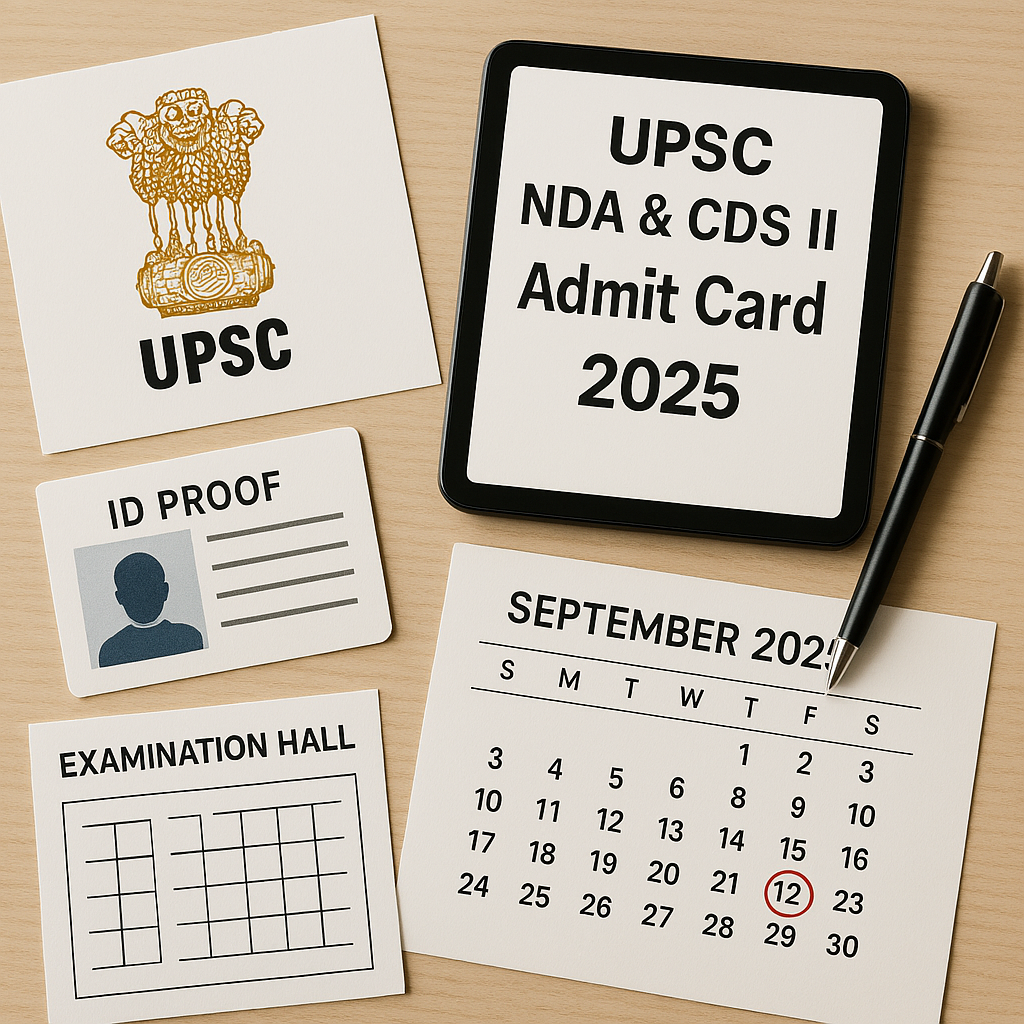
The UPSC NDA / NA II and CDS II Admit Card 2025 has been released. Learn how to download it, the exam schedule, eligibility details, and what to do next.
Table of Contents
The Union Public Service Commission has released admit cards for the National Defence Academy and Naval Academy (NDA/NA) II examination and the Combined Defence Services (CDS) II examination scheduled for September 2025. Candidates who submitted applications can now download their hall tickets from the official UPSC portals. This development marks an important milestone in the 2025 defense recruitment cycle for aspiring military officers.
This comprehensive guide provides verified information about admit card download procedures, examination structure, preparation guidelines, and important requirements based on official UPSC notifications and established examination protocols.
Understanding UPSC Defense Examinations: Purpose and Significance
National Defence Academy and Naval Academy Examination
The NDA/NA examination serves as the gateway for candidates seeking entry into the National Defence Academy and Naval Academy after completing their 10+2 education. The NDA trains cadets for the Indian Army, Navy, and Air Force, while the Naval Academy specifically prepares candidates for naval service. This examination is conducted twice annually by UPSC to identify suitable candidates for rigorous military training programs.
Successful candidates undergo comprehensive training at these premier institutions, which combines academic education with military discipline. The selection process includes a written examination followed by Services Selection Board (SSB) interviews and medical examinations. Only candidates who clear all stages receive final appointment orders for joining these institutions.
The examination attracts thousands of aspirants annually who wish to serve the nation through armed forces. The competitive nature of these examinations requires systematic preparation across multiple subject areas. Understanding the examination structure and requirements forms the foundation for effective preparation strategies.
Combined Defence Services Examination
The CDS examination provides opportunities for graduates to join the Indian Military Academy, Officers Training Academy, Indian Naval Academy, and Air Force Academy. Unlike the NDA examination which accepts 10+2 candidates, CDS requires candidates to hold bachelor’s degrees for most entries. This examination also occurs twice yearly, offering multiple opportunities for eligible candidates.
The CDS pathway suits candidates who completed their graduation and wish to pursue military careers. Different academy options cater to various educational backgrounds and service preferences. The examination structure differs from NDA in terms of subject coverage and marking patterns.
Both examinations represent established pathways into India’s defense services with distinct eligibility criteria and training programs. Candidates should carefully evaluate which examination aligns with their educational qualifications and career aspirations. Understanding these fundamental differences helps in making informed decisions about examination registration.
Official Admit Card Release Information
Release Timeline and Access Details
UPSC released the admit cards for both NDA II and CDS II examinations on September 4, 2025, through its official web portals. The examinations are scheduled for September 14, 2025, providing candidates with adequate time for final preparations and logistical arrangements. The simultaneous release of admit cards for both examinations maintains consistency in UPSC’s examination administration procedures.
Candidates can access their admit cards exclusively through digital download from official UPSC websites. Physical copies are not dispatched through postal services, making online access the only method for obtaining examination authorization. This digital-first approach aligns with current government digitization initiatives and reduces environmental impact.
The ten-day window between admit card release and examination date allows sufficient time for candidates to verify details and arrange travel. This timeline follows established UPSC practices for major recruitment examinations. Candidates should utilize this period for thorough preparation alongside logistical planning.
Official Portal Information
Admit cards are available on two official UPSC portals: upsc.gov.in and upsconline.nic.in. Both portals provide identical functionality for admit card download, offering candidates flexibility in access. The websites maintain secure authentication protocols to protect candidate information and prevent unauthorized access.
The online portal features dedicated sections for different examinations with clear navigation menus. Candidates should access only official UPSC domains to avoid fraudulent websites that may misuse personal information. Bookmarking official URLs ensures quick access without searching through potentially unreliable sources.
UPSC maintains these portals with regular updates about various examinations and recruitment activities. The admit card section specifically highlights current examination cycles with prominent placement on the homepage. Candidates should familiarize themselves with portal navigation before attempting to download admit cards.
Step-by-Step Admit Card Download Process
Accessing the Official Portal
Begin by opening a web browser and navigating to either upsc.gov.in or upsconline.nic.in. Ensure you have a stable internet connection to prevent interruptions during the download process. The homepage displays various sections including notifications, examinations, and recruitment information.
Locate the “e-Admit Card” section, which is typically prominently displayed on the homepage. This section contains links to admit cards for all active examinations. Click on the relevant link for “NDA & NA II / CDS II Admit Card 2025” to proceed to the login page.
The portal interface is designed for straightforward navigation even for first-time users. However, candidates should allow sufficient time for the process rather than attempting downloads at the last minute. Early download provides opportunities to address any potential issues well before the examination date.
Credential Entry and Verification
The login page requires specific information to authenticate candidate identity. Enter your Registration ID or Roll Number exactly as provided during application submission. This identifier uniquely associates your application with examination records maintained by UPSC.
Provide your Date of Birth in the format specified on the login page, typically DD-MM-YYYY. Accuracy in date entry is crucial as mismatches will prevent admit card access. Double-check both registration details and date of birth before submitting the login form.
Complete the security verification (CAPTCHA) displayed on the page. This step prevents automated systems from accessing the portal and protects candidate information. Carefully enter the characters shown in the CAPTCHA image, distinguishing between similar-looking letters and numbers.
Download and Verification Procedures
After successful authentication, the system displays your admit card on screen. Review all details carefully before downloading to identify any discrepancies immediately. The admit card contains essential information including examination center details, reporting time, and specific instructions.
Use the download option to save the admit card as a PDF file on your device. Choose a clearly labeled filename and save location for easy retrieval. Consider saving copies in multiple locations such as computer hard drive, cloud storage, and mobile device.
Print multiple copies of the admit card on good quality paper using a clear printer. Ensure that all text, photographs, and barcodes are legible in the printed version. Unclear or damaged admit cards may cause entry problems at examination centers, making quality printing essential.
Detailed Information Verification Requirements
Personal Information Accuracy
Examine your name spelling across all fields of the admit card. The name should match exactly with your official identity documents that you will present at the examination center. Even minor spelling variations can create verification issues and potentially delay or prevent examination entry.
Verify the date of birth printed on the admit card against your application records and official documents. This information serves as a key verification point at examination centers. Discrepancies in birth date require immediate correction through official UPSC channels.
Check the photograph quality and positioning on the admit card. The image should clearly show your face and match your current appearance. Signature verification is equally important as examiners compare admit card signatures with those on answer sheets and attendance records.
Examination Details Confirmation
Confirm the examination date, which is scheduled for September 14, 2025, for both NDA II and CDS II. Note any specific session timings mentioned for your particular examination and paper sequence. Different papers may have different start times requiring careful attention to scheduling details.
Review the examination center address thoroughly, noting the complete location including building name, street address, city, and any specific landmark information. Understanding the center location helps in planning travel routes and estimating journey time. Unfamiliar locations may require reconnaissance visits before examination day.
Examine any special instructions printed on the admit card regarding entry procedures, prohibited items, or examination-specific requirements. These instructions represent official examination guidelines that candidates must follow. Failure to comply with stated instructions may result in examination disqualification.
Center-Specific Information
The admit card specifies the exact venue where you must appear for the examination. This information includes the examination center code, complete address, and sometimes a map or landmark reference. Center allocation is based on various factors including candidate preference, availability, and logistical considerations.
Note the reporting time specified on your admit card, which typically precedes the examination start time by 30-60 minutes. This window allows for entry procedures, verification processes, and candidate settling time. Late arrival after gate closure time results in examination denial regardless of circumstances.
Some admit cards include additional center-specific instructions such as parking arrangements, prohibited entry gates, or facility limitations. These details help candidates plan their examination day logistics effectively. Following center-specific guidelines ensures smooth entry and minimizes examination day stress.
NDA II 2025 Examination Structure
Mathematics Paper Components
The Mathematics paper carries 300 marks and tests candidates across various mathematical domains. The examination duration is 150 minutes (2.5 hours), requiring efficient time management for completing all questions. This paper assesses both conceptual understanding and problem-solving speed.
Algebra forms a significant portion with questions on complex equations, inequalities, progressions, and polynomial operations. Candidates encounter problems requiring manipulation of algebraic expressions and solving systems of equations. Understanding fundamental algebraic principles and practicing various problem types builds competency in this area.
Analytical geometry questions test coordinate geometry concepts including straight lines, circles, conic sections, and transformations. Three-dimensional geometry problems may also appear requiring spatial visualization abilities. Regular practice with geometric problems and diagram interpretation enhances performance in this section.
Trigonometry coverage includes ratios, identities, equations, and applications of trigonometric functions. Questions may involve angle relationships, trigonometric equations, and height-distance problems. Memorizing key formulas and practicing diverse problem types develops proficiency in trigonometric problem-solving.
Calculus questions assess understanding of limits, continuity, differentiation, and integration fundamentals. Both differential and integral calculus applications appear in various contexts. Building strong foundational knowledge through systematic study of calculus concepts ensures success in this challenging area.
General Ability Test Structure
The GAT paper carries 600 marks divided between English (200 marks) and General Knowledge (400 marks). The examination duration matches the Mathematics paper at 150 minutes. The higher weightage on general knowledge emphasizes the importance of broad awareness alongside linguistic ability.
English section questions test grammar, vocabulary, comprehension, and composition skills. Grammar questions identify errors in sentences or require selecting grammatically correct options. Vocabulary questions assess synonym, antonym, and contextual word usage knowledge. Comprehension passages test reading understanding and inference abilities.
General Knowledge encompasses current affairs, history, geography, polity, economics, and science. Current affairs questions cover national and international developments from the past year. History questions span ancient, medieval, and modern periods with emphasis on Indian history. Geography includes both physical and human geography concepts relevant to India and the world.
Physics questions test mechanics, heat, light, sound, electricity, and modern physics concepts. Chemistry coverage includes organic, inorganic, and physical chemistry fundamentals. Biology questions address human physiology, botany, zoology, and environmental science topics. These science sections require understanding basic principles and their applications.
Marking Scheme and Strategy
Each correct answer in the NDA examination earns 2.5 marks. This straightforward marking rewards accurate responses without complexity in score calculation. The positive marking system encourages attempting questions where candidates have reasonable confidence.
Negative marking applies with 0.83 marks deducted for each incorrect answer. This penalty represents approximately one-third of the marks awarded for correct answers. The negative marking system discourages random guessing and rewards careful question selection.
Understanding this marking scheme is crucial for strategic question attempt planning. Candidates should attempt questions where they can confidently eliminate at least two incorrect options. Random guessing on questions with complete uncertainty typically reduces overall scores due to negative marking penalties.
CDS II 2025 Examination Structure
English Paper Requirements
The English paper for CDS II examination carries 100 marks and has a duration of 120 minutes (2 hours). This paper tests language proficiency essential for effective communication in military service. Questions assess both passive understanding and active language usage abilities.
Grammar questions identify errors in sentence construction or require selecting grammatically correct alternatives. Topics include tenses, subject-verb agreement, articles, prepositions, and sentence structure. Strong grammar fundamentals developed through consistent practice ensure success in this section.
Vocabulary questions test word meanings, synonyms, antonyms, and contextual usage. Building a robust vocabulary through regular reading and word learning significantly improves performance. Understanding nuances in word meanings and their appropriate contexts demonstrates advanced language proficiency.
Reading comprehension passages test ability to understand written material and draw inferences. Passages cover diverse topics requiring careful reading and analytical thinking. Questions assess literal understanding, inference capability, and critical analysis skills. Developing speed reading with retention improves efficiency in this time-sensitive section.
Elementary Mathematics Coverage
The Mathematics paper carries 100 marks with a 120-minute duration. This paper tests fundamental mathematical concepts applicable to everyday problem-solving. The “elementary” designation indicates focus on basic mathematical operations and standard problem types rather than advanced theoretical concepts.
Arithmetic forms a substantial portion including number systems, percentages, ratio and proportion, and profit-loss calculations. Questions require computational accuracy and conceptual clarity. Regular practice with arithmetic operations and word problems builds necessary skills.
Algebra questions involve linear equations, quadratic equations, and basic algebraic manipulations. Problems may appear as pure mathematical questions or practical applications requiring equation formulation. Understanding algebraic principles and practicing various problem patterns ensures competency.
Geometry and trigonometry questions test mensuration, coordinate geometry basics, and trigonometric applications. These questions often involve diagram interpretation and spatial reasoning. Memorizing standard formulas and practicing geometric problem-solving techniques develops proficiency.
Statistics and probability questions assess data interpretation and basic probability calculations. Understanding fundamental statistical measures and probability principles suffices for this section. These questions often present data in tabular or graphical formats requiring analytical interpretation.
General Knowledge Scope
The General Knowledge paper carries 100 marks with a 120-minute duration. This paper tests broad awareness across multiple domains relevant to informed citizenship and military service. Questions span historical facts, geographical knowledge, political understanding, and current developments.
Current affairs questions cover significant national and international events from the past year. Topics include political developments, economic policies, scientific achievements, and social issues. Regular news reading and monthly current affairs compilation helps in maintaining updated knowledge.
History questions emphasize Indian history across ancient, medieval, and modern periods. Important events, personalities, movements, and their significance feature prominently. Understanding chronological sequences and cause-effect relationships in historical developments aids in answering these questions.
Geography covers physical features, climate patterns, natural resources, and human geography of India and world. Questions test both factual knowledge and understanding of geographical processes. Map-based questions may require identifying locations or understanding spatial relationships.
Polity questions assess knowledge of constitutional provisions, government structures, and governance mechanisms. Understanding fundamental rights, directive principles, and governmental functioning forms the core requirement. Recent constitutional amendments and landmark judgments may also appear.
Essential Documents and Examination Day Requirements
Mandatory Documentation Checklist
The admit card serves as the primary document without which examination entry is impossible. Candidates must carry the original printed copy with clear, legible text and photographs. Digital copies on mobile devices are generally not accepted, making physical printouts mandatory.
Valid photo identification is required for candidate verification at examination centers. Acceptable documents typically include Aadhaar card, PAN card, driving license, passport, or voter ID card. The photograph on the ID should reasonably match current appearance to facilitate verification.
Some examination centers may require recent passport-size photographs beyond what appears on the admit card. Candidates should carry 2-3 recent photographs matching the specifications provided in examination instructions. These photographs may be required for attendance sheets or other documentation.
Permitted and Prohibited Items
Blue or black ballpoint pens are mandatory for answering objective-type questions on OMR sheets. Candidates should carry multiple pens to ensure backup in case of pen failure. Gel pens, fountain pens, and pencils are typically not permitted for final answer marking.
Simple analog watches may be permitted at some centers for time tracking, though this varies by center regulations. Smartwatches and any electronic timing devices are strictly prohibited. Candidates should verify specific center rules regarding watches before examination day.
Electronic devices including mobile phones, calculators, smartwatches, and any communication equipment are strictly prohibited. Storage facilities may be limited or unavailable at examination centers, making it advisable to avoid bringing such items. Violation of these rules can result in examination disqualification.
Books, study materials, loose papers, and any written notes are not permitted inside examination halls. Water bottles may be allowed but should be transparent without labels. Candidates should travel light with only essential permitted items to expedite security checks.
Reporting and Entry Procedures
The admit card specifies the reporting time, typically 30-60 minutes before examination commencement. Arriving during this window ensures sufficient time for security checks, verification procedures, and locating assigned seats. Gate closure occurs at the specified time with no entry permitted thereafter.
Security frisking is standard at all examination centers. Candidates should cooperate fully with security personnel and allow adequate time for these procedures. Multiple security checkpoints may exist depending on center layout and security protocols.
Verification procedures include matching admit card details with identity documents and candidate appearance. Biometric verification may be implemented at some centers. Candidates should remain patient during these processes as they ensure examination integrity for all participants.
Effective Preparation Strategy for Defense Examinations
Creating Structured Study Plans
Systematic preparation requires dividing the syllabus into manageable segments with specific completion targets. Allocate time proportionally to different subjects based on their weightage and your proficiency level. Higher-weightage subjects or weaker areas deserve more preparation time.
Daily study schedules should balance different subjects to maintain variety and prevent monotony. Include dedicated time slots for theory learning, problem-solving practice, and revision. Consistency in following daily schedules matters more than occasional intensive study sessions.
Weekly and monthly milestones help track preparation progress and identify lagging areas. Set specific targets such as completing certain topics, achieving particular mock test scores, or mastering defined question types. Regular assessment against these milestones enables timely course corrections.
Subject-Specific Preparation Approaches
Mathematics preparation requires understanding fundamental concepts followed by extensive problem-solving practice. Begin with NCERT textbooks for Classes 10-12 to build foundational knowledge. Progress to previous years’ question papers and specialized preparation books for advanced practice.
Develop speed and accuracy simultaneously through regular timed practice. Initial focus on accuracy ensures conceptual clarity while gradually increasing solving speed optimizes examination performance. Maintain a formula sheet for quick revision of important formulas and shortcuts.
General Knowledge preparation demands regular reading across multiple sources. Daily newspaper reading maintains current affairs awareness while covering national and international developments. Monthly current affairs magazines provide consolidated information useful for systematic revision.
Static general knowledge requires structured study of history, geography, polity, economics, and science. Standard reference books covering these subjects provide comprehensive information. Creating subject-wise notes facilitates quick revision before examinations.
Mock Tests and Performance Analysis
Regular mock test practice under examination conditions builds time management skills and examination temperament. Attempt full-length tests simulating actual examination environment including time limits and distractions. This practice reduces examination day anxiety by creating familiarity with the experience.
Analyze mock test performance thoroughly to identify patterns in mistakes and weak areas. Categorize errors as conceptual misunderstandings, silly mistakes, or time management issues. This classification helps in developing targeted improvement strategies.
Track progress through successive mock tests to assess preparation effectiveness. Improvement trends indicate successful preparation strategies while stagnant or declining scores signal need for approach modifications. Maintain records of mock test scores and error patterns for comprehensive analysis.
Revision Techniques and Memory Retention
Spaced repetition involves revising topics at increasing intervals to strengthen long-term retention. Schedule multiple revision cycles for important topics rather than single intensive sessions. This technique aligns with how memory consolidation occurs in the brain.
Active recall practice involves testing yourself without referring to study materials. This technique is more effective than passive reading for strengthening memory. Create flashcards or practice questions for regular self-testing sessions.
Visual learning aids including mind maps, diagrams, and charts help in organizing information and improving recall. Creating visual representations of complex topics enhances understanding and memory. These tools are particularly effective for subjects with numerous interconnected concepts.
Physical and Mental Preparation for Defense Services
Fitness Requirements and Training
Physical fitness represents a crucial component of defense service readiness though not directly tested in written examinations. Candidates should begin fitness training early, gradually building endurance, strength, and flexibility. Regular physical activity also supports mental alertness and stress management during preparation.
Cardiovascular endurance development through running, swimming, or cycling improves stamina. Start with comfortable distances and progressively increase intensity. Aim for 20-30 minutes of cardiovascular exercise most days of the week.
Strength training using bodyweight exercises like push-ups, pull-ups, and squats builds muscular fitness. These exercises require no equipment and can be performed anywhere. Progressive increases in repetitions and sets gradually develop strength.
Flexibility exercises including stretching and yoga prevent injuries and improve overall physical capability. Dedicate 10-15 minutes daily to flexibility training. These practices also contribute to stress reduction and mental calmness.
Stress Management and Mental Conditioning
Examination preparation involves psychological challenges including stress, anxiety, and motivation fluctuations. Recognizing these challenges and implementing coping strategies maintains preparation quality. Mental health deserves equal attention alongside academic preparation.
Meditation and breathing exercises provide effective stress management tools. Even 10-15 minutes of daily meditation practice reduces anxiety and improves concentration. Deep breathing techniques can be employed during study sessions or before sleep for relaxation.
Maintaining social connections and recreational activities prevents burnout during intensive preparation periods. Allocate time for family, friends, and hobbies to maintain life balance. These activities provide mental refreshment and emotional support.
Positive self-talk and visualization techniques build confidence and motivation. Replace negative thoughts with constructive affirmations about your preparation and capabilities. Visualizing successful examination performance creates positive mental associations.
Examination Day Strategy and Execution
Pre-Examination Morning Routine
Rise early on examination day to allow sufficient time for morning routines without rushing. A hurried morning increases stress levels and disrupts mental clarity. Plan to complete breakfast and preparation activities with comfortable time margins.
Consume a balanced breakfast providing sustained energy throughout the examination. Avoid heavy meals that cause drowsiness or digestive discomfort. Light, nutritious food optimizes physical and mental performance.
Review key formulas or quick revision notes briefly if it helps confidence, but avoid intensive study on examination morning. Last-minute learning rarely helps and may increase anxiety. Trust your preparation and focus on remaining calm and alert.
Travel and Arrival Planning
Leave for the examination center with substantial time buffer for unexpected delays. Traffic congestion, vehicle problems, or other unforeseen circumstances can cause delays. Arriving early prevents stress and allows time for settling.
Locate your specific examination hall and seat upon arrival. Familiarize yourself with restroom locations and water facilities. This reconnaissance prevents confusion and time wastage during examination hours.
Use waiting time before entry for relaxation rather than anxious anticipation. Brief meditation, light stretching, or calm conversation with fellow candidates helps maintain composure. Avoid discussions about topics or preparation levels that might trigger anxiety.
During Examination Performance Optimization
Read instructions carefully before beginning the examination. Clarify any doubts with invigilators immediately. Misunderstanding instructions can lead to procedural errors affecting performance.
Scan the entire question paper quickly to assess difficulty levels and plan attempt strategy. Identify sections or questions where you have strong confidence. Beginning with confident questions builds momentum and secures marks early.
Allocate time proportionally across sections based on marks and your proficiency. Avoid spending excessive time on single questions at the expense of others. If stuck on a question, mark it for later review and move forward.
Mark answers carefully on OMR sheets ensuring proper darkening of circles without overflows or unclear marks. Double-check question numbers and corresponding answer bubbles. Transfer answers from rough work to OMR sheets accurately.
Reserve final 10-15 minutes for reviewing marked answers and attempting marked questions. Check for any inadvertent errors or unanswered questions you can now solve. This review often identifies silly mistakes that can be corrected.
Post-Examination Procedures and Timeline
Answer Key Publication and Verification
UPSC typically releases provisional answer keys within one week after examination conduct. These answer keys allow candidates to estimate their performance and prepare for subsequent selection stages. Answer keys are published on official UPSC portals with instructions for accessing them.
Candidates should compare their responses with published answer keys carefully. Calculate approximate scores considering the marking scheme including negative marks. This estimation helps in realistic assessment of qualification chances.
UPSC provides a window for objections or representations regarding answer keys. Candidates who identify errors can submit formal objections with supporting evidence and prescribed fees. Subject experts review these objections before finalizing answer keys.
Result Declaration and Qualifying Standards
Final results are typically declared 6-8 weeks after examination conduct, accounting for answer key finalization and evaluation processes. UPSC publishes results as roll number lists of qualified candidates on its official website. Detailed scorecards may be available through candidate login portals.
Qualifying standards vary based on examination difficulty, vacancy numbers, and candidate performance. UPSC determines cutoff marks separately for different categories following reservation policies. Previous year cutoffs provide general guidance but each examination cycle has independent cutoff determination.
Qualified candidates receive call letters for Services Selection Board (SSB) interviews which represent the next selection stage. SSB interviews assess personality, intelligence, and officer-like qualities through various tests spread across 5-6 days. Medical examinations follow successful SSB clearance.
Preparation for Subsequent Stages
Candidates confident about written examination qualification should begin SSB preparation immediately. Understanding SSB processes, psychological tests, group tasks, and interview techniques requires dedicated preparation. SSB success demands different capabilities than written examinations.
Maintaining physical fitness continues being important for medical examinations and overall officer readiness. Continue regular exercise routines and address any health concerns proactively. Medical standards for defense services are stringent, requiring excellent health.
Current affairs knowledge remains crucial for SSB interviews. Continue reading newspapers and staying updated on national and international developments. Interviewers assess awareness and opinions on contemporary issues during personal interviews.
Understanding Career Pathways in Defense Services
National Defence Academy Training
NDA provides integrated training combining academic education with military disciplines. Cadets complete bachelor’s degree programs while undergoing rigorous military training. The academy prepares officers for Army, Navy, and Air Force through this comprehensive approach.
Training spans three years at NDA followed by service-specific training at respective academies. Academic curriculum includes science, humanities, and professional military subjects. Physical training, weapon handling, and leadership development form core components.
Cadets develop discipline, teamwork, and leadership qualities essential for military service. The academy environment emphasizes character building alongside professional competence. Graduates emerge as commissioned officers ready for active service roles.
Combined Defence Services Academies
CDS qualifiers undergo training at Indian Military Academy (Army), Naval Academy (Navy), Air Force Academy, or Officers Training Academy depending on their selection. Training duration and curriculum vary across academies reflecting service-specific requirements.
Indian Military Academy provides comprehensive military training for Army officers over approximately one year. Physical conditioning, weapon training, tactics, and leadership development constitute key elements. Graduates receive permanent commissions in the Army.
Officers Training Academy offers shorter training programs for graduates joining through CDS and other entries. This academy prepares officers for both technical and non-technical roles across services. Training emphasizes leadership, military knowledge, and physical fitness.
Long-term Career Prospects
Defense service careers offer progressive responsibility, specialized training opportunities, and diverse postings. Officers advance through rank structures from Lieutenant to senior positions based on performance and experience. Career progression includes command positions, staff appointments, and specialized roles.
Continuous learning through advanced courses and foreign training opportunities enhances professional capabilities. Officers may specialize in various fields including operations, logistics, training, intelligence, or technical domains. These specializations create diverse career pathways within services.
Post-retirement opportunities include defense sector positions, security consulting, or transitions to civilian careers. The skills and experiences gained in military service translate valuably to multiple sectors. Defense service veterans receive respect and recognition across society.
Addressing Common Challenges and Concerns
Handling Admit Card Discrepancies
Candidates who identify errors in admit card information should contact UPSC immediately through official channels. Helpline numbers and email addresses are available on the official website. Provide detailed information about discrepancies along with supporting documentation.
Common discrepancies include name spelling errors, incorrect date of birth, wrong examination center allocation, or photograph issues. Most issues can be resolved if reported promptly with sufficient time before examination. Keep records of all communications with UPSC regarding corrections.
In cases where corrections cannot be completed before examination, carry additional supporting documents proving correct information. Explain the situation to examination center authorities with documented evidence of attempts to rectify the issue. Most centers accommodate genuine cases with proper documentation.
Managing Examination Anxiety
Pre-examination anxiety is normal and experienced by most candidates. Acknowledging these feelings rather than suppressing them represents a healthy approach. Implement stress management techniques learned during preparation phase for maintaining calm.
Focus on elements within your control such as preparation quality, examination day planning, and physical health. Worrying about uncontrollable factors like paper difficulty or competition wastes mental energy. Maintain perspective that examinations represent opportunities rather than threats.
Support from family, friends, and fellow aspirants provides emotional cushioning. Share concerns with trusted individuals who offer encouragement and rational perspectives. Avoid individuals who amplify anxiety through negative discussions.
Alternative Career Pathways
Candidates should recognize that defense examinations represent one pathway among multiple career opportunities. Unsuccessful attempts do not define individual worth or limit future possibilities. Many successful military officers cleared these examinations after multiple attempts.
Parallel preparation for alternative examinations or career paths provides backup options. Banking examinations, civil services, state government recruitments, or private sector careers offer viable alternatives. Diversifying preparation across multiple opportunities reduces dependence on single examinations.
Each examination attempt provides learning experiences improving future performance. Analyzing unsuccessful attempts objectively identifies improvement areas. Persistent effort with strategic modifications eventually yields success for determined aspirants.
Official Resources and Information Sources
Primary Information Channels
The UPSC official website (upsc.gov.in) serves as the authoritative source for all examination-related information. Bookmark this website and check regularly for notifications, admit cards, results, and other updates. Official notifications carry legal validity and should be prioritized over secondary sources.
The UPSC online portal (upsconline.nic.in) provides candidate login facilities for accessing personalized information. Registered candidates can view application status, download admit cards, and access results through this portal. Maintain login credentials securely for easy access.
UPSC customer service centers provide telephone and email support for candidate queries. Contact details are available on the official website. Use these channels for resolving doubts or addressing issues requiring official intervention.
Avoiding Misinformation and Fraud
Unofficial websites, social media pages, or telegram groups often circulate unverified information about examinations. These sources may provide speculative content or deliberately spread misinformation. Verify any information received through unofficial channels against official UPSC announcements.
Coaching institutes and preparation platforms offer valuable study resources but their predictions about dates, cutoffs, or procedures lack official authority. Use these platforms for preparation guidance rather than official information. Distinguish between coaching advice and official notifications.
Fraudulent websites may impersonate official UPSC portals to collect personal information or financial details. Always verify website URLs carefully before entering sensitive information. Official UPSC websites use government domain extensions (.gov.in or .nic.in).
Supplementary Reference Materials
NCERT textbooks for Classes 6-12 provide foundational knowledge across various subjects. These books offer conceptual clarity and serve as excellent starting points for examination preparation. Focus particularly on Classes 10-12 for relevant content depth.
Standard reference books by established publishers cover specific examination topics comprehensively. Previous years’ question paper compilations reveal examination patterns and important topics. These resources should supplement rather than replace fundamental textbook study.
Current affairs magazines and newspapers provide updated information essential for general knowledge sections. Establish daily reading habits covering national newspapers and monthly current affairs compilations. This consistent reading builds comprehensive awareness over time.
Key Takeaways and Action Points
Critical Deadlines and Dates
Admit cards for NDA II and CDS II examinations are currently available for download from official UPSC portals. Candidates must download and verify their admit cards immediately. The examination is scheduled for September 14, 2025, requiring prompt preparation finalization.
Gate closure at examination centers occurs at specified times with no entry permitted thereafter. Plan to reach centers well before closure time accounting for travel contingencies. Late arrival results in examination denial without exceptions.
Answer key publication typically occurs within one week after examination. Result declaration follows 6-8 weeks after examination conduct. Mark these timelines for planning subsequent preparation stages or career decisions.
Essential Preparation Points
Focus remaining preparation time on revision and mock test practice rather than new topic learning. Strengthen weak areas identified through mock tests and previous practice. Maintain confidence in your preparation while acknowledging and addressing gaps.
Organize all required documents including admit card, identity proofs, and photographs. Keep these documents in a dedicated folder for easy access on examination day. Prepare backup copies of admit cards and maintain digital copies on mobile devices.
Plan examination day logistics including travel routes, departure time, and contingency arrangements. Identify the examination center location beforehand if unfamiliar with the area. Arrange accommodation if required for candidates traveling from distant locations.
Post-Examination Planning
Maintain physical fitness and current affairs awareness for SSB interview preparation. Qualified candidates face subsequent selection stages requiring different preparation approaches. Starting SSB preparation early provides competitive advantage.
Analyze examination experience objectively to identify strengths and improvement areas. This analysis proves valuable for future attempts if required or for approaching other competitive examinations. Learn from the experience regardless of outcomes.
Consider alternative career pathways and examination opportunities as backup options. Success often comes through persistent effort across multiple attempts. Maintain balanced perspective recognizing that examinations represent opportunities among many possibilities.
Frequently Asked Questions
How can I download the UPSC NDA II and CDS II admit card for 2025?
Visit the official UPSC websites at upsc.gov.in or upsconline.nic.in and locate the e-Admit Card section on the homepage. Select the link for NDA & NA II / CDS II Admit Card 2025 and enter your Registration ID or Roll Number along with Date of Birth. Complete the security verification and download the admit card as a PDF file. Print multiple clear copies immediately after downloading. Physical admit cards are not sent by post, making online download the only access method.
What is the examination date and timing for NDA II and CDS II 2025?
Both NDA II and CDS II examinations are scheduled for September 14, 2025. The NDA examination consists of two papers: Mathematics and General Ability Test, each lasting 2.5 hours. The CDS examination comprises three papers: English (9:00 AM – 11:00 AM), General Knowledge (12:30 PM – 2:30 PM), and Elementary Mathematics (following the GK paper), each lasting 2 hours. Specific reporting times are mentioned on individual admit cards and candidates must arrive before gate closure.
What documents are mandatory for examination day entry?
Candidates must carry the original printed admit card with clear text and photographs. A valid government-issued photo identification document such as Aadhaar card, PAN card, driving license, passport, or voter ID is required for verification. Multiple blue or black ballpoint pens are necessary for answering on OMR sheets. Recent passport-size photographs may be required at some centers. Candidates should avoid bringing prohibited items like mobile phones, electronic devices, books, or study materials.
What is the marking scheme for NDA and CDS examinations?
In the NDA examination, each correct answer earns 2.5 marks. Negative marking applies with 0.83 marks deducted for each incorrect answer. The Mathematics paper carries 300 marks while the General Ability Test carries 600 marks for a total of 900 marks. In the CDS examination, each paper carries 100 marks with similar negative marking principles. Understanding this structure helps in strategic question selection and avoiding unnecessary negative marks through random guessing.
What happens if there are errors in my admit card?
Contact UPSC immediately through official helpline numbers or email addresses available on the website if you identify any
discrepancies in your admit card. Provide detailed information about the error along with supporting documents such as application form copies or identity proofs. Common errors include name spelling mistakes, incorrect date of birth, or wrong examination center allocation. Address these issues promptly as corrections require processing time. If corrections cannot be completed before the examination, carry additional supporting documents proving correct information and explain the situation to examination center authorities with documented evidence of correction attempts.
What subjects and topics are covered in the NDA II examination?
The NDA examination consists of two papers. The Mathematics paper (300 marks, 2.5 hours) covers algebra, matrices and determinants, trigonometry, analytical geometry of two and three dimensions, differential and integral calculus, vector algebra, statistics, and probability. The General Ability Test (600 marks, 2.5 hours) includes English (grammar, vocabulary, comprehension) worth 200 marks and General Knowledge worth 400 marks covering physics, chemistry, biology, history, geography, current affairs, and general science. Both papers use objective-type multiple-choice questions with negative marking for incorrect answers.
What is the difference between NDA and CDS examinations in terms of eligibility?
The NDA examination is for unmarried male and female candidates who have completed or are appearing in 10+2 examination. Age limits are 16.5 to 19.5 years as of the joining date. NDA trains cadets for Army, Navy, and Air Force. The CDS examination is for graduate candidates seeking entry into Indian Military Academy, Officers Training Academy, Naval Academy, or Air Force Academy. CDS has different eligibility criteria for various academies with age limits typically between 19 and 25 years depending on the academy. Educational qualifications and marital status requirements differ between the two examinations.
How should I utilize the remaining time before September 14, 2025?
Focus on comprehensive revision of all syllabus topics rather than learning new material. Take full-length mock tests under examination conditions to build time management skills and examination temperament. Analyze mock test performance to identify and strengthen weak areas. Maintain daily current affairs reading for general knowledge sections. Ensure physical and mental fitness through regular exercise and stress management techniques. Organize all required documents and plan examination day logistics including travel arrangements and center location verification. Avoid intensive last-minute studying on the day before examination to remain fresh and alert.
When will the results be declared and what are the subsequent stages?
UPSC typically declares NDA and CDS examination results 6-8 weeks after the examination date. Provisional answer keys are usually published within one week after the examination, allowing candidates to estimate their performance. Results appear as roll number lists on the official UPSC website. Qualified candidates receive call letters for Services Selection Board (SSB) interviews, which assess personality, intelligence, and officer-like qualities through psychological tests, group tasks, and personal interviews over 5-6 days. Candidates who clear SSB undergo medical examinations. Final merit lists are prepared based on combined performance in written examination, SSB interview, and medical fitness.
Conclusion and Final Guidance
The release of admit cards for UPSC NDA II and CDS II examinations 2025 marks the final preparation phase before examination day. Candidates have completed extensive preparation over several months and should now focus on consolidation, revision, and maintaining optimal physical and mental condition. The examination scheduled for September 14, 2025, represents an important opportunity for aspiring defense officers to demonstrate their capabilities.
Success in these examinations requires balanced preparation across all subjects, effective time management, and strategic question attempt planning. The comprehensive information provided in this guide covers all essential aspects from admit card procedures through examination structure and preparation strategies. Candidates should focus on elements within their control while maintaining confidence in their preparation quality.
Remember that these written examinations represent the first stage in a multi-phase selection process. Qualified candidates must successfully complete SSB interviews and medical examinations before final selection. Maintaining holistic preparation across academic, physical, and personality dimensions ensures readiness for all selection stages. The journey toward serving the nation through defense services begins with dedication, systematic preparation, and unwavering commitment to excellence.
Download your admit card immediately, verify all details carefully, organize required documents, and approach the examination with confidence. Your preparation and determination will guide you toward success in these prestigious defense service examinations.
About the Author
Nueplanet is an educational content specialist with extensive experience in analyzing competitive examination systems and government recruitment processes. With a background in providing verified information to examination aspirants, Nueplanet focuses on delivering accurate, factual content sourced exclusively from official notifications and reliable government portals.
Professional Approach: All content is meticulously researched using official UPSC notifications, government announcements, and verified examination documentation. The author maintains strict standards of accuracy and transparency, avoiding speculation or unverified information. Each article undergoes thorough fact-checking against primary official sources.
Commitment to Aspirants: Understanding the importance of reliable information for career-critical decisions, [Author Name] prioritizes clarity, completeness, and accuracy in all content. The goal is to empower examination aspirants with comprehensive, verified information enabling informed preparation and decision-making.
Expertise Areas: Competitive examination analysis, recruitment process documentation, official notification interpretation, and examination preparation guidance based on verified sources and established best practices.
Content Verification Statement:
This article is based exclusively on official UPSC notifications, established examination protocols, and publicly available information as of the publication date. All factual claims are sourced from official UPSC portals and verified government announcements. Candidates are encouraged to verify all information through official UPSC channels (upsc.gov.in and upsconline.nic.in) before making any decisions.
Published: September 05, 2025
Last Updated: September 05, 2025
Next Review Date: September 10, 2025 (pre-examination update)
Disclaimer: This article provides educational information based on official sources for guidance purposes only. The author is not affiliated with UPSC or any government body. Candidates must verify all details including examination dates, procedures, and requirements through official UPSC channels. Individual circumstances may vary and candidates should consult official notifications for personalized guidance. This content does not constitute official examination advice or guarantee any outcomes.
Helpful Resources
Latest Posts
- Scotland vs Namibia – ICC CWC League 2 Match Report
- Netherlands vs Poland – World Cup Qualifiers Europe Full Match Report
- Barbados Royals vs Amazon Warriors: CPL 2025 Thriller Ends in Last-Over Finish
- Indian Stock Market: Latest Updates, Trends, and Insights
- IB ACIO Exam Date 2025: Complete Guide with Admit Card, Pattern & Updates
- Shein: Controversies, Fines & France’s Pushback Against Fast Fashion
Tag
UPSC NDA & CD












Post Comment