









UPPSC Implements Stringent Security Measures for RO/ARO Exam: Detailed Report
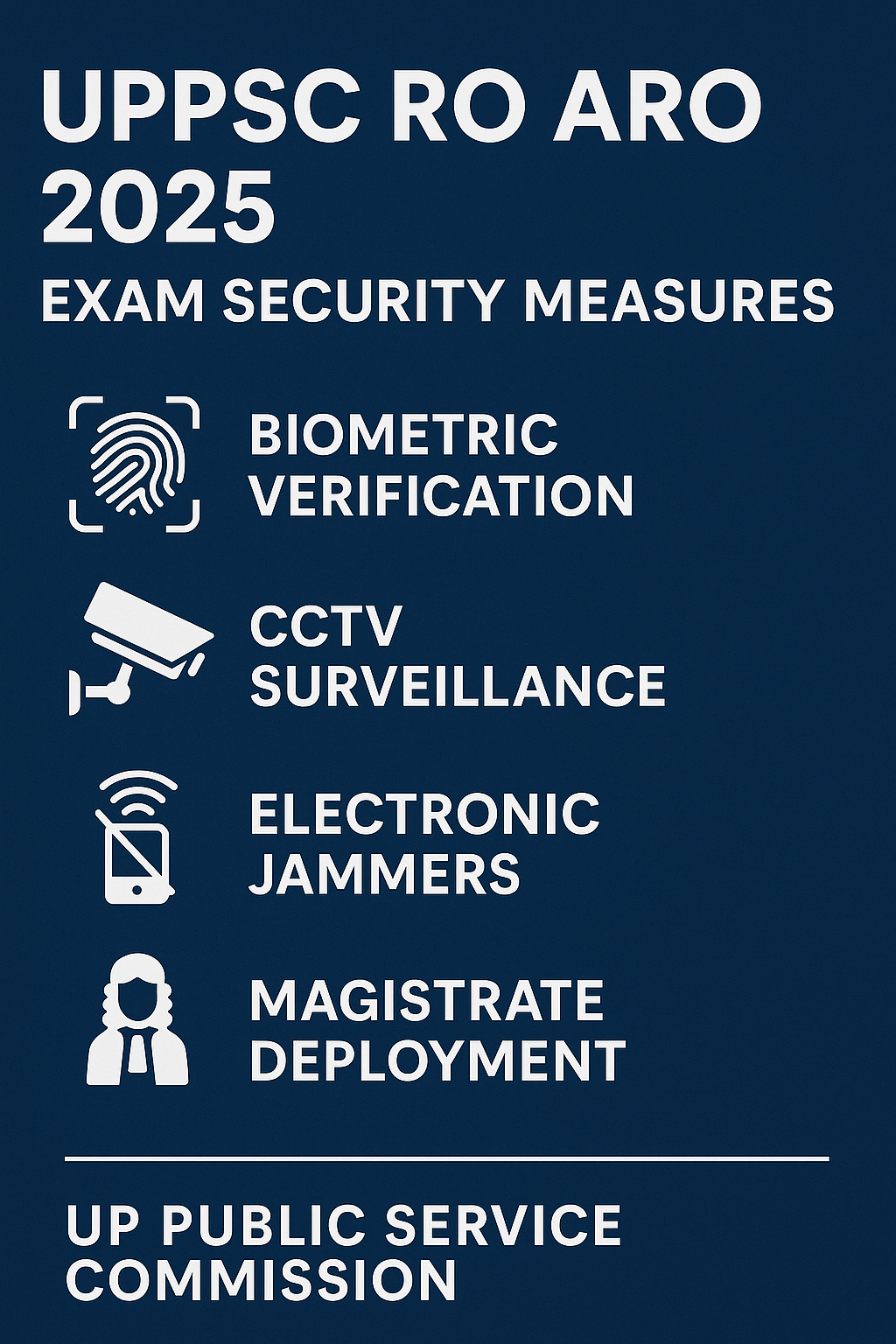
The Uttar Pradesh Public Service Commission (UPPSC) has introduced strict security measures ahead of the RO/ARO 2025 examination to ensure transparency and prevent malpractice. Here is everything aspirants need to know.
Table of Contents
The Uttar Pradesh Public Service Commission (UPPSC) has announced comprehensive security protocols for the upcoming Review Officer (RO) and Assistant Review Officer (ARO) 2025 examination. This recruitment drive aims to fill administrative positions across various state departments in Uttar Pradesh. The enhanced security framework reflects the commission’s focus on maintaining examination integrity and ensuring fair opportunities for all candidates.
This guide provides verified information about exam dates, application procedures, security measures, and preparation guidelines based on official UPPSC notifications. Candidates preparing for this competitive examination will find detailed insights into eligibility criteria, exam pattern, and important timelines.
Understanding the UPPSC RO/ARO Examination Framework
The Review Officer and Assistant Review Officer positions represent important administrative roles within Uttar Pradesh’s state government structure. These positions involve responsibilities related to record maintenance, administrative review, and clerical functions across various departments.
The 2025 recruitment cycle is expected to attract a large number of applicants given the stability and benefits associated with government service. Understanding the examination structure helps candidates plan their preparation effectively.
Positions and Vacancy Details
The commission has announced recruitment for approximately 3,000 positions across two categories. The Review Officer positions comprise roughly half of the available posts, while Assistant Review Officer positions account for the remaining vacancies.
These numbers are subject to official confirmation through the detailed recruitment notification. Candidates should verify exact vacancy figures from the official UPPSC portal before applying.
Final vacancy distribution across districts and departments will be specified in the official notification. Reserved category allocations follow government guidelines for SC, ST, OBC, and EWS candidates.
Examination Schedule and Important Dates
Based on the available information, the examination is scheduled to be conducted in July 2025. The commission typically follows a structured timeline from application to result declaration.
Key Timeline Information
Application Period: The application window is expected to open in March 2025 and remain active through April 2025. This provides candidates with approximately two months to complete their registration and submit required documents.
Examination Dates: The primary examination dates are scheduled for mid-July 2025, with reserve dates allocated for late July in case of unforeseen circumstances. The examination will be conducted across multiple days to accommodate the large number of candidates.
Admit Card Release: Admit cards are typically released three weeks before the examination date. Candidates should download and verify all details on their admit cards immediately upon release.
Result Declaration: Based on standard processing timelines, results are expected approximately two months after the examination. The commission publishes answer keys before final results for transparency.
Candidates should regularly check the official UPPSC website (uppsc.up.nic.in) for confirmed dates and any schedule modifications. The commission issues notifications through its official portal and authorized media channels.
Eligibility Criteria and Application Requirements
Understanding eligibility requirements is essential before beginning the application process. The commission sets specific criteria regarding age, educational qualifications, and other parameters.
Educational Qualifications
Candidates must possess a bachelor’s degree from a recognized university to apply for both RO and ARO positions. The degree can be in any discipline, though specific departmental preferences may be mentioned in detailed notifications.
The degree must be completed by the time of application submission. Candidates in their final year of graduation may not be eligible unless specifically permitted by the commission.
Age Limit Parameters
Age criteria typically range from 21 to 40 years, calculated as of a specific cutoff date mentioned in the notification. Reserved category candidates receive age relaxation as per government regulations.
Upper age limits for SC/ST candidates usually include five years of relaxation, while OBC candidates typically receive three years. Additional relaxation may be available for specific categories like PwD candidates or ex-servicemen.
Document Requirements
Applicants must prepare several documents for the application process. These include educational certificates, category certificates (if applicable), identity proof, and recent photographs.
Documents should be scanned in specified formats and sizes as mentioned in the application guidelines. Original documents will be required during document verification for selected candidates.
Examination Pattern and Structure
The UPPSC RO/ARO examination follows an offline, OMR-based format. Understanding the exam structure helps candidates develop effective preparation strategies.
Paper Format Details
The examination consists of 150 multiple-choice questions covering various subjects. The total duration is three hours, providing candidates with adequate time to attempt all questions.
Questions are divided across General Studies and Aptitude sections. Each section tests different competencies relevant to the administrative positions.
Marking Scheme
The examination follows a positive and negative marking system. Each correct answer earns one mark, while incorrect responses result in a deduction of 0.25 marks.
This negative marking structure emphasizes the importance of accuracy over random guessing. Candidates should attempt questions only when reasonably confident about their answers.
Unattempted questions do not result in any deduction. Strategic time management allows candidates to focus on questions within their knowledge areas.
Syllabus and Subject Coverage
Comprehensive syllabus knowledge is fundamental to effective preparation. The examination covers multiple subject areas testing both general knowledge and specific aptitude.
General Studies Components
Indian History: Questions cover ancient, medieval, and modern Indian history including major events, movements, and personalities. Focus areas include freedom struggle, constitutional development, and post-independence history.
Geography: The syllabus includes physical geography, Indian geography, and world geography. Topics cover climate, resources, agriculture, and economic geography.
Indian Polity: Constitutional provisions, fundamental rights, directive principles, and government structure form key areas. Understanding of parliamentary system, judiciary, and federal structure is essential.
Economics: Basic economic concepts, Indian economy, planning, budgeting, and current economic issues are covered. Knowledge of recent government schemes and economic policies is beneficial.
Science and Technology: General science questions test basic concepts from physics, chemistry, and biology. Current developments in science and technology are also included.
Uttar Pradesh Specific Content
A significant portion focuses on Uttar Pradesh’s history, geography, culture, and current developments. Questions may cover state government schemes, administrative structure, and recent initiatives.
Understanding the state’s demographic profile, major industries, and cultural heritage provides an advantage. Recent developments in infrastructure, education, and social sectors are relevant.
Current Affairs
Questions on national and international events from the past 12 months are standard. Candidates should maintain awareness of government policies, important appointments, and significant events.
Regular reading of newspapers and monthly current affairs compilations helps build this knowledge base. Focus on both national and state-level developments.
Aptitude Section
Mathematical reasoning, logical analysis, and data interpretation questions test analytical abilities. These questions assess problem-solving skills and numerical aptitude.
English language components may include grammar, vocabulary, and comprehension. Communication skills relevant to administrative positions are evaluated.
Enhanced Security Measures Overview
The commission has implemented multiple security layers to ensure examination integrity. These measures address various potential security concerns and establish a secure testing environment.
Biometric Verification Systems
Digital fingerprint scanning and facial recognition technology form the primary identity verification mechanism. Candidates undergo biometric verification at multiple checkpoints during the examination process.
The system cross-references biometric data with the commission’s candidate database in real-time. This technology prevents impersonation and ensures only registered candidates appear for the examination.
Candidates with specific conditions affecting fingerprint scanning should inform authorities in advance. Alternative verification methods are available in such cases.
Surveillance Infrastructure
Examination centers are equipped with comprehensive video surveillance systems. These systems record activities throughout the examination duration.
Monitoring teams review footage in real-time to identify any irregular activities. Recorded footage serves as evidence in case of disputes or appeals.
The surveillance system operates under privacy guidelines, focusing on security rather than invasive monitoring. Audio-visual data is protected and accessed only by authorized personnel.
Electronic Device Restrictions
A strict policy prohibits all electronic devices within examination premises. This includes smartphones, smartwatches, calculators, and any communication-capable devices.
Candidates found carrying prohibited items face immediate disqualification. The policy ensures no candidate gains unfair advantage through unauthorized means.
Storage facilities for personal belongings may have limited availability. Candidates are advised to avoid bringing unnecessary items to examination centers.
Signal Blocking Technology
Communication signal blocking systems prevent the use of mobile networks and wireless communication within examination areas. This technology eliminates possibilities of external assistance during the examination.
The systems block multiple frequency ranges while maintaining emergency communication channels. Implementation extends to areas surrounding examination centers for comprehensive coverage.
Administrative Supervision
Senior administrative officials oversee examination conduct at major centers. Their presence ensures immediate resolution of any issues and maintains discipline.
Inspection teams conduct random verification visits during examination hours. These teams check compliance with security protocols and address irregularities.
Document Authentication
Multiple verification stages confirm the authenticity of identity documents. High-resolution scanning and hologram detection prevent use of fraudulent documents.
Physical features are matched with document photographs to confirm identity. This multi-layered approach establishes foolproof identity verification.
Examination Centers and Logistics
UPPSC establishes examination centers across all districts of Uttar Pradesh. The distribution ensures candidates can appear for examinations within reasonable proximity to their locations.
Center Allocation Process
Centers are allocated based on candidate preferences indicated during application. The commission considers factors like candidate density and available infrastructure.
Final center allocation details appear on admit cards. Candidates should verify their assigned centers immediately upon admit card release.
Center changes are typically not permitted except under extraordinary circumstances. Any requests for center changes must follow official procedures with valid justification.
Major City Coverage
Larger cities like Lucknow, Kanpur, Allahabad, and Varanasi host multiple examination centers. These locations have better infrastructure and accessibility.
Smaller district headquarters also have designated centers to accommodate local candidates. The distribution aims to minimize travel burden on candidates.
Reporting Guidelines
Candidates must report to their assigned centers well before the scheduled examination time. Late arrivals may result in denied entry as examination protocols require timely completion of security procedures.
The verification process at entry points requires adequate time. Candidates should plan to reach centers at least 90 minutes before the scheduled start time.
Traffic conditions and local factors should be considered while planning arrival times. Visiting the center location a day before the examination helps avoid confusion on exam day.
Document Checklist for Examination Day
Carrying correct documents is critical for smooth entry and verification. Missing or incorrect documents can lead to denied entry.
Mandatory Documents
The printed admit card downloaded from the official website is absolutely essential. The document must be clear and legible with all details visible.
A government-issued photo identity document is required for verification. Acceptable documents include Aadhar Card, PAN Card, Voter ID, or Passport.
Recent passport-size photographs matching those uploaded during application should be carried. These may be required for attendance records.
Category-Specific Documents
Candidates claiming reserved category benefits must carry relevant certificates. SC/ST/OBC certificates must be issued by competent authorities.
Economically Weaker Section (EWS) candidates require valid income certificates. These certificates must be current and issued as per government guidelines.
Differently-abled candidates claiming special provisions must carry disability certificates. These documents should specify the nature and percentage of disability.
Additional Recommendations
Carrying extra copies of all documents provides backup in case of any issues. Documents should be organized in a transparent folder for easy access.
Self-attested copies of certificates may be useful though not always mandatory. Keeping digital copies accessible on email or cloud storage provides additional backup.
Special Provisions for Differently-Abled Candidates
The commission provides comprehensive accommodations for candidates with disabilities. These provisions ensure equal opportunity while maintaining examination standards.
Available Accommodations
Additional time allowances are provided based on disability type and severity. Scribe services are available for candidates unable to write independently.
Specially designed examination halls with accessibility features are arranged. Priority entry lanes reduce waiting time during security procedures.
Alternative biometric verification methods accommodate candidates with specific disabilities. Magnification equipment and other assistive devices are provided as needed.
Application Process for Accommodations
Candidates must indicate their requirements during the application process. Valid disability certificates from authorized medical boards must be submitted.
Specific accommodation requirements should be confirmed at least 15 days before the examination. This allows the commission adequate time for necessary arrangements.
Preparation Strategy and Study Approach
Effective preparation requires systematic planning and consistent effort. Understanding the examination pattern and syllabus helps develop focused study plans.
Time Management Planning
Creating a realistic study schedule covering all subjects is fundamental. Allocate time proportionally based on subject weightage and personal strengths.
Daily study hours should be consistent rather than intensive sporadic sessions. Regular breaks and revision cycles improve retention and understanding.
Monthly targets help track progress and adjust strategies as needed. Practice with previous year papers under timed conditions builds examination temperament.
Subject-Wise Preparation
For General Studies, NCERT textbooks provide strong foundational knowledge. Standard reference books supplement NCERT content for competitive examination requirements.
Current affairs require daily newspaper reading and monthly magazine compilation. Maintaining notes of important events aids quick revision.
Aptitude sections benefit from regular practice of quantitative problems. Understanding concepts rather than memorizing formulas improves problem-solving ability.
Revision Techniques
Multiple revision cycles strengthen memory and understanding. First revision should occur within days of initial learning for better retention.
Short notes and mind maps help consolidate information. These tools enable quick revision in the final days before examination.
Group discussions with fellow aspirants provide different perspectives and clarify doubts. However, focused individual study remains essential for deep understanding.
Mock Tests and Practice
Regular practice with mock tests familiarizes candidates with examination format. Analyzing performance identifies weak areas requiring additional focus.
Time-bound practice improves speed and accuracy. Learning from mistakes made in practice tests prevents repetition during actual examination.
Resource Selection
Choosing appropriate study materials prevents information overload. Standard reference books recommended by successful candidates provide reliable content.
Online platforms and mobile applications offer convenience but should supplement rather than replace comprehensive book study. Quality matters more than quantity in resource selection.
Answer Key and Result Process
Understanding the post-examination process helps candidates track their progress and prepare for subsequent stages.
Answer Key Publication
The commission typically publishes preliminary answer keys within 10 days of examination completion. Candidates can download these from the official website.
This transparency allows candidates to estimate their scores before official results. Self-assessment helps in deciding whether to continue preparation for other examinations.
Objection Submission
A specific window is provided for candidates to submit objections to answer keys. Objections must be supported by documentary evidence from standard references.
A prescribed fee is usually required for each objection submission. Valid objections lead to answer key modifications that affect final results.
Final Answer Key
After considering objections, the commission releases the final answer key. This becomes the basis for result calculation and cannot be challenged further.
Result Declaration
Final results include candidate roll numbers, scores, and merit positions. The commission publishes cutoff marks for different categories.
Qualifying candidates receive notifications for document verification and subsequent selection stages. Results remain available on the official website for specified durations.
Document Verification
Selected candidates must appear for document verification at designated centers. All original certificates and documents are verified against application details.
Candidates failing document verification face disqualification. Ensuring document accuracy during application prevents issues at this stage.
Communication Channels and Updates
Staying informed about official announcements is crucial throughout the examination process. Multiple channels provide information to candidates.
Official Website
The UPPSC official portal (uppsc.up.nic.in) is the primary source for all notifications. Candidates should check this website regularly for updates.
All official notifications, admit cards, answer keys, and results are published here. Candidates should bookmark this website for easy access.
Mobile and Email Alerts
Registered mobile numbers and email addresses receive notifications about important updates. Candidates should ensure these details remain accurate and accessible.
SMS alerts inform about admit card availability, examination schedules, and result declarations. Email notifications provide detailed information with relevant links.
Helpline Support
The commission operates helpline numbers for candidate queries. These helplines function during working hours on weekdays.
Common queries regarding application, examination procedures, and results can be addressed through these channels. Technical issues with the website or application portal should be reported promptly.
Social Media
Official social media handles provide timely updates about examinations. However, candidates should verify critical information from the official website.
Social media is useful for general updates but should not be the sole source of information. Important decisions should be based on official website notifications.
Common Challenges and Solutions
Understanding potential challenges helps candidates prepare better and avoid last-minute issues.
Application Process Difficulties
Technical issues during online application submission can occur due to high traffic. Completing applications well before deadlines prevents last-minute stress.
Document upload errors often result from incorrect file formats or sizes. Following specified guidelines carefully ensures smooth submission.
Payment gateway failures sometimes interrupt application completion. Taking screenshot confirmations of successful transactions provides evidence if needed.
Admit Card Issues
Occasionally, candidates face difficulties downloading admit cards. Clearing browser cache and trying different browsers often resolves such issues.
Discrepancies in admit card details should be reported immediately to the commission. Minor errors might be correctable before examination dates.
Center Location Confusion
Unfamiliarity with examination center locations causes unnecessary stress. Visiting centers a day before the examination eliminates this concern.
Using reliable navigation applications helps reach centers without delays. Accounting for traffic conditions prevents last-minute rushing.
Examination Day Stress
Anxiety on examination day affects performance. Adequate sleep and timely meals maintain physical and mental readiness.
Arriving early at centers reduces stress related to security procedures. Carrying all required documents in an organized manner streamlines entry processes.
Post-Examination Career Prospects
Understanding career opportunities after selection motivates candidates and provides clarity about future prospects.
Job Profile Description
Review Officers handle administrative and record-keeping responsibilities in state departments. The role involves document management, verification processes, and clerical functions.
Assistant Review Officers support senior officers in administrative tasks. Both positions offer stable government employment with defined career progression.
Salary and Benefits
Selected candidates receive pay scales as per state government norms for their respective positions. Regular increments and promotional opportunities are available.
Government employees receive various allowances including dearness allowance, house rent allowance, and medical benefits. Pension and retirement benefits provide long-term financial security.
Career Growth
Government service offers structured career advancement through departmental examinations and promotional channels. Experience gained in these positions provides foundation for higher administrative roles.
Dedicated officers can progress to senior positions within their departments over time. Some positions provide opportunities for further specialization and training.
Maintaining Examination Integrity
The commission’s security measures reflect commitment to fair and transparent examination conduct. Understanding the rationale behind these measures helps candidates appreciate their importance.
Purpose of Security Protocols
Enhanced security prevents malpractices that undermine merit-based selection. When examinations are conducted fairly, deserving candidates achieve success based on their abilities.
Security measures protect the credibility of government certifications. Positions obtained through fair processes carry greater professional value.
Candidate Responsibilities
Adhering to examination rules and security protocols is every candidate’s responsibility. Cooperation with verification procedures ensures smooth examination conduct.
Reporting any observed irregularities to authorities maintains examination integrity. Candidates should focus entirely on their preparation rather than seeking unfair advantages.
Zero Tolerance Policy
Any violations of examination rules result in severe consequences including disqualification. Attempting malpractices risks permanent debarment from future examinations.
Legal action may be initiated against serious violations. The potential consequences far outweigh any perceived short-term benefits of cheating.
Expert Recommendations for Success
While this guide provides information based on official sources, certain general recommendations benefit examination candidates.
Consistency Over Intensity
Regular daily study proves more effective than occasional intensive sessions. Building knowledge gradually creates stronger foundations than last-minute cramming.
Focus on Understanding
Conceptual understanding enables application to different question types. Memorization alone proves insufficient for aptitude-based questions.
Health and Wellness
Physical and mental health directly impact preparation effectiveness. Regular exercise, adequate sleep, and balanced nutrition support cognitive functions.
Managing stress through healthy outlets prevents burnout during prolonged preparation periods. Maintaining hobbies and social connections provides necessary balance.
Realistic Goal Setting
Setting achievable milestones maintains motivation throughout preparation. Unrealistic expectations create unnecessary pressure and disappointment.
Tracking progress against goals enables timely strategy adjustments. Celebrating small achievements sustains enthusiasm during challenging preparation periods.
Verification and Source Information
This guide compiles information from official UPPSC notifications and standard examination procedures. Candidates should always verify current details from the official UPPSC website.
Examination patterns, dates, and procedures may undergo changes. Official notifications supersede any information provided in general guides.
No third-party websites or coaching institutes can provide more reliable information than official sources. Candidates should be cautious of misleading information from unverified sources.
Key Takeaways
The UPPSC RO/ARO 2025 examination represents an important opportunity for candidates seeking government employment in Uttar Pradesh. Understanding examination procedures, eligibility criteria, and security measures helps candidates prepare effectively.
Enhanced security protocols ensure fair examination conduct that benefits genuinely prepared candidates. Systematic preparation covering all syllabus areas provides the best success foundation.
Regular monitoring of official communications keeps candidates informed about important updates. Following all examination rules and guidelines ensures smooth participation without complications.
Success in competitive examinations requires dedication, consistent effort, and strategic preparation. Candidates should focus on building strong conceptual foundations rather than seeking shortcuts.
Next Steps for Aspirants
Candidates interested in applying should regularly check the official UPPSC website for notification releases. Once the application window opens, complete the registration process carefully with accurate information.
Begin syllabus-based preparation immediately rather than waiting for examination dates. Creating a comprehensive study plan covering all subjects ensures thorough preparation.
Identify reliable study resources and maintain consistent study schedules. Practice with previous examination papers builds familiarity with question patterns.
Join study groups or forums for doubt clarification and motivation. However, maintain individual focus on personal preparation goals.
Mark all important dates in a calendar to avoid missing deadlines. Set reminders for application submission, admit card download, and examination dates.
Plan examination day logistics in advance including travel arrangements and required documents. Eliminate potential obstacles that might create unnecessary stress.
Maintain confidence throughout the preparation journey. Thousands of candidates succeed in such examinations through dedicated preparation and smart strategies.
Frequently Asked Questions (FAQs)
What are the confirmed examination dates for UPPSC RO/ARO 2025?
The examination is scheduled for July 15-16, 2025, according to the current information. Reserve dates are set for July 22-23, 2025, in case of unforeseen circumstances. Candidates should verify exact dates from the official UPPSC website (uppsc.up.nic.in) when the formal notification is released. Examination dates occasionally undergo changes, so regular monitoring of official announcements is essential for accurate information.
What documents are mandatory for examination day entry?
Candidates must carry three essential documents: printed admit card from the official website, a government-issued photo identity document (Aadhar Card, PAN Card, Voter ID, or Passport), and recent passport-size photographs. Category certificate holders should carry relevant SC/ST/OBC/EWS certificates. Differently-abled candidates must bring disability certificates if claiming special provisions. All documents should be originals; photocopies may not be accepted for verification purposes.
How does the biometric verification process work?
Biometric verification involves fingerprint scanning and facial recognition at designated checkpoints within examination centers. The system matches candidate biometrics with data stored in the UPPSC database. Verification occurs at entry, during hall allocation, and at submission points. Candidates with finger injuries or conditions affecting fingerprint capture should inform authorities in advance. Alternative biometric methods like iris scanning are available in such cases. The process adds approximately 5-10 minutes to the entry procedure.
What electronic devices are prohibited during the examination?
All electronic devices are strictly prohibited, including smartphones, smartwatches, fitness bands, Bluetooth devices, calculators, electronic watches, and earphones. Candidates found carrying any prohibited items face immediate disqualification. The ban extends to analog watches with electronic displays. Candidates should leave all such devices at home or in vehicles as storage facilities may not be available at centers. Only pens and pencils are permitted inside examination halls.
When will the application process begin for UPPSC RO/ARO 2025?
Based on available information, the application window is expected to open in March 2025 and remain active through April 2025. The exact start date will be announced through official notification on the UPPSC website. Candidates should prepare required documents in advance to complete applications promptly once the window opens. An application correction window typically follows the main application period for candidates to rectify minor errors.
What is the qualification requirement for RO and ARO positions?
Candidates must possess a bachelor’s degree in any discipline from a university recognized by the University Grants Commission (UGC). The degree must be completed before the application deadline. Candidates awaiting final year results are generally not eligible unless specifically mentioned in the official notification. Professional degrees and technical qualifications are also acceptable if they meet the basic graduate degree requirement.
How can candidates check their examination results?
Results are published on the official UPPSC website (uppsc.up.nic.in) approximately two months after the examination. Candidates can check results using their registration number or roll number. The commission also sends SMS and email notifications to registered contact details. Result announcements include category-wise cutoff marks and merit lists. Selected candidates receive further instructions regarding document verification schedules.
Are there special provisions for candidates from reserved categories?
Yes, candidates from Scheduled Castes (SC), Scheduled Tribes (ST), Other Backward Classes (OBC), and Economically Weaker Sections (EWS) receive benefits as per government guidelines. These include age relaxation, application fee concessions, and reserved vacancies. Age relaxation typically includes 5 years for SC/ST candidates and 3 years for OBC candidates. Candidates must submit valid category certificates from competent authorities to claim these benefits.
What happens if there are discrepancies in the answer key?
After the examination, UPPSC publishes a preliminary answer key. Candidates can submit objections during a specified window, usually 7-10 days. Objections must be supported by documentary evidence from standard reference materials. A prescribed fee is charged for each objection. The commission reviews all objections and publishes a final answer key after incorporating valid corrections. Results are calculated based on the final answer key.
How should candidates prepare for the General Studies section?
General Studies preparation requires comprehensive coverage of Indian history, geography, polity, economics, and science. NCERT textbooks (classes 6-12) provide foundational knowledge. Standard reference books for competitive examinations supplement NCERT content. Current affairs from the past 12 months should be studied through newspapers and monthly compilations. Uttar Pradesh-specific topics require special focus, including state history, geography, and recent government initiatives. Regular revision and practice with previous year papers improve retention and application ability.
About the Author
Nueplanet
Nueplanet is an educational content specialist focusing on competitive examination guidance and career opportunities in government services. With extensive experience analyzing examination patterns and official notifications, Nueplanet provides fact-based information to help candidates navigate complex application processes and preparation strategies.
This content is created to offer transparent, verified information sourced directly from official government portals and commission notifications. The goal is to help examination aspirants access accurate information without promotional influence or misleading claims.
All information presented undergoes verification against official sources before publication. When updates or corrections become necessary, content is promptly revised to maintain accuracy. Readers are encouraged to cross-verify critical details from official sources before making important decisions.
Commitment to Accuracy: Content presented here prioritizes factual accuracy over promotional language. Official government sources including UPPSC portals and notifications form the foundation of all information provided. This approach ensures readers receive reliable guidance for their examination preparation journey.
Content Update Policy: This article was originally published on July 15, 2025 and last updated on July 15, 2025. Regular reviews ensure information remains current with official announcements and procedural changes.
Contact and Feedback: Readers who identify outdated information or have suggestions for content improvement can provide feedback through designated channels. Continuous improvement based on reader input helps maintain content quality and relevance.
Article Publish Date: July 15, 2025
Last Updated: July 15, 2025
Content Verification Date: July 15, 2025
Note: This guide provides general information based on standard UPPSC examination procedures and available information. Candidates must verify all critical details including dates, eligibility criteria, and application procedures from the official UPPSC website (uppsc.up.nic.in). Official notifications supersede information provided in any third-party guides or resources.
Helpful Resources
Latest Posts
- National RailOne App: Indian Railways’ One-Stop Solution for Travellers
- HDB Financial Services IPO Allotment GMP: All You Need to Know
- TNPSC Admit Card 2025 Released: Everything You Need to Know
- Jharkhand Polytechnic Result 2025 Declared: Check Your Scores, Merit List, and Admission Process
- 7th July Public Holiday India: Is Muharram 2025 a National Holiday?












Post Comment