









UP NEET Counselling 2025: Round 1 & Round 2 Key Updates for Medical Aspirants
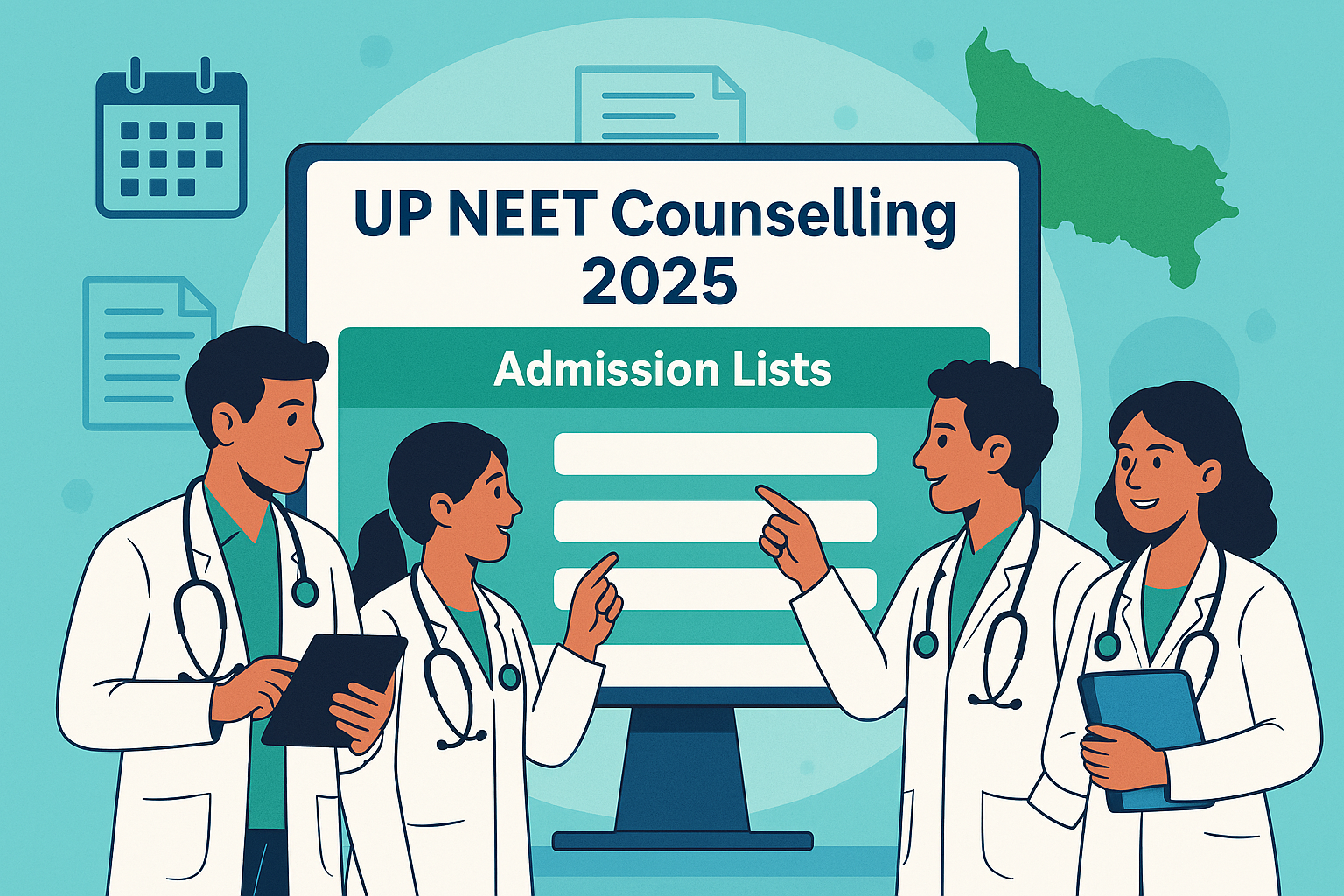
UP NEET Counselling 2025 is underway, with Round 1 seat allotment results released and Round 2 registration starting soon. Here’s everything you need to know about dates, process, eligibility, and important guidelines.
Table of Contents
The Uttar Pradesh NEET counselling process serves as the official admission pathway for medical and dental courses in the state. This article provides comprehensive information about UP NEET Counselling 2025, including Round 1 outcomes, Round 2 schedule, eligibility requirements, and application procedures.
Understanding UP NEET Counselling: Purpose and Overview
The UP NEET counselling is conducted by the Directorate General of Medical Education and Training (DGME), Uttar Pradesh. This process allocates MBBS and BDS seats in government and private medical institutions across the state based on NEET UG 2025 scores.
The counselling operates through multiple rounds to ensure optimal seat utilization. Candidates participate based on their NEET rankings, category reservations, and domicile status. The process includes online registration, choice filling, seat allotment, document verification, and final admission confirmation.
Understanding this mechanism helps candidates navigate the admission process effectively. Each round offers specific opportunities for seat allocation and upgradation.
Seat Distribution and Availability in UP Medical Colleges
Uttar Pradesh offers substantial medical education opportunities through its network of medical and dental colleges. The state has 56 medical colleges offering 8,450 MBBS seats and 32 dental colleges providing 2,880 BDS seats.
Government medical colleges contribute 2,150 MBBS seats to the total pool. Private medical colleges account for 6,300 MBBS seats across various institutions. This distribution ensures diverse options for candidates across different rank ranges.
The seat allocation follows constitutional reservation policies. Reserved category seats constitute 49.5% of total availability, distributed among SC, ST, OBC, and EWS categories. State quota seats represent 85% of total seats, designated for UP domicile candidates.
Category-wise Seat Reservation
| Category | Reservation Percentage | Approximate Seats (MBBS) |
|---|---|---|
| General | 50.5% | 4,267 |
| OBC | 27% | 2,282 |
| SC | 15% | 1,268 |
| ST | 4% | 338 |
| EWS | 10% | 845 |
This structured reservation system ensures equitable access to medical education across different social categories. Candidates should understand their category benefits when planning their counselling strategy.
NEET UG 2025: Foundation Examination Details
NEET UG 2025 serves as the qualifying examination for UP counselling participation. The National Testing Agency (NTA) conducts this entrance test for medical and dental admissions across India.
The examination is scheduled for May 5, 2025, following the pattern of second Sunday in May. The test duration spans 3 hours and 20 minutes (200 minutes). Candidates attempt 200 multiple-choice questions carrying 720 total marks.
Each correct answer awards 4 marks. Incorrect responses incur negative marking of 1 mark per question. The examination takes place at over 4,750 centers across India and 14 international locations.
NEET UG 2025 Subject Distribution
Physics Section (50 questions, 200 marks):
- Mechanics: 15 questions
- Thermodynamics: 8 questions
- Electromagnetism: 12 questions
- Optics: 8 questions
- Modern Physics: 7 questions
Chemistry Section (50 questions, 200 marks):
- Physical Chemistry: 17 questions
- Inorganic Chemistry: 16 questions
- Organic Chemistry: 17 questions
Biology Section (100 questions, 360 marks):
- Botany: 50 questions (180 marks)
- Zoology: 50 questions (180 marks)
Qualifying Percentile Requirements
Different categories have specific qualifying percentiles for counselling eligibility:
- General Category: 50th percentile (approximately rank 70,000+)
- SC/ST/OBC Categories: 40th percentile (approximately rank 1,37,000+)
- General-PwD: 45th percentile
- SC/ST/OBC-PwD: 40th percentile
These percentiles determine counselling participation eligibility. Candidates meeting these criteria can register for UP NEET counselling rounds.
UP NEET Counselling Round 1: Statistical Analysis
Round 1 of UP NEET Counselling 2025 concluded in December 2024 with significant candidate participation. The round witnessed 1,85,420 total registrations from eligible NEET qualifiers.
The allotment process successfully allocated 8,890 seats combining MBBS and BDS programs. MBBS seats constituted 7,125 allotments, while BDS seats accounted for 1,765 allotments. Government college seats comprised 1,950 successful allotments, with private colleges filling 6,940 seats.
Category-wise Round 1 Allotment Data
General Category Performance: The general category received 3,598 MBBS seat allotments, representing 50.5% of total allocations. The lowest allotted rank reached 45,230. King George’s Medical University, Lucknow recorded the highest cutoff at rank 1,245.
OBC Category Results: OBC candidates secured 1,925 MBBS seats (27.0% of allocations). The lowest rank allotted was 85,670. The category achieved 78.5% fulfillment of top choice preferences.
SC Category Allocation: SC candidates obtained 1,068 MBBS seats (15.0% of total). The lowest allotted rank was 1,25,890. Government medical colleges accommodated 456 SC category candidates.
ST Category Distribution: ST candidates received 321 MBBS seats (4.5% allocation). The lowest rank reached 1,45,670. Tribal area preference schemes recorded 89.2% success rates.
EWS Category Achievement: EWS candidates secured 713 MBBS seats (10.0% distribution). The lowest allotted rank was 67,430. All candidates completed income certificate verification requirements.
Top Medical Colleges: Round 1 Cutoff Analysis
Government Medical Institutions
King George’s Medical University (KGMU), Lucknow: KGMU recorded a cutoff rank of 1,245 for Round 1. The institution offers 250 MBBS seats annually. The university operates 19 postgraduate departments, providing advanced medical education opportunities.
Institute of Medical Sciences (IMS), BHU Varanasi: IMS BHU established a cutoff rank of 1,890. The college provides 150 MBBS seats. The institution maintains international recognition for research excellence in medical sciences.
Sanjay Gandhi Postgraduate Institute (SGPGI), Lucknow: SGPGI set a cutoff rank of 2,340 for admissions. The institute offers 50 MBBS seats with super-specialty medical care focus. The institution emphasizes advanced medical training and research.
Private Medical Colleges
Era’s Lucknow Medical College: This institution recorded a cutoff rank of 12,450. The college offers 150 MBBS seats with modern infrastructure facilities. The campus maintains contemporary medical education standards.
Integral Institute of Medical Sciences, Lucknow: Integral Institute established a cutoff rank of 15,680. The college provides 150 MBBS seats. Clinical training occurs at an attached 1,000+ bed hospital facility.
UP NEET Counselling 2025 Round 2: Schedule and Timeline
Round 2 presents additional opportunities for candidates seeking medical admissions. The process accommodates new registrants, Round 1 non-allottees, and upgrade seekers.
Complete Round 2 Schedule
| Activity | Date | Time |
|---|---|---|
| Online Registration Opens | January 15, 2025 | 10:00 AM |
| Registration Closes | January 20, 2025 | 11:59 PM |
| Choice Filling Begins | January 16, 2025 | 2:00 PM |
| Choice Locking Deadline | January 21, 2025 | 11:59 PM |
| Seat Allotment Processing | January 22-24, 2025 | – |
| Result Declaration | January 25, 2025 | 2:00 PM |
| Document Verification Period | January 26-30, 2025 | Office Hours |
| Fee Payment Deadline | January 31, 2025 | 11:59 PM |
| Admission Reporting | February 1-5, 2025 | College Hours |
Round 2 Seat Availability
Round 2 offers 1,325 MBBS seats from various sources. Government colleges contribute 200 vacant seats. Private colleges provide 1,125 available seats. Management quota conversions add 85 additional seats.
BDS seats total 1,115 in Round 2. Government dental colleges offer 180 seats. Private dental colleges provide 935 available seats.
Eligibility Criteria for Round 2 Participation
Eligible Candidate Categories
Candidates not receiving seat allotments in Round 1 can participate in Round 2. Fresh registrants who missed Round 1 registration period qualify for Round 2. Candidates allotted seats in Round 1 can seek upgradation opportunities.
Candidates who forfeited Round 1 seats within the specified deadline remain eligible. NRI and management quota aspirants can apply for specific designated seats.
Required Documentation
All candidates must prepare original certificates for verification. UP domicile certificate is mandatory for state quota seat eligibility. NEET UG 2025 scorecard and admit card require presentation.
Category certificates are necessary for claiming reservation benefits. EWS candidates must submit valid income certificates. Documents must meet authenticity and validity standards set by DGME.
Strategic Approach to Choice Filling
Choice filling represents a critical component of the counselling process. Candidates must understand optimal strategies for maximizing admission prospects.
Priority-based College Selection
Candidates should list preferred institutions first in their choice order. Dream colleges should occupy the top 5 preference positions. Government colleges generally offer cost advantages over private institutions.
Location considerations include proximity to residence and campus infrastructure quality. College reputation affects postgraduate preparation opportunities. Safety options ensure admission security when higher preferences remain unfulfilled.
Expected Round 2 Cutoff Ranges
Government Medical College Estimates:
| College | Expected Cutoff Rank |
|---|---|
| KGMU Lucknow | 8,500+ |
| IMS BHU | 12,800+ |
| MLN Medical College Allahabad | 18,900+ |
| GSVM Medical College Kanpur | 22,400+ |
| Autonomous State Medical College Lucknow | 28,750+ |
Private Medical College Projections:
| College | Expected Cutoff Rank |
|---|---|
| Era’s Medical College | 45,000+ |
| Integral Institute | 52,000+ |
| Rama Medical College | 68,000+ |
| Santosh Medical College | 85,000+ |
| Subharti Medical College | 95,000+ |
These estimates help candidates plan realistic choice combinations based on their NEET ranks.
Category-specific Strategy Recommendations
General Category Candidates: Fill minimum 50+ choices for comprehensive option coverage. Mix government and private colleges across preference range. Consider deemed universities as backup alternatives when appropriate.
OBC Category Candidates: Leverage 27% reservation for enhanced college opportunities. Focus on government institutions with favorable OBC cutoffs. Include central universities offering OBC benefits in choice lists.
SC/ST Category Candidates: Utilize 21% combined reservation effectively across choices. Target government colleges with historically lower cutoffs. Consider state-specific tribal area preference schemes when applicable.
EWS Category Candidates: Maximize 10% reservation benefits in choice selection. Ensure income certificate validity meets current requirements. Balance government and private college choices appropriately.
Document Verification Process: Complete Requirements
Document verification transforms provisional allotments into confirmed admissions. Candidates must prepare comprehensive documentation sets for verification.
Academic Documents Checklist
NEET and School Certificates:
- NEET UG 2025 Admit Card (original plus 3 photocopies)
- NEET UG 2025 Scorecard (original plus 3 photocopies)
- Class 10th Certificate (original plus 3 photocopies)
- Class 12th Certificate and Marksheet (original plus 3 photocopies)
- Character Certificate from Class 12th institution
- Migration Certificate (if from different educational board or state)
Identity and Residence Documentation
Personal Identification:
- Aadhaar Card (original plus 3 photocopies)
- UP Domicile Certificate (valid document plus 3 photocopies)
- Passport (if available, for future reference purposes)
- PAN Card (optional but recommended for administrative processes)
Category and Reservation Certificates
Reservation Documentation:
- Caste Certificate for SC/ST/OBC applicants (if claiming reservation)
- Income Certificate for EWS category candidates
- Disability Certificate for PwD candidates from competent authority
- Minority Certificate if claiming minority quota benefits
Additional Required Documents
Medical and Photographic Requirements:
- 10 recent passport-size photographs meeting specification standards
- Medical Fitness Certificate from registered medical practitioner
- HIV Test Report (recent, within 3-month validity period)
- Hepatitis B Test Report (mandatory for medical student admissions)
Verification Timeline Structure
Document verification follows a structured 5-day process. Days 1-2 involve initial document submission and preliminary verification. Days 3-4 include certificate authentication and cross-verification procedures. Day 5 covers final approval and admission confirmation processes.
Fee payment window opens for 48 hours following successful verification. Candidates must complete payment within this deadline to secure admissions.
Fee Structure Analysis: Government and Private Colleges
Understanding complete fee structures enables effective financial planning for medical education.
Government Medical College Fees
MBBS Program Annual Breakdown:
- Tuition Fee: ₹50,000
- Development Fee: ₹10,000
- Library and Laboratory Fee: ₹8,000
- Examination Fee: ₹5,000
- Medical Insurance: ₹2,000
- Total Annual Fee: ₹75,000
- 5-Year Course Total: ₹3,75,000
BDS Program Annual Breakdown:
- Tuition Fee: ₹40,000
- Development Fee: ₹8,000
- Clinical Fee: ₹12,000
- Equipment Fee: ₹6,000
- Total Annual Fee: ₹66,000
- 4-Year Course Total: ₹2,64,000
Private Medical College Fee Ranges
MBBS Course Categories:
- Premium Private Colleges: ₹15-25 lakhs annually
- Mid-tier Private Colleges: ₹8-15 lakhs annually
- Basic Private Colleges: ₹5-8 lakhs annually
Additional Charges:
- Admission Fee: ₹50,000-₹2,00,000 (one-time)
- Security Deposit: ₹1,00,000-₹5,00,000 (refundable)
- Hostel Fee: ₹80,000-₹1,50,000 annually
- Books and Equipment: ₹50,000-₹1,00,000 annually
Financial Aid and Scholarship Opportunities
Various scholarship programs assist students in managing medical education costs. Government and private scholarships provide financial support based on merit and need.
Government Scholarship Programs
State-level Assistance:
- UP State Scholarship: Up to ₹25,000 annually
- Post Matric Scholarship: ₹5,000-₹20,000 annually (category-based)
- Minority Scholarship: ₹3,000-₹15,000 annually
- Merit-cum-Means Scholarship: Up to ₹50,000 annually
Private Scholarship Options
Institution-based Programs:
- College Merit Scholarships: 10-50% tuition fee waiver
- Need-based Financial Aid: Up to 75% fee reduction for eligible students
- Toppers Reward Program: Full fee waiver for top NEET rank holders
Candidates should research specific scholarship eligibility and application procedures. Many scholarships require separate applications with supporting documentation.
Counselling Preparation: Expert Recommendations
Systematic preparation enhances counselling success probability. Candidates should adopt structured approaches to documentation and research activities.
Pre-counselling Documentation Strategy
Begin document preparation 30 days before counselling commencement. Create multiple photocopy sets (minimum 5 complete sets) of all required documents. Laminate important certificates for physical protection during handling.
Organize documents in systematic file folders with labeled sections. Maintain digital copies on cloud storage platforms for backup accessibility. Verify certificate validity dates, particularly for caste and income certificates.
College Research Activities
Study previous year cutoff trends covering 3-5 year periods. Analyze college rankings from NIRF and other recognized rating systems. Review infrastructure details through official college websites and virtual tours.
Read student feedback on academic facilities and faculty quality. Examine clinical exposure opportunities and hospital facilities. Connect with current students through official social media groups for firsthand insights.
Choice Filling Best Practices
Fill maximum allowed choices (typically 100+ options) for comprehensive coverage. Maintain strict ascending preference order reflecting genuine college preferences. Include colleges slightly above expected cutoff ranges for potential opportunities.
Add sufficient safety options ensuring guaranteed admission within rank range. Review and modify choice lists multiple times before final locking deadline.
Technical Preparation Requirements
Use stable internet connection during critical activities like choice filling. Maintain backup internet options (mobile hotspot or alternative connection). Complete all processes well before deadlines to avoid last-minute technical issues.
Take screenshots of important pages during registration and choice filling. Print confirmation receipts immediately after completing each counselling stage.
Post-allotment Action Plan
Receiving seat allotment triggers specific time-sensitive actions. Candidates must respond promptly to secure their allocated seats.
Immediate Response Steps (Within 24 hours)
Download seat allotment letter from official portal immediately. Verify college details including name, course, and category allocation. Check reporting dates and document verification schedules carefully.
Arrange transportation to allotted college location for verification. Prepare required document sets organized for easy verification. Contact college admission office for clarification of specific queries or requirements.
Financial Arrangement Activities
Arrange required fee amount through demand draft or online payment methods. Prepare backup payment options in case primary method encounters issues. Calculate total first-year expenses including fees, hostel, and other costs.
Explore applicable scholarship opportunities and application procedures. Plan accommodation arrangements if hostel facilities are unavailable or undesired.
Common Mistakes to Avoid During Counselling
Understanding typical errors helps candidates navigate the process more effectively. Several common pitfalls can jeopardize admission opportunities.
Documentation-related Errors
Expired certificates represent frequent problems, particularly caste and income certificates. Name spelling inconsistencies across different documents create verification complications. Missing signatures or official seals on certificates cause rejection.
Unclear or poor-quality photocopies hinder verification processes. Forgetting to carry original certificates to verification venues prevents completion. Candidates should verify all documentation thoroughly before submission.
Choice Filling Mistakes
Filling too few choices severely limits admission possibilities. Incorrect preference order placing less-preferred colleges first wastes opportunities. Ignoring historical cutoff trends leads to unrealistic choice selection.
Choosing only highly competitive options without safety alternatives risks non-allotment. Last-minute choice modifications often result in technical errors or incomplete submissions.
Process Management Problems
Missing registration deadlines eliminates counselling participation entirely. Delayed fee payment causes automatic seat forfeiture despite successful allotment. Failure to report to allotted college on designated dates cancels admissions.
Inadequate travel planning for document verification creates time pressure and stress. Ignoring official communications results in missed important updates or requirement changes.
Technology Platform Navigation Guide
Mastering the digital platform ensures smooth counselling navigation. Understanding technical requirements and features optimizes the experience.
Official Portal Access
The primary portal operates at www.upneet.gov.in (verify current official website). The login section provides secure candidate portal access with credentials. Information section contains latest news, announcements, and guideline documents.
Download section offers important forms, certificates, and information bulletins. Help section includes frequently asked questions and technical support contact information. Contact section lists official helpline numbers and email addresses for assistance.
Mobile Application Features
UP NEET Mobile App offers convenience for on-the-go access. Real-time notification alerts inform candidates of important updates immediately. Offline document storage capability allows access without internet connectivity.
Choice filling functionality enables preference selection from mobile devices. Result checking convenience provides instant access to allotment outcomes. Customer support chat feature offers direct assistance for queries.
System Requirements
Updated web browsers (Chrome, Firefox, Safari) ensure compatibility. Stable internet connection (minimum 2 Mbps speed) prevents disconnections. JavaScript and cookies must be enabled in browser settings.
PDF reader software enables document download and viewing. Scanner or mobile scanning application facilitates document upload processes.
Career Pathways After Medical Graduation
Understanding career opportunities informs educational planning decisions. Medical and dental degrees offer diverse professional pathways.
MBBS Career Options
Specialization Directions:
- Clinical Specialties: Medicine, Surgery, Pediatrics, Gynecology, Orthopedics
- Diagnostic Specialties: Radiology, Pathology, Microbiology, Biochemistry
- Para-clinical Specialties: Anatomy, Physiology, Pharmacology
- Super-specialties: Cardiology, Neurology, Oncology, Nephrology, Gastroenterology
Professional Opportunities:
- Government Hospital Service through NEET PG examination
- Private Practice and Independent Consulting
- Medical Teaching and Academic Research
- Healthcare Administration and Management roles
- Medical Writing and Healthcare Journalism
- International Medical Practice (USMLE, PLAB pathways)
BDS Career Possibilities
Dental Specializations:
- Oral and Maxillofacial Surgery
- Orthodontics and Dentofacial Orthopedics
- Periodontics and Oral Implantology
- Conservative Dentistry and Endodontics
- Prosthodontics and Crown & Bridge
- Oral Pathology and Microbiology
Professional Pathways:
- Private Dental Practice establishment
- Government Dental Service through examinations
- Corporate Dental Chains employment
- Dental Product Industry positions
- Academic Teaching and Research roles
- International Dental Practice opportunities
Official Information Sources
Candidates should rely on official sources for accurate, updated information. Multiple authoritative platforms provide counselling details.
Primary Official Channels
The Directorate General of Medical Education and Training (DGME), Uttar Pradesh publishes official notifications. The National Testing Agency (NTA) conducts NEET UG examination and releases results. State government websites provide policy updates and reservation information.
Medical Counselling Committee (MCC) manages All India Quota counselling. Individual college websites offer institution-specific admission information. Official social media accounts share timely updates and announcements.
Verification Methods
Cross-reference information across multiple official sources for accuracy. Check publication dates on documents and announcements for currency. Verify web addresses carefully to avoid fraudulent websites.
Contact official helpline numbers for clarification of ambiguous information. Download official notification PDFs directly from government portals for authentic documentation.
Frequently Asked Questions (FAQs)
1. What is the complete timeline for UP NEET Counselling 2025 including all rounds?
UP NEET Counselling 2025 operates through multiple rounds with specific timelines. Round 1 concluded in December 2024 with registration from December 15-20, choice filling until December 21, and results on December 25, 2024. Round 2 registration opens January 15, 2025, with choice filling from January 16-21, 2025. Results will be declared January 25, 2025, followed by document verification January 26-30, 2025, and admission reporting February 1-5, 2025. The foundational NEET UG 2025 examination is scheduled for May 5, 2025, with results expected by June 2025. Additional rounds (if conducted) typically occur in February-March with similar but compressed timelines for each phase.
2. Can I participate in Round 2 if I already received a seat in Round 1?
Yes, candidates allotted seats in Round 1 can participate in Round 2 through the upgrade option. This allows seeking better college or course options while retaining the Round 1 seat as security. The upgrade process requires registering for Round 2 during the specified registration window and potentially paying additional counselling fees.
Candidates must fill fresh choices ranking preferred colleges higher than their Round 1 allotment. Important conditions apply: receiving an upgraded seat in Round 2 automatically forfeits the Round 1 seat. If no upgrade is received, candidates retain their original Round 1 allocation. Document verification and admission formalities must be completed for the final accepted seat. This upgrade facility is typically available only during Round 2.
3. What are the mandatory documents required for UP NEET Counselling registration and verification?
Essential documents include NEET UG 2025 admit card and scorecard (originals plus 3 copies each), Class 10th and 12th certificates with marksheets (originals plus 3 copies), valid UP domicile certificate (original plus 3 copies), and Aadhaar card (original plus 3 copies).
Additional category-specific documents: caste certificate for SC/ST/OBC candidates, income certificate for EWS category (annual income below ₹8 lakhs), and 10 recent passport-size photographs. Further requirements include character certificate from Class 12th institution, migration certificate if from different educational board, medical fitness certificate,
HIV and Hepatitis B test reports (within 3 months validity), and disability certificate for PwD candidates. Candidates should obtain all documents 30 days before counselling, create 5 complete photocopy sets, laminate important certificates, and maintain digital backup copies.
4. How do I calculate my admission chances based on my NEET rank and category?
Admission probability depends on NEET rank, category, domicile status, and college preferences. For UP government medical colleges, General category candidates typically need ranks below 25,000, OBC candidates up to 60,000, SC candidates up to 1,20,000, and ST candidates up to 1,50,000 for reasonable chances.
Private medical colleges have varied cutoffs ranging from 45,000 to 2,00,000+ ranks depending on institution reputation and fee structure. Analysis methodology: review previous year cutoff data available on official DGME website (www.upneet.gov.in), examine trends over 3-5 years for pattern identification, consider category reservation benefits (27% for OBC, 15% for SC, 4% for ST, 10% for EWS), and calculate percentile position relative to total NEET applicants.
Opening and closing rank data for each college and category provides the most accurate prediction framework.
5. What are the complete fee structures for government versus private medical colleges in UP?
Government medical colleges charge approximately ₹75,000 annually for MBBS programs (total ₹3.75 lakhs for 5-year duration) and ₹66,000 annually for BDS programs (total ₹2.64 lakhs for 4-year duration). These fees include tuition, development charges, library, laboratory, and examination fees.
Private medical colleges have significantly higher fee structures ranging from ₹5-25 lakhs annually for MBBS: premium colleges charge ₹15-25 lakhs annually, mid-tier colleges charge ₹8-15 lakhs annually, and basic private colleges charge ₹5-8 lakhs annually. Additional costs include hostel fees (₹80,000-₹1.5 lakhs yearly), books and equipment (₹50,000-₹1 lakh yearly), admission fees (₹50,000-₹2 lakhs one-time), and security deposits (₹1-5 lakhs refundable).
Financial aid options include UP State Scholarship (₹25,000 yearly), Post-Matric Scholarships (₹5,000-₹20,000), minority scholarships, and college-specific merit scholarships offering 10-75% fee waivers.
6. What is the difference between State Quota and All India Quota seats?
State Quota represents 85% of total seats reserved for UP domicile candidates, filled through UP NEET counselling conducted by DGME. These seats exist in both government and private medical colleges within Uttar Pradesh. All India Quota represents 15% of seats filled through centralized counselling conducted by Medical Counselling Committee (MCC) for candidates from any Indian state, covering government medical colleges and deemed universities nationwide.
Key differences: State Quota requires valid UP domicile certificate (minimum 3-year residence proof), has comparatively lower cutoffs for UP residents, includes both government and private institutions, and follows state reservation policies (49.5% reservation). All India Quota accepts candidates from any state, has higher cutoffs due to national competition level, covers only government medical colleges and central/deemed universities, and follows central reservation policies.
Strategic advantage: UP domicile candidates can participate in both counselling processes simultaneously, significantly increasing admission probability.
7. What reservation policies apply in UP NEET Counselling 2025?
UP follows constitutional reservation policies with 49.5% seats reserved for backward categories. Detailed distribution: General category receives 50.5% seats, OBC candidates get 27% reservation, SC category has 15% reserved seats, ST candidates receive 4% quota, and EWS (Economically Weaker Sections) get 10% reservation.
Additional provisions include 85% state quota for UP domicile candidates, 15% All India Quota managed centrally, 5% horizontal reservation for PwD (Persons with Disabilities), and 2% quota for ex-servicemen in government colleges. Eligibility requirements: valid caste certificates from competent authority (Tehsildar or above) for SC/ST/OBC categories,
income certificate showing annual family income below ₹8 lakhs for EWS, UP domicile certificate valid for minimum 3 years continuous residence, and disability certificate from designated medical board for PwD candidates. Inter-category sliding (filling reserved category seats with general category candidates) occurs when seats remain vacant after multiple rounds.
8. What strategies should I use for effective choice filling in Round 2?
Effective choice filling requires multi-dimensional strategic planning. Priority-based approach: list top 5 dream colleges first, prioritize government colleges for cost advantage (₹75,000 vs ₹5-25 lakhs annually) and reputation benefits, consider location factors including home proximity and infrastructure quality, evaluate college reputation for postgraduate entrance exam preparation and research opportunities, and include sufficient safety options where your rank guarantees admission.
Quantity strategy: fill maximum allowed choices (typically 100+ options available), include colleges slightly above your expected cutoff range (margin of 5,000-10,000 ranks), add variety across government and private institutions for balanced options, consider deemed universities as backup alternatives, and maintain strict ascending preference order reflecting genuine priorities. Research-based selection:
analyze 3-5 years of historical cutoff trends for pattern identification, study college infrastructure and faculty qualifications, review current student feedback through official forums, check NIRF rankings and NAAC accreditation status, and evaluate clinical exposure opportunities through attached hospital bed strength. Category optimization: leverage reservation benefits effectively (27% OBC, 15% SC, 4% ST, 10% EWS), understand inter-category sliding possibilities when reserved seats remain vacant, and balance aspirational choices with realistic options based on previous year opening-closing ranks for your category.
Conclusion: Key Takeaways for Successful Counselling
UP NEET Counselling 2025 represents the administrative process connecting NEET UG performance with actual medical college admissions. Understanding the complete procedure enhances candidates’ ability to secure appropriate seats.
Round 1 concluded successfully with 8,890 total allotments. Round 2 offers 1,325 MBBS and 1,115 BDS seats for various candidate categories. The structured timeline requires attention to specific dates and deadlines.
Effective preparation involves systematic documentation collection, thorough college research, strategic choice filling, and timely response to allotments. Candidates should utilize official sources for accurate information and avoid common pitfalls through careful planning.
Financial planning remains important given significant fee differences between government and private institutions. Scholarship opportunities can reduce financial burden for eligible candidates.
Next Steps for Candidates:
- Verify NEET UG 2025 qualification status
- Prepare complete documentation sets with multiple copies
- Research colleges based on rank, category, and preferences
- Register for Round 2 within the January 15-20, 2025 window
- Fill choices strategically before January 21, 2025 deadline
- Monitor result declaration on January 25, 2025
- Complete document verification during January 26-30, 2025
- Pay fees before January 31, 2025 deadline
- Report to allotted college February 1-5, 2025
Regular monitoring of official DGME website and notifications ensures candidates remain informed of any schedule changes or additional requirements. Successful navigation of this process opens pathways to medical education and healthcare careers.
About the Author
Nueplanet
Nueplanet is an educational content specialist focusing on medical entrance examinations and admission processes. With the years of experience covering NEET and medical counselling procedures, Nueplanet provides verified, factual information sourced from official notifications and government portals.
Commitment to Accuracy: All information published undergoes verification against official sources including NTA, DGME, and state government notifications. Content is regularly updated to reflect the latest official announcements and schedule changes.
About This Website: This platform aims to provide transparent, accurate information about examination processes and admission procedures. We prioritize official source verification and factual reporting over promotional content. All dates, statistics, and procedures mentioned are sourced from official government notifications and institutional announcements.
Sources Referenced:
- Directorate General of Medical Education and Training (DGME), Uttar Pradesh
- National Testing Agency (NTA)
- Official UP NEET Counselling Portal
- Government of Uttar Pradesh notifications
Last Updated: August 14, 2025
Originally Published: August 14, 2025
For corrections or additional information, please contact through official channels or verified email addresses listed on the website.











Post Comment