







TS EAMCET 2025: Mock Allotment Results Released, Final Seat Allotment Soon
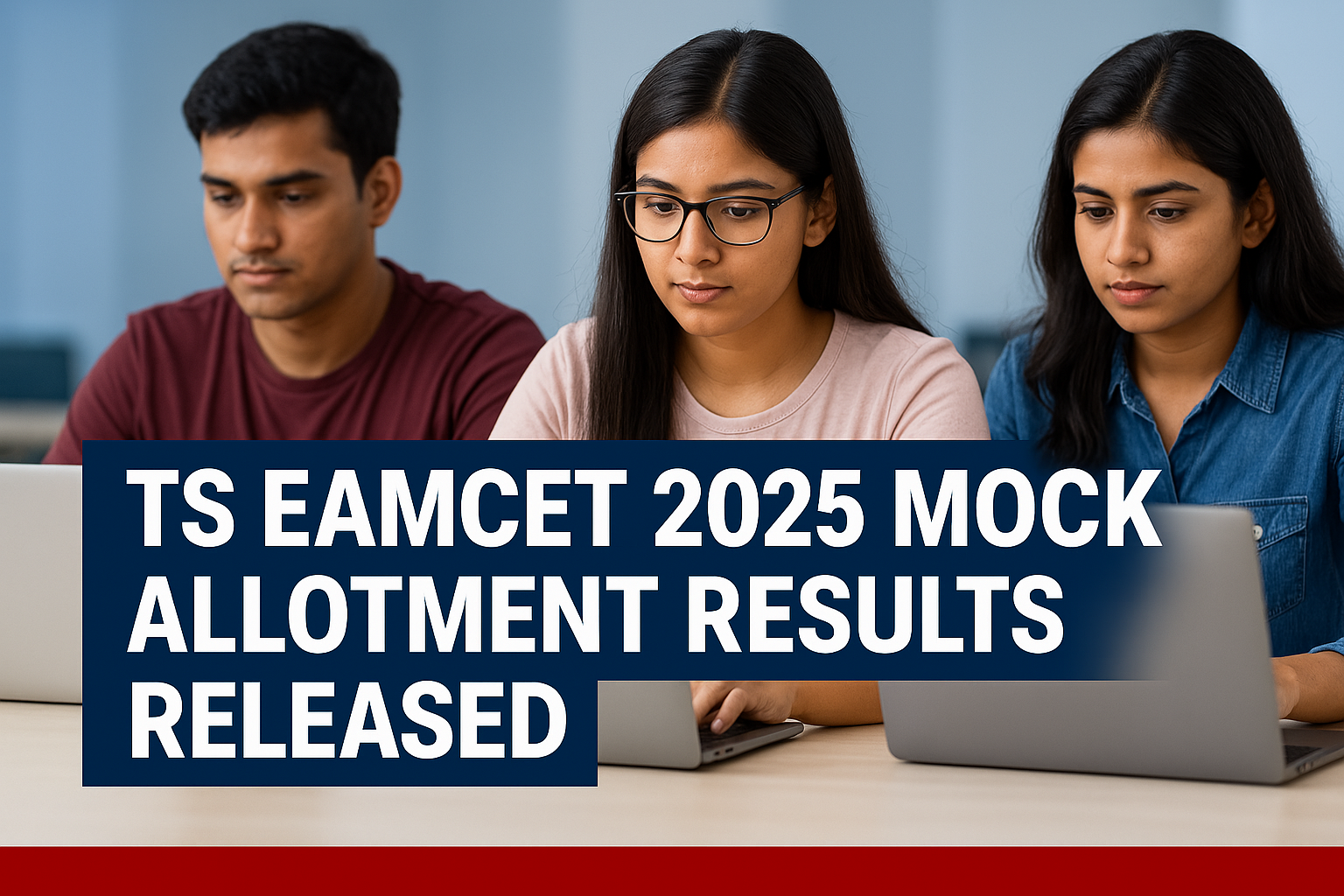
The Telangana State EAMCET (EAPCET) 2025 mock seat allotment results are now out on tgeapcet.nic.in, helping candidates assess their possible seat allocation before final allotment. Here are all updated details on counselling, important dates, and process.
Table of Contents
The Telangana State Engineering, Agriculture and Medical Common Entrance Test (TS EAMCET) 2025 Phase 1 mock seat allotment results have been published by the Telangana Council of Higher Education (TSCHE) on July 13, 2025. Candidates who participated in the Phase 1 counselling process can now access their provisional seat allocations through the official website at tgeapcet.nic.in.
The mock allotment serves as a preliminary indication of seat allocation based on current web options and rank positions. This provisional allotment allows candidates to review their potential seat assignment and make informed modifications to their preference list before the final allotment. The web options editing window remains open until July 14, 2025, providing candidates the opportunity to optimize their choices.
TS EAMCET functions as the primary entrance examination for admission to undergraduate engineering, agriculture, and pharmacy programs in Telangana’s state-level institutions. Conducted by Jawaharlal Nehru Technological University Hyderabad (JNTUH) on behalf of TSCHE, the examination assesses candidates across subjects relevant to their chosen stream. Understanding the counselling process and utilizing the mock allotment effectively is essential for securing preferred college and course combinations.
Understanding TS EAMCET Examination System
TS EAMCET serves as a state-level entrance test conducted annually for admission to various professional courses in Telangana. The examination covers three primary streams: engineering, agriculture, and pharmacy. Each stream has specific eligibility requirements and separate test components aligned with the respective field of study.
The examination is administered through a computer-based test (CBT) format at multiple centers across Telangana and select locations outside the state. The CBT format ensures standardized evaluation and quick result processing. The test duration is three hours with 160 questions carrying one mark each. There is no negative marking, which encourages candidates to attempt all questions.
JNTUH manages the technical aspects of examination conduct, result processing, and counselling procedures. TSCHE oversees the policy framework, seat allocation, and overall admission process. This dual management structure ensures both technical efficiency and policy compliance throughout the admission cycle.
TS EAMCET 2025 Examination Timeline
The TS EAMCET 2025 notification was released on February 15, 2025, marking the official start of the admission process. The online application window opened on March 1, 2025, and remained active until March 31, 2025. During this period, candidates submitted their applications, uploaded required documents, and paid the prescribed application fee through the online portal.
An application correction window was provided from April 5 to April 10, 2025. This facility allowed candidates to rectify errors in their submitted applications. Corrections were limited to specific fields, and certain details like name and date of birth required supporting documentation for modification.
Hall tickets for TS EAMCET 2025 were released on May 1, 2025. Candidates downloaded their admit cards from the official website using their application number and registered password. The admit card contained essential information including examination date, reporting time, venue address, and instructions for candidates.
The TS EAMCET 2025 examinations were conducted from May 8 to May 12, 2025, across multiple sessions to accommodate different streams and shifts. Engineering stream examinations occurred on May 8-10, 2025, while agriculture and pharmacy stream tests took place on May 11-12, 2025. The examination schedule included morning and afternoon sessions to manage the large candidate volume efficiently.
Official answer keys were published on May 15, 2025, allowing candidates to estimate their performance. A challenge mechanism was provided for candidates to raise objections against answer keys with supporting evidence. Expert committees reviewed all challenges and made necessary corrections before final result processing.
The final examination results were declared on May 25, 2025. Rank cards became available for download, showing each candidate’s TS EAMCET rank, qualifying status, and percentile score. These ranks form the basis for counselling and seat allocation processes.
Counselling Registration and Document Verification
Phase 1 counselling registration opened on July 1, 2025, and continued until July 10, 2025. Qualified candidates registered for counselling through the official portal by creating login credentials and paying the counselling fee. The registration fee structure varies based on category, with concessions for reserved category candidates.
Document verification occurred from July 5 to July 12, 2025. Candidates uploaded scanned copies of all required certificates through the counselling portal. The verification process ensures candidates meet eligibility criteria and submitted authentic documents. Authorities review academic certificates, category certificates, domicile proof, and other relevant documents during this phase.
Web options entry was conducted from July 8 to July 12, 2025. During this period, candidates selected their preferred colleges and courses in order of priority. The system allowed selection of unlimited options, encouraging candidates to fill diverse choices across different college tiers and branches. The final preference list determines seat allocation based on rank and availability.
Mock Seat Allotment Purpose and Benefits
The mock seat allotment represents a provisional allocation based on candidates’ current web options and rank positions. This preliminary result helps candidates understand allocation patterns and potential outcomes before the final allotment. The mock allotment does not constitute actual seat assignment and carries no binding commitment.
The primary benefit of mock allotment is strategic insight into the counselling process. Candidates can assess whether their current preferences align with realistic allocation possibilities. If the mock allotment differs significantly from expectations, candidates can modify their web options during the editing window to improve final outcomes.
Mock allotment also reduces anxiety and uncertainty by providing advance information about probable seat allocation. Candidates gain time to research their provisionally allotted college, understand infrastructure and placement records, and make informed decisions about acceptance or modification. This preview mechanism enhances transparency in the admission process.
Candidates satisfied with their mock allotment can retain their current preferences without changes. Those seeking different allocations can strategically modify their preference order, add new options, or remove less desirable choices. The flexibility to adjust preferences based on mock results represents a significant advantage in the counselling system.
How to Check TS EAMCET 2025 Mock Allotment Result
Candidates should visit the official TS EAMCET website at tgeapcet.nic.in to access mock allotment results. The homepage displays a prominent link or notification about Phase 1 mock seat allotment results. Clicking this link redirects to the result access page or candidate login portal.
The login page requires candidates to enter their hall ticket number as mentioned on their TS EAMCET admit card. The password is the one created during counselling registration. After entering credentials correctly, candidates must complete any security verification such as captcha before proceeding to view results.
Upon successful login, the mock allotment result displays on screen showing the provisionally allotted college name, college code, course name, and seat category. The result also indicates the candidate’s rank, category, and preference number at which the allotment occurred. Candidates should carefully review all details for accuracy.
The allotment letter can be downloaded in PDF format for offline viewing and record-keeping. Saving multiple copies in different locations ensures access even if technical issues arise later. Taking screenshots provides additional backup. The downloaded document contains official formatting and serves as a reference during the web options editing phase.
Web Options Editing Window Details
The web options editing facility opened on July 13, 2025, immediately following the mock allotment result announcement. This window remains active until July 14, 2025, at 11:59 PM. The 36-hour duration provides adequate time for candidates to analyze their mock allotment, conduct research on colleges, and make informed preference modifications.
During the editing window, candidates can make unlimited changes to their web options without restrictions. Preferences can be added, deleted, or reordered as many times as desired before the deadline. The system saves the most recent submission as the final preference list for actual seat allotment purposes.
To edit web options, candidates must log into the counselling portal using their credentials. The interface displays the current preference list with options to modify. Candidates can use drag-and-drop functionality or manual entry to rearrange choices. The system provides real-time updates showing the modified preference order.
After completing all desired changes, candidates must submit the modified preference list before the deadline. A confirmation message appears upon successful submission, and candidates should download the updated preference list acknowledgment. This document serves as proof of the final submitted choices for the actual allotment process.
Strategic Approach to Web Options Editing
Analyzing the mock allotment result forms the first step in strategic web options modification. Candidates should assess their satisfaction level with the provisionally allotted college and course. If the allotment aligns with top preferences and expectations, minimal or no changes may be necessary. However, if the allotment differs significantly from desired outcomes, substantial preference list revision becomes advisable.
Researching colleges thoroughly helps make informed editing decisions. Candidates should investigate infrastructure facilities, faculty qualifications, laboratory equipment, library resources, and campus amenities. Placement records indicating percentage of students placed, average salary packages, and recruiting companies provide insights into career prospects. Accreditation status from bodies like NBA and NAAC indicates quality standards.
Comparing the mock allotted seat with other available options in the preference list helps identify improvement possibilities. If better colleges or preferred branches appear lower in the preference order, reordering them higher may increase chances of favorable final allotment. Adding previously unconsidered colleges that meet quality criteria expands options without affecting current good placements.
Financial considerations play an important role in preference decisions. Government and university colleges typically charge lower fees compared to private institutions. Candidates should evaluate fee structures against family financial capacity and scholarship availability. Balancing educational quality with affordability ensures sustainable academic pursuits without excessive financial burden.
Location factors merit consideration based on individual circumstances. Some candidates prioritize proximity to hometown for family support and cost savings on accommodation and travel. Others prefer urban locations for enhanced industry exposure and placement opportunities. Weighing location preferences against college quality helps optimize the preference list effectively.
Course and Branch Selection Considerations
Computer Science and Engineering remains the most sought-after branch across most engineering colleges. High demand results in higher cutoff ranks even at mid-tier institutions. Candidates interested in CSE should include multiple colleges offering this branch across different tiers to maximize allocation chances. Alternative branches like Information Technology and Computer Science (Data Science) offer similar curriculum and career prospects.
Electronics and Communication Engineering attracts significant interest due to versatile career opportunities in telecommunications, embedded systems, and VLSI design. The branch provides pathways to both core electronics companies and software industry positions. ECE cutoffs generally fall slightly below CSE, making it an attractive option for candidates with ranks in the near-competitive range.
Mechanical Engineering, Civil Engineering, and Electrical Engineering represent traditional core engineering disciplines with stable career prospects. These branches typically have moderate competition compared to computer-related fields. Infrastructure development, manufacturing sector growth, and power sector expansion provide employment opportunities. Candidates interested in core engineering should prioritize reputed colleges over branch preferences.
Emerging disciplines like Artificial Intelligence and Machine Learning, Data Science, Cybersecurity, and Renewable Energy Engineering represent high-growth areas. These specializations align with industry trends and future job market demands. However, not all colleges offer these programs, and availability is limited. Candidates should verify curriculum quality and faculty expertise in these specialized branches.
Agriculture and pharmacy streams offer distinct career pathways. Agriculture engineering, agriculture science, and allied subjects prepare candidates for careers in agricultural development, food technology, and agribusiness. Pharmacy programs lead to pharmaceutical industry careers, hospital pharmacy, drug research, and regulatory affairs. These streams typically have lower competition compared to engineering but offer specialized career opportunities.
Final Seat Allotment Process
The final seat allotment for Phase 1 will be announced on July 15, 2025, at 10:00 AM according to the official schedule. The allotment process uses a computerized algorithm that considers multiple parameters including TS EAMCET rank, web options preference order, category reservation, and seat availability. The algorithm allocates seats strictly in order of rank within each category.
The allocation system follows a sequential approach where higher-ranked candidates receive priority in seat assignment. Within a candidate’s preference list, the algorithm checks each option in order and assigns the first available seat that matches the candidate’s eligibility. Once allocated, the candidate exits the allocation process, and the system proceeds to the next candidate.
Category-based reservations ensure adequate representation of Scheduled Castes, Scheduled Tribes, Backward Classes, and Economically Weaker Sections. Specific percentages are reserved for each category as per government policies. Separate merit lists operate for each category during seat allocation. Additionally, gender-based reservations in certain colleges ensure diversity in student composition.
Local and non-local area classifications affect eligibility for certain seats. A portion of seats in each college is reserved for candidates with local area status based on study location during qualifying examination. The remaining seats are available to non-local candidates on an open merit basis. This regional balance ensures both local student access and merit-based competition.
Post-Allotment Procedures and College Reporting
Candidates allotted seats in the final Phase 1 allotment must report to their assigned colleges within the specified timeline, typically starting from July 16, 2025. The exact reporting dates vary by institution and are mentioned in the allotment order. Prompt reporting is essential as delayed candidates risk seat cancellation without refund of fees.
Document verification occurs during college reporting where candidates present original certificates for verification against uploaded scanned copies. The verification checklist includes TS EAMCET hall ticket, rank card, allotment order, SSC certificate, intermediate certificate and marks memo, transfer certificate, conduct certificate, category certificate (if applicable), income certificate, domicile certificate, and recent photographs.
Fee payment completes the admission process. The fee structure varies by institution type and course. Government colleges typically charge ₹35,000 to ₹50,000 annually for engineering programs. University colleges range from ₹45,000 to ₹70,000 per year. Private colleges charge between ₹85,000 to ₹2,50,000 annually depending on institution reputation and facilities. Payment methods include online transactions, demand drafts, or cash payments at designated centers.
Seat confirmation requires candidates to physically sign admission registers and complete all formalities within the reporting period. Hostel accommodation applications are submitted during this phase for candidates requiring residential facilities. After successful admission confirmation, candidates receive student identification numbers and official college documentation.
Subsequent Counselling Phases
Phase 2 counselling typically commences within one week after Phase 1 conclusion. Candidates who did not receive allotments in Phase 1, those who seek upgrades to better colleges, and fresh registrants participate in Phase 2. The process follows identical steps including registration, document verification, web options entry, and seat allotment.
The number of seats available in Phase 2 depends on vacancies from Phase 1. Vacancies arise when candidates allocated seats in Phase 1 fail to report, withdraw from counselling, or receive upgrades in subsequent phases. Additional seats may become available if colleges report increased capacity or new courses receive approval.
Phase 3 and subsequent phases continue until all available seats are filled or no eligible candidates remain. Each successive phase typically has fewer seats and limited participation. Cutoff ranks gradually decrease in later phases as premium seats get filled early. However, quality seats occasionally appear in later phases due to candidate withdrawals or changed circumstances.
Spot counselling represents the final admission opportunity conducted through physical reporting at designated centers. Remaining vacant seats across all colleges are displayed, and candidates physically present can choose available seats in order of rank. Spot counselling requires carrying original documents and readiness for immediate fee payment and admission confirmation.
Seat Sliding and Upgradation Mechanism
The sliding option allows candidates allotted seats in Phase 1 to participate in Phase 2 seeking better allocations while retaining their current seat. If the candidate receives a higher preference option in Phase 2 based on available seats, an automatic upgrade occurs. The previous seat gets vacated and becomes available for other candidates. If no better option is available, the candidate retains the original Phase 1 seat.
Upgrading follows strict rules based on the preference list submitted before Phase 2 allotment. Only options ranked higher than the currently held seat are considered for upgradation. The system does not allow downward movement to lower preferences once a seat is allotted. This mechanism ensures rational seat movement aligned with candidate preferences.
Candidates satisfied with their Phase 1 allotment can choose the “freeze” option, confirming their seat and withdrawing from subsequent counselling phases. Freezing provides certainty and allows early commencement of college-related preparations. However, frozen seats cannot be changed regardless of seat availability in later phases.
The withdrawal option allows candidates to exit counselling completely, releasing their allotted seat for other candidates. This option suits candidates who secured admission through other channels or decided against pursuing the course. Withdrawal typically attracts partial fee refund after deducting processing charges as per TSCHE policies.
Scholarship and Financial Assistance
The Telangana Fee Reimbursement Scheme provides complete tuition fee waiver for eligible students. Candidates from families with annual income below ₹2 lakhs qualify for this scheme covering 100% tuition fees. The scheme extends to hostel fees and mess charges for students requiring residential accommodation. Applications are submitted online through the TS ePass portal within 30 days of admission.
Post-Matric Scholarships support SC/ST students pursuing professional education. The scheme covers tuition fees, maintenance allowance, and other educational expenses. BC category students receive need-based scholarships with income criteria. Minority community students access special scholarship provisions through minority welfare departments. Applications occur through the National Scholarship Portal.
Central government scholarships include merit-cum-means scholarships for top-performing students from economically disadvantaged backgrounds. The Top Class Education Scheme supports students from SC/ST/OBC categories in premier institutions. Professional course scholarships specifically target technical education. All central schemes operate through the National Scholarship Portal (scholarships.gov.in).
Education loans from banks provide additional financial support. Public sector banks including State Bank of India, Canara Bank, and Bank of Baroda offer education loan schemes with competitive interest rates ranging from 9% to 13% annually. Private banks like HDFC, ICICI, and Axis Bank provide flexible loan options with simplified documentation. Loan amounts cover tuition fees, hostel charges, equipment costs, and other educational expenses.
Institution Categories and Selection Strategy
Government engineering colleges operated by the state government offer quality education at affordable fees. These institutions typically have well-established infrastructure, experienced faculty, and consistent placement records. Admission competition is high due to the combination of low fees and reasonable quality. Government college seats fill quickly in early counselling phases.
University constituent colleges affiliated with Osmania University, JNTUH, and Kakatiya University maintain good academic standards. These colleges benefit from university academic frameworks, centralized examination systems, and shared resources. Fee structures fall between government and private colleges. University colleges attract candidates seeking balance between affordability and educational quality.
Private engineering colleges vary significantly in quality, infrastructure, and placement records. Top-tier private institutions rival government colleges in facilities and outcomes but charge substantially higher fees. Mid-tier private colleges offer decent education at moderate costs. Lower-tier private colleges fill seats in later counselling phases and may have limited placement success. Thorough research is essential when considering private institutions.
Autonomous colleges have greater freedom in curriculum design, examination conduct, and academic innovations. Autonomy enables these institutions to update course content rapidly, implement innovative teaching methods, and maintain higher academic standards. Many autonomous colleges have strong industry partnerships facilitating internships and placements. The autonomous status generally indicates institutional maturity and quality.
Understanding Cutoff Trends and Rank Analysis
Computer Science Engineering cutoffs at premier government colleges typically range from 400 to 1,000 ranks for general category candidates. University colleges and top private institutions have cutoffs between 1,500 to 5,000 ranks. Mid-tier private colleges admit candidates with ranks up to 15,000. The exact cutoffs fluctuate annually based on factors including seat availability, number of candidates, and difficulty level.
Electronics and Communication Engineering cutoffs generally fall 500 to 1,500 ranks below CSE cutoffs at comparable institutions. Top government colleges admit ECE candidates with ranks from 1,000 to 2,500. University colleges and premium private institutions fill ECE seats with ranks between 2,500 to 7,000. Mid-tier private colleges accept candidates up to rank 20,000 depending on specific circumstances.
Mechanical, Civil, and Electrical Engineering branches have moderate competition with cutoffs starting from 2,000 to 3,000 ranks at top government colleges. These core branches in university colleges admit candidates with ranks between 4,000 to 10,000. Private colleges offering these programs fill seats with ranks extending to 25,000 or beyond depending on institutional reputation and year-specific demand patterns.
Analyzing previous year cutoffs helps candidates make realistic preference choices. However, cutoffs change annually due to variable factors. Candidates should consider three-year trends rather than relying solely on previous year data. Understanding rank-wise seat distribution across college tiers enables strategic preference list creation maximizing allocation chances while including aspirational choices.
Career Prospects and Industry Opportunities
Telangana’s information technology sector, particularly in Hyderabad, offers extensive placement opportunities for engineering graduates. Major multinational companies including Microsoft, Google, Amazon, Facebook, and Apple maintain development centers employing thousands of engineers. Domestic IT giants like TCS, Infosys, Wipro, and Tech Mahindra actively recruit from Telangana engineering colleges with competitive salary packages.
Starting salaries for computer science graduates from premier institutions range from ₹6 lakhs to ₹15 lakhs per annum. Top performers receive packages exceeding ₹20 lakhs from product-based companies and startups. Core engineering branches secure average packages between ₹4 lakhs to ₹8 lakhs in manufacturing, infrastructure, and power sectors. Individual performance, skills, and institutional reputation significantly influence placement outcomes.
The startup ecosystem in Hyderabad, supported by T-Hub and other incubation centers, provides entrepreneurship opportunities. Students can access mentorship, funding, and networking platforms to launch technology ventures. Many successful startups have emerged from engineering colleges, creating employment opportunities and contributing to the innovation economy. Entrepreneurship education integrated into engineering curricula fosters startup culture.
Higher education opportunities include master’s programs at IITs, NITs, IISc, and central universities through GATE examination. International education prospects exist in universities across the United States, Germany, Canada, Australia, and other countries. Research careers in DRDO, ISRO, CSIR laboratories, and academic institutions attract students interested in advanced science and technology. The engineering degree serves as a foundation for diverse career pathways.
Technical Support and Helpline Services
TSCHE operates dedicated helpline numbers for counselling-related queries. General inquiries can be directed to 040-23120158 and 040-23120159 during working hours from 9:00 AM to 6:00 PM on weekdays. Technical support for website issues, login problems, and payment difficulties is available at 040-23120160. Specific counselling issues regarding allotment, preferences, or documentation can be addressed through 040-23120161.
Email support provides written communication for complex queries requiring detailed explanations. Academic-related questions can be sent to academic@tsche.ac.in. Technical problems including website errors or payment gateway issues should be reported to support@tgeapcet.nic.in. Grievances regarding counselling process, allotment disputes, or procedural concerns can be submitted to grievances@tsche.ac.in. Response times typically range from 24 to 48 hours.
The official website tgeapcet.nic.in serves as the primary information source for all counselling updates. The site publishes notifications, schedule changes, important announcements, and detailed procedural guidelines. Candidates should check the website regularly, particularly during active counselling periods. The FAQ section addresses common queries about eligibility, documentation, fee payment, and allotment processes.
Regional help centers operate in major cities across Telangana providing face-to-face assistance. The main center at TSCHE office in Himayatnagar, Hyderabad, offers comprehensive support for document verification and grievance handling. Additional centers in Warangal, Karimnagar, Nizamabad, and Khammam provide local language support and documentation assistance. Candidates can visit these centers during operating hours for personalized guidance.
Important Reminders and Best Practices
Candidates must meet all deadlines strictly as extensions are rarely granted. The web options editing window closes at 11:59 PM on July 14, 2025, after which no modifications are possible. College reporting must occur within specified dates mentioned in the allotment order. Late reporting results in automatic seat cancellation and forfeiture of paid fees without refund possibilities.
Maintaining accurate contact information ensures receiving timely notifications. Candidates should verify their registered mobile number and email address can receive SMS and email alerts. Checking spam folders prevents missing important communications. Regularly logging into the counselling portal helps track status updates, pending actions, and deadline reminders.
Keeping backup copies of all documents prevents complications during verification. Digital backups should be stored in multiple locations including cloud storage, email attachments to self, and physical devices. Printed copies of certificates should be organized systematically for easy access during college reporting. Having extra photocopies prepared beforehand saves time during admission processes.
Seeking guidance from reliable sources helps make informed decisions. School counselors, college admission offices, and official helplines provide accurate information. Candidates should avoid relying on unofficial sources, rumors, or unverified social media posts. When in doubt, contacting official channels ensures receiving correct procedural information and prevents mistakes that could jeopardize admission prospects.
Frequently Asked Questions (FAQs)
1. What is the purpose of mock seat allotment in TS EAMCET counselling?
The mock seat allotment provides a provisional indication of seat assignment based on current web options and rank. It allows candidates to assess their potential allocation before final seat allotment. This preview enables strategic modification of preferences during the web options editing window. The mock allotment carries no binding commitment and does not constitute actual seat allocation. Candidates can use this information to optimize their preference list, add or remove colleges, and improve their chances of securing desired seats in the final allotment scheduled for July 15, 2025.
2. Can I change my web options after viewing the mock allotment result?
Yes, candidates can modify their web options during the editing window from July 13 to July 14, 2025, at 11:59 PM. Unlimited changes are permitted during this period including adding new colleges, removing existing options, and reordering preferences. All modifications must be submitted before the deadline as no changes are possible after the window closes. The final submitted preference list will be used for actual seat allotment. Candidates should carefully analyze their mock allotment and make strategic adjustments to improve final allocation outcomes.
3. When will the final Phase 1 seat allotment result be announced?
The final Phase 1 seat allotment for TS EAMCET 2025 will be declared on July 15, 2025, at 10:00 AM according to the official schedule. Results will be accessible through the official website tgeapcet.nic.in. Candidates will receive SMS and email notifications on their registered contact details. The final allotment is binding and candidates must report to their allotted colleges within the specified timeline starting from July 16, 2025. Delayed reporting may result in seat cancellation. Candidates should keep all required documents ready for immediate college reporting after final allotment.
4. What documents are required for college reporting after seat allotment?
Essential documents include TS EAMCET hall ticket, rank card, allotment order, SSC certificate for age proof, intermediate certificate and marks memo, transfer certificate from previous institution, conduct certificate, original category certificate (if claiming reservation), income certificate for fee concessions, Telangana domicile certificate, Aadhar card for identity verification, and recent passport-size photographs. All documents should be original copies for verification. Candidates should carry multiple photocopies of each document. Missing or incorrect documents may delay admission or result in seat cancellation.
5. If I am not satisfied with my Phase 1 allotment, can I participate in Phase 2?
Yes, candidates can participate in Phase 2 counselling through the sliding option if they wish to seek better allocations. The sliding mechanism allows retaining the Phase 1 seat while remaining eligible for upgrades in subsequent phases. If a higher preference option becomes available in Phase 2, automatic upgradation occurs. If no better option is available, the candidate retains the Phase 1 seat. Alternatively, candidates can withdraw from Phase 1 and participate fresh in Phase 2, though this involves forfeiting the Phase 1 seat completely. Strategic decision-making based on rank and available options is advisable.
6. What is the fee structure for engineering colleges in Telangana?
Fee structures vary significantly by institution type. Government engineering colleges charge approximately ₹35,000 to ₹50,000 annually including tuition and other mandatory fees. University constituent colleges range from ₹45,000 to ₹70,000 per year. Private engineering colleges charge between ₹85,000 to ₹2,50,000 annually depending on institutional reputation, infrastructure, and location. Additional expenses include hostel fees (₹30,000-60,000 annually if applicable), mess charges (₹3,000-5,000 monthly), books, equipment, and personal expenses. Financial assistance through government scholarships and education loans can reduce the effective cost burden for eligible students.
7. Are scholarships available for TS EAMCET admitted students?
Yes, multiple scholarship schemes support engineering students in Telangana. The Telangana Fee Reimbursement Scheme provides complete tuition fee waiver for students from families with annual income below ₹2 lakhs. Post-Matric Scholarships support SC/ST/BC students through state and central schemes. Central government scholarships including Merit-cum-Means and Top Class Education schemes offer additional financial assistance. Applications are submitted through TS ePass portal and National Scholarship Portal respectively. Education loans from public and private banks provide comprehensive financial support with favorable interest rates. Students should apply for relevant schemes immediately after admission confirmation to ensure timely disbursement.
8. How can I verify the authenticity and quality of my allotted college?
Verify college approval status through the AICTE official website (facilities.aicte-india.org) to confirm technical education authorization. Check university affiliation details on the respective university website. Review NBA accreditation status indicating program quality standards. NAAC grades provide institutional quality assessment. Visit the college website to review infrastructure, faculty profiles, placement records, and student testimonials. Contact current students or alumni through social media for authentic feedback. Check the official TS EAMCET approved college list published by TSCHE. Government and university colleges generally maintain consistent quality standards, while private college quality varies significantly requiring thorough investigation.
Conclusion and Next Steps
The release of TS EAMCET 2025 Phase 1 mock seat allotment results on July 13, 2025, provides candidates with valuable insights into potential seat allocations. This provisional allotment serves as a strategic tool enabling informed modification of web options before the final allotment. Candidates should utilize the editing window effectively to optimize their preference lists based on mock allotment outcomes, college research, and realistic rank analysis.
The final Phase 1 seat allotment scheduled for July 15, 2025, will determine actual college and course assignments. Candidates must prepare for immediate college reporting with all required original documents. Understanding fee structures, scholarship opportunities, and admission procedures ensures smooth transition from counselling to actual college admission. Prompt action on all deadlines prevents complications that could jeopardize admission prospects.
Subsequent counselling phases provide additional opportunities for candidates seeking upgrades or those who did not receive Phase 1 allotments. The sliding mechanism allows participation in later phases while retaining current seats. Strategic decision-making about seat acceptance, sliding, or withdrawal requires careful consideration of individual circumstances, rank position, and available alternatives. Candidates should make informed choices aligned with their educational goals and career aspirations.
TS EAMCET opens pathways to quality engineering, agriculture, and pharmacy education in Telangana’s institutions. The structured counselling process ensures transparent, merit-based seat allocation. Candidates who navigate the process diligently, meet all requirements, and make strategic decisions position themselves for successful admission and rewarding educational experiences. The immediate focus should remain on completing web options editing by July 14, 2025, and preparing for final allotment and subsequent college reporting.
About the Author
Nueplanet
Higher Education Information Specialist
Nueplanet is an education journalist with the years of experience covering state-level entrance examinations, engineering admissions, and higher education policies in Telangana and Andhra Pradesh. Nueplanet specializes in providing accurate information about TS EAMCET, TS EAPCET, ECET, and other state-administered entrance tests.
Nueplanet has worked with regional educational portals and news organizations. Nueplanet focus is on delivering factual, well-researched content based exclusively on official sources including TSCHE notifications, university announcements, and government policy documents.
All information in Nueplanet articles is verified through official channels including tgeapcet.nic.in, TSCHE official notifications, and participating institution websites. Content is regularly updated to reflect the latest changes, deadline modifications, and procedural updates announced by authorities.
Professional Goal: To assist students and families in understanding complex admission processes through accurate, transparent, and timely information that supports informed educational decision-making.
Source Verification: All dates, procedures, and institutional information are cross-referenced with official sources. Statistics regarding seats, participation, and cutoffs are sourced from official reports and verified announcements. Readers are encouraged to verify critical information through official portals before making important decisions.
Reader Note: For authoritative information, always refer to the official TS EAMCET website (tgeapcet.nic.in) and contact TSCHE helplines for procedural clarifications.
Published: July 13, 2025
Last Updated: July 13, 2025
Disclaimer: This article is based on official information available from tgeapcet.nic.in and TSCHE notifications as of the publication date. Candidates must verify all details including dates, procedures, and requirements from official sources. The author and platform assume no responsibility for decisions made based on this information. Always follow only official communications from TSCHE and TS EAMCET authorities for binding information regarding counselling, allotment, and admission procedures. For official updates, visit tgeapcet.nic.in or contact TSCHE helplines.
Helpful Resources
Latest Posts
- National RailOne App: Indian Railways’ One-Stop Solution for Travellers
- HDB Financial Services IPO Allotment GMP: All You Need to Know
- TNPSC Admit Card 2025 Released: Everything You Need to Know
- Jharkhand Polytechnic Result 2025 Declared: Check Your Scores, Merit List, and Admission Process
- 7th July Public Holiday India: Is Muharram 2025 a National Holiday?
Tag
TS EAMCET 2025










Post Comment