









Trump Dead Trend Explained: Internet Hoax, Social Media Reaction, and Verified News
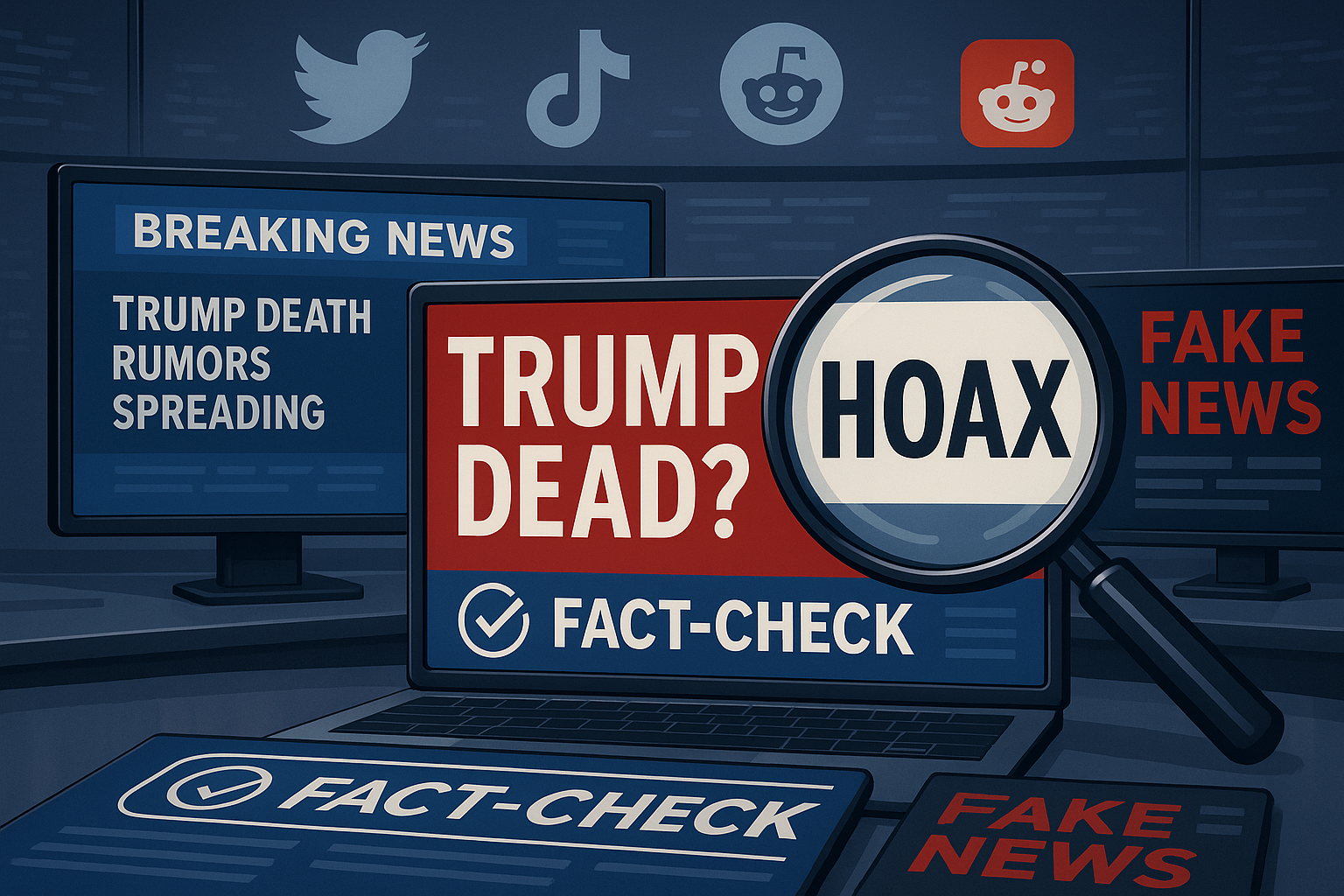
The phrase “Trump dead” has been trending online, sparking confusion worldwide. Here’s a fact-checked, in-depth analysis of the viral rumor, why it spread, and what the latest verified news reveals.
Table of Contents
Understanding the Viral “Trump Dead” Phenomenon
In late August 2025, internet users worldwide witnessed a significant misinformation event. The phrase “Trump dead” rapidly spread across multiple social media platforms, generating millions of search queries. People frantically searched for terms including “Is Trump dead?” and “Did Donald Trump die?”
The reality remains clear and verified: Donald Trump is alive and continues his political activities. This incident serves as a critical case study in how modern information systems can amplify false narratives. The event demonstrates the complex relationship between satire, social media algorithms, and public information consumption.
This analysis examines verified facts about the hoax, its spread mechanisms, and broader implications for information ecosystems. Understanding these dynamics helps readers develop critical evaluation skills for future similar incidents.
Origins of the Misinformation Campaign
Initial Content Sources
The “Trump dead” trend emerged from multiple satirical social media accounts during late September 2025. These accounts regularly publish political commentary mixed with humor and exaggerated statements. The initial posts contained deliberately ambiguous language designed to provoke reactions among followers.
Phrases such as “Trump is dead but his legacy lives on” and “Trump died today—to the old ways of politics” represented intentional wordplay. Sophisticated audiences familiar with these accounts understood the metaphorical intent. However, online content frequently loses its original context when shared across platforms.
When users screenshot posts and share them without attribution, satirical framing disappears. This context collapse proved essential to transforming humor into perceived news. The separation between satirical intent and audience interpretation created conditions for widespread confusion.
Visual Content Manipulation
Alongside textual ambiguity, manipulated visual content accelerated the hoax’s spread. Creators produced mock news broadcasts with fabricated graphics resembling legitimate news networks. Others circulated edited photographs suggesting funeral preparations or somber gatherings.
Research consistently shows humans process visual information faster than text. Images also remain in memory more vividly than written content. When users encounter imagery suggesting major events, sharing impulses often override verification instincts. The desire to share breaking news first frequently supersedes accuracy concerns.
These visual elements provided false credibility to the narrative. Even skeptical users sometimes questioned whether something genuine had occurred when confronted with seemingly official-looking graphics and photographs.
Platform-Specific Acceleration
Reddit and TikTok functioned as primary accelerants for trend amplification. Reddit’s voting system rewards early engagement, promoting popular content to wider audiences through upvoting mechanisms. The “Trump dead” content gained visibility across multiple subreddit communities focused on politics, satire, and current events.
TikTok’s algorithm maximizes user engagement and viewing duration. The platform promoted videos containing “Trump dead” references to users who had previously engaged with political content. Short-form videos claimed to offer breaking news or showed creator reactions to the alleged death. Many lacked clear satirical disclaimers.
The trend achieved critical momentum over approximately 48 hours. Social media analysts describe this as “escape velocity”—when organic sharing generates sufficient momentum to sustain growth without additional creator input. Search volume increased by over 2,000 percent compared to baseline levels during this period.
Social Media Amplification Mechanics
Algorithmic Promotion Systems
Social media algorithms operate with one primary objective: maximize user engagement. These systems measure engagement through likes, shares, comments, and viewing duration. Algorithms do not distinguish between accurate information and misinformation. They identify content generating strong reactions and promote it systematically.
The “Trump dead” phrase triggered intense emotional responses across political perspectives. Supporters experienced shock and concern. Critics responded with skepticism or dark humor. Both reaction types generated high engagement, signaling to algorithms that this content deserved broader distribution.
Platform recommendation systems entered feedback loops, showing content to progressively larger audiences. This created exponential growth patterns characteristic of viral phenomena. The algorithmic prioritization operated independent of content accuracy or social value.
Social Proof Dynamics
As more users encountered and shared the content, the trend gained perceived legitimacy through volume alone. Psychological research demonstrates that people use others’ behavior as shortcuts for determining truth. When millions discuss a topic, observers unconsciously assume substantive basis exists.
Network effects amplified this dynamic significantly. Users observed multiple friends and followed accounts discussing the topic. This created impressions of independent confirmation rather than recognition of a single rumor cascading through networks. The illusion of multiple corroborating sources represents one of misinformation’s most effective psychological mechanisms.
Different platforms contributed unique amplification characteristics. X (formerly Twitter) enabled rapid sharing through retweets and quote tweets. The platform’s trending topics sidebar provided prominent placement, introducing the phrase to users who had not encountered it organically.
Cross-Platform Migration Patterns
Facebook allowed the trend to reach older demographic segments less active on platforms like TikTok. Posts in community groups and personal pages reached audiences with varying digital literacy levels. Some users lacked the skepticism developed by younger, chronically online populations.
TikTok produced elaborate content including mock eulogies, reaction videos, and conspiracy theory explanations. The platform’s full-screen format made satirical content particularly convincing to casual viewers who did not examine usernames or video descriptions carefully.
Instagram and Snapchat facilitated peer-to-peer sharing through direct messages. This allowed the rumor to spread through private channels where fact-checkers and corrections could not easily penetrate. The combination of public and private sharing channels created comprehensive distribution networks.
Factors Contributing to Global Reach
Political Polarization Effects
Donald Trump remains among the most polarizing figures in contemporary global politics. His presidency, post-presidential activities, and potential future candidacy ensure sustained attention from supporters and critics alike. This polarization creates ideal conditions for viral content because both groups have strong engagement incentives.
Supporters sought information frantically to confirm or deny the rumor, driven by genuine concern. Critics engaged through mockery or discussing implications for American politics. Both engagement forms fed algorithmic systems, ensuring continued promotion of related content.
Emotional intensity surrounding Trump also reduced critical thinking among some users. When people encounter information about subjects they care deeply about, analytical processing often decreases. Research on motivated reasoning demonstrates that individuals sometimes accept information aligned with emotional states while rejecting contradictory evidence.
Timing and Political Context
The hoax gained traction during intense political activity periods in late September 2025. Discussions about potential 2028 presidential candidates, ongoing debates about tariffs and international trade policy, and various legal proceedings involving Trump kept him prominent in public consciousness. This existing attention created fertile conditions for Trump-related viral trends.
The news cycle during this period featured numerous significant global events competing for attention. In such environments, sensational claims can temporarily dominate discourse before verification processes respond. The “Trump dead” trend filled a momentary void in major breaking news.
Broader societal factors also contributed to success. Public trust in institutions, including media organizations, has eroded substantially over recent years. Many people express uncertainty about whom to believe when confronted with conflicting information. This trust deficit creates opportunities for false narratives to gain footholds.
Cross-Platform Synergy Effects
The trend benefited from cross-platform amplification where content originated on one platform and migrated to others, gathering momentum at each stage. TikTok videos were screenshotted and posted to X. X posts were shared in Facebook groups. Facebook discussions generated news coverage, which was then discussed on Reddit.
Each platform added new audiences and engagement, creating self-reinforcing cycles that no single platform could have generated independently. This multi-platform synergy represents a significant challenge for misinformation containment efforts. Effective responses require coordination across competing companies with different policies and priorities.
Verified Facts: Trump’s Actual Status
Official Confirmations
Multiple authoritative sources confirmed Trump’s continued existence and activity throughout the incident. His official social media accounts remained active with recent posts during the period in question. Public appearances at political rallies and events in late September 2025 provided visual confirmation of his wellbeing.
Media organizations with verified sources close to Trump’s circle consistently reported his ongoing activities and statements. The hoax appears to have originated partly from Trump’s team canceling or rescheduling several public appearances during the rumor’s emergence. This created an unusual gap in his typically active public schedule.
Some circulating photographs showed Trump with apparent bruising or discoloration. Subsequent fact-checks explained these as photographic artifacts or normal aging-related skin changes. Satirical accounts exploited this circumstance combination with ambiguous posts about Trump “dying” to his old approach or his influence “passing.”
Fact-Checking Organization Response
Professional fact-checking organizations responded swiftly. Snopes, PolitiFact, Reuters Fact Check, and similar services published detailed analyses explaining the hoax’s origins and confirming Trump’s status. These organizations traced the rumor’s evolution, identified key manipulated content pieces, and provided timestamps demonstrating recent Trump activity.
Traditional news organizations also addressed the trend with more restrained coverage. Major newspapers and broadcast networks published brief clarifications, acknowledging the viral nature while confirming falsity. Some media critics questioned whether outlets should have ignored the trend entirely to avoid legitimizing it.
Despite authoritative debunking, searches and discussions persisted for days beyond initial corrections. This pattern reflects well-documented phenomena in misinformation research: false claims spread faster and further than corrections. Several factors explain this asymmetry in information dynamics.
Why Corrections Faced Challenges
Emotional content generates more engagement than factual corrections. Sensational claims about prominent figure deaths trigger visceral reactions that mundane confirmations of continued life cannot match. People who share misinformation rarely see or share subsequent corrections.
Social media algorithms tend to show users new content rather than updates to previously engaged posts. Confirmation bias leads individuals to accept information consistent with existing beliefs while skeptically scrutinizing contradictory evidence. Those predisposed to believe negative information about Trump might accept death rumors more readily.
Real-World Consequences and Impacts
Political Ramifications
False rumors about major political figure deaths create immediate political uncertainty. During the brief peak virality period, political analysts and strategists addressed questions about succession, election impacts, and potential party dynamic shifts—all based on fabricated information.
Political opponents found themselves in awkward positions, uncertain whether to comment on the trending topic. Offering condolences risked appearing gullible if the rumor proved false. Remaining silent might seem callous if something genuine had occurred. This paralysis of political discourse, even temporarily, represents tangible misinformation costs.
The episode demonstrated how easily false narratives disrupt political campaigns and messaging. Resources devoted to addressing the hoax—from campaign staff time to media interviews clarifying Trump’s status—diverted attention from substantive policy discussions and legitimate political activities.
Financial Market Effects
Financial markets proved unexpectedly sensitive to the trend. Analysis of trading patterns during peak hoax periods revealed short-term volatility in several sectors. Defense contractors, energy companies, and certain technology stocks experienced unusual trading volume.
This suggests some market participants positioned for potential policy shifts that might follow Trump’s death. Currency markets showed subtle movements as well. The US dollar experienced minor fluctuations against major currencies during rumor spread periods.
While market movements proved small and temporary, they illustrated how misinformation generates real economic consequences. Traders and algorithms monitoring social media sentiment sometimes react to trending topics before confirming veracity. This creates opportunities for market manipulation.
Erosion of Information Trust
Perhaps the most significant long-term impact involves cumulative erosion of trust in information institutions. Each viral hoax gaining widespread traction before debunking leaves people slightly more skeptical of all information, including accurate reporting. This growing cynicism creates vicious cycles.
People become increasingly uncertain about what to believe, paradoxically making them more vulnerable to sophisticated misinformation exploiting their confusion. The hoax also damaged trust in social media platforms themselves. Users who fell for the rumor or wasted time investigating its veracity experienced frustration with platforms allowing false information to trend.
Historical Context of Death Hoaxes
Pre-Digital Era Incidents
False reports of famous people’s deaths have circulated for centuries. Mark Twain famously responded to premature obituaries stating that “reports of my death are greatly exaggerated.” Various historical figures, from politicians to artists, have been subjects of mistaken or deliberately false death announcements.
Earlier hoaxes typically resulted from genuine mistakes—miscommunication, identity confusion, or premature reporting based on unconfirmed sources. Their spread remained limited by slower pre-internet communication pace, allowing corrections to catch up before misinformation reached global scale.
Social Media Era Transformation
The internet era transformed death hoaxes from occasional mistakes into recurring phenomena. Celebrities including Morgan Freeman, Jackie Chan, and Bill Nye have repeatedly been “killed” by internet rumors. These hoaxes follow predictable patterns involving false social media reports gaining viral traction.
Content gets amplified by users who do not verify information before sharing. Eventually authoritative sources or celebrities themselves provide debunking. Public figures like Elon Musk have faced multiple death hoax campaigns, often linked to fabricated news about accidents or health crises.
Patterns Across Incidents
Examining multiple death hoaxes reveals consistent patterns. Hoaxes typically begin with vague or satirical content that can be misinterpreted. Claims invoke strong emotions overriding analytical thinking. Social media algorithms accelerate spread before verification can occur.
Visual “evidence” through manipulated images or videos provides false credibility. Authoritative debunking arrives hours or days after peak spread. Some percentage of exposed audiences continues believing the hoax despite corrections. Understanding these patterns equips individuals and institutions to respond more effectively to future incidents.
Psychological Mechanisms Behind Viral Misinformation
Cognitive Biases in Operation
Several well-documented cognitive biases contributed to the hoax’s spread. The availability heuristic causes people to judge event likelihood based on how easily examples come to mind. Because death is salient and memorable, and because people had seen news of other prominent figure deaths recently, Trump’s death seemed more plausible than statistical probability suggested.
Confirmation bias drives individuals to seek information confirming existing beliefs while dismissing contradictory evidence. Those with negative Trump views might accept death rumors more readily because they align with wishes or expectations. Supporters might paradoxically fall for the hoax because of fear it could be true.
The bandwagon effect—the tendency to adopt beliefs because many others hold them—proved particularly powerful. As the trend gained momentum, people assumed substantive basis must exist for widespread discussion. Negativity bias causes human attention to gravitate toward negative information more strongly than positive content.
Information Processing Under Uncertainty
The hoax exploited how people process information when facing uncertainty. Presented with ambiguous claims, individuals often accept the first explanation encountered rather than suspending judgment until additional evidence arrives. This “cognitive ease” principle explains why many who first encountered the hoax through believable-seeming sources struggled to update beliefs when presented with corrections.
The effort required to verify information often exceeds the effort required to share it. Forwarding shocking claims to friends takes seconds. Confirming accuracy through multiple credible sources requires minutes or longer. This asymmetry favors misinformation spread over verification processes.
Emotional Reasoning Effects
Strong emotions impair analytical thinking. The “Trump dead” phrase triggered intense emotional responses—shock, grief, relief, skepticism, or curiosity—that interfered with rational evaluation. When emotionally activated, people often share content impulsively rather than engaging critical faculties that might identify false information warning signs.
This emotional hijacking explains why even sophisticated, educated individuals sometimes fall for obvious hoaxes. Intelligence and education provide limited protection against misinformation when emotional circuits activate before analytical systems engage. The illusion of explanatory depth also plays a role.
Pathways Forward: Addressing Misinformation
Platform Responsibilities
Social media companies face mounting pressure to address misinformation without compromising legitimate speech. Improved verification systems could temporarily slow spread of unconfirmed information about major events while allowing normal content to flow freely. Algorithmic adjustments might prioritize information quality alongside engagement.
Adding small delays or verification prompts before allowing users to share potentially high-impact claims could reduce impulsive sharing while preserving speech freedoms. Platforms could provide automatic context for trending topics, showing users the range of sources discussing issues and highlighting consensus among credible outlets.
Journalistic Standards Evolution
News organizations must evolve approaches to misinformation. Rapid response capacity for quickly addressing viral hoaxes without inadvertently amplifying them remains essential. This might include standardized debunking formats emphasizing truth over falsehood in headlines and content structure.
Explanatory journalism that helps audiences understand misinformation mechanics provides more value than simply stating facts. Media outlets could identify emerging false narratives before they reach critical mass, intervening early when corrections prove most effective. Collaborative fact-checking approaches might present unified fronts carrying more authority than individual corrections.
Educational Imperatives
Long-term solutions require improved digital literacy across all demographic segments. Educational systems should integrate media literacy and critical thinking about online information throughout K-12 education and beyond. Governments and nonprofits can conduct campaigns teaching citizens to identify misinformation markers.
Social media companies could implement educational interventions—brief lessons or quizzes—appearing when users engage with potentially false content. Teaching verification skills in context helps develop critical evaluation habits over time.
Individual Best Practices
Every social media user bears responsibility for their role in information ecosystems. Adopting personal policies of verifying shocking claims through multiple credible sources before sharing dramatically reduces misinformation spread. Learning to assess source credibility—examining author credentials, publication reputation, and evidence quality—provides protection against false claims.
Recognizing when content triggers strong emotions and using those moments as cues to engage critical thinking rather than impulsive sharing helps break misinformation cycles. When discovering you have shared false information, promptly correcting the error demonstrates intellectual integrity and helps contain misinformation damage.
Cultural Dimensions of Political Satire
Satire’s Democratic Functions
Political satire serves vital functions in healthy democracies. It provides pressure release valves for political tensions, offers alternative perspectives on powerful figures, and enables marginalized voices to critique authority through humor. Satirists have played important roles in political culture throughout history.
However, satire relies on shared understanding between creator and audience about what constitutes reality. When this shared foundation erodes, satire becomes indistinguishable from misinformation for growing audience portions. The “Trump dead” trend emerged from satirical contexts but escaped into spaces where audiences lacked frame of reference to recognize it as humor.
The Transformation Pipeline
A troubling pattern has emerged where satirical content regularly transforms into believed misinformation as it spreads across platforms and demographics. This pipeline operates through several mechanisms including content divorced from context losing satirical markers.
Generational and cultural differences in humor interpretation create misunderstandings. Visual content particularly resists contextual preservation as it circulates. Some actors deliberately exploit this pattern, creating ambiguously satirical content designed to deceive while maintaining plausible deniability if challenged.
Expert Analysis of Information Ecosystems
Communication Research Insights
Academic experts in communication studies emphasize three critical observations. Current information systems consistently prioritize speed over accuracy, rewarding those who share first rather than those who verify carefully. This structural incentive creates persistent advantages for misinformation over truth.
Research demonstrates that false information spreads faster, further, and more deeply than accurate information across all content categories. Mechanisms driving this bias include the novelty of false claims, their emotional resonance, and their simplified narratives compared to complex reality.
Declining trust in institutions and experts creates vulnerability to misinformation while simultaneously making corrections less effective. When people distrust authoritative sources, debunking from those sources lacks persuasive power. This represents a fundamental challenge for information integrity efforts.
Technology Specialist Perspectives
Experts in technology systems and platform design highlight technical dimensions of the challenge. Current recommendation algorithms optimize for engagement metrics correlating poorly with information quality. Redesigning these systems to balance engagement with accuracy remains technically challenging and commercially risky for platforms.
The scale of content production on major platforms—hundreds of millions of posts daily—exceeds human review capacity. Automated systems struggle with context, satire, and nuanced content. This creates both over-moderation and under-moderation problems that resist easy technical solutions.
Political Science Observations
Scholars studying political behavior and institutions observe that extreme political polarization creates conditions where partisans accept information confirming their worldviews while rejecting credible contradictory evidence. This motivated reasoning makes misinformation particularly effective in politically charged contexts.
The declining legitimacy of political institutions, media organizations, and expert communities creates vacuums that conspiracy theories and misinformation fill. Rebuilding trust represents a generational project without simple solutions. The ability of false narratives to dominate public discourse raises concerns about democratic governance viability when citizens cannot establish shared baseline facts.
Frequently Asked Questions
Is Donald Trump currently alive and what is his verified status?
No, Donald Trump is not dead. All credible sources including official government channels, major news organizations, and fact-checking services confirm that Trump remains alive as of late 2025. The “Trump dead” phrase that went viral in September 2025 originated from satirical social media content that was misinterpreted as factual news.
Trump has made multiple public appearances since the hoax emerged. His official social media accounts remain active with recent posts. Professional fact-checking organizations including Snopes, Reuters Fact Check, and PolitiFact thoroughly debunked the rumor and traced its origins to online satire that lost its original context when shared across platforms.
How did the “Trump dead” misinformation campaign originate?
The trend began in late September 2025 through satirical social media posts using deliberate wordplay. Initial posts appeared on parody accounts and used phrases like “Trump is dead but his legacy lives on” or “Trump died to his old ways,” intending metaphorical commentary on political approaches rather than literal death announcements.
The satire lost its context when users shared screenshots without attribution, stripping away markers indicating non-literal intent. Manipulated images including fake news broadcasts and doctored photographs added visual credibility. The combination of Trump’s unusually quiet public schedule period, some photographs showing apparent bruising, and existing political tensions created conditions where satirical content could be misinterpreted as genuine breaking news.
Why did this hoax spread so rapidly across social media platforms?
Multiple interconnected factors contributed to explosive viral spread. Social media algorithms prioritize content generating high engagement regardless of accuracy. The “Trump dead” phrase triggered intense emotional responses across the political spectrum, creating engagement that algorithms interpreted as signals to promote content further.
Trump’s status as one of the world’s most polarizing political figures ensured any related news would command attention. Cross-platform amplification allowed content to originate on one platform and migrate to others, gathering new audiences at each stage. Influencers and high-follower accounts sharing content provided credibility and reach. The psychological phenomenon of social proof made the trend appear more legitimate as more people discussed it, creating feedback loops that sustained momentum.
What were the real-world impacts of this misinformation event?
The hoax generated consequences extending beyond social media. Politically, the false rumor created temporary uncertainty and diverted resources from substantive discussions to addressing misinformation. Political analysts had to field questions about election implications and party dynamics based on fabricated information.
Financial markets showed unexpected sensitivity with short-term volatility in defense, energy, and technology sectors as some traders positioned for potential policy shifts. The US dollar experienced minor fluctuations against major currencies during peak rumor spread. While market movements remained small and temporary, they demonstrated how misinformation generates real economic consequences. The episode further eroded public trust in information institutions, with each viral hoax leaving people more skeptical of all information including accurate reporting.
Has Trump been targeted by similar death hoaxes previously?
Yes, like many prominent public figures, Trump has faced multiple death hoaxes throughout his public life, particularly after entering politics. These previous incidents followed similar patterns including ambiguous social media posts, manipulated images, or satirical content being misinterpreted as factual news.
However, the September 2025 “Trump dead” trend represented one of the most widespread and globally viral episodes. The pattern of repeated death hoaxes targeting Trump reflects broader phenomena affecting many celebrities and political figures. The frequency of hoaxes targeting Trump specifically relates to his extremely high public profile, the intense emotions he evokes across the political spectrum, and the engagement that Trump-related content generates on social media platforms.
What actions should individuals take when encountering viral hoaxes?
When confronted with shocking claims like “Trump dead” or similar viral trends, individuals should follow several best practices. First, pause before sharing and resist impulses to immediately forward sensational content. Second, verify claims through multiple credible sources including mainstream news organizations, official accounts, and professional fact-checking websites like Snopes, PolitiFact, or Reuters Fact Check.
Third, examine the original source of claims, considering whether content comes from satirical accounts, parody sites, or unverified sources. Fourth, look for visual manipulation signs in images or videos. Fifth, check timestamps and compare against known recent activities of the person in question. Finally, if you have shared false information, promptly post corrections to help contain misinformation damage.
How can social media platforms better address misinformation spread?
Platforms can implement several improvements while balancing free expression concerns. Enhanced verification systems could temporarily slow unconfirmed information spread about major events. Algorithmic adjustments might prioritize information quality alongside engagement metrics. Adding friction through verification prompts before sharing high-impact claims could reduce impulsive sharing.
Platforms could provide automatic context for trending topics, showing users the range of sources discussing issues and highlighting credible outlet consensus. Improved collaboration between competing platforms could address cross-platform misinformation migration. Educational interventions appearing when users engage with potentially false content could teach verification skills in context. However, any solutions must balance misinformation reduction with preserving legitimate speech and avoiding over-censorship.
What role does political polarization play in misinformation vulnerability?
Political polarization significantly increases misinformation vulnerability through several mechanisms. When people have strong emotional investments in political figures, they process information about those figures less analytically. Confirmation bias leads individuals to accept information aligning with existing beliefs while rejecting contradictory evidence.
Supporters of polarizing figures like Trump frantically seek information when concerning rumors emerge, driven by genuine worry. Critics engage through skepticism or mockery. Both engagement forms feed algorithmic systems that promote content based on engagement levels. The emotional intensity surrounding highly polarizing figures reduces critical thinking among some users. Research on motivated reasoning demonstrates that individuals sometimes accept information aligned with emotional states while rejecting more credible contradictory evidence, making polarized political environments particularly fertile ground for misinformation spread.
About the Author
Author: Nueplanet
Nueplanet is a dedicated digital information analyst specializing in social media dynamics, misinformation patterns, and contemporary information ecosystem challenges. With extensive experience tracking viral phenomena and analyzing digital communication trends, Nueplanet focuses on providing factual, well-researched content that helps readers navigate the complex modern information landscape.
This analysis draws from verified sources including official fact-checking organizations, academic research on misinformation dynamics, and documented platform behaviors. Nueplanet is committed to accuracy, transparency, and helping readers develop critical evaluation skills for assessing online information.
Our Commitment: All content published undergoes thorough verification through multiple authoritative sources. We prioritize factual accuracy over sensationalism and provide readers with tools to independently verify information. When corrections are necessary, they are implemented promptly and transparently.
Published: August 30, 2025
Last Updated: August 30, 2025
Category: Digital Media Analysis, Social Media Trends, Misinformation Research
Note: This article is designed to be informative and educational. Placeholders for internal links to related content about social media trends, fact-checking resources, and digital literacy guides can be inserted during site publishing.
Helpful Resources
Latest Posts
Tag
Trump Dead Trend
Related Posts













Post Comment