








TG EAPCET 2025: Over 5900 Engineering Seats Still Vacant After Mock Allotment
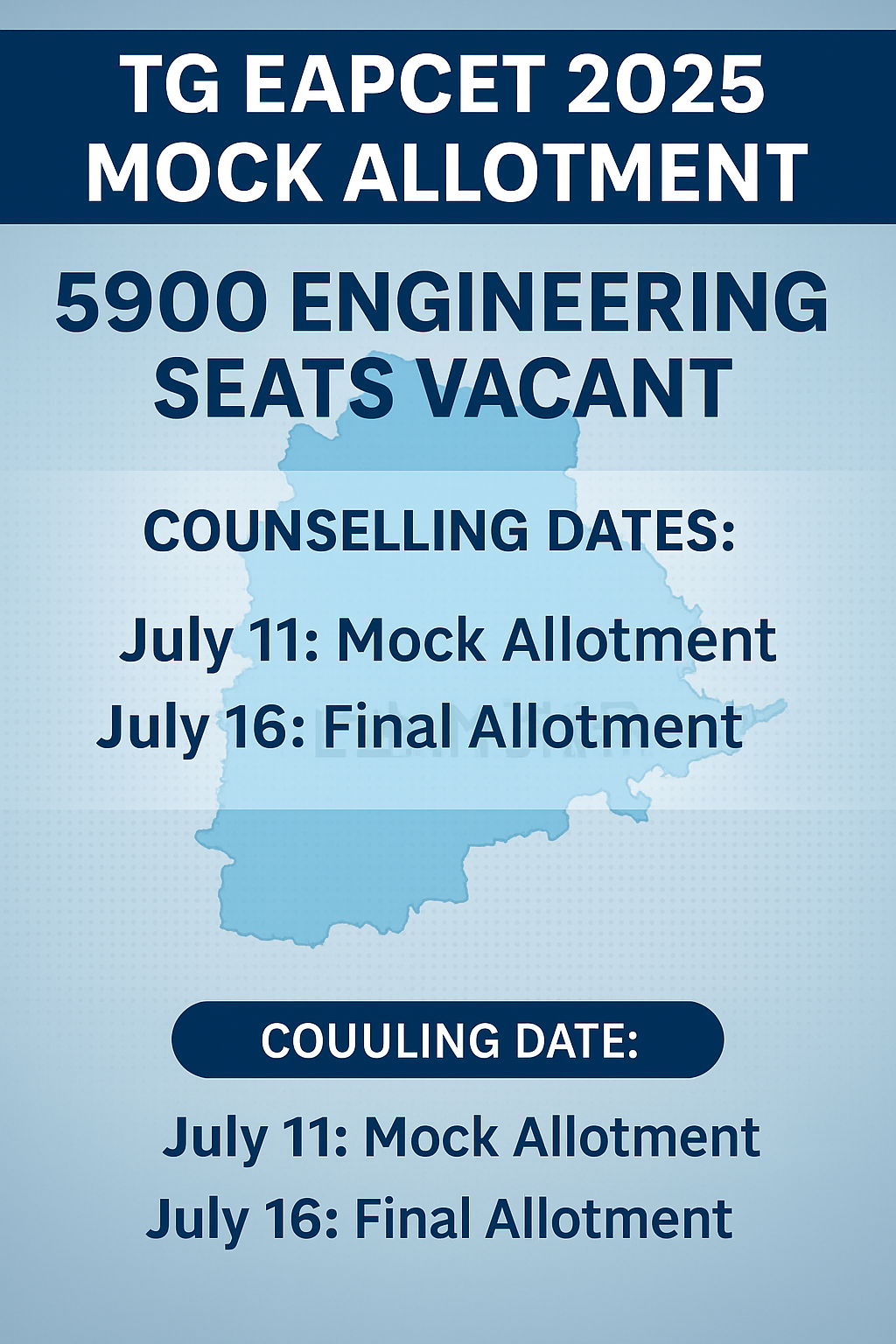
The TG EAPCET 2025 mock allotment revealed that 5900 engineering seats remain unfilled, raising critical questions on student preferences, counselling trends, and final seat allotment expectations. Read the full update below.
Table of Contents
Introduction to TG EAPCET 2025
The Telangana State Engineering, Agriculture, and Pharmacy Common Entrance Test (TG EAPCET) serves as the primary entrance examination for undergraduate admissions across engineering, agriculture, and pharmacy programs in Telangana. Conducted by Jawaharlal Nehru Technological University Hyderabad (JNTUH) under the authority of the Telangana State Council of Higher Education (TSCHE), this examination provides access to thousands of seats in government and private institutions. The 2025 edition has drawn attention due to significant seat availability following the mock allotment process.
Understanding the TG EAPCET examination structure and counselling process is essential for prospective students. This guide provides detailed information about exam patterns, eligibility requirements, counselling schedules, and strategic approaches to securing admission. The information presented here is based on official notifications and verified data from TSCHE.
Understanding TG EAPCET: Exam Structure and Purpose
Examination Overview
TG EAPCET functions as a standardized assessment for students seeking admission to professional courses in Telangana state. The examination evaluates candidates’ knowledge in core subjects required for engineering and related disciplines. JNTUH administers the test on behalf of TSCHE, ensuring consistent standards across all participating institutions.
The examination serves multiple purposes beyond simple admission screening. It helps institutions identify qualified candidates, maintains educational standards, and provides equal opportunity access to higher education. Students from various educational boards can participate, making it an inclusive assessment process.
Exam Pattern and Format
The TG EAPCET 2025 follows a structured format designed to assess subject knowledge comprehensively. The examination consists of 160 multiple-choice questions distributed across three core subjects. Candidates receive three hours to complete the test, with questions weighted equally across subject areas.
Exam Structure Details:
| Component | Specification |
|---|---|
| Total Questions | 160 MCQs |
| Duration | 180 minutes (3 hours) |
| Mathematics | 80 questions |
| Physics | 40 questions |
| Chemistry | 40 questions |
| Marking System | +1 for correct, 0 for incorrect |
| Negative Marking | None |
| Language Options | Telugu, English, Urdu |
The absence of negative marking allows candidates to attempt all questions without penalty. This marking scheme encourages students to utilize their complete knowledge without fear of score reduction.
Eligibility Criteria for TG EAPCET 2025
Candidates must meet specific academic and residential requirements to appear for TG EAPCET. The eligibility criteria ensure that applicants possess the necessary educational foundation for engineering programs. These requirements are established by TSCHE and remain consistent with national education standards.
Academic Requirements:
- Completion of 10+2 or equivalent examination with Physics, Chemistry, and Mathematics
- Minimum aggregate marks: 45% for General category candidates
- Minimum aggregate marks: 40% for BC/SC/ST category candidates
- Recognition from a state or central board
Residency Requirements:
- Domicile certificate from Telangana or Andhra Pradesh
- Proof of residence through official documentation
- No upper age limit specified
The educational qualification must be from a recognized board or institution. Candidates appearing for their qualifying examination can also apply, subject to meeting requirements before admission.
TG EAPCET 2025 Mock Allotment Analysis
Mock Allotment Results Overview
The TSCHE released mock allotment results on July 11, 2025, providing candidates with preliminary insights into the seat allocation process. Mock allotments serve as practice exercises, helping students understand how their web options translate into actual seat assignments. This process allows candidates to refine their choices before final allotment.
According to official data from TSCHE, the mock allotment processed approximately 77,000 engineering seats across participating institutions. The exercise provisionally filled around 71,000 seats, indicating strong participation in the counselling process. The remaining seats present opportunities for candidates who strategically adjust their preferences.
Seat Availability Statistics
The mock allotment revealed specific patterns in seat distribution across institutions and branches. Understanding these statistics helps candidates make informed decisions during the option revision period. The data reflects preferences, competition levels, and institutional capacities across Telangana.
Seat Distribution Summary:
| Category | Numbers |
|---|---|
| Total Engineering Seats | Approximately 77,000 |
| Provisionally Filled Seats | Approximately 71,000 |
| Vacant Seats | Over 5,900 |
| Provisional Fill Rate | 92.3% |
The vacant seats span multiple engineering branches and institutions. These vacancies occur due to various factors including candidate preferences, fee considerations, and overlapping admission timelines with other examinations.
Factors Contributing to Seat Vacancies
Several elements influence seat availability patterns in engineering admissions. Understanding these factors helps candidates identify potential opportunities and make strategic decisions. The vacancies do not necessarily indicate quality issues but rather reflect complex decision-making processes among candidates.
Primary Contributing Factors:
Students often wait for subsequent counselling rounds hoping for preferred institution-branch combinations. This strategic waiting creates vacancies in earlier rounds that get filled progressively. Additionally, some candidates receive multiple admission offers from different entrance examinations, requiring them to choose between options.
Fee structures at private institutions influence decision-making for some families. Candidates may prefer waiting for government college seats or exploring scholarship opportunities. Branch preferences also play a significant role, with some engineering disciplines experiencing lower initial demand despite strong career prospects.
Regional preferences affect seat distribution patterns. Students may prefer colleges closer to their hometowns, leaving vacancies in institutions located in different districts. The availability of hostel facilities and transportation connectivity also influences choices.
Complete Counselling Schedule and Important Dates
Official Timeline for TG EAPCET 2025 Counselling
The counselling process follows a structured timeline established by TSCHE. Adhering to these dates is crucial for successful participation. Missing deadlines can result in forfeited opportunities, making schedule awareness essential.
Counselling Phase Schedule:
| Phase | Dates | Activity |
|---|---|---|
| Certificate Verification | July 8-12, 2025 | Document submission and verification |
| Web Options Entry | July 8-12, 2025 | College and branch preference submission |
| Mock Allotment | July 11, 2025 | Preliminary results publication |
| Option Freezing Deadline | July 12, 2025 | Final date for preference modification |
| Final Allotment Results | July 16, 2025 | Official seat allocation announcement |
| College Reporting | July 19, 2025 | Admission confirmation at assigned colleges |
Candidates should note that certificate verification and web options entry occur simultaneously. The mock allotment results provide guidance for option modification before the July 12 deadline. Final allotment results become binding upon declaration.
Certificate Verification Process
Document verification constitutes a critical component of the counselling process. Candidates must present original certificates along with photocopies for verification at designated centers. TSCHE specifies required documents through official notifications.
Essential Documents Checklist:
- TG EAPCET 2025 Hall Ticket with rank card
- 10th class (SSC) certificate for age and date of birth proof
- Intermediate (10+2) marks sheet and passing certificate
- Transfer certificate from last attended institution
- Caste certificate (if applicable for reservation benefits)
- Income certificate (for fee reimbursement eligibility)
- Domicile certificate (Telangana or Andhra Pradesh residence proof)
- Aadhar card for identification
- Recent passport-size photographs
All documents should be self-attested. Candidates must carry original certificates for verification, though institutions retain photocopies. Any discrepancy in documents can lead to disqualification from the counselling process.
Web Options Entry Strategy
The web options entry system allows candidates to express their college and branch preferences in priority order. This digital platform accepts multiple combinations, with candidates able to select numerous options based on their interests. The allotment algorithm processes these preferences against available seats and candidate ranks.
Strategic option selection requires careful consideration of multiple factors. Candidates should research institutional facilities, placement records, faculty profiles, and branch-specific opportunities. Including diverse options across different institutions and branches increases the likelihood of securing admission.
The system permits option modification until the specified deadline. Candidates can add, remove, or reorder preferences based on mock allotment insights. Effective use of this flexibility can significantly improve final allotment outcomes.
Engineering Branches and Career Prospects
Traditional Engineering Disciplines
Core engineering branches continue to offer stable career opportunities with established industry connections. These disciplines maintain consistent demand in both public and private sector employment. Understanding each branch’s scope helps candidates make informed choices.
Civil Engineering focuses on infrastructure development, construction, and project management. Government departments, construction companies, and consulting firms regularly recruit civil engineers. Starting packages typically range from ₹3.5 to ₹6 lakhs per annum depending on the organization.
Mechanical Engineering provides versatile career options across manufacturing, automotive, aerospace, and energy sectors. The discipline’s broad applicability ensures diverse employment opportunities. Fresh graduates can expect starting salaries between ₹4 to ₹7 lakhs annually.
Electrical and Electronics Engineering combines power systems with electronic applications. Industries ranging from power generation to consumer electronics employ electrical engineers. Average starting compensation ranges from ₹4.5 to ₹8 lakhs per year.
Computer Science and Information Technology
Computer Science Engineering (CSE) and Information Technology (IT) remain highly sought after due to technology sector growth. These branches prepare students for software development, data analysis, cybersecurity, and system administration roles. The digital transformation across industries has expanded demand for computing professionals.
Starting salaries in CSE and IT typically range from ₹5 to ₹12 lakhs per annum for capable graduates. Top performers from reputed institutions can secure packages exceeding ₹15 lakhs. Continuous skill development in programming languages, frameworks, and technologies enhances career progression.
The field offers diverse specialization options including artificial intelligence, machine learning, cloud computing, and mobile application development. Industry certifications complement academic knowledge, improving employability in competitive markets.
Emerging Engineering Specializations
Several engineering branches with current seat availability offer promising career trajectories. These disciplines address contemporary challenges and benefit from government initiatives in specific sectors.
Biotechnology Engineering combines biological sciences with engineering principles. The pharmaceutical industry, research institutions, and healthcare organizations employ biotechnology graduates. Starting packages range from ₹4 to ₹8 lakhs annually with significant growth potential.
Metallurgical and Materials Engineering focuses on material properties, processing, and applications. Manufacturing industries, research organizations, and quality control departments require metallurgical expertise. Fresh engineers typically earn ₹5 to ₹9 lakhs per year.
Food Technology Engineering addresses food processing, preservation, and quality management. The expanding food processing industry offers numerous opportunities. Government initiatives supporting agricultural processing create additional employment avenues with starting salaries around ₹4 to ₷7 lakhs.
Agricultural Engineering applies engineering principles to farming, irrigation, and rural development. Government schemes focused on agricultural modernization generate consistent demand. Starting compensation ranges from ₹3.5 to ₹6 lakhs with public sector stability.
Regional Distribution of Available Seats
District-wise Seat Availability
Engineering colleges across Telangana districts offer varied seat availability based on institutional capacity and historical preferences. Understanding regional distribution helps candidates identify options in preferred locations. District-wise analysis reveals concentration patterns and potential opportunities.
Major Urban Centers:
Hyderabad accommodates the highest number of engineering institutions with diverse specializations. Colleges in the capital city offer approximately 1,500 available seats across various branches. Institutions like CBIT, MGIT, and VNRVJIET provide strong programs particularly in computer science, electronics, and information technology.
Warangal represents the second-largest educational hub with around 800 available seats. Colleges such as KITS and SRIT maintain reputable programs in civil engineering, mechanical engineering, and mining engineering. The region’s industrial base supports practical training opportunities.
Tier-2 Cities and Districts:
Karimnagar offers approximately 600 seats with strengths in agricultural engineering and food technology. The district’s agricultural economy aligns well with these specializations. Nizamabad provides around 450 seats with growing programs in biotechnology and chemical engineering.
Medak district institutions offer approximately 400 seats focused on automobile and aeronautical engineering. Nalgonda accommodates around 350 seats with electronics and information technology emphasis. Other districts collectively provide about 1,800 seats distributed across various private institutions.
Infrastructure and Connectivity Considerations
Location decisions should account for infrastructure availability and accessibility. Most engineering colleges in Telangana benefit from improved road connectivity through state highway development projects. Public transportation networks serve major institutional clusters, reducing commuting challenges for day scholars.
Hostel facilities are available at most institutions for outstation students. Accommodation costs vary by location, with Hyderabad typically having higher expenses compared to tier-2 cities. Students should factor total living costs when evaluating options across different districts.
Digital infrastructure supports online learning and resource access across regions. Most colleges maintain adequate internet connectivity for educational purposes. Library facilities and laboratory equipment vary by institution, requiring individual assessment during decision-making.
Financial Planning and Support Mechanisms
Education Cost Structure
Engineering education involves multiple expense categories requiring comprehensive financial planning. Tuition fees vary significantly between government and private institutions. Government college fees typically range from ₹35,000 to ₹75,000 per annum, while private institutions charge ₹1 lakh to ₹2.5 lakhs annually depending on specialization and facilities.
Additional expenses include examination fees, laboratory charges, library fees, and miscellaneous institutional charges. These supplementary costs add approximately ₹10,000 to ₹25,000 per year. Students should budget for textbooks, study materials, and project expenses totaling around ₹8,000 to ₹15,000 annually.
Living expenses for hostellers include accommodation, meals, transportation, and personal needs. Monthly hostel fees range from ₹3,000 to ₹8,000 depending on facilities. Total living expenses typically amount to ₹50,000 to ₹1.2 lakhs per year for residential students.
Government Fee Reimbursement Schemes
The Telangana government operates fee reimbursement programs for eligible students from economically weaker sections. These schemes significantly reduce financial burden for qualifying candidates. Understanding eligibility criteria and application procedures is essential for accessing these benefits.
Students from SC/ST/BC categories with family income below specified thresholds qualify for full or partial fee reimbursement. The scheme covers tuition fees, examination fees, and certain other institutional charges. Successful applicants receive direct payment to their institutions, eliminating upfront payment requirements.
Application processes typically occur online through designated government portals. Students must submit income certificates, caste certificates, and admission proof during application. Timely submission ensures reimbursement processing before fee deadlines.
Scholarship Opportunities
Multiple scholarship programs support engineering students based on merit or financial need. Government scholarships include the National Scholarship Portal offerings covering various categories. Private scholarships from corporate foundations and educational trusts provide additional opportunities.
Merit-based scholarships reward academic excellence with partial or complete fee waivers. Many private institutions offer institutional scholarships ranging from 25% to 100% fee reduction for top-ranking candidates. These scholarships may have continuation criteria based on maintaining minimum academic performance.
Need-based financial assistance helps economically disadvantaged students pursue engineering education. Application processes require income documentation and academic records. Students should explore multiple scholarship sources to maximize financial support.
Education Loan Options
Financial institutions offer education loans specifically designed for higher education expenses. Banks provide loans covering tuition fees, hostel charges, and related educational expenses. Interest rates vary between lenders, typically ranging from 8% to 12% per annum.
Collateral requirements depend on loan amounts, with many banks offering collateral-free loans up to ₹7.5 lakhs. Repayment typically begins six months to one year after course completion, providing a grace period for job search. Some schemes offer interest subsidies during the study period for economically weaker students.
Application procedures require admission proof, cost estimates, co-borrower documentation, and academic records. Processing timelines vary, making early application advisable. Comparing multiple lenders helps identify favorable terms regarding interest rates, repayment periods, and processing charges.
Strategic Decision-Making Framework
Analyzing Mock Allotment Data
Mock allotment results provide valuable insights for refining web options. Candidates should systematically analyze which college-branch combinations received allocations at their rank level. This analysis reveals realistic expectations and helps identify underutilized opportunities.
Comparing mock allotment outcomes with entered preferences highlights mismatches between aspirations and probabilities. Candidates whose mock allotments differ significantly from top preferences should consider adjusting their option order. Adding more achievable combinations improves chances of securing satisfactory allotments.
The data also reveals which branches and institutions had higher vacancy rates. These patterns indicate lower competition areas where candidates might secure admission despite modest ranks. Strategic inclusion of such options provides safety nets while maintaining aspirational choices.
Research Methodology for College Selection
Effective college selection requires multi-dimensional research beyond basic rankings. Candidates should investigate placement records over the past three to five years, noting placement percentages and salary ranges. Institutional websites and alumni networks provide valuable information.
Faculty credentials influence educational quality significantly. Researching faculty qualifications, research publications, and industry experience helps assess academic standards. Colleges with PhD-qualified faculty and active research programs typically offer better learning environments.
Infrastructure assessment should cover laboratory facilities, library resources, computing facilities, and project spaces. Site visits or virtual tours help evaluate physical infrastructure. Student reviews and alumni feedback provide experiential perspectives on institutional culture and support systems.
Industry connections through internship programs, guest lectures, and placement partnerships indicate institutional engagement with professional sectors. Colleges maintaining active industry relationships facilitate better practical exposure and employment opportunities for students.
Branch Selection Considerations
Engineering branch selection should align with personal interests, aptitude, and career goals. Students should honestly assess their subject preferences and problem-solving approaches. Forced choices in mismatched branches often lead to academic struggles and career dissatisfaction.
Career outlook research involves examining employment trends, salary progressions, and growth opportunities in different engineering disciplines. Government policy initiatives in specific sectors signal long-term opportunities. For example, renewable energy focus creates demand for relevant engineering specializations.
Flexibility considerations matter as some branches offer broader career options while others are more specialized. Computer science provides diverse paths across multiple industries, while specialized branches like aerospace engineering have narrower but focused opportunities. Neither approach is superior; alignment with personal goals determines suitability.
Geographic and Lifestyle Factors
Location preferences significantly impact the overall educational experience. Urban campuses offer better industry exposure, internship opportunities, and cultural experiences. However, they typically involve higher living costs and more competitive environments.
Tier-2 city colleges often provide more peaceful environments with lower distractions and reduced expenses. These settings can be conducive to focused academics, though they may offer fewer industry interaction opportunities. Students should evaluate their personality and learning preferences when considering location factors.
Distance from home affects visit frequency, emergency accessibility, and cultural comfort. While some students thrive in completely independent environments, others perform better with occasional family support. There is no universal best choice; individual circumstances guide appropriate decisions.
Government Initiatives and Educational Support
TSCHE Infrastructure Development Plans
The Telangana State Council of Higher Education continues investing in engineering education infrastructure. Recent initiatives focus on upgrading laboratory facilities with contemporary equipment matching industry standards. These improvements enhance practical learning opportunities for students across institutions.
TSCHE has promoted industry-academia partnerships to improve curriculum relevance. Collaborative programs enable students to access industry projects, internships, and mentorship. These connections facilitate smoother transitions from academic environments to professional settings.
The council emphasizes quality enhancement through faculty development programs. Regular training sessions for teaching staff incorporate pedagogical innovations and subject updates. Improved faculty capabilities directly benefit student learning outcomes and institutional performance.
Technology Integration in Education
Digital transformation initiatives have modernized engineering education delivery. Online learning platforms supplement traditional classroom instruction, providing flexible access to educational content. Many institutions now offer hybrid learning models combining face-to-face and digital instruction.
Virtual laboratories enable simulation-based learning where physical equipment limitations exist. These digital tools allow students to conduct experiments and develop practical skills remotely. The COVID-19 pandemic accelerated adoption of such technologies across educational institutions.
E-library access provides students with extensive digital resources including international journals, e-books, and research databases. This digital access democratizes information availability, particularly benefiting institutions with limited physical library collections.
Research and Innovation Promotion
Government programs encourage undergraduate research through funding opportunities and competition platforms. Students engaging in research projects develop critical thinking, problem-solving, and innovation capabilities. These experiences enhance employment prospects and support graduate study pursuits.
Startup incubation support within engineering colleges fosters entrepreneurial thinking. Incubation centers provide mentorship, infrastructure, and networking opportunities for student entrepreneurs. Government schemes offering seed funding make startup ventures more accessible to engineering graduates.
Participation in national-level competitions, hackathons, and technical challenges receives institutional support. These platforms allow students to test their skills against peers nationwide while gaining industry visibility. Success in such competitions significantly strengthens career profiles.
Institutional Responses to Seat Availability
Private College Initiatives
Private engineering institutions have introduced various programs to attract qualified students for available seats. Merit-based scholarship schemes offer partial to complete fee waivers for candidates with strong academic records. These financial incentives make private education more accessible to deserving students.
Enhanced placement support programs aim to improve employment outcomes for graduates. Dedicated placement cells coordinate with companies, organize campus recruitment drives, and provide career counseling. Transparent placement data helps prospective students evaluate institutional performance.
Infrastructure investments in emerging technology areas demonstrate commitment to quality education. Colleges are establishing centers of excellence in fields like artificial intelligence, data science, and Internet of Things. These specialized facilities provide students with exposure to cutting-edge technologies.
Government College Enhancements
Government engineering colleges maintain advantages in fee structure and established reputations. Recent initiatives focus on updating aging infrastructure and incorporating modern teaching methodologies. Capital investments in laboratories, workshops, and computing facilities improve practical learning environments.
Alumni engagement programs leverage successful graduates for mentorship and industry connections. Alumni networks provide valuable guidance for current students regarding career planning and job opportunities. These connections often facilitate internships and placement opportunities.
Research collaborations with government laboratories and public sector organizations provide students with unique project opportunities. Such partnerships expose students to real-world challenges and large-scale technical projects. Government college students benefit from these institutional relationships.
Preparing for Final Allotment and Admission
Option Modification Strategy
The period between mock allotment and option freezing deadline presents a critical opportunity for strategic adjustments. Candidates should systematically review their mock allotment outcomes and compare them with initial preferences. Discrepancies indicate need for preference reordering or option additions.
Adding achievable safety options ensures candidates receive some allotment rather than none. Students should include college-branch combinations slightly below their expected level as backup choices. These options activate only if higher preferences remain unfilled, providing security without compromising aspirations.
Removing unrealistic options that consumed high preference positions allows reallocation to more achievable choices. If mock allotment indicates certain combinations are beyond reach at current rank levels, removing them focuses the algorithm on realistic possibilities. This pruning improves overall allotment efficiency.
Reordering preferences based on updated priorities accommodates changed perspectives following research and reflection. Students may discover previously overlooked colleges offer superior opportunities or realize certain initial preferences don’t align with updated goals. The revision window accommodates such refinements.
Document Preparation for College Reporting
Upon final allotment announcement on July 16, 2025, students must quickly prepare for college reporting by July 19, 2025. This tight timeline requires advance preparation of all necessary documents. Organizing paperwork beforehand prevents last-minute complications during admission finalization.
Required Documents Checklist:
- TG EAPCET 2025 hall ticket and rank card
- Allotment order (downloaded from official portal)
- Original certificates: 10th class, intermediate marks sheets, transfer certificate
- Category certificates (if applicable): caste, income, domicile
- Identity proof: Aadhar card, passport, or equivalent
- Passport-size photographs (at least 10 copies)
- Migration certificate (for students from boards outside Telangana)
- Medical fitness certificate from recognized medical practitioner
Photocopies of all documents should be prepared in advance. Most institutions require self-attested copies for file maintenance. Carrying extra copies prevents delays during admission processing.
Fee Payment and Admission Confirmation
Colleges specify fee payment deadlines during admission processing. Students should clarify exact amounts covering tuition, examination fees, caution deposit, and other charges. Payment methods typically include online transfer, demand draft, or direct deposit at institutional banks.
Admission confirmation requires timely fee payment along with document verification. Delayed payments beyond specified deadlines may result in seat cancellation and reallocation to other candidates. Students facing financial constraints should immediately discuss payment plans or loan documentation with admission offices.
Fee receipts must be carefully preserved as proof of payment. These documents become necessary for various future transactions including examination registrations, certificate issuance, and scholarship applications. Maintaining organized financial records prevents complications throughout the course.
Official Resources and Support Systems
Primary Information Sources
The official TG EAPCET counselling portal maintained by TSCHE serves as the authoritative source for all counselling-related information. Candidates should bookmark this portal and check regularly for updates, notifications, and announcements. Official communications supersede information from other sources.
JNTU Hyderabad website provides examination-related notifications, answer keys, and result announcements. Students should monitor this portal during examination phases. The university also publishes important clarifications regarding eligibility, examination procedures, and technical issues.
Telangana State Council of Higher Education website hosts policy documents, scholarship information, and institutional directories. This resource helps students understand broader educational policies and support programs available in Telangana.
Helpline and Support Services
TSCHE operates dedicated helplines during counselling periods to address candidate queries. Telephone support typically operates extended hours during critical phases like certificate verification and option entry. Students should note helpline numbers and operating hours for quick resolution of urgent issues.
Regional help centers across Telangana districts provide in-person assistance for candidates facing technical difficulties or documentation challenges. These centers prove particularly valuable for students unfamiliar with digital processes. Staff at these locations guide candidates through online procedures step-by-step.
Online support through email and chat systems offers alternatives for non-urgent queries. Response times vary based on query volume, but these channels effectively address clarification requests regarding procedures, eligibility, and documentation requirements.
Mobile Application Features
The official TG EAPCET mobile application provides convenient access to essential information and services. Push notifications alert candidates about important deadlines, result announcements, and procedural updates. This real-time communication prevents missed deadlines due to lack of awareness.
Application features typically include rank prediction tools, college information databases, counselling schedules, and document checklists. Students can research options, track application status, and receive guidance through mobile interfaces. The application serves as a comprehensive resource throughout the admission process.
Frequently Asked Questions (FAQs)
What is TG EAPCET and who conducts this examination?
TG EAPCET (Telangana State Engineering, Agriculture, and Pharmacy Common Entrance Test) is a state-level entrance examination for admission to undergraduate engineering, agriculture, and pharmacy programs in Telangana. Jawaharlal Nehru Technological University Hyderabad (JNTUH) conducts the examination on behalf of the Telangana State Council of Higher Education (TSCHE). The test serves as the primary gateway for accessing approximately 77,000 engineering seats across government and private institutions in the state.
How many engineering seats are currently available after the mock allotment?
According to official data released by TSCHE on July 11, 2025, over 5,900 engineering seats remain available following the mock allotment process. Out of approximately 77,000 total engineering seats, around 71,000 were provisionally filled during the mock allotment exercise. These vacant seats span multiple engineering branches and institutions across different districts of Telangana, providing substantial opportunities for candidates in the counselling process.
When will the final seat allotment results be announced?
The final seat allotment results for TG EAPCET 2025 will be declared on July 16, 2025. Following this announcement, candidates must report to their assigned colleges by July 19, 2025, for admission confirmation. Students have until July 12, 2025, to modify their web options based on mock allotment insights before preferences are finalized for the actual allotment process.
Can students change their web options after viewing mock allotment results?
Yes, candidates have the flexibility to modify their web options until July 12, 2025, after reviewing the mock allotment results released on July 11, 2025. Students can add new college-branch combinations, reorder existing preferences, or remove unrealistic choices during this revision period. This strategic window allows candidates to make informed adjustments based on actual allotment patterns observed in the mock exercise.
What documents are required for certificate verification during counselling?
Essential documents for certificate verification include the TG EAPCET 2025 hall ticket with rank card, 10th class certificate for age proof, intermediate marks sheet and passing certificate, transfer certificate from the last attended institution, and valid identity proof such as Aadhar card. Category-specific documents include caste certificate for reservation benefits, income certificate for fee reimbursement eligibility, and domicile certificate proving Telangana or Andhra Pradesh residence. Candidates must present original certificates along with self-attested photocopies at verification centers.
Which engineering branches have significant seat availability and what are their career prospects?
Several engineering disciplines show notable seat availability including Biotechnology, Metallurgical Engineering, Food Technology, Agricultural Engineering, and Ceramic Engineering. Biotechnology offers opportunities in pharmaceuticals, research, and healthcare with starting salaries ranging from ₹4 to ₹8 lakhs annually. Metallurgical Engineering serves manufacturing and materials science sectors with packages between ₹5 to ₹9 lakhs per year. Food Technology addresses the expanding food processing industry with government support creating employment opportunities. These branches provide strong career trajectories despite lower initial preference rates compared to computer science or electronics.
What financial support options exist for engineering students in Telangana?
Multiple financial assistance mechanisms support engineering education in Telangana. The state government operates fee reimbursement schemes for SC/ST/BC category students from families below specified income thresholds, covering tuition and examination fees. Merit-based scholarships from institutions offer 25% to 100% fee waivers for high-ranking candidates. Education loans from banks provide collateral-free financing up to ₹7.5 lakhs with interest rates between 8% to 12% per annum. National Scholarship Portal listings and private foundation scholarships offer additional support based on merit or financial need.
How should candidates strategically approach the option selection process?
Effective web option selection requires comprehensive research about available colleges and branches. Candidates should analyze placement records over the past three to five years, evaluate faculty credentials and infrastructure quality, and assess career prospects for different engineering disciplines. Including diverse options across multiple institutions and branches increases allotment probability. Students should prioritize based on realistic expectations demonstrated by mock allotment data rather than solely on popular perceptions. Safety options slightly below expected rank levels provide security while maintaining aspirational top choices. Geographic considerations including location accessibility, living costs, and family proximity also merit attention during option prioritization.
About the Author
Nueplanet
Educational content specialist with extensive experience covering entrance examinations and higher education admissions in India. Committed to providing accurate, verified information sourced exclusively from official notifications, government portals, and institutional announcements. All content undergoes thorough fact-checking against primary sources including TSCHE, JNTUH, and relevant education department publications.
Last Updated: July 12, 2025
Published: July 12, 2025
This article presents information based on official notifications available as of the publication date. Candidates should verify all details through official TG EAPCET counselling portal and TSCHE communications for the most current information.
Key Takeaways:
The TG EAPCET 2025 counselling process presents significant opportunities with over 5,900 engineering seats available across institutions. Candidates can strategically utilize the option modification period until July 12, 2025, to refine their preferences based on mock allotment insights. Final allotment results will be announced on July 16, 2025, with college reporting required by July 19, 2025.
Successful admission requires thorough research about available colleges and branches, timely document preparation, and strategic web option selection. Financial planning should account for tuition fees, living expenses, and available support mechanisms including scholarships, fee reimbursement, and education loans. Students should rely on official sources for accurate information and utilize available support systems during the counselling process.
Next Steps for Candidates:
- Review mock allotment results carefully and compare with your initial preferences
- Research available colleges and branches using official resources and placement data
- Modify web options strategically by July 12, 2025 deadline
- Prepare all required documents in advance for quick college reporting
- Monitor official TSCHE and JNTUH portals regularly for updates and notifications
- Explore financial support options including scholarships, loans, and government schemes
- Contact helplines or visit regional centers for clarification of any doubts
Helpful Resources
Latest Posts
- ICAI CA Final May 2025 Results Expected Between First Week of July.
- Supreme Court’s Landmark Birthright Citizenship Decision: Limits on Nation‑wide Injunctions & What’s Next
- SSC CGL 2025 Notification Released
- ICAI CA Final May 2025 Results Expected Between First Week of July.
- Kings Mountain ICE Raid: Inside the Buckeye Fire Equipment Factory Operation
Tag
TG EAPCET









Post Comment