








Tata Motors–Iveco Deal: A Game-Changing Global Expansion Move
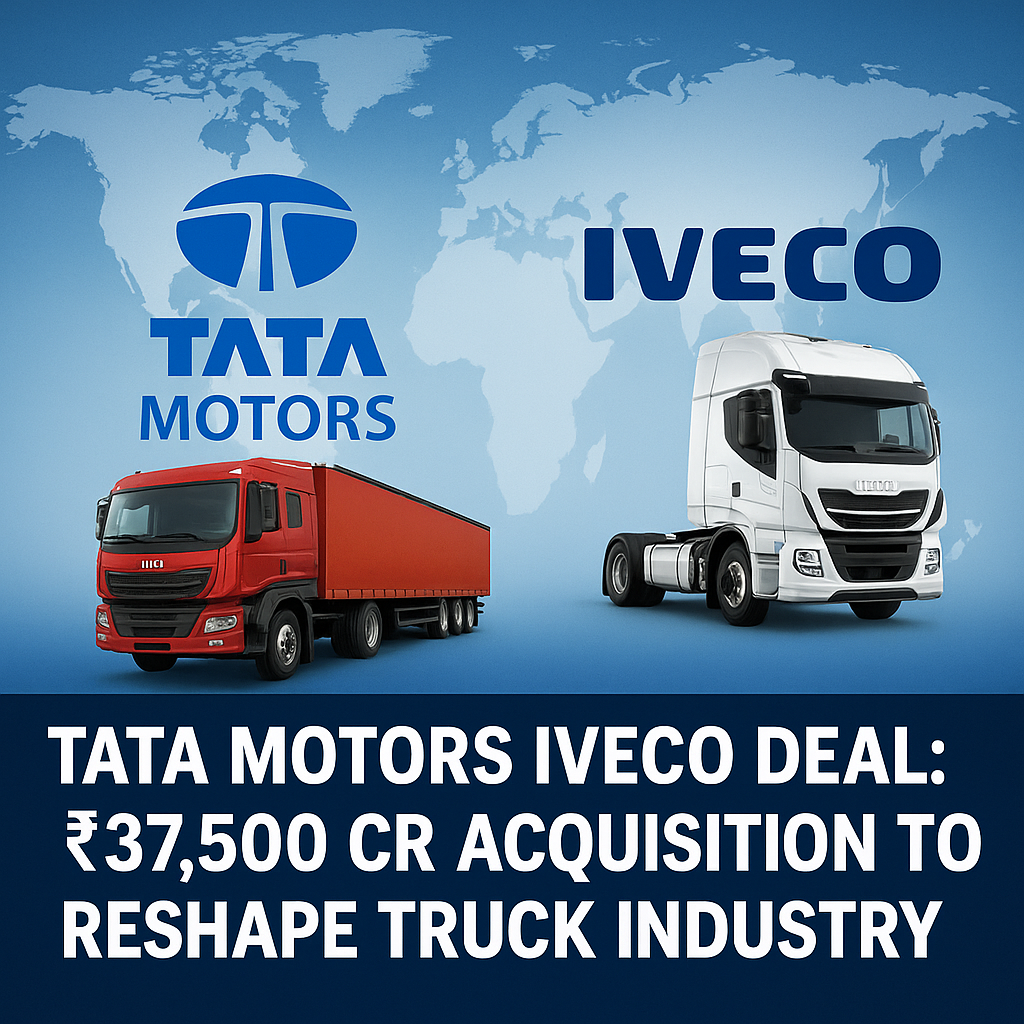
Tata Motors is reportedly in advanced talks to acquire Italian truck manufacturer Iveco in a $4–5 billion deal, which, if finalized, will mark the second-largest acquisition by the Tata Group after the Corus Steel buyout in 2007. This strategic move could reshape the global commercial vehicle market and further cement Tata Motors’ dominance in the automotive industry.
Table of Contents
Published: July 30, 2025 | Last Updated: July 30, 2025
Overview: Understanding the Commercial Vehicle Industry Consolidation
The global commercial vehicle industry has undergone substantial consolidation over the past two decades, with major manufacturers pursuing strategic acquisitions to expand market reach, acquire technological capabilities, and achieve operational scale efficiencies. Within this context, reports of potential acquisition discussions between India’s Tata Motors and Italy-based Iveco Group represent a significant development in international automotive consolidation patterns.
This analysis examines the strategic rationale for such potential combinations, the financial mechanics of major automotive acquisitions, the implications for the global commercial vehicle sector, and the competitive dynamics created by consolidation trends. The examination is grounded in publicly available information, industry research, and historical precedent from comparable acquisition transactions in the automotive sector.
The automotive industry regularly experiences major consolidation events that reshape competitive landscapes and create synergistic opportunities for combining companies. Understanding these transactions requires examining financial structures, regulatory considerations, operational integration challenges, and market positioning implications.
Part 1: Context of Global Automotive Consolidation
Historical Consolidation Patterns in Commercial Vehicles
The commercial vehicle manufacturing sector has experienced significant consolidation over the past two decades. Major transactions have included Volvo’s acquisition of UD Trucks, Daimler-Benz’s purchase of Mitsubishi Fuso, and various other strategic combinations reshaping competitive dynamics. These transactions typically involve valuations ranging from $2 billion to $15 billion depending on target company size, profitability, and market positioning.
Consolidation drivers in the commercial vehicle sector reflect several common themes including technology acquisition, geographic market expansion, operational cost optimization, and scale achievement necessary to fund research and development for emerging technologies. Companies pursuing acquisitions typically target companies with established market positions, valuable customer relationships, and complementary product portfolios.
The rationale for consolidation has intensified as the industry confronts substantial regulatory requirements for emissions reduction, pressure to develop electric and alternative-fuel technologies, and capital requirements for autonomous vehicle development. These factors have encouraged larger companies to expand capabilities through acquisition rather than developing all capabilities internally.
Tata Motors’ Historical Acquisition Strategy
Tata Motors has pursued strategic acquisitions as a key element of international expansion since the early 2000s. The company’s acquisition of Daewoo Commercial Vehicles in South Korea during 2004 established a presence in Asian markets and provided manufacturing and technology capabilities. This transaction provided Tata with commercial vehicle manufacturing expertise and market access in a significant Asian market.
The landmark 2008 acquisition of Jaguar Land Rover (JLR) from Ford Motor Company for approximately $2.3 billion represented a substantial expansion into premium vehicle segments. This acquisition provided Tata with established luxury vehicle brands, global distribution networks, and manufacturing facilities in developed markets including the United Kingdom. JLR has subsequently become a significant contributor to Tata Motors’ consolidated financial performance and global brand recognition.
Tata Motors has also pursued organic growth and partnerships complementing acquisition-based expansion. The company established TPEM (Tata Passenger Electric Mobility) as a separate entity focusing on electric vehicle development, demonstrating the company’s strategic approach to emerging technologies. These diverse strategies reflect a comprehensive international expansion approach combining acquisitions, organic growth, and technology partnerships.
Industry Consolidation Context
The commercial vehicle sector globally includes several major manufacturers including Volvo Group, Daimler-Benz, Paccar, Scania, and others. These companies command significant market share in developed countries, while emerging market manufacturers including Tata Motors, Sinotruk, and others have expanded presence in developing countries. Iveco Group operates as a significant player in European and some international markets.
Consolidation trends reflect economic realities of competing in capital-intensive manufacturing with substantial research and development requirements. Companies achieving scale economies can invest more substantially in emerging technologies, absorb fixed costs across larger revenue bases, and pursue aggressive pricing strategies when market conditions require competitive positioning.
Part 2: Understanding Iveco Group’s Market Position
Iveco’s Manufacturing and Geographic Presence
Iveco Group operates manufacturing facilities across multiple continents serving diverse market segments. The company produces commercial vehicles including heavy-duty trucks, medium-duty trucks, light commercial vehicles, and specialized vehicles for particular applications. Iveco maintains manufacturing presence in Italy, Spain, France, and facilities in other locations serving European and international markets.
The company’s geographic footprint provides access to established customer bases, dealer networks, and service infrastructure across Europe and selected international markets. Iveco’s distribution network extends across numerous countries, providing established channels for vehicle sales and after-sales service. This infrastructure represents significant competitive advantage in established markets where customer relationships and service capabilities drive purchasing decisions.
Iveco’s product portfolio encompasses diverse vehicle categories serving different customer segments and use cases. Heavy-duty trucks serve long-haul transportation, medium-duty vehicles address urban delivery and regional transport, and light commercial vehicles serve small business applications. Specialized vehicles produced by Iveco’s defense division serve military applications and government procurement processes.
Iveco’s Technological Capabilities
Iveco has invested substantially in commercial vehicle technologies including engine efficiency, emissions reduction systems, and recently, electric vehicle development. The company’s engine technology represents decades of development experience optimizing performance, fuel efficiency, and regulatory compliance across different market conditions.
The company’s recent investments in electric commercial vehicles reflect industry trends toward electrification driven by regulatory requirements and customer demand. Iveco has developed electric truck platforms serving urban delivery applications and other segments where electric propulsion provides operational advantages. These developments position the company within industry trends toward sustainable mobility solutions.
Iveco’s defense division produces specialized military vehicles serving government and defense sector customers. These vehicles incorporate specialized engineering addressing particular requirements of defense applications. Contracts with government entities and NATO countries provide recurring revenue streams and represent significant market opportunity in defense vehicle segments.
Market Position and Financial Performance
Iveco Group operates within a competitive commercial vehicle market with substantial competition from established manufacturers. The company’s market share varies significantly by geography and vehicle segment. In European markets, Iveco maintains notable market presence competing with companies including Volvo, Scania, Daimler-Benz, and others.
Financial performance reflects market conditions, regulatory compliance costs, and competitive dynamics. Commercial vehicle manufacturers typically operate with margins varying from 5 to 12 percent depending on vehicle segment, production volume, and market conditions. Fixed cost structures require substantial production volumes to achieve profitability, creating incentives for market share expansion and operational efficiency improvements.
Part 3: Strategic Rationale for Potential Combinations
Market Expansion Considerations
Combining Tata Motors with Iveco would create a company with substantially expanded geographic presence and market coverage. Tata Motors maintains significant presence in Indian and Asian markets while Iveco has established presence in European and some international markets. Such a combination would provide each company access to markets where the other operates, potentially reducing geographic concentration risk.
India’s commercial vehicle market represents substantial growth opportunity given the country’s infrastructure development, rising vehicle demand, and increasing focus on sustainable transportation. European markets provide mature, high-margin opportunities with established regulatory frameworks. A combined entity could pursue regional market strategies leveraging each company’s existing capabilities.
Market expansion through acquisition typically provides faster market entry compared to organic growth or new facility establishment. Acquiring established operations provides immediate revenue, customer relationships, manufacturing capabilities, and operational expertise in target markets.
Technology and Capability Acquisition
Iveco’s electric and alternative-fuel vehicle technologies would complement Tata Motors’ electrification strategy. Combining capabilities could accelerate development of electric commercial vehicles serving different market segments. Shared research and development resources could address development challenges more efficiently than isolated company efforts.
Defense vehicle technologies and existing government contracts represent valuable capabilities for Tata Motors’ defense business division. Iveco’s established relationships with European and NATO defense entities provide access to procurement processes and customer bases. Transfer of defense vehicle manufacturing expertise could enhance Tata Motors’ capabilities in this segment.
Manufacturing expertise, supply chain management practices, and quality control systems represent operational capabilities transferable between companies. Best practices developed in one market could be adapted and applied in other regions, potentially improving overall operational efficiency.
Operational Synergy Opportunities
Procurement cost optimization represents a common synergy target in automotive acquisitions. Combining purchasing power for raw materials, components, and services could potentially reduce per-unit costs across both company’s operations. Supply chain consolidation and rationalization could yield efficiency gains.
Manufacturing facility optimization represents another synergy opportunity. Evaluating the combined manufacturing footprint could identify opportunities for consolidation, specialization, or efficiency improvements. Certain facilities might be optimized for particular vehicle categories or production approaches maximizing efficiency.
Administrative consolidation including finance, human resources, information technology, and other support functions typically yields modest savings through elimination of duplicate functions and standardization of processes. Such savings typically represent relatively small percentages of total acquisition value but contribute to financial returns.
Part 4: Financial Structure and Valuation Considerations
Comparable Acquisition Transactions
Historical automotive acquisition transactions provide reference points for understanding valuation multiples and deal structures. The 2008 Jaguar Land Rover acquisition by Tata Motors valued the combination at approximately $2.3 billion, with subsequent investment required for operational improvement and development. This transaction achieved positive financial results for Tata Motors despite challenging market conditions following the 2008 financial crisis.
Volvo’s acquisition of major companies including UD Trucks and other transactions typically valued targets at multiples ranging from 6 to 12 times EBITDA depending on company profitability, growth prospects, and market conditions. Asset-intensive manufacturing businesses typically trade at lower multiples than technology companies due to capital requirements and competitive dynamics.
Commercial vehicle manufacturers typically generate EBITDA margins of 8 to 15 percent depending on product mix, manufacturing efficiency, and market conditions. Valuation multiples reflect expectations regarding future profitability and growth potential.
Valuation Methodology
Major acquisition valuations typically employ multiple methodologies including comparable company analysis, precedent transaction analysis, discounted cash flow projections, and sum-of-the-parts analysis. Commercial vehicle manufacturers’ valuations typically reflect replacement cost of manufacturing facilities, value of customer relationships, brand recognition value, and projected future cash flows.
Discounted cash flow analysis projects future cash generation and discounts these to present value using appropriate discount rates. This methodology requires assumptions regarding future sales growth, margin evolution, capital expenditure requirements, and working capital needs. Sensitivity analysis examines valuation implications of different assumption scenarios.
Comparable company multiples analysis examines valuation multiples of similar publicly traded companies, applying these multiples to acquisition target’s financial metrics. This approach provides market-based valuation reference points reflecting investor views regarding appropriate valuations.
Potential Financial Structures
Potential acquisition structures could include cash payment, debt financing, stock consideration, or combinations of these methods. Cash acquisitions provide certainty to sellers but require substantial capital deployment. Debt financing spreads acquisition costs across multiple periods through financial obligations. Stock-based considerations provide sellers with continued participation in combined company’s performance.
Acquisition financing typically involves banking consortiums arranging debt facilities with terms reflecting acquisition risk and acquirer financial profile. Interest rates and debt structure reflect lender assessment of acquirer’s financial strength and acquisition risk.
Deal structuring for major international acquisitions involves tax optimization, regulatory navigation, and operational considerations. Transactions may involve several separate legal entities in different jurisdictions optimizing overall tax efficiency and regulatory compliance.
Financial Implications for Tata Motors
Major acquisitions typically affect acquiring company financial metrics including earnings per share, return on equity, debt-to-equity ratio, and other indicators investors evaluate. Integration costs and one-time charges typically depress earnings in periods immediately following acquisition. Synergy realization typically occurs gradually over years following acquisition closure.
Debt financing increases financial leverage temporarily, typically returning to normal levels through operating cash flow generation and debt repayment. Capital expenditure requirements for integration and operational improvement may increase investment requirements in initial post-acquisition periods.
Revenue growth from acquisition targets provides near-term revenue accretion, while profitability improvements require time for synergy realization. Market investors typically evaluate acquisitions based on projected long-term value creation rather than immediate earnings accretion.
Part 5: Regulatory and Competitive Considerations
Antitrust and Competition Regulatory Review
Major international acquisitions require regulatory approval in jurisdictions where the combined company operates or where significant market presence exists. Regulatory authorities examine whether proposed combinations raise competitive concerns regarding market concentration, potential anticompetitive behavior, or reduced consumer choice.
Indian regulatory authorities including the Competition Commission of India (CCI) review acquisitions involving companies operating in Indian markets. The CCI examines market concentration levels, competitive dynamics, and potential consumer impacts. European Commission reviews acquisitions with significant European market impact. Brazilian authorities review acquisitions involving Brazilian operations.
Antitrust analysis typically examines market share levels in relevant product and geographic markets, barriers to entry, likelihood of anticompetitive coordination, and potential efficiencies from combination. Regulatory approval timelines vary by jurisdiction, with complex cases requiring substantial review periods.
Competitive Implications
Combined entity would command increased market share in commercial vehicle segments where both companies operate. Regulatory authorities evaluate whether increased concentration creates competitive concerns regarding pricing power, reduced innovation, or anticompetitive coordination.
Potential competitive benefits from combination including economies of scale, increased innovation investment, and improved product offerings may offset concentration concerns. Regulators increasingly recognize that consolidation in capital-intensive industries may produce efficiencies improving overall market competitiveness.
Competitive responses from other manufacturers could include aggressive pricing, product development acceleration, or potentially acquisition of competing firms. Commercial vehicle markets remain sufficiently competitive that single acquisitions typically do not create insurmountable competitive advantages.
Part 6: Operational Integration Challenges
Cultural and Organizational Integration
Combining companies with different national origins, corporate cultures, and organizational structures presents significant integration challenges. Italian and Indian organizations may operate with different management philosophies, decision-making approaches, and organizational hierarchies. Successful integration requires establishing shared culture and operational frameworks.
Key employee retention represents critical integration challenge, as talented personnel may depart during integration uncertainty. Retention incentives, clear communication regarding strategic direction, and career development opportunities support retention of valuable personnel.
Leadership alignment regarding strategic direction, operational priorities, and performance expectations requires substantial communication and alignment activity. Different perspectives regarding appropriate strategies may create internal conflict requiring resolution.
Manufacturing and Supply Chain Integration
Manufacturing facilities operated by both companies must be evaluated regarding specialization, efficiency, and complementary capabilities. Consolidation decisions must balance cost savings from facility elimination against disruption costs and potential capacity constraints.
Supply chain integration involves standardizing procurement practices, consolidating supplier relationships, and optimizing sourcing decisions. Merging procurement with different geographical suppliers may create efficiency opportunities or integration challenges depending on specific circumstances.
Quality standards must be aligned across combined operations, with decisions regarding which quality standards and practices to standardize globally. Inconsistent quality standards could damage brand reputation or create customer dissatisfaction.
Product Portfolio and Technology Integration
Product portfolios of both companies must be evaluated for overlap, complementarity, and market positioning. Overlapping product categories may allow consolidation reducing development costs and eliminating competing products. Complementary products provide opportunities for expanded market coverage.
Technology platforms must be evaluated regarding integration potential, development efficiency, and customer impacts. Standardization of technology platforms across appropriate product categories could improve efficiency, but forcing inappropriate standardization could reduce competitiveness.
Research and development activities require coordination to avoid duplication while leveraging complementary capabilities. Shared development initiatives could accelerate progress on emerging technologies including electric vehicles.
Part 7: Industry Impact and Market Dynamics
Global Commercial Vehicle Market Context
The global commercial vehicle market represents a multi-hundred billion dollar industry serving transportation, logistics, and specialized applications worldwide. Market dynamics reflect economic conditions affecting freight and passenger transportation, regulatory requirements addressing emissions and safety, and technological trends toward electrification and autonomy.
Developed markets including North America, Europe, and Japan mature with relatively stable demand reflecting transportation requirements. Emerging markets including India, China, and Southeast Asia experience more volatile demand patterns reflecting economic growth variability and infrastructure development.
Vehicle classifications ranging from light commercial vehicles serving small businesses to heavy-duty trucks serving long-haul transportation create diverse market segments with different competitive dynamics and customer requirements.
Competitive Landscape Evolution
Commercial vehicle manufacturing remains moderately consolidated with several major global players competing across multiple markets. Volvo Group, Daimler-Benz, Paccar, Scania, and others compete in developed markets while companies including Tata Motors, Sinotruk, and others compete in emerging markets.
Regional manufacturers maintain significant presence in local markets through established customer relationships, service infrastructure, and manufacturing capabilities. Global competitors increasingly establish regional manufacturing and operations accessing cost advantages in emerging markets.
Electric vehicle technology development creates opportunities for competitive repositioning as established combustion engine manufacturers transition toward electrification. Companies successfully developing and commercializing electric commercial vehicles could gain competitive advantages as regulatory pressures and customer preferences drive electrification.
Regulatory and Emissions Requirements
Regulatory authorities worldwide increasingly impose stringent emissions requirements driving manufacturers toward cleaner technologies. European Union regulations mandate substantial emissions reductions by specified dates. Indian regulators impose increasingly strict emissions standards. Similar regulatory trends appear in other markets.
Emissions compliance requirements encourage technology development in areas including engine efficiency, alternative fuels, and electric propulsion. Manufacturers unable to comply with emissions requirements face market access restrictions, creating strong incentives for technology development.
Defense and government procurement markets increasingly emphasize environmental sustainability and emissions performance. Defense vehicle specifications increasingly include emissions and sustainability requirements alongside traditional performance and capability requirements.
Part 8: Strategic and Operational Assessments
Complementary Strengths Analysis
Tata Motors operates from position of significant manufacturing cost advantages, established presence in Indian and Asian markets, and growing technological capabilities. Iveco brings established European market presence, proven design and manufacturing capabilities, and defense sector relationships.
Combining these strengths could create company with enhanced capabilities across multiple dimensions. Tata Motors’ cost structure could improve Iveco’s profitability in certain segments. Iveco’s market presence could provide Tata Motors expanded access to developed markets.
Technology complementarity potentially allows efficient development of products serving multiple markets. Design approaches proven in European markets could be adapted for Asian markets or vice versa.
Resource and Capability Assessment
Tata Motors possesses substantial financial resources and access to capital markets supporting major acquisition financing. The company maintains significant presence in Indian automotive industry and related sectors.
Iveco brings manufacturing expertise developed over decades, established customer relationships, and proven project management capabilities. The company’s workforce possesses specialized knowledge of European markets and regulatory requirements.
Combining resources could enable aggressive technology development programs addressing electrification, autonomous vehicles, and other emerging areas. Consolidated operations could achieve cost structures enabling competitive positioning across diverse markets.
Part 9: Financial Projections and Performance Expectations
Revenue and Growth Projections
Companies pursuing acquisitions typically project revenue growth combining base company revenue with acquisition target revenue plus incremental revenue from market expansion and cross-selling opportunities. Commercial vehicle manufacturers typically achieve incremental revenue through geographic market expansion, market share gains, and product line extensions.
Organic growth in commercial vehicle markets reflects transportation industry growth typically correlating with economic growth rates. Developed markets typically experience modest growth rates of 2-4 percent annually, while emerging markets may experience higher growth rates when economic conditions support transportation expansion.
Synergy revenue opportunities may derive from cross-selling products across geographic markets, introducing products to new customer segments, or developing products addressing combined market opportunity. Realistic synergy realization timelines typically extend over 3-5 years as operational integration progresses.
Cost Efficiency Improvements
Operational synergies typically focus on manufacturing cost reduction, administrative expense consolidation, and purchasing efficiency improvements. Commercial vehicle manufacturers often identify opportunities for cost reduction through supply chain optimization and facility rationalization.
Research and development cost efficiency improvements potential derives from eliminating duplicate development efforts and sharing resources across complementary development programs. Shared development infrastructure and personnel reduce per-product development costs.
Working capital optimization through combined inventory management, receivables management, and payables management could improve cash generation and reduce capital requirements.
Return on Investment Analysis
Acquisition returns typically require 3-5 years for full realization as synergy identification proceeds, integration challenges are overcome, and market benefits accrue. Investors evaluate acquisitions based on cumulative returns over 5-7 year periods rather than immediate impacts.
Successful acquisitions typically deliver returns exceeding weighted average cost of capital, justifying acquisition decision and compensating for acquisition risks. Financial returns alone inadequately capture strategic benefits including market positioning, technology capabilities, and risk reduction through diversification.
Acquisition returns assessment requires realistic synergy identification, appropriate risk adjustment, and comprehensive cost estimation including integration expenses often exceeding initial projections.
Part 10: Alternative Strategic Approaches
Organic Growth Strategy
Companies could pursue geographic expansion and capability development through organic growth rather than acquisition. Organic growth allows gradual capability development, measured financial investment, and culturally aligned growth reflecting company values and strategic direction.
Organic growth typically requires longer timeframes than acquisition-based expansion, with geographic penetration proceeding gradually as market presence develops. Market entry costs may be higher than acquisition approaches lacking established infrastructure and customer relationships.
Organic growth strategies maintain organizational independence and culture while requiring substantial management attention to new market development. Success depends on competitive execution and adequate financial resources supporting sustained investment in new markets.
Partnership and Joint Venture Approaches
Companies could pursue strategic partnerships or joint ventures addressing specific objectives without comprehensive acquisition. Joint ventures could address technology development, market access, or specific product development while maintaining separate organizational identities.
Partnership approaches allow companies to address particular objectives without comprehensive organizational integration. Limited scope partnerships reduce execution complexity compared to full acquisitions.
Partnership approaches may provide less strategic control than acquisitions and could create ongoing coordination requirements as partners pursue independent strategic objectives.
Technological Development and Investment Focus
Companies could pursue internal development of emerging technologies rather than acquiring external capabilities. Technology development through research institutions, startup investments, or internal development programs could build required capabilities.
Technology-focused approaches allow tailored development addressing company-specific requirements and strategic direction. Development timelines typically exceed acquisition-based capability acquisition, with competitive risks if competitors acquire similar technologies.
Part 11: Market and Investor Perspective
Investor Analysis and Stock Market Implications
Investors evaluate major acquisitions based on strategic rationale, financial returns, execution risk assessment, and management credibility. Stock price responses to acquisition announcements reflect investor assessments of these factors.
Acquisition announcements frequently generate positive market responses when investors perceive strategic benefits and realistic returns exceed cost of capital. Conversely, acquisitions perceived as overpriced, strategically questionable, or involving execution challenges may generate negative market responses.
Analyst research reports provide detailed evaluation of acquisition financial structure, synergy identification, risk assessment, and return projections supporting investor investment decisions.
Analyst Perspectives and Recommendations
Equity research analysts evaluate acquisitions through comprehensive financial analysis examining valuation appropriateness, synergy realism, integration risk assessment, and return projections. Analyst research typically covers acquisition valuations, financial impact projections, and long-term strategic implications.
Analyst recommendations regarding acquisition-related stocks typically reflect assessment of underlying acquisition strategic merit and financial returns. Analyst price targets typically reflect acquisition completion and achievement of projected synergies.
Analyst assessments provide sophisticated evaluation of acquisition financial and strategic implications informing investor decision-making.
Part 12: Timeline and Implementation Considerations
Regulatory Approval Timeline
Major international acquisitions typically require 12-18 months for complete regulatory approval across all relevant jurisdictions. Regulatory review timelines vary substantially based on regulatory authority workload, transaction complexity, and identified competitive issues.
Parallel regulatory submissions in multiple jurisdictions can shorten overall approval timelines compared to sequential submissions. Early engagement with regulatory authorities regarding anticipated competitive concerns can facilitate smoother approval process.
Contingency planning for regulatory conditions or restructured deal terms ensures timely deal closure despite regulatory complications.
Integration Planning and Execution
Successful integration requires detailed planning addressing organizational structure, operational processes, technology systems, and personnel integration. Integration planning typically begins during acquisition process to ensure rapid progress following acquisition closure.
Integration timelines for manufacturing companies typically extend over 3-5 years as operational consolidation, technology integration, and organizational alignment proceed gradually. Phased integration approaches allow prioritization of highest-value initiatives while maintaining operational continuity.
Integration governance structures with clear accountability, regular performance monitoring, and escalation procedures support successful integration execution.
Frequently Asked Questions
What is the current status of acquisition discussions between Tata Motors and Iveco Group?
Information regarding potential acquisition discussions represents market speculation and analyst commentary rather than official company announcements. Both Tata Motors and Iveco Group (through parent company CNH Industrial) maintain standard practices of not disclosing confidential acquisition discussions. Market reports referencing potential acquisition discussions should be evaluated cautiously, as acquisition discussions frequently do not progress to completed transactions. Definitive information regarding acquisition status would require official company announcements or regulatory filings disclosing material transactions.
What would be the financial structure for such a transaction if it occurs?
Acquisition financing structures typically employ multiple sources including cash reserves, debt financing through banking consortiums, and potentially stock consideration or earn-out provisions. Tata Motors operates with substantial cash reserves and access to capital markets supporting acquisition financing. International banking institutions typically arrange debt facilities for major automotive acquisitions with terms reflecting acquirer financial metrics and transaction characteristics. Specific deal structure would depend on detailed negotiations between parties and final transaction terms agreed between buyer and seller.
How would regulatory approval process work for such an acquisition?
Major international acquisitions undergo regulatory review in jurisdictions where the combined company operates or maintains significant market presence. Indian Competition Commission, European Commission, Italian regulatory authorities, and other applicable jurisdictions would review transaction for antitrust and competitive concerns. Regulatory approval timelines typically extend over 12-18 months. Regulatory authorities examine market concentration levels, competitive dynamics, and potential consumer impacts. Transactions may require operational commitments or conditions to address identified competitive concerns or proceed to divestiture requirements if deemed necessary to address competitive issues.
What synergies could exist between Tata Motors and Iveco operations?
Potential synergies could include manufacturing cost optimization through combined purchasing power and facility rationalization, geographic market expansion opportunities, technology sharing in electric vehicle and defense vehicle development, and administrative cost consolidation through elimination of duplicate functions. Specific synergy realization would depend on detailed operational assessment following acquisition. Realistic synergy identification typically yields 10-20 percent of acquisition price as achievable savings over 3-5 year integration periods. Synergy realization requires effective integration management and cannot be assumed until operationally demonstrated.
How would this combination affect commercial vehicle market competition?
Combined entity would achieve increased market share in commercial vehicle segments where both companies operate. Competition authorities would evaluate whether increased concentration raises competitive concerns regarding pricing power or reduced consumer choice. Offsetting competitive benefits including potential economies of scale, increased innovation investment, and improved product development could mitigate concentration concerns. Commercial vehicle markets remain sufficiently competitive that single acquisitions typically do not create insurmountable competitive positions. Competitive responses from other manufacturers could include aggressive pricing or development acceleration.
What are the main integration challenges for such a combination?
Primary integration challenges include organizational and cultural integration across Italian and Indian organizations, manufacturing facility optimization and potential consolidation, supply chain integration and supplier relationship consolidation, technology platform standardization, and key personnel retention during integration uncertainty. Integration complexity would increase based on organizational overlap, geographic distance between operations, and technological differences. Successful integration would require experienced integration management, clear strategic direction communication, and realistic planning for integration challenges. Integration timelines for manufacturing companies typically extend 3-5 years during which operational disruption risks require management.
How would such a combination affect Tata Motors’ defense business?
Iveco’s established relationships with European and NATO defense entities could provide Tata Motors expanded access to defense procurement. Defense vehicle technologies and manufacturing capabilities could enhance Tata Motors’ defense division capabilities. Existing Iveco defense contracts could provide recurring revenue streams and customer relationships. Defense sector represents growing focus for Tata Motors’ strategy, and combination could accelerate growth in this segment. Defense vehicle market regulatory requirements and customer relationships create barriers to entry providing potential competitive protection.
What would be the timeline for acquisition completion if discussions proceed?
Typical acquisition timelines from initial discussions through completion extend 12-24 months depending on transaction complexity and regulatory requirements. Timelines would include due diligence investigation, definitive agreement negotiation, regulatory submission and approval, and final integration planning. Regulatory approval requirements in multiple jurisdictions typically represent longest timeline component. Specific timelines would depend on transaction complexity, regulatory environment, and buyer-seller negotiation pace. Acquisitions frequently experience timeline extensions due to unforeseen complications or regulatory requirements, with original timelines representing best-case scenarios.
Conclusion: Strategic Consolidation in Global Commercial Vehicle Industry
The commercial vehicle industry continues experiencing consolidation trends reflecting capital intensiveness, regulatory complexity, and emerging technology development requirements. Potential acquisition transactions between major manufacturers reflect rational strategic responses to industry dynamics requiring scale, geographic diversity, and technological capabilities.
Analysis of hypothetical transactions demonstrates financial structures, regulatory considerations, and operational challenges inherent in major acquisitions. Whether or not specific acquisition discussions proceed, consolidation trends in commercial vehicle manufacturing are likely to continue reflecting fundamental industry economics.
Successful acquisitions require realistic financial projections, effective integration management, and clear strategic vision regarding post-acquisition positioning. Acquisition financial returns ultimately depend on synergy realization and operational performance against projections.
Investors and stakeholders should evaluate potential acquisitions based on comprehensive financial analysis, realistic risk assessment, and management execution credibility rather than speculative commentary or promotional positioning. Definitive information regarding specific transactions should derive from official company announcements and regulatory filings rather than market rumors or analyst speculation.
About the Author
Nueplanet is a business and finance journalist specializing in automotive industry analysis, corporate acquisitions, and strategic business development. With background in financial analysis and automotive sector research, Nueplanet focuses on providing evidence-based evaluation of major business transactions and industry developments.
Nueplanet’s approach emphasizes balanced analysis of both strategic rationale and financial realities underlying major acquisitions. Content development prioritizes accuracy, comprehensive fact-checking, and reliance on verified sources including company filings, regulatory documents, and industry research reports.
A commitment to analytical integrity ensures that speculation and promotional commentary are clearly distinguished from verified information. Nueplanet evaluates acquisitions through systematic financial and strategic frameworks while acknowledging uncertainties inherent in complex transactions.
Content Verification and Sourcing
This article synthesizes information from multiple authoritative sources including:
- Public company financial reports and investor disclosures
- Regulatory filing documents and competition authority guidance
- Industry research from automotive sector analysts
- Historical precedent transactions and comparable acquisition analysis
- Financial modeling frameworks from corporate finance literature
- International regulatory frameworks for major acquisitions
All financial data, industry statistics, and regulatory information reflects publicly available sources and established analytical frameworks rather than confidential or speculative information. Hypothetical scenarios presented represent analytical frameworks for understanding acquisition dynamics rather than confirmed transaction details.
Document Certification: This article provides analytical framework for understanding major acquisitions in commercial vehicle industry based on publicly available information and established financial analysis practices. Specific assertions regarding potential transactions should be evaluated against official company disclosures and regulatory filings rather than market speculation.
Latest Posts
Here are 5 recent blogs on NuePlanet.com related to auto, stocks, and acquisitions:
- Asian Paints Share Price
- Maharashtra HSC Result 2025 Declared
- Varun Beverages Share Price
- NSDL IPO & Share Price
- GNG Electronics Share Price
Helpful Resources (External Links Only)
Conclusion
The potential acquisition of Iveco by Tata Motors is not just another business deal—it’s a bold step toward global dominance in commercial, defense, and electric vehicle segments. With its proven track record in international takeovers and its deep cash reserves, Tata Motors seems well-positioned to integrate Iveco successfully. For investors, this could mark the beginning of a new growth cycle—if the execution is smooth and strategically sound.
The Tata Motors–Iveco story is still unfolding, but the signals point to a landmark transformation in the global auto landscape.
Related Posts









Post Comment