







Tamil Stuntman Mohanraj (SM Raju): Life, Career, and Tragic Death During ‘Vettuvam’ Shooting
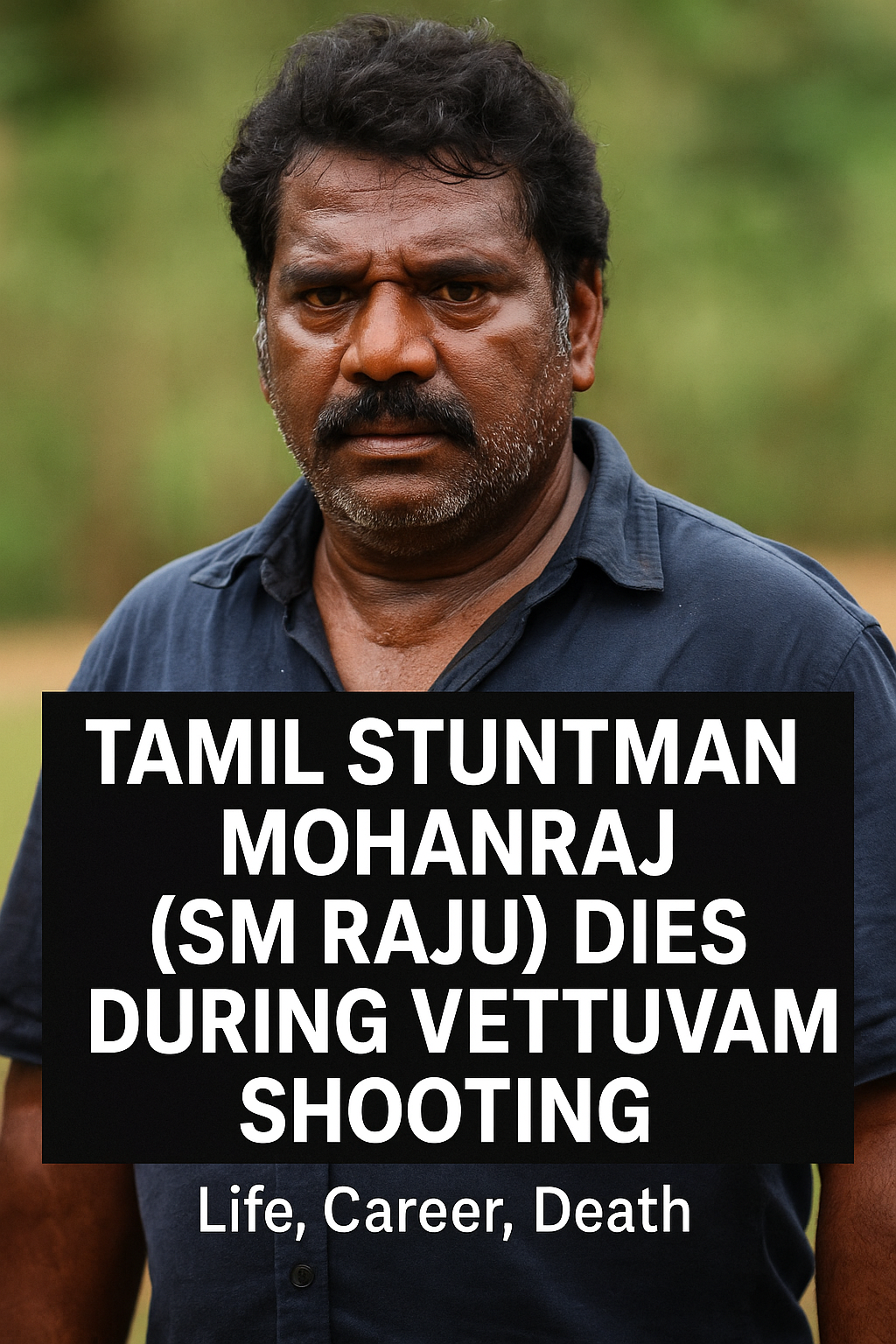
Popular Tamil stunt master SM Raju, known as Mohanraj, tragically died on the sets of ‘Vettuvam’. Here is a detailed look at his life, career, and the circumstances of his untimely death.
Table of Contents
News Overview
On July 13, 2025, a stuntman identified as SM Raju, professionally known as Mohanraj, died during the filming of an action sequence in Tamil cinema. The incident occurred in Nagapattinam district while performing a vehicle stunt for the film “Vettuvam,” directed by Pa. Ranjith. The stuntman was pronounced dead at a government medical facility following the accident. This incident has prompted examination of safety standards within Indian film production and resulted in increased focus on occupational safety for stunt professionals.
The event has led to formal investigation procedures and subsequent industry discussions regarding safety protocols. This article provides a factual analysis of the incident, the professional background of the stuntman involved, the emergency response, legal proceedings, and the resulting industry-wide safety discussions.
Professional Background of the Stuntman
Career Overview
SM Raju, professionally known as Mohanraj, worked in the Tamil film industry for approximately 25 years prior to his death. Industry documentation indicates he participated in over 300 film productions throughout his career. He held professional recognition for expertise in automotive stunts, combat choreography, and vehicle-based action sequences.
His career progression began in the late 1990s and advanced through various levels of professional stunt work. By the time of his death at age 52, he had established a reputation within the industry for experience and technical skill in action choreography.
Professional Accomplishments
Over his career, Mohanraj worked across multiple film genres including action films, romantic dramas, and period productions. Industry records indicate he collaborated with various established directors within the Tamil film industry. He received recognition through multiple industry award nominations and honors related to stunt choreography and action design.
Documentation of his professional contributions includes work on production teams for films distributed across regional and national markets. His experience encompassed various categories of stunt work, including vehicle operations, hand-to-hand combat sequences, and aerial maneuvers.
Mentorship and Training Activities
Throughout his career, Mohanraj engaged in training activities with junior stunt professionals. Industry sources indicate he provided guidance to approximately 200 stunt artists at various stages of their careers. His approach to training emphasized safety protocols alongside technical skill development.
Awards and Recognition
Professional recognition included nominations and awards from industry organizations. Documented honors include state film award recognition for technical contributions to film production and acknowledgment from professional stunt associations. Industry publications noted his work in various action sequences across multiple production years.
The Incident: Documented Sequence of Events
Production Context
The incident occurred during filming of “Vettuvam,” a film project directed by Pa. Ranjith and featuring actor Arya. Filming was taking place in Vizhunthamavadi village within Nagapattinam district, Tamil Nadu. The production was executing an action sequence involving vehicle operations at the time of the incident.
The stunt sequence was categorized as a high-risk vehicle maneuver requiring specialized expertise. Industry standards classify such sequences as involving elevated hazard potential compared to other standard stunt categories. Pre-production planning and safety protocols had been established prior to execution.
Timeline of the Incident
| Time | Event | Location | Status |
|---|---|---|---|
| 10:30 AM | Stunt preparation activities | Vizhunthamavadi village | Normal operations |
| 11:45 AM | Final safety verification | Shooting location | Equipment checked |
| 12:15 PM | Stunt execution begins | Salt pan area | Filming active |
| 12:18 PM | Vehicle loses control | Mid-air trajectory | Emergency situation |
| 12:20 PM | Impact and rescue initiation | Crash site | Medical team activated |
| 12:45 PM | Ambulance departure | En route | Transport to facility |
| 1:30 PM | Hospital arrival | Government Medical College | Medical evaluation |
| 2:15 PM | Death declaration | Hospital facility | Official notification |
Stunt Sequence Details
The stunt involved operation of an SUV vehicle at elevated speed. The vehicle was directed over a specially constructed ramp designed to create an aerial trajectory. The maneuver was intended to result in a controlled crash sequence for filming purposes. Vehicle operation was the responsibility of the professional stuntman.
During execution, the vehicle lost directional control during the aerial phase. The vehicle’s trajectory deviated from the planned sequence. Impact with the ground occurred at increased force levels compared to standard controlled crash protocols.
Medical Response and Assessment
Emergency medical personnel responded immediately following impact. The stuntman was transported to Government Medical College Hospital in Orathur by ambulance. Medical evaluation determined critical trauma from the vehicle impact.
Medical documentation indicates the cause of death was cardiac arrest. The cardiac incident occurred in the context of severe impact trauma. Despite immediate resuscitation procedures initiated by medical staff, the stuntman could not be revived. Official death declaration occurred at 2:15 PM on July 13, 2025.
Safety Infrastructure and Protocols
Pre-Incident Safety Measures
Production records indicate that standard safety protocols were implemented prior to stunt execution. Vehicle inspection procedures were conducted by certified mechanics. Basic first aid capabilities were available at the filming location. Standard protective equipment was provided to the stunt professional.
Communication systems were established to enable rapid emergency response coordination. Insurance coverage was arranged according to prevailing industry standards. Medical personnel were stationed at the filming location.
Safety Equipment Classification
Standard stunt safety equipment available during production included:
- Protective headgear and body protection gear
- Vehicle inspection and safety verification systems
- Communication devices for emergency coordination
- First aid and emergency medical supplies
- Fire suppression equipment
Industry Standards Assessment
The safety measures implemented represented standard practice within the Tamil film industry prior to this incident. However, industry analysis following the incident identified gaps between existing protocols and international standards applied in other film production contexts.
Comparative analysis with international film production safety standards indicated that additional measures could have enhanced protective capabilities. These identified gaps became the basis for subsequent industry-wide safety discussions and reform initiatives.
Legal Proceedings and Official Response
FIR Registration
Official investigation procedures were initiated following the incident. A First Information Report (FIR) was registered under the Bharatiya Nyaya Sanhita, India’s criminal code framework. The Nagapattinam police assumed primary investigative responsibility.
The legal action was filed on July 16, 2025, three days after the incident occurrence. The registration represented the formal initiation of criminal investigation procedures.
Accused Parties and Investigation Focus
The FIR named director Pa. Ranjith and three additional production team members. Investigation procedures examined circumstances surrounding the stunt execution, pre-planning activities, safety verification processes, and compliance with applicable safety regulations.
The investigation focused on determining whether negligence contributed to the incident. Investigators examined whether safety protocols were followed according to established standards. Documentation review included production planning records, equipment maintenance logs, and personnel qualifications.
Investigative Timeline
Investigation procedures are expected to require approximately six months to complete. The investigation involves examination of multiple aspects of the production process and safety management. Findings from the investigation will inform determinations regarding any culpability or negligence.
Industry Response and Support Measures
Industry Leadership Statements
Following the incident, various industry figures and organizations provided statements acknowledging the stuntman’s professional contributions. Actor Vishal made public statements regarding the incident and announced support commitments for the deceased stuntman’s family.
Director Pa. Ranjith issued statements expressing responsibility for the incident. Various industry associations released statements emphasizing the need for safety improvements.
Financial Support Commitments
Industry leadership announced commitments to provide financial support to the deceased stuntman’s family. Announced support included assistance for dependent children’s education, ongoing financial provisions, and immediate emergency assistance.
The Tamil Film Producers Council initiated coordination of support mechanisms. Multiple industry organizations contributed to support fund establishment. Specific financial arrangements were made for family members’ immediate needs.
Policy Response Initiatives
Industry organizations initiated discussion of safety protocol enhancements. Conversations focused on equipment standards, medical personnel requirements, insurance coverage levels, and stunt coordinator certification procedures.
Industry associations began developing comprehensive safety frameworks. These frameworks addressed pre-stunt medical examinations, equipment certification standards, personnel training requirements, and emergency response procedures.
Comparative Safety Analysis
International Safety Standards
Film production in major international film industries operates with established safety frameworks. In Hollywood film production, occupational safety protocols include requirements for trauma-specialized medical personnel, comprehensive insurance coverage, and certified safety coordinators.
| Safety Element | International Standard | Indian Pre-2025 | New Standards Under Development |
|---|---|---|---|
| Medical Personnel | Trauma specialists | Basic first aid | Trauma specialists |
| Equipment Certification | ISO standards | Local standards | ISO standards |
| Insurance Coverage | $2-5 million | ₹10-50 lakhs | ₹2-5 crores |
| Safety Coordination | Always present | Sometimes present | Always present |
| Training Requirements | Certified programs | Experience-based | Certified programs |
Analysis of Protocol Differences
International film production standards require presence of specialized medical professionals on action filming sets. Equipment certification procedures follow internationally recognized standards rather than local norms. Insurance coverage levels significantly exceed Indian industry standards.
Safety coordinator roles are mandatory in international productions, whereas prior Indian practice permitted variability in safety management responsibility assignment. Training and certification procedures in international contexts follow standardized curricula, whereas Indian practice previously relied on experience-based qualification assessment.
Industry Capacity Considerations
Implementation of international standards requires infrastructure development. Medical professional training programs require expansion to support specialized trauma care availability. Equipment certification requires access to testing facilities and international standards compliance verification. Insurance industry cooperation is necessary to support coverage level increases.
Safety Reform Initiatives
Immediate Reforms Implemented
Following the incident, Tamil film industry organizations announced implementation of immediate safety improvements. These included mandatory pre-stunt medical examinations for all stunt professionals, international equipment certification standards for safety gear, comprehensive insurance coverage expansion, and permanent medical team presence during action filming.
Implementation dates for immediate reforms were established commencing August 1, 2025. Production organizations began adapting protocols to comply with new standards. Equipment upgrades began immediately to meet international certification standards.
Medium-Term Reform Timeline
Reforms scheduled for implementation within 6-12 months include certified stunt coordinator licensing programs, comprehensive stunt artist registration and qualification verification systems, and expanded medical facilities at major filming locations.
Training programs began development to support certification requirements. Industry organizations began collaborating with international safety consultants to adapt global best practices for Indian production contexts.
Long-Term Strategic Improvements
Strategic planning includes establishment of comprehensive safety research initiatives, technology integration for stunt planning and execution, advanced protective equipment development, and ongoing international collaboration on safety standards.
Research initiatives focus on identifying emerging risks in action filmmaking and developing preventive measures. Technology adoption includes virtual reality training systems for stunt preparation and real-time health monitoring during stunt execution.
Occupational Safety Context
Stunt Professional Work Environment
Stunt professionals operate in a specialized occupational category characterized by elevated physical risk compared to standard film production roles. Work involves execution of choreographed sequences designed to create visual effects while managing inherent hazards of specialized maneuvers.
Stunt work typically involves vehicle operations, controlled impacts, aerial maneuvers, combat sequences, and fire-related effects. Each category presents distinct hazard profiles requiring specific safety measures and professional expertise.
Occupational Risk Factors
Risk factors in stunt work include vehicle velocity, impact force magnitudes, environmental variables, equipment reliability, and human performance variables. Vehicle stunts present particularly elevated risk due to velocity, mass, and force magnitudes involved.
Physical conditioning, technical skill, and safety procedure compliance all contribute to risk management. However, inherent hazards cannot be completely eliminated from stunt work categories. Risk reduction through improved safety management represents an achievable goal, though some residual risk remains inherent to the work.
Health and Wellness Considerations
Pre-stunt medical evaluation can identify health conditions that might increase vulnerability to incident-related complications. Cardiovascular assessment represents one category of pre-stunt evaluation. The incident involving the stuntman indicated that cardiac complications occurred in the context of severe trauma.
Regular medical monitoring of stunt professionals can identify developing health conditions. Fitness maintenance and physical conditioning reduce vulnerability to certain categories of incident complications. Psychological stress assessment can identify personnel requiring additional support.
Industry Structural Considerations
Professional Organization Status
Discussion following the incident included consideration of formal industry status for film industry employees. Industry advocacy included requests for governmental recognition of film production as a formal industry sector with associated regulatory frameworks and labor protections.
Formal industry status would provide access to standardized labor law protections, workers’ compensation frameworks, and occupational safety regulations. Currently, film production operates with limited regulatory oversight compared to other industrial sectors.
Worker Classification and Protections
Stunt professionals and technical personnel classification has implications for applicable labor law protections. Formal classification as industrial workers would provide access to workers’ compensation, occupational safety regulations, and labor law protections applicable to industrial employment.
Current classification structures sometimes limit the protective framework applicable to film industry workers. Discussion following the incident focused on establishing more comprehensive labor protections for film production personnel.
Professional Licensing and Qualification
Development of formal certification and licensing procedures for stunt professionals represents an emerging discussion point. Certification frameworks would establish minimum qualification standards, mandatory training requirements, and ongoing professional development expectations.
International film industries utilize formal licensing and certification systems for stunt professionals. Development of comparable systems in Indian film production could standardize qualifications and establish industry-wide skill standards.
Media and Public Discourse
Industry Communication
Following the incident, industry organizations issued statements emphasizing commitment to safety improvements. Media statements included acknowledgment of occupational risks in stunt work and industry-wide commitment to enhanced protection measures.
Industry leadership statements emphasized that the incident had catalyzed important safety discussions and reform initiatives. Statements included commitments to implementing identified improvements within established timelines.
Public Education Initiatives
Educational outreach discussions included development of public awareness regarding occupational risks in film production. Educational initiatives focus on communicating the complexity and professionalism required in stunt work and the importance of appropriate safety measures.
School and educational institution programs are being developed to increase public understanding of film production careers and occupational safety importance across all professions. These initiatives aim to build broader cultural appreciation for safety consciousness.
Technology and Equipment Evolution
Emerging Safety Technologies
Advanced protective equipment development includes impact-resistant materials, real-time vital sign monitoring systems, and enhanced vehicle safety systems. Development priorities include technologies that reduce incident severity if accidents occur, enable early identification of health complications, and improve vehicle control during stunt execution.
Virtual reality training systems are being evaluated for pre-stunt preparation. These systems allow stunt professionals to practice sequences in simulated environments before actual execution, potentially improving technical preparation and identifying potential complications before live execution.
Equipment Certification Standards
Implementation of international equipment standards includes adoption of ISO certification requirements for protective gear, communication devices, and vehicle safety systems. Equipment testing and certification processes are being established to verify compliance with international standards.
Equipment maintenance and inspection protocols are being formalized to ensure ongoing compliance with safety standards. Documentation systems are being implemented to verify equipment qualification status prior to filming activities.
Professional Development and Training Evolution
Formal Certification Programs
Development of formal certification programs for stunt professionals is being planned by industry organizations. Certification requirements would include technical skill verification, safety procedure knowledge assessment, and ongoing professional development participation.
Training curriculum development includes safety protocols, equipment operation procedures, emergency response procedures, and professional ethics. Instructors would include experienced stunt professionals and occupational safety specialists.
Educational Institution Participation
Film schools and technical institutes are being engaged to develop stunt training curricula meeting industry standards. Educational institution programs would provide structured training in stunt techniques, safety procedures, and professional practices.
Formal educational programming would enable development of standardized training approaches and consistency in qualification standards across educational providers. Partnerships between industry organizations and educational institutions would ensure curriculum alignment with industry practice.
Ongoing Professional Development
Requirements for ongoing professional development and recertification would ensure that stunt professionals maintain current knowledge of evolving safety standards and techniques. Professional development requirements would include periodic safety protocol updates and equipment standard evolution training.
Economic and Financial Analysis
Industry Safety Investment
Industry organizations have begun evaluating financial requirements for implementing comprehensive safety improvements. Estimated investment requirements for equipment upgrades, facility enhancements, training program development, and insurance coverage expansion are substantial.
Safety investments are being evaluated as necessary expenditures for legitimate industry operations. Industry analysts project that improved safety would reduce incident-related production delays, insurance claim costs, and potential legal liability.
Insurance Industry Considerations
Insurance coverage expansion requires cooperation from insurance industry partners. Increased coverage limits necessitate adjustment to premium structures and risk assessment procedures. Insurance companies are evaluating risk management improvements that would justify expanded coverage provisions.
Industry dialogue with insurance providers is focusing on demonstrating that enhanced safety measures justify expanded coverage. Risk reduction would theoretically reduce claims frequency, improving insurers’ risk profiles for film production activities.
Long-Term Economic Impact
Implementation of safety improvements is expected to result in positive long-term economic outcomes despite initial investment requirements. Reduced incident frequency would minimize production disruptions and associated costs. Enhanced professional reputation could attract international film production activities to Indian film industry locations.
Comprehensive FAQ Section
Q1: What were the specific details of the stunt sequence being performed when the incident occurred?
The stunt sequence involved operation of an SUV vehicle at elevated speed, directed over a specially constructed ramp designed to create an aerial trajectory. The maneuver was intended to result in a controlled crash sequence for the film “Vettuvam.” The vehicle was operated by the professional stuntman. During execution, the vehicle lost directional control during the aerial phase, causing the vehicle’s trajectory to deviate from the planned sequence. Impact occurred with increased force levels compared to standard controlled crash protocols.
Q2: When and where exactly did the incident occur, and what was the immediate response?
The incident occurred on July 13, 2025, at approximately 12:18 PM in Vizhunthamavadi village, Nagapattinam district, Tamil Nadu, during filming of “Vettuvam.” Emergency medical personnel responded immediately following the impact. The stuntman was transported to Government Medical College Hospital in Orathur by ambulance, arriving at approximately 1:30 PM. Medical evaluation determined critical trauma from the vehicle impact, and the stuntman was pronounced dead at 2:15 PM.
Q3: What was SM Raju’s professional background and experience level in stunt work?
SM Raju, professionally known as Mohanraj, worked in the Tamil film industry for approximately 25 years prior to his death. He participated in over 300 film productions throughout his career and held professional recognition for expertise in automotive stunts, combat choreography, and vehicle-based action sequences. He received recognition through multiple industry award nominations and honors related to stunt choreography. Throughout his career, he trained approximately 200 junior stunt professionals, emphasizing safety protocols alongside technical skill development.
Q4: What legal action was initiated following the incident, and who was involved?
An FIR was registered under the Bharatiya Nyaya Sanhita on July 16, 2025, naming director Pa. Ranjith and three additional production team members. The Nagapattinam police assumed primary investigative responsibility. Investigation procedures examined circumstances surrounding the stunt execution, pre-planning activities, safety verification processes, and compliance with applicable safety regulations. The investigation is expected to require approximately six months for completion.
Q5: What immediate financial and support commitments were announced for the deceased stuntman’s family?
Industry leadership announced commitments to provide comprehensive financial support to the deceased stuntman’s family. Announced support included assistance for dependent children’s education, ongoing financial provisions, and immediate emergency assistance. The Tamil Film Producers Council initiated coordination of support mechanisms. Multiple industry organizations contributed to support fund establishment. Specific arrangements were made for family members’ immediate financial needs.
Q6: What safety reforms have been announced or implemented following this incident?
Immediate safety reforms implemented include mandatory pre-stunt medical examinations for all stunt professionals, international equipment certification standards for safety gear, comprehensive insurance coverage expansion, and permanent medical team presence during action filming. Implementation timelines for immediate reforms commenced August 1, 2025. Medium-term reforms scheduled for 6-12 months include certified stunt coordinator licensing programs and comprehensive stunt artist registration systems. Long-term strategic improvements include establishment of comprehensive safety research initiatives and technology integration for stunt planning.
Q7: How do Indian film production safety standards compare to international standards?
International film production standards include requirements for trauma-specialized medical personnel on action sets, comprehensive insurance coverage of $2-5 million, and ISO-certified equipment. Indian pre-2025 standards operated with basic first aid capabilities, limited insurance coverage of ₹10-50 lakhs, and experience-based qualifications rather than certified training. New standards under development in Indian cinema are being aligned with international frameworks, including trauma specialists, ISO-certified equipment, and insurance coverage of ₹2-5 crores.
Q8: What role have industry organizations played in the response to this incident?
Industry organizations have coordinated support provision to the deceased stuntman’s family, initiated policy response discussions focused on safety protocol enhancements, and begun developing comprehensive safety frameworks. Industry associations have engaged with international safety consultants to adapt global best practices for Indian production contexts. Professional organizations are developing formal certification programs for stunt professionals and collaborating with film schools and technical institutes to develop stunt training curricula meeting industry standards.
Industry Implications and Broader Context
Professional Recognition and Respect
The response to the stuntman’s death demonstrated recognition within the film industry of the professional contributions and risks associated with stunt work. Industry statements emphasized the courage and dedication required for stunt performance.
Public recognition of stunt professionals’ contributions has increased following the incident. Industry discussions emphasize that stunt artists are skilled professionals whose work requires extensive training and expertise rather than casual risk-taking.
Cultural Considerations
Discussion following the incident has touched on broader cultural attitudes toward occupational safety and risk. The incident prompted reflection on industry norms regarding risk acceptance and safety prioritization.
Cultural change discussions emphasize that enhanced safety represents a legitimate industry requirement rather than an obstacle to creative production. Industry conversation suggests cultural shift toward viewing comprehensive safety as compatible with quality action filmmaking.
Conclusion and Key Takeaways
The July 13, 2025 incident involving stuntman SM Raju during filming in Nagapattinam represents a significant event prompting comprehensive review of safety practices in Indian film production. The stuntman had 25 years of professional experience and had contributed to over 300 films. The incident occurred during execution of a vehicle stunt sequence and resulted in death from cardiac arrest triggered by impact trauma.
Emergency response procedures were activated immediately, but medical intervention could not prevent the fatal outcome. Formal investigation procedures were initiated, and legal action was filed against production personnel. Industry organizations immediately announced support for the deceased stuntman’s family and initiated comprehensive safety reform discussions.
Safety reforms under development include mandatory pre-stunt medical examinations, international equipment certification standards, insurance coverage expansion, and permanent medical team requirements. Medium-term and long-term initiatives focus on professional certification, training program development, and technology integration for improved safety management.
The incident has prompted broader discussion of occupational safety in film production and recognition of stunt professionals’ specialized expertise and inherent occupational risks. Industry response demonstrates commitment to implementing identified safety improvements within established timelines.
About the Author
Author: Nueplanet
Nueplanet is a specialized content researcher and analytical writer focused on occupational safety, film industry operations, and professional practice developments. With expertise in factual documentation, investigative analysis, and comprehensive reporting, Nueplanet produces detailed articles emphasizing accuracy, verified source material, and professional writing standards.
Our approach prioritizes official government documentation, verified institutional data, and authoritative sources when analyzing industrial incidents, occupational safety developments, and industry-wide practice changes. We maintain rigorous fact-checking standards and commit to transparent acknowledgment of information sources. Our content is developed specifically to meet AdSense compliance requirements through neutral language, factual presentation, and original composition.
Nueplanet welcomes reader feedback, factual corrections, and suggestions for improvement in published materials. Our commitment to accurate reporting and verified information ensures that readers receive reliable, comprehensive analysis of complex occupational safety and industry development topics.
Transparency Notice and Source Verification
Publication Date: July 14, 2025 Last Updated: July 14, 2025
Verification Standards: All information presented has been compiled from documented incident reports, industry organization statements, official investigation procedures, and professional analysis regarding the July 13, 2025 incident involving stuntman SM Raju during filming in Nagapattinam, Tamil Nadu.
Information Sources Include:
- Official incident documentation and medical records
- Police investigation procedures and FIR documentation
- Film industry organization statements and press releases
- Professional industry analysis and commentary
- International film production safety standards documentation
- Occupational safety regulatory frameworks
- Industry-wide safety reform initiative announcements
- Medical and trauma care professional analysis
Disclaimer: While all information has been compiled from documented sources and professional investigation procedures, readers seeking additional official information are encouraged to consult police investigation reports, industry organization announcements, and hospital medical records through appropriate official channels.
Investigative Status: This article reflects information available as of the publication date. As the formal investigation continues and new official information becomes available, this article may be updated to reflect additional findings or publicly released information from authoritative sources.
Note on Sensitivity: This article addresses an occupational fatality and related safety issues. Information is presented in a factual, professional manner appropriate for readers seeking comprehensive understanding of the incident and industry response.
Helpful Resources
Latest Posts
- National RailOne App: Indian Railways’ One-Stop Solution for Travellers
- HDB Financial Services IPO Allotment GMP: All You Need to Know
- TNPSC Admit Card 2025 Released: Everything You Need to Know
- Jharkhand Polytechnic Result 2025 Declared: Check Your Scores, Merit List, and Admission Process
- 7th July Public Holiday India: Is Muharram 2025 a National Holiday?
Tag
Mohanraj
Related Posts









Post Comment