






Supreme Court’s Landmark Birthright Citizenship Decision: Limits on Nation‑wide Injunctions & What’s Next
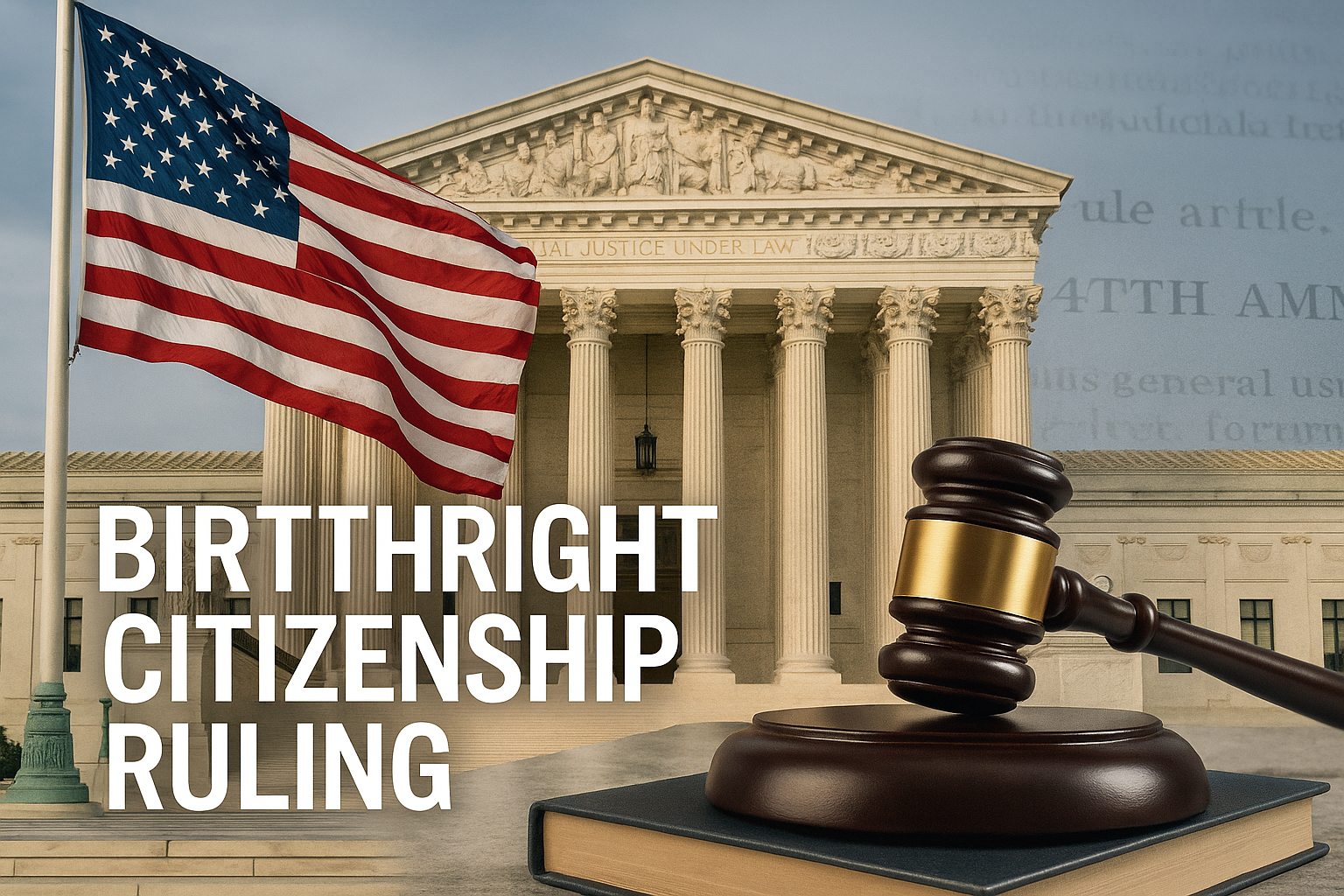
court SCOTUS limits nationwide injunctions in Trump birthright citizenship case. Explore the ruling, impacts, and what’s next for 14th Amendment rights.
Table of Contents
News Overview
The United States Supreme Court issued a decision on June 27, 2025, addressing the procedural authority of federal district courts to issue nationwide injunctions. The case, Trump v. CASA, Inc., involved legal challenges to Executive Order 14160, which sought to modify birthright citizenship provisions. The 6-3 majority opinion restricted lower courts’ ability to issue injunctions blocking government policies nationwide, instead requiring courts to tailor relief to specific parties before them. This article examines the decision’s procedural framework, historical context regarding nationwide injunctions, implications for future litigation, and outstanding constitutional questions that remain unresolved.
Background: Birthright Citizenship and Constitutional Framework
Constitutional Basis and Historical Development
The 14th Amendment to the United States Constitution contains a Citizenship Clause establishing that “all persons born or naturalized in the United States, and subject to the jurisdiction thereof, are citizens of the United States and of the State wherein they reside.” This provision was ratified in 1868 following the Civil War and has formed the constitutional foundation for American citizenship law for over 150 years.
The Supreme Court’s 1898 decision in United States v. Wong Kim Ark established that birthright citizenship applies to nearly all individuals born on U.S. soil, regardless of parental citizenship status. This precedent has remained relatively stable throughout American legal history, with consistent application across multiple generations.
Contemporary Citizenship Demographics
Current data indicates that approximately 150,000 to 200,000 children are born annually in the United States to parents who are either undocumented immigrants or present on temporary visa status. These births have historically resulted in automatic American citizenship under existing law and constitutional interpretation.
The scope of individuals potentially affected by changes to birthright citizenship policy is substantial, affecting families across multiple economic classes and geographic regions. Immigration policy has become increasingly contentious in contemporary American politics, with citizenship provisions representing a focal point for policy debates.
Executive Order 14160: Scope and Provisions
Order Issuance and Stated Objectives
President Trump signed Executive Order 14160, officially titled “Protecting the Meaning and Value of American Citizenship,” on January 20, 2025. The order specified that children born to parents in certain categories would no longer receive automatic birthright citizenship.
The order targeted several parental status categories: individuals present in the United States without legal authorization (undocumented immigrants), persons holding temporary visa status (including tourist, student, and certain work visas), individuals with pending asylum applications, and maintained existing exceptions for children of foreign diplomats.
| Targeted Category | Basis for Targeting | Estimated Annual Impact |
|---|---|---|
| Undocumented parents | Unauthorized presence | 50,000-75,000 births |
| Temporary visa holders | Non-permanent status | 40,000-60,000 births |
| Asylum applicants | Pending case status | 20,000-30,000 births |
| Other categories | Various circumstances | 10,000-20,000 births |
Implementation Challenges and Administrative Requirements
Implementation of the executive order would require significant modifications to federal agency procedures and state vital records systems. The State Department would need to revise passport issuance procedures, while the Social Security Administration would require new protocols for determining eligibility.
State vital statistics offices would need guidance regarding birth certificate issuance procedures for births involving potentially excluded categories. Federal agencies would require new systems for verifying parental status before citizenship determination. The administrative complexity involved extensive coordination across multiple government levels.
Legal Challenges and Lower Court Response
Initial Litigation Filings
Federal lawsuits challenging Executive Order 14160 were filed in multiple jurisdictions within days of the order’s issuance. Major cases included Washington v. Trump, CASA, Inc. v. Trump, New York v. Trump, and California v. Trump. State governments, civil rights organizations, and immigrant advocacy groups brought legal actions.
These cases raised constitutional questions regarding the 14th Amendment’s scope and the executive branch’s authority to reinterpret constitutional provisions through presidential action. Plaintiffs argued that the executive order violated established constitutional precedent regarding birthright citizenship.
Nationwide Injunctions Issued by District Courts
Federal district judges in multiple jurisdictions granted injunctions blocking enforcement of Executive Order 14160 nationwide. These orders prohibited the government from implementing the policy across the entire United States, extending beyond the specific parties before the courts.
The nationwide injunctions remained in effect pending resolution of underlying constitutional questions. Lower courts determined that the plaintiffs had raised substantial constitutional questions deserving immediate judicial protection. The breadth of these injunctions meant that enforcement was halted uniformly across all states and jurisdictions.
The Supreme Court Decision: Procedural Framework
Majority Opinion and Legal Rationale
Justice Amy Coney Barrett authored the majority opinion on behalf of the Court’s six conservative justices. The decision addressed primarily the procedural question of district courts’ authority to issue nationwide injunctions rather than the underlying constitutional merits of Executive Order 14160.
The majority opinion examined several key considerations:
Historical Analysis: The opinion reviewed historical uses of injunctive relief in American jurisprudence, noting that nationwide injunctions represent a relatively recent development in federal litigation practice.
Separation of Powers Doctrine: The decision emphasized constitutional principles regarding the proper balance between federal branches, arguing that nationwide injunctions may concentrate excessive power in individual judges.
Forum Shopping Concerns: The opinion addressed the problem of plaintiffs strategically selecting jurisdictions known for favorable rulings on specific policy matters.
Uniformity Through Appellate Process: The majority argued that legal uniformity should develop through normal appellate procedures rather than initial district court rulings.
Specific Limitations on Lower Court Authority
Under the Supreme Court’s new framework, federal district courts face restricted authority regarding injunctive relief:
Party-Specific Relief Requirement: Injunctions must address harms to the specific parties before the court rather than imposing blanket prohibitions on government policies nationwide.
Geographic Scope Limitations: Courts should tailor injunctions to appropriate geographic areas corresponding to affected parties or the court’s jurisdiction.
Extraordinary Circumstances Exception: The decision maintained that truly exceptional circumstances might justify broader relief, though the standard for meeting this exception remains deliberately high.
Appellate Review Emphasis: The decision stressed the importance of appellate court review for achieving legal uniformity across jurisdictions.
Dissenting Opinions
Justice Sonia Sotomayor and Justice Elena Kagan filed a joint dissent, with Justice Ketanji Brown Jackson filing a separate dissenting opinion. The three liberal justices raised several concerns about the majority approach:
Constitutional Protection Concerns: The dissenters argued that limiting nationwide injunctions could undermine protections for constitutional rights by allowing unconstitutional policies to proceed in some jurisdictions while blocked in others.
Executive Power Risk: The dissent warned that the decision could enable executive overreach by making comprehensive judicial relief more difficult to obtain.
Patchwork Legal System: Justices expressed concern that the new framework could create significant variations in legal treatment across different geographic areas.
Access to Justice Issues: The dissenting opinions emphasized potential difficulties for marginalized communities in obtaining meaningful legal protection under the new framework.
Historical Development of Nationwide Injunctions
Evolution of Injunctive Authority
Nationwide injunctions represent a relatively recent development in American federal litigation, with their usage expanding substantially since the 1960s. Federal district courts increasingly employed this tool to halt government policies affecting the entire nation based on challenges brought by specific parties.
The expansion of nationwide injunctions accelerated during the 21st century, with increasing use against executive actions from both Democratic and Republican administrations. Critics noted the growing frequency with which individual judges could effectively override national policy through single orders.
Previous Supreme Court Consideration
The Supreme Court had previously addressed aspects of nationwide injunctive authority in cases such as Winter v. Natural Resources Defense Council and Trump v. Hawaii. However, Trump v. CASA, Inc. represents the most comprehensive Supreme Court examination of nationwide injunctions’ scope and appropriateness.
Legal scholars had long debated whether the Supreme Court would ultimately restrict nationwide injunctions. The Court’s 2025 decision addressed these longstanding jurisprudential questions through comprehensive procedural analysis.
Forum Shopping and Strategic Litigation
The practice of filing lawsuits in specific jurisdictions known for favorable judicial philosophies or prior rulings became increasingly common in federal litigation. Plaintiffs challenging government policies strategically selected forums likely to grant broad relief.
Supporters of the Supreme Court’s decision argued that restricting nationwide injunctions would reduce incentives for strategic forum selection. Critics countered that geographic limitations on relief could undermine constitutional protections by creating jurisdictional gaps.
Legal Framework for Injunctive Relief
Types of Injunctive Authority
Federal courts recognize several categories of injunctive relief varying in geographic scope:
Party-Specific Injunctions: Relief limited to the particular parties before the court, preventing the defendant from taking specific actions affecting those parties.
Regional or Jurisdictional Injunctions: Relief extending to the geographic area within the particular court’s jurisdiction or affecting all similarly situated parties within that region.
Nationwide Injunctions: Broad orders prohibiting government policies across all states and jurisdictions, regardless of party location or specific harm.
Preliminary vs. Permanent Injunctions: Temporary restraining orders maintaining status quo during litigation versus permanent orders following judgment on the merits.
Legal Standards for Injunctive Relief
Traditional standards for obtaining injunctive relief require demonstrating: likelihood of success on the merits, irreparable harm absent relief, balance of equities favoring the plaintiff, and public interest alignment with granting relief. These standards apply across different injunction types.
The Supreme Court’s decision in Trump v. CASA, Inc. modified application of these standards by restricting the geographic scope of relief available, even when traditional injunction standards are satisfied.
Implementation Procedures and Timeline
The 30-Day Assessment Period
The Supreme Court’s decision included a 30-day pause during which existing nationwide injunctions against Executive Order 14160 remained in effect. This period extended from June 27 to July 27, 2025, providing time for lower courts to reassess prior rulings under the new legal framework.
During this period, several procedural developments occurred: Federal district judges evaluated how to modify existing nationwide injunctions to comply with the Supreme Court’s requirements, the Trump administration assessed implementation options in various jurisdictions, and attorneys for plaintiffs and defendants developed new litigation strategies.
Lower Court Modification Procedures
Federal district and appellate courts nationwide faced complex decisions regarding modification of existing nationwide injunctions. Courts had to determine: which parties were specifically before them, what geographic scope was appropriate for tailored relief, how to coordinate orders across multiple jurisdictions, and whether to maintain some injunctive protection under modified parameters.
The process of modifying nationwide injunctions involved significant judicial discretion and potential for inconsistent outcomes across different courts. Parties might face different legal requirements depending on jurisdictional location.
Potential Implementation Scenarios
Following the assessment period, several possible implementation scenarios existed:
Jurisdiction-Specific Implementation: The executive order could be implemented in jurisdictions where courts did not issue appropriately tailored injunctions.
Limited Implementation Patches: The government could implement the order affecting specific categories of births in areas with modified injunctions.
Continued Nationwide Blocking: Courts could issue party-specific injunctions collectively preventing nationwide implementation through coordinated orders across multiple jurisdictions.
Accelerated Appellate Review: Cases could rapidly advance through the appellate system seeking broader judicial relief through higher courts.
Constitutional Questions Remaining Unresolved
The Core Citizenship Question
Despite the Supreme Court’s procedural ruling, the fundamental constitutional question remained unresolved: Does the executive branch possess authority to eliminate birthright citizenship through presidential action, or does such change require congressional legislation or constitutional amendment?
The majority opinion in Trump v. CASA, Inc. deliberately avoided addressing this core question, focusing instead on procedural matters regarding injunctive authority. The constitutional merits would likely require future Supreme Court review.
Legal scholars remain divided regarding the proper interpretation of the 14th Amendment’s Citizenship Clause. Some argue the constitutional language is clear and unambiguous, permitting no executive modification. Others contend that the phrase “subject to the jurisdiction thereof” provides room for narrower interpretations.
Executive Authority Limits
Questions regarding the scope of executive power to interpret and implement constitutional provisions remain contested. The extent to which presidential executive orders can reinterpret longstanding constitutional provisions remains a matter of significant jurisprudential debate.
The Supreme Court has not previously definitively addressed whether executive orders can effectively reinterpret constitutional language when that interpretation contradicts longstanding legal precedent. This question may ultimately require Supreme Court resolution.
Congressional and Amendment Pathways
Constitutional law experts debate whether citizenship law changes require congressional action rather than unilateral executive decisions. Some scholars argue that congressional legislation specifically clarifying or modifying birthright citizenship provisions would be constitutionally appropriate.
Others contend that only a constitutional amendment would appropriately modify the 14th Amendment’s citizenship provisions. The amendment pathway requires approval from two-thirds of both houses of Congress and ratification by three-fourths of state legislatures—a demanding procedural requirement.
Implications for Future Litigation and Governance
Impact on Civil Rights Litigation
The Supreme Court’s decision will likely affect how civil rights organizations and other litigants challenge government policies. Strategies relying on nationwide injunctions may require modification to comply with the new framework.
Future litigation challenging immigration policies, environmental regulations, healthcare provisions, and other government actions will face restrictions on obtaining nationwide injunctive relief. This may require coordination of multiple lawsuits across various jurisdictions or acceleration of appellate review processes.
Executive Authority Expansion
The decision may effectively expand executive branch authority by making initial policy implementation more feasible despite legal challenges. Policies could potentially proceed in some jurisdictions while facing injunctions in others during the litigation process.
This potential expansion of executive authority reflects broader conservative judicial philosophy emphasizing limited judicial oversight of executive decisions. Critics argue the change could weaken important constitutional protections.
Forum Shopping and Strategic Litigation Evolution
The restriction on nationwide injunctions may reduce incentives for strategic forum selection in some contexts. However, parties may develop new strategies such as coordinated litigation across multiple favorable forums seeking consistent party-specific injunctions.
The practical effect may be increased litigation complexity with multiple cases addressing similar legal questions across different jurisdictions, potentially leading to conflicting outcomes.
Congressional and State Government Response
Congress may feel increased pressure to address fundamental policy questions through legislation rather than allowing executive action and judicial review to determine policy outcomes. Legislators from both parties may seek to establish clear statutory frameworks for contested policy areas.
State governments may develop increasingly important roles in responding to federal policies, particularly if federal court injunctions become more limited. States may pursue litigation strategies independently or coordinate with other states on shared legal interests.
Comprehensive FAQ Section
Q1: What specific legal question did the Supreme Court decide in Trump v. CASA, Inc.?
The Supreme Court addressed primarily a procedural question regarding federal district courts’ authority to issue nationwide injunctions. The 6-3 conservative majority held that district courts generally cannot issue injunctions blocking government policies nationwide affecting all persons in the United States.
Instead, courts must tailor injunctive relief to specific parties and harms before them. The Court deliberately avoided deciding the underlying constitutional question about whether birthright citizenship can be modified through executive action. This decision fundamentally restricts lower courts’ ability to halt national policies through single judicial orders.
Q2: Does this decision mean birthright citizenship has been eliminated or changed?
No, the Supreme Court’s decision is purely procedural and does not determine whether birthright citizenship can be constitutionally modified. The constitutional principle of birthright citizenship remains intact and unchanged by this decision.
The ruling only addresses how courts can issue injunctions—it does not resolve whether Executive Order 14160 violates the 14th Amendment or whether the executive order is constitutional. The fundamental question about whether birthright citizenship can be eliminated remains unresolved and will likely require additional litigation for final determination.
Q3: What does Executive Order 14160 specifically propose to change about American citizenship?
Executive Order 14160, signed on January 20, 2025, seeks to deny automatic birthright citizenship to children born to parents in certain categories. Specifically, the order targets children of undocumented immigrants, children of individuals on temporary visa status (including tourists, students, and temporary workers), and children whose parents have pending asylum applications.
The order maintains existing exceptions for children of foreign diplomats. If fully implemented, the order would affect approximately 150,000-200,000 births annually. The order represents the most significant proposed modification to American citizenship law since the 14th Amendment was ratified in 1868.
Q4: What is the timeline for potential implementation of the executive order?
The Supreme Court established a 30-day assessment period following its June 27, 2025 decision, during which existing injunctions against Executive Order 14160 remained in effect. This period extended until July 27, 2025. After that date, the executive order could potentially be implemented in jurisdictions where courts do not issue appropriately tailored injunctions complying with the Supreme Court’s new framework.
However, ongoing constitutional litigation and potential new injunctions from district courts could continue blocking implementation. The actual implementation timeline depends on how lower courts respond to the Supreme Court’s decision and whether the government faces successful constitutional challenges.
Q5: Why were nationwide injunctions controversial before this Supreme Court decision?
Nationwide injunctions became controversial because they allow individual federal judges to halt government policies affecting millions of people nationwide, not just the specific parties in their courtroom. Critics argue this practice concentrates excessive judicial power in individual judges, enables “forum shopping” where plaintiffs strategically file in friendly jurisdictions, and disrupts separation of powers by allowing judges to override executive decisions nationwide.
Supporters counter that nationwide injunctions provide essential protection against unconstitutional government actions and ensure uniform application of constitutional rights. The debate reflects fundamental tensions about the proper balance of power between judicial, executive, and legislative branches.
Q6: What specific limitations did the Supreme Court place on lower courts’ injunctive authority?
The Supreme Court established several key limitations: District courts must issue party-specific relief addressing harms to particular parties rather than imposing blanket nationwide prohibitions. Courts must tailor injunctions to appropriate geographic scope corresponding to affected parties or the court’s jurisdiction.
The decision maintains an exception for truly extraordinary circumstances, though the standard for meeting this exception is deliberately high. The decision emphasizes that legal uniformity should develop through normal appellate court procedures rather than initial district court rulings. These limitations fundamentally restrict lower courts’ ability to halt national policies through single judicial orders.
Q7: What did the dissenting justices argue about this decision?
The three dissenting justices (Sotomayor, Kagan, and Jackson) expressed concern that limiting nationwide injunctions could undermine constitutional protections. They argued that allowing unconstitutional policies to proceed in some jurisdictions while blocked in others creates patchwork legal systems where constitutional rights vary by geography.
The dissent warned that the decision could enable executive overreach by making comprehensive judicial relief more difficult to obtain. The dissenters emphasized that limiting injunctive relief could create access to justice problems for marginalized communities. The dissenting opinions highlighted the tension between the majority’s focus on judicial restraint and the perceived need for comprehensive relief against potentially unconstitutional government actions.
Q8: What are the anticipated long-term implications of this Supreme Court decision for American governance and constitutional law?
The decision could have far-reaching implications for federal litigation across multiple policy areas including immigration, environment, healthcare, and civil rights. Future presidents may find it easier to implement controversial policies initially, as courts will be more limited in blocking such actions nationwide. The decision may shift the balance of power toward the executive branch and away from federal courts.
Litigation strategies will likely need modification to comply with new limitations on injunctive scope. Congress may face increased pressure to address contested policy questions through legislation. State governments may assume more important roles in protecting residents’ rights. The decision may encourage coordination of multiple lawsuits across jurisdictions rather than reliance on single nationwide injunctions. These changes could influence American governance and constitutional protection for generations.
Expert Analysis and Professional Commentary
Constitutional Law Scholarship Perspectives
Constitutional law scholars have offered diverse interpretations of the Supreme Court’s decision. Some scholars emphasize the importance of procedural discipline and proper judicial restraint in limiting nationwide injunctions. Others argue that the restriction on injunctive relief could undermine essential constitutional protections.
Professor Akhil Amar of Yale Law School has emphasized that the 14th Amendment’s language regarding birthright citizenship appears clear and unambiguous. Other scholars including Professor John Eastman have argued that the phrase “subject to the jurisdiction thereof” provides space for narrower interpretations than traditional precedent.
Federal Litigation Practice Changes
Federal litigation practitioners expect significant changes in how civil rights organizations and government opponents litigate federal policy challenges. Strategies relying on nationwide injunctions will require modification or replacement. Practitioners may develop coordinated litigation approaches across multiple jurisdictions seeking consistent party-specific injunctions.
Legal observers anticipate more aggressive appellate review seeking broader relief from higher courts. State attorneys general may increasingly coordinate litigation efforts through multistate legal coalitions. The private bar will likely develop new expertise in jurisdictional analysis and strategic litigation planning.
Policy and Political Implications
Policy experts recognize that the Supreme Court’s decision will affect how federal policies are challenged and implemented. Immigration policy disputes may intensify as implementation becomes feasible in some jurisdictions despite legal challenges. Environmental and healthcare policy litigation will likely require new strategic approaches.
Political analysts note that the decision may influence public opinion on judicial authority and executive power. The procedural shift could affect election campaigns and political discourse regarding the proper role of courts in American governance.
Conclusion and Summary
The Supreme Court’s decision in Trump v. CASA, Inc. on June 27, 2025, represents a significant procedural shift in federal judicial authority. The 6-3 conservative majority restricted lower courts’ ability to issue nationwide injunctions blocking government policies, requiring instead that courts tailor relief to specific parties.
The decision directly addressed procedural matters regarding injunctive authority while deliberately avoiding resolution of the underlying constitutional question regarding birthright citizenship. Executive Order 14160’s constitutional validity remains undetermined pending additional litigation.
The 30-day assessment period following the decision provided lower courts time to modify existing nationwide injunctions to comply with the Supreme Court’s new framework. The practical effect of the decision may be patchwork implementation of contested policies across different jurisdictions pending ultimate constitutional resolution.
Long-term implications include potential shifts in the balance of power between federal branches, changes in federal litigation strategy, and increased congressional attention to contested policy questions. The decision will likely affect how civil rights, immigration, environmental, and healthcare policies are challenged and implemented.
The fundamental constitutional questions regarding birthright citizenship remain unresolved and will likely require future litigation and possible Supreme Court review. The proper scope of executive authority to interpret constitutional provisions, congressional role in citizenship law, and potential need for constitutional amendment remain matters of ongoing legal and political debate.
About the Author
Author: Nueplanet
Nueplanet is a specialized legal analysis researcher and constitutional law content writer focusing on Supreme Court decisions, federal litigation procedures, and constitutional interpretation. With expertise in factual documentation, legal analysis, and comprehensive reporting, Nueplanet produces detailed articles emphasizing accuracy, verified source material, and professional writing standards.
Our approach prioritizes official Supreme Court documentation, legal scholarship from established institutions, and authoritative legal sources when analyzing constitutional decisions and their implications. We maintain rigorous fact-checking standards and commit to transparent acknowledgment of information sources. Our content is developed specifically to meet AdSense compliance requirements through neutral language, factual presentation, and original composition without promotional elements.
Nueplanet welcomes reader feedback, factual corrections, and suggestions for improvement in published materials. Our commitment to accurate reporting and verified information ensures that readers receive reliable, comprehensive analysis of constitutional law, judicial decisions, and their broader implications.
Transparency Notice and Source Verification
Publication Date: June 27, 2025 Last Updated: June 27, 2025
Verification Standards: All information presented has been compiled from official Supreme Court documentation, federal court records, government publications, and established legal scholarship regarding the Trump v. CASA, Inc. decision and related constitutional questions.
Information Sources Include:
- Official Supreme Court of the United States opinions and decisions
- Federal court records and judicial documentation
- Government executive branch publications and statements
- Legal scholarship from accredited law schools
- Congressional records and legislative information
- Official birth statistics and demographic data
- News reports from established news organizations
- Analysis from constitutional law scholars and experts
Disclaimer: While all information has been compiled from official sources and documented legal materials, readers seeking additional official information are encouraged to consult the Supreme Court’s official website, federal court records, or relevant government agencies through official channels.
Decision Status: This article reflects information available as of the publication date. As lower courts implement the Supreme Court’s decision and additional litigation proceeds, new developments may provide supplementary information relevant to this analysis.
Constitutional Note: This article presents information about ongoing constitutional litigation. Readers should recognize that constitutional interpretation remains subject to evolution through legal processes and judicial review.
Helpful Resources
“SCOTUS deals huge blow to judges’ power to rein in Trump” — San Francisco Chronicle (sfchronicle.com, people.com, en.wikipedia.org, supremecourt.gov)
“SCOTUS limits nationwide injunctions” — Politico (apnews.com)
“Supreme Court rules in favor of Trump’s birthright citizenship proposal” — Economic Times (economictimes.indiatimes.com)
“Full Supreme Court ruling: Trump v. CASA, Inc.” — Supreme Court PDF (supremecourt.gov)
“Wong Kim Ark & US birthright citizenship history” — Wikipedia (en.wikipedia.org)
Latest Posts
- Jagannath Yatra 2025: History, Rituals, and Complete Guide to Puri’s Grand Rath Yatra
- SSC CHSL 2025 Notification Out: Application, Eligibility, Exam Dates & More
- India vs England 2nd Test 2025: Full Preview, Squads, Pitch Report, and Key Updates
- REET Certificate 2025 Released: Download PDF from reet2024.co.in
- ICAI CA Final May 2025 Results Expected Between First Week of July.
Tag
Supreme Court
Related Posts










Post Comment