









SSC CHSL 2025 Amazing Ultimate Guide: Master Your Government Job Dreams with Complete Exam Preparation Strategy
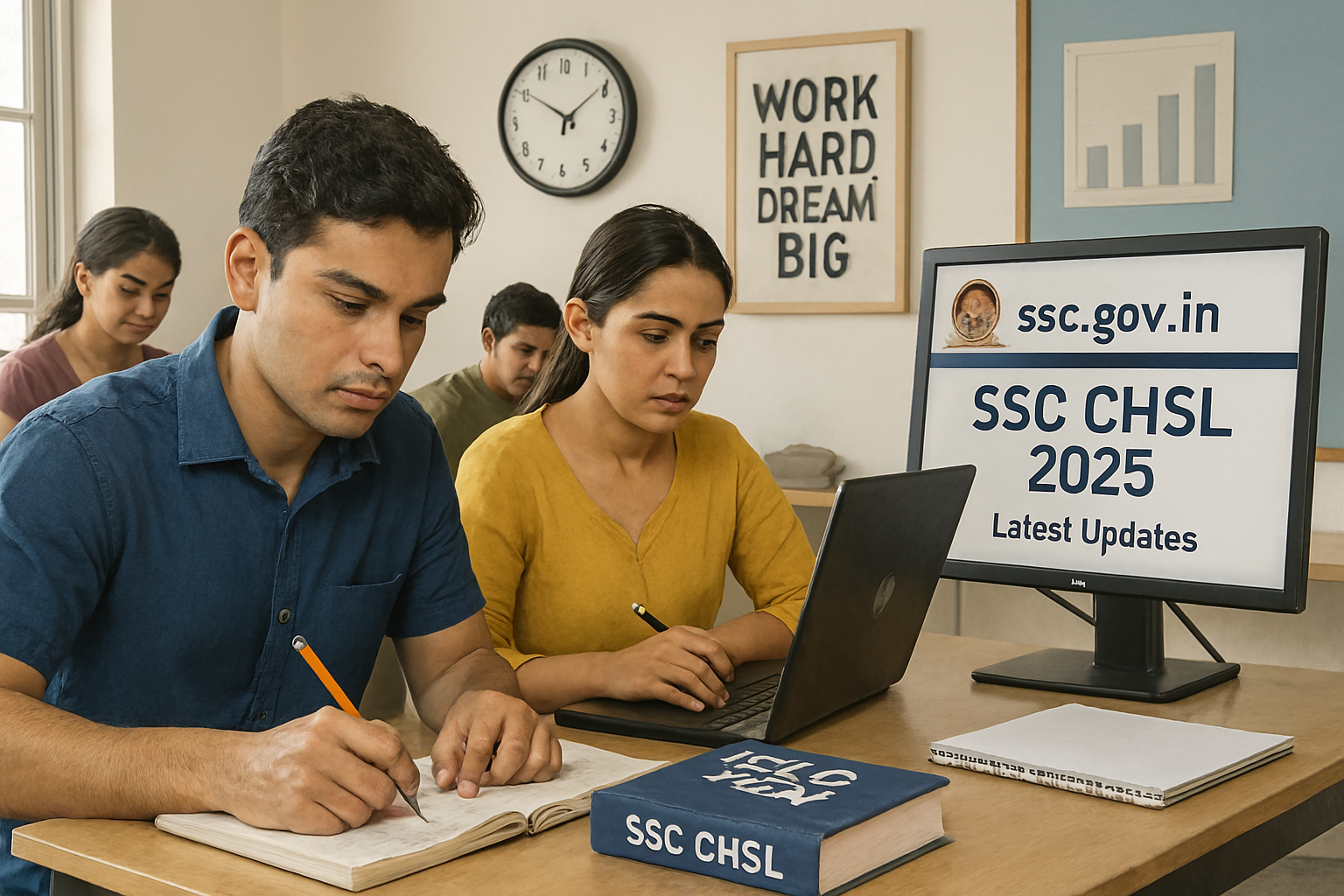
SSC CHSL 2025 is a major government exam for aspirants aiming for clerical and data entry posts. This guide covers exam dates, syllabus, eligibility, preparation tips, and the latest updates on postponements.
Table of Contents
The Staff Selection Commission Combined Higher Secondary Level examination for 2025 has undergone significant scheduling adjustments that affect thousands of aspirants across India. This comprehensive analysis examines the official announcements, revised timelines, and strategic preparation approaches for candidates pursuing central government employment opportunities.
The SSC CHSL examination serves as a critical recruitment mechanism for multiple government positions including Lower Division Clerk, Junior Secretariat Assistant, Postal Assistant, and Data Entry Operator roles. These positions represent stable career opportunities within India’s administrative framework, offering competitive compensation and long-term employment security.
Overview of SSC CHSL 2025 Examination Structure
Purpose and Scope
The Combined Higher Secondary Level examination functions as a standardized recruitment process for central government departments. The Staff Selection Commission conducts this assessment to fill clerical and administrative positions across various ministries and organizations. Candidates who successfully complete all examination tiers become eligible for government appointments based on merit rankings and position availability.
The examination assesses multiple competencies including logical reasoning, mathematical aptitude, language proficiency, and general awareness. This multi-dimensional evaluation ensures selected candidates possess necessary skills for effective government service. The three-tier structure provides comprehensive assessment of both theoretical knowledge and practical abilities.
Official Examination Components
Tier 1: Computer-Based Test The initial screening consists of objective multiple-choice questions across four subjects. Candidates receive 60 minutes to complete 100 questions carrying 200 total marks. Each correct response earns 2 marks while incorrect answers result in 0.5 mark deduction. This tier determines qualification for subsequent assessment stages.
Tier 2: Descriptive Assessment Qualified candidates proceed to descriptive writing evaluation testing essay composition and letter drafting abilities. This 60-minute assessment carries 100 marks and evaluates written communication skills essential for administrative roles. Candidates must demonstrate clear expression, proper grammar usage, and logical content organization.
Tier 3: Skill/Typing Verification The final tier involves position-specific skill assessments including typing speed tests for relevant posts. Candidates must achieve minimum proficiency standards in designated languages. This practical evaluation confirms candidates possess necessary technical competencies for their selected positions.
Recent Schedule Modifications and Official Updates
Postponement Announcement Details
The Staff Selection Commission announced revised timelines for SSC CHSL 2025 Tier 1 examinations during July 2025. The initial September 2025 examination dates required adjustment due to administrative considerations and logistical coordination requirements. Official communications through ssc.gov.in confirmed the postponement while assuring candidates of transparent rescheduling processes.
This modification affects approximately several lakh registered candidates across examination centers nationwide. The Commission emphasized commitment to maintaining examination integrity while ensuring optimal testing conditions. Candidates received notifications through registered contact information and official website announcements.
Revised Timeline Framework
| Stage | Previous Schedule | Updated Status |
|---|---|---|
| Notification Release | July 2025 | Completed |
| Application Period | July-August 2025 | Extended |
| Tier 1 Examination | Early September 2025 | Rescheduled (TBA) |
| Admit Card Release | 4 days before exam | Per revised dates |
| Tier 1 Results | September 2025 | October-November 2025 |
| Tier 2 Descriptive Test | October 2025 | November-December 2025 |
| Tier 3 Skills Assessment | November 2025 | December 2025-January 2026 |
| Final Result Declaration | December 2025 | January-February 2026 |
The postponement creates additional preparation time for registered candidates. However, this extension applies uniformly across all applicants, maintaining competitive parity. Candidates should utilize this period for comprehensive syllabus coverage and practice enhancement rather than relaxed preparation approaches.
Official Communication Channels
The Staff Selection Commission maintains ssc.gov.in as the exclusive source for authentic examination information. All official notifications regarding date announcements, admit card availability, result publications, and procedural updates appear exclusively through this portal. Regional SSC offices provide supplementary information through their designated websites.
Candidates must exercise caution regarding unofficial information sources including social media platforms and third-party websites. Relying on unverified channels may lead to misinformation affecting preparation strategies and examination readiness. Direct monitoring of official SSC communications ensures access to accurate and timely information.
Historical Context and Examination Significance
Evolution of Standardized Government Recruitment
The Combined Higher Secondary Level examination emerged from efforts to standardize government recruitment processes across central departments. Prior to systematic examination frameworks, recruitment procedures varied significantly across organizations, creating inconsistencies in candidate evaluation and selection. The SSC CHSL examination established uniform assessment standards ensuring merit-based selection.
Over successive years, the examination has incorporated technological advancements and methodological improvements. The transition from paper-based to computer-based testing enhanced efficiency and reduced processing timelines. These developments have strengthened examination credibility while improving candidate experience.
Position Categories and Responsibilities
Lower Division Clerk (LDC) These positions involve general administrative duties including record maintenance, file management, and routine correspondence. LDCs support departmental operations through efficient documentation and information processing. The role requires organizational skills, attention to detail, and basic computer proficiency.
Junior Secretariat Assistant (JSA) JSA positions entail secretarial support functions within government secretariats. Responsibilities include drafting routine correspondence, maintaining official records, and coordinating departmental communications. This role demands strong language skills and understanding of administrative procedures.
Postal Assistant (PA) Postal Assistants perform operational duties within postal department offices. Tasks include mail sorting, counter services, financial transactions, and customer assistance. The position requires numerical ability, customer service skills, and familiarity with postal operations.
Data Entry Operator (DEO) DEO positions focus on accurate data input and database maintenance across government information systems. These roles require typing proficiency, attention to accuracy, and understanding of data management principles. DEOs contribute to digital record-keeping and information accessibility initiatives.
Eligibility Parameters and Application Requirements
Educational Qualifications
Candidates must have completed 12th standard education from recognized educational boards or equivalent qualifications. This requirement ensures basic educational competency necessary for understanding administrative procedures and performing assigned duties. Candidates from all academic streams including science, commerce, and humanities qualify for application.
The Commission accepts various equivalent qualifications including senior secondary certificates, intermediate examinations, and higher secondary completion certificates. Candidates must verify their qualification validity through official SSC guidelines before application submission. Educational certificates require verification during document submission stages.
Age Specifications
| Category | Minimum Age | Maximum Age | Age Calculation Date |
|---|---|---|---|
| General/EWS | 18 years | 27 years | August 1, 2025 |
| OBC | 18 years | 30 years | August 1, 2025 |
| SC/ST | 18 years | 32 years | August 1, 2025 |
| PwD (General) | 18 years | 37 years | August 1, 2025 |
| PwD (OBC) | 18 years | 40 years | August 1, 2025 |
| PwD (SC/ST) | 18 years | 42 years | August 1, 2025 |
Age relaxation provisions follow government reservation policies ensuring equitable opportunities across demographic categories. Ex-servicemen receive additional age relaxation based on military service duration. Candidates must calculate their age as of the specified reference date for determining eligibility.
Nationality Requirements
Applicants must be Indian citizens, subjects of Nepal, subjects of Bhutan, or Tibetan refugees who arrived in India before January 1, 1962. Persons of Indian origin migrating from specified countries also qualify under certain conditions. These nationality provisions align with central government employment policies.
Candidates from specific categories require certificates of eligibility from Government of India authorities. The application process includes declaration of nationality status with supporting documentation. Verification occurs during document submission following successful examination completion.
Comprehensive Subject-wise Preparation Framework
General Intelligence and Reasoning (50 Marks)
This section evaluates logical thinking, pattern recognition, and problem-solving abilities through 25 questions. Topics include analogies, classification, series completion, coding-decoding, blood relations, direction sense, and logical sequences. Success requires understanding question patterns and developing systematic solving approaches.
Key Topic Areas:
- Analogies and classifications requiring relationship identification
- Series completion involving number, letter, and mixed sequences
- Coding-decoding problems using substitution and pattern logic
- Blood relation questions testing family relationship understanding
- Direction and distance calculations assessing spatial reasoning
- Logical venn diagrams evaluating set relationships
- Statement-conclusion problems requiring logical inference
Effective preparation involves daily practice of 30-40 reasoning questions covering different difficulty levels. Candidates should maintain error logs identifying weak areas requiring focused attention. Understanding question patterns through previous year paper analysis reveals frequently tested concepts. Time management practice ensures completing all questions within allocated duration.
Quantitative Aptitude (50 Marks)
Mathematical proficiency assessment covers arithmetic, algebra, geometry, and trigonometry through 25 questions. Topics emphasize practical problem-solving rather than theoretical complexity. Candidates require strong fundamental concepts combined with calculation speed for optimal performance.
Primary Content Areas:
- Number systems including HCF, LCM, and divisibility rules
- Percentage calculations and their practical applications
- Profit and loss problems involving commercial mathematics
- Time and work questions requiring efficiency calculations
- Time, speed, and distance problems with relative motion
- Simple and compound interest financial calculations
- Ratio and proportion applications across contexts
- Algebra basics including linear equations and simplification
- Geometry fundamentals covering triangles, circles, and mensuration
- Trigonometry basics involving angle relationships
Preparation strategy should prioritize accuracy over speed initially, gradually building solving velocity through consistent practice. Creating formula reference sheets facilitates quick revision and examination day reference. Mental calculation techniques reduce dependency on paper calculations, improving time efficiency. Regular practice of 25-30 questions daily across topics maintains skill sharpness.
General Awareness (50 Marks)
This section assesses knowledge of current events, Indian polity, geography, history, economics, science, and culture through 25 questions. The broad scope requires systematic study approaches and consistent information updating. Success combines static knowledge with current affairs awareness.
Content Distribution:
- Current affairs covering national and international developments (40-50%)
- Indian polity including constitution, governance, and political system (15-20%)
- Geography covering Indian and world physical and economic geography (10-15%)
- Indian history focusing on freedom movement and post-independence era (10-15%)
- General science emphasizing physics, chemistry, and biology basics (10-15%)
- Economics covering basic concepts and Indian economic development (5-10%)
- Indian culture including art, literature, and heritage (5-10%)
Daily newspaper reading forms the foundation for current affairs preparation. Candidates should focus on national dailies covering political, economic, social, and international developments. Monthly current affairs compilations enable systematic revision of important events. Creating topic-wise notes facilitates efficient revision and long-term retention.
English Language (50 Marks)
Language proficiency evaluation tests grammar knowledge, vocabulary, comprehension abilities, and sentence construction through 25 questions. This section assesses communication skills essential for administrative roles requiring clear written expression and understanding.
Assessment Components:
- Spotting errors in grammatical construction and usage
- Sentence improvement requiring appropriate expression selection
- Fill in the blanks testing vocabulary and contextual understanding
- Synonyms and antonyms evaluating word knowledge
- Spelling correction identifying commonly misspelled words
- Idioms and phrases assessing figurative language understanding
- One-word substitution testing vocabulary range
- Reading comprehension passages with multiple questions
Grammar fundamentals require thorough understanding including tenses, articles, prepositions, conjunctions, and sentence structure. Vocabulary building should occur through contextual learning rather than isolated memorization. Regular reading of quality English content improves comprehension speed and vocabulary naturally. Practicing previous year questions reveals frequently tested grammar concepts and question patterns.
Strategic Preparation Methodologies
Study Schedule Development
Effective preparation requires structured study schedules allocating adequate time across subjects based on individual strengths and weaknesses. Candidates should create realistic timetables accommodating personal circumstances while ensuring comprehensive syllabus coverage. Consistent daily study proves more effective than irregular intensive sessions.
Sample Daily Schedule Framework:
- Morning session (2-3 hours): Strong subject or new topic learning
- Afternoon session (2 hours): Practice questions and problem solving
- Evening session (1-2 hours): Current affairs reading and revision
- Night session (1 hour): Previous day topic revision and self-assessment
Schedules require flexibility accommodating energy levels and concentration patterns. Some candidates perform optimally during morning hours while others prefer evening study. Identifying personal peak productivity periods enables efficient time utilization. Regular breaks prevent mental fatigue and maintain sustained concentration.
Mock Test Integration
Regular mock test practice simulates actual examination conditions while providing performance feedback. Taking full-length tests under timed conditions builds stamina and reduces examination anxiety. Mock tests reveal time management issues, accuracy patterns, and knowledge gaps requiring attention.
Mock Test Strategy:
- Initial phase: One mock test weekly focusing on completion
- Intermediate phase: Two mock tests weekly with time constraints
- Final phase: Three mock tests weekly with strict timing
- Post-test analysis: Detailed error review and concept clarification
Analysis should identify patterns including repeatedly missed question types, time-consuming sections, and silly mistakes. This analysis guides subsequent preparation focus and strategy refinement. Comparing performance across successive tests tracks improvement and maintains motivation.
Revision Techniques
Systematic revision consolidates learned concepts and prevents forgetting. Multiple revision cycles with decreasing intervals optimize long-term retention. Creating concise notes facilitates quick revision without reviewing entire study material.
Effective Revision Approaches:
- First revision: Within 24 hours of initial learning
- Second revision: After 7 days reinforcing memory traces
- Third revision: After 30 days for long-term retention
- Regular revision: Monthly cycles for sustained recall
Formula sheets, important facts compilations, and concept summaries enable efficient last-minute revision. Visual learning aids including diagrams, flowcharts, and mind maps enhance recall for visual learners. Group discussions provide alternative perspectives and clarify doubts through peer interaction.
Tier 2 Descriptive Writing Preparation
Essay Composition Skills
Descriptive paper essay questions typically present social, economic, or current affairs topics requiring structured analysis. Essays must demonstrate clear thinking, logical argument progression, and comprehensive topic understanding. Word limits generally range from 200-250 words requiring concise yet complete expression.
Essay Structure Components:
- Introduction: Topic context and thesis statement (25-30 words)
- Body paragraphs: Main arguments with supporting details (130-180 words)
- Conclusion: Summary and final perspective (30-40 words)
Topic familiarity comes from regular current affairs reading and analytical thinking development. Practicing diverse topics builds writing versatility and reduces examination anxiety. Time management practice ensures completing essays within allocated duration while maintaining quality.
Letter and Application Writing
Formal letter writing requires understanding various formats and appropriate language usage. Common letter types include applications, complaints, requests, and official correspondence. Letters must follow proper structure including addresses, dates, subject lines, salutations, body content, and closings.
Letter Writing Elements:
- Sender’s address positioned appropriately based on format
- Date placement following standard conventions
- Receiver’s address with proper designation and organization
- Subject line summarizing letter purpose concisely
- Salutation using appropriate formal greeting
- Body paragraphs organized logically with clear purpose
- Complimentary closing with signature and name
Regular practice of different letter types builds familiarity with formats and improves writing speed. Understanding common scenarios enables quick content organization during examination. Maintaining formal language tone without excessive complexity ensures clarity and professionalism.
Position-Specific Skill Test Preparation
Typing Speed Requirements
Data Entry Operator positions require minimum typing speeds of 8,000 key depressions per hour (35 words per minute approximately) in English or 30 words per minute in Hindi. Lower Division Clerk positions in certain departments may also require typing skills. These requirements ensure candidates possess necessary operational competencies.
Typing Skill Development:
- Initial phase: Focus on accuracy without speed pressure
- Intermediate phase: Gradually increase speed while maintaining accuracy
- Advanced phase: Practice at examination speeds with error minimization
- Final phase: Sustained practice at required speeds building consistency
Online typing tutors and practice software provide structured learning environments with progress tracking. Regular daily practice of 30-45 minutes builds muscle memory and improves speed naturally. Familiarity with examination keyboard layout reduces adjustment time during actual tests.
Computer Proficiency Verification
Some positions require basic computer skills assessments evaluating familiarity with common software applications and computer operations. These tests ensure candidates can effectively utilize technology in modern government work environments. Preparation involves hands-on practice with standard office software.
Basic computer knowledge includes operating system navigation, file management, word processing, spreadsheet applications, and internet usage. Candidates should gain practical experience with commonly used government software applications. Understanding computer fundamentals prevents technical difficulties during skill tests.
Financial Implications and Career Benefits
Compensation Structure
SSC CHSL positions offer competitive salary packages within central government pay scales. The pay matrix system provides structured compensation with regular increments and advancement opportunities.
| Position | Pay Level | Basic Pay Range (₹) | Grade Pay |
|---|---|---|---|
| LDC/JSA | Level 2 | 19,900 – 63,200 | 1,900 |
| PA/SA | Level 4 | 25,500 – 81,100 | 2,400 |
| DEO | Level 4 | 25,500 – 81,100 | 2,400 |
Additional allowances significantly enhance total compensation including Dearness Allowance (DA) based on inflation indices, House Rent Allowance (HRA) varying by city classification, and Transport Allowance for commuting expenses. Medical benefits, leave travel concessions, and pension provisions add substantial value beyond basic salary.
Long-term Career Advantages
Government employment provides exceptional job security unaffected by economic fluctuations or organizational restructuring. Employees receive regular promotions through time-bound advancement and departmental promotion examinations. Many employees advance to officer-level positions through internal assessments and additional qualifications.
Comprehensive benefits packages include medical coverage for employees and dependents, education allowances for children, housing assistance programs, and pension security after retirement. These benefits create substantial financial value across career spans and retirement years.
Work-Life Balance Characteristics
Central government positions typically maintain defined working hours reducing unpredictable overtime requirements. Generous leave policies include earned leave, casual leave, and special leave categories. This balance enables personal pursuits, family time, and health maintenance alongside professional responsibilities.
Government employees report high job satisfaction due to meaningful public service contributions and stable work environments. The prestige associated with government service enhances social standing and community respect. These psychological benefits complement tangible financial advantages.
Analysis of Competitive Landscape
Application and Selection Statistics
SSC CHSL examinations attract lakhs of applications annually across India. Competition ratios vary significantly across position categories and regional preferences. Understanding competitive dynamics helps candidates develop realistic expectations and appropriate preparation intensity.
Historical Application Trends:
- Total applications typically exceed 40 lakh registrations
- Actual examination appearance rates approximately 60-70% of registrations
- Tier 1 qualification rates approximately 1-2% of appeared candidates
- Final selection rates vary based on vacancy announcements
These statistics demonstrate the examination’s competitive nature requiring thorough preparation and strategic examination approach. However, focused preparation significantly improves success probability regardless of overall competition levels.
Regional Variations
Competition intensity varies across states and examination centers based on local educational infrastructure and government employment preferences. Metropolitan examination centers typically experience higher competition compared to smaller city locations. Position preferences also vary regionally based on local employment market conditions.
Candidates should focus on personal preparation quality rather than competitive statistics. Comprehensive subject mastery and effective examination strategy enable success regardless of application numbers. Comparing performance against syllabus standards proves more productive than competitor comparisons.
Post-Selection Process and Appointment
Document Verification Procedures
Qualified candidates undergo detailed document verification following final result declaration. Required documents include educational certificates, identity proof, category certificates, and character verification. Candidates must present original documents alongside self-attested copies for official verification.
Document discrepancies or incomplete submissions may result in candidature cancellation despite successful examination performance. Ensuring document availability and accuracy before examination prevents complications during appointment processing. Candidates should verify document requirements through official notifications.
Medical Examination Requirements
Selected candidates undergo medical fitness assessments ensuring ability to perform assigned duties. Medical standards vary based on position requirements and departmental specifications. Candidates must meet prescribed health criteria for appointment confirmation.
Medical examinations typically assess vision, hearing, physical fitness, and absence of conditions affecting work performance. Candidates with medical concerns should verify specific requirements and accommodation provisions beforehand. Most routine health conditions do not affect eligibility for clerical positions.
Training and Induction
New appointees typically undergo orientation programs familiarizing them with departmental procedures, government rules, and workplace protocols. Training duration varies based on position complexity and organizational requirements. This induction ensures smooth transition into government service roles.
Initial probation periods assess job performance and suitability for permanent appointment. Successful probation completion leads to confirmation in service with full benefits and security. This period enables new employees to adapt to government work culture and operational procedures.
Technological Resources for Preparation
Official Digital Platforms
The Staff Selection Commission maintains comprehensive digital resources supporting candidate preparation. The official website provides previous year question papers, syllabus details, and examination guidelines. These resources form authentic preparation materials directly from examination authorities.
SSC’s official YouTube channel offers guidance videos, answer key explanations, and procedural information. Regional office websites provide localized information and language-specific resources. Candidates should prioritize official sources over third-party materials for accurate information.
Mobile Applications and Online Tools
Numerous mobile applications offer practice questions, mock tests, and study materials for SSC CHSL preparation. While these tools provide convenient practice opportunities, candidates should verify content accuracy against official syllabus. Quality applications provide detailed explanations and performance analytics supporting improvement.
Online typing tutors facilitate skill development for typing test preparation. These platforms offer structured lessons, speed tracking, and accuracy improvement exercises. Regular practice through reliable applications builds required proficiency levels systematically.
Common Preparation Challenges and Solutions
Time Management Difficulties
Many candidates struggle balancing preparation with professional or academic commitments. Creating realistic schedules acknowledging existing responsibilities prevents burnout and maintains consistency. Even limited daily study time produces results through consistent long-term effort.
Prioritizing high-value activities like previous year paper practice and weak area improvement optimizes limited preparation time. Eliminating time-wasting activities and maintaining focused study sessions increases effective preparation hours. Quality study proves more valuable than extended unfocused sessions.
Motivation Maintenance
Extended preparation periods challenge sustained motivation levels. Setting incremental goals and tracking progress maintains forward momentum. Celebrating small achievements and improvement milestones reinforces positive preparation behaviors.
Connecting with fellow aspirants through study groups or online communities provides mutual support and accountability. Sharing experiences and strategies reduces isolation and provides perspective during challenging preparation phases. However, maintaining individual focus prevents unhealthy comparisons.
Information Overload Management
The vast syllabus and abundant study materials overwhelm many candidates. Following structured preparation plans with defined daily goals prevents scattered unfocused studying. Limiting resource diversity ensures thorough coverage rather than superficial familiarity with numerous materials.
Quality trumps quantity in resource selection. Thoroughly mastering few standard reference books proves more effective than superficially reviewing numerous sources. Systematic topic-wise completion provides satisfaction and measurable progress tracking.
Strategic Examination Day Approach
Pre-Examination Preparation
The day before examination should focus on light revision and mental preparation rather than learning new concepts. Reviewing formula sheets, important facts, and previous mistakes maintains readiness without excessive stress. Adequate sleep and proper nutrition support optimal cognitive performance.
Candidates should verify admit card details, examination center location, and required materials beforehand. Planning travel routes with buffer time prevents last-minute rush and anxiety. Carrying permitted items only avoids entry complications at examination centers.
During Examination Strategy
Reading instructions carefully before beginning prevents procedural errors affecting scores. Attempting easier questions first builds confidence and secures quick marks. Marking difficult questions for later review prevents time waste on challenging items.
Maintaining steady pace prevents rushing through final questions. Regular time checking ensures adequate allocation across sections. Avoiding panic during difficult sections maintains clear thinking and prevents silly mistakes.
Post-Examination Actions
After completing examinations, candidates should avoid excessive discussion about answers to prevent anxiety from score speculation. Focusing on subsequent preparation stages proves more productive than dwelling on completed examinations. Tier 1 qualified candidates should immediately begin Tier 2 preparation.
Reviewing performance honestly after initial emotional reactions subside enables learning from mistakes. Identifying areas requiring improvement guides preparation for future examinations if necessary. Maintaining perspective about single examination outcomes prevents disproportionate disappointment or overconfidence.
Frequently Asked Questions
What positions are available through SSC CHSL 2025 examination?
The examination recruits candidates for Lower Division Clerk (LDC), Junior Secretariat Assistant (JSA), Postal Assistant (PA), and Data Entry Operator (DEO) positions across central government departments. These roles involve clerical, administrative, and operational duties within government offices. Position allocation occurs based on candidate preferences, merit ranking, and departmental vacancy availability.
Why has the SSC CHSL 2025 Tier 1 examination been postponed?
The Staff Selection Commission postponed the initially scheduled September 2025 Tier 1 examination due to administrative and logistical considerations. Official revised dates will be announced through ssc.gov.in following coordination of examination arrangements. Candidates should monitor official channels regularly for updated schedule information. The postponement affects registered candidates uniformly without creating competitive disadvantages.
What educational qualifications are required for SSC CHSL 2025 application?
Candidates must have completed 12th standard (10+2) education from recognized boards or equivalent qualifications. All academic streams including science, commerce, and humanities qualify for application. Educational certificates undergo verification during document submission following successful examination completion. Candidates should verify their qualification validity through official SSC guidelines before applying.
What is the age limit for SSC CHSL 2025 examination?
General category candidates must be between 18-27 years as calculated on August 1, 2025. Age relaxation provisions extend maximum limits to 30 years for OBC candidates, 32 years for SC/ST candidates, and up to 42 years for certain reserved categories. These relaxations follow government reservation policies ensuring equitable opportunity access.
How should candidates structure their SSC CHSL 2025 preparation?
Effective preparation requires systematic subject coverage, regular mock test practice, and consistent current affairs updating. Daily study sessions should address reasoning, quantitative aptitude, general awareness, and English language progressively. Creating realistic schedules, maintaining error logs, and focusing on weak areas optimize preparation efficiency. Tier 2 and Tier 3 preparation should begin after Tier 1 qualification.
What is the complete examination pattern for SSC CHSL 2025?
Tier 1 comprises 100 objective questions (25 per subject) totaling 200 marks with 60-minute duration. Correct answers earn 2 marks while incorrect responses incur 0.5 mark deduction. Tier 2 involves descriptive writing (essay and letter) for 100 marks in 60 minutes. Tier 3 consists of position-specific skill or typing tests with minimum speed requirements. All tiers require qualification for final selection.
Where can candidates access official SSC CHSL 2025 information?
The Staff Selection Commission’s official website at ssc.gov.in provides all authentic examination information including notifications, admit cards, results, and schedule updates. Regional SSC office websites offer additional localized information. Candidates should avoid relying on unofficial sources to prevent misinformation affecting preparation and examination readiness.
What salary and benefits do SSC CHSL positions offer?
Selected candidates receive pay level-based salaries ranging from ₹19,900-63,200 for LDC/JSA positions and ₹25,500-81,100 for PA/DEO positions. Additional allowances include Dearness Allowance, House Rent Allowance, and Transport Allowance significantly enhancing total compensation. Comprehensive benefits encompass medical coverage, pension provisions, leave travel concessions, and various welfare schemes providing substantial long-term financial value.
About the Author
Nueplanet is a dedicated educational content specialist focusing on competitive examination guidance and government recruitment processes. With extensive experience analyzing examination patterns, eligibility requirements, and preparation strategies, Nueplanet provides candidates with accurate, comprehensive information supporting their career aspirations.
All content derives from official government sources including Staff Selection Commission notifications, verified examination data, and authoritative recruitment information. Nueplanet prioritizes accuracy and transparency, ensuring readers receive factual, up-to-date guidance for examination preparation and career planning. The commitment to verified information helps candidates make informed decisions and develop effective preparation strategies.
This analysis incorporates official SSC communications, historical examination data, and established preparation methodologies. All statistics, dates, and procedural details reflect publicly available official information as of July 2025. Nueplanet maintains dedication to providing thorough, research-based content enhancing candidate understanding of competitive examination processes.
Published: September 5, 2025
Last Updated: September 5, 2025
Disclaimer: This content provides educational guidance based on publicly available official information. Candidates should verify all details including examination dates, eligibility criteria, and procedural requirements through official SSC channels at ssc.gov.in before making application or preparation decisions.
Helpful Resources
Latest Posts
- Eicher Motors Share Price: Latest High, Drivers, and What’s Next for Investors
- Varun Beverages Share Price: Fresh Rally, Growth Drivers, and Updated Investor Outlook
- Netweb Share Price: Strategic AI Order Sparks Rally—Investor Playbook & Outlook
- New GST Rates 2025: Complete Updated Slabs, Reforms, and Council Meeting Highlights
Related Posts








Post Comment