






SSC CHSL 2025: Correction Window Date Postponed to July 25 – Key Updates, Last Date, and Exam Details
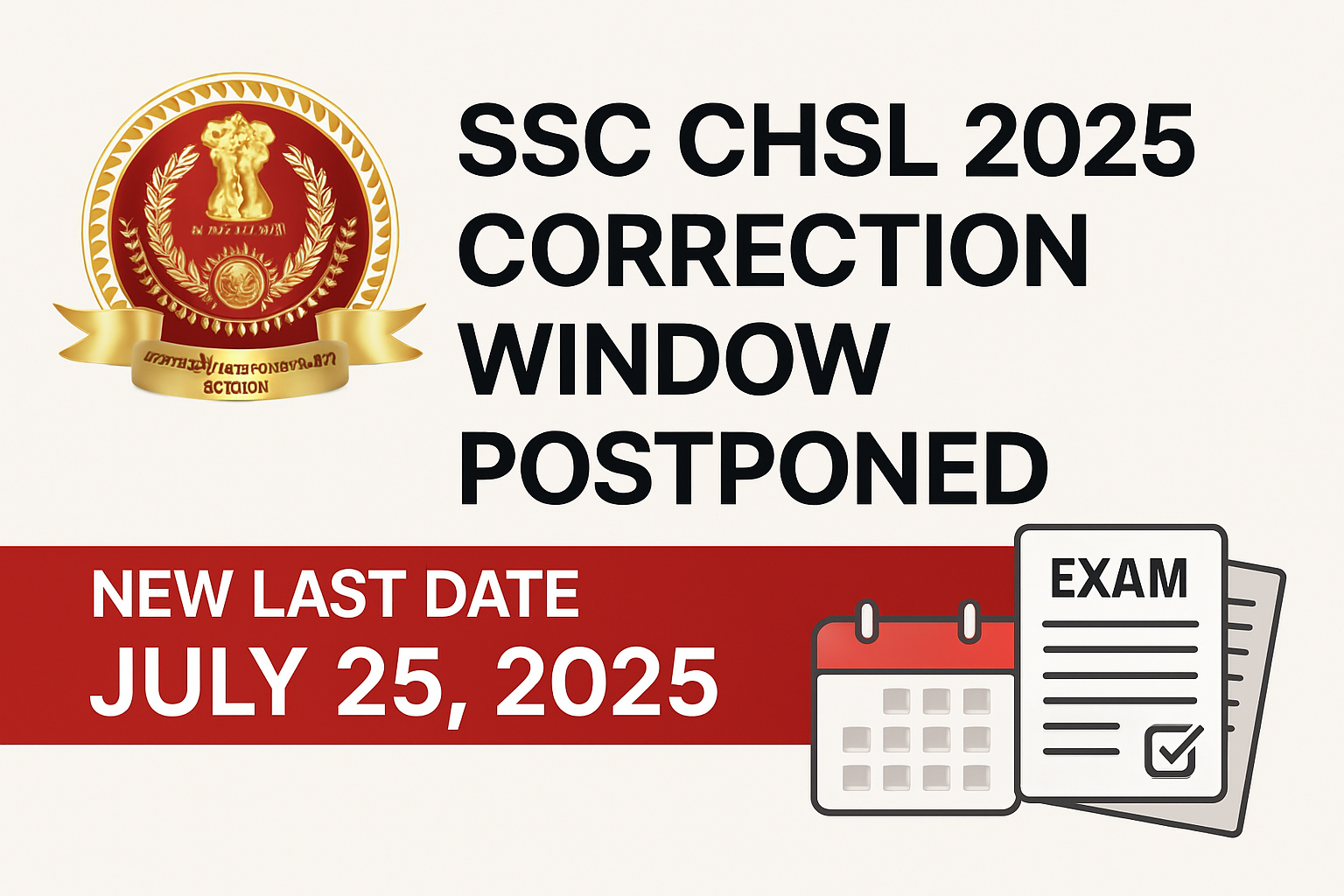
The SSC CHSL 2025 correction window date has been postponed to July 25, giving aspirants more time to edit applications. Check new dates, important instructions, and preparation strategies here.
Table of Contents
Introduction to SSC CHSL 2025 Examination
The Staff Selection Commission (SSC) conducts the Combined Higher Secondary Level (CHSL) examination annually to recruit candidates for various Group B and Group C posts across central government ministries and departments. The SSC CHSL examination serves as a crucial gateway for candidates who have completed their 10+2 education to secure stable government employment.
The examination assesses candidates’ abilities across multiple domains including reasoning, general awareness, quantitative aptitude, and language proficiency. Positions filled through this examination include Lower Division Clerk (LDC), Junior Secretariat Assistant (JSA), Postal Assistant (PA), Sorting Assistant (SA), and Data Entry Operator (DEO).
According to the official notification released by SSC, the CHSL 2025 recruitment cycle has commenced with the application process that opened on April 8, 2025. This article provides comprehensive information about the recent correction window extension and detailed insights into the examination structure, eligibility criteria, and preparation guidelines based on official sources.
Recent Update: Correction Window Date Modification
The Staff Selection Commission has announced a modification in the correction window schedule for SSC CHSL 2025 applicants. Originally scheduled to close on July 24, 2025, the correction facility has been extended by one day to accommodate candidates who faced technical difficulties during the initial period.
Revised Correction Window Timeline
The updated correction window will remain open until July 25, 2025, at 11:59 PM. This extension provides candidates with additional time to review and modify their application details where permissible. The decision follows reports of server congestion and login issues experienced by multiple applicants attempting to access the correction facility.
Candidates are advised to utilize this extended window to verify all submitted information carefully. The correction facility typically allows modifications to specific fields including personal details (with supporting documents), educational qualifications, category information, examination center preferences, and post selections.
Permissible Corrections During the Window
During the correction window, candidates can generally modify the following details:
- Personal information such as address and contact details
- Educational qualification details and certificate numbers
- Category certificate information (SC/ST/OBC/EWS/PwD)
- Preferred examination center cities (subject to availability)
- Post preferences among available positions
However, fundamental details like candidate name and date of birth typically require submission of supporting documents for modification. Candidates should refer to the official SSC notification for specific guidelines on permissible changes and required documentation.
SSC CHSL 2025: Complete Examination Overview
Purpose and Scope of the Examination
The SSC CHSL examination is designed to fill positions in various central government departments that require a minimum educational qualification of 10+2 or equivalent. These positions form the backbone of administrative and operational functions across government offices nationwide.
The examination provides employment opportunities in multiple categories:
Lower Division Clerk (LDC): These positions involve general clerical work including file maintenance, data entry, correspondence handling, and administrative support in government offices.
Junior Secretariat Assistant (JSA): JSA roles focus on secretariat operations including documentation, record keeping, official correspondence, and providing assistance to senior officials in various ministries.
Postal Assistant (PA): PA positions are part of the Department of Posts, involving counter operations, mail processing, financial transactions, and customer service at post offices across India.
Sorting Assistant (SA): SA roles involve mail sorting, distribution planning, logistics coordination, and ensuring timely delivery of postal items through India Post network.
Data Entry Operator (DEO): DEO positions require computer proficiency and involve digitizing records, database management, data verification, and maintaining electronic filing systems in government departments.
Expected Vacancy Numbers for 2025
While the official vacancy notification for SSC CHSL 2025 has not been released at the time of application opening, historical data from previous recruitment cycles provides insight into expected numbers. The SSC typically announces final vacancy details closer to the examination dates or after the initial tier of examination.
Based on recruitment trends from 2022-2024, the examination typically advertises between 3,000 to 6,000 positions across all post categories combined. The actual number of vacancies varies based on departmental requirements, retirement patterns, and government policies regarding new recruitments.
Candidates should note that vacancy announcements may be released in phases, with some departments notifying their requirements during the application period and others after the preliminary examination. Regular checking of the official SSC website ensures candidates stay updated on vacancy-related announcements.
Eligibility Criteria for SSC CHSL 2025
Educational Qualification Requirements
The minimum educational qualification for SSC CHSL 2025 requires candidates to have passed the 10+2 examination or equivalent from a recognized board or university. The qualifying examination must be completed by August 1, 2025, which serves as the cut-off date for educational eligibility.
Recognized qualifications include:
- Senior Secondary Examination (10+2) from any state or central board
- Intermediate examination from any recognized university
- 12th standard pass under the 10+2 system of education
- Equivalent qualifications approved by the Government of India
Candidates appearing in their final year examination are not eligible to apply until they receive their final results. All educational certificates must be issued by institutions recognized by relevant education authorities in India.
Age Limit Specifications
The age eligibility for SSC CHSL 2025 is calculated as of August 1, 2025. Candidates must be born between specific dates to satisfy age requirements:
Minimum Age: 18 years (born not later than August 1, 2007)
Maximum Age for General Category: 27 years (born not earlier than August 2, 1998)
Age Relaxation for Reserved Categories
The government provides age relaxation benefits to candidates belonging to reserved categories as per existing policies:
- OBC (Non-Creamy Layer): 3 years relaxation (maximum age 30 years)
- Scheduled Caste (SC): 5 years relaxation (maximum age 32 years)
- Scheduled Tribe (ST): 5 years relaxation (maximum age 32 years)
- Persons with Disabilities (PwD) – General: 10 years relaxation (maximum age 37 years)
- PwD + OBC: 13 years cumulative relaxation (maximum age 40 years)
- PwD + SC/ST: 15 years cumulative relaxation (maximum age 42 years)
Ex-servicemen and other special categories receive age relaxation as per government rules applicable at the time of recruitment. Candidates claiming age relaxation must provide valid category certificates issued by competent authorities.
Complete SSC CHSL 2025 Examination Schedule
Important Dates Timeline
Based on the official notification and updates, the SSC CHSL 2025 examination follows this schedule:
Notification Release: April 8, 2025
Application Period: April 8, 2025 to May 7, 2025
Application Correction Window: July 25, 2025 (extended deadline at 11:59 PM)
Admit Card Release: Expected in August 2025
Tier I Examination: Tentatively scheduled for September 2025
Tier I Result Declaration: Expected in October 2025
Tier II Examination: Tentatively scheduled for December 2025
Tier II Result Declaration: Expected in January-February 2026
Tier III (Skill Test/Typing Test): Expected in February-March 2026
Final Result Declaration: Expected in March-April 2026
Candidates should note that these dates are tentative except for officially announced dates. The SSC may modify the schedule based on administrative requirements. All updates are published on the official SSC website at ssc.nic.in.
How to Track Official Updates
Candidates should regularly monitor the following official sources for authentic information:
- SSC Official Website: https://ssc.nic.in
- Regional SSC Websites for region-specific updates
- Official SSC social media channels (verified accounts only)
- Email notifications sent to registered email addresses
Creating an account on the SSC portal and enabling email notifications ensures candidates receive timely alerts about important announcements, admit card releases, and result declarations.
SSC CHSL Application Process and Fee Structure
Step-by-Step Application Procedure
The application process for SSC CHSL 2025 is conducted entirely online through the official SSC website. Here is the detailed procedure:
Step 1: Registration
Visit the official SSC website and navigate to the “Apply” section. Click on “Combined Higher Secondary Level Examination 2025” and select “Register Now.” Provide basic details including name, date of birth, email address, and mobile number. An OTP-based verification process completes the initial registration.
Step 2: Login and Form Filling
Use the registration number and password to log in to the application portal. Complete all sections of the application form including personal details, educational qualifications, work experience (if any), and category information.
Step 3: Document Upload
Upload scanned copies of recent photograph and signature in specified format and size. The photograph must be in JPEG format, 10-40 KB in size, with dimensions of 3.5 cm × 4.5 cm. The signature must be in JPEG format, 5-20 KB in size, with dimensions of 4 cm × 2 cm.
Step 4: Examination Center Selection
Choose preferred examination center cities from the available list. The SSC typically offers multiple examination center options across all states. Select centers strategically considering travel convenience and accommodation availability.
Step 5: Fee Payment
Pay the application fee through available online payment modes (debit card, credit card, net banking, or UPI). Offline payment through bank challan may also be available for certain categories. Save the payment receipt for future reference.
Step 6: Final Submission
Review all entered information carefully before final submission. After submission, download the confirmation page and take multiple printouts for record keeping. Note the application number for future correspondence.
Application Fee Details
The application fee structure for SSC CHSL 2025 follows the standard pattern:
General and OBC Candidates: Rs. 100 (plus applicable payment gateway charges)
Women Candidates of All Categories: No fee (only payment gateway charges applicable)
Scheduled Caste (SC) Candidates: No fee (only payment gateway charges applicable)
Scheduled Tribe (ST) Candidates: No fee (only payment gateway charges applicable)
Persons with Disabilities (PwD): No fee (only payment gateway charges applicable)
Ex-Servicemen (ESM): No fee (only payment gateway charges applicable)
Payment gateway charges typically range from Rs. 10 to Rs. 20 depending on the payment mode selected. Candidates should verify the exact fee amount displayed during the payment process.
SSC CHSL Examination Pattern and Structure
The SSC CHSL examination consists of three tiers, each assessing different competencies required for the advertised positions.
Tier I: Computer-Based Examination
Tier I is an objective-type computer-based test conducted across multiple sessions. The examination parameters are:
Duration: 60 minutes (80 minutes for candidates eligible for scribe facility)
Total Questions: 100 questions
Maximum Marks: 200 marks (each question carries 2 marks)
Negative Marking: 0.5 marks deducted for each incorrect answer
Examination Mode: Computer-Based Test (CBT)
Subject-wise Distribution for Tier I
Section 1: General Intelligence and Reasoning (25 questions, 50 marks)
This section tests analytical and logical reasoning abilities. Question types include analogies, similarities and differences, space visualization, problem solving, analysis, judgment, decision making, visual memory, discrimination, observation, relationship concepts, arithmetical reasoning, verbal and figure classification, arithmetical number series, and non-verbal series.
Section 2: General Awareness (25 questions, 50 marks)
This section evaluates candidates’ knowledge of current events and static general knowledge. Topics covered include history (with focus on Indian history), culture, geography (covering Indian and world geography), economic scene, general polity including Indian Constitution, scientific research, and current affairs of national and international importance.
Section 3: Quantitative Aptitude (25 questions, 50 marks)
This section tests mathematical and numerical ability. Topics include number systems, computation of whole numbers, decimals and fractions, fundamental arithmetical operations, percentages, ratio and proportion, square roots, averages, interest (simple and compound), profit and loss, discount, partnership business, mixture and allegation, time and distance, time and work, basic algebraic identities, geometry, trigonometry, statistical charts, and data interpretation.
Section 4: English Language (25 questions, 50 marks)
This section assesses English language proficiency. Areas tested include vocabulary (synonyms, antonyms, word meanings), grammar (parts of speech, tenses, articles, prepositions), sentence structure, spot the error, fill in the blanks, spellings, detecting mis-spelt words, idioms and phrases, one-word substitution, improvement of sentences, active/passive voice, direct/indirect narration, shuffling of sentence parts, cloze passage, and comprehension passage.
Tier II: Descriptive Paper
Tier II is a descriptive paper designed to test writing skills in English or Hindi. The parameters are:
Duration: 60 minutes (80 minutes for candidates with scribe facility)
Maximum Marks: 100 marks
Examination Mode: Pen and Paper Based
Language: English or Hindi (candidate’s choice)
Question Types: Essay writing (approximately 200-250 words), letter writing (formal or informal), and application writing
This tier evaluates candidates’ ability to express ideas clearly in writing with proper grammar, vocabulary, and coherent structure. The content, organization, expression, grammar, and vocabulary are assessed during evaluation.
Tier III: Skill Test/Typing Test
Tier III is qualifying in nature and consists of different tests depending on the post applied:
For Data Entry Operator (DEO) Posts:
Data Entry Test on computer at a speed of 8,000 key depressions per hour. Duration is 15 minutes with accuracy requirements.
For Lower Division Clerk (LDC)/Junior Secretariat Assistant (JSA) Posts:
Typing Test on computer with a speed requirement of 35 words per minute in English or 30 words per minute in Hindi. The test duration is 10 minutes.
For Postal Assistant/Sorting Assistant Posts:
No skill test or typing test is required for these positions.
Candidates must qualify in Tier III (where applicable) to be considered for final selection. The marks obtained in Tier III are not counted for merit but qualifying this tier is mandatory.
Salary Structure and Service Benefits
Pay Scale Details
The salary structure for SSC CHSL positions follows the 7th Central Pay Commission recommendations:
Lower Division Clerk (LDC) and Junior Secretariat Assistant (JSA):
Pay Level: 2 (Rs. 19,900 – Rs. 63,200)
Basic Pay: Rs. 19,900 (starting)
Gross Salary: Approximately Rs. 25,000 – Rs. 30,000 per month (including allowances)
Postal Assistant (PA) and Sorting Assistant (SA):
Pay Level: 4 (Rs. 25,500 – Rs. 81,100)
Basic Pay: Rs. 25,500 (starting)
Gross Salary: Approximately Rs. 35,000 – Rs. 40,000 per month (including allowances)
Data Entry Operator (DEO):
Pay Level: 4 (Rs. 25,500 – Rs. 81,100)
Basic Pay: Rs. 25,500 (starting)
Gross Salary: Approximately Rs. 35,000 – Rs. 40,000 per month (including allowances)
Additional Benefits and Allowances
Central government employees receive various allowances and benefits:
Dearness Allowance (DA): Revised bi-annually based on inflation index
House Rent Allowance (HRA): Based on city classification (X, Y, or Z category)
Transport Allowance: Fixed monthly amount for commuting expenses
Medical Benefits: Comprehensive medical coverage under Central Government Health Scheme (CGHS)
Leave Travel Concession (LTC): Travel benefits for employee and family once in a block period
Provident Fund: Contribution to General Provident Fund (GPF) or National Pension System (NPS)
Gratuity: Lump sum payment on retirement based on years of service
Pension Benefits: Defined benefit pension or NPS benefits based on joining date
These benefits significantly enhance the overall compensation package beyond the basic salary component.
Career Growth and Promotional Opportunities
Advancement Pathways
Government service offers structured career progression with regular promotional opportunities:
For LDC/JSA Positions:
Initial position at Pay Level 2 with opportunities to advance to Upper Division Clerk (UDC) at Pay Level 4 through departmental examinations or promotion after specified service period. Further advancement to Assistant and Section Officer positions is possible through continued service and qualifying examinations.
For Postal Assistant/Sorting Assistant:
Starting at Pay Level 4 with progression to Inspector posts at Pay Level 7 and subsequently to supervisory and management positions in postal operations through departmental promotions and examinations.
For Data Entry Operator:
Beginning at Pay Level 4 with technical skill-based advancement opportunities in IT and data management divisions of respective departments.
Promotions generally consider factors including years of service, performance appraisals, qualifying departmental examinations, and availability of higher positions. The annual confidential report (ACR) system evaluates employee performance and influences promotion decisions.
Training and Skill Development
Selected candidates undergo induction training programs organized by respective departments. Continuous professional development opportunities include:
- Computer skills and office automation training
- Language proficiency enhancement programs
- Specialized job-related technical training
- Leadership and management development courses
- Workshops on government procedures and regulations
Regular training ensures employees remain updated with evolving administrative practices and technology integration in government functioning.
Preparation Strategy for SSC CHSL 2025
Creating an Effective Study Plan
Successful preparation requires systematic planning spanning several months. A recommended approach divides preparation into distinct phases:
Foundation Phase (3-4 months before examination):
Focus on building conceptual clarity in all subjects. Study NCERT textbooks for Classes 10-12 for mathematics and general science fundamentals. Develop comprehensive notes for static general knowledge topics. Build vocabulary through regular reading of quality English content. Practice basic to moderate difficulty questions to strengthen fundamentals.
Intensive Practice Phase (2-3 months before examination):
Increase practice intensity with previous years’ question papers and topic-wise questions. Take regular mock tests to assess preparation levels. Identify weak areas through test analysis and focus additional time on improvement. Refine time management skills by practicing under timed conditions. Update current affairs notes with recent developments.
Revision and Test Phase (Final month before examination):
Conduct comprehensive revision of all subjects using prepared notes. Take full-length mock tests regularly to simulate examination conditions. Analyze mistakes thoroughly and avoid repeating errors. Focus on speed improvement while maintaining accuracy. Maintain physical health and manage stress through proper rest and exercise.
Subject-wise Preparation Tips
For Quantitative Aptitude:
Master fundamental concepts before attempting complex problems. Create formula sheets for quick revision. Practice mental calculation to save time during examination. Focus on accuracy over speed initially, then gradually increase solving speed. Work on arithmetic topics which carry maximum weightage including percentage, profit-loss, time-distance, and data interpretation.
For General Intelligence and Reasoning:
Practice diverse question types regularly to develop pattern recognition skills. Focus on puzzles, coding-decoding, syllogisms, and series questions. Develop systematic approaches to solve different question categories. Time management is crucial as reasoning questions can be time-consuming. Regular practice improves speed and accuracy significantly.
For General Awareness:
Read daily newspapers focusing on national and international current events. Prepare monthly current affairs compilations. Study static GK topics including history, geography, polity, and economics systematically. Use reliable sources like government publications and standard reference books. Make concise notes for quick revision. Follow credible news sources and avoid unverified information.
For English Language:
Build vocabulary by learning new words daily with contextual usage. Study basic grammar rules thoroughly including tenses, articles, prepositions, and sentence structure. Practice reading comprehension passages regularly to improve speed and understanding. Work on error detection and sentence improvement questions. Write practice essays and letters to prepare for Tier II descriptive paper.
Mock Test Strategy
Regular mock test practice is essential for examination success. Follow these guidelines:
Take at least one full-length mock test weekly during preparation. Attempt tests under strict time constraints matching actual examination conditions. Analyze performance thoroughly after each test, identifying weak areas and recurring mistakes. Track progress over time to monitor improvement. Use mock tests to experiment with different question attempt strategies and finalize the optimal approach.
Maintain a balance between sectional tests (focusing on individual subjects) and full-length tests (simulating actual examination). Sectional tests help build subject-specific strength while full-length tests develop stamina and time management skills needed for the actual examination.
Understanding Previous Year Cutoff Trends
Historical Cutoff Analysis
SSC CHSL cutoff marks vary based on factors including question difficulty, number of applicants, available vacancies, and normalization across multiple examination shifts. Historical data provides insight into expected cutoff ranges:
General Category: Typically ranges between 130-145 marks out of 200 for Tier I, varying annually based on examination difficulty.
OBC Category: Generally 5-10 marks below General category cutoffs, ranging between 125-140 marks.
SC Category: Usually ranges between 105-120 marks depending on competition and vacancy numbers.
ST Category: Typically ranges between 95-110 marks based on annual variations.
These are approximate ranges based on previous years’ data. Actual cutoffs for SSC CHSL 2025 will depend on factors specific to this recruitment cycle including total applicants, question difficulty level, normalization process, and vacancy numbers announced.
Factors Influencing Cutoff Determination
Several factors collectively determine final cutoff marks:
Total Number of Applicants: Higher applications generally increase competition and may raise cutoffs.
Vacancy Numbers: More vacancies typically result in lower cutoffs as more candidates qualify.
Question Difficulty Level: Easier papers result in higher cutoffs and vice versa.
Normalization Process: For multi-shift examinations, normalization adjusts scores to account for difficulty variations across shifts.
Category-wise Reservation: Reserved category cutoffs are determined independently based on reservation policies.
Candidates should aim to score significantly above expected cutoffs to ensure comfortable qualification margins accounting for uncertainties.
Document Verification Process
Required Documents Checklist
Candidates qualifying all tiers of the examination must appear for document verification. Essential documents include:
Educational Certificates:
- 10th standard mark sheet and certificate (for age proof)
- 12th standard mark sheet and certificate (for educational qualification)
- All mark sheets if degree or diploma is submitted
Identity Proof:
- Aadhaar card (mandatory for identity verification)
- PAN card (if available)
- Valid photo identification with photograph
Category Certificates (if applicable):
- Caste certificate for SC/ST/OBC candidates
- Non-Creamy Layer (NCL) certificate for OBC candidates (issued within current financial year)
- EWS certificate (if applicable, issued within current financial year)
- Disability certificate from competent authority for PwD candidates
- Ex-serviceman discharge certificate (if applicable)
Additional Documents:
- Domicile certificate (if required for specific posts)
- Character certificate from previous educational institution or employer
- Passport size photographs (multiple copies)
- Any other documents specified in the official document verification call letter
Verification Process Timeline
The SSC conducts document verification after announcement of final results. Candidates receive notifications regarding document verification schedule through registered email and SMS. The process typically occurs at regional SSC offices or designated centers.
During verification, officials examine original certificates and retain self-attested photocopies. Any discrepancies between application details and submitted documents may result in candidature cancellation. Candidates must carry all original certificates along with one set of self-attested photocopies.
Successful completion of document verification is mandatory for final selection and appointment. Candidates failing to produce required documents or found using false certificates are disqualified and may face legal action.
Official Resources and Support
Where to Find Authentic Information
Candidates must rely exclusively on official sources for authentic information:
Primary Official Source:
Staff Selection Commission Official Website: https://ssc.nic.in
This website publishes all official notifications, admit cards, results, and updates. Candidates should bookmark this site and check regularly for announcements.
Regional SSC Websites:
Each SSC region maintains its own website for region-specific information:
- SSC Central Region (CR)
- SSC Eastern Region (ER)
- SSC Karnataka Kerala Region (KKR)
- SSC Madhya Pradesh Region (MPR)
- SSC Northern Region (NR)
- SSC North Eastern Region (NER)
- SSC North Western Region (NWR)
- SSC Southern Region (SR)
- SSC Western Region (WR)
Regional websites provide information about document verification schedules and region-specific announcements.
Official Contact Information:
For queries, candidates can contact SSC through:
- Email addresses provided on the official website
- Helpline numbers published in official notifications
- Grievance redressal mechanisms available on the SSC portal
Avoiding Misinformation
Candidates should exercise caution regarding information from unofficial sources:
- Verify all information against official SSC notifications
- Avoid relying on unverified social media posts or WhatsApp forwards
- Be skeptical of coaching institutes claiming “inside information”
- Do not trust websites mimicking official SSC portals
- Cross-check dates and announcements with official sources
Unofficial sources may spread incorrect information, outdated details, or rumors that can mislead candidates. Always verify critical information from the official SSC website before taking any action.
Important Instructions for Examination Day
Before the Examination
Admit Card Requirements:
Download and print the admit card from the official SSC website when released. The admit card contains essential details including examination date, shift timing, examination center address, and reporting time. Carry the admit card along with a valid photo ID to the examination center. No candidate is permitted to enter without a valid admit card and photo ID.
What to Carry:
- Admit card (printed copy)
- Original photo ID (Aadhaar, PAN, Voter ID, Driving License, or Passport)
- Pen (for rough work only; computer-based examination does not require writing instruments)
- Water bottle (sealed, if permitted)
What Not to Carry:
- Mobile phones or electronic devices
- Calculators or smartwatches
- Study materials or books
- Bags or pouches
- Any metallic items or accessories
Most examination centers provide secure storage facilities for prohibited items, but it is advisable not to carry them to avoid inconvenience.
During the Examination
Time Management Strategy:
The 60-minute duration requires efficient time allocation. A suggested approach allocates approximately 15 minutes per section, with a final 10-15 minutes for revision and attempting remaining questions. However, candidates should develop personalized strategies based on their strengths and weaknesses.
Attempting Questions:
Begin with sections where you are most confident to secure those marks early. Use the marking feature to flag difficult questions for later review. Given the negative marking of 0.5 marks per wrong answer, avoid random guessing. Attempt questions where you can eliminate at least 2 options to maintain reasonable accuracy.
Technical Issues:
If you encounter technical problems during the computer-based test, immediately raise your hand and inform the invigilator. Do not attempt to resolve technical issues yourself. The examination authorities provide compensatory time for genuine technical disruptions that cause loss of examination time.
Frequently Asked Questions (FAQs)
1. What is the revised last date for SSC CHSL 2025 correction window?
The correction window for SSC CHSL 2025 applications has been extended and will now close on July 25, 2025, at 11:59 PM. This represents a one-day extension from the originally scheduled closing date of July 24, 2025. The extension was implemented to accommodate candidates who experienced technical difficulties accessing the correction facility and to ensure all eligible candidates receive adequate opportunity to review and modify their application details where permissible.
2. When will the SSC CHSL 2025 Tier I examination be conducted?
Based on the official notification pattern and historical examination schedules, the SSC CHSL 2025 Tier I computer-based examination is tentatively scheduled for September 2025. The exact dates will be announced by the Staff Selection Commission along with the release of admit cards, which typically occurs 2-3 weeks before the examination. Candidates should regularly monitor the official SSC website at ssc.nic.in for confirmed examination date announcements and admit card release notifications.
3. What is the minimum educational qualification required for SSC CHSL 2025?
Candidates must have passed the 10+2 examination or equivalent from a recognized board or university to be eligible for SSC CHSL 2025. The qualifying examination must be completed by August 1, 2025, which serves as the eligibility cut-off date. Recognized qualifications include Senior Secondary (10+2) from any state or central board, Intermediate examination from recognized universities, or equivalent qualifications approved by the Government of India. Candidates appearing in final examinations are not eligible to apply until results are declared.
4. What changes can be made during the correction window?
During the correction window, candidates can typically modify personal details such as address and contact information, educational qualification details, category certificate information (SC/ST/OBC/EWS/PwD), preferred examination center cities (subject to availability), and post preferences. However, fundamental details like candidate name and date of birth generally require submission of supporting documents for modification. Candidates should refer to the specific instructions provided in the official correction window notification for detailed guidelines on permissible changes and required documentation.
5. How many vacancies are expected for SSC CHSL 2025?
The official vacancy notification for SSC CHSL 2025 has not been released at the time of application opening. Based on historical recruitment patterns from previous years, the examination typically advertises between 3,000 to 6,000 positions across all post categories including LDC, JSA, PA, SA, and DEO. The actual vacancy numbers depend on departmental requirements and government recruitment policies. Candidates should monitor the official SSC website for the official vacancy notification, which may be released in phases with some departments announcing requirements during the application period and others after the preliminary examination.
6. What is the negative marking scheme in SSC CHSL Tier I examination?
The SSC CHSL Tier I examination implements a negative marking scheme where 0.5 marks are deducted for each incorrect answer. Since each question carries 2 marks, an incorrect answer results in loss of 0.25 marks (one-fourth of the question value). This negative marking system is designed to discourage random guessing and reward accuracy over quantity. Candidates should adopt a strategic approach by attempting questions where they have reasonable confidence and avoiding wild guesses on questions where they cannot eliminate any options.
7. Is there any application fee for SSC CHSL 2025, and what is the refund policy?
The application fee for SSC CHSL 2025 is Rs. 100 for General and OBC category male candidates, plus applicable payment gateway charges. Women candidates of all categories, SC/ST candidates, PwD candidates, and Ex-servicemen are exempted from the application fee and need to pay only the payment gateway charges (approximately Rs. 10-20). The SSC does not provide refunds of application fees under normal circumstances. However, if a candidate’s application is rejected by the system during processing, the fee may be refunded according to SSC’s refund policy outlined in the official notification.
8. Can I apply for multiple posts in SSC CHSL 2025?
Yes, candidates can select multiple post preferences during the application process for SSC CHSL 2025. The application form typically allows candidates to indicate their preferences for various positions including LDC, JSA, PA, SA, and DEO. However, candidates should note that final allocation of posts depends on merit, preferences indicated, available vacancies, and meeting specific requirements like typing test qualification (for certain posts). It is advisable to carefully consider all post options and arrange preferences strategically based on individual career goals and qualifications.
About the Author
Nueplanet
Nueplanet is an educational content specialist with expertise in government recruitment examinations and career guidance. With a focus on providing accurate, verified information from official sources, Nueplanet helps aspirants navigate the complexities of competitive examinations.
Commitment: All information presented is researched from official government notifications, Staff Selection Commission publications, and verified sources. Content is regularly updated to reflect the latest official announcements.
Conclusion and Key Takeaways
The SSC CHSL 2025 examination represents a significant opportunity for 10+2 qualified candidates to secure stable government employment across various central government departments. The recent extension of the correction window to July 25, 2025, demonstrates the commission’s commitment to providing fair opportunities to all candidates.
Essential Points to Remember
The examination follows a three-tier structure with Tier I being computer-based objective test, Tier II being descriptive paper, and Tier III consisting of skill tests for specific positions. Candidates must meet educational qualification of 10+2 pass and age requirements (18-27 years for General category) as of August 1, 2025.
The tentative examination schedule places Tier I in September 2025, with subsequent tiers following in later months. Regular monitoring of the official SSC website ensures candidates stay updated on confirmed dates, admit card releases, and result announcements.
Next Steps for Aspirants
Candidates who have already submitted applications should utilize the extended correction window to verify all details carefully. Those preparing for the examination should focus on systematic preparation covering all four sections of Tier I while also developing writing skills for Tier II.
Creating a realistic study plan, taking regular mock tests, staying updated with current affairs, and maintaining consistency in preparation are crucial factors for success. Candidates should rely exclusively on official SSC sources for information and avoid unverified claims from unofficial channels.
The combination of thorough preparation, strategic planning, and proper utilization of available resources can significantly enhance candidates’ chances of success in SSC CHSL 2025.
Disclaimer: This article is based on information available from official SSC notifications and public sources as of the publication date. Candidates are advised to verify all critical information from the official Staff Selection Commission website (ssc.nic.in) before taking any action. The author and publisher are not responsible for any changes in examination schedules, eligibility criteria ad all.
Last Updated : July 23, 2025
Published: July 23, 2025
Helpful Resources
Latest Posts
- HBSE Compartment Exam 2025: Admit Cards Released for Haryana Class 10 and 12 – Check Full Details
- Karnataka 2nd PUC Exam 3 Results 2025 Declared on karresults.nic.in
- JAC Result 2025 Declared: Check Class 11 Pass Percentage, Websites, and More
- National RailOne App: Indian Railways’ One-Stop Solution for Travellers
- HDB Financial Services IPO Allotment GMP: All You Need to Know
Tag
ssc chsl 2025






Post Comment