









SSC CGL Exam Date 2025: Admit Card Released, Know Key Details & Schedule
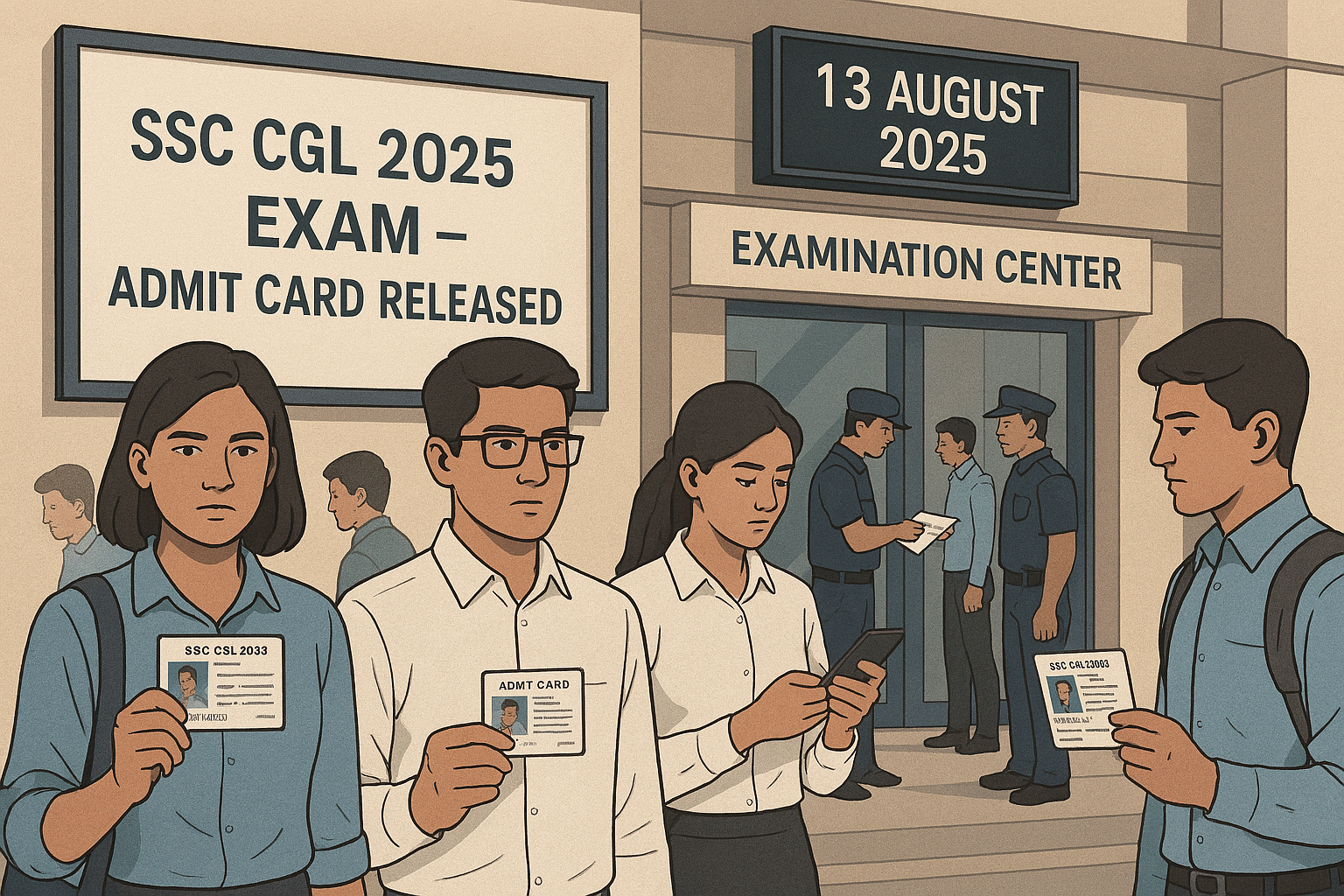
The SSC CGL 2025 Tier 1 exam dates have been announced. Admit cards are now available for download, with exams scheduled between August 13 and August 30.
Table of Contents
The Staff Selection Commission has released admit cards for the Combined Graduate Level (CGL) Tier 1 Examination 2025. This development allows registered candidates to access their hall tickets through respective regional SSC portals. The examination, scheduled between August 13 and August 30, 2025, represents a significant recruitment drive for various central government positions across multiple departments and ministries.
The SSC CGL examination serves as a gateway to Group B and Group C positions in central government organizations. Each year, this examination attracts approximately 30 lakh registered candidates competing for several thousand vacancies. The computer-based test format ensures standardized evaluation across all sessions and examination centers nationwide.
This guide provides comprehensive information about the admit card download process, examination details, pattern analysis, and preparation strategies. All information presented derives from official SSC notifications and established examination protocols.
Understanding SSC CGL 2025 Tier 1 Examination
The Combined Graduate Level Examination functions as a multi-tier selection process conducted by the Staff Selection Commission. This examination identifies suitable candidates for various posts in ministries, departments, and organizations under the Government of India.
The Tier 1 examination serves as the preliminary screening stage. Candidates qualifying this stage become eligible for subsequent tiers, including Tier 2 (advanced written examination), Tier 3 (descriptive paper), and Tier 4 (skill test/computer proficiency test). The final selection depends on cumulative performance across all applicable tiers.
Examination Authority and Conduct
The Staff Selection Commission, established in 1975, operates as the premier recruiting agency for Group B and Group C posts in central government departments. The commission maintains regional offices across India to facilitate decentralized examination conduct and candidate services. These regional offices handle application processing, admit card distribution, and examination center coordination.
For SSC CGL 2025, the commission has implemented enhanced security protocols and technological systems. These measures ensure examination integrity and fair evaluation across all sessions. The extended examination schedule accommodates the large candidate base while maintaining standardized difficulty levels through statistical normalization processes.
SSC CGL 2025 Tier 1: Key Examination Details
Understanding the complete examination framework helps candidates prepare effectively and manage logistics appropriately.
Official Examination Information
| Examination Component | Details |
|---|---|
| Examination Name | Staff Selection Commission Combined Graduate Level Tier 1 |
| Conducting Body | Staff Selection Commission |
| Examination Mode | Computer-Based Test (CBT) |
| Examination Dates | August 13 to August 30, 2025 |
| Admit Card Release | August 6, 2025 (region-wise) |
| Number of Sessions | Multiple sessions across 18 days |
| Duration per Session | 60 minutes |
| Official Portal | ssc.gov.in |
Examination Schedule Overview
The 18-day examination window allows systematic distribution of candidates across multiple sessions. Each session maintains equivalent difficulty through sophisticated question banking and statistical equating methods. This approach ensures no candidate faces disadvantage due to their assigned session timing.
The examination sessions typically occur in morning and afternoon slots. Specific timing appears on individual admit cards based on center capacity and candidate allocation. Candidates should note their exact reporting time, which usually precedes the examination start by 30-60 minutes for verification procedures.
Admit Card Download Process: Step-by-Step Guide
The Staff Selection Commission distributes admit cards through regional websites to reduce server load and improve access reliability. This decentralized approach prevents technical issues common during high-traffic periods.
Regional Website Access
Candidates must access their admit cards through the specific regional SSC website corresponding to their application region. The commission operates regional offices in various zones including Northern, Eastern, Western, Southern, Central, Kerala-Karnataka, Madhya Pradesh, and North-Eastern regions.
Each regional website maintains independent servers for admit card distribution. This system ensures candidates can download hall tickets without facing server overload issues. Verify your registered region before attempting download to access the correct portal.
Required Information for Download
Before beginning the download process, ensure availability of the following:
- Registration Number or Roll Number: This unique identifier was provided during application submission
- Date of Birth: Must match exactly with application details (format: DD-MM-YYYY)
- Internet Connection: Stable connection prevents download interruptions
- PDF Reader: Required for viewing and printing the admit card document
Detailed Download Instructions
Follow these steps to successfully download your SSC CGL 2025 Tier 1 admit card:
Step 1: Website Navigation Visit your designated regional SSC website using the official link. Regional websites typically follow the format: [region].ssc.gov.in. Ensure you are accessing an official government website by verifying the URL structure and security certificate.
Step 2: Locate Admit Card Section On the homepage, find the SSC CGL 2025 Tier 1 admit card download link. This link usually appears prominently in the notifications or latest updates section. Click on the designated link to proceed to the login page.
Step 3: Enter Credentials Input your registration number or roll number in the designated field. Enter your date of birth in the specified format. Double-check all entries for accuracy before proceeding, as incorrect information prevents admit card access.
Step 4: Security Verification Complete the captcha verification or any security challenge presented. This step prevents automated access and maintains system security. Ensure clear visibility of the captcha image before entering the response.
Step 5: Download Admit Card After successful verification, the system displays your admit card. Review all details carefully on screen. Click the download button to save the PDF file to your device. Save copies in multiple locations including cloud storage for backup.
Step 6: Print Preparation Open the downloaded PDF using a compatible reader. Print the admit card on standard A4 size white paper. Take multiple printouts (recommended: 2-3 copies) for safety. Avoid using colored paper or non-standard sizes.
Step 7: Detail Verification Carefully verify all information on the printed admit card:
- Candidate name and photograph
- Father’s name and date of birth
- Registration and roll numbers
- Examination date and session timing
- Examination center complete address
- Reporting time and important instructions
Report any discrepancies immediately to the concerned regional office helpdesk. Do not attempt to make manual corrections on the admit card, as this may lead to entry denial.
Essential Documents and Items Checklist
The Staff Selection Commission maintains strict entry protocols at examination centers. Understanding permissible and prohibited items prevents last-minute complications.
Mandatory Documents
Candidates must carry the following documents without exception:
Primary Documents:
- Original printed admit card (photocopies not accepted under any circumstances)
- Valid government-issued photo identification proof in original
- Additional passport-size photographs (check center-specific requirements on admit card)
Acceptable Identification Proofs:
The following documents serve as valid identification for examination center entry:
- Aadhaar Card: Most commonly accepted form of identification
- Voter ID Card: Election Commission issued photo identity card
- PAN Card: Permanent Account Number card with photograph
- Driving License: Valid license issued by transport authority
- Passport: Current Indian passport
- Bank Passbook: With attached photograph
- Government Employee ID: Identity card issued by central/state government departments
- Photo Identity issued by recognized college/university: Must be currently valid
Ensure the photograph on the ID proof is clearly visible and matches your current appearance. The name on the identification document should match the admit card details exactly. Any mismatch may lead to entry denial or verification delays.
Permitted Items at Examination Center
Candidates may carry the following items:
- Transparent water bottle (in some centers, cap may need to be removed)
- Simple analog wristwatch (digital watches typically prohibited)
- Basic stationery as specified in admit card instructions
- Personal medication with prescription if questioned
- Small hand towel or handkerchief
Strictly Prohibited Items
The following items are not allowed inside examination premises:
- Mobile phones and related accessories
- Electronic devices of any nature (smartwatches, fitness trackers, Bluetooth devices)
- Calculators, computing devices, slide rules
- Books, notebooks, study materials, loose papers
- Bags, wallets, purses, briefcases
- Food items (water typically allowed as specified)
- Communication devices
- Cameras or recording equipment
Examination centers provide secure storage facilities for prohibited items at candidate’s risk. However, the commission recommends not bringing such items to avoid inconvenience and potential loss.
SSC CGL Tier 1 Examination Pattern and Structure
The examination pattern remains consistent across all sessions, ensuring standardized evaluation for all candidates. Understanding this structure enables strategic preparation and effective time management.
Overall Examination Framework
The Tier 1 examination consists of four distinct sections testing different competencies. The computer-based format presents questions with multiple-choice options. Candidates select answers using mouse clicks or keyboard inputs on the testing interface.
Examination Components:
| Section | Questions | Marks | Time Allocation | Difficulty Level |
|---|---|---|---|---|
| General Intelligence & Reasoning | 25 | 50 | 12-15 minutes | Moderate to High |
| General Awareness | 25 | 50 | 8-12 minutes | Variable |
| Quantitative Aptitude | 25 | 50 | 20-25 minutes | High |
| English Comprehension | 25 | 50 | 15-20 minutes | Moderate |
| Total | 100 | 200 | 60 minutes | Mixed |
Marking Scheme and Negative Marking
Each question carries 2 marks, with the total examination worth 200 marks. The marking system includes negative marking to discourage random guessing and reward genuine knowledge.
Marking Details:
- Correct Answer: +2 marks
- Incorrect Answer: -0.50 marks (0.25 deduction per mark)
- Unanswered Question: 0 marks
The negative marking significantly impacts final scores. With 25% penalty on each incorrect response, candidates should attempt questions based on reasonable confidence levels. Random guessing typically reduces net scores due to the penalty structure.
Section-wise Content Analysis
General Intelligence and Reasoning:
This section evaluates logical thinking, analytical abilities, and problem-solving skills. Question types include:
- Analogies and classifications
- Series completion (number, letter, figure)
- Coding and decoding
- Blood relations
- Direction sense and distance
- Logical reasoning
- Syllogisms
- Statement and conclusions
- Figure-based reasoning
- Pattern recognition
The section requires minimal subject-specific knowledge but demands logical thinking and pattern identification abilities. Regular practice improves speed and accuracy in recognizing question patterns.
General Awareness:
This section tests knowledge of current events, general knowledge, and awareness of social, economic, and political developments. Coverage includes:
- Current affairs (national and international)
- Indian history and culture
- Geography (India and world)
- Economic developments
- General science and technology
- Sports and awards
- Government schemes and policies
- Constitutional and political systems
- Environmental issues
- Books and authors
The dynamic nature of current affairs requires continuous updating. Static general knowledge topics form the foundation, while recent developments (typically last 6-12 months) carry significant weightage.
Quantitative Aptitude:
Mathematical competency testing through various topics:
- Number systems and simplification
- Percentages and averages
- Ratio and proportion
- Profit and loss
- Simple and compound interest
- Time and work
- Time, speed, and distance
- Geometry and mensuration
- Trigonometry
- Algebra
- Data interpretation
- Statistics
This section often determines final rankings due to its scoring potential. Strong mathematical foundation, formula knowledge, and calculation speed prove crucial for success.
English Comprehension:
Language proficiency assessment covering:
- Reading comprehension passages
- Grammar (parts of speech, tenses, voice, narration)
- Vocabulary (synonyms, antonyms, idioms)
- Sentence structure and error detection
- Fill in the blanks
- Phrase replacement
- One-word substitution
- Spelling errors
Regular reading, grammar practice, and vocabulary building enhance performance in this section. Comprehension passages test understanding and inference abilities beyond basic grammar knowledge.
Examination Center Information and Preparation
The Staff Selection Commission establishes examination centers across India to ensure accessibility for candidates from diverse geographical locations. Understanding center allocation and preparation requirements facilitates smooth examination day experience.
Center Allocation Process
Examination centers are assigned based on several factors:
- Candidate’s preference indicated during application
- Availability of infrastructure meeting SSC standards
- Geographic distribution to minimize travel burden
- Security and technical capability of venues
- Capacity to accommodate assigned candidate numbers
The admit card displays complete examination center details including precise address, contact information, and specific instructions. Candidates cannot request center changes after allocation except in extraordinary circumstances approved by the commission.
Examination Center Categories
Metropolitan Centers: Major cities with multiple examination venues offering extensive infrastructure. These centers typically have higher capacity and multiple sessions. Examples include Delhi, Mumbai, Bangalore, Chennai, Kolkata, and Hyderabad.
Regional Centers: State capitals and significant cities with adequate infrastructure. These centers serve candidates from surrounding districts and regions. Examples include Jaipur, Lucknow, Bhopal, Chandigarh, and Patna.
District Centers: Smaller cities and towns where local candidates can take examinations. These centers ensure accessibility for candidates from remote areas, reducing travel requirements and associated stress.
Pre-Examination Center Visit
Conducting a reconnaissance visit to your assigned center provides several benefits:
- Familiarity with exact location and accessibility
- Understanding of travel time under normal conditions
- Identification of transportation options
- Knowledge of nearby facilities (food, rest areas)
- Reduction of examination day uncertainty and stress
Plan this visit during similar time of day as your examination schedule to assess traffic conditions and travel duration accurately. Note alternative routes in case of unexpected disruptions.
Examination Day Reporting
Arrive at the center well before the reporting time mentioned on your admit card. The reporting time typically ranges from 30-60 minutes before examination commencement. Late arrivals face entry denial regardless of circumstances.
Reporting Timeline:
- Arrive 60-90 minutes before examination start
- Entry gates close at reporting time (no late entry)
- Document verification and biometric capture require time
- Settling into examination hall and system familiarization
Center-Specific Instructions
Some centers may have unique requirements or instructions mentioned on admit cards. Read these carefully and comply fully. Common variations include:
- Specific parking arrangements
- Additional document requirements
- COVID-19 protocols (if applicable)
- Special security measures
- Photography and biometric procedures
Important Timeline and Dates
Understanding the complete examination cycle helps candidates plan preparation and manage post-examination processes effectively.
Comprehensive SSC CGL 2025 Timeline
| Event | Date/Period | Duration | Required Action |
|---|---|---|---|
| Admit Card Release | August 6, 2025 | Ongoing until exam completion | Download, verify, print |
| Tier 1 Examination | August 13-30, 2025 | 18 days | Appear for assigned session |
| Answer Key Publication | Early September 2025 | 7 days for challenges | Review and submit objections if needed |
| Tier 1 Result Declaration | Mid-September 2025 | Permanent record | Check qualification status |
| Tier 2 Notification | September-October 2025 | Registration period | Register if qualified |
| Tier 2 Examination | October-November 2025 | 3-5 days typically | Advanced preparation |
| Tier 2 Results | December 2025 | Permanent record | Verify qualification for next stage |
| Tier 3 (Descriptive) | December 2025-January 2026 | Single day | Prepare descriptive writing |
| Final Result | January-February 2026 | Subject to verification | Document preparation |
These dates remain tentative pending official confirmation. The commission may adjust schedules based on administrative requirements or unforeseen circumstances. Regular monitoring of official notifications ensures awareness of any changes.
Post-Examination Procedures
Answer Key Challenge: After examination completion, SSC releases preliminary answer keys for candidate review. Candidates can challenge answers they believe are incorrect by submitting representations with supporting evidence. Each challenge requires a nominal fee (typically ₹100 per question). Valid challenges result in fee refunds and answer key corrections affecting all candidates.
Result Declaration: Results list candidates who qualify for Tier 2 based on their Tier 1 scores and applied cutoff marks. The commission releases category-wise cutoff marks along with results. Candidates can check results using registration numbers on the official website.
Subsequent Tier Notifications: Qualified candidates receive notifications for subsequent examination tiers. Each tier requires separate registration and admit card downloads. The timeline between tiers allows preparation time for advanced level assessments.
Preparation Strategies for Optimal Performance
With admit cards released and examination dates confirmed, candidates enter the critical final preparation phase. Strategic approaches maximize performance potential during this period.
Final Phase Preparation Framework
Knowledge Consolidation:
Focus shifts from new topic learning to consolidating acquired knowledge. Review all covered subjects systematically. Create concise revision notes containing formulas, key concepts, and shortcuts. Identify persistent weak areas requiring additional attention.
Develop subject-wise summary sheets for quick revision. These sheets should include:
- Important formulas and their applications
- Common mistake patterns and corrections
- Frequently tested concepts
- Quick solution methods and shortcuts
Speed and Accuracy Development:
Practice under timed conditions simulating actual examination environment. Develop personal strategies for time allocation across sections. Balance speed with accuracy, considering negative marking implications.
Use stopwatch-based practice sessions for individual sections. Track improvement in solving speed over multiple attempts. Analyze time-consuming question types and develop efficient approaches.
Current Affairs Integration:
General Awareness requires updated knowledge of recent developments. Focus on the last six months of current events including:
- National and international news
- Government policies and schemes
- Sports achievements and awards
- Economic developments
- Scientific and technological advancements
- Important appointments and agreements
Maintain daily current affairs notes from reliable sources. Create monthly summaries for quick revision. Link current events with static general knowledge for comprehensive understanding.
Psychological Preparation:
Mental readiness significantly impacts examination performance. Practice stress management techniques including:
- Regular meditation or relaxation exercises
- Positive visualization of successful performance
- Adequate sleep pattern maintenance (7-8 hours)
- Balanced nutrition for sustained energy
- Physical exercise for stress release
Avoid intensive studying on the day before examination. Light revision and adequate rest prove more beneficial than cramming.
Mock Test Strategy
Full-length mock tests provide invaluable preparation benefits. These tests simulate actual examination conditions and help develop time management skills.
Mock Test Schedule:
- Daily full-length tests during final two weeks
- Multiple tests on alternate days three weeks before examination
- Sectional tests for targeted improvement in specific areas
- Previous year question paper practice maintaining time limits
Mock Test Analysis:
After each test, conduct thorough analysis:
- Review all incorrect answers understanding the correct approach
- Identify time-consuming questions and alternative methods
- Track accuracy rates across different topic areas
- Monitor improvement trends over multiple tests
- Adjust strategy based on performance patterns
Performance Metrics Tracking:
Maintain records of mock test performances including:
- Overall scores and sectional scores
- Accuracy percentages by section
- Time taken per section
- Question types causing maximum difficulty
- Improvement trajectory over time
This data-driven approach identifies specific areas requiring attention and validates preparation effectiveness.
Career Opportunities After SSC CGL Selection
Understanding post-selection career prospects provides motivation and clarity about long-term benefits of SSC CGL qualification.
Recruiting Organizations and Departments
Successful candidates receive appointments in various central government ministries and departments. Major recruiting organizations include:
Financial and Taxation Departments:
- Income Tax Department
- Central Board of Indirect Taxes and Customs
- Comptroller and Auditor General of India
- Central Board of Direct Taxes
Investigation and Enforcement:
- Central Bureau of Investigation (CBI)
- Enforcement Directorate
- Narcotics Control Bureau
- Directorate of Revenue Intelligence
Ministry Operations:
- Ministry of External Affairs
- Ministry of Home Affairs
- Ministry of Defence
- Ministry of Statistics and Programme Implementation
Parliamentary and Constitutional Bodies:
- Parliament Secretariat
- Cabinet Secretariat
- Election Commission of India
- Office of the Controller General of Accounts
Position Categories and Grade Levels
SSC CGL recruits for positions across different grade levels:
Group B Gazetted Posts:
These positions carry greater responsibility and decision-making authority:
- Assistant Commissioner (Income Tax)
- Assistant Audit Officer
- Preventive Officer (Customs)
- Assistant Enforcement Officer
Group B Non-Gazetted Posts:
Inspector-level positions in various departments:
- Inspector (Income Tax, Central Excise, Customs)
- Sub-Inspector (CBI)
- Inspector (Preventive Officer)
- Inspector (Examiner)
Group C Posts:
Assistant-level positions forming the largest recruitment category:
- Assistant/Upper Division Clerk
- Tax Assistant
- Junior Accountant
- Accountant
- Statistical Investigator
- Auditor
Salary Structure and Benefits
Government positions offer attractive salary packages with regular increments and allowances.
Pay Scale Ranges (as per 7th Pay Commission):
| Position Level | Pay Scale Range (₹) | Grade Pay Level |
|---|---|---|
| Group B Gazetted | 47,600 – 177,500 | Level 7-10 |
| Group B Non-Gazetted | 35,400 – 142,400 | Level 6-8 |
| Group C | 25,500 – 81,100 | Level 4-6 |
Additional Benefits:
Government employees receive comprehensive benefits beyond basic salary:
- Dearness Allowance (DA) revised biannually
- House Rent Allowance (HRA) based on city classification
- Transport Allowance for daily commuting
- Medical facilities for employee and dependents
- Leave Travel Concession for family travel
- Pension schemes ensuring post-retirement security
- Job security with minimal termination risk
- Regular promotions based on service years and performance
- Educational assistance for children
- Government accommodation options in certain positions
Career Growth and Promotion
Government service offers structured career progression with defined promotion timelines. Regular departmental examinations provide opportunities for accelerated advancement. Performance-based annual increments ensure salary growth throughout service tenure.
Senior positions become accessible through experience and competitive departmental examinations. Many positions offer deputation opportunities to different ministries and international postings.
Technical Infrastructure and Examination Systems
Understanding the technological framework of computer-based examinations helps candidates prepare appropriately and manage potential technical situations.
Computer-Based Test Interface
The examination interface follows standardized design across all centers:
Screen Layout Components:
- Question display area with clear formatting
- Multiple-choice options with selection buttons
- Navigation panel showing all question numbers
- Timer displaying remaining examination time
- Section indicator showing current section
- Tools including calculator and language selection (where applicable)
Question Navigation Features:
- Color-coded question palette indicating status
- Ability to mark questions for review
- Direct navigation to any question number
- Section-wise movement between different subjects
- Clear distinction between answered, not answered, and marked for review
Response Mechanism: Candidates select answers by clicking on option buttons. The system immediately records selections. Changes can be made by selecting different options. Clearing an answer is possible through designated clear response buttons.
System Requirements and Backup
Examination centers maintain systems meeting commission specifications:
- Modern computers with stable operating systems
- High-resolution monitors for clear question display
- Functional keyboard and mouse devices
- Uninterrupted power supply with backup systems
- Secure network connectivity for data transmission
Centers have backup computer systems available for immediate deployment in case of technical failures. Invigilators monitor systems continuously and provide immediate assistance for technical issues.
Biometric Verification Process
Security protocols include biometric verification at multiple stages:
Entry Verification: Fingerprint capture upon center entry matching with records. This prevents impersonation and ensures only authorized candidates access examination halls.
Pre-Examination Verification: Photograph capture comparing with admit card and database images. This additional layer confirms candidate identity before system login.
Post-Examination Verification: Some centers conduct exit verification ensuring the same candidate completes the examination. This comprehensive approach maintains examination integrity.
Data Security and Transmission
The commission implements multiple security layers for question paper distribution and response collection:
- Encrypted question papers preventing unauthorized access
- Secure networks for data transmission to central servers
- Digital audit trails recording all actions and timestamps
- Backup data collection methods preventing loss
- Post-examination verification of response data integrity
Special Provisions and Accessibility
The Staff Selection Commission ensures examination accessibility for all eligible candidates, including those with disabilities and special requirements.
Provisions for Persons with Disabilities (PwD)
Extended Time Allowance: Candidates with benchmark disabilities receive compensatory time. The standard provision grants 20 minutes extra per hour of examination (20 minutes for 60-minute examination). This compensates for time required to read questions or mark responses given disability constraints.
Scribe Assistance: Visually impaired candidates and those with physical disabilities affecting writing can avail scribe assistance. The scribe’s qualification should be one level below the examination level. Scribes must bring valid identification and provide an undertaking.
Infrastructure Accessibility: Centers ensure:
- Wheelchair accessibility with ramps
- Ground floor examination halls where possible
- Accessible washroom facilities
- Special seating arrangements near entry/exit
- Adequate space for movement aids
Modified Interface Options: The computer-based test interface offers:
- Screen magnification tools
- Adjustable font sizes
- High contrast display options
- Alternative input methods for differently-abled candidates
Language Options and Assistance
While SSC CGL Tier 1 is primarily in English and Hindi, certain accommodations exist:
Question Language: General Intelligence, Quantitative Aptitude, and General Awareness sections typically available in English and Hindi. English Comprehension section remains in English only by design.
Translation Support: Candidates can toggle between English and Hindi versions where available. This flexibility helps candidates understand questions in their preferred language.
Regional Accommodations
The commission considers geographical diversity in examination conduct:
- Examination centers in remote areas and smaller cities
- Accommodations for candidates from challenging terrain regions
- Special travel time considerations for remote locations
- Extended reporting times where significant travel is involved
Frequently Asked Questions (FAQs)
Q1: When exactly is the SSC CGL 2025 Tier 1 examination scheduled?
The SSC CGL 2025 Tier 1 examination is scheduled from August 13 to August 30, 2025. This 18-day examination window accommodates approximately 30 lakh registered candidates through multiple sessions. Your specific examination date and timing appear on your admit card. The commission assigns session timings based on center capacity and candidate distribution to ensure smooth examination conduct across all days.
Q2: How do I download my SSC CGL 2025 Tier 1 admit card?
Download your admit card from your respective regional SSC website starting August 6, 2025. You need your registration number (or roll number) and date of birth for access. Visit the official regional SSC portal, locate the admit card download section, enter required credentials, complete security verification, and download the PDF. Print multiple copies on white A4 paper and verify all details for accuracy. Report discrepancies immediately to the regional SSC helpdesk.
Q3: What is the complete examination pattern and marking scheme?
The examination consists of 100 questions carrying 200 marks total, divided equally across four sections: General Intelligence & Reasoning, General Awareness, Quantitative Aptitude, and English Comprehension (25 questions and 50 marks each). The test duration is 60 minutes. Each correct answer awards 2 marks, while each incorrect answer incurs a penalty of 0.50 marks. Unanswered questions receive zero marks. This negative marking system requires strategic question selection based on confidence levels.
Q4: Which documents must I carry to the examination center?
You must carry the original printed admit card (photocopies not accepted) and a valid government-issued photo identification proof in original. Acceptable ID proofs include Aadhaar Card, Voter ID, PAN Card with photograph, Driving License, Passport, bank passbook with photograph, or government employee identity card. Ensure the name on your ID matches admit card details exactly. Additionally, carry passport-size photographs if specified on your admit card.
Q5: What happens if I face technical issues during the computer-based examination?
Examination centers have technical support staff and backup systems to address technical issues immediately. If you encounter system problems, alert the invigilator immediately by raising your hand. Do not attempt to fix technical issues yourself. Invigilators document technical failures and provide compensatory time or alternative systems as needed. The commission has established protocols ensuring no candidate faces disadvantage due to technical problems beyond their control.
Q6: What are the typical cutoff marks for SSC CGL Tier 1 across different categories?
Cutoff marks vary annually based on examination difficulty, number of vacancies, and candidate performance distribution. Historical patterns show General category cutoffs typically range between 130-140 marks, OBC-NCL between 125-135 marks, SC between 110-120 marks, and ST between 105-115 marks out of 200. These are indicative ranges; actual cutoffs may differ. Tier 1 cutoffs serve only for qualification to Tier 2, while final selection depends on cumulative performance across all tiers.
Q7: When will SSC CGL 2025 Tier 1 results be declared, and what follows?
Results are expected in mid-September 2025, approximately 15-20 days after examination completion. The commission releases answer keys before results, allowing candidates to challenge incorrect answers. Qualified candidates become eligible for SSC CGL Tier 2 examination tentatively scheduled for October-November 2025. Tier 2 includes advanced papers in Quantitative Abilities and English Language & Comprehension, with additional specialized papers based on post preferences. The entire selection process extends through early 2026.
Q8: Are there special provisions for candidates with disabilities or special needs?
Yes, the commission provides comprehensive accommodations for persons with benchmark disabilities. Provisions include compensatory time (20 minutes extra for 60-minute examination), scribe assistance for visually impaired and mobility-affected candidates, wheelchair-accessible infrastructure, ground floor examination halls, special seating arrangements, and modified computer interfaces with magnification and contrast options. Candidates must indicate disability status during application and provide required certificates for availing these provisions.
About the Author
Name: Nueplanet
Bio: Nueplanet is an educational content specialist with over the years of experience covering competitive examinations and government recruitment processes in India. Nueplanet has extensively researched examination systems, candidate support mechanisms, and career development pathways in public service.
Nueplanet work focuses on providing accurate, verified information derived exclusively from official sources including government notifications, commission websites, and authorized publications. Nueplanet believes in transparent reporting that empowers candidates with factual knowledge rather than promotional content. Nueplanet maintains regular contact with examination authorities and educational institutions to ensure information currency and accuracy.
Commitment to Accuracy: All content published undergoes verification against official sources before publication. Information derives from Staff Selection Commission notifications, official websites, and government circulars. Regular updates ensure content remains current with latest developments and policy changes.
Expertise Areas: Competitive examination processes, government recruitment systems, SSC examinations, UPSC procedures, state-level recruitment, examination pattern analysis, and career guidance for public service aspirants.
Published: August 06, 2025 2025
Last Updated: August 06, 2025 2025
Category: Government Recruitment Exams | SSC Examinations
Tags: SSC CGL 2025, Tier 1 Admit Card, Government Jobs, Competitive Exams, Staff Selection Commission
Disclaimer: This article provides information based on official SSC notifications and established examination patterns. While every effort has been made to ensure accuracy, candidates should verify all critical details from official SSC sources at ssc.gov.in and respective regional SSC websites. The author and publisher assume no responsibility for decisions made based solely on this content without official verification. Examination procedures and dates may change based on administrative requirements. Always refer to official communications for final confirmation.
Note: This content is prepared for informational purposes to help SSC CGL 2025 aspirants understand examination processes and requirements. It is not affiliated with or endorsed by the Staff Selection Commission. For official information, always consult SSC’s official website and authorized communications.
Helpful Resources
Conclusion
With the SSC CGL 2025 exam dates announced and admit cards now live, aspirants are advised to gear up for the biggest competitive exam of the year. Regular practice, updated knowledge, and adherence to exam instructions will play a crucial role in cracking Tier 1. Stay informed and stay prepared!
Latest Posts:
- Income Tax Return Filing: A Complete Guide for FY 2024-25
- SBI Clerk Notification 2025: 6589 Vacancies Announced – Check Eligibility, Apply Online
- CEE Kerala Releases KEAM 2025 Seat Allotment Lists: Phase 2 Engineering, Phase 1 Architecture
- GATE 2026 Registration Expected Soon: Eligibility, Fees, and Application Process Explained
- Was There a Ceasefire Violation with Pakistan? Indian Army Rejects Reports
Tag
SSC CGL










Post Comment