








SSC CGL Exam 2025: Major Reforms Announced, What Aspirants Need to Know
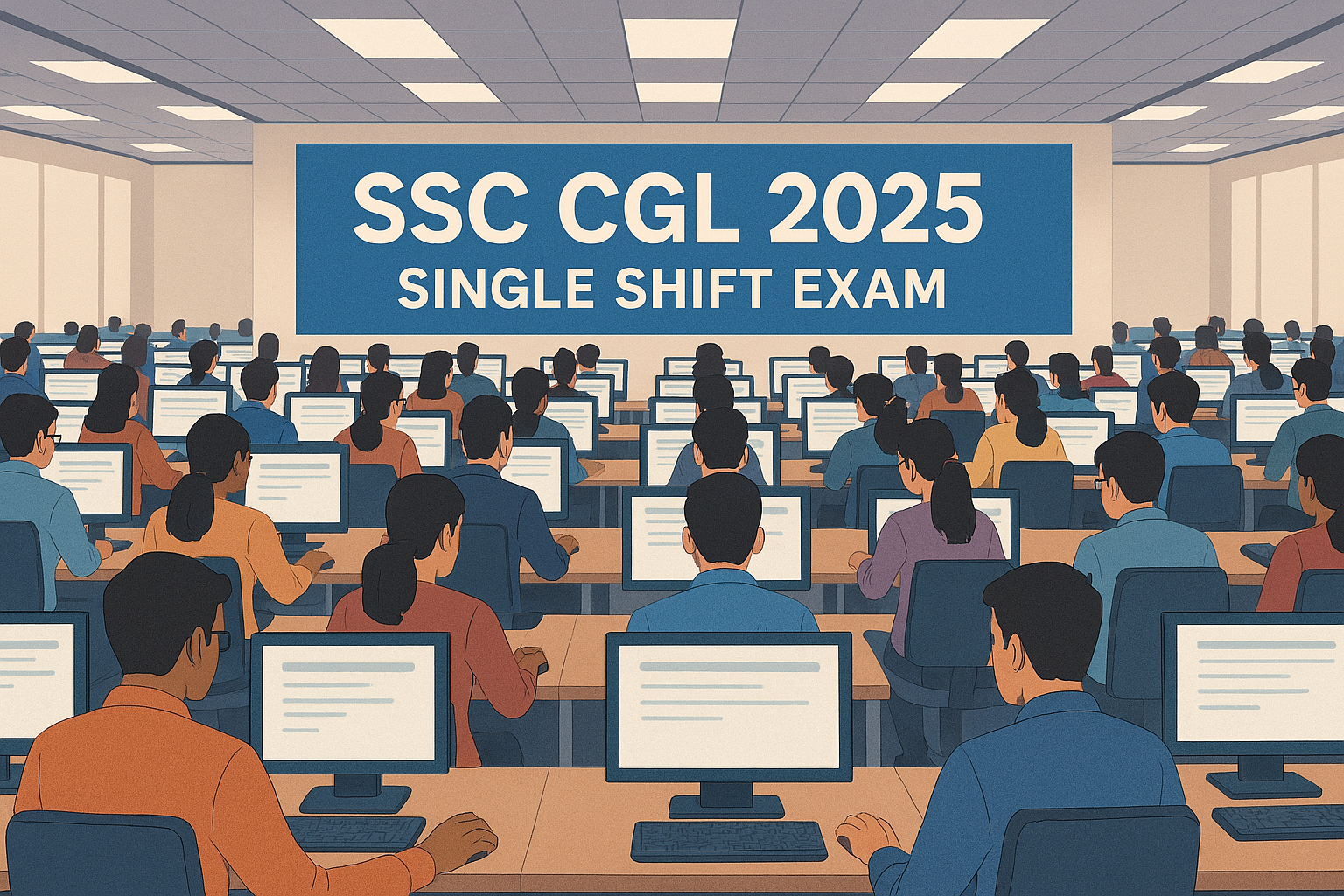
The SSC CGL exam 2025 will undergo major reforms, including a single-shift schedule. Here’s a complete breakdown of changes, preparation tips, and what it means for aspirants.
Table of Contents
The Staff Selection Commission (SSC) has introduced significant reforms to the Combined Graduate Level (CGL) examination for 2025. The most notable change is the implementation of a single-shift examination format for Tier 1, marking a departure from the multi-shift system used in previous years.
This comprehensive guide provides detailed information about the SSC CGL 2025 examination structure, eligibility criteria, preparation strategies, and the implications of the new single-shift format. The information is based on official SSC notifications and government communications as of October 2025.
Understanding SSC CGL: Purpose and Significance
Overview of the Examination
The SSC CGL examination serves as the primary recruitment mechanism for Group B and Group C positions across various central government ministries, departments, and organizations. The examination has consistently attracted between 25 to 30 lakh registrations annually, making it one of India’s largest government recruitment processes.
The examination provides access to prestigious administrative positions that offer job security, structured pay scales, and career advancement opportunities. Since its inception, SSC CGL has been the preferred route for graduates seeking stable government employment in diverse departments.
Positions Available Through SSC CGL
The examination opens pathways to multiple government positions:
Assistant Audit Officer (AAO): Works under the Comptroller and Auditor General of India. These officers conduct financial oversight and audit government accounts. The position offers excellent career growth within the Indian Audit and Accounts Department.
Inspector (Income Tax and GST): Tax administration positions involve conducting investigations, assessments, and ensuring compliance. Income Tax Inspectors work directly with the taxation system. GST Inspectors monitor businesses and prevent revenue leakage, a role that has gained importance since the 2017 tax reform.
Assistant Section Officer (ASO): These officers work in ministry secretariats handling administrative functions, file management, and policy implementation. The position provides direct exposure to central government functioning.
Sub-Inspector (CBI and NIA): Sub-Inspectors in the Central Bureau of Investigation and National Investigation Agency handle criminal cases, terrorism investigations, and national security matters. These positions require physical fitness tests and carry significant responsibility.
Financial Positions: Various departments require Auditors and Accountants to manage budgets, maintain accounts, and ensure fiscal discipline. These technical positions offer specialized career paths with stability.
Statistical Roles: Statistical Investigators and Assistants work with organizations like the National Sample Survey Office, contributing to data collection and analysis that shapes government policy.
Preventive Officers: Customs and Excise Preventive Officers engage in enforcement activities, prevent smuggling, and ensure compliance with customs regulations at ports and international borders.
The diversity of positions available through a single examination makes SSC CGL particularly attractive to candidates with varied interests and educational backgrounds.
Major Reform: Single-Shift Examination Format
Official Announcement and Background
In March 2025, the Staff Selection Commission officially announced that the SSC CGL Tier 1 examination would be conducted in a single shift. This represents the first time in the examination’s history that all candidates will attempt the same paper under identical conditions on the same day.
Previously, the large volume of applicants necessitated conducting the examination across multiple shifts over several days. A candidate appearing on one day might face a different paper than someone taking the exam on another day. While SSC employed statistical normalization to adjust for varying difficulty levels, this system remained controversial among aspirants.
Reasons for the Reform
Elimination of Normalization: The normalization formula, while mathematically designed for fairness, created persistent concerns among candidates. Many aspirants believed that shift allocation played too significant a role in final scores. With the single-shift format, every candidate faces identical questions with the same difficulty level, and raw scores directly determine rankings.
Enhanced Security: Multiple shifts create multiple opportunities for potential malpractice. Question papers could theoretically be compromised between shifts. A single examination window significantly reduces these security vulnerabilities.
Absolute Fairness: No candidate can claim disadvantage due to receiving a comparatively tougher paper. Everyone competes on precisely equal terms with the same questions and conditions.
Administrative Simplification: Preparing multiple sets of questions of comparable difficulty presents enormous challenges. Single-shift examinations streamline question paper creation and reduce administrative complexity.
Faster Results: With only one set of answer keys to verify and no normalization calculations required, SSC can announce results more quickly than in previous multi-shift formats.
Reduced Legal Challenges: Historical court cases often centered on normalization disputes. The single-shift examination eliminates this entire category of potential legal challenges.
Technical Infrastructure Requirements
Expanded Testing Centers: India’s network of authorized computer-based testing centers has grown substantially in recent years. Thousands of centers equipped with modern computers and reliable internet connectivity now exist across the country, from metropolitan cities to district headquarters.
Improved Server Capacity: SSC has invested in robust server infrastructure capable of handling millions of simultaneous user sessions without system crashes or slowdowns. Cloud computing technologies provide the scalability necessary for such large-scale operations.
Real-Time Monitoring: Advanced proctoring software allows examination authorities to monitor all centers simultaneously, flagging suspicious activities or technical issues instantly for immediate resolution.
Biometric Authentication: Fingerprint and photograph verification ensure that the correct candidate takes the examination, preventing impersonation attempts.
Secure Digital Delivery: Digital encryption ensures that question papers remain secure until the exact moment the examination begins across all centers nationwide.
SSC CGL 2025 Examination Structure
Tier 1: Preliminary Examination
The SSC CGL Tier 1 examination tests candidates across four sections:
| Section | Questions | Marks | Topics Covered |
|---|---|---|---|
| Quantitative Aptitude | 25 | 50 | Arithmetic, Algebra, Geometry, Trigonometry, Data Interpretation |
| General Intelligence & Reasoning | 25 | 50 | Logical Reasoning, Verbal/Non-verbal Reasoning, Analytical Puzzles |
| General Awareness | 25 | 50 | History, Geography, Polity, Economics, Science, Current Affairs |
| English Comprehension | 25 | 50 | Reading Comprehension, Grammar, Vocabulary, Sentence Correction |
Examination Details:
- Total Questions: 100
- Total Marks: 200
- Time Duration: 60 minutes
- Marking Scheme: +2 marks for correct answer, -0.5 marks for incorrect answer
- Mode: Computer-Based Test (CBT)
The negative marking system penalizes random guessing and rewards calculated decision-making regarding which questions to attempt.
Tier 2: Main Examination
Candidates who successfully clear Tier 1 advance to Tier 2, which consists of multiple papers:
Paper 1 – Quantitative Abilities: A comprehensive mathematics test covering advanced arithmetic, algebra, geometry, trigonometry, and statistics. This paper requires deeper mathematical understanding beyond surface-level knowledge.
Paper 2 – English Language and Comprehension: An in-depth English examination testing advanced grammar, vocabulary, essay writing, comprehension, and language usage. This paper is particularly important for posts requiring strong communication skills.
Paper 3 – Statistics: Required only for Statistical Investigator positions. This specialized paper covers probability theory, sampling techniques, statistical inference, and data analysis methodologies.
Paper 4 – General Studies (Finance and Economics): Mandatory for certain accounting and audit posts. The paper covers financial management, economics principles, accounting fundamentals, and fiscal policy.
Each paper typically consists of 100 questions for 200 marks, with 2 hours provided for completion. Tier 2 is substantially more challenging than Tier 1, requiring detailed calculations and conceptual clarity.
Tier 3: Descriptive Paper
Most positions require candidates to complete a descriptive paper testing writing skills in either English or Hindi. Candidates must write essays, letters, or precis within a stipulated time frame. This tier evaluates communication abilities essential for administrative positions.
Skill Tests and Document Verification
Computer Proficiency Test (CPT): For positions requiring extensive computer use, candidates must demonstrate word processing, spreadsheet management, and presentation skills.
Data Entry Speed Test (DEST): Certain positions require typing proficiency at specified speeds with accuracy standards.
Document Verification: After clearing all tiers, candidates undergo thorough document verification where educational certificates, identity proofs, category certificates, and other credentials are verified before final selection.
Eligibility Criteria for SSC CGL 2025
Educational Qualifications
Basic Requirement: Candidates must possess a bachelor’s degree in any discipline from a recognized university or equivalent qualification. The degree can be in arts, science, commerce, or any other stream recognized by the University Grants Commission (UGC) or equivalent authority.
Position-Specific Requirements:
- Statistical Investigator positions may require degrees in Statistics, Mathematics, or related quantitative fields
- Tax Assistant positions often prefer Commerce or Economics backgrounds, though this is typically a preference rather than a strict requirement
- Most other positions accept degrees from any discipline
Age Limits and Relaxations
General Age Range: Most positions require candidates to be between 18-30 years as of the cutoff date (usually August 1 of the examination year).
Age Relaxations:
| Category | Age Relaxation |
|---|---|
| OBC (Non-Creamy Layer) | 3 years |
| SC/ST | 5 years |
| PwD (Persons with Disabilities) | 10 years |
| Ex-Servicemen | 3 years (after deduction of military service) |
| Central Government Civilian Employees | 5 years (40 years for General, 45 for OBC, no limit for SC/ST) |
Age relaxations are cumulative for candidates belonging to multiple categories, subject to government guidelines.
Nationality Requirements
Candidates must be:
- A citizen of India, or
- A subject of Nepal, or
- A subject of Bhutan, or
- A Tibetan refugee who came to India before January 1, 1962, with the intention of permanently settling in India, or
- A person of Indian origin who has migrated from Pakistan, Burma, Sri Lanka, East African countries (Kenya, Uganda, Tanzania, Zambia, Malawi, Zaire, Ethiopia, and Vietnam) with the intention of permanently settling in India
Number of Attempts
There is no restriction on the number of attempts for SSC CGL, provided the candidate meets the age criteria on the cutoff date for the specific examination year.
Effective Preparation Strategy for SSC CGL 2025
Understanding the Changed Dynamics
The single-shift format fundamentally alters preparation approach. Previously, some candidates might have relied on favorable normalization outcomes. The new format eliminates this variable, making individual performance the sole determinant of success.
Core Preparation Principles
Accuracy Over Volume: With raw scores determining selection, accuracy becomes paramount. A candidate attempting 70 questions with 90% accuracy will score significantly better than someone attempting 85 questions at 75% accuracy. The negative marking penalty is substantial—each incorrect answer nullifies the benefit of two correct answers.
Speed with Precision: The examination allows approximately 36 seconds per question on average. Candidates must develop the ability to solve problems quickly without sacrificing correctness. This skill develops only through repeated practice under timed conditions.
Balanced Preparation: With 25 questions in each section, neglecting any area severely limits maximum possible scores. A balanced approach—strengthening strong areas while improving weaker ones—yields better overall results.
Question Selection Strategy: Not all questions need to be attempted sequentially. Develop the skill to quickly scan questions, identify easier ones, attempt those first, and return to challenging problems if time permits. This approach maximizes scores by ensuring easy marks aren’t missed while struggling with difficult questions.
Section-Wise Preparation Strategy
Quantitative Aptitude:
This section often determines overall success or failure. Focus areas include:
- Number systems and simplification for quick marks
- Percentage and ratio problems appearing in various forms
- Data interpretation requiring graph reading and calculation speed
- Geometry and mensuration needing formula clarity
- Algebra demanding conceptual understanding beyond memorization
Practice mental calculation techniques regularly. The cumulative time saved across multiple questions by calculating mentally rather than on paper can be significant.
General Intelligence and Reasoning:
This section rewards pattern recognition and logical thinking:
- Verbal reasoning improves through regular puzzle-solving practice
- Non-verbal reasoning requires spatial visualization skills
- Coding-decoding questions follow recognizable patterns
- Analytical reasoning demands systematic problem-solving approaches
Regular practice with diverse question types builds the mental flexibility this section demands.
General Awareness:
This section has become increasingly dynamic:
- Static topics (history, geography, polity, science) form the foundation
- Current affairs from approximately 12-18 months before the examination are crucial
- Government schemes launched in the past year receive emphasis
- Awards, appointments, and international events must be tracked
- Scientific developments and technological breakthroughs feature regularly
Maintain a monthly current affairs compilation. Review quality newspapers daily, focusing on editorial sections for depth beyond basic facts.
English Comprehension:
Strong language skills develop over extended periods:
- Read quality newspapers and magazines to build vocabulary naturally
- Practice grammar through exercises rather than just theoretical study
- Reading comprehension improves with exposure to diverse writing styles
- Idioms and phrases require memorization with contextual understanding
For candidates from regional language backgrounds, English proficiency often becomes a key differentiator. Consistent effort in this section yields substantial benefits.
The Power of Mock Examinations
Mock tests serve multiple critical functions in preparation:
Time Management Training: Taking full-length tests under timed conditions trains you to work within examination constraints. You discover which sections consume excessive time and develop strategies to manage the clock effectively.
Stamina Building: Maintaining concentration for 60 continuous minutes while solving diverse problems requires mental stamina that only practice builds.
Error Pattern Identification: Reviewing mock tests reveals whether mistakes stem from conceptual gaps, calculation errors, or question misreading. Each error type requires different corrective measures.
Examination Simulation: Mock tests reduce examination day anxiety by familiarizing you with the experience. The actual examination feels less intimidating when you’ve already taken dozens of similar tests.
Performance Tracking: Regular mocks provide data on improvement trajectory. Stagnating scores signal the need for strategy adjustment.
Schedule at least two full-length mock tests weekly in the final two months before the examination. Analyze each test thoroughly before attempting the next one.
Revision Strategy
Many aspirants make the mistake of continuous new learning without consolidating previous knowledge. Effective revision includes:
Spaced Repetition: Review concepts at increasing intervals. Study something today, review it after three days, then after a week, then after two weeks. This spacing improves long-term retention significantly.
Formula and Concept Sheets: Maintain concise notes of key formulas, shortcuts, and concepts for quick review. These sheets become invaluable in the final week before examination.
Error Journals: Maintain a dedicated notebook of mistakes made during practice. Review this regularly to avoid repeating errors in the actual examination.
Topic-Wise Tests: After revising a specific topic, take targeted tests on just that area to ensure concepts have solidified.
Collaborative Learning: Discussing concepts with fellow aspirants reveals gaps in understanding and exposes you to different problem-solving approaches. However, limit group study to specific sessions—most preparation should be individual and self-directed.
Current Affairs Preparation
Importance in SSC CGL
Recent examinations have allocated 30-40% of General Awareness questions to current affairs. This emphasis reflects SSC’s desire to recruit candidates aware of contemporary issues rather than those with only theoretical knowledge.
Effective Current Affairs Strategy
Daily News Tracking: Dedicate 30-40 minutes daily to newspaper reading. Focus on:
- National and international political developments
- Economic policy changes and government initiatives
- Scientific breakthroughs and technology news
- Environmental issues and climate change developments
- Sports achievements beyond tournament winners
- Awards and honors to individuals and organizations
- Appointments to significant government positions
- Summit meetings and international cooperation
Monthly Consolidation: While daily reading is essential, monthly consolidation prevents information overload. Use monthly current affairs magazines or create personal monthly summaries.
Topic-Wise Organization: Instead of chronological notes, organize current affairs by themes:
- Government schemes and initiatives
- International relations and diplomacy
- Economic developments
- Science and technology
- Environment and ecology
- Sports and culture
This organization aids in recalling related information during examination.
Key Current Affairs Areas (2024-2025)
Government Initiatives: Schemes launched or significantly modified in 2024-2025, including digital infrastructure projects, rural development programs, education initiatives, and health sector reforms.
International Relations: India’s evolving relationships with neighboring countries, BRICS developments, India-US partnership, India’s role in G20 and UN forums, and bilateral agreements.
Economic Developments: Budget 2025 highlights, RBI policy changes, inflation trends, GST modifications, startup ecosystem developments, and digital payment system evolution.
Scientific Achievements: ISRO missions, defense technology developments, medical breakthroughs, artificial intelligence progress in India, and renewable energy advancements.
Sports: Major tournament results across various sports, Indian athletes’ international achievements, and significant sporting events hosted by or participated in by India.
Examination Day Strategy
Pre-Examination Preparation
Admit Card: Download and print multiple copies of your admit card. Verify all details carefully—name, photograph, examination center, date, and time. Report any discrepancies immediately to SSC through official channels.
Center Reconnaissance: If possible, visit your examination center a few days prior. Note the travel time, exact location, and parking availability. This reconnaissance prevents last-minute confusion.
Documentation: Organize all required documents—admit card, original identity proof (Aadhaar card, PAN card, driving license, or passport), and recent photographs. Keep everything in one accessible folder.
Avoid Last-Minute Cramming: The final 2-3 days should focus on light revision, not new learning. Review formula sheets, error journals, and take confidence-building easy mock tests.
Rest and Nutrition: Ensure adequate sleep in the nights before examination. Avoid heavy or unfamiliar foods that might cause digestive discomfort on examination day.
During the Examination
Arrive Early: Reach the examination center at least 45-60 minutes before the scheduled time. This buffer accounts for security checks, document verification, and technical setup.
Document Verification: Carry original identity proofs as photocopies are not accepted. The verification process takes time when thousands of candidates are entering simultaneously.
Maintain Calm: Practice deep breathing if you feel anxious. Examination anxiety is normal and manageable. Trust your preparation and maintain confidence.
Initial Paper Scan: When the examination begins, spend 2-3 minutes scanning the entire paper to gauge overall difficulty and plan your attempt sequence.
Strategic Question Selection: Attempt questions in order of difficulty—easiest first. This ensures you don’t lose marks you could have scored while stuck on difficult problems.
Time Tracking: Monitor the on-screen timer regularly. Ideally, complete 80-85 questions in 50 minutes, leaving 10 minutes for revision and attempting remaining questions.
Avoid Panic: If you encounter a particularly difficult section, don’t panic. Other candidates face the same challenges. Move to another section and return if time permits.
Calculated Guessing: With 0.5 mark negative marking, random guessing is costly. If you can confidently eliminate two options, calculated guessing becomes viable. Otherwise, skip the question.
Technical Issues: If your computer malfunctions, immediately raise your hand and alert the invigilator. Don’t panic—established protocols exist to provide extra time or machine changes.
Post-Examination Actions
Answer Key Verification: SSC releases provisional answer keys for candidate challenges. Review your responses against the official key. If you believe an answer is incorrect, gather supporting evidence from reliable sources and file a representation during the challenge window. Each challenge typically requires a nominal fee, refundable if your challenge is accepted.
Avoid Excessive Comparisons: After the examination, avoid prolonged discussions about answers with other candidates. Different people remember differently, and these discussions often create unnecessary anxiety without serving any productive purpose.
Focus on Next Stage: If you believe you’ve performed well in Tier 1, immediately begin preparing for Tier 2. Waiting for results means losing valuable preparation time that could be utilized productively.
Impact on Other SSC Examinations
Potential Extension to SSC CHSL
The reforms introduced for SSC CGL exam 2025 may extend to other SSC examinations. The Combined Higher Secondary Level (CHSL) examination recruits candidates for Lower Division Clerk, Data Entry Operator, Postal Assistant, and Sorting Assistant positions.
With application numbers rivaling CGL, CHSL faces similar normalization controversies. SSC officials have indicated that reforms similar to those implemented in CGL are under active consideration for CHSL. While no official announcement has been made as of October 2025, the CHSL examination scheduled for late 2025 or early 2026 may adopt the single-shift format.
Other SSC Examinations
SSC MTS (Multi-Tasking Staff): This examination for lower-level government positions sees enormous participation. Reform here would benefit millions of candidates from economically weaker sections seeking government employment.
SSC JE (Junior Engineer): Technical recruitment for engineering posts might follow similar reforms, though the smaller candidate pool makes multi-shift issues less pronounced.
SSC Stenographer: This specialized examination could also benefit from single-shift administration, ensuring fairness and transparency.
The broader trend suggests SSC is committed to eliminating normalization across all examinations wherever logistically feasible.
Long-Term Implications
Technological Infrastructure Development
The push to conduct large examinations in single shifts will likely accelerate India’s digital examination infrastructure development:
Testing Center Expansion: Private testing center operators will invest in expanding capacity, benefiting not just SSC but all examination bodies conducting computer-based tests.
Server Capacity Enhancement: Cloud infrastructure in India will benefit from the demands of large-scale simultaneous examinations, improving overall digital infrastructure.
Cybersecurity Improvements: Protecting high-stakes examinations will drive improvements in cybersecurity protocols and data protection measures.
Accessibility Enhancement: Ensuring even remote areas have examination centers with adequate facilities will gradually improve educational infrastructure nationwide.
Restoration of Public Trust
Perhaps the most significant long-term impact could be restoration of trust in government recruitment processes:
Merit-Based Selection: When candidates believe the system is truly merit-based, it strengthens faith in public institutions. This is particularly important in a country where government jobs represent aspirational success for millions.
Reduced Cynicism: Controversies and legal challenges breed cynicism about whether preparation alone suffices for success. Fair examination administration counters this institutional cynicism.
Institutional Confidence: Young students observing transparent, fair examination processes develop greater institutional trust, benefiting society beyond just these specific examinations.
Important Dates and Application Process
Expected Timeline for SSC CGL 2025
Based on SSC’s annual examination calendar and historical patterns:
| Event | Expected Timeline |
|---|---|
| Official Notification | November-December 2025 |
| Application Start Date | Within 2-3 days of notification |
| Application End Date | Approximately 30 days from start |
| Tier 1 Examination | March-April 2026 |
| Tier 1 Results | 2-3 months after Tier 1 |
| Tier 2 Examination | 1-2 months after Tier 1 results |
| Tier 2 Results | 2-3 months after Tier 2 |
| Tier 3 & Skill Tests | As per schedule |
| Final Results | 15-18 months after notification |
Note: These are indicative timelines based on previous years’ patterns. Candidates should regularly check the official SSC website (ssc.nic.in) for confirmed dates.
Application Process
Online Registration: Applications must be submitted through the official SSC portal. Candidates need to register, fill in personal and educational details, upload photographs and signatures, and pay the application fee.
Application Fee:
| Category | Fee Amount |
|---|---|
| General/OBC Male Candidates | ₹100 |
| Women/SC/ST/PwD/Ex-Servicemen | No Fee |
Payment can be made through online banking, credit/debit cards, or at designated bank branches.
Document Requirements:
- Recent passport-size photograph (digital format)
- Signature (digital format)
- Educational certificates (for verification stage)
- Category certificate (if applicable)
- Identity proof
Frequently Asked Questions (FAQs)
Q1: What is the most significant change in SSC CGL 2025?
The SSC CGL Tier 1 examination will be conducted in a single shift format for the first time. All candidates across India will attempt the same question paper at the same time on the same day. This eliminates the multi-shift system and completely removes the normalization of marks. Every candidate’s raw score will directly determine their ranking, ensuring equal opportunity and absolute fairness for all participants.
Q2: When will the SSC CGL 2025 notification be released and when is the examination expected?
Based on SSC’s annual examination calendar released in early 2025, the official notification for SSC CGL 2025 is expected in November or December 2025. The Tier 1 examination is likely to be conducted in March or April 2026. However, candidates should regularly check the official SSC website at ssc.nic.in for precise dates as schedules may change due to administrative considerations.
Q3: What are the complete eligibility criteria for SSC CGL 2025?
Candidates must possess a bachelor’s degree in any discipline from a recognized university. The age requirement is typically 18-30 years as of the cutoff date (usually August 1 of the examination year). Age relaxations are provided: OBC candidates receive 3 years, SC/ST candidates get 5 years, and PwD candidates receive 10 years relaxation. Specific posts like Statistical Investigator may require degrees in Statistics or Mathematics. There is no restriction on the number of attempts as long as age criteria are met.
Q4: How should preparation strategy change for the single-shift format?
The single-shift format requires greater emphasis on accuracy over attempting maximum questions, since raw scores directly determine selection without normalization adjustments. Focus on solving questions you confidently know rather than attempting everything. Practice time management through full-length mock tests that simulate actual examination conditions. Maintain balanced preparation across all four sections—Quantitative Aptitude, Reasoning, English, and General Awareness. Strengthen mental stamina to maintain concentration throughout the 60-minute examination window.
Q5: What documents are required at the examination center?
Candidates must carry their admit card (downloaded and printed from the SSC website) along with a valid original photo identity proof. Acceptable identity documents include Aadhaar card, PAN card, driving license, passport, or voter ID card. Both admit card and identity proof are mandatory; photocopies will not be accepted. Prohibited items include mobile phones, calculators, watches, electronic devices, study materials, paper, and bags. The examination interface displays a timer, so watches are not needed.
Q6: How many vacancies are typically available through SSC CGL?
Vacancy numbers vary annually based on government department requirements. Recent years have seen 7,000-12,000 vacancies advertised through CGL, though actual selections sometimes differ slightly based on candidates clearing all stages. The official vacancy notification specifies exact numbers for each recruitment cycle. Candidates should check the official notification when released for the 2025 vacancy details across various positions and departments.
Q7: What is the complete examination structure and marking scheme?
SSC CGL consists of multiple tiers: Tier 1 (100 questions, 200 marks, 60 minutes) tests Quantitative Aptitude, Reasoning, General Awareness, and English with 25 questions each. Each correct answer awards 2 marks, and each incorrect answer deducts 0.5 marks. Tier 2 includes multiple papers on Quantitative Abilities, English, Statistics (for specific posts), and General Studies (Finance & Economics for specific posts). Tier 3 is a descriptive paper testing writing skills. Some positions require Computer Proficiency Test or Data Entry Speed Test, followed by document verification.
Q8: Will SSC CHSL also adopt the single-shift examination format?
While SSC has not officially announced similar reforms for the Combined Higher Secondary Level (CHSL) examination as of October 2025, Commission officials have indicated that reforms are under active consideration. Given that CHSL faces similar normalization controversies with comparable application numbers to CGL, experts anticipate that the CHSL examination scheduled for late 2025 or 2026 will likely adopt the single-shift format. Candidates preparing for CHSL should monitor official announcements and prepare assuming similar reforms may apply.
Q9: What is the typical selection timeline from application to final appointment?
The complete SSC CGL selection process typically spans 12-18 months from notification to final appointment. After the notification release, candidates have approximately 30 days for online applications. Tier 1 examination usually occurs 3-4 months after application deadline. Results are declared within 2-3 months of Tier 1, after which Tier 2 is conducted (typically 1-2 months after Tier 1 results). Tier 2 results take another 2-3 months. Tier 3, skill tests, document verification, and medical examination (for certain posts) follow. Final appointment letters are typically issued 15-18 months after initial notification, though timelines can vary.
Q10: What are the best official resources for SSC CGL preparation and updates?
The official SSC website (ssc.nic.in) is the primary source for notifications, admit cards, result declarations, and official announcements. The SSC candidate portal allows application submission, status tracking, and document access. Previous year question papers available on the SSC website and educational platforms reveal question patterns and frequently tested topics. For current affairs, rely on quality newspapers, government press releases, and official ministry websites. Candidates should verify all information from official sources only and avoid relying on unofficial websites or unverified information.
Key Takeaways
The SSC CGL 2025 examination introduces the single-shift format for Tier 1, eliminating normalization and ensuring absolute fairness. All candidates will attempt identical questions under the same conditions. This reform enhances security, simplifies administration, and accelerates result declaration.
The examination provides access to prestigious Group B and Group C positions across central government departments. Eligibility requires a bachelor’s degree with age typically between 18-30 years, subject to category-based relaxations. The selection process includes Tier 1, Tier 2, Tier 3, skill tests, and document verification.
Effective preparation requires balanced focus across all sections, emphasis on accuracy over volume, regular mock tests, and systematic current affairs tracking. The single-shift format makes individual performance the sole determinant of success, increasing the importance of strategic preparation.
Next Steps for Aspirants
Immediate Actions:
- Regularly check ssc.nic.in for official notifications and updates
- Gather required documents and certificates for application
- Begin systematic preparation across all four sections
- Subscribe to official SSC communications for timely updates
Preparation Planning:
- Create a structured study schedule allocating time to each section
- Enroll in or purchase quality mock test series
- Develop a current affairs compilation system
- Identify and address weak areas through targeted practice
Application Process:
- Complete online registration immediately after notification release
- Upload clear, compliant photographs and signatures
- Pay application fee through secure methods
- Save application confirmation and maintain digital copies
Ongoing Strategy:
- Take regular full-length mock tests under timed conditions
- Analyze performance to identify improvement areas
- Maintain physical and mental health throughout preparation
- Stay updated on examination pattern changes or notifications
Candidates should avoid relying on unofficial sources, third-party websites, or unverified information. All dates, procedures, eligibility criteria, and requirements should be confirmed from official SSC communications.
About the Author
Nueplanet
Nueplanet is an educational content specialist with expertise in government recruitment examinations and competitive exam preparation. With a commitment to providing accurate, verified, and comprehensive information, Nueplanet researches official notifications, government guidelines, and examination conducting body communications to ensure content reliability.
This article is based on official announcements from the Staff Selection Commission and publicly available information as of October 2025. All details have been verified from SSC’s official website and related government communications. The content is regularly reviewed and updated to reflect the latest information and changes in examination procedures.
About This Platform:
This platform is dedicated to providing verified, accurate, and timely information about government recruitment examinations, competitive exams, and career opportunities in India. We prioritize official sources including examination conducting bodies, government notifications, and authorized communications to ensure content reliability. Our goal is to help aspirants make informed decisions based on factual, transparent information without promotional bias.
Published: September 03, 2025
Last Updated: September 03, 2025
Disclaimer: This article is based on official information available at the time of publication. Candidates are strongly advised to verify all details including dates, fees, eligibility criteria, examination pattern, and procedures from the official Staff Selection Commission website at ssc.nic.in before making any decisions. The author and platform are not responsible for any changes made by the authorities after publication. Always refer to official SSC notifications and communications for the most current and accurate information.
Helpful Resources
Latest Posts
- Maruti Suzuki: Driving India’s Auto Story
- Gujarat Mineral Development Corporation (GMDC) Share Price: Surge, Strategy & Outlook
- Is Stock Market Open Today? Holiday Schedule, Global Cues, and Market Outlook
- Weather in Srinagar: Heavy Rains, Alerts & What You Need to Know
- Indus Towers Share Price: African Expansion Sparks Volatility & Strategic Pivot
Tag
SSC CGL Exam









Post Comment