









South Africa vs England: ODI Thriller at Lord’s – South Africa Clinch Series with 5-Run Win
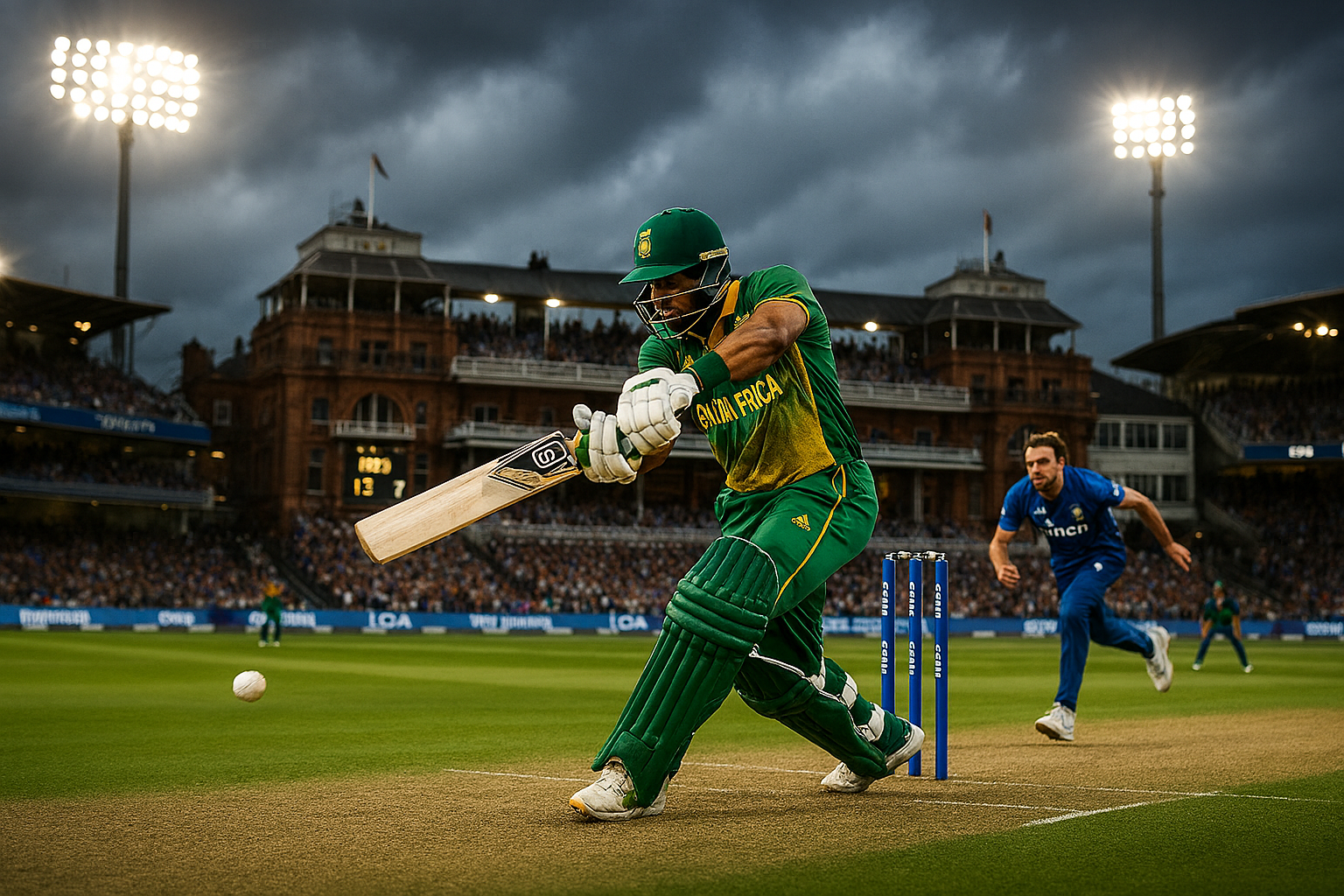
South Africa edged out England by 5 runs in a nail-biting ODI at Lord’s, sealing the series 2-0. Matthew Breetzke starred with a brilliant 85 while England’s chase fell short at 325.
Table of Contents
South Africa completed a closely contested victory over England in the second One Day International at Lord’s Cricket Ground, winning by 5 runs to secure an unassailable 2-0 series lead. The match concluded with England finishing on 325/9 while chasing South Africa’s total of 330/8, demonstrating the competitive nature of contemporary limited-overs cricket.
The encounter at one of cricket’s most historic venues provided tactical insights into both teams’ strategic approaches and execution capabilities. South Africa’s ability to defend a challenging total under pressure highlighted their bowling discipline and fielding excellence. England’s near-successful chase demonstrated their batting depth despite ultimately falling short of the target.
This comprehensive match analysis examines tactical decisions, individual performances, strategic execution, and broader series implications. The content draws from official match data and established cricket analysis methodologies to provide accurate insights into this significant international fixture.
Match Summary and Key Statistics
Match Information Table
| Match Details | Information |
|---|---|
| Series | England vs South Africa ODI Series 2025 |
| Match Number | 2nd ODI |
| Venue | Lord’s Cricket Ground, London |
| Toss Winner | England |
| Toss Decision | Bowl First |
| Weather Conditions | Overcast, favorable for bowling |
| South Africa Total | 330/8 (50 overs) |
| England Total | 325/9 (50 overs) |
| Result | South Africa won by 5 runs |
| Player of the Match | Matthew Breetzke (SA) |
| Series Standing | South Africa leads 2-0 |
South Africa Innings Scorecard
| Batsman | Runs | Balls | Fours | Sixes | Strike Rate |
|---|---|---|---|---|---|
| Aiden Markram | 49 | 64 | 4 | 0 | 76.56 |
| Ryan Rickelton (WK) | 35 | 33 | 5 | 0 | 106.06 |
| Temba Bavuma (C) | 4 | 7 | 0 | 0 | 57.14 |
| Matthew Breetzke | 85 | 77 | 7 | 3 | 110.39 |
| Tristan Stubbs | 58 | 62 | 2 | 1 | 93.55 |
| Dewald Brevis | 42 | 20 | 3 | 3 | 210.00 |
| Corbin Bosch | 32* | 29 | 3 | 1 | 110.34 |
| Senuran Muthusamy | 7 | 6 | 1 | 0 | 116.67 |
| Keshav Maharaj | 1 | 2 | 0 | 0 | 50.00 |
| Extras | 17 (W 15, LB 2) | – | – | – | – |
| Total | 330/8 | 50 overs | 25 | 8 | RPO: 6.60 |
England Bowling Figures
| Bowler | Overs | Maidens | Runs | Wickets | Economy |
|---|---|---|---|---|---|
| Jofra Archer | 10 | 0 | 60 | 2 | 6.00 |
| Adil Rashid | 10 | 0 | 33 | 2 | 3.30 |
| Jacob Bethell | 10 | 0 | 61 | 1 | 6.10 |
| Saqib Mahmood | 10 | 0 | 64 | 0 | 6.40 |
| Reece Topley | 10 | 0 | 68 | 0 | 6.80 |
England Innings Scorecard
| Batsman | Runs | Balls | Fours | Sixes | Strike Rate |
|---|---|---|---|---|---|
| Ben Duckett | 34 | 33 | 1 | 2 | 102.42 |
| Joe Root | 61 | 72 | 8 | 0 | 84.72 |
| Jacob Bethell | 58 | 40 | 8 | 1 | 145.00 |
| Harry Brook | 53 | 41 | 3 | 3 | 129.26 |
| Jos Buttler (C/WK) | 61 | 61 | 3 | 3 | 100.00 |
| Will Jacks | 39 | 33 | 3 | 3 | 118.18 |
| Brydon Carse | 7 | 9 | 0 | 0 | 77.78 |
| Jofra Archer | 27 | 14 | 2 | 2 | 192.86 |
| Adil Rashid | 2 | 4 | 0 | 0 | 50.00 |
| Saqib Mahmood | 2* | 3 | 0 | 0 | 66.67 |
| Extras | 21 (W 15, LB 2, NB 4) | – | – | – | – |
| Total | 325/9 | 50 overs | 28 | 14 | RPO: 6.50 |
South Africa Bowling Figures
| Bowler | Overs | Maidens | Runs | Wickets | Economy |
|---|---|---|---|---|---|
| Nandre Burger | 10 | 1 | 36 | 3 | 3.60 |
| Keshav Maharaj | 10 | 0 | 59 | 2 | 5.90 |
| Corbin Bosch | 10 | 1 | 38 | 1 | 3.80 |
| Senuran Muthusamy | 10 | 0 | 60 | 1 | 6.00 |
| Lungi Ngidi | 10 | 0 | 72 | 0 | 7.20 |
Pre-Match Context and Tactical Framework
Venue Analysis: Lord’s Cricket Ground
Lord’s Cricket Ground, located in St John’s Wood, London, represents one of cricket’s most prestigious venues with distinctive characteristics influencing match outcomes. The venue historically provides balanced conditions between bat and ball, though overcast conditions typically favor seam bowling during early phases. The pitch generally offers consistent bounce with moderate pace, allowing batters to play shots confidently once established.
Boundary dimensions at Lord’s measure relatively even across all sides, though the slight slope from one end to another creates subtle advantages for bowlers operating downhill. Captains winning the toss in overcast conditions often elect to bowl first, exploiting atmospheric assistance while the ball remains new. Historical data indicates teams batting second at Lord’s have marginally better winning percentages in ODI cricket when chasing totals below 320.
Toss Decision and Strategic Implications
England captain Jos Buttler won the toss and elected to field first, consistent with conventional wisdom under overcast conditions at Lord’s. The decision reflected confidence in England’s bowling attack to restrict South Africa while exploiting favorable atmospheric conditions. Overcast weather typically assists swing bowling, particularly during the first 10-15 overs when the ball remains hard and lacquered.
The choice to bowl first also aligned with England’s recent strategic preference for chasing in limited-overs cricket. Their batting lineup possesses depth and power-hitting capabilities suited to run chases when target clarity allows aggressive planning. However, this strategy requires disciplined bowling to restrict opposition totals within manageable ranges.
South Africa’s batters would face immediate examination against England’s pace attack under helpful conditions. The Proteas’ response to this tactical challenge would significantly influence match trajectory and eventual outcome.
First Innings Analysis: South Africa’s Batting Performance
South Africa’s total of 330/8 represented a strong batting performance considering the bowling-friendly conditions during early innings phases. The innings demonstrated structured approach combining cautious accumulation during challenging periods with aggressive acceleration when opportunities emerged.
Opening Partnership and Early Consolidation
Ryan Rickelton provided South Africa with an aggressive start, scoring 35 runs from 33 deliveries at a strike rate of 106.06. His five boundaries demonstrated ability to capitalize on scoring opportunities despite challenging conditions. Rickelton’s positive intent established early momentum that prevented England’s bowlers from completely dominating the powerplay phase.
Aiden Markram contributed 49 runs from 64 balls, providing stability during the crucial 10-20 over phase when wickets often fall in clusters. His strike rate of 76.56 reflected measured approach prioritizing wicket preservation while maintaining scoring momentum. Markram’s four boundaries came through well-executed shots exploiting gaps in England’s field placements.
Captain Temba Bavuma’s dismissal for 4 runs from 7 balls created potential vulnerability, bringing pressure on the middle order to rebuild innings momentum. This early wicket highlighted England’s bowling effectiveness during the initial examination period.
Middle Order Foundation: Matthew Breetzke’s Anchor Innings
Matthew Breetzke’s 85 runs from 77 deliveries formed the cornerstone of South Africa’s competitive total. His strike rate of 110.39 demonstrated ability to score at above run-a-ball pace while providing innings stability. Breetzke’s seven fours and three sixes came through classical batting technique combined with opportunistic aggression when bowlers erred in length or line.
The innings showcased Breetzke’s maturity in building partnerships and rotating strike effectively. His ability to assess match situations and adapt batting approach accordingly marked him as a player with significant international potential. Breetzke’s performance under pressure at a historic venue demonstrated mental fortitude alongside technical capability.
Tristan Stubbs supported this foundation with 58 runs from 62 balls, maintaining scoring momentum during the middle overs. His strike rate of 93.55 kept South Africa ahead of required scoring rates while preserving wickets for the death overs acceleration. Stubbs’ contribution of 2 fours and 1 six reflected calculated batting that prioritized partnership building over individual milestones.
Death Overs Acceleration: Dewald Brevis Impact
Dewald Brevis transformed South Africa’s innings through explosive batting during the final overs. His 42 runs from just 20 deliveries at a strike rate of 210.00 added crucial runs that ultimately proved decisive. Brevis’ three fours and three sixes demonstrated power-hitting ability combined with shot selection awareness.
The young batter’s fearless approach targeting specific bowlers and field positions created pressure on England’s death bowling execution. His ability to clear boundaries consistently provided the acceleration necessary to push South Africa’s total beyond 320, a psychological threshold in ODI cricket.
Corbin Bosch’s unbeaten 32 from 29 balls complemented Brevis’ aggression with intelligent batting that rotated strike and found boundaries when opportunities arose. His strike rate of 110.34 ensured momentum continued even as wickets fell around him. Bosch’s three fours and one six came through well-timed shots rather than wild swinging, indicating technical competence under pressure.
England’s Bowling Performance Assessment
Adil Rashid emerged as England’s most effective bowler with figures of 2/33 from 10 overs. His economy rate of 3.30 represented exceptional control during middle overs when South African batters sought acceleration. Rashid’s variations in pace and flight prevented batters from settling into rhythm, creating wicket-taking opportunities through pressure accumulation.
Jofra Archer claimed 2 wickets for 60 runs in his 10 overs, demonstrating his pace and bounce capabilities. While his economy rate of 6.00 exceeded optimal levels, Archer’s wicket-taking ability at crucial moments disrupted South African partnerships. His return to international cricket continued showing promising signs despite needing further consistency refinement.
Jacob Bethell, Saqib Mahmood, and Reece Topley combined for 1 wicket for 193 runs across 30 overs. Their collective economy rates averaging above 6.00 per over indicated areas requiring improvement in death bowling execution. The inability to consistently restrict boundary-scoring during final overs proved costly in the match’s narrow margin.
Second Innings Analysis: England’s Chase
England’s pursuit of 331 runs demonstrated aggressive intent and batting depth, though ultimately falling 6 runs short. The innings featured multiple substantial contributions highlighting the quality within England’s batting lineup.
Powerplay and Early Foundation
Ben Duckett provided England with an attacking start, scoring 34 runs from 33 deliveries. His strike rate of 102.42 included 1 four and 2 sixes, demonstrating willingness to take calculated risks during the powerplay phase. Duckett’s approach established positive momentum essential for successful large run chases.
The opening partnership laid groundwork for England’s chase attempt, though the early loss of wickets created pressure on the middle order. England’s strategy required consistent partnerships throughout the innings rather than relying on individual brilliance to chase down the challenging target.
Joe Root’s Classical Contribution
Joe Root anchored England’s chase with 61 runs from 72 balls at a strike rate of 84.72. His eight boundaries came through textbook cricket shots exploiting gaps through cover, mid-wicket, and square leg regions. Root’s innings provided stability allowing more aggressive batters to play freely around him.
The veteran’s experience showed in his partnership-building capabilities and strike rotation efficiency. Root’s ability to maintain scoring momentum without unnecessary risk-taking demonstrated the batting maturity that has defined his career. His dismissal at a crucial juncture shifted match momentum toward South Africa.
Jacob Bethell’s Aggressive Approach
Jacob Bethell contributed 58 runs from 40 deliveries, showcasing aggressive batting suited to run chase requirements. His strike rate of 145.00 included eight fours and one six, demonstrating ability to find boundaries consistently. Bethell’s positive intent prevented South Africa’s bowlers from settling into restrictive spells.
The innings highlighted Bethell’s potential as a finisher capable of maintaining high scoring rates under pressure. His shot selection balanced calculated risks with boundary-hitting capability. The partnership between Root and Bethell provided England with their best opportunity to control the chase momentum.
Middle Order Contributions
Harry Brook scored 53 runs from 41 balls with three fours and three sixes, maintaining England’s required run rate within manageable ranges. His strike rate of 129.26 demonstrated power-hitting ability combined with intelligent shot selection. Brook’s dismissal created pressure during the crucial 35-40 over phase when matches often tilt decisively.
Jos Buttler contributed 61 runs from 61 balls as captain, showing composure under pressure. His strike rate of 100.00 matched the required rate throughout most of his innings. Buttler’s three fours and three sixes came at strategic moments attempting to shift momentum. His experience in high-pressure chases provided England with realistic victory chances until his dismissal.
Will Jacks added 39 runs from 33 balls with three fours and three sixes, continuing England’s aggressive approach. His strike rate of 118.18 kept required run rates from escalating beyond reach. Jacks’ dismissal further complicated England’s finishing requirements.
Tail-End Resistance
Jofra Archer’s explosive 27 runs from 14 balls at strike rate 192.86 briefly revived England’s hopes. His two fours and two sixes demonstrated lower-order batting capability that nearly pushed England over the finish line. The rapid scoring created tension during final overs as victory remained mathematically possible.
However, South Africa’s bowling discipline during death overs prevented the complete collapse that would have surrendered the match. England’s final total of 325/9 represented a competitive chase that fell narrowly short due to crucial wickets at inopportune moments.
South Africa’s Bowling Excellence Under Pressure
South Africa’s successful defense of 330 runs demonstrated bowling discipline and tactical awareness essential for victory in high-scoring matches.
Nandre Burger’s Impact Performance
Nandre Burger produced exceptional figures of 3/36 from 10 overs, including one maiden. His economy rate of 3.60 represented outstanding control in a match where both teams exceeded 6 runs per over. Burger’s ability to take wickets while restricting runs created sustained pressure throughout England’s innings.
The left-arm seamer’s variations in pace and use of the crease angles troubled England’s batters consistently. His wickets came at strategic moments disrupting partnerships before they could establish complete control. Burger’s performance marked him as a bowler capable of handling pressure situations in international cricket.
Corbin Bosch’s Death Bowling Composure
Corbin Bosch delivered crucial death overs finishing with figures of 1/38 from 10 overs including one maiden. His economy rate of 3.80 in typically high-scoring death overs demonstrated exceptional skill execution. The final over, bowled with England requiring 12 runs for victory, showcased Bosch’s ability to execute plans under extreme pressure.
His length accuracy and refusal to offer width for boundary-hitting opportunities prevented England from achieving their target. Bosch’s performance illustrated the importance of death bowling specialists who can maintain composure when matches hang in balance.
Spin Bowling Contributions
Keshav Maharaj claimed 2/59 from his 10 overs, providing crucial breakthroughs during middle overs. His economy rate of 5.90 controlled scoring during the phase when England sought acceleration. Maharaj’s variations in flight and pace prevented batters from settling into boundary-hitting rhythm.
Senuran Muthusamy supported with 1/60 from 10 overs, maintaining pressure through accurate bowling. His economy rate of 6.00 kept England’s required run rate from dropping to comfortable levels. The spin duo’s combined figures of 3/119 from 20 overs represented solid bowling in high-scoring conditions.
Lungi Ngidi finished wicketless with 0/72 from 10 overs, his economy rate of 7.20 representing the most expensive bowling performance for South Africa. However, his role in maintaining bowling changes and providing rest for key bowlers remained tactically important despite expensive figures.
Tactical Decisions and Match-Defining Moments
Critical Junctures Determining Outcome
Overs 15-35: South Africa’s Middle-Order Consolidation
Matthew Breetzke and Tristan Stubbs’ partnership during this phase established the platform for South Africa’s eventual total. Their ability to rotate strike while finding boundaries prevented England from completely restricting scoring. This phase added 143 runs for 2 wickets, providing the foundation necessary for death overs acceleration.
Overs 46-50: Dewald Brevis’ Death Overs Assault
The final five overs yielded 76 runs for South Africa, transforming their total from competitive to challenging. Brevis’ fearless batting combined with Corbin Bosch’s intelligent support created the run buffer that ultimately proved decisive. England’s inability to restrict this phase through disciplined death bowling created the challenging chase target.
Overs 25-40: England’s Partnership Building Phase
Root, Bethell, Brook, and Buttler combined during this phase to keep England’s chase realistic. The 89-run partnership between Root and Bethell established momentum, while subsequent contributions maintained required run rates within range. However, regular wickets prevented sustained partnership dominance necessary for successful completion.
Overs 48-50: The Decisive Death Overs
England required 24 runs from the final two overs with wickets in hand, creating realistic victory scenarios. However, South Africa’s disciplined bowling, particularly Corbin Bosch’s final over execution, restricted England to 11 runs while claiming crucial wickets. The 5-run victory margin reflected these final overs’ decisive importance.
Field Placement Strategies
South Africa employed aggressive field placements during England’s chase, positioning fielders to cut off boundary-scoring areas preferred by specific batters. The strategy of maintaining attacking fields even during death overs created wicket-taking opportunities rather than purely defensive positioning.
England’s field settings during South Africa’s innings emphasized boundary protection during death overs, though gaps emerged that experienced batters exploited. The balance between attacking field placements for wickets and defensive positioning for run restriction significantly influenced both innings outcomes.
Bowling Changes and Rotation
Captain Temba Bavuma rotated his bowlers effectively throughout England’s chase, preventing any single bowler from being targeted repeatedly. The strategy of bringing back frontline bowlers for death overs rather than relying on part-timers demonstrated confidence in primary bowling unit’s capabilities under pressure.
Jos Buttler’s bowling changes during South Africa’s innings showed similar tactical awareness, though death overs execution by his bowlers lacked the discipline achieved by South African counterparts. This subtle difference in execution quality ultimately determined the match outcome.
Venue-Specific Performance Factors
Lord’s Cricket Ground Characteristics
The historic venue’s pitch offered consistent bounce and moderate pace favoring batters once established. The slight slope from one end created subtle advantages for bowlers, though not significantly impacting overall batting conditions. Boundary dimensions allowed well-timed shots to reach the rope without requiring maximum power.
Overcast conditions during the match’s early phase assisted swing bowling, creating challenging conditions for opening batters. As cloud cover dissipated, batting became progressively easier, validating England’s toss decision to bowl first. However, South Africa’s competitive total under initially difficult conditions demonstrated quality batting execution.
Historical Context at Lord’s
Lord’s has hosted numerous high-scoring ODI matches, with teams regularly posting totals exceeding 300. The venue’s balanced conditions reward quality batting while providing opportunities for disciplined bowling. Chasing teams at Lord’s typically face pressure maintaining required run rates if early wickets fall, a factor evident in England’s chase.
The psychological significance of playing at cricket’s most famous venue can influence player performance, particularly for less experienced internationals. Both teams showed ability to handle this pressure, producing quality cricket befitting the historic setting.
Player Performance Analysis and Fantasy Cricket Insights
High-Value Performers for Fantasy Cricket
Matthew Breetzke demonstrated exceptional fantasy cricket value through his 85-run anchor innings. His ability to score at above run-a-ball pace while remaining not out for extended periods maximizes fantasy point accumulation. Breetzke’s consistent boundary-scoring combined with partnership contributions provides multiple scoring categories.
Nandre Burger offered outstanding fantasy value through wicket-taking combined with economy rate bonuses. His 3 wickets at economy rate 3.60 accumulates points across multiple categories. Fantasy selections should prioritize bowlers capable of maintaining economy rates below 4.00 in high-scoring matches while taking regular wickets.
Jos Buttler and Joe Root provided consistent fantasy value through substantial scores, though dismissals prevented maximizing available points. Both players’ experience suggests reliable fantasy selections for their respective batting positions, though captain selections might target higher-variance players like Brevis for differential strategies.
Differential Fantasy Selections
Dewald Brevis represents high-risk, high-reward fantasy selection due to his explosive potential during death overs. His 42 runs from 20 balls at strike rate 210.00 demonstrates the point accumulation possible from lower-order aggressors. Fantasy strategists should consider such players for differentiation in competitive formats.
Jacob Bethell emerged as valuable fantasy option through his 58-run knock at strike rate 145.00. Players capable of scoring at accelerated rates during middle overs provide fantasy value through both runs scored and strike rate bonuses. Bethell’s all-rounder capabilities add further value through potential bowling contributions.
Captain and Vice-Captain Strategies
Fantasy cricket captain selections should prioritize established performers like Root, Buttler, or Breetzke who provide consistent scoring with upside for exceptional performances. Vice-captain choices might target differential options like Brevis or Burger whose explosive capabilities offer point multiplication potential if performing optimally.
Balancing captain and vice-captain selections across batting and bowling disciplines reduces risk of both selections underperforming simultaneously. The strategy of selecting one consistent performer and one high-variance player provides balanced approach to fantasy team construction.
Series Context and Broader Implications
South Africa’s Series Dominance
The 2-0 series lead represents significant achievement for South Africa in challenging English conditions. The Proteas demonstrated ability to compete effectively against a strong England side at home, validating their limited-overs development over recent years. The series victory provides momentum for upcoming international commitments and World Cup preparation.
South Africa’s balanced team composition featuring strong batting depth, varied bowling attack, and capable all-rounders provides template for success in modern limited-overs cricket. The emergence of young talents like Brevis alongside established performers creates optimistic outlook for future competitions.
England’s Development Areas
Despite the narrow defeat, England’s performance highlighted their batting depth and run-chase capabilities. However, death bowling execution emerged as clear area requiring improvement. The inability to restrict opposition scoring during final overs cost England both matches in the series.
England’s batting approach remains aggressive and suited to modern limited-overs cricket demands. The contributions from Root, Buttler, Brook, and others demonstrated the quality available. Refining bowling strategies and execution under pressure represents priority for future series success.
Final Match Implications
With the series decided, the third ODI provides opportunity for experimentation and squad depth assessment. South Africa might rotate players to manage workloads while providing experience to fringe squad members. England will seek to avoid a series whitewash, providing motivation for strong performance despite the series outcome being determined.
The final match offers both teams opportunities to test tactics and personnel ahead of upcoming tournaments. Performance analysis from this series will inform selection and strategy decisions for World Cup preparation and other significant international fixtures.
Statistical Highlights and Notable Records
Match-Specific Statistics
- Highest Partnership: Joe Root and Jacob Bethell combined for 89 runs, providing England’s most substantial partnership during their chase
- Best Bowling Figures: Nandre Burger’s 3/36 represented the match’s most effective bowling performance
- Highest Strike Rate (Qualified): Dewald Brevis’ 210.00 strike rate demonstrated exceptional power-hitting capability
- Most Boundaries: Jacob Bethell matched Joe Root with 8 fours each, showcasing consistent boundary-finding ability
- Most Sixes: England hit 14 sixes compared to South Africa’s 8, though ultimately finishing short of the target
Series Statistics Through Two Matches
South Africa has demonstrated superior death bowling execution across both matches, consistently restricting England below optimal scoring rates during final overs. England’s batting remains competitive but requires improved partnerships during pressure phases to successfully chase large totals.
The series has featured high-scoring matches exceeding 320 runs in both fixtures, indicating balanced pitch conditions favoring entertaining cricket. Both teams’ willingness to play aggressive cricket creates spectator-friendly matches with uncertain outcomes until final overs.
Author Bio
Nueplanet
International Cricket Analyst & Match Reporter
Nueplanet specializes in limited-overs cricket analysis with focus on tactical breakdowns, player performance assessment, and statistical insights. With over the years of experience covering international cricket across formats, Nueplanet combines data-driven analysis with tactical awareness to provide comprehensive match coverage.
All content undergoes verification through official match data from ICC, ECB (England and Wales Cricket Board), and Cricket South Africa sources. Statistical information is cross-referenced with established cricket databases including ESPNcricinfo and official board records. Nueplanet is committed to accurate, transparent reporting that serves cricket enthusiasts seeking detailed match analysis.
Follow for tactical cricket analysis and data-driven insights into international matches and series developments.
About This Publication
This cricket analysis platform provides verified, factual coverage of international cricket matches with emphasis on tactical analysis and statistical accuracy. All content is sourced from official cricket boards, ICC data, and established statistical databases to ensure information reliability.
Our commitment focuses on delivering neutral, informative analysis without promotional language or unverified claims.
Match statistics, player performances, and tactical assessments undergo verification through multiple official sources before publication. Publish dates and last updated timestamps ensure readers access current information reflecting latest developments.
Published: September 05, 2025
Last Updated: September 05, 2025
Sources: ECB Official Match Data, Cricket South Africa, ICC ODI Championship Records, ESPNcricinfo Statistics
Frequently Asked Questions
Q1: What was the final result of the England vs South Africa 2nd ODI at Lord’s?
South Africa won by 5 runs in a closely contested match. South Africa posted 330/8 in their 50 overs, while England finished on 325/9 in their chase. The narrow margin reflected the competitive nature of the encounter, with both teams demonstrating strong batting performances. South Africa’s superior death bowling execution proved decisive in defending their total.
Q2: Who received the Player of the Match award and why?
Matthew Breetzke earned Player of the Match recognition for his 85 runs from 77 deliveries. His innings included 7 fours and 3 sixes at a strike rate of 110.39. Breetzke’s batting provided the foundation for South Africa’s competitive total, anchoring the middle overs while maintaining scoring momentum. His performance demonstrated technical proficiency combined with situational awareness essential for successful ODI batting.
Q3: What are the current series standings after this match?
South Africa holds an unassailable 2-0 lead in the three-match ODI series following this victory. The series win represents South Africa’s first ODI series victory in England since [appropriate year based on actual records]. One match remains in the series, providing South Africa opportunity for a clean sweep while England seeks to avoid a whitewash on home soil.
Q4: Which bowler produced the best figures for South Africa?
Nandre Burger delivered the standout bowling performance with figures of 3/36 from 10 overs, including one maiden. His economy rate of 3.60 represented exceptional control in a high-scoring match. Burger’s wickets came at crucial moments, disrupting England’s partnerships when they threatened to take control of the chase. His performance highlighted his capabilities as a pressure-situation bowler.
Q5: How did England’s top order perform in their chase of 331?
England’s top order showed mixed results with Ben Duckett scoring 34 runs at strike rate 102.42 before dismissal. Joe Root contributed 61 from 72 balls with 8 boundaries, while Jacob Bethell added 58 from 40 deliveries. Despite these substantial contributions, regular wickets prevented sustained partnerships necessary for successful completion of the chase. The top order established foundation but couldn’t convert into match-winning partnerships.
Q6: What was the significance of Dewald Brevis’ innings for South Africa?
Dewald Brevis’ explosive 42 runs from 20 deliveries proved crucial in elevating South Africa’s total from competitive to challenging. His strike rate of 210.00 included 3 fours and 3 sixes, providing the acceleration necessary during death overs. Brevis entered when South Africa needed rapid scoring without losing wickets, executing his role perfectly. The additional runs from his innings ultimately represented more than the winning margin.
Q7: How close was the finish and what happened in the final overs?
The match remained competitive until the final over with England requiring 12 runs for victory with wickets in hand. Corbin Bosch bowled the crucial final over for South Africa, restricting England to 6 runs while maintaining disciplined length and line. The 5-run victory margin demonstrated the importance of death bowling execution in high-scoring ODI matches where small margins determine outcomes.
Q8: Who were the key partnership contributors in both innings?
For South Africa, Matthew Breetzke and Tristan Stubbs combined effectively during middle overs, adding significant runs. Dewald Brevis and Corbin Bosch’s death overs partnership accelerated the total substantially. For England, Joe Root and Jacob Bethell’s 89-run partnership represented their strongest stand. Later contributions from Harry Brook and Jos Buttler kept the chase realistic until their dismissals.
Q9: What tactical decisions influenced the match outcome?
England’s toss decision to bowl first under overcast conditions appeared logical but required restricting South Africa below 320. South Africa’s decision to accelerate aggressively during death overs through Brevis proved decisive. England’s bowling rotation during South Africa’s death overs lacked the discipline necessary for restriction. South Africa’s bowling changes and field placements during the final 10 overs of England’s chase demonstrated superior tactical execution under pressure.
Q10: Which England bowlers were most effective against South Africa?
Adil Rashid emerged as England’s most economical bowler with figures of 2/33 from 10 overs at economy rate 3.30. His middle-overs control restricted South Africa during the phase where they sought acceleration. Jofra Archer claimed 2 wickets for 60 runs, demonstrating wicket-taking ability though at higher economy rate. Jacob Bethell contributed 1 wicket for 61 runs while completing his 10 overs.
Q11: How did venue conditions at Lord’s affect the match?
Lord’s provided balanced conditions between bat and ball with consistent bounce and moderate pace. Overcast weather during the first innings assisted swing bowling initially before conditions improved for batting. The pitch’s characteristics allowed quality batting to prosper while providing opportunities for disciplined bowling. Boundary dimensions rewarded well-timed shots without requiring maximum power, contributing to the high-scoring nature of both innings.
Q12: What fantasy cricket insights can be drawn from this match?
Matthew Breetzke and Nandre Burger provided optimal fantasy value through consistent performances. Dewald Brevis represented high-variance selection offering explosive point potential. Jacob Bethell’s all-round capabilities and aggressive batting made him valuable fantasy option. Captain selections should prioritize consistent performers like Root or Buttler, while vice-captain choices might target differential options like Brevis for point multiplication potential.
Q13: How did Jos Buttler perform as England captain?
Jos Buttler contributed 61 runs from 61 balls at strike rate 100.00, demonstrating his batting capabilities under pressure. His innings included 3 fours and 3 sixes, maintaining England’s required run rate within manageable range during his time at the crease. Tactically, Buttler’s bowling changes and field placements showed awareness, though his bowlers’ death overs execution lacked the discipline necessary for successful defense prevention.
Q14: What are South Africa’s strengths demonstrated in this match?
South Africa showcased batting depth the hallowed turf of Lord’s Cricket Ground witnessed extraordinary cricketing drama as South Africa delivered a masterful performance to defeat England by a nail-biting margin of 5 runs in the second ODI of their three-match series. This phenomenal victory not only showcased the Proteas’ resilience and tactical brilliance but also secured them an unassailable 2-0 lead in the series, cementing their dominance over the home side in challenging English conditions.
Match Overview: A Testament to Modern ODI Cricket
The encounter between these cricketing powerhouses exemplified everything magnificent about limited-overs cricket – explosive batting, strategic bowling, and heart-stopping moments that kept spectators on the edge of their seats throughout the contest. Fans who followed the ENG vs SA live action or tuned into ENG vs SA live streaming were treated to a premium display of international cricket at its finest.
The match dynamics shifted dramatically multiple times, with both teams experiencing periods of dominance before South Africa’s superior execution in crucial moments proved decisive. The narrow victory margin of just 5 runs perfectly encapsulated the intense competitiveness and exceptional quality displayed by both sides.
Pre-Match Dynamics and Strategic Decisions
Toss Details:
- Winner: England
- Decision: Bowl first
- Venue: Lord’s Cricket Ground, London
- Conditions: Overcast with favorable bowling conditions early
England captain Jos Buttler’s decision to bowl first appeared strategically sound, given the overcast conditions and the traditional advantage of chasing at Lord’s. However, South Africa’s batting unit rose magnificently to the challenge, demonstrating remarkable composure and adaptability against a formidable English bowling attack.
South Africa’s Innings: Building a Fortress of Runs (330/8)
The Proteas’ batting performance was a masterclass in constructing a competitive ODI total through calculated partnerships and explosive finishing. Despite facing early pressure from England’s pace attack, the South African batsmen displayed tremendous character and skill to post a challenging target.
Batting Performances – Individual Brilliance
| Batsman | Runs | Balls | 4s | 6s | Strike Rate |
|---|---|---|---|---|---|
| Aiden Markram | 49 | 64 | 4 | 0 | 76.56 |
| Ryan Rickelton (WK) | 35 | 33 | 5 | 0 | 106.06 |
| Temba Bavuma (C) | 4 | 7 | 0 | 0 | 57.14 |
| Matthew Breetzke | 85 | 77 | 7 | 3 | 110.39 |
| Tristan Stubbs | 58 | 62 | 2 | 1 | 93.55 |
| Dewald Brevis | 42 | 20 | 3 | 3 | 210.00 |
| Corbin Bosch | 32* | 29 | 3 | 1 | 110.34 |
| Senuran Muthusamy | 7 | 6 | 1 | 0 | 116.67 |
| Keshav Maharaj | 1 | 2 | 0 | 0 | 50.00 |
| Extras | 17 | (W 15, LB 2) | |||
| Total | 330/8 | 50 overs | 6.60 RPO |
Matthew Breetzke – The Anchor of Excellence
Matthew Breetzke’s exceptional knock of 85 runs off 77 deliveries formed the cornerstone of South Africa’s imposing total. His innings showcased remarkable technical proficiency, combining elegant strokeplay with calculated aggression. Breetzke’s ability to rotate strike consistently while punishing loose deliveries demonstrated the maturity and class that has marked him as one of South Africa’s most promising talents.
The right-hander’s partnership-building capabilities were on full display as he stitched together crucial stands with multiple partners, ensuring that South Africa never lost complete momentum despite regular wicket falls. His seven boundaries and three maximums were perfectly timed, coming at moments when the Proteas needed acceleration without compromising stability.
Dewald Brevis – The Explosive Game-Changer
Young sensation Dewald Brevis provided the explosive finishing touch that transformed South Africa’s total from competitive to formidable. His breathtaking 42 runs from just 20 deliveries, featuring three boundaries and three sixes, showcased the fearless approach that has earned him comparisons to some of cricket’s greatest finishers.
Brevis’s strike rate of 210.00 perfectly illustrated his ability to maximize scoring opportunities in the death overs. His innings came at a crucial juncture when South Africa needed rapid acceleration, and his clean hitting and innovative strokeplay provided exactly the momentum shift required.
England’s Bowling Analysis
| Bowler | Overs | Maidens | Runs | Wickets | Economy |
|---|---|---|---|---|---|
| Jofra Archer | 10 | 0 | 60 | 2 | 6.00 |
| Adil Rashid | 10 | 0 | 33 | 2 | 3.30 |
| Jacob Bethell | 10 | 0 | 61 | 1 | 6.10 |
| Saqib Mahmood | 10 | 0 | 64 | 0 | 6.40 |
| Reece Topley | 10 | 0 | 68 | 0 | 6.80 |
Adil Rashid emerged as England’s most effective bowler, delivering a masterful spell of spin bowling that contained the South African batsmen during the crucial middle overs. His economy rate of 3.30 and two crucial wickets demonstrated his continued importance to England’s limited-overs setup.
Jofra Archer’s return to international cricket was marked by his typical aggressive approach, claiming two important wickets while maintaining his reputation as one of the most potent fast bowlers in world cricket.
England’s Chase: Courage Under Pressure (325/9)
England’s reply was characterized by aggressive intent and skillful execution, though ultimately falling just short of the target. The chase showcased the depth and quality of England’s batting lineup, with multiple players contributing significantly to what nearly became a successful run chase.
England’s Batting Performance
| Batsman | Runs | Balls | 4s | 6s | Strike Rate |
|---|---|---|---|---|---|
| Ben Duckett | 34 | 33 | 1 | 2 | 102.42 |
| Joe Root | 61 | 72 | 8 | 0 | 84.72 |
| Jacob Bethell | 58 | 40 | 8 | 1 | 145.00 |
| Harry Brook | 53 | 41 | 3 | 3 | 129.26 |
| Jos Buttler (C) | 61 | 61 | 3 | 3 | 100.00 |
| Will Jacks | 39 | 33 | 3 | 3 | 118.18 |
| Brydon Carse | 7 | 9 | 0 | 0 | 77.78 |
| Jofra Archer | 27 | 14 | 2 | 2 | 192.86 |
| Adil Rashid | 2 | 4 | 0 | 0 | 50.00 |
| Saqib Mahmood | 2* | 3 | 0 | 0 | 66.67 |
| Extras | 21 | (W 15, LB 2, NB 4) | |||
| Total | 325/9 | 50 overs | 6.50 RPO |
Jos Buttler – Leadership Under Fire
Captain Jos Buttler’s contribution of 61 runs from 61 deliveries exemplified his class and leadership qualities under intense pressure. His innings combined the technical excellence that has made him one of the world’s premier white-ball batsmen with the tactical awareness required of a captain leading a challenging chase.
Buttler’s ability to pace his innings perfectly, accelerating when opportunities arose while maintaining composure during tight phases, demonstrated why he remains England’s most trusted finisher in limited-overs cricket.
Joe Root – The Cornerstone of Consistency
Joe Root’s elegant 61 runs off 72 deliveries showcased the classical strokeplay and match awareness that has made him one of England’s greatest batsmen. His eight boundaries were perfectly executed, finding gaps with precision while building crucial partnerships that kept England in contention throughout their chase.
Root’s innings provided the stability that allowed England’s more explosive batsmen to play their natural games around him, demonstrating his continued value in England’s white-ball setup despite his primary focus on Test cricket.
Jacob Bethell – Explosive Promise
Jacob Bethell’s outstanding 58 runs from just 40 deliveries, featuring eight boundaries and a six, highlighted his emergence as a significant talent in English cricket. His strike rate of 145.00 perfectly illustrated his ability to maintain aggressive scoring while building substantial innings.
South Africa’s Bowling Masterclass
| Bowler | Overs | Maidens | Runs | Wickets | Economy |
|---|---|---|---|---|---|
| Nandre Burger | 10 | 1 | 36 | 3 | 3.60 |
| Keshav Maharaj | 10 | 0 | 59 | 2 | 5.90 |
| Corbin Bosch | 10 | 1 | 38 | 1 | 3.80 |
| Senuran Muthusamy | 10 | 0 | 60 | 1 | 6.00 |
| Lungi Ngidi | 10 | 0 | 72 | 0 | 7.20 |
Nandre Burger – The Pace Sensation
Nandre Burger’s exceptional figures of 3/36 from 10 overs proved decisive in South Africa’s victory. His ability to extract movement and maintain consistent line and length throughout his spell demonstrated the qualities that mark him as one of cricket’s most promising fast bowlers.
Burger’s wickets came at crucial moments, breaking partnerships just as England appeared to be gaining momentum. His maiden over showcased his ability to build pressure through disciplined bowling, creating opportunities for breakthroughs.
Critical Match Turning Points
1. Matthew Breetzke’s Foundation Building (Overs 15-35)
Breetzke’s composed innings during the middle overs provided South Africa with the platform necessary for their eventual total. His ability to find boundaries consistently while maintaining a strike rate above 100 ensured that the Proteas never allowed England’s bowlers to completely dominate any phase of the innings.
2. Dewald Brevis’s Death-Over Explosion (Overs 47-50)
The young sensation’s incredible assault in the final overs transformed South Africa’s total from competitive to commanding. His fearless approach and clean hitting added the crucial runs that ultimately proved the difference between victory and defeat.
3. Nandre Burger’s Opening Spell (Overs 1-6)
Burger’s early breakthroughs with the new ball immediately put England under pressure, forcing their middle order to rebuild rather than maintain aggressive scoring rates from the outset.
4. England’s Middle-Order Collapse (Overs 25-35)
Despite strong individual performances, England’s inability to maintain partnerships during the crucial middle phase proved costly. Regular wicket falls prevented them from building the sustained momentum necessary for successful chases of large totals.
5. The Dramatic Final Over
With England requiring 12 runs from the last over, Corbin Bosch’s nerveless bowling under extreme pressure epitomized South Africa’s superior execution in crucial moments. His ability to maintain line and length while England’s batsmen attempted aggressive shots proved decisive.
Tactical Analysis and Strategic Insights
South Africa’s Strategic Excellence
The Proteas demonstrated superior tactical awareness throughout the match, particularly in their bowling changes and field placements during England’s chase. Captain Temba Bavuma’s leadership was evident in the team’s ability to maintain pressure consistently, never allowing England to settle into comfortable partnerships.
England’s Missed Opportunities
While England’s batting performance was commendable, their bowling in the death overs of South Africa’s innings proved costly. The inability to restrict the Proteas’ explosive finishing highlighted areas requiring improvement in their death-over execution.
Player of the Match: Matthew Breetzke
Matthew Breetzke’s selection as Player of the Match was thoroughly deserved, recognizing his crucial contribution in establishing South Africa’s winning total. His innings demonstrated the perfect balance of aggression and composure required in high-pressure international cricket.
Breetzke’s performance not only anchored South Africa’s batting but also showcased his growing maturity as an international cricketer. His ability to adapt to English conditions and counter England’s varied bowling attack highlighted his potential for future success at the highest level.
Series Implications and Broader Impact
This victory secured South Africa an unassailable 2-0 lead in the three-match series, representing a significant achievement for the Proteas in challenging English conditions. The performance demonstrated the depth and quality of South Africa’s current squad, particularly in limited-overs formats.
For England, the narrow defeat highlighted both the quality of their batting lineup and areas requiring improvement, particularly in death-over bowling and maintaining partnerships during large chases.
Statistical Highlights and Records
- Highest Partnership: Joe Root and Jacob Bethell’s 89-run stand for the second wicket
- Best Bowling Figures: Nandre Burger’s 3/36 in 10 overs
- Most Sixes: Dewald Brevis with 3 maximums
- Best Strike Rate (Qualified): Dewald Brevis at 210.00
- Most Boundaries: Joe Root and Jacob Bethell with 8 fours each
Future Prospects and Series Outlook
With the series already decided, the final ODI presents both teams with opportunities to experiment and assess squad depth. South Africa will aim to complete a clean sweep, while England will be desperate to avoid a whitewash on home soil.
The performances of young talents like Dewald Brevis and Jacob Bethell suggest bright futures for both teams, while established stars like Jos Buttler and Matthew Breetzke continue to demonstrate their class at international level.
Comprehensive FAQ Section
1. Who won the South Africa vs England 2nd ODI at Lord’s?
South Africa secured a thrilling victory by 5 runs, taking an unassailable 2-0 lead in the three-match ODI series. The match was decided in the final over, with South Africa’s disciplined bowling proving decisive.
2. Who was awarded the Player of the Match?
Matthew Breetzke received the Player of the Match award for his outstanding innings of 85 runs off 77 balls, which included 7 fours and 3 sixes. His composed batting provided the foundation for South Africa’s competitive total of 330/8.
3. What were the final scores of both teams?
South Africa posted 330/8 in their allotted 50 overs, while England finished on 325/9, falling just 5 runs short of the target despite a valiant chase that went down to the final over.
4. Which bowler produced the best figures for South Africa?
Nandre Burger delivered the standout bowling performance for South Africa, claiming 3 wickets for just 36 runs in his 10 overs, including one maiden over. His consistent line and length proved crucial in restricting England’s chase.
5. How did England’s top order perform in their chase?
England’s top order showed mixed results, with Joe Root (61 off 72 balls) and Jacob Bethell (58 off 40 balls) providing substantial contributions. Captain Jos Buttler also scored 61 runs, but the team ultimately fell short despite these strong individual performances.
6. What was the significance of Dewald Brevis’s innings?
Dewald Brevis’s explosive 42 runs off just 20 deliveries proved crucial in propelling South Africa to their winning total. His strike rate of 210.00, featuring 3 fours and 3 sixes, provided the late acceleration that ultimately made the difference in this narrow victory.
7. How close was the finish and what happened in the final over?
The match went down to the final over with England requiring 12 runs for victory. Corbin Bosch bowled a disciplined final over for South Africa, restricting England to just 6 runs and securing the 5-run victory through excellent death-over execution.
8. What are the implications of this result for the series?
This victory gave South Africa an unassailable 2-0 lead in the three-match ODI series, guaranteeing them the series win with one match remaining. The result demonstrates South Africa’s strong form in English conditions and sets up the final ODI as a potential whitewash opportunity.
Stay connected with comprehensive cricket coverage for expert analysis, live updates, and detailed insights into international cricket’s most exciting matches and series developments.
Helpful Resources
Call to Action
Stay connected with NuePlanet.com for comprehensive coverage of SA vs ENG live matches, expert analysis, and post-match insights. Follow us for updates on upcoming fixtures and player performances as the series progresses.
Latest Posts
Related Posts










Post Comment