









Sona BLW Share Price: China EV JV Boost, Expert Analysis, and Future Outlook
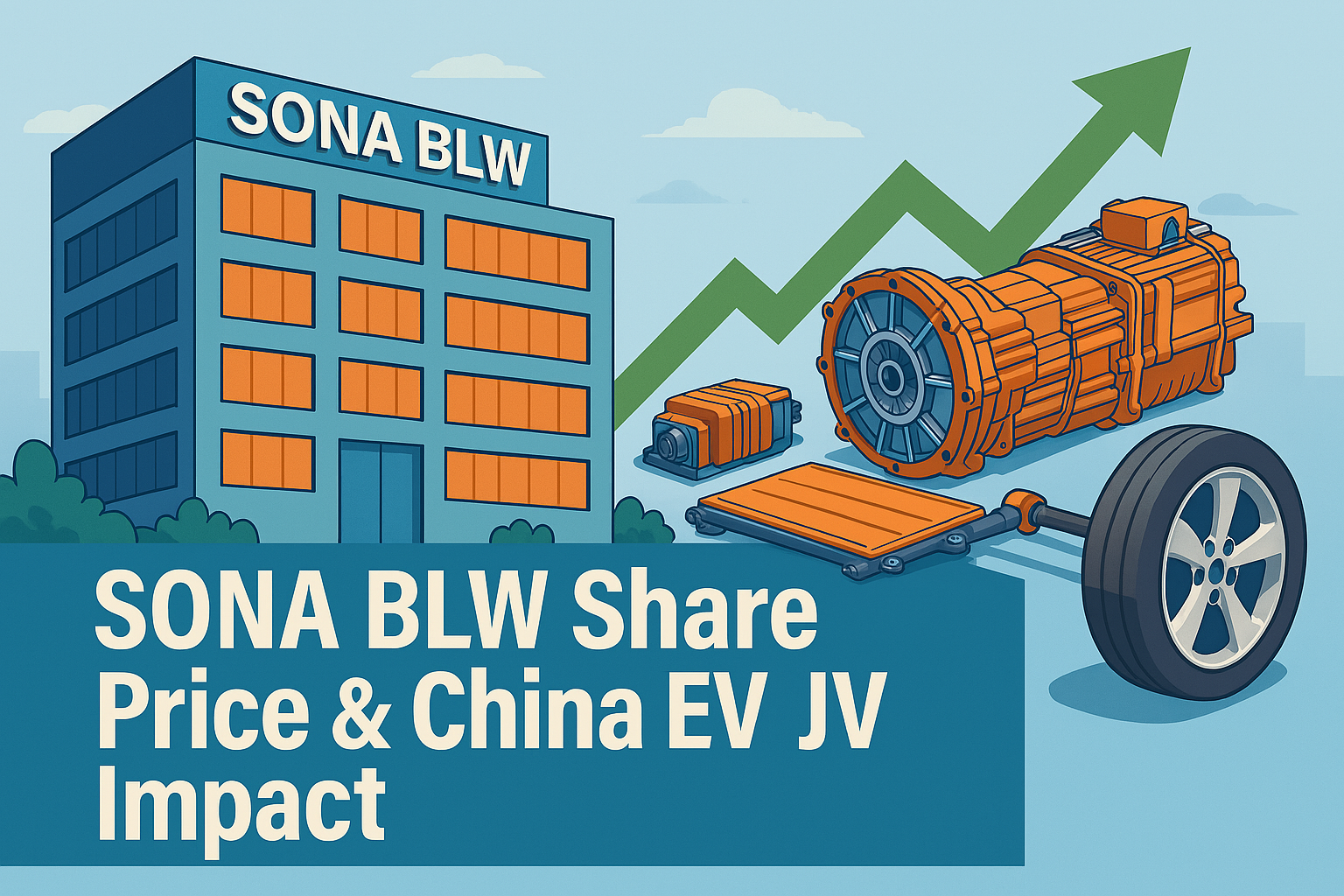
Sona BLW share price gained momentum after its $20 million China EV joint venture announcement. This article analyses Sona BLW share price trends, recent business updates, expert recommendations, and future growth outlook.
Table of Contents
Introduction: Sona BLW’s Strategic Expansion into Chinese EV Market
Sona BLW Precision Forgings Limited, also known as Sona Comstar, announced a joint venture agreement in China with an investment of $20 million on July 20, 2025. The partnership focuses on manufacturing high-precision electric vehicle (EV) differential assemblies and traction motors for the Chinese automotive market.
The company, headquartered in Gurugram, India, manufactures automotive components including differential assemblies, precision-forged bevel gears, and motor systems. This joint venture represents the company’s strategic entry into China, which is currently the world’s largest electric vehicle market.
Market data indicates the company’s shares responded to the announcement with trading activity on Indian stock exchanges. This analysis examines the joint venture’s implications, financial context, and market positioning based on publicly available information.
Company Background and Business Operations
Corporate Profile and Operations
Sona BLW Precision Forgings was established in 1995 and operates manufacturing facilities across multiple countries. The company serves automotive original equipment manufacturers (OEMs) globally with specialized component solutions.
As of July 2025, the company reported a market capitalization of ₹31,500 crore on Indian stock exchanges. The business operates across India, North America, Europe, and now China through the newly announced partnership.
The company’s product portfolio includes differential assemblies for power transmission, precision-forged bevel gears for automotive applications, and motor systems ranging from conventional starters to electric vehicle traction motors.
Manufacturing Capabilities and Product Lines
Differential Assemblies: These components facilitate power distribution in vehicle drivetrains. The company manufactures both conventional and electric vehicle-specific differential systems with precision engineering standards.
Precision-Forged Bevel Gears: Manufacturing process involves advanced forging technology to produce high-strength gears. These components serve various automotive applications requiring durability and precision tolerances.
Motor Systems: Product range includes conventional starter motors, micro-hybrid systems, and electric vehicle traction motors. The EV traction motor segment has shown increasing revenue contribution in recent quarters.
Global Market Presence
The company maintains operations across four continents with manufacturing facilities and technical centers. India represents the primary manufacturing base with multiple production locations.
North American operations serve major automotive OEMs in the region. European presence includes partnerships with premium automotive manufacturers. The new China joint venture expands the company’s Asian footprint beyond India.
China Joint Venture: Structure and Strategic Objectives
Partnership Details and Investment Structure
The joint venture was announced on July 20, 2025, with a $20 million investment commitment. The partnership involves collaboration with a Chinese automotive component manufacturer, though specific partner details were not disclosed in initial announcements.
Manufacturing focus includes high-precision EV differential assemblies and traction motors designed for electric vehicles. The facility aims to serve Chinese automotive OEMs with locally manufactured components.
According to the company’s MD & Group CEO Vivek Vikram Singh, the joint venture aims to enhance technology capabilities and accelerate market penetration in Asia. The statement emphasized positioning for the electric mobility transition.
Strategic Objectives and Market Access
Market Entry Strategy: The joint venture provides access to China’s substantial electric vehicle manufacturing ecosystem. Local production enables proximity to major EV manufacturers and reduced logistics timelines.
Technology Development: Partnership structure facilitates knowledge exchange in manufacturing processes and product innovation. Collaboration may accelerate development of next-generation EV components.
Supply Chain Optimization: Local manufacturing in China reduces dependency on cross-border logistics. This approach can improve delivery timelines and potentially reduce costs for Chinese customers.
Regional Expansion: The facility positions the company for growth across the Asia-Pacific region. China’s dominant position in EV manufacturing creates significant market opportunities for component suppliers.
Share Price Performance and Market Response
Recent Trading Activity
Share price data from July 2025 shows trading activity following the joint venture announcement. On July 21, 2025, shares closed at ₹680, followed by ₹695 on July 22, 2025.
The 52-week trading range extended from ₹455 to ₹740. Current trading levels position the stock in the upper portion of this annual range.
Trading volumes increased following the announcement, indicating heightened investor interest. Market participants responded to the strategic expansion news through increased participation.
Historical Price Trends
Over the twelve-month period through July 2025, the stock showed appreciation from lower levels. The yearly low of ₹455 was recorded earlier in the fiscal year.
Peak valuations near ₹740 represented the 52-week high. Current trading around ₹695 suggests consolidation below peak levels with potential for further movement.
Annual performance indicates approximately 35% appreciation from year-ago levels. This performance reflects both company-specific developments and broader market trends in the automotive sector.
Valuation Metrics Analysis
Based on available financial data, the company trades at the following approximate metrics:
- Price-to-Earnings Ratio: 28.5x (trailing basis)
- Price-to-Book Value: 4.2x
- Enterprise Value/EBITDA: 18.5x
- Market Cap to Sales: 12.8x
These valuation multiples reflect market assessment of growth prospects and profitability. Comparison with industry peers provides context for relative valuation positioning.
Traditional automotive component manufacturers typically trade at lower multiples. Companies with significant EV exposure often command premium valuations reflecting growth expectations.
Financial Performance Analysis
Revenue Trends and Growth Trajectory
Historical financial data shows progressive revenue expansion over recent fiscal years. FY22 revenue stood at ₹1,850 crore, growing to ₹2,150 crore in FY24.
Electric vehicle component revenue has increased as a percentage of total sales. In FY22, EV components represented 20% of revenue, expanding to 30% by FY24.
Analyst estimates project continued revenue growth in FY25 and FY26. These projections incorporate assumptions about EV market expansion and the company’s market share trajectory.
Profitability Metrics and Margins
EBITDA performance showed improvement from ₹535 crore in FY24. The EBITDA margin of 24.9% in FY24 indicates strong operational efficiency.
Net profit after tax (PAT) reached ₹340 crore in FY24 with PAT margins consistently above 15%. Return on equity (ROE) exceeded 22%, indicating effective capital utilization.
Return on capital employed (ROCE) of 23.4% in FY24 demonstrates efficient asset deployment. These profitability metrics compare favorably with industry benchmarks.
Q1 FY26 Quarterly Results
The April-June 2025 quarter showed revenue of ₹675 crore, representing 18.5% year-over-year growth. EBITDA reached ₹170 crore with a 25.2% margin, showing 50 basis points expansion.
Net profit for Q1 FY26 was ₹108 crore, marking 25.3% year-over-year growth. EV component revenue contribution reached 40% of total revenue during the quarter.
Management commentary indicated strong order book visibility for 18-24 months. Capacity utilization stood at 85% with expansion plans under consideration.
Balance Sheet and Financial Health
Financial strength indicators include:
- Debt Levels: The company maintains relatively low debt levels supporting financial flexibility
- Cash Position: Adequate liquidity for operational requirements and strategic investments
- Working Capital: Efficient management of receivables and inventory
- Capital Allocation: Focus on growth investments including capacity expansion and technology development
Analyst Coverage and Market Perspectives
Brokerage Research Recommendations
Multiple brokerage firms provide research coverage on Sona BLW shares. Target prices and recommendations vary based on different valuation methodologies and assumption sets.
Motilal Oswal Securities has issued a “Buy” recommendation with a target price of ₹780. The research emphasizes growth potential in EV traction motors and the positive impact of the China joint venture.
ICICI Securities maintains a “Hold” rating with a ₹715 target price. The analysis acknowledges near-term valuation concerns while recognizing long-term structural opportunities in electric vehicles.
Axis Capital recommends “Add” with a ₹760 target. The research highlights the China partnership’s potential to expand market share and technology capabilities.
Additional coverage from firms including Jefferies, Kotak Securities, and HDFC Securities shows varying target prices between ₹730-₹775. Consensus among analysts trends toward cautiously positive with recognition of growth opportunities.
Valuation Methodology Considerations
Research analysts employ multiple valuation approaches:
Discounted Cash Flow (DCF): Projects future cash flows based on revenue growth, margin assumptions, and capital requirements. Key variables include EV market penetration rates and the company’s market share trajectory.
Price-to-Earnings Multiples: Compares current trading multiples to historical ranges and peer companies. Forward P/E ratios based on projected earnings may differ from trailing multiples.
EV/EBITDA Analysis: Enterprise value relative to earnings before interest, taxes, depreciation, and amortization provides another valuation perspective. This metric accounts for capital structure differences.
Peer Comparison: Relative valuation versus automotive component manufacturers and EV-focused companies. Comparisons account for size differences, growth profiles, and geographic exposure.
Electric Vehicle Market Context
Global EV Market Dynamics
The global electric vehicle market continues expanding with varying adoption rates across regions. China leads in absolute EV sales volume, while European markets show strong penetration rates.
Indian EV market growth has accelerated with government policy support and improving infrastructure. Two-wheeler and three-wheeler segments show faster adoption compared to passenger vehicles.
Component suppliers benefit from increasing EV production volumes. Differential assemblies and traction motors represent critical components in electric drivetrain systems.
China’s EV Market Position
China represents approximately 40% of global electric vehicle sales. The market includes numerous domestic EV manufacturers alongside international brands.
Government policies supporting electric mobility have created favorable conditions for EV adoption. Infrastructure development including charging networks continues expanding.
Component localization requirements and supply chain considerations drive demand for locally manufactured parts. Foreign companies often pursue joint ventures or partnerships for market access.
Competitive Landscape in EV Components
Multiple companies supply components to the electric vehicle industry globally. Competition includes both traditional automotive suppliers and specialized EV component manufacturers.
Differentiation factors include technical capabilities, cost competitiveness, quality standards, and customer relationships. Companies with early mover advantages in specific components may benefit from established positions.
Vertical integration strategies vary among OEMs, with some manufacturers preferring external suppliers for specialized components. Market dynamics continue evolving as the industry matures.
Technical Analysis Perspective
Price Chart Patterns and Trends
Technical analysis of the stock chart shows several key levels and patterns:
Moving Averages:
- 50-day moving average: ₹658
- 100-day moving average: ₹620
- 200-day moving average: ₹585
Current price above all major moving averages indicates positive technical positioning. The relationship between short-term and long-term moving averages suggests upward momentum.
Support and Resistance Levels:
- Strong resistance: ₹740 (52-week high)
- Immediate resistance: ₹695
- Current range: ₹680-695
- Immediate support: ₹665
- Strong support: ₹640
These levels represent areas where buying or selling interest has historically emerged. Breakouts above resistance or breaks below support may signal trend changes.
Momentum Indicators
Relative Strength Index (RSI) readings provide insight into overbought or oversold conditions. Current readings in the 60-65 range suggest positive momentum without extreme overbought conditions.
Moving Average Convergence Divergence (MACD) indicator shows the relationship between short-term and long-term price trends. Positive divergence indicates bullish momentum.
Volume analysis shows trading activity patterns. Increased volume on up days suggests accumulation, while volume patterns on down days indicate selling pressure levels.
Risk Factors and Investment Considerations
Market and Industry Risks
Automotive Demand Cyclicality: The automotive industry experiences cyclical patterns tied to economic conditions. Downturns in vehicle production impact component suppliers’ revenue and profitability.
EV Adoption Pace: Electric vehicle market growth depends on multiple factors including battery costs, charging infrastructure, government policies, and consumer preferences. Slower than expected adoption would impact component demand.
Technology Changes: Rapid technological evolution in electric drivetrains creates opportunities but also risks. Components may face obsolescence if technology shifts to different architectures.
Competition: Increasing competition from global and local players could pressure market share and pricing. New entrants with innovative technologies may disrupt established positions.
Operational and Financial Risks
Manufacturing Execution: Successful ramp-up of the China joint venture depends on execution of construction, equipment installation, and production processes. Delays or quality issues could impact financial returns.
Customer Concentration: Dependence on major automotive OEMs creates vulnerability to customer-specific challenges. Loss of key customers or volume reductions significantly impact revenue.
Currency Exposure: Significant export revenue creates foreign exchange risk. Currency movements between the rupee, dollar, euro, and yuan affect translated revenues and profitability.
Commodity Prices: Raw material costs including steel, aluminum, and copper fluctuate with global commodity markets. Price increases may squeeze margins if not passed through to customers.
Regulatory and Policy Risks
Government Policy Changes: EV incentives, emission regulations, and import duties affect market dynamics. Policy changes in key markets could impact demand patterns.
Trade Relations: International operations create exposure to trade policies and tariffs. Changes in trade relationships between countries may affect supply chains and market access.
Environmental Regulations: Manufacturing operations must comply with environmental standards. Stricter regulations may require additional investments in pollution control and waste management.
Growth Opportunities and Future Outlook
Electric Vehicle Market Expansion
Continued growth in global EV adoption creates expanding demand for components. Multiple countries have announced phase-out dates for internal combustion engines, supporting long-term transition trends.
Infrastructure development including charging networks improves EV viability. Battery cost reductions and range improvements address consumer adoption barriers.
The company’s focus on critical components positions it to participate in industry growth. Differential assemblies and traction motors represent essential elements of electric drivetrains.
Geographic Expansion Strategy
The China joint venture represents a significant geographic expansion. Success in this market could create a template for other regional expansions.
Existing operations in North America and Europe provide diversification across major automotive markets. Each region has different characteristics regarding EV adoption and competitive dynamics.
Emerging markets present future opportunities as EV adoption expands beyond developed economies. Strategic positioning in multiple geographies reduces dependence on any single market.
Technology Development and Innovation
Research and development investments target next-generation products. Efficiency improvements, weight reduction, and cost optimization represent ongoing focus areas.
Collaboration with OEM customers on new vehicle programs creates early involvement opportunities. Joint development programs can secure business for future vehicle launches.
Integration of digital technologies and smart features in components aligns with industry trends. Software-enabled hardware creates potential for differentiation and value addition.
Capacity Expansion Initiatives
Current capacity utilization of 85% indicates room for growth within existing facilities. Additional capacity expansions would support volume increases as demand grows.
Automation and manufacturing efficiency improvements enhance productivity. Industry 4.0 technologies enable data-driven optimization of production processes.
Quality management systems ensure consistent product performance. Continuous improvement initiatives target defect reduction and process optimization.
Frequently Asked Questions (FAQs)
What is the significance of Sona BLW’s China joint venture announcement?
Sona BLW announced a $20 million joint venture in China on July 20, 2025, to manufacture EV differential assemblies and traction motors. This partnership provides access to China’s electric vehicle market, which represents approximately 40% of global EV sales. Local manufacturing enables proximity to Chinese OEMs and participation in the world’s largest EV ecosystem. The joint venture represents strategic expansion beyond Sona BLW’s existing operations in India, North America, and Europe.
What were Sona BLW’s Q1 FY26 financial results?
Sona BLW reported Q1 FY26 (April-June 2025) revenue of ₹675 crore, showing 18.5% year-over-year growth. EBITDA reached ₹170 crore with a 25.2% margin, expanding 50 basis points year-over-year. Net profit was ₹108 crore, representing 25.3% year-over-year growth. Electric vehicle components contributed 40% of total revenue during the quarter, up from 30% in FY24. Management indicated strong order book visibility for 18-24 months with capacity utilization at 85%.
What is Sona BLW’s current share price and recent performance?
As of July 22, 2025, Sona BLW shares closed at ₹695 on Indian stock exchanges. The 52-week trading range extended from ₹455 to ₹740. Trading volumes increased following the China joint venture announcement, indicating heightened market interest. Over the twelve months through July 2025, the stock showed approximately 35% appreciation. Current trading levels position the stock near the upper portion of its annual range.
How do analysts view Sona BLW shares?
Multiple brokerage firms provide coverage with varying target prices. Motilal Oswal Securities has a “Buy” rating with ₹780 target price. ICICI Securities maintains “Hold” with ₹715 target. Axis Capital recommends “Add” with ₹760 target. Additional coverage shows targets ranging between ₹730-₹775. Analyst perspectives generally acknowledge growth opportunities in electric vehicles while noting current valuation considerations. Recommendations reflect different views on risk-reward profiles and investment timeframes.
What are the main risks for investors considering Sona BLW?
Key risks include automotive demand cyclicality affecting production volumes and component orders. Electric vehicle adoption pace may vary from projections based on infrastructure development, battery costs, and policy changes. Competition from global and local players could pressure market share and pricing. The China joint venture’s success depends on effective execution of manufacturing ramp-up. Currency fluctuations affect export revenues. Technology changes in EV drivetrains could impact component specifications and demand patterns.
How does Sona BLW’s EV component business compare to its traditional business?
Electric vehicle components represented 40% of Q1 FY26 revenue, growing from 20% in FY22. Management targets further increases in EV revenue contribution. EV components typically include differential assemblies and traction motors specifically designed for electric drivetrains. Traditional business includes conventional starter motors and components for internal combustion engine vehicles. The company’s strategic focus emphasizes growing EV exposure while maintaining existing conventional automotive business during the industry transition period.
What is Sona BLW’s competitive position in the EV component market?
Sona BLW manufactures specialized components including differential assemblies and traction motors for electric vehicles. The company serves global OEMs across multiple regions. Competitive positioning depends on technical capabilities, cost competitiveness, quality standards, and customer relationships. The company’s established presence in traditional automotive components provides foundation for EV component development. Market position varies by region and customer segment, with the China joint venture aimed at expanding presence in the world’s largest EV market.
What financial metrics indicate Sona BLW’s operational performance?
Key metrics from FY24 include EBITDA margin of 24.9%, indicating strong operational efficiency. Return on equity exceeded 22%, demonstrating effective capital utilization. Return on capital employed reached 23.4%, showing efficient asset deployment. Net profit margin consistently remained above 15%. Q1 FY26 showed continued margin expansion with 25.2% EBITDA margin. These profitability indicators compare favorably with automotive component industry benchmarks and reflect the company’s operational efficiency and pricing power.
About the Author
Nueplanet
Automotive Sector and Manufacturing Analyst
Nueplanetspecializes in analyzing automotive industry developments, manufacturing companies, and electric vehicle sector trends. Nueplanet is based on publicly available information from company announcements, stock exchange filings, and official disclosures.
Commitment to Accuracy: All information presented in this analysis is sourced from official company announcements, stock exchange filings, and verified financial reports. The content reflects data available as of the publication date and does not constitute investment recommendations or advice.
Sources Referenced:
- BSE India and NSE India official filings
- Sona BLW Precision Forgings investor presentations
- Company earnings announcements and press releases
- Stock exchange corporate announcements
- SEBI registered analyst research reports
Published: July 22, 2025
Last Updated: July 22, 2025
Conclusion: Summary of Sona BLW’s Strategic Development
Sona BLW Precision Forgings announced a $20 million joint venture in China on July 20, 2025, focusing on electric vehicle component manufacturing. The partnership provides market access to China’s substantial EV ecosystem and positions the company for participation in the world’s largest electric vehicle market.
Q1 FY26 financial results showed revenue of ₹675 crore with 18.5% year-over-year growth and net profit of ₹108 crore, representing 25.3% year-over-year expansion. Electric vehicle components contributed 40% of quarterly revenue, indicating increasing exposure to the EV transition.
Share price as of July 22, 2025, stood at ₹695 with market capitalization of ₹31,500 crore. Analyst coverage includes varying target prices and recommendations reflecting different perspectives on valuation and growth prospects.
The company’s strategic focus on electric vehicle components, combined with geographic expansion and technology development, positions it to participate in the automotive industry’s transition. Financial performance will depend on successful execution of the China joint venture, EV market adoption rates, and competitive dynamics in global automotive component markets.
Disclaimer: This article is for informational purposes only and does not constitute investment advice, recommendation, or solicitation to buy or sell securities. All investments carry risks including potential loss of principal. Investors should conduct independent research and consult qualified financial advisors before making investment decisions. Stock prices, financial projections, and analyst targets are subject to change. Past performance does not guarantee future results. Information presented reflects data available as of publication date and may not reflect subsequent developments.
Helpful Resources
Latest Posts
- Boeing 787 Dreamliner Crash: A Deep Dive into Safety Concerns and Corporate Accountability
- National CA Day 2025: Honouring India’s Accounting Backbone
- HBSE Compartment Exam 2025: Admit Cards Released for Haryana Class 10 and 12 – Check Full Details
- Karnataka 2nd PUC Exam 3 Results 2025 Declared on karresults.nic.in
- JAC Result 2025 Declared: Check Class 11 Pass Percentage, Websites, and More
Related Posts












Post Comment