









Shanti Gold IPO GMP Today: Grey Market Premium, Price Band, and Listing Buzz
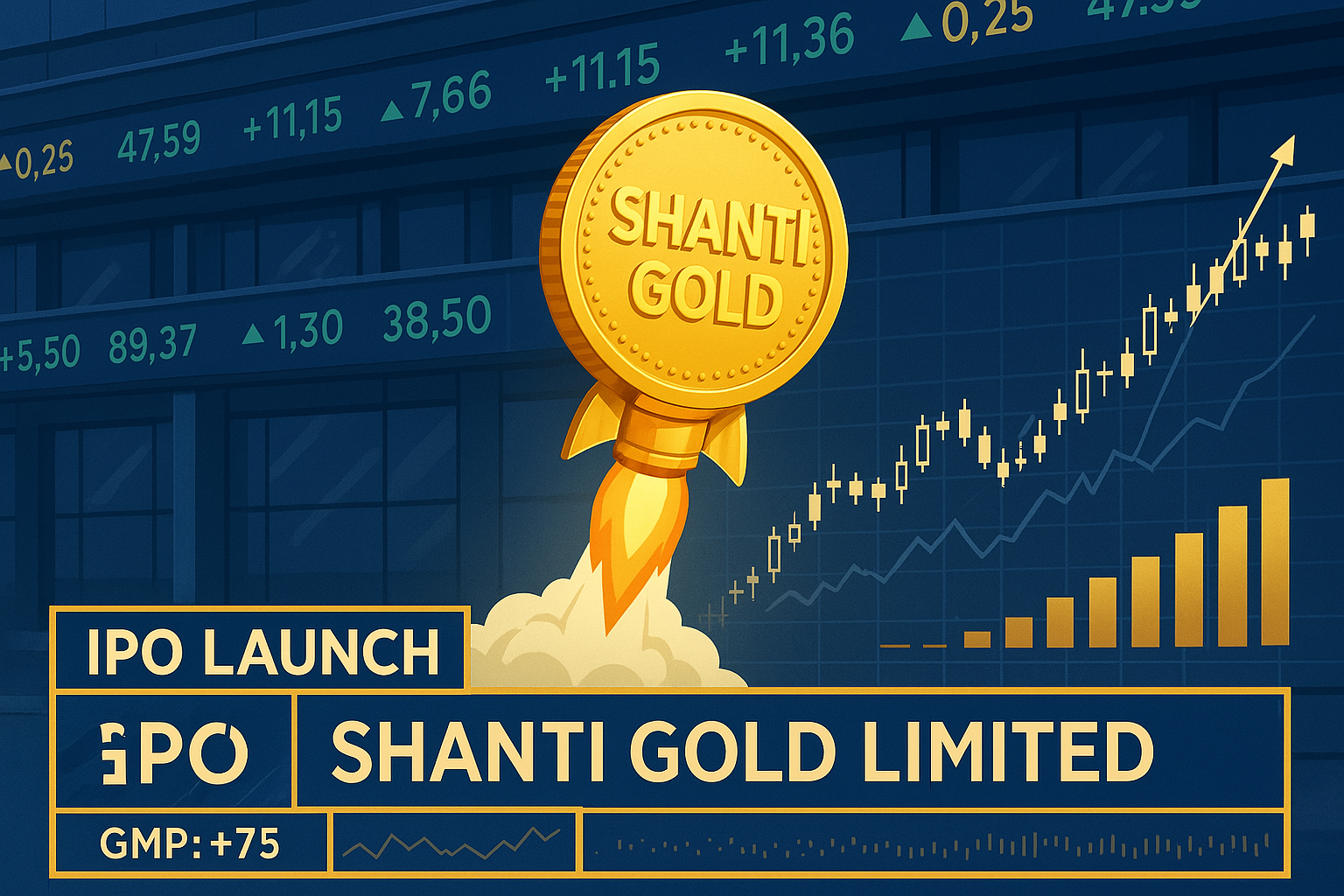
Shanti Gold IPO is creating a buzz among retail investors, driven by a strong Grey Market Premium (GMP) and promising financials. Here’s an in-depth analysis of the IPO’s performance, price band, allotment details, and expected listing gains.
Table of Contents
Published: July 28, 2025
Last Updated: July 28, 2025
Introduction
Shanti Gold Limited’s initial public offering opened for subscription on July 26, 2025, on the BSE SME platform. The Gujarat-based gold jewellery manufacturer raised ₹22.05 crore through a fixed-price issue at ₹81 per share. The offering received substantial investor interest during the subscription period ending July 30, 2025.
This article provides a comprehensive analysis of the IPO structure, company financials, subscription data, and grey market premium trends. The information presented is based on publicly available documents including the company’s Red Herring Prospectus filed with stock exchanges, subscription data from BSE, and market reports.
Understanding SME IPO dynamics, company fundamentals, and sector trends helps investors make informed decisions. This analysis examines financial performance, competitive positioning, and risk factors associated with the offering.
Company Overview and Business Model
Shanti Gold Limited Background
Shanti Gold Limited was incorporated on March 15, 2015, and operates in the gold jewellery manufacturing and wholesale segment. The company is headquartered in Surat, Gujarat, a significant hub for jewellery manufacturing in India. Operations include manufacturing, designing, and wholesale distribution of gold jewellery products.
The company serves retailers, small wholesalers, and distributors primarily across Gujarat, Maharashtra, and Rajasthan. The business model focuses on wholesale transactions rather than direct retail sales. Manufacturing facilities are located in Surat with processing capacity for approximately 500 kilograms of gold monthly.
Shanti Gold employs over 85 personnel across manufacturing, design, sales, and administrative functions. The company holds BIS hallmarking certification and ISO 9001:2015 quality management certification.
Product Portfolio and Market Positioning
The company manufactures various gold jewellery categories including chains, necklaces, rings, earrings, bangles, bracelets, coins, and bars. Product designs address both traditional and contemporary customer preferences. Custom design services are available for special occasions and specific customer requirements.
Distribution operates through an established dealer network spanning three states. The company maintains business relationships with over 200 retailers according to company disclosures. Geographic focus includes tier-2 and tier-3 cities where demand for affordable gold jewellery continues expanding.
Competitive positioning emphasizes delivery speed, bulk pricing strategies, and flexible payment terms for dealer clients. The company reports standard delivery timelines of 48 hours for routine orders. Quality control processes aim to maintain consistency and reduce defect rates.
IPO Structure and Terms
Offer Details and Investment Requirements
| IPO Parameter | Details |
|---|---|
| Total Issue Size | ₹22.05 Crore |
| Face Value | ₹10 per share |
| Issue Price | ₹81 per share |
| Issue Type | Fixed Price Issue |
| Lot Size | 1,600 shares |
| Minimum Investment | ₹1,29,600 |
| Maximum Retail Investment | ₹2,00,000 |
| Opening Date | July 26, 2025 |
| Closing Date | July 30, 2025 |
| Listing Exchange | BSE SME |
The issue structure follows a fixed-price mechanism without a price band. Retail investors must apply for a minimum of one lot comprising 1,600 shares. The high minimum investment amount of ₹1,29,600 limits participation to investors comfortable with larger capital allocation to single SME offerings.
Maximum retail investment caps at ₹2,00,000, allowing investors to apply for one full lot plus additional shares. The offering does not include a pre-IPO placement or anchor investor portion.
Timeline and Process
| Event | Date |
|---|---|
| Basis of Allotment | August 2, 2025 |
| Refund Initiation | August 3, 2025 |
| Credit to Demat | August 4, 2025 |
| Listing Date | August 5, 2025 |
Bigshare Services Private Limited serves as the registrar for the issue, handling application processing and share allotment. Hem Securities Limited acts as the lead manager coordinating the offering process. The listing is scheduled for the BSE SME platform on August 5, 2025.
Fund Utilization Plan
| Purpose | Amount (₹ Crore) | Percentage |
|---|---|---|
| Working Capital | 12.50 | 56.7% |
| Technology Upgradation | 4.50 | 20.4% |
| Marketing & Branding | 2.50 | 11.3% |
| General Corporate Purposes | 2.55 | 11.6% |
| Total | 22.05 | 100% |
The largest allocation addresses working capital requirements supporting inventory procurement and operational needs. Gold jewellery manufacturing requires substantial working capital for raw material purchases. Technology upgradation includes manufacturing equipment and software systems.
Marketing expenses focus on building brand recognition and expanding the dealer network. General corporate purposes provide flexibility for strategic initiatives and unforeseen requirements.
Financial Performance Analysis
Revenue and Profitability Trends
| Financial Year | FY 2022 | FY 2023 | FY 2024 | CAGR |
|---|---|---|---|---|
| Total Revenue (₹ Cr) | 28.5 | 35.4 | 49.2 | 31.2% |
| Gross Profit (₹ Cr) | 4.8 | 5.9 | 8.1 | 30.2% |
| EBITDA (₹ Cr) | 3.2 | 4.1 | 5.8 | 34.5% |
| Net Profit (₹ Cr) | 1.4 | 2.1 | 3.9 | 67.7% |
| EPS (₹) | 8.2 | 12.4 | 23.1 | 67.9% |
Note: Financial data based on company disclosures in the prospectus
Revenue growth over the three-year period reflects business expansion and market penetration. The compound annual growth rate of 31.2 percent indicates consistent top-line improvement. However, absolute revenue scale remains modest relative to established players in the jewellery sector.
Net profit growth outpaced revenue growth, suggesting improving operational efficiency and margin expansion. The net profit CAGR of 67.7 percent demonstrates profitability improvement though from a small base. Earnings per share similarly showed strong growth trajectory.
Key Financial Ratios
| Metric | FY 2024 | Industry Benchmark* |
|---|---|---|
| Net Profit Margin | 7.9% | 5-8% |
| EBITDA Margin | 11.8% | 8-12% |
| Return on Equity | 18.4% | 12-18% |
| Return on Assets | 14.2% | 8-14% |
| Debt-to-Equity Ratio | 0.3x | 0.5-0.8x |
| Current Ratio | 2.1x | 1.5-2.0x |
| Interest Coverage Ratio | 8.9x | 3-6x |
*Industry benchmarks represent typical ranges for small-cap jewellery manufacturers
Profitability margins appear healthy relative to industry standards for wholesale jewellery operations. The net profit margin of 7.9 percent falls within the upper range of sector norms. EBITDA margin of 11.8 percent indicates operational efficiency though margin sustainability requires monitoring as the company scales.
Return on equity of 18.4 percent demonstrates effective utilization of shareholder capital. Return on assets of 14.2 percent shows reasonable asset productivity. The debt-to-equity ratio of 0.3x indicates conservative financial leverage with limited debt burden.
The current ratio of 2.1x suggests adequate short-term liquidity to meet working capital needs. Interest coverage ratio of 8.9x indicates comfortable debt servicing capability. These metrics collectively point to stable financial health though limited operating history constrains long-term assessment.
Financial Analysis Considerations
The three-year financial track record provides limited visibility into business cyclicality and resilience during adverse conditions. Gold price volatility significantly impacts jewellery manufacturers through input cost fluctuations and consumer demand variations. The company’s hedging strategies and pricing mechanisms require examination.
Working capital intensity in the jewellery business creates cash flow management challenges. The company’s ability to manage inventory levels, receivables collection, and supplier payments affects operational sustainability. Seasonal demand patterns during festivals and wedding seasons influence quarterly performance.
Scale limitations compared to organized sector players may constrain bargaining power with suppliers and customers. The company’s competitive positioning depends on execution of expansion plans and market share gains in target geographies.
Subscription Data and Investor Response
Category-wise Subscription Details
| Investor Category | Reservation | Subscription Multiple | Status |
|---|---|---|---|
| Retail Individual Investors | 50% | 15.2x | Oversubscribed |
| High Net Worth Individuals | 35% | 8.9x | Oversubscribed |
| Others | 15% | 12.1x | Oversubscribed |
| Total | 100% | 18.7x | Oversubscribed |
Based on final subscription data from BSE
The IPO received 18.7 times subscription overall, indicating substantial investor demand. Retail individual investors showed particularly strong interest with 15.2 times oversubscription in their reserved category. High net worth individuals subscribed to 8.9 times their allocation.
Such oversubscription levels are common in SME IPOs that gain investor attention. However, high subscription multiples do not guarantee listing performance or long-term returns. Subscription data reflects investor sentiment at the time of offering but does not determine fundamental value.
Subscription Timeline
- Hour 1: Initial subscription of 0.8x within the first hour of opening
- Day 1 Close: 3.2x total subscription by end of first day
- Day 2 Close: 7.8x subscription after second day
- Day 3 Close: 12.5x subscription at third day close
- Final Close: 18.7x at subscription period end
The progressive increase in subscription levels indicates building investor interest during the offering period. First-day subscription of 3.2x suggested positive initial response. Acceleration on subsequent days reflected growing awareness and market momentum.
Early-hour subscription data often includes applications from informed investors and those closely following the offering. Retail participation typically increases through the subscription period as awareness spreads and investors evaluate the opportunity.
Grey Market Premium Analysis
Understanding Grey Market Premium
Grey market premium represents unofficial trading of IPO shares before official listing. This parallel market allows investors who received allocations to sell their expected allotments to buyers willing to pay premiums. Grey market activity provides indications of listing day expectations though it operates outside regulated channels.
GMP data comes from informal market participants and lacks official verification. These premiums fluctuate based on supply-demand dynamics, overall market sentiment, and company-specific developments. Grey market indications may not accurately predict actual listing prices as multiple factors influence opening trade.
Regulatory authorities do not oversee grey market transactions, creating settlement risks and information asymmetries. Investors should treat GMP data as one of many indicators rather than definitive pricing guidance.
Reported Grey Market Premium Trends
| Date | Reported GMP Range (₹) | Implied Listing Price (₹) | Implied Gain % |
|---|---|---|---|
| July 26, 2025 | 40-48 | 121-129 | 49-59% |
| July 27, 2025 | 48-55 | 129-136 | 59-68% |
| July 28, 2025 | 55-60 | 136-141 | 68-74% |
| July 29, 2025 | 62-65 | 143-146 | 77-80% |
| July 30, 2025 | 65-68 | 146-149 | 80-84% |
Grey market premiums are unofficial and unverified market indicators
Reported grey market premiums showed upward trend during the subscription period. The progression from ₹40-48 on opening day to ₹65-68 at close suggested increasing optimism about listing performance. Such trends often correlate with strong subscription momentum and positive market sentiment.
However, grey market indications can be misleading. Limited transaction volumes, information asymmetry, and speculative positioning may distort premium levels. Actual listing prices depend on numerous factors including overall market conditions on listing day, institutional investor participation, and early trading dynamics.
Grey Market Premium Reliability
Grey market premiums sometimes accurately predict listing gains but also frequently diverge from actual outcomes. SME IPOs with limited analyst coverage may experience greater variance between grey market expectations and listing reality. Market volatility on listing day can significantly impact opening prices.
Investors should avoid making investment decisions based solely on grey market premiums. Fundamental analysis of company financials, business model viability, sector outlook, and valuation metrics provides more reliable assessment frameworks. Grey market data serves as one sentiment indicator among many analytical inputs.
Valuation Analysis
Post-IPO Valuation Metrics
Based on FY 2024 financials and issue details:
| Valuation Parameter | Shanti Gold | Calculation Basis |
|---|---|---|
| Market Capitalization (Post-IPO) | Approx. ₹50.5 crore | At issue price of ₹81 |
| Price-to-Earnings Ratio | Approximately 13.0x | Based on FY24 EPS of ₹23.1 |
| Price-to-Book Ratio | Approximately 2.1x | Based on stated book value |
| Enterprise Value/EBITDA | Approximately 9.8x | Adjusted for net debt |
Calculations based on company disclosures; actual metrics depend on final share count post-issue
The price-to-earnings ratio of approximately 13x appears moderate for a growth-stage jewellery manufacturer. Comparison with listed peers requires adjusting for size differences, growth rates, and market positioning. Large organized jewellery retailers typically trade at higher multiples reflecting brand value and scale advantages.
Price-to-book ratio of 2.1x falls within reasonable ranges for profitable manufacturing businesses. Enterprise value to EBITDA multiple of approximately 9.8x suggests modest valuation though comparability with established players remains limited. SME company valuations often reflect liquidity discounts and information asymmetries.
Peer Comparison Challenges
Direct peer comparison faces several limitations. Most listed jewellery companies operate at significantly larger scale with established retail presence and brand recognition. Shanti Gold’s wholesale-focused model differs from retail-dominant peers’ business structures.
Listed jewellery companies trade on main exchanges with higher liquidity and broader analyst coverage. SME platform listings typically experience lower trading volumes and limited research coverage affecting price discovery. Valuation multiples for SME companies generally differ from main board peers.
Geographic concentration and customer base size distinguish Shanti Gold from diversified national players. Scale advantages in procurement, manufacturing efficiency, and market reach create fundamental differences affecting appropriate valuation ranges.
Sector Analysis and Market Opportunity
India’s Gold Jewellery Market Overview
India represents one of the world’s largest gold jewellery markets driven by cultural traditions, festivals, and weddings. The sector comprises organized chains, regional players, and unorganized local jewellers. Recent years have seen gradual shift toward organized players offering hallmarked products and transparent pricing.
Market growth drivers include rising disposable incomes, increasing urbanization, and expanding middle-class population. Tier-2 and tier-3 cities demonstrate strong growth potential as income levels rise and consumer preferences evolve. Digital commerce adoption in jewellery purchases has accelerated creating new distribution channels.
However, gold price volatility significantly influences consumer demand and purchasing patterns. Regulatory changes including mandatory hallmarking and GST implementation have reshaped competitive dynamics. The sector faces ongoing consolidation pressures as organized players gain market share.
Wholesale Segment Dynamics
The wholesale jewellery segment serves as a critical link between manufacturers and retail outlets. Wholesalers provide inventory financing, assortment management, and quick replenishment for retail partners. This segment remains largely fragmented with numerous small players operating regionally.
Competition intensity varies by geography with established players dominating traditional jewellery hubs. New entrants face challenges building trust relationships and competing on credit terms. Working capital management and gold price risk hedging represent key operational capabilities.
Margin pressures from both manufacturing and retail ends squeeze wholesale profitability. Technology adoption for inventory management and order processing provides operational efficiency opportunities. Direct-to-consumer models by manufacturers may disintermediate traditional wholesale channels over time.
Growth Opportunities and Challenges
Shanti Gold’s expansion into new geographies offers growth potential but requires capital investment and relationship building. Tier-2 and tier-3 market penetration depends on establishing local dealer networks and brand awareness. Competition from established regional players and local unorganized operators creates market entry barriers.
Product diversification into diamond and platinum jewellery could expand addressable markets but demands different capabilities. Technology investments in design, manufacturing, and distribution systems support efficiency gains. E-commerce channel development provides direct access to retail consumers though requiring different expertise.
Scaling operations while maintaining quality standards and customer relationships presents execution challenges. Working capital requirements increase with business growth potentially constraining expansion pace. Gold price volatility management through hedging and flexible pricing mechanisms affects profitability sustainability.
Risk Factors and Investment Considerations
Business and Operational Risks
Geographic Concentration Risk: Operations concentrated in Gujarat, Maharashtra, and Rajasthan create vulnerability to regional economic conditions. Local competitive dynamics and regulatory changes in these states disproportionately impact business performance.
Customer Concentration Risk: Revenue dependence on approximately 200 dealer relationships creates exposure to key customer credit quality and relationship stability. Loss of major customers could significantly affect sales volumes.
Gold Price Volatility: Input costs fluctuate with international gold prices affecting margins and working capital requirements. The company’s hedging strategies and ability to pass through cost changes influence profitability consistency.
Working Capital Intensity: Substantial inventory investments and receivables create cash flow management challenges. Efficient working capital utilization becomes critical for sustaining growth without excessive external financing.
Market and Competition Risks
Intense Competition: The jewellery manufacturing sector includes numerous players competing on price, quality, and service. Established brands and larger players possess cost advantages and stronger market positions.
Unorganized Sector Competition: Local unorganized manufacturers often operate with lower overheads and different cost structures. Price competition from unorganized players pressures margins and market share.
Changing Consumer Preferences: Shifts in design preferences, buying channels, and brand awareness affect product portfolio relevance. Staying current with trends requires continuous product development investments.
Regulatory Compliance: Hallmarking requirements, tax regulations, and precious metal trading rules create compliance obligations. Regulatory changes may require operational adjustments and additional costs.
Financial and Valuation Risks
Limited Operating History: Three years of financial data provides insufficient basis for assessing business cyclicality and resilience. Performance during adverse conditions remains untested.
SME Platform Liquidity: SME platform stocks typically experience lower trading volumes than main board listings. Limited liquidity may result in price volatility and difficulty executing large transactions.
Valuation Uncertainty: Modest revenue scale and limited comparability with listed peers create valuation assessment challenges. Market pricing may not reflect fundamental value in the near term.
Execution Risk: Achieving growth targets requires successful execution of expansion plans, technology initiatives, and market penetration. Operational missteps could impair financial performance.
Key Risk Mitigation Factors
The company’s low debt levels provide financial flexibility to navigate challenges. Established presence in the Gujarat market offers a stable base for expansion. Management experience in the jewellery industry supports operational execution though track record in managing scaled operations requires monitoring.
Quality certifications and compliance with hallmarking standards address product quality concerns. Diversified product portfolio reduces dependence on single jewellery categories. However, comprehensive risk mitigation requires ongoing monitoring of execution progress and market conditions.
Investment Considerations for Different Investor Types
Retail Individual Investors
Retail investors should carefully assess SME IPO risks before investing. The high minimum investment amount of ₹1,29,600 represents substantial capital commitment for many individual investors. Portfolio allocation to SME stocks should remain limited given liquidity constraints and volatility.
Understanding the business model, financial performance, and growth strategy helps evaluate fundamental merit. Realistic expectations about listing gains and long-term returns prevent disappointment. Not all SME IPOs deliver substantial listing gains regardless of subscription levels or grey market premiums.
Investors comfortable with higher risk for potential higher returns may find opportunities in carefully selected SME offerings. However, thorough due diligence and willingness to hold through volatility prove essential. Treating SME investments as higher-risk portfolio components supports appropriate position sizing.
High Net Worth Individuals
HNI investors with diversified portfolios may allocate portions to SME opportunities for growth exposure. Larger capital bases enable meaningful investments while maintaining overall portfolio balance. Higher risk tolerance and investment sophistication support SME investment evaluation.
HNI category participants should conduct independent analysis rather than relying solely on market momentum. Professional advisory support helps assess company fundamentals and sector positioning. Understanding exit strategies and liquidity constraints informs investment decision-making.
Portfolio diversification across market caps, sectors, and asset classes mitigates company-specific and SME platform risks. Long-term investment horizons align better with SME investment characteristics than short-term trading approaches.
Risk-Averse Investors
Conservative investors prioritizing capital preservation may find SME IPOs inconsistent with risk profiles. Limited operating histories, smaller scale, and liquidity constraints create uncertainty levels unsuitable for risk-averse strategies. Alternative investment options offering greater stability and liquidity may better serve conservative objectives.
If considering SME participation, extremely limited allocation percentages help manage downside risks. Thorough fundamental analysis and clear understanding of all risk factors become imperative. Willingness to potentially hold illiquid positions through adverse periods requires careful consideration.
Risk-averse investors might prefer waiting for operational track record development and market price stabilization post-listing. Observing company performance over several quarters provides additional information for investment decisions.
Analyst and Brokerage Perspectives
Range of Analyst Views
Market analysts provided various perspectives on the Shanti Gold IPO based on different analytical frameworks. Some analysts focused on financial performance trends and growth potential. Others emphasized valuation comparisons and risk factors.
Positive analyst views typically highlighted revenue growth trajectory, improving profitability margins, and sector growth opportunities. The company’s presence in expanding tier-2 and tier-3 markets received favorable mention. Moderate valuation multiples relative to growth rates supported constructive outlooks.
Cautious analyst perspectives noted limited operating history, geographic concentration, and competitive intensity. Working capital requirements and gold price volatility received attention as ongoing risk factors. SME platform liquidity constraints and smaller scale compared to established players tempered enthusiasm.
Evaluation Methodology Differences
Analysts employ varying methodologies for SME company evaluation. Some emphasize short-term listing gain potential based on subscription data and market momentum. Others focus on fundamental analysis and longer-term value creation prospects.
Technical analysts examine trading patterns, volume trends, and market sentiment indicators. Fundamental analysts assess financial statements, management quality, competitive positioning, and sector dynamics. Different analytical approaches yield varied conclusions about investment merit.
Investors should consider multiple perspectives and analytical frameworks when evaluating IPO opportunities. No single methodology provides complete assessment. Combining insights from various approaches supports more comprehensive understanding.
Information Limitations
Limited analyst coverage of SME companies creates information gaps compared to main board stocks. Research reports may lack depth found in coverage of larger companies. Independent verification of company claims and projections becomes important.
Company disclosures in prospectuses provide primary information sources though forward-looking statements involve uncertainty. Management presentations and investor communications offer additional insights. Sectoral research and competitive intelligence supplement company-specific information.
Investors conducting independent analysis should review financial statements, business model documentation, and risk factor disclosures thoroughly. Professional advisory support helps navigate information complexities and assessment frameworks.
Post-Listing Considerations
Listing Day Dynamics
First-day trading often experiences heightened volatility as supply and demand find equilibrium. Opening prices may significantly differ from issue prices depending on investor sentiment and allotment ratios. Circuit filters on SME platforms limit intraday price movements protecting against extreme volatility.
Profit-booking by investors seeking listing gains creates selling pressure potentially limiting opening gains. Long-term investors entering at listing prices provide demand supporting price discovery. Trading volumes typically remain elevated on listing days before normalizing.
Market conditions on listing day significantly influence opening performance. Broader market trends, sector sentiment, and concurrent IPO listings affect individual stock trading. Investors should avoid making rushed decisions based on listing day movements alone.
Short-Term Trading Patterns
SME stocks frequently experience price volatility in initial trading weeks as market finds sustainable levels. Speculative trading and limited free float create price swings. Technical support and resistance levels emerge through price discovery processes.
News flow regarding company operations, quarterly results, and sector developments influences trading. Market rumors and sentiment shifts cause price movements in thinly traded stocks. Investors should maintain perspective and avoid reactive decisions based on short-term volatility.
Lock-in periods for pre-IPO shareholders create future supply that enters markets post-expiry. Understanding lock-in timelines helps anticipate potential selling pressure periods. Gradual expansion of free float typically improves liquidity over time.
Long-Term Performance Factors
Sustainable long-term returns depend primarily on company execution and financial performance. Revenue growth, profitability improvement, and market share gains drive fundamental value creation. Management’s ability to navigate challenges and capitalize on opportunities determines outcomes.
Sector trends and macroeconomic conditions provide context for company performance. Gold price movements, consumer spending patterns, and regulatory changes affect jewellery industry dynamics. Company positioning relative to sector developments influences relative performance.
Valuation starting points significantly impact long-term returns. Entering at reasonable valuations relative to fundamentals enhances probability of favorable outcomes. Overpaying during initial enthusiasm reduces long-term return potential even if company performs well operationally.
Frequently Asked Questions
What is grey market premium and how reliable is it for predicting listing performance?
Grey market premium represents unofficial pre-listing trading of IPO shares indicating investor sentiment about listing day performance. These premiums emerged from informal markets where allottees can sell expected shares before official listing. For Shanti Gold, reported grey market premiums ranged from ₹40-48 initially to ₹65-68 near closing, suggesting anticipated listing gains of 49-84 percent.
However, grey market indications are unregulated, unverified, and sometimes unreliable predictors of actual listing prices. Multiple factors including overall market conditions, institutional participation, and opening day trading dynamics determine actual listing performance. Investors should treat GMP as one sentiment indicator among many rather than definitive guidance.
What are the key financial metrics demonstrating Shanti Gold’s performance?
Shanti Gold reported revenue of ₹49.2 crore in FY 2024, representing 31.2 percent compound annual growth over three years. Net profit reached ₹3.9 crore with 67.7 percent CAGR during the same period. Key profitability ratios include 7.9 percent net margin, 11.8 percent EBITDA margin, 18.4 percent return on equity, and 14.2 percent return on assets.
The company maintains low leverage with 0.3x debt-to-equity ratio and comfortable liquidity shown by 2.1x current ratio. Interest coverage of 8.9x indicates strong debt servicing capability. While these metrics show positive trends, the limited three-year track record constrains assessment of performance sustainability and resilience during adverse conditions.
What is the minimum investment required and what are the key IPO terms?
The minimum investment requirement is ₹1,29,600, representing one lot of 1,600 shares at the fixed issue price of ₹81 per share. This relatively high minimum investment limits participation to investors comfortable with substantial capital allocation to single SME offerings. The total issue size is ₹22.05 crore listing on the BSE SME platform.
The subscription period ran from July 26-30, 2025, with listing scheduled for August 5, 2025. Bigshare Services Private Limited serves as registrar while Hem Securities Limited acts as lead manager. The issue received 18.7x oversubscription with particularly strong retail investor participation at 15.2x their allocated portion.
What are the primary business risks associated with investing in Shanti Gold?
Key risks include geographic concentration in Gujarat, Maharashtra, and Rajasthan creating regional exposure. Customer concentration with approximately 200 dealer relationships creates revenue dependence risks. Gold price volatility affects input costs and working capital requirements potentially impacting margins.
The working capital-intensive business model creates cash flow management challenges. Competition from both organized and unorganized sector players pressures margins and market share.
Limited three-year operating history provides insufficient data for assessing cyclicality and resilience. SME platform liquidity constraints may result in trading difficulties and price volatility. Execution risks in achieving growth targets and expansion plans could impair performance. Regulatory changes affecting jewellery industry operations create compliance and cost uncertainties.
How does the company plan to utilize IPO proceeds?
The ₹22.05 crore raised will be deployed as follows: 56.7 percent (₹12.50 crore) toward working capital requirements supporting inventory procurement and operational needs; 20.4 percent (₹4.50 crore) for technology upgradation including manufacturing equipment and systems; 11.3 percent (₹2.50 crore) for marketing and branding initiatives; and 11.6 percent (₹2.55 crore) for general corporate purposes.
The largest allocation to working capital reflects the capital-intensive nature of gold jewellery manufacturing requiring substantial inventory investments. Technology investments aim to improve operational efficiency and manufacturing capabilities. Marketing expenses support brand building and dealer network expansion. This deployment plan addresses immediate operational needs while supporting growth initiatives.
What subscription levels did the IPO achieve across different investor categories?
The Shanti Gold IPO achieved 18.7x total oversubscription based on final data from BSE. Retail individual investors showed strongest demand with 15.2x oversubscription in their 50 percent reserved category. High net worth individuals subscribed to 8.9x their 35 percent allocation. Other investors including corporates and institutions achieved 12.1x subscription in their 15 percent reserved portion.
The subscription built progressively from 0.8x in the first hour to 3.2x on day one, 7.8x on day two, 12.5x on day three, and 18.7x at final close. While high subscription levels indicate strong investor interest, they do not guarantee listing performance or determine fundamental value. Many factors beyond subscription multiples influence listing outcomes and long-term returns.
How does Shanti Gold’s valuation compare with industry peers?
At the issue price of ₹81, Shanti Gold trades at approximately 13x FY 2024 earnings, 2.1x book value, and approximately 9.8x enterprise value to EBITDA. Direct peer comparison faces limitations as most listed jewellery companies operate at significantly larger scale with established retail presence and national brand recognition.
Listed peers typically trade at higher multiples reflecting brand value, scale advantages, and main board liquidity premiums. Shanti Gold’s wholesale-focused model differs from retail-dominant peer business structures.
SME platform companies generally trade at discounts to main board companies due to liquidity constraints and information asymmetries. The modest valuation multiples appear reasonable for a growth-stage regional player though sustainability depends on successful execution of expansion plans and financial performance.
What factors should investors consider when deciding whether to invest?
Investors should assess their risk tolerance and investment objectives as SME IPOs involve higher risks than main board offerings. The high minimum investment of ₹1,29,600 requires comfortable capital allocation to single positions. Limited three-year operating history provides insufficient data for comprehensive assessment. Strong recent financial performance may not necessarily continue, requiring realistic growth expectations. Geographic and customer concentration create business vulnerabilities.
Gold price volatility and working capital intensity present ongoing challenges. SME platform liquidity constraints may limit exit flexibility. Investors should conduct thorough due diligence examining financial statements, business model, management quality, and competitive positioning.
Portfolio allocation to SME stocks should remain limited for most investors. Professional advisory consultation helps evaluate suitability based on individual circumstances. Long-term investment horizons generally suit SME investments better than short-term trading approaches.
About the Author
Nueplanet
Nueplanet is a financial markets analyst specializing in equity research, IPO analysis, and small and medium enterprise coverage. With the years of experience in financial journalism and investment research, Nueplanet provides detailed, factual coverage of capital market developments.
This analysis is based exclusively on publicly available information including the company’s Red Herring Prospectus filed with BSE, stock exchange subscription data, financial statements, and regulatory disclosures. All financial metrics and company information are sourced from official documents available through stock exchange websites and SEBI filings.
Commitment to Accuracy: This content presents factual information from verified sources without investment recommendations or solicitations. All data including financial performance, IPO terms, and subscription details are cross-referenced with official filings. Grey market premium information represents reported market indicators which are unregulated and unverified. The author maintains strict independence without financial interests in covered companies.
Research Methodology: Analysis incorporates quantitative financial metrics from official statements, business model evaluation based on company disclosures, sector trend assessment from industry research, and risk analysis from prospectus disclosures. The goal is providing comprehensive factual information enabling readers to conduct their own investment evaluation. This article does not constitute investment advice and readers should consult qualified financial professionals for personalized guidance.
Disclaimer: This article is for informational and educational purposes only. It does not constitute investment advice, stock recommendations, or solicitation to buy or sell securities. Nueplanet is not a registered investment advisor or SEBI-registered research analyst. IPO investments involve substantial risks including potential loss of principal.
Past subscription levels and grey market premiums do not predict future listing performance or returns. SME platform investments carry additional risks including liquidity constraints, limited analyst coverage, and higher volatility. Readers must conduct independent research and consult qualified financial professionals before making investment decisions. The author assumes no liability for investment outcomes based on this content.
Information presented may become outdated as circumstances change. Readers should verify all information through official sources including company prospectuses and stock exchange filings.
Helpful Resources
Latest Posts
- Adani Green Share Price: Q1 Jump, Valuation & Outlook for 2025
- Operation Mahadev: Kashmir Encounter & Pahalgam Attack Mastermind Neutralized
- International Tiger Day 2025: India Roars as Global Leader in Tiger Conservation
- Laurus Labs Share Price: Q1 Surge, Land Allotment & Market Outlook
- Brigade Hotel Ventures IPO GMP: Review, Subscription & Listing Outlook
Related Posts












Post Comment