









Regaal Resources Share Price: Stellar Debut and Market Outlook
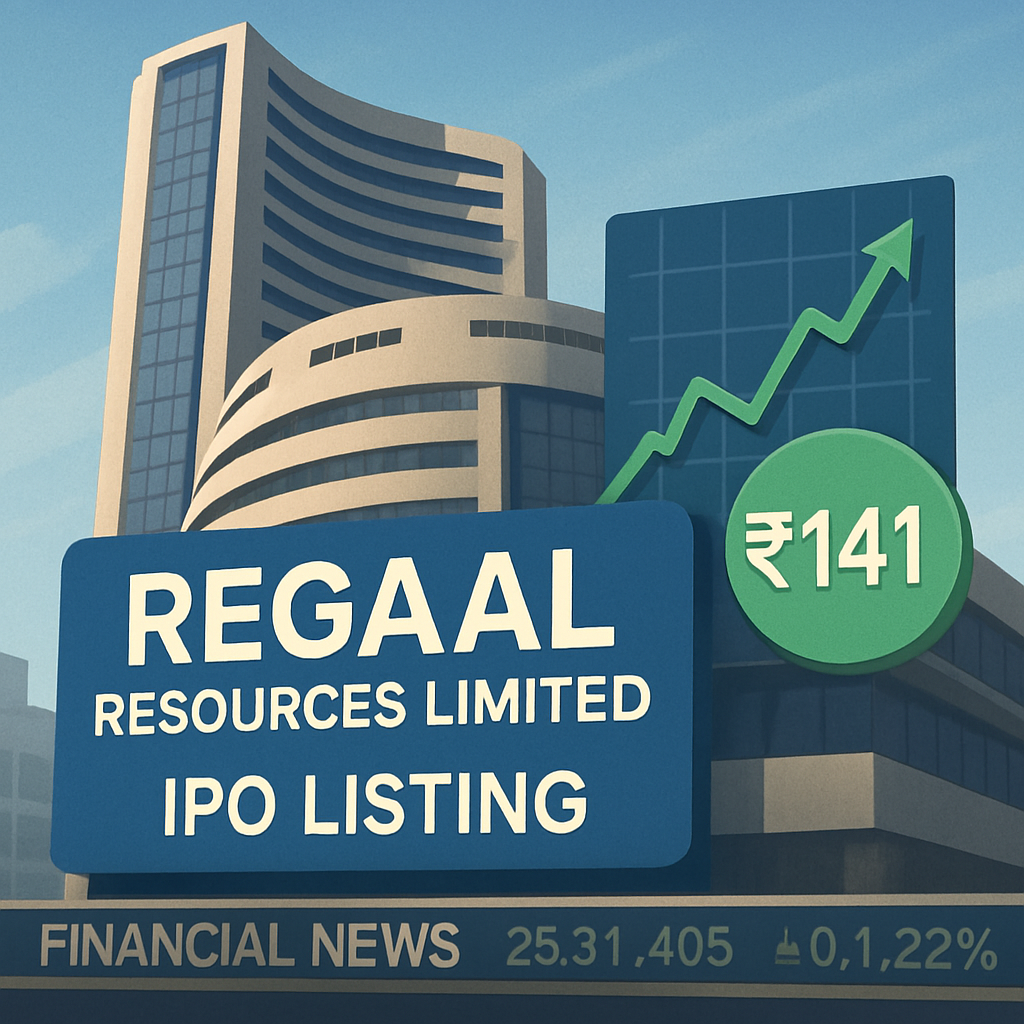
Regaal Resources Limited made a remarkable stock market debut, listing at a 38% premium over its IPO price. Here’s a detailed analysis of its share price movement, IPO highlights, and what investors can expect.
Table of Contents
Introduction: Market Debut of Regaal Resources Limited
Regaal Resources Limited completed its stock market listing on August 20, 2025, following a three-day initial public offering that concluded on August 14, 2025. The shares commenced trading on the National Stock Exchange at ₹141 per share and on the Bombay Stock Exchange at ₹141.80 per share.
The listing price represented a premium over the IPO issue price of ₹102 per equity share. This market debut attracted attention from institutional and retail investor segments participating in the agro-processing sector. The company operates in maize milling and specialty products manufacturing across India.
This analysis examines the company’s business operations, financial metrics, subscription performance, and current market positioning. Information presented derives from stock exchange filings, company disclosures, and verified market data sources.
Company Overview: Regaal Resources Business Operations
Manufacturing Capabilities and Capacity
Regaal Resources operates maize processing facilities with a combined daily capacity of 750 tonnes. The company established operations in 2012 and has expanded production capabilities through facility upgrades and process improvements over the subsequent years.
Manufacturing infrastructure includes equipment for processing raw maize into various derivative products. Quality control systems ensure output meets food safety standards and customer specifications. The company maintains certifications required for domestic and international market access.
Production processes convert agricultural raw materials into finished goods across multiple product categories. This vertical integration approach provides control over quality parameters and production efficiency. Facility locations consider proximity to raw material sources and market access.
Product Portfolio Structure
The company manufactures native maize starch used in industrial applications including textiles, paper manufacturing, and adhesive production. Modified starch products serve specialized food processing requirements where functional properties differ from native starch specifications.
Consumer products include custard powder and icing sugar marketed through retail distribution channels. These branded offerings target household consumption alongside food service establishments. Product development focuses on applications where maize derivatives provide functional or cost advantages.
Maize flour production serves bakery and food manufacturing customers requiring specific particle sizes and functional characteristics. Animal feed ingredients represent another product segment utilizing by-products from starch extraction processes. This diversified portfolio addresses multiple end-use markets across industrial and consumer segments.
Market Position Assessment
Industry data indicates Regaal Resources ranks within the top ten maize milling operations in India based on processing capacity. The sector includes both large integrated facilities and smaller regional processors serving local markets.
Competition exists from established domestic manufacturers and imports in certain product categories. Market positioning depends on factors including product quality, pricing competitiveness, delivery reliability, and technical service capabilities. Customer relationships span industrial buyers, food manufacturers, and distribution partners.
The company competes through operational efficiency, product consistency, and supply chain reliability. Geographic presence and distribution networks influence market penetration across different regions. Brand recognition varies between industrial ingredients sold on specifications versus consumer products where brand equity affects purchase decisions.
IPO Structure and Subscription Performance
Issue Parameters and Timeline
| Parameter | Details |
|---|---|
| IPO Opening Date | August 12, 2025 |
| IPO Closing Date | August 14, 2025 |
| Issue Price | ₹102 per share |
| Issue Size | ₹306 crore |
| Lot Size | 144 shares |
| Minimum Investment | ₹14,688 |
| Listing Date | August 20, 2025 |
The offering consisted of fresh equity shares issued by the company for business purposes. The price band structure followed SEBI regulations for mainboard listings. Subscription period spanned three trading days allowing investor evaluation and application submission.
Subscription Response Analysis
Market data indicates the IPO received applications totaling 159.87 times the shares available for subscription. This oversubscription level reflects demand across different investor categories including retail individuals, non-institutional investors, and qualified institutional buyers.
High subscription multiples typically result from combination of factors including company fundamentals, sector outlook, valuation perception, and overall market conditions. The demand pattern influences allotment ratios particularly for retail and non-institutional categories where proportionate allocation applies.
Category-wise demand patterns:
- Retail Individual Investors: Applications from individuals bidding up to ₹2 lakh
- Non-Institutional Investors: High net worth individuals and entities
- Qualified Institutional Buyers: Mutual funds, insurance companies, and FPIs
Institutional participation provides insights into professional investor assessment of company prospects. Large subscription numbers can indicate positive sentiment but do not guarantee post-listing performance outcomes.
Listing Day Performance
The stock opened at ₹141 on NSE and ₹141.80 on BSE on August 20, 2025. These listing prices represented premiums of 38.24% and 39% respectively over the ₹102 IPO price.
First-day trading volumes reflected activity from different participant types including allotment recipients, grey market participants, and new buyers entering at listing prices. Price discovery during initial sessions establishes reference levels for subsequent trading.
Listing gains represent one-day performance rather than sustainable valuations. Post-listing price movements depend on trading activity, company fundamentals, sector trends, and broader market conditions over extended periods.
Financial Performance Analysis
Revenue Growth Trajectory
Company filings indicate revenue increased from ₹601.08 crore in financial year 2024 to ₹917.58 crore in financial year 2025. This represents year-over-year growth of approximately 53%.
The revenue expansion reflects factors including volume growth, product mix changes, pricing realizations, and market conditions. Multi-year data shows compound annual growth rate of 36.95% between fiscal years 2023 and 2025.
Revenue sources span industrial customers purchasing ingredients, consumer product sales through retail channels, and exports to international markets. Geographic and product diversification affects overall revenue stability and growth patterns.
Profitability Metrics
Profit after tax expanded from ₹22.14 crore in FY2024 to ₹47.67 crore in FY2025, representing growth of 115%. This profitability improvement exceeded revenue growth rates indicating margin expansion.
Operating leverage from capacity utilization, product mix optimization, and operational efficiency improvements contribute to profitability changes. Raw material costs, processing expenses, and overhead absorption affect profit margins in commodity-linked businesses.
Key profitability indicators include:
- Gross profit margin reflecting production efficiency
- Operating profit margin showing core business profitability
- Net profit margin after interest and tax impacts
- Return on equity measuring shareholder value generation
Balance Sheet Structure
Asset composition includes fixed assets for manufacturing facilities, working capital components of inventory and receivables, and cash holdings. The balance sheet structure reflects capital requirements for operating a processing business with procurement, production, and distribution cycles.
Liability structure includes equity capital raised through the IPO, retained earnings from operations, and debt obligations if any for capacity expansion or working capital. The debt-to-equity ratio indicates financial leverage levels.
Working capital management involves inventory holding periods, customer payment terms, and supplier credit arrangements. Efficient cash conversion cycles reduce financing requirements and improve return on capital employed.
Current Market Performance and Valuation
Share Price Trends
Recent trading data shows shares trading around ₹110-111 per share on NSE. The 52-week price range shows a low of ₹108 per share since listing commenced. Post-listing price action reflects normal volatility as the stock establishes trading patterns.
Price movements depend on multiple factors including trading volumes, institutional holdings, retail investor sentiment, company news, sector trends, and broader market conditions. Newly listed stocks often exhibit higher volatility during initial months as price discovery occurs.
Support and resistance levels develop through trading activity over time. Technical analysts monitor these levels alongside volume patterns to assess demand-supply dynamics. Fundamental investors focus on business performance relative to market valuations.
Valuation Metrics
Current market capitalization stands at approximately ₹951 crore based on outstanding shares and market price. This valuation reflects investor assessment of the company’s worth based on earnings capacity, growth prospects, and risk factors.
| Metric | Value | Sector Average |
|---|---|---|
| Price-to-Earnings Ratio | 22.75 | 25.31 |
| Price-to-Book Ratio | 1.99 | Varies by company |
| Market Capitalization | ₹951 crore | N/A |
The P/E ratio of 22.75 compares against sector average of 25.31, suggesting relative valuation versus peers. However, P/E comparisons require context including growth rates, profitability margins, and business quality differences.
Price-to-book ratio indicates market value relative to net asset value on the balance sheet. This metric varies significantly across industries based on asset intensity and intangible value factors.
Trading Liquidity Considerations
Daily trading volumes indicate activity levels and ease of executing buy or sell transactions. Higher liquidity generally enables better price discovery and reduces transaction costs for investors.
The stock’s inclusion in market indices depends on free float, market capitalization, and trading turnover criteria. Index inclusion generates automatic buying from passive funds tracking those indices.
Institutional holding patterns influence liquidity and price stability. Long-term institutional investors provide stability while active traders contribute to daily volume. Foreign portfolio investor participation adds another dimension to ownership structure.
Sector Context: Indian Agro-Processing Industry
Industry Structure and Characteristics
India’s agro-processing sector converts agricultural commodities into value-added products for domestic consumption and exports. The industry includes diverse segments from grain milling to food manufacturing across organized and unorganized operations.
Maize processing specifically involves extracting starch, oil, and protein components for industrial and food applications. The sector has evolved from basic milling operations to sophisticated processing producing specialized ingredients.
Industry dynamics include seasonality in raw material availability, quality variations in agricultural inputs, logistics requirements for bulky commodities, and working capital intensity from procurement cycles.
Demand Drivers and Growth Factors
Consumption growth for processed food products drives demand for ingredients including starches and specialty compounds. Urbanization and changing dietary patterns increase processed food consumption versus traditional preparations.
Industrial applications in textiles, paper, pharmaceuticals, and other sectors create sustained demand for starch products. Technical specifications and quality consistency requirements favor organized manufacturers with testing capabilities.
Government policies affecting agriculture, food processing, and exports influence sector dynamics. Infrastructure development for food parks and processing clusters supports industry growth. Export opportunities arise from India’s cost competitiveness in certain product categories.
Competitive Landscape Analysis
The maize processing industry includes large-scale integrated operations, medium-sized specialized processors, and small regional mills. Competition intensity varies across product categories and geographic markets.
Established players benefit from scale economies, customer relationships, and technical expertise. Entry barriers include capital requirements for processing facilities, raw material sourcing networks, and quality certifications.
Import competition affects certain product segments where international suppliers offer price or specification advantages. Domestic manufacturers compete through supply chain proximity, service responsiveness, and understanding of local market requirements.
Raw Material Supply Chain Dynamics
Maize Procurement Strategies
Raw material availability and pricing significantly impact processing economics. Maize procurement requires managing seasonal production patterns, quality variations, and price fluctuations across harvest cycles.
Companies develop relationships with farmer networks, agricultural cooperatives, and commodity traders to ensure consistent supply. Direct procurement from production regions reduces intermediary costs and improves quality control.
Storage infrastructure enables procurement during harvest periods when prices are typically lower. Adequate storage capacity balances between carrying costs and supply security during lean seasons.
Cost Management Considerations
Maize prices depend on production volumes, government support policies, export-import dynamics, and competing demand from feed and food uses. Price volatility creates margin pressure if pass-through to customers is limited by contracts or competitive conditions.
Processing efficiency affects yield rates and by-product realization. Modern equipment and process optimization improve output per unit of raw material input. Energy costs for drying, milling, and refining also impact total production economics.
Risk management strategies may include futures contracts, forward purchases, or inventory policies to mitigate price volatility. The ability to adjust product mix based on margin profiles provides operational flexibility.
Quality Control Systems
Agricultural raw materials exhibit quality variations based on growing conditions, handling practices, and storage duration. Testing protocols assess parameters including moisture content, protein levels, and contamination presence.
Quality specifications affect processing yields and final product characteristics. Stringent input standards ensure consistent output quality meeting customer requirements and food safety regulations.
Traceability systems track material batches from procurement through processing to finished goods. This documentation supports quality investigations, regulatory compliance, and customer assurance requirements.
Growth Strategy and Expansion Plans
Capacity Expansion Initiatives
The company has indicated plans for capacity additions to support revenue growth objectives. Expansion decisions consider market demand projections, capacity utilization rates, and return on investment calculations.
Greenfield facilities require significant capital investment and development timelines. Brownfield expansions at existing locations may offer faster implementation and infrastructure cost advantages. Equipment selection balances capacity, efficiency, and flexibility considerations.
Financing for expansion utilizes internal cash generation supplemented by IPO proceeds. The optimal capital structure balances debt and equity considering cost of capital and financial flexibility requirements.
Market Development Activities
Geographic expansion into regions with limited current presence creates revenue growth opportunities. Distribution network development requires channel partnerships, logistics infrastructure, and local market understanding.
Product portfolio expansion addresses additional market segments or customer applications. New product development involves technical validation, customer trials, and commercial scale-up processes.
Export market penetration leverages India’s cost competitiveness and quality capabilities. International business requires certifications, compliance with destination market regulations, and establishment of distribution relationships.
Operational Efficiency Improvements
Process optimization initiatives reduce production costs and improve yields. Technology upgrades and automation investments enhance productivity while maintaining quality consistency.
Energy efficiency programs lower operating costs and align with sustainability objectives. Waste reduction and by-product utilization improve overall economics and environmental performance.
Supply chain optimization encompasses procurement, production planning, inventory management, and distribution logistics. Integrated approaches reduce total system costs while improving service levels.
Investment Considerations and Risk Factors
Business Risk Assessment
Agricultural commodity exposure creates inherent volatility in raw material costs. Procurement price fluctuations may not be fully recovered through product pricing adjustments affecting profitability.
Seasonal production patterns and weather dependencies impact supply availability and costs. Adverse agricultural conditions can disrupt operations or compress margins during periods of tight supply.
Competition from existing players and potential new entrants affects pricing power and market share. Technological changes or substitute products could alter demand patterns for current product offerings.
Regulatory and Compliance Factors
Food safety regulations govern processing operations, product specifications, and quality control requirements. Compliance necessitates ongoing investment in systems, testing, and documentation.
Agricultural policies affecting crop production, procurement prices, and trade regulations influence industry dynamics. Policy changes can impact raw material costs, market access, or competitive conditions.
Environmental regulations regarding water usage, waste management, and emissions require operational controls and monitoring systems. Evolving standards may necessitate additional compliance investments.
Financial and Market Risks
Customer concentration if revenues depend heavily on limited buyers creates vulnerability to individual customer decisions. Diversification across customers and sectors reduces this dependency risk.
Working capital requirements for inventory and receivables place demands on cash flows. Efficient management prevents liquidity constraints during business scaling or adverse conditions.
Market price volatility for listed shares creates mark-to-market fluctuations in portfolio values. New listings often exhibit higher volatility as trading patterns establish and information disseminates.
Macroeconomic Sensitivity
Economic growth rates influence demand for processed food products and industrial applications. Slower economic activity can reduce consumption and capital expenditure affecting company revenues.
Interest rate changes affect financing costs for expansion and working capital. Cost inflation in labor, energy, and logistics impacts operational expenses and margin profiles.
Currency fluctuations influence export competitiveness and import costs. Rupee depreciation benefits exports while increasing costs for any imported inputs or equipment.
Technical Analysis Perspectives
Price Pattern Development
Technical analysis examines price movements and trading volumes to identify patterns and trends. For newly listed stocks, limited historical data restricts certain long-term technical indicators.
Support levels represent price points where buying interest historically emerges limiting further declines. Resistance levels indicate prices where selling pressure constrains upward movement. These levels develop through trading activity over time.
The listing premium created initial resistance around ₹140-142 levels where profit booking occurred. Subsequent stabilization around ₹110-111 establishes support zones where buyers re-enter.
Volume Analysis
Trading volumes indicate liquidity and intensity of buying or selling pressure. Higher volumes during price advances suggest conviction behind the move. Declining volumes during corrections may indicate normal profit-taking rather than fundamental concerns.
Institutional trading activity typically involves larger transaction sizes visible in volume patterns. Retail participation shows in smaller average trade sizes and broader order book distribution.
Delivery percentage indicates proportion of trades resulting in actual share transfers versus intraday speculation. Higher delivery percentages suggest investment-oriented buying rather than short-term trading.
Momentum Indicators
Moving averages smooth price data to identify trend directions. Short-term averages crossing above long-term averages generate buy signals in technical systems. For new listings, these indicators require sufficient trading history to become meaningful.
Relative Strength Index measures momentum and identifies overbought or oversold conditions. RSI readings above 70 suggest overbought while below 30 indicates oversold situations.
Moving Average Convergence Divergence tracks trend changes and momentum shifts. MACD crossovers generate trading signals for technical practitioners.
Peer Comparison Analysis
Industry Comparable Assessment
Evaluating Regaal Resources requires comparison with similar companies in agro-processing and maize milling segments. Relevant peers include other listed food ingredient manufacturers with comparable business models.
Comparison Parameters:
- Revenue scale and growth rates
- Profitability margins and ROE
- Capacity and market share
- Product portfolio breadth
- Geographic presence
- Valuation multiples
Size differences affect comparability as larger companies may enjoy scale benefits while smaller operations demonstrate higher growth rates. Business model variations including vertical integration levels and product specialization create valuation differences.
Relative Valuation Analysis
Comparing P/E ratios requires adjusting for growth rate differentials. Companies with higher growth typically command premium valuations. The PEG ratio (P/E divided by growth rate) normalizes for growth differences.
Price-to-sales and EV-to-EBITDA multiples provide alternative valuation frameworks. These metrics avoid earnings quality issues and enable comparison across companies with different capital structures.
Return on equity and return on invested capital measure management effectiveness in generating returns. Superior returns justify premium valuations if sustainable over time.
Competitive Positioning Assessment
Market share data indicates relative competitive position within the industry. Higher market shares often correlate with scale advantages and customer preference.
Product differentiation through quality, innovation, or branding creates competitive moats protecting margins. Commodity-oriented businesses face greater pricing pressure than differentiated offerings.
Customer relationship strength and retention rates indicate competitive positioning. Long-term contracts or repeat business provide revenue visibility and reduce customer acquisition costs.
Institutional Holding Patterns
Ownership Structure Analysis
Post-IPO ownership includes promoter holdings, institutional investors, and public shareholders. SEBI regulations mandate promoter holding disclosures and lock-in requirements.
Institutional categories include mutual funds, insurance companies, foreign portfolio investors, and banks. These professional investors conduct detailed due diligence before investing and their participation validates company quality.
Public shareholding comprises retail investors and non-institutional participants. Free float availability affects liquidity and index inclusion eligibility.
Institutional Buying Patterns
Mutual fund holdings indicate domestic institutional interest. Fund managers evaluate companies based on growth prospects, management quality, and portfolio fit.
Foreign portfolio investor participation brings international capital and diverse perspectives. FPI flows respond to Indian market attractiveness, company fundamentals, and global risk appetite.
Systematic Investment Plan inflows from retail investors provide steady buying pressure. SIP investments average rupee costs over time reducing market timing risks.
Shareholding Changes and Trends
Quarterly shareholding pattern disclosures reveal institutional and promoter holding changes. Increasing institutional accumulation suggests positive outlook while reducing holdings may indicate concerns.
Pledged share percentages by promoters indicate financial stress if present. Unpledged holdings demonstrate promoter confidence and financial strength.
Block deals and bulk deals appearing in exchange disclosures show significant transactions. These trades may indicate institutional position building or exits affecting supply-demand dynamics.
Dividend Policy and Shareholder Returns
Earnings Distribution Framework
Companies establish dividend policies balancing cash distribution to shareholders with retained earnings for growth investments. Payout ratios indicate proportion of earnings distributed versus retained.
Growth-oriented companies typically retain more earnings for expansion while mature businesses distribute higher percentages. The optimal approach depends on reinvestment opportunities and capital requirements.
Dividend sustainability depends on consistent earnings generation and cash flow adequacy. Companies maintaining stable or growing dividends command premium valuations from income-focused investors.
Total Shareholder Return Perspective
Investment returns combine price appreciation and dividend income. Historical returns provide context but do not guarantee future performance.
Total shareholder return calculation includes dividends reinvested and capital gains over measurement periods. Comparing returns against benchmarks like sectoral indices or broader markets assesses relative performance.
Long-term wealth creation depends on sustainable business growth, efficient capital allocation, and reasonable entry valuations. Compounding benefits emerge over extended holding periods.
Capital Allocation Priorities
Management capital allocation decisions significantly impact shareholder value creation. Choices include organic growth investments, acquisitions, debt reduction, or shareholder distributions.
Return on incremental capital deployed indicates management effectiveness. Investments generating returns exceeding cost of capital create value while below-threshold returns destroy value.
Buyback programs return cash to shareholders through share repurchases reducing outstanding shares. This approach provides tax advantages over dividends in certain situations.
Sector Policy Environment
Government Support Initiatives
Ministry of Food Processing Industries implements schemes supporting agro-processing sector development. Programs include infrastructure subsidies, technology upgradation assistance, and market linkage support.
Production Linked Incentive schemes may cover food processing segments encouraging domestic manufacturing and exports. Eligibility criteria and incentive structures affect participation economics.
Agricultural policies affecting minimum support prices, procurement mechanisms, and crop patterns influence raw material availability and costs for processing companies.
Trade Policy Considerations
Export promotion schemes provide incentives for food ingredient exports. Duty drawbacks, market development assistance, and export credit facilitate international business.
Import duties on competing products protect domestic manufacturers. Tariff structures balance consumer interests, farmer welfare, and industry competitiveness considerations.
Free trade agreements with partner countries create market access opportunities or competitive challenges depending on relative cost structures and quality capabilities.
Food Safety and Quality Regulations
Food Safety and Standards Authority of India establishes manufacturing standards, testing requirements, and labeling regulations. Compliance ensures consumer safety and maintains industry credibility.
Licensing requirements and periodic inspections verify adherence to prescribed standards. Documentation systems demonstrate compliance and enable traceability.
Voluntary certifications including ISO, HACCP, or organic standards enhance market access and customer confidence. These credentials support premium positioning and export market penetration.
Future Outlook and Market Catalysts
Industry Growth Projections
Market research indicates continued growth in India’s food processing sector driven by consumption patterns, urbanization, and income growth. Processed food penetration remains below developed market levels suggesting long runway.
Industrial applications for starch products grow with manufacturing sector expansion. Specific segments including pharmaceuticals, textiles, and paper drive specialized ingredient demand.
Export potential exists as Indian manufacturers gain international recognition for quality and cost competitiveness. Government support for exports and improving infrastructure enhance market access.
Company-Specific Catalysts
Capacity expansion completion and utilization ramp-up drive revenue growth and operating leverage benefits. New facility contributions appear as production stabilizes and customer qualification completes.
Market share gains through customer acquisitions or wallet share expansion with existing buyers increase revenues. Successful product launches or geographic expansion create additional growth vectors.
Margin improvements from operational efficiency, procurement optimization, or favorable product mix enhance profitability. Operating leverage as fixed costs spread over larger volumes improves margins.
Valuation Re-rating Potential
Consistent execution on growth and profitability objectives builds investor confidence supporting multiple expansion. Delivery against guidance and market expectations influences valuation perceptions.
Index inclusion in mid-cap or sector-specific indices generates automatic buying from passive funds. This demand supports prices independent of fundamental factors.
Sector re-rating if industry growth exceeds expectations or structural changes improve economics benefits constituent companies. Positive sector sentiment elevates valuations across industry participants.
Author Information and Credentials
About the Author:
Nueplanet specializes in analyzing Indian equity markets with focus on IPO evaluations, sector research, and company fundamentals. Professional experience includes the years covering financial markets and corporate developments.
Nueplanet analysis and investment research methodologies. Nueplanet maintains independence from covered companies and bases analysis on publicly disclosed information.
Research Approach:
Content derives exclusively from verified sources including company filings with stock exchanges, SEBI disclosures, annual reports, and official financial statements. Market data comes from recognized stock exchanges and financial information platforms.
Analysis maintains objectivity through fact-based assessment without promotional intent. Multiple perspectives receive consideration including growth potential and risk factors. Updates incorporate new information as developments occur.
Professional Standards:
Nueplanet adheres to principles of accuracy, transparency, and balanced presentation. All material information relevant to investment decisions receives disclosure. Conflicts of interest or limitations in analysis are acknowledged.
Regular content review ensures currency and accuracy as situations evolve. Corrections appear promptly if errors are identified. Reader feedback informs content improvements and topic selection.
Disclaimer:
This content provides educational information and market analysis. It does not constitute investment advice, stock recommendations, or solicitation to buy or sell securities. Readers should conduct independent research and consult qualified financial advisors before investment decisions.
Stock market investments involve risks including potential loss of principal. Past performance does not indicate future results. The author holds no positions in discussed securities and receives no compensation from mentioned companies.
Published: August 20, 2025
Last Updated: August 20, 2025
Frequently Asked Questions (FAQs)
Q1: What was the listing performance of Regaal Resources IPO?
Regaal Resources listed on August 20, 2025, at ₹141 per share on NSE and ₹141.80 per share on BSE. These listing prices represented premiums of 38.24% and 39% respectively over the IPO issue price of ₹102 per share. The subscription period ran from August 12-14, 2025, receiving applications totaling 159.87 times the available shares. Listing day performance reflects initial investor enthusiasm though post-listing prices depend on ongoing trading dynamics and fundamental developments.
Q2: What is the current share price and market capitalization of Regaal Resources?
Recent market data shows Regaal Resources trading around ₹110-111 per share on NSE. The company’s market capitalization stands at approximately ₹951 crore based on outstanding shares and current market price. The 52-week low since listing is ₹108 per share. Trading activity and price movements continue as the stock establishes patterns following its recent market debut. Investors should monitor current prices through official stock exchange platforms for real-time information.
Q3: How does Regaal Resources’ valuation compare to industry peers?
Regaal Resources shows a Price-to-Earnings ratio of 22.75 compared to the sector average of 25.31, suggesting relative discount to peer valuations. The Price-to-Book ratio stands at 1.99. However, direct comparisons require context including differences in growth rates, profitability margins, business scale, and product mix. Companies with higher growth or superior returns typically command premium valuations. Investors should conduct comprehensive peer analysis considering multiple metrics and qualitative factors.
Q4: What are the main products manufactured by Regaal Resources?
The company produces native maize starch for industrial applications in textiles, paper, and adhesives. Modified maize starch serves specialized food processing requirements. Consumer products include custard powder and icing sugar for retail markets. Maize flour serves bakery and food manufacturing customers. Animal feed ingredients utilize processing by-products. This diversified portfolio addresses multiple market segments reducing dependence on single product categories while providing cross-selling opportunities.
Q5: What revenue and profit growth has Regaal Resources achieved?
Company filings show revenue increased from ₹601.08 crore in FY2024 to ₹917.58 crore in FY2025, representing 53% year-over-year growth. Profit after tax expanded from ₹22.14 crore to ₹47.67 crore, reflecting 115% growth. The compound annual growth rate between FY2023 and FY2025 reached 36.95% for revenues. This financial performance demonstrates business expansion though investors should evaluate sustainability considering market conditions, competitive dynamics, and execution capabilities.
Q6: What are the key investment risks for Regaal Resources shareholders?
Primary risks include agricultural commodity price volatility affecting raw material costs, competition from existing and new market entrants, regulatory changes in food processing or agricultural sectors, economic sensitivity affecting demand, and execution risks in capacity expansion plans. Maize price fluctuations impact margins if customer pricing doesn’t adjust proportionally. Customer concentration creates dependence on key buyers. Working capital requirements place demands on cash flows during scaling. Quality issues could damage reputation and market position.
Q7: What growth strategies is Regaal Resources pursuing?
Growth initiatives include capacity expansion to handle larger volumes and reduce delivery timelines. Geographic market development into regions with limited current presence creates revenue opportunities. Product portfolio expansion addresses additional customer applications and segments. Export market penetration leverages cost competitiveness. Operational efficiency improvements through process optimization and technology upgrades reduce costs. These strategies aim to increase market share, improve margins, and establish stronger competitive positioning.
Q8: How do institutional investors view Regaal Resources?
The high IPO subscription including institutional categories indicates positive professional investor assessment. Institutional participation during the offering demonstrated confidence in fundamentals and growth prospects. Post-listing institutional holding patterns visible in quarterly disclosures provide ongoing sentiment indicators. Mutual fund and foreign portfolio investor accumulation suggests positive outlook while reduced holdings may signal concerns. Index inclusion potential could generate additional institutional buying from passive investment vehicles tracking market benchmarks.
Q9: What is the outlook for India’s agro-processing sector?
Industry projections indicate continued growth driven by increasing consumption of processed foods, urbanization, rising incomes, and changing dietary patterns. Government support through food processing schemes, infrastructure development, and export promotion provides tailwinds. Industrial applications in manufacturing sectors create sustained demand for ingredients. However, sector faces challenges including raw material volatility, competition, and regulatory requirements. Established players with scale, quality systems, and customer relationships benefit from consolidation trends.
Q10: What timeframe suits investment in Regaal Resources shares?
Investment horizon appropriateness depends on individual objectives, risk tolerance, and portfolio construction. Short-term performance faces volatility from trading dynamics, sentiment shifts, and technical factors. Medium-term results depend on quarterly performance, capacity utilization, and strategic initiative execution. Long-term value creation correlates with sustained revenue growth, margin improvement, and market share gains. Growth-focused businesses typically suit longer investment periods allowing time for expansion plans to materialize and compound returns to accumulate.
Editorial Standards:
This analysis maintains factual accuracy through exclusive reliance on verified public information sources. Content avoids promotional language and investment recommendations. All financial data derives from official company filings and exchange disclosures. Regular updates ensure information currency as new developments occur. The author maintains independence from covered companies and receives no compensation from mentioned entities.
Helpful Resources
Call to Action: Investors looking to diversify into agro-based mid-cap stocks should closely monitor Regaal Resources’ share performance and consider long-term investment strategies.
Latest Posts
Related Posts












Post Comment