









Railtel Share Price: Fresh Contract Wins Boost Market Sentiment
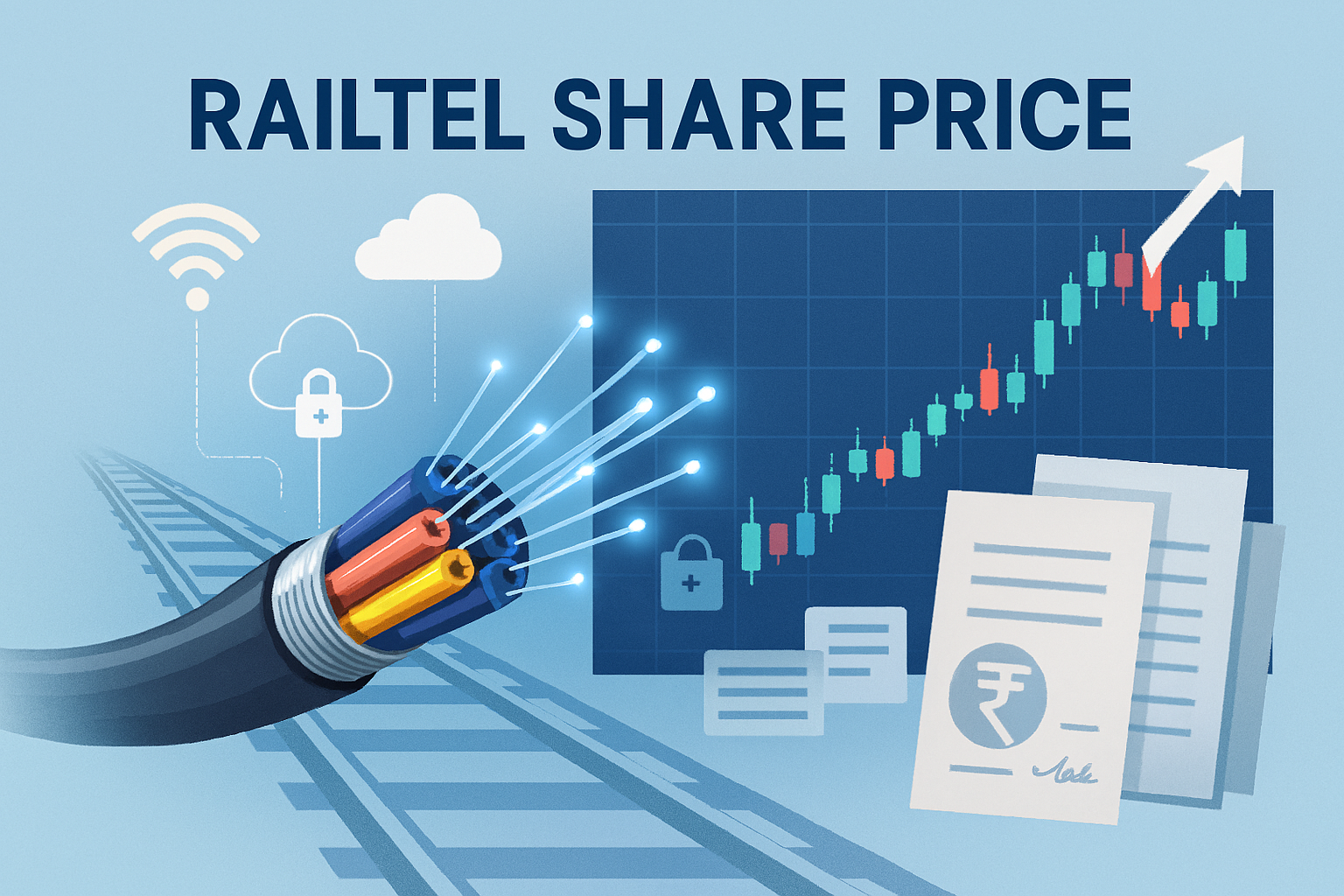
The Railtel share price surged following news of fresh contract wins worth ₹50 crore, highlighting investor optimism about the company’s growth prospects. Analysts and market participants are closely tracking the stock as it benefits from both government-backed telecom initiatives and private sector demand.
Table of Contents
Published: August 21, 2025 | Last Updated: August 21, 2025
Market Overview: Recent Contract Wins and Stock Performance
RailTel Corporation of India Limited has secured multiple contracts valued at over ₹103 crores from Panvel and Nashik civic bodies, contributing to a 4% share price increase. Trading data from September 2024 indicates shares at ₹354.50 on both NSE and BSE exchanges. The company’s market capitalization stands at ₹12,318 crores, representing a 17.4% decline over the previous year despite recent positive developments.
Recent contract acquisitions span multiple Indian states and sectors, demonstrating the company’s operational capabilities across diverse project types. The order wins include smart city infrastructure projects, educational technology implementations, and municipal digital systems. These contracts provide revenue visibility for upcoming quarters and reflect sustained demand for telecom infrastructure services.
Financial results for Q1 FY26 show revenue from operations increasing 33.27% year-over-year to ₹743.81 crores. Net profit rose 6.59% to ₹72.64 crores in the quarter ended September 2024, compared to ₹68.15 crores in the corresponding previous period. Annual revenue stands at ₹3,663 crores with net profit of ₹317 crores, indicating operational scale in the telecommunications infrastructure sector.
Promoter holding remains at 72.8%, reflecting continued government ownership and strategic control. The substantial government stake provides policy alignment and potential advantages in securing public sector contracts. However, working capital metrics show debtors outstanding for 166 days, indicating extended payment cycles typical of government contracts.
Company Profile: Operations and Business Segments
RailTel Corporation operates as a central government public sector undertaking under the Ministry of Railways. The company provides telecommunications infrastructure and services across multiple segments, leveraging optical fiber cable laid alongside railway tracks. This network infrastructure spans over 67,000 kilometers, providing connectivity across major Indian cities and remote locations.
Core Business Operations
The company’s business model encompasses several distinct operational segments. Railway-based telecommunications form the foundational infrastructure, utilizing right-of-way access along railway corridors for fiber optic cable deployment. This strategic positioning enables cost-effective network expansion compared to traditional telecommunications operators requiring separate infrastructure rights.
Enterprise networking solutions constitute a significant revenue stream, delivering data connectivity services to corporate clients, government agencies, and institutional customers. Services include virtual private networks, managed services, and dedicated bandwidth solutions. These offerings generate recurring revenue through multi-year contracts with established clients across various industries.
Data center operations represent an expanding business segment, with facilities located in strategic metropolitan areas. The company provides colocation services, cloud connectivity, and managed hosting solutions for organizations requiring secure data infrastructure. Increasing digital transformation initiatives by enterprises and government agencies support growth in this segment.
Public WiFi deployment projects cover railway stations, educational institutions, and public spaces across India. The company has implemented connectivity solutions at thousands of locations, serving millions of users. These projects align with government digital inclusion objectives while establishing brand visibility among consumer segments.
Technology Infrastructure and Capabilities
Network infrastructure includes optical fiber cables, switching equipment, transmission systems, and data center facilities. The company maintains and upgrades this infrastructure to support evolving bandwidth requirements and emerging technology standards. Investment in next-generation network equipment ensures service quality and competitive positioning.
Technical expertise encompasses network design, project implementation, operations management, and maintenance services. Engineering teams handle complex telecommunications projects from planning through execution, including civil works, equipment installation, testing, and commissioning. Service delivery capabilities span multiple technology domains and customer segments.
Quality management systems and operational processes align with international standards and regulatory requirements. Certifications demonstrate compliance with industry best practices for network operations, security protocols, and service delivery. These certifications support participation in competitive tenders requiring specific quality credentials.
Financial Performance Analysis: Key Metrics and Trends
Revenue Growth and Profitability
First quarter FY26 revenue growth of 33.27% represents significant acceleration compared to historical performance trends. This growth stems from increased project execution activity and expanded service delivery across existing customer relationships. The revenue increase reflects both new contract wins from previous periods entering execution phase and organic growth in recurring service segments.
Net profit margin stands at approximately 9.8% based on quarterly results, indicating reasonable profitability levels for a capital-intensive infrastructure business. Operating expenses include network maintenance, employee costs, and project execution expenses. Profit growth of 6.59% year-over-year suggests operational leverage as revenue increases, though margin expansion remains modest.
Annual financial performance shows total revenue of ₹3,663 crores generating net profit of ₹317 crores, representing an annual profit margin of approximately 8.7%. This profitability level reflects the company’s business mix across various service categories with differing margin characteristics. Project-based revenues typically carry lower margins than recurring service revenues.
Working Capital and Cash Flow Considerations
Debtor days of 166 indicate extended collection periods for receivables, common in government contract-based businesses. Payment realization from government agencies and public sector clients follows administrative processes that create timing delays. This working capital characteristic requires careful cash flow management and financing arrangements.
The extended receivables period impacts cash conversion cycles and working capital requirements. Companies serving government clients must maintain sufficient liquidity to fund operations during payment processing periods. Interest costs on working capital financing affect overall profitability, making efficient receivables management important for financial performance.
Contract structures typically include milestone-based payments tied to project completion stages rather than continuous billing. This payment structure creates lumpiness in cash inflows corresponding to project milestone achievements. Effective project management ensuring timely milestone completion becomes critical for maintaining cash flow stability.
Capital Structure and Financial Position
Government ownership of 72.8% provides implicit financial backing and reduced refinancing risks compared to purely private sector companies. Access to government support during financial stress periods creates stability for lenders and investors. This ownership structure also influences dividend policy and capital allocation decisions.
Debt levels and capital expenditure requirements depend on growth strategies and infrastructure expansion plans. Telecom infrastructure projects require upfront capital investment before generating returns. Balancing growth investments with financial prudence determines sustainable expansion rates and return on capital employed.
Asset base consists primarily of network infrastructure, equipment, and real estate for data centers and offices. Depreciation charges reflect asset useful lives and technology obsolescence rates. Regular capital expenditure maintains network quality and competitiveness as technology standards evolve.
Recent Contract Wins: Analysis and Implications
Municipal Smart City Projects
The ₹70.94 crore contract from Nashik Municipal Smart City Development Corporation covers network backbone infrastructure supply, installation, and maintenance. Project scope includes laying fiber optic cable, network equipment deployment, testing, commissioning, and ongoing operations support. The contract duration provides multi-year revenue visibility with recurring maintenance fees.
Smart city projects integrate various digital services including surveillance systems, traffic management, citizen services portals, and IoT sensor networks. These implementations require robust telecommunications backbone infrastructure capable of handling data from multiple sources. RailTel’s expertise in large-scale network deployment positions it competitively for such projects.
Municipal contracts demonstrate the company’s ability to serve state and local government clients beyond traditional railway and central government relationships. Geographic diversification across multiple states reduces concentration risk and expands addressable market opportunities. Success in municipal projects creates reference cases for similar opportunities in other cities.
Education Sector Digital Infrastructure
The ₹209 crore project from Bihar Education Project Council represents significant entry into education technology infrastructure. Digital education initiatives require connectivity solutions linking schools, administrative offices, and remote learning platforms. Growing emphasis on technology-enabled education creates expanding market opportunities.
Education sector projects typically involve distributed networks connecting multiple locations with centralized management systems. Implementation challenges include working across diverse geographic areas and coordinating with multiple stakeholders. Successful execution demonstrates capabilities relevant for other distributed network projects.
Government focus on improving education access and quality through technology integration supports continued investment in digital education infrastructure. Various state governments are implementing similar initiatives, creating pipeline opportunities for companies with proven execution capabilities in this sector.
State Government Technology Projects
The ₹17.47 crore contract from Chhattisgarh government, along with other state-level contracts, demonstrates geographic reach across multiple Indian states. These projects cover diverse applications including e-governance systems, rural connectivity, and administrative network infrastructure. State government relationships complement central government project access.
Winning contracts across different states indicates competitive positioning in bidding processes and technical capability assessment by various government evaluation committees. Success rates in competitive tenders reflect factors including pricing competitiveness, technical specifications compliance, and past performance track records.
Regional expansion through state government contracts reduces dependency on any single client or geography. Diversified revenue sources across central government, state governments, municipal bodies, and private enterprises create business stability through economic and budget cycles.
Growth Drivers and Market Opportunities
Government Digital Transformation Initiatives
India’s Digital India program encompasses numerous technology infrastructure projects aimed at increasing digital connectivity and service delivery. These initiatives span rural broadband expansion, e-governance implementation, digital payment infrastructure, and citizen service portals. Government investment in digital infrastructure creates sustained demand for telecommunications and technology services.
Smart Cities Mission targets development of 100 cities with integrated digital infrastructure including intelligent transport systems, surveillance networks, utilities management, and citizen services. The program requires substantial telecommunications backbone infrastructure to connect various systems and sensors. RailTel’s experience in smart city projects positions it to participate in this multi-year initiative.
BharatNet aims to provide broadband connectivity to all gram panchayats (village councils) across India, representing massive rural connectivity infrastructure requirements. The project involves laying fiber optic cable to connect hundreds of thousands of villages, creating long-term deployment and maintenance opportunities. Companies with existing fiber infrastructure and project execution capabilities hold advantages in this sector.
Enterprise Digital Adoption Trends
Corporate sector digital transformation accelerated following pandemic-driven remote work adoption and cloud migration initiatives. Organizations require robust data connectivity, secure networks, and reliable bandwidth for distributed operations. Demand for enterprise networking solutions and data center services benefits infrastructure providers.
Data localization requirements and privacy concerns increase demand for domestic data center services as organizations seek to host sensitive data within India. Growing cloud adoption by enterprises drives colocation service demand as companies establish hybrid cloud architectures. RailTel’s data center locations in major metros provide proximity to enterprise customers.
Financial services, healthcare, manufacturing, and retail sectors demonstrate high technology adoption rates, requiring sophisticated networking infrastructure. Sector-specific compliance requirements create opportunities for managed service providers offering secure, compliant connectivity solutions. Long-term enterprise relationships generate recurring revenue streams with relatively stable cash flows.
Infrastructure Modernization Requirements
Legacy telecommunications infrastructure across government agencies and public sector enterprises requires upgrading to support modern applications and bandwidth requirements. Network modernization projects involve replacing outdated equipment, expanding capacity, and implementing security enhancements. These upgrade cycles create ongoing business opportunities for infrastructure providers.
Railway telecommunications modernization aligns with broader railway infrastructure upgrades and operational efficiency initiatives. Modern signaling systems, passenger information systems, and operational communications require high-capacity, reliable networks. RailTel’s position within the railway ecosystem provides natural advantages for these projects.
Critical infrastructure sectors including power, defense, and transportation increasingly require secure, dedicated telecommunications networks separate from public infrastructure. Specialized network requirements and security considerations create opportunities for providers with appropriate certifications and capabilities.
Competitive Landscape and Market Position
Public Sector Telecommunications Providers
RailTel competes with other government-owned telecommunications infrastructure companies including Bharat Sanchar Nigam Limited (BSNL) and PowerGrid Corporation’s telecom subsidiary. Each company possesses distinct infrastructure advantages: BSNL holds telecommunications licenses and spectrum, PowerGrid maintains transmission line-based fiber infrastructure, while RailTel leverages railway corridor access.
Competitive advantages for RailTel include extensive optical fiber network spanning major population centers and remote areas through railway connectivity. Railway infrastructure access provides cost advantages for network expansion compared to obtaining new right-of-way permissions. Strategic locations for network nodes near railway stations offer connectivity to transportation hubs.
Government project allocations among public sector companies depend on technical capabilities, past performance, financial capacity, and strategic priorities. Competition for government contracts occurs through tender processes evaluating multiple factors beyond pricing. Established track records and domain expertise in specific project types influence award decisions.
Private Sector Competition
Private telecommunications operators including Reliance Jio, Bharti Airtel, and Vodafone Idea compete in enterprise networking segments with extensive nationwide networks. These companies possess significant financial resources, advanced technology infrastructure, and established enterprise customer relationships. Competition intensity varies across different service categories and customer segments.
Private sector advantages include faster decision-making processes, aggressive pricing strategies, and integrated service bundles combining connectivity with cloud and digital services. However, government policy preferences for public sector companies in certain projects and security-sensitive applications create protected market segments.
System integrators and IT services companies compete for smart city projects, digital infrastructure implementations, and technology services contracts. These competitors bring software development capabilities, systems integration expertise, and industry-specific solution offerings. Partnerships or competition with these companies depends on specific project requirements.
Differentiation Factors
RailTel’s unique positioning combines government ownership benefits with specialized infrastructure assets and proven project execution capabilities. The railway-based fiber network represents difficult-to-replicate infrastructure providing nationwide reach. Government ownership facilitates participation in projects requiring public sector supplier preferences or security clearances.
Technical expertise in large-scale network deployment, operations management, and maintenance services differentiates the company in project execution capabilities. Experience managing complex, geographically distributed telecommunications infrastructure demonstrates competence in handling demanding government projects. Quality certifications and compliance track records support competitive positioning.
Customer relationships with government agencies, railways, public sector enterprises, and large corporations provide recurring business opportunities and reference cases for new projects. Long-standing relationships create familiarity with client requirements and procurement processes. Installed base of existing customers offers opportunities for service expansion and technology upgrades.
Risk Factors and Investment Considerations
Project Execution and Operational Risks
Large-scale infrastructure projects involve execution risks including delays in obtaining regulatory approvals, land acquisition challenges, equipment procurement issues, and coordination with multiple stakeholders. Project delays impact revenue recognition timing and cash flow generation. Contingency planning and project management capabilities mitigate these operational risks.
Technology infrastructure projects require coordination with civil contractors, equipment suppliers, and client organizations. Dependencies on third parties for critical project components create execution uncertainties. Vendor management and supply chain oversight become important for ensuring timely project completion.
Quality issues or project failures could impact reputation and future business opportunities. Performance track records influence evaluation in competitive tenders for subsequent projects. Maintaining consistent execution quality across multiple concurrent projects requires robust project management systems and experienced personnel.
Financial and Working Capital Challenges
Extended payment cycles typical of government contracts create working capital pressures requiring financing arrangements. Interest costs on working capital borrowings affect profitability margins. Efficient receivables management and accelerated collection processes help minimize financing costs.
Revenue concentration in government projects creates exposure to budget allocation changes and government spending priorities. Economic downturns or fiscal constraints could impact government infrastructure spending. Diversification across different government agencies and private sector clients reduces concentration risk.
Capital-intensive infrastructure expansion requires significant upfront investment before generating returns. Balancing growth investments with maintaining financial stability requires prudent capital allocation. Over-aggressive expansion without corresponding revenue growth could strain financial resources.
Competitive and Market Risks
Intensifying competition from private sector players with superior financial resources and technology capabilities pressures pricing and market share. Private operators’ aggressive enterprise market strategies could impact RailTel’s growth in commercial segments. Maintaining cost competitiveness while ensuring quality service delivery becomes challenging.
Technology evolution and changing customer preferences require continuous infrastructure upgrades and service innovation. Failure to keep pace with technology trends could result in competitive disadvantage and obsolescence of existing infrastructure. Sustained capital expenditure in technology modernization becomes necessary for maintaining relevance.
Regulatory changes affecting telecommunications sector policies, spectrum allocation, or licensing requirements could impact competitive dynamics. Government policy shifts regarding public sector company roles in telecommunications infrastructure affect market access and growth opportunities.
Governance and Organizational Factors
Government ownership structure influences decision-making processes, strategic flexibility, and management autonomy. Bureaucratic procedures typical of public sector organizations could slow response to market opportunities or competitive threats. Navratna status provides enhanced operational flexibility compared to other government enterprises.
Employee productivity, talent retention, and organizational culture affect operational efficiency and service quality. Competition for technical talent with private sector companies offering higher compensation requires effective human resource strategies. Skill development and training programs ensure workforce capabilities match evolving technology requirements.
Political factors and government policy priorities influence project allocations, strategic direction, and management appointments in government-owned enterprises. Alignment with national development priorities and political support affect long-term growth trajectory and resource availability.
Analyst Perspectives and Valuation Assessment
Price Target Analysis
Analyst price targets for RailTel shares demonstrate significant variation, ranging from ₹247.50 to ₹865 depending on methodologies, assumptions, and time horizons. Conservative targets around ₹247.50 represent approximately 30% downside from current levels of ₹354.50, reflecting cautious views on execution risks and competitive pressures.
Mid-range targets of ₹480-505 for 2024, extending to ₹560-615 for 2025 and ₹615-637 for 2026, represent moderate optimism regarding order book execution and market opportunities. These projections assume successful project delivery, sustained government infrastructure spending, and market share maintenance in competitive segments.
Optimistic long-term targets reaching ₹865 reflect bullish scenarios of accelerated digital infrastructure growth, successful technology transitions, and significant market share gains. Such outcomes require exceptional execution, favorable policy environment, and limited competitive disruption. Investors should consider multiple scenarios when evaluating price targets.
Valuation Methodology Considerations
Telecommunications infrastructure companies typically trade at valuations reflecting steady cash flows, capital intensity, and growth prospects. Multiples consider factors including revenue growth rates, profit margins, return on capital employed, and competitive positioning. Government ownership may result in valuation discounts due to governance concerns or premium for stability.
Comparable company analysis examines valuations of similar telecom infrastructure providers, adjusting for differences in growth rates, profitability, and market positions. Pure-play telecom operators trade at different multiples reflecting distinct business models and risk characteristics. Public sector comparables provide more relevant benchmarking for government-owned enterprises.
Discounted cash flow models project future cash flows based on revenue growth assumptions, margin expectations, and capital expenditure requirements. Key sensitivities include government spending levels, competitive intensity, and technology investment needs. Terminal value assumptions significantly impact long-term valuation estimates.
Investment Thesis Evaluation
The positive investment case emphasizes RailTel’s strategic positioning for India’s digital infrastructure expansion, government backing providing project access and stability, unique railway-based fiber network assets, and growing order book providing revenue visibility. Recent contract wins demonstrate competitive capabilities and expanding geographic reach.
Bearish perspectives highlight intense competition from better-capitalized private operators, execution risks on complex projects, working capital pressures from extended payment cycles, and limited pricing power in competitive tenders. Dependence on government spending creates exposure to policy shifts and budget constraints.
Neutral assessments recognize both growth opportunities and execution challenges, suggesting the stock’s suitability depends on individual investor risk tolerance and portfolio objectives. Current valuation levels may offer entry points for long-term investors confident in India’s digital transformation trajectory, while near-term volatility remains possible.
Investment Strategies and Portfolio Implications
Investor Profile Alignment
Conservative investors seeking stable dividend income with modest growth potential may find RailTel suitable given government backing and recurring revenue characteristics. The company’s public sector status provides perceived stability during market volatility. However, limited growth compared to dynamic private sector companies may not meet aggressive return objectives.
Growth-oriented investors focused on India’s digital transformation theme can use RailTel as core infrastructure exposure complementing holdings in technology services, software, and telecommunications equipment companies. The stock provides leveraged exposure to government infrastructure spending and smart city development initiatives.
Value investors may identify opportunities during market corrections when the stock trades below intrinsic value based on asset base and cash flow generation. Government ownership creates situations where market pricing diverges from fundamental value due to governance concerns or sentiment toward public sector companies.
Portfolio Positioning Considerations
RailTel represents telecommunications infrastructure exposure within equity portfolios, distinct from telecom operators focused on consumer services or enterprise IT companies. Sector allocation decisions should consider the stock’s correlation with government spending cycles and infrastructure development themes. Position sizing reflects risk tolerance and diversification objectives.
International investors seeking India exposure through specific growth themes can include RailTel as part of infrastructure or digital transformation baskets. Currency considerations and geopolitical factors affect total return calculations for non-Indian investors. ADR or ETF structures may provide alternative access mechanisms.
Tactical trading strategies based on contract announcement momentum or quarterly result patterns create short-term opportunities. However, illiquidity during certain periods and government ownership impact could limit tactical position flexibility. Long-term holding approaches better suit the company’s project-based business model.
Risk Management Approaches
Position limits based on risk tolerance prevent overexposure to company-specific execution risks or public sector governance concerns. Diversification across multiple infrastructure and telecommunications companies reduces concentration risk. Stop-loss disciplines help limit downside during adverse developments or market corrections.
Monitoring key performance indicators including order book value, revenue growth trends, debtor days, and contract win rates provides early warning signals for investment thesis changes. Quarterly result analysis and management commentary offer insights into operational trajectory and strategic direction.
Rebalancing triggers based on valuation metrics or portfolio weight thresholds maintain intended risk-return profiles as stock prices and market conditions evolve. Regular review of analyst perspectives and industry developments informs hold, add, or reduce decisions.
Sector Outlook and Macroeconomic Context
India’s Digital Infrastructure Development
Government commitment to digital infrastructure as economic development enabler ensures sustained investment in telecommunications and technology projects. Budget allocations for Digital India initiatives, smart cities, and rural connectivity programs create multi-year revenue pipelines for infrastructure providers. Policy continuity across political cycles reflects broad consensus on digital transformation priorities.
Private sector digital adoption complements government initiatives, with enterprises increasing technology spending to improve operational efficiency and customer engagement. Cloud migration, cybersecurity investments, and digital workplace implementations drive demand for connectivity and data center services. Economic growth and business confidence levels influence enterprise spending patterns.
Technology evolution toward 5G networks, Internet of Things applications, and edge computing creates infrastructure upgrade requirements. These technological transitions require substantial capital investment in network modernization and capacity expansion. Companies with financial resources and technical capabilities to support next-generation technologies gain competitive advantages.
Telecommunications Sector Dynamics
India’s telecommunications sector undergoes consolidation and restructuring as operators balance subscriber growth with profitability objectives. Competitive intensity in consumer services contrasts with more stable enterprise and infrastructure segments. Government policies regarding spectrum allocation, foreign investment, and licensing affect sector dynamics.
Infrastructure sharing and network cooperation arrangements between operators create both opportunities and challenges for independent infrastructure providers. Tower companies and fiber infrastructure operators pursue neutral host models serving multiple telecommunications operators. RailTel’s positioning as infrastructure provider rather than service operator influences competitive dynamics.
Regulatory developments regarding net neutrality, data privacy, and security requirements shape telecommunications infrastructure investment patterns. Compliance costs and operational restrictions affect profitability across the sector. Changes in regulatory framework create both risks and opportunities for different players.
Government Policy and Budget Allocation
Union budget allocations for telecommunications and digital infrastructure projects directly impact revenue opportunities for companies dependent on government contracts. Budget constraints during economic slowdowns could pressure infrastructure spending. Policy priorities shift based on economic conditions and political considerations.
State government infrastructure budgets vary significantly across different states based on fiscal positions and political priorities. Projects span diverse applications from smart cities to rural connectivity to administrative networks. Geographic diversification across multiple states reduces exposure to individual state budget fluctuations.
Public-private partnership models for infrastructure projects balance government funding constraints with private sector efficiency. Different project structures affect risk allocation, return expectations, and execution timelines. Understanding project structure implications becomes important for evaluating business opportunities.
Frequently Asked Questions
Q1: What recent contracts has RailTel Corporation secured, and how do they impact financial performance?
RailTel secured multiple contracts in 2024-2025 including ₹70.94 crores from Nashik Municipal Smart City Development Corporation, ₹209 crores from Bihar Education Project Council, ₹17.47 crores from Chhattisgarh government, and ₹103 crores from Panvel-Nashik civic bodies. These contracts enhance revenue visibility for FY25-26 and demonstrate competitive capabilities across smart city, education, and municipal infrastructure segments. The order book provides multi-year revenue streams from project implementation and maintenance phases.
Q2: How has RailTel’s financial performance trended in recent quarters?
Q1 FY26 results show revenue from operations increasing 33.27% year-over-year to ₹743.81 crores, representing significant acceleration from historical growth rates. Net profit rose 6.59% to ₹72.64 crores compared to ₹68.15 crores in the corresponding previous period. Annual revenue stands at ₹3,663 crores with profit of ₹317 crores. The company maintains profit margins around 8-10% while managing working capital with debtors outstanding for 166 days due to government contract payment cycles.
Q3: What are the primary growth drivers for RailTel’s business expansion?
Growth drivers include government digital infrastructure initiatives such as Digital India, Smart Cities Mission, and BharatNet rural connectivity program. Enterprise digital transformation creates demand for data center services and networking solutions. RailTel’s unique railway-based fiber network spanning 67,000+ kilometers provides competitive advantages for nationwide project deployment. Government ownership with 72.8% promoter holding facilitates access to public sector contracts while ensuring policy alignment.
Q4: What risks should investors consider when evaluating RailTel shares?
Key risks include project execution delays affecting revenue recognition, extended payment cycles creating working capital pressures, intense competition from private telecommunications operators with superior resources, technology obsolescence requiring continuous infrastructure investment, and dependence on government spending vulnerable to policy changes. Working capital metrics showing 166-day debtor outstanding periods require careful cash flow management. Market capitalization declined 17.4% over the previous year despite recent contract wins.
Q5: How does RailTel compare to other telecommunications infrastructure companies?
RailTel competes with government-owned entities like BSNL and PowerGrid’s telecom subsidiary, each possessing distinct infrastructure advantages. Private operators including Reliance Jio and Bharti Airtel compete in enterprise segments with extensive networks and financial resources. RailTel’s differentiation stems from railway corridor-based fiber infrastructure, government ownership benefits, and proven track record in complex project execution. Competitive positioning varies across different service categories and customer segments.
Q6: What analyst price targets exist for RailTel shares?
Analyst price targets range widely from ₹247.50 (representing approximately 30% downside) to optimistic long-term targets of ₹865. Mid-range projections suggest ₹480-505 for 2024, ₹560-615 for 2025, and ₹615-637 for 2026. This variation reflects different methodologies, assumption sets, and risk assessments. Conservative targets emphasize execution risks and competitive pressures, while optimistic projections assume successful digital infrastructure opportunity capture and sustained government support.
Q7: How does government ownership affect RailTel’s operations and investment attractiveness?
Government ownership at 72.8% provides implicit financial backing, preferential consideration for public sector contracts, and alignment with national infrastructure priorities. Navratna status grants operational flexibility compared to other government enterprises. However, public sector governance structures may slow decision-making compared to private companies. Investors weigh stability and project access advantages against potential governance constraints and bureaucratic procedures.
Q8: What is RailTel’s dividend policy and shareholder return history?
While the document doesn’t specify recent dividend details, government-owned profitable enterprises typically maintain regular dividend policies. RailTel’s cash flow from operations and profitability support potential dividend distributions, though specific yields depend on board decisions and share price levels. Shareholder returns combine dividend income with capital appreciation from business growth. Market capitalization decreased 17.4% over the past year, indicating stock price challenges despite operational progress.
Summary and Investment Perspective
RailTel Corporation operates as a significant player in India’s telecommunications infrastructure sector, benefiting from government ownership and strategic railway-based fiber network assets. Recent contract wins totaling several hundred crores demonstrate competitive capabilities and expanding geographic reach across smart city, education, and municipal infrastructure projects.
Financial performance shows strong revenue growth of 33.27% year-over-year in Q1 FY26, though working capital management requires attention given extended payment cycles typical of government contracts. The company maintains reasonable profitability margins around 8-10% while managing capital-intensive infrastructure operations. Market capitalization of ₹12,318 crores reflects mid-cap status within the telecommunications sector.
Investment considerations balance growth opportunities from India’s digital transformation initiatives against execution risks, competitive pressures, and working capital challenges. Analyst price targets demonstrate significant variation, suggesting investors should evaluate multiple scenarios and timeframes based on individual risk tolerance and investment objectives. The stock suits investors seeking infrastructure exposure within India-focused portfolios, particularly those emphasizing government-backed digital development themes.
About the Author
Nueplanet
Telecommunications & Infrastructure Market Analyst
Nueplanet specializes in analyzing telecommunications infrastructure companies, government policy impacts on digital infrastructure development, and public sector enterprise performance. With the years of experience covering India’s technology and infrastructure sectors, Nueplanet provides fact-based analysis derived from company filings, stock exchange disclosures, and official government sources.
Commitment to Accuracy: All content relies on publicly available information from NSE, BSE, SEBI filings, company announcements, quarterly results, annual reports, and government publications. Analysis represents objective assessment of available data and does not constitute investment recommendations.
Disclaimer
This article provides informational content only and does not constitute investment advice, financial recommendations, or solicitation to buy or sell securities. Readers should conduct independent research and consult qualified financial advisors before making investment decisions. Stock market investments involve risks including potential loss of principal.
Information presented derives from publicly available sources considered reliable at publication time. The author and publisher assume no responsibility for errors, omissions, or subsequent changes in circumstances. Market conditions, company performance, and regulatory environments may change, affecting information relevance.
Stock price targets and analyst opinions referenced represent external views and do not reflect author recommendations. Investment decisions require individual assessment of financial situation, risk tolerance, and investment objectives. Past performance does not guarantee future results.
Sources: NSE India, BSE India, company quarterly results, annual reports, investor presentations, SEBI filings, Ministry of Railways announcements, and other official government publications.
Helpful Resources
Latest Posts
Related Posts












Post Comment