









PM Modi and Japan’s High-Speed Rail Collaboration: What’s Next for India
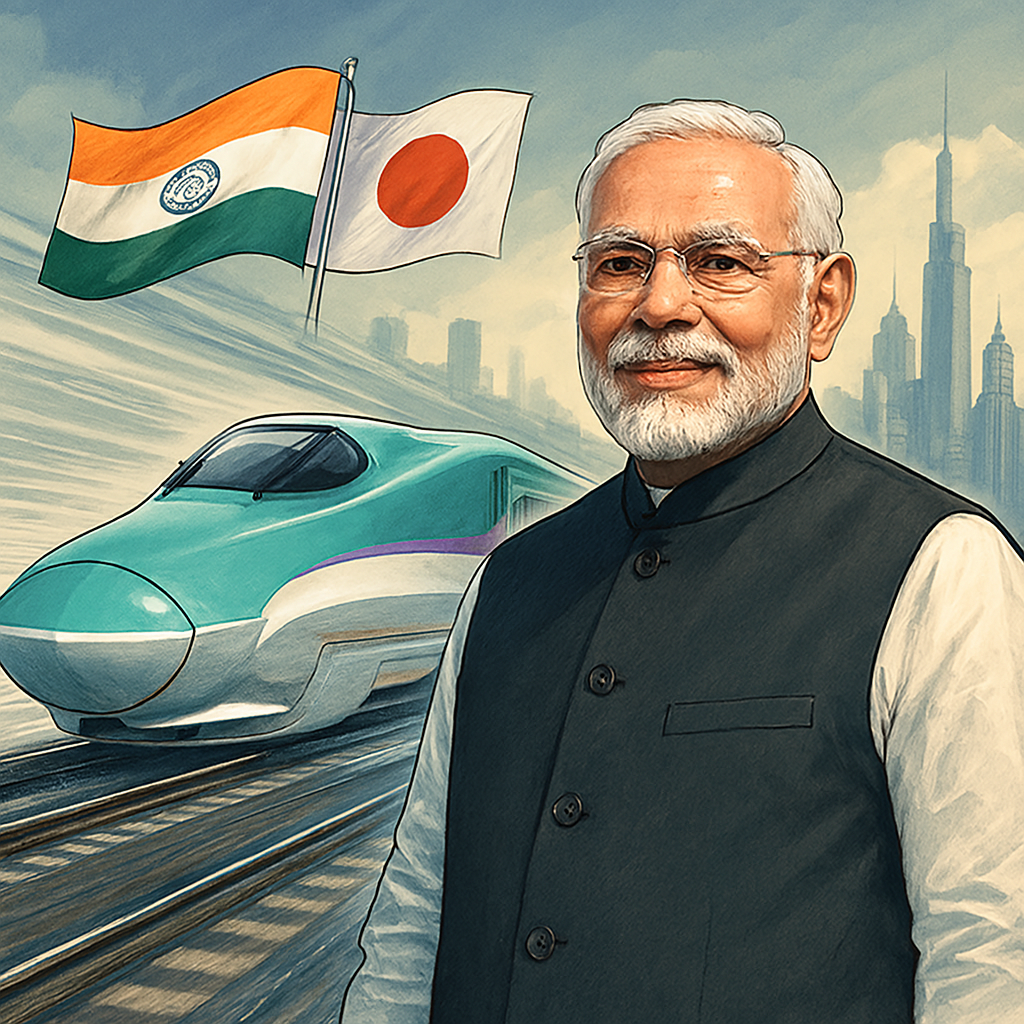
Prime Minister PM Modi’s vision for modern India includes the introduction of Japan’s advanced Shinkansen technology. The next phase of India’s rail revolution is set to transform connectivity with 320 kmph bullet trains.
Table of Contents
Introduction to India’s High-Speed Rail Development
India’s infrastructure landscape is undergoing a significant transformation with the development of high-speed rail corridors. The Mumbai-Ahmedabad High-Speed Rail (MAHSR) project represents the country’s first bullet train initiative, incorporating Japanese Shinkansen technology. This comprehensive analysis examines the project’s current status, technological specifications, economic implications, and future expansion plans based on verified information and official sources.
The high-speed rail corridor aims to reduce travel time between Mumbai and Ahmedabad from approximately seven hours to around two hours. The project involves collaboration between Indian and Japanese authorities, with technical expertise and financial support provided through bilateral agreements. This article presents factual information about the project’s development, engineering specifications, and expected impact on regional connectivity.
Project Background and Development Timeline
Origins of the Mumbai-Ahmedabad High-Speed Rail Project
The MAHSR project was formally initiated following diplomatic engagements between India and Japan in 2015. The foundation stone laying ceremony took place in Ahmedabad on September 14, 2017, attended by representatives from both nations. This event marked the official commencement of construction activities for India’s first bullet train corridor.
The project emerged from discussions about infrastructure modernization and technology transfer between the two countries. Japan’s experience with Shinkansen operations spanning several decades provided the technical foundation for India’s high-speed rail development. The collaboration includes not only train supply but also comprehensive knowledge transfer in areas such as railway operations, maintenance protocols, and safety management systems.
Financial Structure and International Cooperation
The project is financed through a loan of ₹88,087 crore (approximately $12 billion USD) from Japan. The loan terms include an interest rate of 0.1% per annum with a repayment period of 50 years. A 15-year moratorium on repayment allows for revenue generation before loan servicing begins.
This financial arrangement reflects the strategic nature of Indo-Japanese cooperation in infrastructure development. The concessional terms reduce the immediate fiscal burden while enabling access to advanced technology. The funding mechanism demonstrates how international partnerships can facilitate large-scale infrastructure projects in developing economies.
Technical Specifications and Train Technology
Shinkansen Technology Adaptation for Indian Conditions
The MAHSR project utilizes Shinkansen technology, specifically variants of the E5 series trains adapted for Indian operational requirements. References to E10 series trains indicate next-generation high-speed trainsets being developed for deployment. These trains are designed for maximum speeds of 320 kilometers per hour, with operational speeds expected to range between 300-310 kilometers per hour during commercial service.
The technology transfer includes various systems beyond the trains themselves. Track infrastructure, signaling systems, power supply networks, and maintenance facilities are being developed according to Japanese specifications. Indian engineers receive training in Japan to ensure proper operation and maintenance of the high-speed rail system after commissioning.
Engineering Features and Safety Systems
Shinkansen trains incorporate multiple safety features developed over decades of operational experience. Automatic train control systems monitor speed and apply brakes if operational parameters are exceeded. Earthquake detection systems can automatically halt trains when seismic activity is detected. Weather monitoring systems adjust operations during adverse conditions to maintain safety standards.
The trains feature aerodynamic designs that reduce air resistance and minimize noise during high-speed operation. Regenerative braking systems recover energy during deceleration, improving overall energy efficiency. Passenger compartments include climate control systems, ergonomic seating, and connectivity features adapted for tropical weather conditions prevalent in the project corridor.
Route Configuration and Infrastructure Development
Corridor Alignment and Station Locations
The Mumbai-Ahmedabad corridor spans approximately 508 kilometers across Maharashtra and Gujarat states. The route includes 12 stations at major urban centers along the alignment. Key stations include Mumbai (Bandra Kurla Complex), Thane, Virar, Boisar, Vapi, Bilimora, Surat, Bharuch, Vadodara, Anand, Ahmedabad, and Sabarmati.
Station locations were selected based on urban population density, existing transportation networks, and regional connectivity requirements. Each station requires supporting infrastructure including access roads, parking facilities, and integration with local transit systems. Land acquisition for stations and the rail corridor has been a significant component of project implementation.
Construction Methodology and Progress
The corridor primarily consists of elevated viaduct structures to minimize land acquisition requirements and maintain operational efficiency. As of construction updates available through mid-2025, over 300 kilometers of viaduct structures have been completed. Construction techniques include the Full Span Launching Method and Span-by-Span construction for different sections based on terrain and engineering requirements.
Bridge construction across rivers and natural obstacles represents a critical component of the infrastructure. According to project reports, 14 river bridges, 7 steel bridges, and 5 prestressed concrete bridges have been completed. A significant milestone was achieved with the launching of a 40-meter full-span box girder near Surat, demonstrating the application of advanced construction engineering methods.
Current Project Status and Revised Timelines
Completion Schedules for Different Sections
The project has experienced timeline adjustments since its initial announcement. Current schedules indicate that the first operational section will be the 50-kilometer stretch between Bilimora and Surat, targeted for completion by August 2026. This section will serve as a testing and demonstration segment before full corridor operations begin.
Partial operations in Gujarat are expected to commence in 2028, allowing passengers to experience high-speed rail services on completed sections. Full connectivity extending to Mumbai is anticipated by 2029-2030, though these dates remain subject to construction progress and regulatory approvals. The phased approach allows for operational experience to be gained while construction continues on remaining sections.
Factors Affecting Implementation Timeline
Several factors have influenced the project timeline. Land acquisition processes, particularly in densely populated urban areas, have required extensive negotiations and legal procedures. Environmental clearances and compliance with regulatory requirements added to the development period. Technical challenges in adapting Japanese specifications to Indian conditions also contributed to timeline extensions.
The COVID-19 pandemic disrupted construction activities during 2020-2021, causing delays in material supply and workforce availability. However, construction momentum has recovered since 2022, with accelerated progress visible in viaduct completion and station development. Project authorities have emphasized maintaining quality standards rather than rushing completion to meet arbitrary deadlines.
Economic Impact Assessment
Direct Economic Benefits and Business Connectivity
Travel time reduction from approximately seven hours to two hours between Mumbai and Ahmedabad represents a significant connectivity improvement. This enables same-day business travel between India’s financial capital and Gujarat’s commercial centers. Enhanced connectivity is expected to strengthen economic integration between the two regions.
The construction phase generates direct employment in engineering, construction, and project management sectors. Thousands of workers have been engaged in civil construction, electrical installations, and specialized technical work. Beyond direct construction employment, allied industries supplying materials, equipment, and services experience increased business activity.
Regional Development and Urban Growth
Cities along the corridor are experiencing infrastructure development in anticipation of bullet train operations. Real estate markets around proposed station locations show increased activity as investors anticipate future connectivity benefits. Commercial development is accelerating in areas with good access to planned stations.
Surat, Vadodara, Bharuch, and Anand represent medium-sized cities that could experience significant growth due to improved connectivity with major metropolitan centers. Industrial enterprises may locate facilities along the corridor to benefit from reduced transportation time for personnel and goods. The tourism sector in Gujarat may also benefit from easier access for visitors from Mumbai.
Comparative Analysis with Global High-Speed Rail Systems
Shinkansen Operational Record in Japan
Japan’s Shinkansen system has operated since 1964 without passenger fatalities due to train accidents. This safety record is attributed to comprehensive safety systems, rigorous maintenance protocols, and conservative operational practices. Average delays across the Shinkansen network are measured in seconds, with system-wide punctuality exceeding 99% according to Japanese railway statistics.
The Tokaido Shinkansen, connecting Tokyo and Osaka, carries over 450,000 passengers daily, demonstrating the capacity of high-speed rail to handle dense traffic volumes. Annual ridership across all Shinkansen lines exceeds 350 million passengers. These operational statistics provide benchmarks for India’s high-speed rail aspirations.
High-Speed Rail Systems in Other Countries
China has developed the world’s largest high-speed rail network, exceeding 40,000 kilometers of track as of 2024. Chinese high-speed trains operate at speeds up to 350 kilometers per hour on certain routes, carrying over 2 billion passengers annually. The extensive Chinese network demonstrates the scalability of high-speed rail technology for large countries with substantial populations.
European countries operate high-speed rail services including France’s TGV, Germany’s ICE, and Spain’s AVE systems. These systems have successfully integrated high-speed rail with conventional rail networks, providing seamless connectivity across regions. European experience shows how high-speed rail can reduce domestic aviation traffic on medium-distance routes.
Environmental Considerations and Sustainability
Carbon Emissions Comparison with Alternative Transportation
High-speed rail produces lower carbon emissions per passenger-kilometer compared to aviation and private vehicle travel. Electric trains powered by grid electricity can utilize renewable energy sources as the power generation mix evolves. The elevated corridor design minimizes land use compared to highway expansion alternatives.
However, the construction phase involves significant cement and steel production, which carries substantial embodied carbon costs. Environmental impact assessments must consider lifecycle emissions including construction, operations, and eventual infrastructure recycling. The net environmental benefit depends on ridership levels and the displacement of higher-emission transportation modes.
Noise Pollution and Wildlife Impact
High-speed trains generate noise during passage, though modern designs incorporate sound-dampening features. Elevated structures may affect bird migration patterns and local wildlife movement. Environmental mitigation measures include sound barriers at sensitive locations and wildlife crossing provisions where the corridor intersects natural habitats.
The project’s environmental clearance process included assessments of impact on local ecosystems. Monitoring programs during construction and operations track actual environmental effects compared to predicted impacts. Adaptive management approaches allow for adjustments to mitigation measures based on observed conditions.
Future Expansion Plans and National Network Vision
Proposed High-Speed Rail Corridors
Beyond the Mumbai-Ahmedabad corridor, several additional high-speed rail routes have been proposed for feasibility studies and potential development. The Delhi-Varanasi corridor would connect India’s capital with a major cultural and religious center. A Delhi-Ahmedabad extension would create north-south high-speed connectivity across western India.
The Mumbai-Nagpur corridor would improve connectivity within Maharashtra state. Proposals for routes connecting Delhi, Bengaluru, and Chennai would create a high-speed network serving India’s three largest metropolitan regions outside Mumbai. A Mumbai-Hyderabad route would link western and southern India’s major cities.
Technology Localization and Manufacturing Development
The “Make in India” initiative aims to progressively increase domestic content in high-speed rail projects. Initial trains will be imported from Japan, but subsequent orders may involve greater domestic manufacturing participation. Technology transfer agreements include provisions for local production of components and systems.
Developing domestic manufacturing capabilities requires significant investment in specialized facilities and workforce training. The long-term vision includes establishing India as a potential exporter of high-speed rail technology to other developing countries. However, achieving this requires sustained investment and knowledge accumulation over multiple project cycles.
Challenges and Implementation Issues
Land Acquisition Complexities
Acquiring land for the 508-kilometer corridor involves negotiations with thousands of landowners across two states. Urban areas present particular challenges due to high property values and existing development. Legal frameworks for land acquisition must balance project requirements with property owner rights.
Compensation mechanisms, rehabilitation provisions, and alternative accommodation arrangements are critical components of land acquisition processes. Delays in finalizing land acquisition have contributed to overall project timeline extensions. Streamlined procedures and fair compensation are essential for future high-speed rail projects.
Technical Adaptation and Regulatory Framework
Adapting Japanese Shinkansen technology to Indian conditions requires modifications to account for different climate zones, geological conditions, and operational requirements. India’s railway regulatory framework needed updates to accommodate high-speed rail operations distinct from conventional railway regulations.
Training programs for operations and maintenance personnel must be comprehensive to ensure safety standards are maintained. Establishing specialized maintenance facilities with required tools and diagnostic equipment represents a significant investment. The regulatory framework must evolve to incorporate international best practices while addressing India-specific conditions.
Financial Viability and Revenue Projections
Ticket Pricing Considerations
While official ticket pricing has not been announced, preliminary estimates suggest fares will be competitive with premium air travel between Mumbai and Ahmedabad. The two-hour journey time positions the bullet train as an alternative to one-hour flights when considering airport access time and security procedures.
Revenue projections depend on anticipated ridership levels, which in turn depend on ticket pricing, frequency of service, and competition from aviation and road transport. International experience shows that high-speed rail attracts ridership when journey times are under three hours, making it competitive with aviation for city-center to city-center travel.
Operational Cost Recovery
Operating costs include electricity for train operations, maintenance of rolling stock and infrastructure, staff salaries, and system administration. Revenue must cover operational costs and contribute to loan repayment and eventual infrastructure renewal. The 15-year moratorium on loan repayment provides time to establish operational patterns and optimize revenue generation.
International high-speed rail experience shows varying degrees of profitability. Japan’s Tokaido Shinkansen is profitable, while some Chinese and European routes require operational subsidies. Financial viability depends on achieving sufficient ridership density along the corridor, which is more likely in densely populated regions with substantial business and tourism traffic.
Social Impact and Accessibility
Changes in Travel Patterns and Mobility
High-speed rail could alter travel patterns between Mumbai and Ahmedabad, enabling daily commutes over distances previously requiring overnight stays. Business travelers may shift from aviation to rail due to city-center connectivity and more predictable travel times. Tourism patterns may change as weekend trips become more feasible.
However, accessibility depends on station locations and integration with local transportation networks. Stations located in peripheral areas may require additional travel time, reducing the overall time advantage. Effective feeder services using local transit modes are essential to maximize the bullet train’s utility.
Employment Generation and Skill Development
Beyond construction employment, the operational phase requires trained personnel for train operations, station management, maintenance activities, and customer service. Specialized training programs have been established to develop required skills. Career opportunities in high-speed rail operations may attract talent from conventional railway operations and other sectors.
The project also stimulates demand for skills in allied sectors such as hospitality, retail, and property management around stations. Educational institutions may develop specialized programs related to high-speed rail technology and operations. The long-term employment impact depends on the extent of network expansion beyond the initial corridor.
Comparative Ticket Pricing Analysis
International High-Speed Rail Fare Structures
To provide context for potential Indian bullet train fares, examining international pricing structures offers useful comparisons. Japan’s Shinkansen Tokyo-Osaka unreserved seat costs approximately ¥13,620 (around ₹8,000), while reserved seats start from ¥14,450 (approximately ₹8,500) for the 515-kilometer journey taking 2.5 hours. This translates to roughly ₹15-16 per kilometer.
China’s high-speed rail system, serving a comparable economic demographic to India, prices the Shanghai-Beijing 1,318-kilometer journey at ¥553-933 (approximately ₹6,800-11,500) for second-class seats, equating to ₹5-9 per kilometer. European high-speed rail tends toward higher pricing, with France’s Paris-Lyon TGV covering 391 kilometers in two hours for €35-135 (₹3,200-12,400), depending on booking time and flexibility.
Projected Fare Structure for Indian Context
Given the Mumbai-Ahmedabad distance of 508 kilometers and considering India’s economic context, fare estimates suggest pricing between ₹3,000-5,000 for standard seating may be necessary to achieve both affordability and cost recovery objectives. This would position bullet train fares above current first-class AC rail fares (approximately ₹1,000-1,500) but below or comparable to discounted airline tickets (typically ₹3,500-7,000).
Premium seating categories may command higher fares of ₹6,000-8,000, targeting business travelers prioritizing comfort and onboard amenities. Dynamic pricing strategies, common in aviation, could optimize revenue by adjusting fares based on demand, booking timing, and seat availability. Early-bird discounts and off-peak reductions may help build ridership during initial operational phases.
Technological Innovation and Knowledge Transfer
Advanced Systems Integration
The MAHSR project incorporates sophisticated technological systems beyond the trains themselves. The Automatic Train Control (ATC) system manages train movements, maintaining safe distances between trains and regulating speeds according to track conditions. The Communications-Based Train Control (CBTC) system enables real-time communication between trains and control centers.
Power supply infrastructure includes overhead catenary systems delivering 25kV AC electricity to trains. Substations along the route convert grid power to appropriate voltages and frequencies. Redundancy in power systems ensures continued operations during localized power failures. The sophisticated electrical infrastructure represents a significant technological upgrade from conventional railway electrification.
Training and Capacity Building Initiatives
Indian engineers and technicians undergo specialized training programs in Japan to understand Shinkansen operations, maintenance procedures, and safety protocols. These programs combine classroom instruction with hands-on experience at operational Shinkansen facilities. The knowledge transfer extends beyond technical skills to include organizational practices and safety culture.
Domestic training facilities are being established to provide ongoing skill development for operations personnel. Simulation centers allow train operators to practice emergency procedures and normal operations in controlled environments. Maintenance training includes instruction on specialized diagnostic equipment and preventive maintenance schedules critical for high-speed rail safety.
Regional Cooperation and Diplomatic Dimensions
Indo-Japanese Strategic Partnership
The bullet train project represents a visible element of broader Indo-Japanese strategic cooperation spanning defense, technology, and economic domains. High-level political engagement, including summit meetings between national leaders, provides momentum for project implementation. The collaboration demonstrates how infrastructure projects can strengthen bilateral relationships beyond immediate economic considerations.
Japanese private sector involvement through companies like Hitachi, Kawasaki Heavy Industries, and JR East contributes technical expertise and manufacturing capabilities. These companies gain experience in adapting Shinkansen technology for markets beyond Japan. For India, the partnership provides access to proven technology while demonstrating the country’s ability to execute complex international collaborations.
Regional Connectivity Implications
While the current project connects cities within India, future expansion possibilities include international high-speed rail connections. Theoretical routes connecting India with neighboring countries would require resolution of various technical, regulatory, and political issues. High-speed rail networks in Asia could eventually enable land-based travel between major economic centers across the continent.
Regional economic integration through improved physical connectivity represents a long-term objective for many Asian countries. Infrastructure corridors combining rail, road, and digital connectivity can facilitate trade and people-to-people exchanges. India’s experience with the MAHSR project provides lessons applicable to potential regional connectivity initiatives.
Maintenance Infrastructure and Long-term Sustainability
Specialized Maintenance Facilities
High-speed rail requires dedicated maintenance infrastructure distinct from conventional railway workshops. The MAHSR project includes establishment of specialized depots equipped for train inspection, component replacement, and heavy maintenance activities. These facilities require specialized tools, diagnostic equipment, and controlled environments for precision work.
Preventive maintenance schedules for high-speed trains are more intensive than conventional rolling stock, with daily inspections and scheduled overhauls at regular kilometer intervals. Track maintenance must meet stringent standards for alignment and surface quality, as minor deviations can cause discomfort or safety issues at high speeds. Specialized track inspection vehicles monitor infrastructure condition continuously.
Component Supply Chains and Lifecycle Management
Ensuring availability of spare parts and components is critical for maintaining service reliability. Initial dependence on Japanese suppliers for specialized components necessitates robust supply chain management. Progressive localization of component manufacturing can reduce dependence on imports while building domestic industrial capabilities.
Rolling stock and infrastructure have finite operational lifespans requiring eventual replacement or major refurbishment. Financial planning must account for lifecycle costs including mid-life overhauls and eventual asset replacement. International experience shows that high-speed rail infrastructure typically requires major renewal investments after 30-40 years of operation.
Public Perception and Stakeholder Engagement
Community Response to Project Development
Local communities along the corridor have shown mixed responses to project development. Some welcome improved connectivity and economic opportunities, while others have concerns about land acquisition impacts, noise effects, and changes to local environments. Stakeholder consultation processes aim to address concerns and incorporate community feedback into project implementation.
Property owners displaced by the corridor require fair compensation and, in some cases, rehabilitation support. Transparent processes for land valuation and grievance redressal are essential for maintaining social license for the project. Communication strategies explaining project benefits and addressing concerns help build public support.
Media Coverage and Public Discourse
The bullet train project receives significant media attention, with coverage ranging from progress updates to critical analyses of costs, timelines, and priorities. Public discourse includes debates about resource allocation, with some questioning whether high-speed rail represents the most effective use of infrastructure investment given competing needs in conventional railway upgrades, road development, and other sectors.
Proponents emphasize economic benefits, technology demonstration effects, and alignment with aspirations for modern infrastructure. Critics point to cost overruns, timeline delays, and questions about ridership projections. Balanced public discourse requires accurate information about project status, costs, and expected outcomes based on international experience.
Lessons from International High-Speed Rail Projects
Successful Implementation Examples
Japan’s Shinkansen, operational since 1964, demonstrates the long-term viability of high-speed rail when properly planned and executed. The system has expanded to multiple corridors across Japan, carrying billions of passengers over six decades. Key success factors include substantial initial investment, rigorous safety standards, and integration with urban development planning.
France’s TGV network, launched in 1981, shows how high-speed rail can compete effectively with aviation and private vehicles on medium-distance routes. The hub-and-spoke network centered on Paris has stimulated regional development while reducing road and air traffic. Spain’s rapid AVE network expansion demonstrates that high-speed rail can be successfully deployed across diverse geographic conditions.
Cautionary Cases and Challenges
Some international high-speed rail projects have faced financial difficulties due to overestimated ridership projections or underestimated construction costs. California’s high-speed rail project has experienced substantial cost escalation and timeline extensions, partly due to complex regulatory environments and construction challenges in developed areas.
China’s extensive network includes some routes with insufficient ridership density to cover operational costs, requiring government subsidies. These cases highlight the importance of realistic feasibility studies, careful route selection prioritizing high-density corridors, and transparent assessment of financial viability. Learning from both successes and challenges in other countries can improve outcomes for India’s high-speed rail development.
Integration with Existing Transportation Networks
Multimodal Connectivity Planning
Maximizing bullet train utility requires seamless integration with existing transportation modes. Station design must facilitate easy transfers between high-speed trains, conventional trains, metro systems, buses, and personal vehicles. Coordinated schedules and integrated ticketing systems reduce travel friction and enhance overall journey experience.
Mumbai and Ahmedabad metro systems are expanding, creating opportunities for integrated planning. Dedicated shuttle services, improved road access, and adequate parking facilities at stations support multimodal connectivity. Luggage handling facilities and station amenities influence passenger experience and system competitiveness with alternative transportation modes.
Impact on Aviation and Road Transport
High-speed rail typically competes most effectively with aviation on routes where rail journey times are under three to four hours. The Mumbai-Ahmedabad route, with a projected two-hour bullet train journey versus one-hour flight, falls within this competitive range when accounting for airport access times and security procedures.
Airlines may adjust pricing and schedules in response to bullet train operations, potentially reducing frequencies or shifting capacity to longer routes where rail competition is less significant. The National Highway network connecting Mumbai and Ahmedabad may experience reduced car and bus traffic as travelers opt for faster rail service. However, local and regional road traffic serving intermediate destinations would continue independently of bullet train operations.
Climate Resilience and Disaster Management
Weather Adaptation Measures
High-speed rail operations must account for monsoon conditions, cyclones, and extreme temperatures prevalent in the Mumbai-Ahmedabad corridor. Infrastructure design includes drainage systems managing heavy rainfall, wind barriers at exposed locations, and materials capable of withstanding tropical climate conditions.
Operational protocols may require speed reductions or service suspensions during severe weather events. Weather monitoring systems provide advance warnings allowing trains to reduce speed or seek shelter before hazardous conditions develop. Balancing safety with service reliability requires sophisticated meteorological integration into railway operations management.
Earthquake Preparedness and Structural Design
While the Mumbai-Ahmedabad corridor is not in a high-seismic zone, earthquake preparedness remains important given India’s diverse geological conditions. Structural designs incorporate seismic resilience features, including flexible connections between structural elements and base isolation systems for critical structures.
Early warning systems can detect earthquake tremors and automatically reduce train speeds or apply emergency brakes before significant ground motion occurs. Regular structural inspections and stress testing ensure infrastructure maintains integrity over time. These systems reflect Japanese expertise in operating high-speed rail in seismically active regions.
Digital Infrastructure and Smart Systems
Passenger Information and Ticketing Systems
Modern high-speed rail operations depend on sophisticated digital systems for ticket sales, passenger information, and customer service. Online and mobile booking platforms allow convenient ticket purchase with seat selection and payment integration. Real-time information displays at stations and onboard provide schedule updates, connection information, and service announcements.
Integration with digital payment systems popular in India, including UPI and digital wallets, enhances accessibility. Multi-language support accommodates diverse passenger demographics. Data analytics from ticketing systems inform operational decisions about service frequencies, pricing strategies, and capacity planning.
Operational Management Technology
Control centers manage train movements across the corridor using integrated command and control systems. Real-time monitoring of train locations, speeds, and system status enables responsive management of operations. Automated systems handle routine decisions while operators manage exceptions and emergencies.
Maintenance management systems track component conditions, schedule preventive maintenance, and manage spare parts inventory. Predictive maintenance approaches use sensor data to identify potential failures before they occur, reducing unexpected breakdowns. Digital systems enable the operational efficiency and reliability expected of modern high-speed rail services.
Economic Multiplier Effects and Induced Development
Property Value Changes Along the Corridor
International experience shows that property values typically increase near high-speed rail stations due to improved accessibility. Commercial properties benefit from increased foot traffic and business activity. Residential properties gain value from reduced commute times to major employment centers.
However, property value impacts vary by location, with greatest effects at well-integrated stations in urban centers. Peripheral stations with poor local connectivity may experience more modest impacts. Properties affected by construction noise, visual impacts, or land acquisition may experience negative effects, at least temporarily.
Tourism and Hospitality Sector Growth
Reduced travel times and improved connectivity can stimulate tourism growth in destinations along the corridor. Gujarat’s cultural and religious sites may attract more visitors from Mumbai when accessible via convenient high-speed rail. Weekend tourism becomes more attractive when travel times are minimized.
Hotels, restaurants, and tourism services may expand capacity in anticipation of increased visitor numbers. However, the same connectivity that brings tourists to Gujarat also enables Mumbai-based travelers to make day trips, potentially reducing hotel stays. The net impact on hospitality sectors depends on balancing increased visitor volumes against changed stay patterns.
Author Information
About the Author: Nueplanet
Nueplanet is a dedicated infrastructure and transportation analyst focusing on emerging developments in India’s connectivity landscape. With a commitment to providing accurate, well-researched content based on official sources and verified information, Nueplanet aims to inform readers about significant infrastructure projects shaping India’s future.
The analyses presented prioritize factual accuracy over sensationalism, drawing from government publications, official project documents, and authoritative industry sources. Nueplanet believes informed public discourse about infrastructure development requires transparent, evidence-based reporting that acknowledges both opportunities and challenges.
For updates on India’s infrastructure projects and transportation developments, readers can follow ongoing coverage that maintains the same commitment to accuracy and balanced analysis demonstrated in this article.
Frequently Asked Questions (FAQs)
When will India’s bullet train start operating?
The first operational section of the Mumbai-Ahmedabad bullet train, covering 50 kilometers between Bilimora and Surat, is targeted for completion by August 2026. Limited passenger services in Gujarat are expected to begin in 2028, with full Mumbai connectivity anticipated by 2029-2030, subject to construction progress and regulatory approvals.
How fast will Indian bullet trains travel?
The trains being deployed on the Mumbai-Ahmedabad corridor are designed for maximum speeds of 320 kilometers per hour. Commercial operating speeds are expected to be 300-310 kilometers per hour, balancing speed with safety and energy efficiency. The actual operating speed may vary based on specific track sections and operational requirements.
What is the total cost of the Mumbai-Ahmedabad bullet train project?
The project is financed through a loan of ₹88,087 crore (approximately $12 billion USD) from Japan at a 0.1% annual interest rate. The repayment period spans 50 years with a 15-year moratorium before repayments begin. This concessional financing structure significantly reduces the immediate fiscal burden on India’s budget.
How much time will the bullet train save between Mumbai and Ahmedabad?
Current travel options between Mumbai and Ahmedabad take approximately 6-8 hours by conventional train or road. The bullet train will reduce this to approximately 2 hours for the 508-kilometer journey. When accounting for station access times, this represents a significant time saving for business and leisure travelers compared to existing alternatives.
Which technology is being used for India’s bullet train?
The project utilizes Japanese Shinkansen technology, specifically adapted variants of proven high-speed train systems. The technology transfer includes not only train supply but also expertise in track infrastructure, signaling systems, maintenance protocols, and safety management. Indian engineers receive training in Japan to ensure proper operations and maintenance.
How many stations will be on the Mumbai-Ahmedabad bullet train route?
The corridor includes 12 stations: Mumbai (Bandra Kurla Complex), Thane, Virar, Boisar, Vapi, Bilimora, Surat, Bharuch, Vadodara, Anand, Ahmedabad, and Sabarmati. Station locations were selected based on urban population centers, existing transportation networks, and regional connectivity requirements along the Maharashtra-Gujarat corridor.
What safety features are included in the bullet train system?
The system incorporates comprehensive safety features including automatic train control systems, earthquake detection with automatic emergency stops, weather monitoring with adaptive operations, advanced braking systems, and rigorous maintenance protocols. The design is based on Shinkansen safety standards, which have achieved zero passenger fatalities due to accidents over decades of operation.
Will there be more bullet train corridors in India?
Several additional high-speed rail corridors have been proposed for feasibility studies, including Delhi-Varanasi, Delhi-Ahmedabad, Mumbai-Nagpur, and routes connecting major metropolitan centers like Bengaluru and Chennai. However, implementation depends on completion of the Mumbai-Ahmedabad corridor, lessons learned from the first project, and available financing for future expansion.
Conclusion and Key Takeaways
India’s Mumbai-Ahmedabad High-Speed Rail project represents a significant infrastructure development initiative with implications for transportation connectivity, economic integration, and technology advancement. The project’s implementation involves complex engineering, substantial financial investment, and extensive coordination between Indian and Japanese partners.
Key aspects include the adaptation of proven Shinkansen technology to Indian conditions, phased construction with the first operational section targeted for 2026, and projected full completion by 2029-2030. The financial structure through concessional Japanese lending reduces immediate fiscal burden while enabling access to advanced technology.
Expected benefits include substantial travel time reduction between major economic centers, employment generation during construction and operations, potential regional development along the corridor, and demonstration of India’s capability to execute complex infrastructure projects. Challenges encompass land acquisition complexities, technical adaptation requirements, and questions about long-term financial viability dependent on achieving sufficient ridership.
The project’s success will influence future high-speed rail development in India and potentially other developing countries considering similar infrastructure investments. Realistic assessment requires acknowledging both opportunities and challenges based on international experience, while monitoring actual outcomes as the project progresses toward operational status.
Published: August 29, 2025
Last Updated: August 29, 2025
Author: Nueplanet – Infrastructure and Transportation Analysis
This article is based on publicly available information from official government sources, project authorities, and verified news reports. Readers are encouraged to consult official project websites and government publications for the most current information about the Mumbai-Ahmedabad High-Speed Rail project.
Helpful Resources
Latest Posts
- Anlon Healthcare IPO GMP: Day-3 Subscription Trends and Investor Outlook
- HDFC Share Price: Impact of Bonus Share Adjustment on Market Trends
- Reliance AGM 2025: Key Announcements and Impact on RIL Share Price
- Realme 15000 mAh Battery Phone: Redefining Smartphone Endurance
- USD INR: Rupee Hits Record Low of 87.97 Amid Tariff Concerns
Tag
PM Modi
Related Posts












Post Comment