









PGEL Share Price: Q1 Results Trigger Target Cut and Downgrade
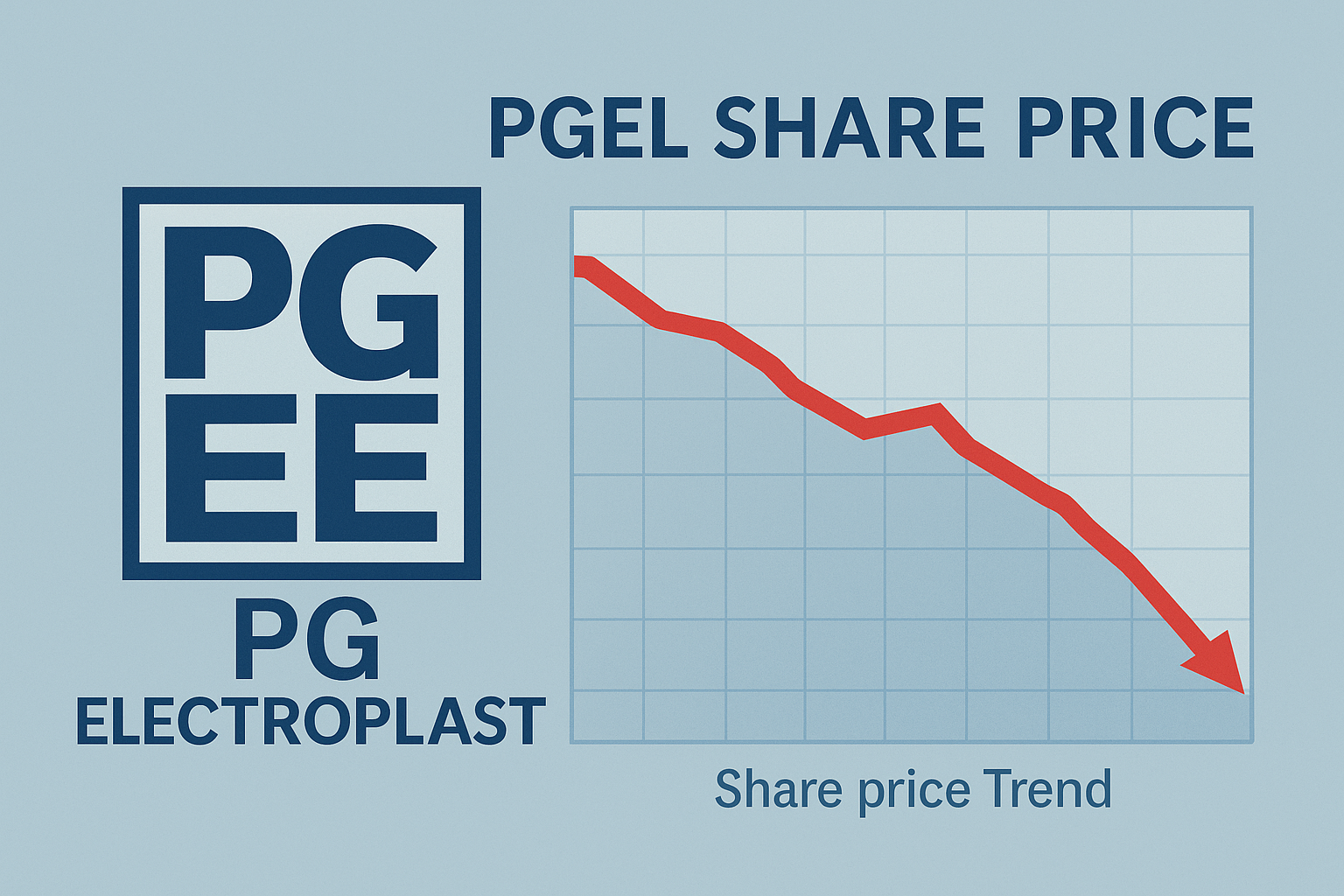
PGEL share price faces downward pressure after Q1 results, with analysts cutting targets due to reduced guidance, inventory adjustments, and lower capex plans. Here’s an in-depth market analysis.
Table of Contents
Introduction: Market Reaction to Mixed Financial Performance
PG Electroplast Ltd (PGEL), a prominent player in India’s electronics manufacturing services sector, experienced notable stock volatility in August 2025 following its first-quarter financial results for fiscal year 2026. The company’s shares declined despite posting double-digit revenue growth, primarily due to margin compression that raised concerns among market participants.
As of September 15, 2025, PGEL shares traded at Rs 571.70 on the National Stock Exchange, reflecting investor reassessment of near-term earnings potential. The stock closed at Rs 541.35 with a tight intraday range between Rs 540 and Rs 548, indicating consolidation after the post-results decline. Trading volume reached 9.58 lakh shares on September 22, 2025, demonstrating sustained market interest in the counter.
This analysis examines the company’s quarterly performance, analyst responses, operational challenges, and long-term positioning within India’s expanding manufacturing ecosystem. The report draws on official company filings, brokerage research, and publicly available financial data.
Q1 FY26 Financial Results: Revenue Growth Meets Profit Decline
Quarterly Revenue Performance
PG Electroplast reported consolidated revenue from operations of Rs 1,503.85 crore for the quarter ended June 30, 2025. This represented year-on-year growth of 13.86% compared to the corresponding period in fiscal year 2025. The revenue expansion demonstrates the company’s ability to capture incremental market share and secure additional business from existing clients.
The double-digit topline growth occurred despite broader headwinds in consumer durables demand. Industry data indicates selective weakness in certain appliance categories during the April-June 2025 quarter, making PGEL’s revenue performance relatively resilient under challenging market conditions.
Profitability Metrics and Margin Analysis
Net profit for Q1 FY26 stood at Rs 66.71 crore, while profit before tax declined 16.26% to Rs 84.68 crore from Rs 101.13 crore in the year-ago quarter. The divergence between revenue growth and profit contraction highlights margin compression across the company’s operations.
Several factors contributed to reduced profitability. Raw material cost inflation affected input expenses, while operational inefficiencies including inventory management challenges impacted overall margins. Additionally, elevated interest costs associated with borrowings weighed on bottom-line performance during the quarter.
The company’s operating metrics suggest temporary efficiency issues rather than structural competitive disadvantages. Management initiatives to optimize production processes and working capital deployment aim to restore historical margin levels over subsequent quarters.
Working Capital and Inventory Considerations
Inventory levels increased during the quarter, indicating either demand-supply mismatches or precautionary stocking ahead of anticipated order fulfillment. Higher inventory carrying costs contributed to margin pressure and affected cash flow generation.
Working capital optimization has become a priority management focus area. Improved demand forecasting, production scheduling efficiency, and supplier payment terms management can reduce the capital tied up in inventory and lower associated financing costs.
Analyst Revisions: Target Price Cuts and Earnings Estimate Adjustments
Brokerage Response to Q1 Results
Multiple research firms revised their financial models and price targets following the quarterly announcement. Nirmal Bang adjusted its target price to Rs 700, maintaining coverage while acknowledging near-term profitability challenges.
Nuvama significantly reduced earnings estimates for fiscal years 2026, 2027, and 2028 by 10-36% across different periods. The revisions incorporated lower assumptions for room air conditioner business growth and reduced margin expectations, while factoring higher interest expenses for FY26.
Another major brokerage lowered its target price to Rs 710 from Rs 1,100, representing approximately 35% reduction. This substantial revision reflected recalibrated expectations regarding profitability trajectory and operational efficiency improvements.
Consensus Estimates and Forward Projections
Based on consolidated coverage from seven analysts, the consensus target price for PGEL stands at Rs 739. Revenue growth forecasts project 17.1% expansion for fiscal year 2026, while profit growth estimates indicate a marginal 0.8% decline.
The revenue growth projection of 17.1% suggests continued optimism about market share gains and client relationship expansion. Analysts appear confident in PGEL’s ability to secure incremental business despite competitive pressures in the electronics manufacturing services sector.
Earnings estimate reductions reflect conservative assumptions during the operational adjustment period. As efficiency initiatives take effect and margin pressures ease, profitability growth is expected to resume alignment with revenue expansion rates.
Company Overview: Business Model and Market Position
Core Manufacturing Capabilities
PG Electroplast operates as an electronics manufacturing services provider with integrated capabilities across multiple production processes. The company specializes in precision plastic molding using advanced injection molding technologies for consumer electronics components and appliance housings.
Printed circuit board assembly services form another core competency, encompassing surface mount technology, through-hole assembly, and multi-layer board manufacturing. These capabilities enable PGEL to serve clients requiring complex electronic assemblies with stringent quality standards.
The company provides both original equipment manufacturing and original design manufacturing solutions. This dual capability allows clients to outsource either production alone or integrated product development and manufacturing services.
Client Relationships and Service Portfolio
PGEL maintains established relationships with leading brands across consumer durables, electrical equipment, and industrial segments. The client portfolio includes Polycab, Havells, Schneider Electric, and Larsen & Toubro, representing prominent players in their respective categories.
These long-term partnerships provide revenue visibility and stability. Repeat business from existing clients demonstrates service quality and competitive pricing that meet customer expectations consistently over multiple years.
The diversified client base reduces revenue concentration risk. Exposure across different end-use segments provides natural hedging against cyclical downturns in specific product categories or market segments.
Competitive Advantages and Market Positioning
Several factors support PGEL’s competitive positioning within India’s electronics manufacturing services industry. Manufacturing scale enables economies in raw material procurement, equipment utilization, and fixed cost absorption.
Operational experience accumulated over decades creates institutional knowledge difficult for newer entrants to replicate quickly. This expertise translates into consistent quality delivery and production efficiency that supports customer retention.
Technical capabilities in specialized applications provide differentiation from competitors focused on commodity manufacturing services. The ability to handle complex assemblies and meet stringent specifications supports premium positioning with key accounts.
Financial Metrics: Market Capitalization and Performance Indicators
Current Financial Standing
As of the analysis date, PG Electroplast’s market capitalization stood at Rs 14,771 crore, representing a decline of 19.9% over the preceding twelve months. The market cap reduction reflects both company-specific challenges and broader market volatility affecting mid-cap manufacturing stocks.
Annual revenue reached Rs 5,053 crore while profit totaled Rs 271 crore based on the most recent fiscal year data. These figures demonstrate substantial operational scale and profitability maintenance despite recent quarterly challenges.
Promoter holding in the company stands at 43.7%, indicating significant insider ownership. The promoter stake decreased by 5.65% during the most recent quarter, though such adjustments may reflect estate planning, collateral requirements, or other non-operational factors.
Debt Profile and Interest Cost Analysis
Financial disclosures indicate the company’s cost of borrowing appears elevated relative to industry benchmarks. High interest expenses contributed to bottom-line pressure during Q1 FY26 and represent an area requiring management attention.
Debt refinancing or restructuring initiatives could reduce financing costs and improve profitability margins. As interest rate cycles evolve, opportunities may emerge to renegotiate borrowing terms or access lower-cost funding sources.
The interplay between debt levels, interest costs, and capital expenditure requirements necessitates careful financial management. Balancing growth investments with debt service capabilities remains crucial for sustainable long-term value creation.
Strategic Initiatives: Capital Expenditure and Capacity Expansion
Planned Investment Program
Management announced plans to invest Rs 700-750 crore in new manufacturing facilities over the coming period. This substantial capital commitment represents approximately 15% of current market capitalization and demonstrates confidence in long-term growth opportunities.
The investment program aims to expand production capacity, incorporate advanced manufacturing technologies, and potentially establish facilities in new geographic locations. Enhanced capabilities should enable PGEL to serve additional clients and penetrate new market segments.
Returns from these investments will require time to materialize. New facilities must achieve operational stability, ramp production to optimal utilization levels, and establish quality consistency before generating target profitability contributions.
Technology Upgradation and Process Modernization
Capital expenditures likely include allocation for modern equipment incorporating automation, digitalization, and Industry 4.0 concepts. Technology upgrades can improve manufacturing efficiency, reduce defect rates, and lower per-unit production costs.
Process modernization also addresses labor availability and cost inflation challenges. Automated solutions reduce dependency on manual labor for repetitive tasks while improving output consistency and quality control.
Investment in technology positions PGEL competitively as client requirements evolve toward higher complexity and tighter specifications. Maintaining technological parity with global manufacturing standards supports retention of multinational clients and attraction of new accounts.
Industry Context: Electronics Manufacturing Services Sector in India
Growth Drivers and Policy Support
India’s electronics manufacturing services sector benefits from favorable policy frameworks including Production Linked Incentive schemes. These programs provide financial incentives for domestic manufacturing and have attracted substantial investment across multiple electronics categories.
Global supply chain reconfiguration following recent disruptions has accelerated interest in India as a manufacturing destination. International brands seek geographic diversification away from concentrated production bases, creating opportunities for capable domestic manufacturers.
Rising domestic consumption of electronic products and appliances provides organic demand growth. India’s expanding middle class and increasing urbanization drive appliance penetration rates higher across product categories.
Competitive Landscape and Market Dynamics
The Indian EMS sector includes both established players and newer entrants attracted by growth prospects. Competition spans pure-play contract manufacturers, captive production units of brand owners, and diversified industrial conglomerates.
Competitive intensity varies across different electronic manufacturing segments. Consumer durables and appliance component manufacturing feature established relationships and high switching costs, providing incumbent advantages.
Price competition remains a factor as clients seek cost optimization. However, quality consistency, delivery reliability, and technical capability increasingly influence sourcing decisions beyond pure cost considerations.
Export Opportunities and Global Integration
India’s improving manufacturing reputation creates export opportunities for domestic EMS providers. International clients seeking alternatives to traditional manufacturing locations evaluate Indian suppliers for global supply chain integration.
Export business typically requires compliance with international quality standards and certifications. Companies investing in such capabilities can access larger addressable markets and diversify revenue sources geographically.
Foreign exchange considerations affect export economics. Rupee depreciation can improve export competitiveness while potentially increasing imported raw material costs for companies dependent on international component sourcing.
Risk Factors: Operational and Financial Challenges
Demand Volatility and Economic Sensitivity
Consumer durables demand exhibits cyclical patterns influenced by economic conditions, consumer sentiment, and seasonal factors. Electronic manufacturers face variable order flows requiring flexible capacity management.
Economic uncertainty affects discretionary spending on appliances and electronic products. Prolonged economic weakness could suppress demand below current forecasts, impacting revenue growth and capacity utilization rates.
Competitive intensity in end-user markets drives pricing pressure that original equipment manufacturers transmit to component suppliers. Manufacturing service providers must continuously improve efficiency to maintain margins amid client cost reduction expectations.
Raw Material Cost and Supply Chain Risks
Electronic component prices fluctuate based on global supply-demand dynamics. Shortages can drive spot prices significantly above contract levels, squeezing margins when output prices remain fixed.
Plastic resin prices, another key input category, exhibit volatility correlated with crude oil prices. Rapid input cost increases can compress margins if companies cannot immediately pass through cost escalations.
Supply chain disruptions can affect component availability and production schedules. Diversified sourcing and inventory buffers provide mitigation but increase working capital requirements and carrying costs.
Financial Management and Debt Service
Working capital intensity in manufacturing businesses creates ongoing funding requirements. Inefficient inventory management or extended customer payment terms can strain liquidity and increase financing costs.
Debt service obligations create fixed cash outflows that must be met regardless of operating performance. Adequate coverage ratios and liquidity buffers are essential for maintaining financial stability through business cycles.
Interest rate fluctuations affect borrowing costs for companies with floating-rate debt. Rising rate environments increase financing expenses and can materially impact profitability if operational margins remain under pressure.
Technical Analysis: Price Patterns and Trading Levels
Recent Price Action and Trading Ranges
Following the Q1 FY26 results announcement, PGEL shares experienced selling pressure that broke through previously established support levels. The stock declined from higher levels to the current trading range around Rs 540-570.
Intraday volatility remained contained with tight high-low ranges, suggesting limited near-term directional conviction among market participants. Consolidation within defined bands often precedes either breakout moves or continuation of established trends.
Trading volume patterns indicate active participation during results announcement periods followed by lower volumes during consolidation phases. Volume analysis provides insights into accumulation versus distribution patterns among different investor categories.
Support and Resistance Considerations
Technical analysts identify support levels around Rs 530-540 based on recent trading history and prior consolidation zones. These levels represent potential accumulation areas if investor sentiment stabilizes.
Resistance appears around Rs 570-580 where selling pressure previously emerged. Sustained trading above these levels would indicate improved market confidence and potentially trigger upward momentum toward higher price targets.
Moving average analysis shows the stock’s relationship to various timeframe averages. Crossovers and relative positioning provide signals regarding trend strength and potential reversal points for technical traders.
Long-Term Outlook: Analyst Projections and Growth Scenarios
Medium-Term Price Targets
Optimistic scenarios suggest potential for PGEL shares to reach Rs 1,317.96 by mid-2025, followed by further appreciation toward Rs 1,583.78. These projections assume successful execution of operational improvement initiatives and favorable market conditions.
For calendar year 2026, some analysts anticipate temporary volatility in early months followed by recovery to approximately Rs 2,079.55 by mid-year. Such projections imply substantial upside potential from current trading levels.
These targets reflect scenarios where margin recovery proceeds as anticipated, capacity investments generate expected returns, and demand conditions improve across key customer segments. Actual outcomes depend on successful execution and supportive macroeconomic conditions.
Revenue Growth and Profitability Trajectory
Consensus revenue growth estimates of 17.1% for FY26 indicate expectations for continued market share gains and business expansion. This growth rate exceeds overall manufacturing sector averages and reflects company-specific opportunities.
Profitability growth projections show near-term pressure reflected in marginal decline estimates, followed by recovery as operational efficiency improves. Margin expansion from improved capacity utilization and cost optimization should drive profit growth acceleration.
Long-term earnings growth depends on successfully converting capacity investments into incremental revenue and maintaining competitive margins. Execution capabilities and market conditions will determine actual realization of projected growth rates.
Investment Considerations: Risk-Return Profile Analysis
Fundamental Strengths Supporting Long-Term Value
PGEL’s established market position provides a foundation for sustained business generation. Long-term client relationships create revenue visibility and reduce customer acquisition costs compared to competitors lacking such partnerships.
Planned capacity investments position the company for future growth as demand conditions improve. Modern facilities with advanced technology should provide cost advantages and capability differentiation supporting competitive positioning.
India’s expanding manufacturing sector creates secular growth tailwinds. Companies with proven capabilities and established market presence stand to benefit from increasing domestic production across electronics categories.
Near-Term Challenges Requiring Monitoring
Margin recovery progress represents the most critical near-term metric for investor confidence. Demonstrated improvement in profitability margins would validate operational efficiency initiatives and support valuation expansion.
Inventory optimization success affects both margins and cash flow generation. Reduced working capital requirements free up capital for growth investments or debt reduction while improving return on capital metrics.
New capacity utilization rates will determine return generation from capital expenditures. Rapid ramp-up and high utilization levels would accelerate payback periods and justify growth investment strategies.
Valuation Framework and Entry Considerations
Current price levels reflect market concerns about near-term earnings pressure. Investors with longer time horizons may view temporary challenges as creating entry opportunities at attractive valuations.
Price-to-earnings multiples based on normalized earnings potential rather than temporarily depressed profits suggest greater upside than current trading levels indicate. Value emerges when operational efficiency returns to historical levels.
Risk-adjusted return potential depends on individual investor time horizons, risk tolerance, and portfolio diversification. Position sizing should reflect both opportunity magnitude and execution risk factors.
Author Bio Section
About the Author: Financial Markets Analyst of Nueplanet
This analysis was prepared by a financial markets research professional with expertise in Indian equity markets, manufacturing sector dynamics, and fundamental analysis. The author holds relevant qualifications in finance and maintains independence from covered companies.
The content reflects analysis of publicly available information including company filings, exchange disclosures, and regulatory submissions. All data sources are verified against official records including NSE/BSE announcements, SEBI filings, and company investor presentations.
This publication aims to provide factual information and balanced analysis to help readers understand company developments and market dynamics. The content does not constitute investment advice, and readers should conduct independent research and consult qualified financial advisors before making investment decisions.
Published: August 11, 2025 Last Updated: August 11, 2025
Sources: NSE/BSE official data, company investor presentations, brokerage research reports, SEBI filings
Frequently Asked Questions
What caused PG Electroplast’s profit decline in Q1 FY26 despite revenue growth?
The profit decline occurred due to margin compression from multiple operational factors. Raw material cost inflation increased input expenses while the company faced inventory management challenges that elevated carrying costs. Additionally, higher interest expenses associated with borrowings impacted bottom-line performance. Operating inefficiencies during the quarter contributed to the divergence between 13.86% revenue growth and 16.26% profit before tax decline.
How significantly have analysts revised their earnings forecasts for PGEL?
Analysts have made substantial downward revisions to earnings estimates following Q1 results. One major brokerage reduced FY26-FY28 earnings estimates by 10-36% across different periods, incorporating lower assumptions for room air conditioner growth and reduced margin expectations. Target price revisions included one firm cutting its target from Rs 1,100 to Rs 710, representing approximately 35% reduction. Despite these adjustments, consensus targets around Rs 739 suggest maintained long-term optimism.
What is the scale of PGEL’s planned capital expenditure program?
The company has announced plans to invest Rs 700-750 crore in new manufacturing facilities over the coming period. This represents approximately 15% of current market capitalization and demonstrates significant commitment to capacity expansion. The investments aim to enhance production capabilities, incorporate advanced technologies, and potentially establish new geographic presence. Management acknowledges that returns from these investments will require time to materialize as new facilities achieve operational stability.
Why has PGEL’s market capitalization declined over the past year?
The market capitalization decreased 19.9% over the preceding twelve months, falling to Rs 14,771 crore. This decline reflects both company-specific operational challenges including margin pressure and inventory management issues, as well as broader market volatility affecting mid-cap manufacturing stocks. The recent quarterly results showing profit decline despite revenue growth triggered analyst downgrades and selling pressure that contributed to the market cap reduction.
What client relationships provide revenue stability for PGEL?
PG Electroplast maintains established partnerships with leading brands including Polycab, Havells, Schneider Electric, and Larsen & Toubro. These relationships span consumer durables, electrical equipment, and industrial segments, providing diversified revenue sources. Long-term partnerships demonstrate service quality and competitive pricing that support customer retention over multiple years. The diversified client base reduces concentration risk and provides natural hedging against cyclical downturns in specific segments.
How do inventory levels impact PGEL’s financial performance?
Elevated inventory levels during Q1 FY26 increased working capital requirements and carrying costs, contributing to margin pressure. Higher inventory suggests either demand-supply mismatches or precautionary stocking ahead of anticipated orders. The increased capital tied up in inventory requires additional financing, which at elevated interest rates impacts profitability. Management has prioritized inventory optimization through improved demand forecasting and production scheduling to reduce these pressures.
What long-term growth projections do analysts forecast for PGEL stock?
Optimistic projections suggest potential for shares to reach Rs 1,317.96 by mid-2025, followed by Rs 1,583.78 later in the year. For 2026, some analysts anticipate recovery to approximately Rs 2,079.55 by mid-year after potential early-year volatility. These targets imply substantial upside potential of 150-280% from current levels, reflecting expectations for operational recovery, margin improvement, and successful capacity expansion. Actual outcomes depend on execution capabilities and market conditions.
What are the key risks facing PG Electroplast’s business operations?
Primary operational risks include demand volatility in consumer durables influenced by economic conditions and seasonal patterns. Raw material price fluctuations for electronic components and plastic resins can compress margins if output prices remain fixed. Competition intensity drives pricing pressure from clients seeking cost optimization. Financial risks include working capital management challenges, debt service obligations amid elevated interest costs, and potential foreign exchange exposure from imported components. Technology obsolescence requires continuous investment to maintain competitive capabilities.
Disclaimer: This content is for informational purposes only and does not constitute investment advice or a recommendation to buy or sell securities. Readers should conduct independent research and consult qualified financial advisors before making investment decisions. Past performance does not guarantee future results. Stock markets involve risk, and investors may lose principal invested.
Latest Posts on NuePlanet:
- CESC Ltd. Share Price Gains for Third Straight Session: What’s Driving the Surge?
- NIACL AO Scorecard 2025 Released: What Next for Aspirants?
- Nifty and Sensex Today: Market Volatility Deepens After Trump’s $50 Tariffs on India
- RGUHS: Installing Anti‑Suicide Devices in Hostel Ceiling Fans After Student Tragedies
- Bajaj Auto Share Price Rises After Q1 Profit Jumps 14%—What It Means for Investors
Helpful Resources
Conclusion
The PGEL share price reflects the market’s concerns over short-term headwinds following the Q1 earnings miss and reduced guidance. While the long-term potential remains, investors may prefer to adopt a wait-and-watch approach until signs of recovery emerge.
Tag
PGEL Share Price
Related Posts












Post Comment