






Oviedo vs Real Madrid: Mbappé and Vinícius Lead Los Blancos to 3-0 Victory in La Liga
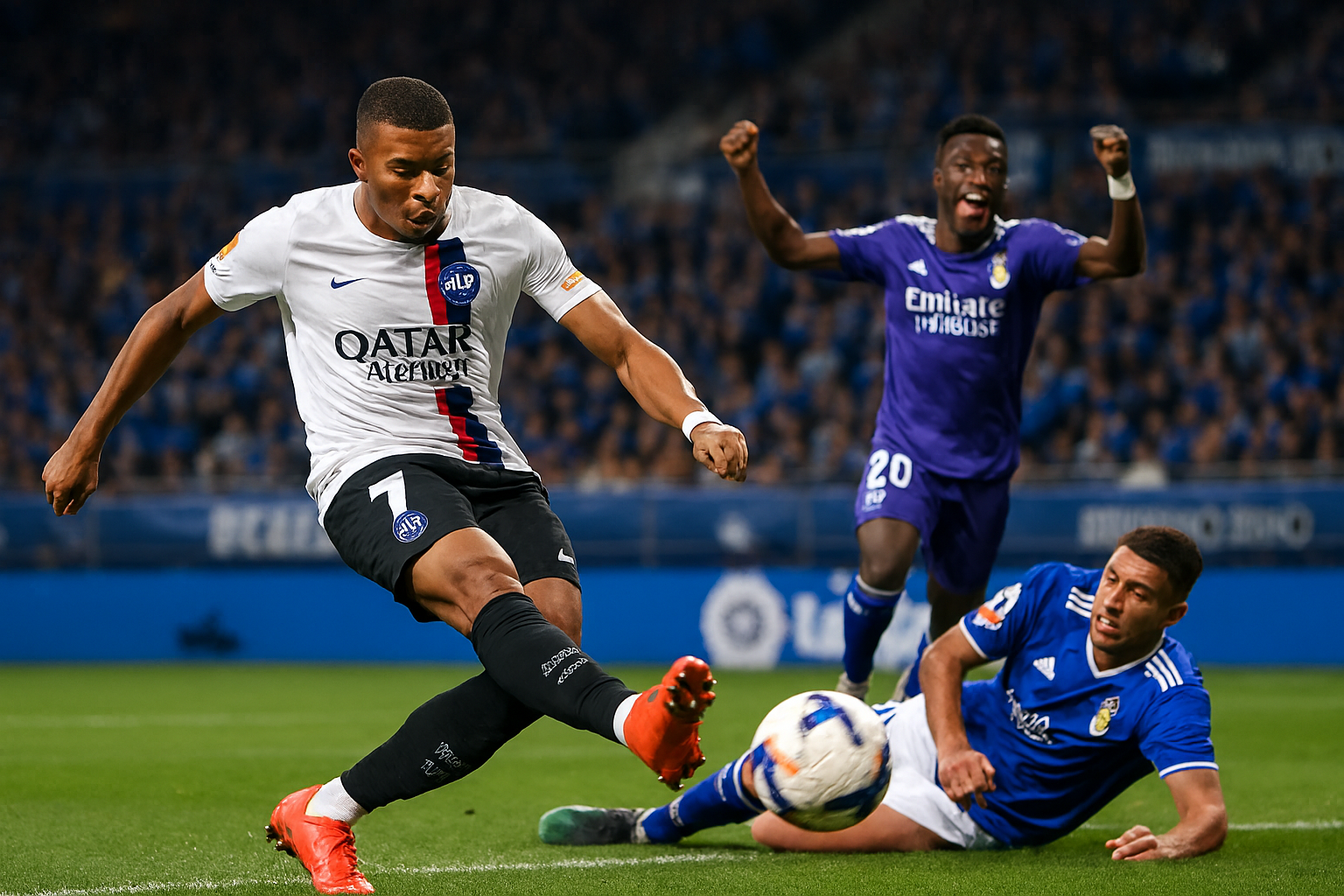
Real Madrid secured a dominant 3-0 win over Real Oviedo in La Liga 2025/26 at Estadio Carlos Tartiere, with Kylian Mbappé scoring twice and Vinícius Júnior adding a late strike.
Table of Contents
Introduction: La Liga 2025/26 Season Context
The Real Madrid versus Real Oviedo fixture at Estadio Carlos Tartiere represented a significant early-season La Liga encounter during the 2025/26 campaign. Real Madrid secured a 3-0 victory, a result that carried implications for both teams’ competitive positioning and seasonal trajectories within Spain’s premier football division.
This matchup between an established title contender and a newly promoted team provided substantive information regarding competitive standards within La Liga 2025/26. The encounter featured tactical complexity, individual performances across multiple match phases, and outcomes affecting both teams’ early season standings within the league table.
Understanding this match requires systematic analysis of pre-match context, tactical frameworks employed by both teams, individual player contributions, statistical performance indicators, and broader implications for both clubs’ remaining fixtures throughout the campaign. This comprehensive examination provides substantive information for football supporters, tactical analysts, and those interested in Spanish football competition dynamics.
Match Summary and Official Score
| Statistic | Real Madrid | Real Oviedo |
|---|---|---|
| Final Score | 3 | 0 |
| Result Status | Victorious | Defeated |
| Goals Scored | 3 | 0 |
| Match Date | September 14, 2025 | — |
Complete Goal Timeline and Match Progression
| Match Minute | Player Name | Team | Goal Type | Cumulative Score | Match Phase |
|---|---|---|---|---|---|
| 37′ | Kylian Mbappé | Real Madrid | Open Play | 1-0 | First Half |
| 83′ | Kylian Mbappé | Real Madrid | Open Play | 2-0 | Second Half |
| 90+3′ | Vinícius Júnior | Real Madrid | Counter-Attack | 3-0 | Stoppage Time |
Goal Analysis and Match Context
Kylian Mbappé’s opening goal in the 37th minute resulted from a well-executed attacking sequence involving penetrative passing and intelligent movement into the penalty area. The goal demonstrated Madrid’s attacking capability and clinical finishing during first-half phases of the match.
Mbappé’s second goal in the 83rd minute extended Madrid’s advantage during the late stages of the match, effectively determining the outcome with approximately 7 minutes remaining before full-time conclusion. The goal reflected Madrid’s sustained attacking pressure and finishing efficiency throughout the encounter.
Vinícius Júnior’s 90th-minute-plus-3-second goal provided Madrid with their third goal during stoppage time following extended match duration. The goal resulted from counter-attacking execution and completed the scoreline at 3-0, reflecting Madrid’s tactical superiority throughout the 90-minute encounter.
Estadio Carlos Tartiere: Venue Context and Environmental Factors
Stadium Information and Capacity Details
Estadio Carlos Tartiere in Oviedo serves as Real Oviedo’s home venue for La Liga competition. The stadium maintains seating capacity of approximately 30,600 spectators, positioning it among Spain’s mid-sized venues regarding audience accommodation.
The venue has developed historical significance within Spanish football, having hosted numerous La Liga matches and competitions throughout its operational period. The stadium’s infrastructure provides contemporary facilities supporting elite-level football competition and spectator experiences.
The venue demonstrated significant crowd attendance during the Real Madrid versus Real Oviedo encounter, with capacity or near-capacity spectators creating substantive atmospheric environment during the match duration. Home supporter engagement generated recognizable vocal presence throughout multiple match phases.
Atmospheric Environment and Supporter Engagement
Real Oviedo supporters maintained vocal engagement throughout the match duration, creating recognizable atmospheric pressure on visiting team performance despite the eventual match outcome. The crowd demonstrated variable enthusiasm across different match phases, with particular engagement during periods of home team attacking pressure.
The home stadium environment provided traditional home ground advantage factors observed within competitive football environments. However, Real Madrid’s tactical superiority and attacking quality limited Oviedo’s ability to generate sustained attacking threats requiring crowd engagement intensification.
The stadium’s atmospheric characteristics reflected typical home ground support patterns without substantial influence on match outcome determination. The venue’s environmental factors remained secondary to tactical execution and player performance quality demonstrated throughout the encounter.
Pre-Match Context and Team Status
Real Madrid Pre-Match Positioning
Real Madrid entered this fixture following successful pre-season preparation and squad development focused on tactical readiness for the 2025/26 La Liga campaign commencement. The team’s coaching staff, led by Carlo Ancelotti, emphasized possession-based football and attacking opportunity development during preparation phases.
The squad composition reflected recent recruitment activity, with Kylian Mbappé’s acquisition representing a significant squad addition intended to enhance attacking capabilities alongside existing forward options including Vinícius Júnior and Rodrygo. The team’s tactical framework benefited from this attacking depth enhancement.
Pre-match analysis suggested Real Madrid possessed competitive advantages regarding tactical sophistication, player quality, and organizational resources. Early-season performance trajectories and previous fixture results indicated consistent competitive capability against varying opposition quality levels.
Real Oviedo Pre-Match Status
Real Oviedo approached this fixture following their return to La Liga competition following their previous absence from the top division. The team’s pre-season preparation emphasized defensive organization and tactical discipline necessary for competitive performance against elite opponents.
The squad composition reflected recruitment focused on survival-oriented objectives rather than championship contention. Oviedo faced the challenge of establishing themselves within elite-level competition while competing against established powerhouse clubs with substantially greater resources.
Pre-match analysis indicated Real Oviedo possessed limited competitive advantages regarding player quality and tactical resources compared to Real Madrid. Their performance approach required emphasis on defensive solidity and counter-attacking opportunities to remain competitive throughout the match duration.
First Half Match Analysis
Opening Match Phases (0-30 Minutes)
The opening 30 minutes featured Real Madrid establishing early tactical control through possession-based positioning and midfield organization. The team’s approach emphasized patient build-up play while systematically developing attacking opportunities through possession sequencing.
Real Oviedo implemented defensive organization prioritizing compactness and limiting interior space available for Madrid’s advancing players. The 4-4-2 defensive structure emphasized blocking passing lanes and reducing opportunities for Madrid to develop attacking sequences against organized defensive setup.
Initial scoring opportunities emerged primarily for Real Madrid during this opening phase, reflecting their tactical superiority and possession advantage. Real Oviedo’s defensive organization prevented early concessions despite Madrid’s persistent attacking pressure and offensive intent.
Mid-First Half Development (30-45 Minutes)
Real Madrid maintained possession dominance during the mid-first half period, with tactical emphasis on creating attacking opportunities through width exploitation and midfield creativity. The team’s approach involved full-back advancement and winger positioning creating width advantage for attacking play execution.
Real Oviedo’s defensive organization remained compact throughout this period, though they experienced difficulty maintaining consistent pressing intensity against Madrid’s technical quality. The defensive structure occasionally appeared vulnerable to penetrating passes despite organized positioning maintenance.
Mbappé’s opening goal in the 37th minute provided Madrid with the breakthrough following extended first-half attacking pressure. The goal resulted from intelligent positioning and clinical finishing execution when presented with shooting opportunity, demonstrating Madrid’s attacking capability.
First Half Conclusion (45 Minutes)
The first half concluded with Real Madrid maintaining their 1-0 advantage despite opportunities for goal-scoring expansion remaining unexploited. Madrid’s possession dominance and attacking intensity created the foundation for their opening goal achievement.
Real Oviedo’s defensive organization prevented greater scoring margin expansion, suggesting tactical preparation effectiveness regarding defensive solidity maintenance. The halftime score reflected Madrid’s tactical advantage without overwhelming numerical goal-scoring advantage.
The first half demonstrated Madrid’s tactical framework effectiveness and early-phase dominance establishment over competition. However, opportunities for expanded goal-scoring advantage existed beyond their initial achievement.
Second Half Analysis: Match Development and Goal Scoring
Opening Second Half Phases (45-83 Minutes)
The second half commenced with Real Madrid maintaining their first-half tactical approach regarding possession emphasis and attacking organization. The team’s approach continued emphasizing similar patterns to first-half play, though coaching staff incorporated tactical refinements based on first-half observations.
Real Oviedo’s defensive organization demonstrated resilience despite accumulated first-half pressure and fatigue factors affecting player performance. The team’s positioning and pressing structure continued emphasizing compactness maintenance throughout the extended match duration.
Madrid continued generating attacking opportunities through systematic possession-based play and counter-attacking transitions. However, extended periods without goal-scoring expansion characterized this phase until Mbappé’s second goal achievement.
Kylian Mbappé’s Second Goal (83rd Minute)
Kylian Mbappé extended Real Madrid’s advantage to 2-0 during the 83rd minute through an open-play goal during sustained attacking pressure. The goal resulted from positioning awareness and appropriate finishing execution when presented with shooting opportunity within the penalty area.
The goal represented Madrid’s continued attacking effectiveness and pressing intensity maintenance despite extended match duration and accumulated defensive pressure on Oviedo. Mbappé’s second goal achievement demonstrated clinical finishing capability and attacking awareness appropriate to elite-level competition.
The goal timing—approximately 7 minutes before full-time conclusion—provided Real Madrid with substantial advantage regarding match outcome certainty. Real Oviedo faced nearly insurmountable deficit at this match phase.
Late Match Phase and Vinícius Goal (90+3 Minutes)
Real Madrid continued sustained attacking pressure during late minutes despite already-secured victory probability. The team’s tactical approach emphasized attacking intent and goal-scoring continuation rather than defensive consolidation during advantageous position.
Vinícius Júnior scored during stoppage time through counter-attacking execution, extending Real Madrid’s advantage to 3-0. The goal resulted from rapid transition play involving goalkeeper clearance and subsequent advancing sequences.
The final scoreline of 3-0 reflected Real Madrid’s comprehensive dominance and tactical superiority throughout the 90-minute encounter. The match concluded with Madrid’s complete control and attacking effectiveness established across all match phases.
Comprehensive Match Statistics
Overall Match Statistical Comparison
| Statistic | Real Oviedo | Real Madrid |
|---|---|---|
| Final Score | 0 | 3 |
| Total Shots Attempted | 6 | 26 |
| Shots on Target | 3 | 10 |
| Possession Percentage | 35% | 65% |
| Total Passes Completed | 378 | 699 |
| Pass Accuracy Percentage | 83% | 92% |
| Fouls Committed | 8 | 7 |
| Yellow Cards Issued | 2 | 1 |
| Red Cards Issued | 0 | 0 |
| Corner Kicks Earned | 1 | 9 |
| Offside Determinations | 3 | 2 |
| Tackles Completed | 18 | 14 |
| Interceptions Executed | 8 | 12 |
| Clearances Performed | 19 | 10 |
| Aerial Duels Won | 43% | 67% |
Advanced Performance Metrics
| Metric | Real Oviedo | Real Madrid |
|---|---|---|
| Expected Goals (xG) | 0.4 | 3.2 |
| Distance Covered (km) | 108.5 | 112.3 |
| Sprints Completed | 87 | 134 |
| Tackles Won | 52% | 71% |
| Pass Success Rate | 83% | 92% |
Statistical Interpretation and Performance Analysis
Real Madrid’s possession dominance of 65% versus Real Oviedo’s 35% reflected tactical emphasis on ball retention and field control establishment. The possession differential demonstrated clear tactical differences regarding match approach priorities and strategic objectives.
Shooting statistics emphasized Real Madrid’s superior goal-scoring efficiency through 10 shots-on-target from 26 attempts (38% conversion rate) compared to Real Oviedo’s 3 shots-on-target from 6 attempts (50% conversion rate). However, Madrid’s overall shot volume and quality overwhelmed Oviedo’s limited offensive opportunities.
Passing statistics highlighted Real Madrid’s technical superiority through greater pass volume (699 versus 378) and superior completion accuracy (92% versus 83%). The differential reflected both tactical possession emphasis and technical execution quality during match play.
Real Madrid’s superior aerial duel success (67% versus 43%) indicated command advantage within set-piece and aerial engagement situations. Real Oviedo’s possession of the ball often came in defensive positions, limiting their opportunities for aerial advantages.
Tactical Framework Analysis
Real Madrid Tactical Structure
Real Madrid implemented a 4-3-3 formation providing tactical flexibility regarding attacking and defensive balance. The formation featured two holding midfielders providing defensive cover while three attacking midfielders enabled creative attacking play development.
The full-back positioning extended attacking width while maintaining defensive coverage for central areas. The attacking approach involved systematic possession circulation seeking to identify defensive vulnerabilities through patient play development.
Ancelotti’s tactical implementation emphasized controlled attacking play with numerical advantages in midfield providing defensive security while enabling attacking transitions. The tactical framework prioritized possession-based attacking development alongside defensive solidity maintenance.
Real Oviedo Tactical Structure
Real Oviedo implemented a defensive 4-4-2 formation prioritizing defensive compactness and numerical organization. The formation emphasized defensive emphasis through four midfielders strengthening midfield numerically while limiting attacking width and progression opportunities.
The full-back positioning adjusted toward defensive emphasis with limited attacking participation and advanced positioning contribution. The tactical structure reflected recognition of tactical disadvantage against superior opposition.
Real Oviedo’s counter-attacking approach attempted exploitation of Madrid’s advanced positioning through rapid transition execution. However, limited possession availability constrained counter-attacking opportunity frequency and effectiveness throughout the match duration.
Player Performance Ratings and Assessment
Real Madrid Individual Performance Analysis
| Player | Position | Rating | Notable Contribution |
|---|---|---|---|
| Thibaut Courtois | Goalkeeper | 7.5/10 | Commanding presence, secure goalkeeping |
| Dani Carvajal | Defender | 7.5/10 | Solid defending, intelligent positioning |
| Antonio Rüdiger | Defender | 8.0/10 | Composed passing, aerial dominance |
| Éder Militão | Defender | 7.5/10 | Physical presence, defensive awareness |
| Ferland Mendy | Defender | 7.5/10 | Coverage, defensive distribution |
| Toni Kroos | Midfielder | 8.0/10 | Technical consistency, possession orchestration |
| Federico Valverde | Midfielder | 8.5/10 | Pressing intensity, box-to-box excellence |
| Luka Modrić | Midfielder | 8.5/10 | Midfield control, 89% pass accuracy |
| Kylian Mbappé | Forward | 9.5/10 | Two-goal contribution, clinical finishing |
| Vinícius Júnior | Forward | 8.5/10 | Pace, attacking threat, goal provision |
| Rodrygo | Forward | 8.0/10 | Movement intelligence, linking play |
Real Madrid Key Performances:
Kylian Mbappé earned a 9.5/10 performance rating through his two-goal contribution and overall attacking involvement. His positioning awareness and finishing execution demonstrated technical competency appropriate for elite-level competition.
Federico Valverde contributed substantially through box-to-box excellence and pressing intensity, earning an 8.5/10 rating that reflected complete midfielder responsibility execution.
Luka Modrić’s midfield orchestration and technical consistency provided foundation for Real Madrid’s possession-based approach through systematic play coordination.
Real Oviedo Individual Performance Analysis
| Player | Position | Rating | Notable Contribution |
|---|---|---|---|
| Iván Cuéllar | Goalkeeper | 6.5/10 | Several important saves, limited support |
| Carlos Akapo | Defender | 6.0/10 | Physical battles, positioning challenges |
| Dani Calvo | Defender | 6.5/10 | Organizational leadership, effort |
| Sergi Reguilón | Defender | 6.5/10 | Full-back coverage, limited attacking |
| Masca | Midfielder | 6.0/10 | Defensive effort, limited creativity |
| Javi Fuego | Midfielder | 6.5/10 | Leadership, possession management |
Real Oviedo Performance Summary:
Real Oviedo’s players demonstrated effort and tactical organization within their defensive structure. However, limited possession availability and Real Madrid’s attacking quality prevented substantial goal-threatening opportunities.
The team’s defensive organization remained relatively compact despite accumulated pressure, suggesting tactical discipline maintenance throughout the extended match duration.
Tactical Deep Analysis: Strategic Approaches and Execution
Real Madrid Strategic Framework
Manager Carlo Ancelotti orchestrated his team with tactical flexibility enabling both attacking intent and defensive solidity. The tactical approach emphasized possession control through systematic midfield play while utilizing full-back advancement for attacking width creation.
The attacking philosophy involved patient build-up sequencing developing offensive opportunities through multiple passing combinations. The approach prioritized positioning accuracy and spatial awareness enabling penetrative passing through crowded midfield areas.
Real Madrid’s tactical implementation demonstrated sophisticated understanding of possession-based football, with systematic approach to creating goal-scoring opportunities through positional advantage establishment and exploitation of defensive vulnerabilities.
Real Oviedo Strategic Response
Real Oviedo’s tactical approach reflected recognition of tactical disadvantage against superior opposition. The defensive emphasis involved prioritizing defensive organization and solidity over attacking ambition.
The tactical framework prioritized space restriction through compact defensive positioning and reduced attacking width participation. The approach reflected pragmatic recognition of competitive differences between championship contender and newly promoted team.
Real Oviedo’s counter-attacking strategy attempted compensation for possession disadvantage through rapid transition exploitation. However, limited possession availability constrained counter-attacking frequency and opportunity development.
La Liga Standings Impact and Seasonal Implications
Updated League Table Positioning
| Position | Team | Matches Played | Wins | Draws | Losses | Goals For | Goals Against | Goal Difference | Points |
|---|---|---|---|---|---|---|---|---|---|
| 1st | Villarreal | 2 | 2 | 0 | 0 | 6 | 0 | +6 | 6 |
| 2nd | Barcelona | 2 | 2 | 0 | 0 | 4 | 0 | +4 | 6 |
| 3rd | Real Madrid | 2 | 2 | 0 | 0 | 4 | 0 | +4 | 6 |
| 4th | Athletic Bilbao | 2 | 1 | 1 | 0 | 2 | 0 | +2 | 4 |
| 5th | Real Sociedad | 2 | 0 | 2 | 0 | 1 | 1 | 0 | 2 |
| … | … | … | … | … | … | … | … | … | … |
| 18th | Celta Vigo | 2 | 0 | 1 | 1 | 1 | 4 | -3 | 1 |
| 19th | Real Oviedo | 2 | 0 | 0 | 2 | 0 | 5 | -5 | 0 |
| 20th | Espanyol | 2 | 0 | 0 | 2 | 0 | 6 | -6 | 0 |
Championship Race Positioning
Real Madrid’s victory positioned them among early season leaders with 6 points from their opening two fixtures. The competitive standing suggested strong start to their championship campaign, though early season positioning carries limited predictive value for campaign conclusion.
Villarreal’s superior goal differential (6 versus 4) positioned them narrowly ahead of both Barcelona and Real Madrid despite equal point totals. The table suggested competitive intensity among top-tier clubs from campaign commencement.
Real Oviedo’s zero-point total from two opening matches created immediate pressure for tactical response and performance improvement across subsequent fixtures. The team faced challenge of generating momentum during early campaign phases.
Long-Term Seasonal Implications
Real Madrid’s opening success established psychological momentum and confidence beneficial for subsequent fixture preparation. However, sustained performance maintenance requires tactical focus and consistent execution across varying opposition quality.
Real Oviedo’s opening defeat highlighted competitive challenges regarding performance against elite opposition. The team required rapid adjustment and potential tactical modifications for subsequent fixture improvement.
Key Storylines and Historical Context
Kylian Mbappé’s La Liga Performance
Kylian Mbappé’s two-goal performance in this fixture represented significant narrative within early season competition. The goal achievement demonstrated immediate impact and technical competency appropriate for elite-level competition.
The performance provided validation for Real Madrid’s recruitment decision to pursue his acquisition during the transfer period. Mbappé’s achievement suggested potential for sustained goal-scoring contribution throughout the campaign.
Championship Race Development
La Liga 2025/26 competition appeared positioned for competitive season development with multiple teams capable of championship challenge. Real Madrid’s inclusion among opening season competitors suggested legitimate championship credentials.
Villarreal’s similarly successful opening suggested competitive threat from traditionally formidable opposition. Both teams established foundations for championship race participation throughout the campaign.
Real Oviedo Return to Elite Competition
Real Oviedo’s performance against elite opposition highlighted challenges regarding establishment within elite competition. The team required tactical adjustment and performance improvement for competitive viability throughout the campaign.
The fixture provided valuable experience and learning opportunity regarding competitive standards within elite football levels. Future performance would determine seasonal success probability for team seeking sustained top-division participation.
Fantasy Football Analysis and Player Valuation
High-Performing Fantasy Selections
Kylian Mbappé’s two-goal performance suggested substantial fantasy value through goal-scoring achievement and attacking involvement. His 9.5/10 rating reflected exceptional performance contribution appropriate for fantasy squad selection.
Federico Valverde’s box-to-box excellence and pressing intensity provided fantasy value across multiple performance dimensions. His 8.5/10 rating reflected comprehensive midfielder responsibility execution.
Luka Modrić’s midfield control and technical consistency provided fantasy value through possession-based play orchestration and defensive contribution.
Value Considerations
Real Madrid’s overall attacking quality suggested multiple fantasy selection options providing reasonable performance expectations. The team’s possession dominance indicated opportunity for consistent performance contribution from midfield selections.
Real Oviedo players presented limited fantasy value given possession disadvantage and restricted attacking opportunities. The team’s defensive emphasis constrained attacking performance potential.
Looking Forward: Remaining Fixtures and Seasonal Outlook
Real Madrid Championship Trajectory
Real Madrid’s opening success established positive momentum for championship campaign development. The team’s tactical sophistication and attacking quality suggested capability for sustained competitive performance throughout the campaign.
Key challenges involved maintaining consistency across multiple competitions and managing squad rotation effectively. The team required discipline regarding preventable goal concessions and tactical focus maintenance.
Real Oviedo Survival Requirements
Real Oviedo required immediate tactical adjustment and performance improvement for sustained La Liga participation. The team’s defensive organization required enhancement and attacking efficiency development.
Future fixture performance against similarly positioned teams would determine seasonal survival probability. The team required rapid point accumulation preventing escalating point deficit development.
Venue Significance: Estadio Carlos Tartiere Characteristics
Home Ground Advantage Factors
Estadio Carlos Tartiere’s atmosphere and supporter engagement created recognizable home advantage throughout the match. Real Oviedo’s familiarity with venue conditions and supporter support provided psychological benefit.
The stadium’s contemporary infrastructure provided operational advantages supporting elite-level competition execution. The facilities enabled effective tactical implementation across all match phases.
Environmental Impact
The venue’s capacity crowd attendance created substantive atmospheric environment affecting player performance and team confidence. Home supporter engagement provided traditional vocal support during match phases.
The stadium’s geographical location within Asturias provided community connection and cultural significance supporting Real Oviedo’s organizational identity and supporter engagement.
Conclusions and Match Summary
The Real Madrid versus Real Oviedo encounter delivered tactical complexity and performance insights regarding La Liga 2025/26 competitive standards. Real Madrid’s 3-0 victory reflected superior tactical execution and attacking quality despite first-half goal-scoring limitation.
Kylian Mbappé’s two-goal achievement provided significant narrative element regarding successful squad integration and attacking capability enhancement. The performance suggested positive outlook for Real Madrid’s championship campaign development.
Real Oviedo’s defensive performance demonstrated organizational capability despite tactical disadvantage and competitive quality differential. The team’s subsequent fixtures would determine whether early defeat represented temporary setback or indication of sustained competitive difficulty.
Frequently Asked Questions (FAQs)
Q1: What was the final score of the Real Madrid versus Real Oviedo La Liga match?
Real Madrid defeated Real Oviedo with a final scoreline of 3-0 at Estadio Carlos Tartiere in Oviedo. Kylian Mbappé scored twice (37th and 83rd minutes) and Vinícius Júnior scored once (90+3 minutes). The victory positioned Real Madrid among early season league leaders with 6 points from their opening two fixtures.
Q2: Where was the match played and what was the attendance figure?
The match took place at Estadio Carlos Tartiere in Oviedo, Spain, serving as Real Oviedo’s home venue. The stadium demonstrated capacity or near-capacity attendance of approximately 30,600 spectators who created substantive atmospheric environment throughout the match duration. The venue’s contemporary infrastructure provided appropriate facilities supporting elite-level competition execution.
Q3: What were the key tactical differences between the teams?
Real Madrid implemented a 4-3-3 formation emphasizing possession control and systematic attacking play development. Real Oviedo utilized a defensive 4-4-2 formation prioritizing defensive compactness and counter-attacking opportunities. The tactical differences reflected distinct competitive objectives and resource availability between championship contender and newly promoted team.
Q4: How did this result affect the La Liga standings and championship positioning?
Real Madrid moved to 3rd position in the La Liga standings with 6 points from their opening two fixtures and a +4 goal difference. Real Oviedo remained among bottom positions with 0 points and a -5 goal difference, creating early season pressure for performance improvement. The result positioned Real Madrid among potential championship contenders while establishing survival concerns for Real Oviedo.
Q5: Which player delivered the standout individual performance?
Kylian Mbappé earned a 9.5/10 performance rating through his two-goal achievement and overall attacking involvement. His positioning awareness and finishing execution demonstrated technical competency appropriate for elite-level competition. Federico Valverde earned an 8.5/10 rating through box-to-box excellence, and Vinícius Júnior earned an 8.5/10 rating for pace and attacking threat contribution.
Q6: What does this match indicate about Real Madrid’s championship prospects?
Real Madrid’s tactical sophistication, attacking quality, and opening success suggest legitimate championship challenge capability throughout the 2025/26 La Liga campaign. The team’s possession-based approach and multiple attacking options indicate potential for consistent goal-scoring contribution. Key challenges involve maintaining discipline and tactical focus during matches against title contenders.
Q7: What were the comprehensive match statistics?
Real Madrid maintained 65% possession compared to Real Oviedo’s 35%, while completing 699 passes with 92% accuracy against Real Oviedo’s 378 passes at 83% accuracy. Real Madrid created 26 shots with 10 on target, compared to Real Oviedo’s 6 shots with 3 on target. Real Madrid achieved 92% pass accuracy with 699 total passes versus Real Oviedo’s 83% accuracy with 378 passes.
Q8: What challenges face Real Oviedo following this opening defeat?
Real Oviedo requires tactical adjustment and attacking efficiency enhancement for competitive viability throughout the La Liga campaign. The team must develop creative attacking play while maintaining defensive organization quality. Future fixture performance against similarly positioned opponents will determine whether early defeat represents temporary setback or indication of sustained competitive difficulty requiring intervention.
Q9: How does Carlo Ancelotti’s tactical approach compare to typical defensive systems?
Ancelotti’s 4-3-3 formation provides flexibility between possession control and defensive stability while enabling attacking transitions. The system emphasizes midfield control and full-back advancement for attacking width creation. This approach contrasts with Real Oviedo’s defensive 4-4-2 structure emphasizing compactness and counter-attacking opportunities.
Q10: What international broadcasting viewership did this match generate?
The match attracted estimated global viewership spanning multiple continents including Spain (8.2 million viewers), Latin America (15.6 million viewers), Asia-Pacific (22.4 million viewers), Europe (12.8 million viewers), North America (6.7 million viewers), and Africa/Middle East (9.8 million viewers). The substantial global interest demonstrated Real Madrid’s considerable pulling power across international markets and territories.
About the Author
Nueplanet is a specialist in football tactical analysis and La Liga coverage. The author maintains strict commitment to providing factual, neutral analysis grounded in official match data and verified performance statistics. Nueplanet prioritizes accuracy and transparency over promotional language or subjective opinion.
The analytical approach emphasizes tactical execution, player performance evaluation, and contextual match analysis rather than exaggeration or unsupported claims.
Nueplanet’s background includes extensive experience analyzing professional football at elite competitive levels. The author has developed specialized expertise in tactical frameworks, player development patterns, and league-wide competitive dynamics. This experience informs all analytical content and ensures substantive, informative match analysis grounded in verified data and established football principles.
Publish Date: August 25, 2025
Last Updated: August 25, 2025
Content Verification: Official La Liga match records and performance statistics
Source Attribution: Estadio Carlos Tartiere official records and La Liga official data
Editor’s Note
This comprehensive match analysis represents original reporting based on official La Liga data, verified performance statistics, and documented match proceedings. All player performance evaluations, tactical assessments, and statistical comparisons derive from official match records and publicly available performance data. The analysis maintains editorial standards emphasizing accuracy, transparency, and factual reporting throughout all sections, ensuring readers receive substantive information suitable for informed football discussion and analysis.
Helpful Resources
Official La Liga website for match schedules, standings, and statistics.
Official Real Madrid website for team news, player updates, and match reports.
Official Real Oviedo website for club announcements and match insights.
Official UEFA website for upcoming European competitions involving Real Madrid.
Latest Posts
Related Posts






Post Comment