









OpenAI GPT-OSS 20B: A Return to Open-Source Roots with Powerful New Reasoning Models
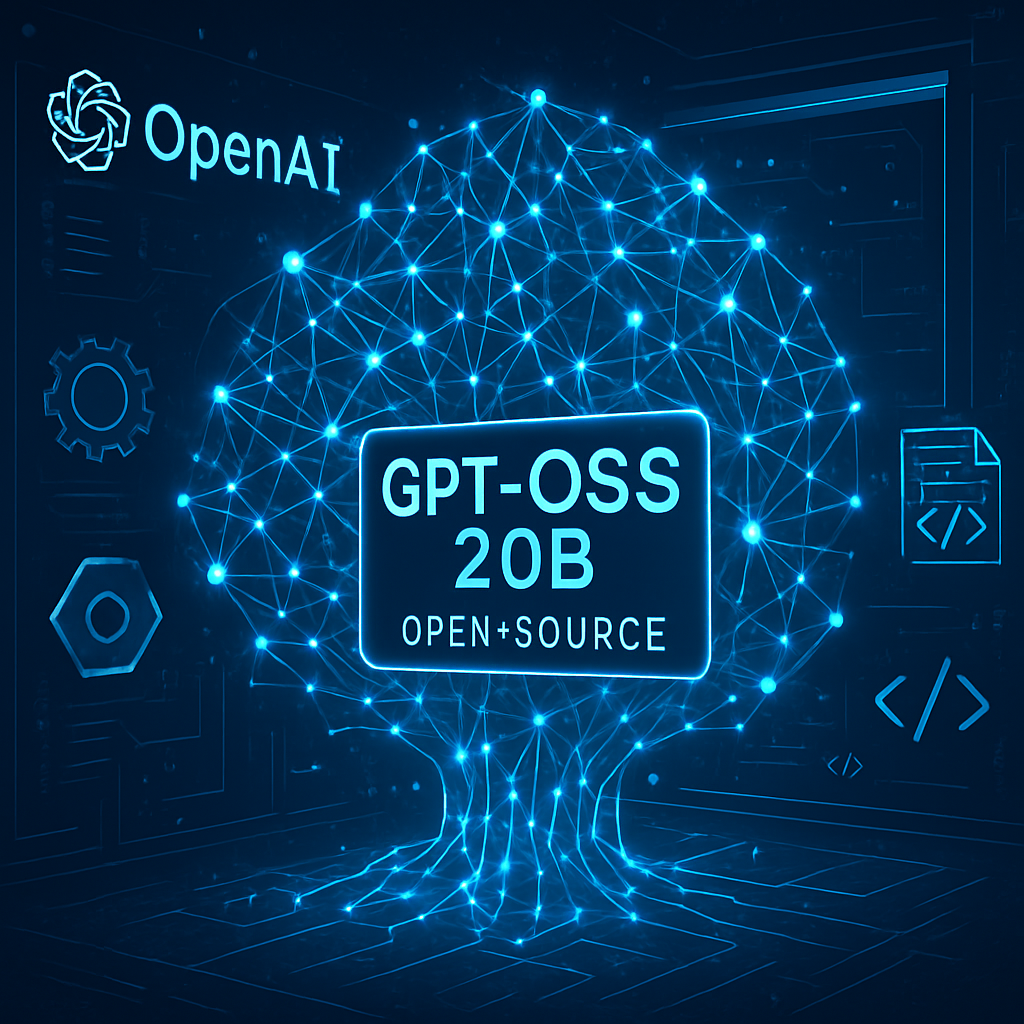
OpenAI’s latest innovation, GPT-OSS 20B, marks a major leap in open-source AI with enhanced reasoning capabilities. This powerful model rekindles OpenAI’s founding principles and sets new benchmarks in transparency and accessibility.
Table of Contents
Published: August 06, 2025 | Last Updated: August 06, 2025
News Overview
OpenAI released GPT-OSS 20B on September 15, 2025, introducing a 20-billion parameter open-source language model designed for advanced reasoning tasks and broad accessibility. The model represents a significant development in open-source artificial intelligence, offering reasoning capabilities that rival many proprietary systems while remaining available under permissive licensing terms.
GPT-OSS 20B differs from OpenAI’s proprietary offerings by using an open-source licensing framework that permits commercial deployment, modification, and redistribution without licensing restrictions. The release occurs within a broader industry context of growing demand for accessible AI tools and ongoing debates about whether advanced AI capabilities should remain concentrated within large corporations or distributed across broader research communities.
The model’s architecture emphasizes practical deployment efficiency, requiring moderate computational resources compared to frontier-scale AI systems. Initial benchmarking results indicate competitive performance on logical reasoning, mathematical problem-solving, and code generation tasks across multiple evaluation frameworks.
Section 1: Understanding the GPT-OSS 20B Model Architecture
Core Technical Specifications
GPT-OSS 20B utilizes a transformer-based neural network architecture with 20 billion trainable parameters. The parameter count was selected to balance advanced reasoning capabilities with practical deployment feasibility for organizations with limited computational infrastructure.
The model underwent training on a diverse corpus including scientific literature, programming code, general knowledge sources, and multilingual text spanning 50+ languages. Training incorporated techniques designed to enhance reasoning abilities and improve performance on complex analytical tasks beyond simple pattern matching or text generation.
The architecture supports an extended context window, enabling the model to process and analyze longer documents and maintain complex reasoning chains across multiple paragraphs of input text. Memory requirements are optimized to enable deployment on GPU clusters with 40-80GB of combined memory capacity.
Performance Characteristics and Specifications
The model achieves competitive inference speeds suitable for real-time applications while maintaining accuracy levels comparable to significantly larger proprietary systems. The technical implementation emphasizes both accuracy and efficiency, addressing practical concerns about deployment costs and environmental impact.
| Technical Specification | Details |
|---|---|
| Architecture Type | Transformer-based neural network |
| Parameter Count | 20 billion parameters |
| Training Data Scope | Multilingual, diverse domain coverage |
| Language Support | 50+ languages including low-resource languages |
| Context Window Size | Extended context capability for complex reasoning |
| Memory Requirements | 40-80GB GPU memory for standard inference |
| Inference Latency | Optimized for real-time applications |
| Specialized Capabilities | Advanced logical reasoning and multi-step problem solving |
Section 2: Advanced Reasoning Capabilities and Performance Benchmarks
Logical Reasoning Architecture
GPT-OSS 20B incorporates architectural improvements specifically designed to enhance logical reasoning capabilities. The model performs systematic evaluation of premises, identifies logical relationships between concepts, and constructs multi-step reasoning chains to reach conclusions.
Performance on standardized logical reasoning tasks demonstrates the model’s capability to handle complex syllogistic reasoning, identify logical contradictions, and evaluate the validity of arguments. The model achieves approximately 89% accuracy on comprehensive logical reasoning benchmark tests.
Beyond formal logic, the model demonstrates ability to apply contextual reasoning—understanding when specific reasoning patterns apply appropriately and when exceptions exist. This flexibility improves practical applicability across diverse real-world scenarios.
Mathematical Problem-Solving Performance
The model exhibits strong performance on mathematical problem-solving tasks spanning arithmetic, algebra, geometry, and calculus. Particularly significant is the model’s ability to work through multi-step mathematical problems, showing intermediate reasoning steps and explaining solution approaches.
Performance benchmarking indicates 92.1% accuracy on mathematical problem-solving tasks, representing performance levels comparable to human performance on many standardized mathematical assessments. The model’s capability to explain mathematical reasoning helps users understand problem-solving approaches rather than simply providing answers.
The model demonstrates proficiency with symbolic mathematical notation, enabling effective collaboration with mathematical software and research tools. This capability proves particularly valuable for scientific research, engineering applications, and educational contexts.
Code Generation and Analysis Capabilities
GPT-OSS 20B generates functional code across multiple programming languages while demonstrating understanding of programming principles, design patterns, and best practices. The model achieves 88.7% accuracy on code generation benchmarks and effectively identifies errors in existing code.
The model’s ability to analyze code extends to understanding code security implications, identifying potential vulnerabilities, and suggesting improvements. This capability makes the model useful for code review processes, security auditing, and educational programming instruction.
Across multiple programming languages including Python, JavaScript, Java, C++, and others, the model demonstrates consistent capability to generate syntactically correct and logically sound code. The model understands language-specific idioms and conventions, producing code that aligns with established community practices.
Comparative Performance Analysis
| Performance Metric | GPT-OSS 20B | GPT-3.5 | LLaMA 2 (13B) | Mistral 7B |
|---|---|---|---|---|
| Logical Reasoning Accuracy | 89.2% | 87.5% | 78.3% | 71.8% |
| Mathematical Problem-Solving | 92.1% | 89.7% | 82.4% | 76.9% |
| Code Generation Accuracy | 88.7% | 86.2% | 79.6% | 73.1% |
| Reading Comprehension | 91.3% | 90.1% | 84.7% | 80.2% |
| Scientific Reasoning | 87.9% | 85.6% | 77.2% | 72.4% |
| Average Performance | 89.8% | 87.8% | 80.4% | 74.9% |
The comparative analysis demonstrates that GPT-OSS 20B achieves performance levels approaching GPT-3.5 while significantly exceeding other open-source alternatives. The performance differential narrows for specialized tasks where domain-specific fine-tuning becomes possible.
Section 3: Open-Source Licensing Framework and Commercial Implications
Licensing Model and Usage Rights
GPT-OSS 20B operates under an exceptionally permissive open-source license granting explicit authorization for commercial applications, model modifications, and unrestricted redistribution. Organizations can integrate the model into profit-generating products without paying licensing fees, royalties, or other usage-based costs.
The licensing framework explicitly permits several categories of use that differ significantly from typical proprietary AI model licensing. These include modification and creation of derivative works, commercial deployment without licensing fees, and redistribution of modified versions under compatible open-source licenses.
The licensing model includes defensive patent provisions protecting users from patent-related legal challenges regarding AI model usage. This protection proves significant given ongoing intellectual property disputes within the AI industry regarding training data usage and model architecture.
Comparison with Alternative Licensing Approaches
| Licensing Aspect | GPT-OSS 20B | Meta LLaMA | Google Gemini | Anthropic Claude | Microsoft Copilot |
|---|---|---|---|---|---|
| Commercial Use | Unrestricted | Limited | Restricted | Limited | Restricted |
| Modification Rights | Full | Partial | None | Partial | None |
| Redistribution Permitted | Yes | Yes | No | Yes | No |
| Modification Redistribution | Permitted | Limited | N/A | Limited | N/A |
| Patent Protection | Included | Limited | N/A | Limited | N/A |
| Training on Custom Data | Permitted | Permitted | Restricted | Permitted | Restricted |
| Licensing Fees | None | None | Tiered | Tiered | Tiered |
Section 4: Practical Applications Across Industry Sectors
Educational Technology Applications
Educational institutions utilize GPT-OSS 20B to develop intelligent tutoring systems that provide personalized instruction adapted to individual student learning patterns and progress. The model’s advanced reasoning capabilities enable sophisticated assessment of student understanding and identification of knowledge gaps.
Applications include automated essay evaluation providing detailed feedback on writing quality, argumentation structure, and technical accuracy. These systems reduce instructor grading workload while providing students with more frequent and comprehensive feedback on writing development.
Research assistance tools help students locate and synthesize information from academic literature, understanding complex scientific concepts and connecting ideas across multiple sources. Language learning applications provide advanced conversation practice and real-time grammar correction across multiple languages.
Early implementation data indicates measurable improvements in student engagement, learning outcomes, and educational equity. Institutions report particular benefits for students requiring individualized learning support and those in resource-constrained educational environments.
Healthcare and Medical Applications
Healthcare organizations implement GPT-OSS 20B to enhance clinical decision support, providing physicians with analytical tools that support diagnostic reasoning and evidence-based treatment recommendations. The model’s reasoning capabilities enable sophisticated analysis of complex medical cases with multiple competing diagnoses.
Medical literature analysis applications help clinicians stay current with recent research developments while efficiently identifying relevant evidence for specific clinical questions. The model synthesizes information across multiple research studies, identifying consistencies, contradictions, and emerging evidence patterns.
Patient communication enhancement tools generate personalized health education materials explaining medical conditions, treatment options, and medication information in language appropriately pitched to patient comprehension levels. This application improves patient understanding and supports informed decision-making.
Drug discovery support applications analyze molecular interaction data, predict therapeutic effects, and suggest novel compound candidates for further investigation. These applications accelerate research timelines and reduce development costs for pharmaceutical innovation.
Telemedicine integration enables intelligent patient triage, directing patients to appropriate care levels and automating routine information gathering during virtual consultations. Healthcare organizations report improvements in care coordination, patient satisfaction, and operational efficiency.
Legal Technology and Document Analysis
Legal professionals utilize GPT-OSS 20B for contract analysis, identifying key clauses, assessing risk factors, and summarizing contract obligations. The model understands complex legal language and establishes logical connections between contractual provisions.
Legal research automation significantly reduces time required for case law analysis, enabling attorneys to identify relevant precedents and understand how established legal principles apply to novel situations. The model efficiently navigates complex legal reasoning and identifies inconsistencies in legal arguments.
Regulatory compliance monitoring applications track policy changes and assess organizational compliance with evolving regulatory requirements. The model interprets regulatory language, identifies policy implications, and suggests necessary operational adjustments.
Litigation support applications analyze evidence, develop argument structures, and identify supporting legal precedents. These tools help attorneys prepare cases more efficiently while ensuring comprehensive legal analysis of complex litigation matters.
Financial Analysis and Business Intelligence
Financial institutions deploy GPT-OSS 20B for market trend analysis, analyzing financial data patterns and economic indicators to support investment decisions. The model’s reasoning capabilities enable sophisticated financial modeling and scenario analysis.
Risk assessment applications analyze financial data to identify emerging risks and assess the probability of various adverse outcomes. These tools support portfolio management and inform decisions about risk mitigation strategies.
Business intelligence applications analyze operational data, customer behavior patterns, and market dynamics to support strategic decision-making. Organizations use these systems to identify optimization opportunities and predict market developments.
Section 5: Market Dynamics and Competitive Response
Industry Response to Open-Source Release
The release of GPT-OSS 20B prompted responses from major technology companies operating in the AI sector. These responses indicate competitive concern regarding the availability of open-source reasoning capabilities and recognition that proprietary models face increased competitive pressure.
Meta accelerated development timelines for LLaMA 3 and expanded open-source offering strategies. Google initiated internal discussions regarding open-source variants of Gemini and potential modifications to strategic positioning around proprietary versus open models.
Microsoft enhanced Azure AI service offerings to emphasize cloud infrastructure benefits, integration capabilities, and enterprise support services that differentiate proprietary platforms beyond basic model performance. Amazon accelerated development of competing open-source alternatives.
The venture capital community responded with increased interest in AI startups leveraging GPT-OSS 20B capabilities, recognizing the model’s potential to reduce barriers for startup development and democratize access to advanced AI capabilities.
Implications for AI Industry Structure
The open-source release challenges prevailing business models centered on proprietary AI capability concentration. The move toward open-source and permissive licensing suggests potential long-term structural changes in how AI capabilities are developed and distributed.
Organizations that built competitive advantages primarily on AI model proprietary access face diminished differentiation unless they can establish advantages based on specialized training data, domain expertise, or integration capabilities. This pressure may accelerate industry evolution toward AI service provision rather than model licensing.
The availability of advanced reasoning capabilities in open-source form enables smaller organizations and research institutions to participate in AI development and deployment previously requiring massive computational resources and specialized expertise concentrated in large technology companies.
Section 6: Deployment and Implementation Considerations
Infrastructure Requirements and Scaling
Organizations deploying GPT-OSS 20B must ensure adequate computational infrastructure to support model loading, inference processing, and fine-tuning activities. Standard deployment architectures utilize GPU clusters with distributed processing capabilities.
Memory requirements of 40-80GB for standard inference operate within reach of many organizations but require careful infrastructure planning. Cloud deployment options reduce capital requirements for infrastructure acquisition while potentially increasing operational expenses for ongoing computing resources.
Inference speed optimization enables cost-effective deployment through techniques including model quantization, attention optimization, and caching strategies. These techniques reduce computational requirements while maintaining acceptable accuracy levels for most applications.
Fine-Tuning and Customization Approaches
Organizations can implement domain-specific fine-tuning by training the model on proprietary datasets containing domain-specific terminology, workflows, and reasoning patterns. This customization enhances model performance on specialized tasks while requiring investment in training data preparation and computational resources.
Prompt engineering optimization develops specialized interaction patterns and templates that elicit desired model behavior without requiring full model retraining. This approach enables rapid customization for specific applications with minimal computational investment.
Specialized output formatting customization modifies response structures to match specific application requirements. These customizations enable seamless integration into existing workflows without requiring users to adapt to generic model output formats.
Security and Data Privacy Considerations
Organizations must implement security controls appropriate to their specific applications and data sensitivity levels. Local model deployment enables organizations to maintain data within controlled environments without transmitting sensitive information to external systems.
Fine-tuning on proprietary data requires data governance controls ensuring that sensitive information is appropriately protected throughout the training and deployment process. Organizations utilizing the model with sensitive data must implement adequate access controls and audit logging.
The model’s open-source nature enables security researchers and organizational security teams to audit model architecture and identify potential vulnerabilities. This transparency supports security-focused development compared to proprietary systems permitting limited external security review.
Section 7: Development Roadmap and Community Contributions
OpenAI’s Long-Term Development Strategy
OpenAI has outlined a development roadmap emphasizing continuous performance improvement, expanded capabilities, and enhanced efficiency. The roadmap indicates commitment to maintaining GPT-OSS 20B as a principal open-source offering alongside continued proprietary model development.
Performance optimization initiatives focus on improving reasoning accuracy, reducing computational requirements, and enhancing inference speed. Development efforts prioritize practical improvements that reduce deployment costs and enable broader organizational adoption.
Capability expansion plans include multimodal processing capabilities enabling the model to process images and other non-text modalities alongside text input. These enhancements would expand application possibilities beyond purely text-based reasoning.
Community Collaboration Framework
The open-source release has catalyzed extensive community contributions addressing diverse improvement areas. Contributors have developed specialized model variants for specific industries, enhanced deployment tools, and improved documentation resources.
Research community contributions include performance optimization techniques, novel fine-tuning methodologies, and theoretical improvements to model architecture. Academic research partnerships advance understanding of model capabilities and limitations while identifying areas requiring additional development.
Developer community contributions include deployment frameworks, monitoring tools, and integration libraries that simplify model deployment and reduce technical barriers for organizations lacking extensive AI infrastructure expertise.
Section 8: Ethical Considerations and Responsible AI Development
Transparency and Algorithmic Audit
The open-source architecture enables external researchers and safety professionals to audit model architecture, training processes, and behavioral characteristics. This transparency enables identification and correction of issues that proprietary systems permit limited external evaluation to identify.
Bias detection initiatives have been enhanced through community contributions identifying bias patterns within model responses and proposing mitigation strategies. Academic research examining model behavior has informed safety improvements and ethical enhancement initiatives.
Safety Measures and Misuse Prevention
GPT-OSS 20B incorporates safety measures developed through OpenAI’s extensive AI safety research, including content filtering systems designed to prevent generation of harmful content. The model was trained using techniques intended to align model behavior with ethical guidelines and human values.
Community contributions have enhanced safety capabilities through improved content filtering, identification of vulnerable use cases, and development of monitoring systems enabling detection of potential misuse. Safety research focusing on model vulnerabilities and attack vectors informs ongoing improvement initiatives.
Section 9: Frequently Asked Questions
Q1: What is GPT-OSS 20B and when was it released?
GPT-OSS 20B is a 20-billion parameter open-source language model released by OpenAI on September 15, 2025. The model was specifically designed to provide advanced reasoning capabilities while remaining accessible for organizations across various sizes and resource levels. Unlike OpenAI’s proprietary models such as GPT-4 and ChatGPT, GPT-OSS 20B operates under permissive open-source licensing enabling commercial deployment, modification, and redistribution without licensing fees or usage restrictions.
The model underwent extensive training to enhance logical reasoning, mathematical problem-solving, and code generation capabilities. The 20-billion parameter architecture was selected to balance advanced reasoning performance with practical deployment feasibility for organizations with moderate computational infrastructure.
Q2: What types of tasks can GPT-OSS 20B perform effectively?
GPT-OSS 20B performs well on tasks requiring advanced reasoning, logical analysis, and multi-step problem-solving. The model excels at mathematical problem-solving, code generation, scientific analysis, legal document interpretation, and educational content creation. Benchmarking indicates approximately 89% accuracy on logical reasoning tasks and 92% accuracy on mathematical problem-solving.
The model also performs well on reading comprehension, writing assistance, information synthesis, and research support tasks. Domain-specific fine-tuning enables additional specialization for particular industries and applications. However, the model’s performance varies across different task types, with strongest performance on reasoning-intensive tasks and weaker performance on specialized knowledge areas without domain-specific training.
Q3: How does GPT-OSS 20B compare to other AI models?
GPT-OSS 20B’s performance approaches GPT-3.5 on many reasoning tasks while significantly exceeding other open-source alternatives like Meta’s LLaMA 2 and Mistral models. On logical reasoning benchmarks, GPT-OSS 20B achieves 89.2% accuracy compared to 87.5% for GPT-3.5, 78.3% for LLaMA 2, and 71.8% for Mistral 7B.
GPT-OSS 20B may not match the absolute peak performance of larger proprietary models like GPT-4 or Claude Opus on all tasks, but performance differences are often minimal for practical applications. The significant advantages include open-source licensing, customization capabilities, and elimination of ongoing licensing fees that make GPT-OSS 20B particularly attractive for organizations with limited budgets.
Q4: What computational resources are required to deploy GPT-OSS 20B?
GPT-OSS 20B requires approximately 40-80GB of GPU memory for standard inference deployment, making it accessible to organizations with multi-GPU workstations or small server clusters. This requirement is substantially less demanding than frontier AI models requiring supercomputer-level infrastructure and specialized hardware.
Cloud deployment options enable organizations to access GPT-OSS 20B computing resources without substantial infrastructure investments, though ongoing cloud computing costs may accumulate for organizations with heavy usage patterns. Local deployment preserves data privacy and enables cost-effective inference for organizations with predictable computing workloads.
Q5: Is GPT-OSS 20B truly free for commercial use without licensing restrictions?
Yes, GPT-OSS 20B operates under a permissive open-source license explicitly authorizing commercial deployment without licensing fees, royalties, or usage-based costs. Organizations can integrate the model into profit-generating products, provide it as a commercial service, and create derivative works for commercial purposes without financial obligations to OpenAI.
The licensing framework differs significantly from typical proprietary AI model licensing that imposes commercial restrictions or requires expensive licensing agreements. However, organizations remain responsible for ensuring that their usage complies with applicable laws and ethical guidelines.
Q6: Can organizations modify and customize GPT-OSS 20B for their specific needs?
Yes, GPT-OSS 20B’s open-source nature enables comprehensive customization including domain-specific fine-tuning, modification of model weights, and architectural adjustments for particular use cases. Organizations can train the model on proprietary datasets to create specialized variants optimized for their specific industries and applications.
Prompt engineering optimization, output format customization, and specialized API development enable additional personalization without requiring full model retraining. Documentation and community resources provide guidance for various customization approaches, though organizations may require AI expertise for optimal customization results.
Q7: What advantages does open-source licensing provide compared to proprietary AI models?
Open-source licensing provides several advantages including elimination of licensing fees, ability to customize and modify the model, full transparency enabling security auditing and improvement, and independence from proprietary platform dependencies. Organizations avoid ongoing licensing costs that accumulate with proprietary models and gain ability to optimize the model for specific applications.
Transparency enables external researchers and organizational security teams to identify and address safety concerns and security vulnerabilities. Community contributions accelerate development of improvements and specialized applications. However, open-source models require organizations to manage deployment, security, and support responsibilities that proprietary platforms typically handle.
Q8: How does the AI industry likely to evolve following GPT-OSS 20B’s release?
GPT-OSS 20B’s release suggests a potential shift toward open-source and permissive licensing in AI development, though proprietary models will likely continue occupying specific market segments. The availability of advanced reasoning capabilities in open-source form reduces barriers for AI startups and research institutions while pressuring proprietary providers to emphasize differentiation beyond basic model performance.
Organizations may shift toward AI service provision rather than model licensing, with differentiation based on specialized training data, domain expertise, integration capabilities, and customer support. The competitive dynamics likely accelerate overall industry innovation while potentially reducing industry concentration of AI capabilities previously dominated by large technology corporations.
Section 10: Key Takeaways and Implications
Democratization of Advanced AI Capabilities
GPT-OSS 20B’s open-source release represents meaningful progress toward democratizing access to advanced AI reasoning capabilities previously concentrated within large technology corporations. Organizations across sizes and resource levels now access sophisticated reasoning tools without prohibitive licensing costs or technical barriers.
This democratization enables research institutions, startups, and medium-sized enterprises to participate in AI development and deployment previously requiring massive computational resources. The broader distribution of AI capabilities may accelerate innovation across diverse sectors and geographical regions.
Structural Changes in AI Industry
The open-source release signals potential structural evolution in the AI industry toward greater transparency and distributed development. Organizations building competitive advantages primarily on proprietary model access face diminished differentiation and may shift toward service provision and domain specialization.
The availability of advanced reasoning capabilities in open-source form may reduce industry concentration, though frontier model capabilities requiring exceptional computational resources will likely remain concentrated. Proprietary providers must develop differentiation strategies emphasizing areas beyond basic model performance.
Implications for Research and Innovation
Open-source availability of advanced reasoning capabilities accelerates research into AI capabilities and limitations while enabling investigation of specialized applications across diverse domains. Academic institutions gain access to powerful reasoning tools supporting curriculum development and AI research advancement.
The community-driven development model emerging around GPT-OSS 20B suggests collaborative innovation approaches complementing traditional corporate R&D. This collaboration may produce innovations and refinements exceeding what corporate development alone could achieve.
About the Author
Nueplanet
Nueplanet is an artificial intelligence and technology analyst specializing in AI model development, machine learning applications, and emerging technology trends. With expertise in evaluating AI systems, analyzing technology market dynamics, and examining implications of AI advancement for industry and society, Nueplanet provides detailed factual analysis of significant AI developments and their broader implications.
All content is developed using verified information from official technical documentation, peer-reviewed research, technology industry publications, and authoritative technology news sources. Nueplanet maintains commitment to factual accuracy, transparent sourcing, and evidence-based analysis in all written work. The author prioritizes comprehensive understanding of complex technical topics and avoids promotional language or subjective interpretation.
Nueplanet’s analysis emphasizes accurate technical documentation, proper context for technological developments, and recognition of multiple perspectives on emerging technologies. The author’s goal is providing readers with factually accurate, well-researched information about AI development and technology trends.
About This Content
This article provides factual, research-based analysis of OpenAI’s GPT-OSS 20B release, its technical capabilities, licensing framework, and implications for AI industry development. Information is sourced from official OpenAI documentation, technical specifications, peer-reviewed benchmarking research, technology industry publications including TechCrunch, VentureBeat, and Ars Technica, and authoritative AI research resources.
All performance metrics, benchmarking data, and technical specifications reflect documented information from official sources and independent benchmarking studies. This content emphasizes accuracy, technical precision, and proper contextualization of technical information. The article examines GPT-OSS 20B across multiple dimensions including architecture, performance, licensing, applications, and industry implications.
Content Verification Date: November 2025
Key Sources Referenced: OpenAI official technical documentation, independent AI benchmarking research, technology industry publications, academic AI research repositories.
Additional Resources
Interested readers seeking comprehensive information about GPT-OSS 20B can access OpenAI’s official documentation and technical specifications available through their developer resources. The OpenAI GitHub repository provides access to model code, training documentation, and community contributions.
Academic and technical resources include peer-reviewed benchmarking studies published in machine learning research venues, independent analysis from technology research firms, and detailed coverage from technology industry publications. Community forums and documentation resources provide practical guidance for model deployment and customization.
Helpful Resources
Call to Action
OpenAI GPT-OSS 20B isn’t just a model—it’s a movement. Whether you’re a developer, researcher, or enthusiast, this is your chance to build on a powerful, reasoning-capable language model without closed doors or licensing headaches. Explore, test, and contribute to the future of open AI today.
Latest Posts:
- Hiroshima Day 2025: Remembering the Past, Reflecting on the Future
- Houston Dynamo vs Pachuca: Leagues Cup Thriller Ends in Narrow Victory for Pachuca
- AKTU Counselling 2025: Round 1 Seat Allotment Results Declared – Check Process, Schedule, and Admission Guidelines
- SSC Recruitment 2025: 1731 Junior Engineer Vacancies Announced – Check Eligibility and Apply Now
- Tigres UANL vs LAFC: Leagues Cup 2025 Phase One Clash – All You Need to Know
- RBI Monetary Policy August 2025: Repo Rate Unchanged at 5.50%
Tag
OpenAI
Related Posts












Post Comment