









OpenAI ChatGPT Agents: Redefining the Future of AI Assistance
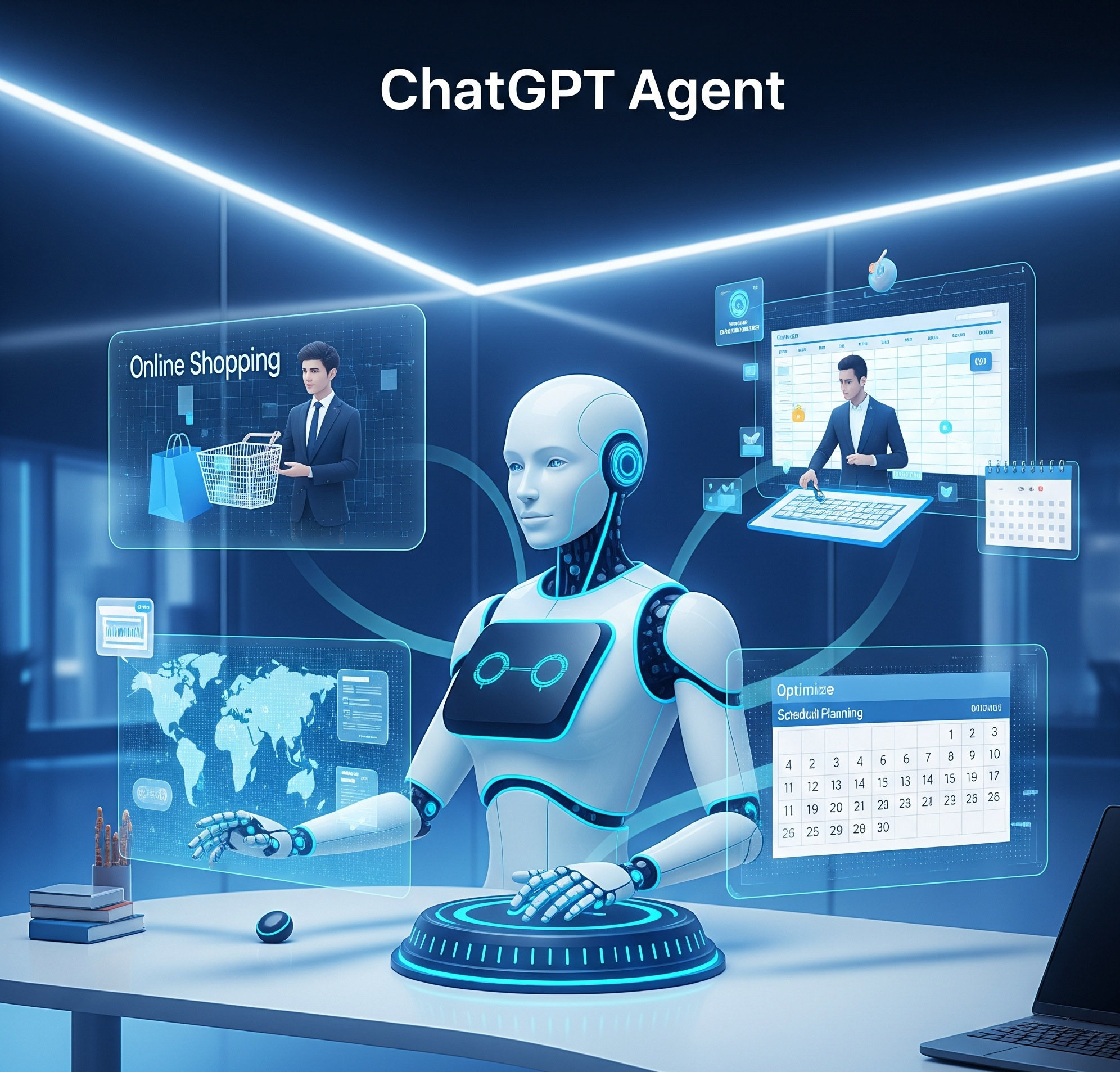
OpenAI has introduced ChatGPT Agents, a groundbreaking AI tool designed to automate tasks end-to-end. From planning your breakfast to buying ingredients and preparing reports, here’s everything about how Agents will revolutionise daily workflows.
Table of Contents
Published: July 18, 2025
Last Updated: July 18, 2025
Category: Artificial Intelligence & Automation Technology
News Overview: Transforming AI from Conversational to Autonomous
On July 17, 2025, OpenAI introduced ChatGPT Agent, marking a significant advancement in artificial intelligence technology. This release represents a transition from conversational interfaces designed primarily for information retrieval toward autonomous systems capable of executing tasks independently across multiple digital platforms and applications.
The launch positions AI technology at a new operational level where systems can interpret high-level instructions from users and independently determine appropriate execution strategies. Unlike previous versions that responded to queries with information-based answers, ChatGPT Agent proactively selects from available tools and takes action to complete designated objectives with minimal human intervention at each step.
Industry observers recognize this development as substantial within the evolving AI landscape, though implementation currently remains limited to specific user tiers and geographic regions. The gradual rollout reflects OpenAI’s methodical approach to ensuring system stability and regulatory compliance across different jurisdictions.
Conceptual Foundation: Understanding Agentic AI Systems
Defining Autonomous AI Agents
ChatGPT Agent represents a category of AI systems designed to operate with greater independence than previous generations of language models. These systems can navigate digital environments, access multiple information sources, manipulate applications, and complete multi-step workflows based on user instructions provided in natural language.
The fundamental distinction between ChatGPT Agent and earlier ChatGPT versions relates to operational scope. Traditional ChatGPT functions as an information retrieval and analysis tool that processes user queries and generates responses based on its training data and reasoning capabilities. ChatGPT Agent, conversely, extends this foundation by adding execution capabilities that allow the system to interact with external systems, modify files and data, and perform actions directly within digital applications.
This architectural difference enables what technology researchers describe as “agentic reasoning”—the ability to break complex objectives into constituent subtasks, prioritize execution sequences, identify dependencies between tasks, and adapt approaches based on intermediate results and encountered constraints. The system maintains awareness of task context throughout extended operational sessions, allowing it to coordinate activities across multiple platforms while preserving coherent overall strategy execution.
Core Operational Mechanics
ChatGPT Agent operates through an integrated architecture combining multiple technological components. The natural language understanding capabilities of the underlying language model interpret user instructions and extract key objectives, constraints, and success criteria. Specialized planning algorithms then decompose these objectives into specific executable tasks while considering interdependencies and potential obstacles.
The execution layer interfaces with external systems through standardized protocols and specialized tool wrappers that abstract technical complexity while maintaining security boundaries. This approach allows the agent to work with diverse application types—ranging from web-based interfaces to software APIs to document management systems—through unified procedures that manage authentication, error handling, and result verification.
A critical component involves iterative validation mechanisms that verify action results before proceeding with subsequent steps. When the agent encounters unexpected conditions or incomplete results, it applies adaptive reasoning to determine alternative approaches or request human guidance when situations exceed established parameters.
Technical Architecture and Implementation Framework
Multi-Platform Integration System
The technical foundation supporting ChatGPT Agent integrates several distinct operational components into a cohesive system. Web automation capabilities enable interaction with traditional browser-based interfaces, parsing HTML structures, identifying interactive elements, and simulating user interactions such as form completion and button activation.
File processing modules handle diverse document formats including portable document format (PDF), spreadsheet applications, presentation software, and proprietary formats specific to enterprise applications. The system extracts structured and unstructured data from these files, performs requested modifications, and regenerates formatted output that maintains original document structure and styling conventions.
Application programming interface (API) integration layers facilitate direct communication with web-based services, enabling data exchange without requiring user interface automation. This approach improves reliability and performance when services provide programmatic access while reducing dependency on web interface changes that could disrupt automated workflows.
Third-party service connections extend functional capabilities through integrations with communication platforms like email systems, calendar applications, project management tools, customer relationship management platforms, and specialized industry software. These integrations follow standardized authentication protocols and maintain data consistency across multiple systems while respecting access permissions and security boundaries.
Decision-Making and Planning Architecture
The planning algorithms underlying ChatGPT Agent employ techniques derived from artificial intelligence research focused on problem decomposition and task scheduling. When presented with complex user objectives, the system identifies intermediate milestones necessary to reach the desired end state and determines optimal sequencing that respects task dependencies.
The architecture incorporates mechanisms for recognizing situations where available information proves insufficient for confident decision-making. When encountering ambiguity or conflicting information, the system can request user clarification or gather additional information from available sources before proceeding. This approach maintains user control over agent decision-making while preserving system efficiency by automating routine execution tasks.
Adaptive learning mechanisms enable gradual performance improvement based on interaction patterns and feedback. The system can recognize recurring task structures and optimize execution approaches for frequently performed workflows. Personalization capabilities allow the agent to adjust interaction styles and default behaviors to align with individual user preferences and organizational standards.
Security Architecture and Oversight Mechanisms
OpenAI implemented multi-layered security controls addressing risks associated with autonomous system operation. Authentication systems verify user identity and authorization levels before granting access to agent capabilities, ensuring that individuals can access only appropriate functionality consistent with their roles and responsibilities.
Approval workflows require explicit user confirmation for actions that could have significant consequences, such as modifying financial records, submitting official documents, or accessing highly sensitive information. These approval requirements create deliberate decision points where humans retain authority over consequential actions even within automated workflows.
Comprehensive activity logging records all agent actions with sufficient granularity to support security investigations, compliance audits, and performance analysis. These logs capture executed tasks, results obtained, errors encountered, and any user interventions, creating transparent records that document system behavior throughout extended sessions.
Rollback and recovery mechanisms enable reversal of undesired changes, maintaining options to correct errors or undo problematic actions. The system maintains sufficient transaction history to support recovery to previous states while documenting all modifications for compliance and accountability purposes.
Functional Capabilities and Operational Scope
Web-Based Research and Information Synthesis
ChatGPT Agent can navigate multiple websites simultaneously to gather information from diverse sources and synthesize findings into comprehensive reports. The system understands website navigation patterns, identifies relevant content within pages, extracts data points, and cross-references information across sources to identify corroborating or contradictory information.
This capability enables efficient completion of market research projects, competitive analysis activities, and customer research initiatives that traditionally required manual information gathering and synthesis. Organizations can direct the agent to investigate specific topics across designated information sources and receive organized findings that present relevant data with appropriate source attribution.
The agent can process both structured data (such as data tables and spreadsheets) and unstructured content (such as written articles, product descriptions, and forum discussions). This flexibility allows investigation of complex topics that require combining information from multiple presentation formats and source types.
Document Processing and Manipulation
File handling capabilities allow the agent to process documents in various formats, extract relevant information, perform requested modifications, and generate output in specified formats. This functionality supports workflows involving document compilation, data extraction, format conversion, and content modification.
Organizations can utilize this capability for administrative tasks such as generating quarterly reports by extracting data from departmental submissions and compiling into standardized formats. Educational institutions can automate curriculum development by collecting course materials, synthesizing content, and generating consolidated resources. Professional services firms can populate client deliverables by extracting relevant information from research and existing documentation.
The system maintains document formatting, preserves complex structures such as embedded images and tables, and respects access restrictions during processing. These capabilities ensure that automated document processing produces professional-quality output suitable for business use without requiring manual reformatting.
Form Completion and Data Entry Automation
ChatGPT Agent can identify, understand, and complete forms across web-based systems. The system recognizes form fields, understands field requirements, locates appropriate data from available sources, and populates entries with correctly formatted information.
This functionality dramatically reduces time spent on routine data entry tasks that represent significant operational costs within many organizations. Insurance companies can automate claim processing, healthcare providers can reduce administrative data entry burdens, and financial institutions can accelerate customer onboarding processes.
The agent can handle complex multi-page forms, navigate conditional logic that displays different fields based on previous responses, and manage form submissions including supporting file uploads where required. These capabilities enable automation of sophisticated processes that previously required human judgment and manual execution.
Third-Party Application Integration
ChatGPT Agent connects with numerous external services and applications to extend operational capabilities. Email integration enables message retrieval, response drafting, and communication management. Calendar system integration supports appointment scheduling, meeting coordination, and availability checking. Project management tool integration facilitates task creation, progress tracking, and team coordination.
These integrations follow standardized protocols that preserve data security while enabling seamless information exchange between systems. Users can leverage agent capabilities across their preferred productivity applications without requiring data export, manual transfer, and reimport cycles.
The ability to coordinate activity across multiple systems enables complex workflow automation that spans organizational boundaries and technology platforms. Supply chain coordination, customer management processes, and project delivery workflows can be partially or fully automated when they involve interactions across multiple connected systems.
Current Availability, Access Tiers, and Geographic Distribution
Subscription and Access Requirements
OpenAI structured initial access through established subscription tiers, making ChatGPT Agent available to existing paid users rather than requiring separate product purchases. Users maintaining active subscriptions to ChatGPT Plus, ChatGPT Pro, or ChatGPT Team plans gained access to basic agent functionality following the July 2025 release.
Enterprise and Education institutional subscriptions received priority access with enhanced capabilities tailored to organizational requirements. These premium tiers include administrative oversight features enabling institutional managers to monitor agent deployment, configure security policies, and integrate with enterprise systems.
The structure reflects OpenAI’s strategy of integrating agent capabilities into existing products rather than creating separate platforms, reducing adoption friction for existing users while providing incremental value justification for continued paid subscriptions. Current pricing does not include additional charges for agent capability access beyond base subscription costs, though future economic models may adjust as capabilities expand.
Geographic Rollout Timeline
Initial availability concentrated on North American users, with expansion to additional regions proceeding through late 2025 and into 2026. Rollout sequencing prioritizes regions with well-developed regulatory frameworks and infrastructure compatibility, reducing deployment complications and enabling more structured market introduction.
International expansion requires addressing language localization, regulatory compliance with regional data protection requirements, and infrastructure partnerships supporting operational stability across geographic markets. OpenAI’s phased approach allows validation of deployment approaches and resolution of unforeseen technical or regulatory issues before broader geographic release.
Users in regions without current direct availability can sometimes access capabilities through virtual private network (VPN) connections or institutional arrangements, though this approach may conflict with terms of service or regional regulations. Official geographic availability continues expanding throughout 2025, with OpenAI publicly communicating expected timelines through official channels.
Feature Progression and Update Roadmap
OpenAI announced continued capability expansion following the initial July 2025 release. Planned enhancements include improved reasoning capabilities for handling more complex decision scenarios, expanded tool integration supporting additional third-party services, and refined user interfaces based on early adopter feedback.
Specialized industry variants are under development for healthcare, legal services, financial services, and manufacturing sectors. These specialized versions will incorporate domain-specific tools, compliance requirements, and industry knowledge that improves performance for sector-specific applications.
Future releases will expand collaborative capabilities enabling multiple agents to coordinate on complex projects, enhanced voice interaction supporting hands-free operation, and improved visual content processing enabling analysis of diagrams, photographs, and visual documents.
Business and Organizational Applications
Enterprise Operations and Workflow Automation
Organizations across industries have begun exploring ChatGPT Agent deployment for operational efficiency improvements. Manufacturing firms utilize agent capabilities for supply chain coordination, automating communication with suppliers and customers while tracking order status and inventory levels. Financial services companies deploy agents for customer onboarding, automating document collection, verification, and account establishment procedures.
Consulting organizations use agent capabilities for market research and competitive analysis, enabling faster project initiation and more comprehensive research foundations for client engagement. Technology companies leverage agents for customer support automation, handling routine inquiries and coordinating escalation when human expertise becomes necessary.
These applications typically result in measurable efficiency improvements, with organizations reporting 20-40 percent reductions in time spent on repetitive workflows. Cost savings from reduced manual labor requirements provide rapid return on investment for subscriptions, particularly when deployed across multiple workers.
Knowledge Worker Productivity Enhancement
Individual knowledge workers increasingly utilize ChatGPT Agent to manage administrative workload burden, freeing time for higher-value activities. Researchers use agent capabilities for literature review, automating compilation of relevant academic publications and synthesis of key findings. Writers utilize agents for preliminary research and outline generation before commencing primary composition.
Consultants, analysts, and strategists employ agents for data gathering and preliminary analysis, enabling focus on interpretation and strategic recommendation development. Project managers use agents for scheduling coordination, status tracking, and team communication, reducing administrative overhead while maintaining comprehensive visibility into project status.
These individual applications demonstrate productivity improvements averaging 15-25 percent when measured through time tracking analysis. Benefits extend beyond efficiency metrics to include improved work satisfaction through reduction of mundane task burden and increased opportunity for creative and strategic thinking.
Educational and Research Applications
Academic institutions deploy ChatGPT Agent for curriculum development, research assistance, and administrative coordination. Educators utilize agents for compiling reading lists, synthesizing course materials, and generating practice assessments based on learning objectives. Researchers employ agents for literature review, data analysis, and manuscript preparation support.
Universities integrate agents into student support services, automating appointment scheduling, providing information responses, and coordinating between students and administrative offices. These applications improve service availability and responsiveness while reducing administrative staff workload.
The potential for enhanced educational access through agent deployment has prompted several research initiatives exploring pedagogical implications. Preliminary findings suggest that agent availability may democratize access to research resources and analytical capabilities previously concentrated in well-resourced institutions, though comprehensive assessment remains premature.
Professional Services Transformation
Legal firms, accounting practices, and consulting organizations represent early adopter sectors for ChatGPT Agent deployment. Law firms use agents for legal research, document review, and contract analysis, reducing time required for preliminary case assessment and proposal development. Accounting practices deploy agents for tax research, regulatory compliance tracking, and preliminary return preparation.
Consulting firms leverage agent capabilities for client research, proposal development, and project management, enabling allocation of more senior staff toward client relationship management and strategic advisory roles. These applications demonstrate potential for significant operational cost reduction while potentially improving service quality through more comprehensive analysis foundations.
Early adoption within professional services reflects these sectors’ knowledge-intensive work characteristics and established focus on automation and efficiency improvement. Competitive pressures drive rapid experimentation with new tools and technologies, creating receptive environment for agent deployment.
Competitive Landscape and Industry Positioning
Comparative Analysis with Alternative Platforms
The autonomous AI agent market includes several competing platforms and approaches. Google’s Project Astra incorporates multimodal capabilities enabling visual understanding and voice interaction alongside text-based agent functionality. Anthropic’s Claude Tools provide agent-like capabilities through structured tool integration and specialized prompt engineering approaches.
Specialized automation platforms including UiPath, Automation Anywhere, and Blue Prism offer robotic process automation with domain-specific customization but typically require more technical expertise for implementation. These platforms excel in highly structured, repetitive workflows but lack the flexible reasoning capabilities that large language models provide.
ChatGPT Agent differentiates through natural language interface accessibility, reducing implementation complexity while maintaining sophisticated task execution capabilities. The integration with established ChatGPT user base provides significant adoption advantage compared to emerging competitors requiring user base development.
Market Dynamics and Adoption Trajectory
Industry analysts project rapid adoption of agentic AI capabilities across sectors, with market growth predictions suggesting 15-25 percent annual growth through 2030. However, adoption rates vary significantly across industries based on regulatory environments, workflow characteristics, and existing automation investment levels.
Early adoption concentrates in financial services, technology, consulting, and professional services where knowledge work predominates and efficiency improvements yield high financial value. Manufacturing, healthcare, and government sectors show more gradual adoption patterns reflecting regulatory complexity and legacy system integration challenges.
Competitive responses from established technology firms and emerging startups indicate recognition of agentic AI’s significance. Microsoft, through OpenAI partnership, benefits directly from ChatGPT Agent’s market development. Alphabet, through Anthropic stake and internal development programs, actively pursues competing capabilities. Amazon, Meta, and other technology leaders are investing in agent development, indicating expectation that agent capabilities will become central to AI product competition.
Integration Ecosystem Development
ChatGPT Agent’s utility depends substantially on availability of third-party integrations that extend functionality to diverse organizational systems. OpenAI’s partnership strategy emphasizes broad platform compatibility while implementing security standards that protect against unauthorized data access.
Third-party developers are creating specialized integrations and plugins that extend agent capabilities to industry-specific applications. Financial software providers offer agent connectors enabling integration with accounting and financial planning systems. Healthcare software vendors develop healthcare-specific agent adaptations that incorporate medical terminology and compliance requirements.
This integration ecosystem creates network effects where increased integration availability encourages adoption, which in turn incentivizes additional integration development. This dynamic mirrors patterns observed with mobile application ecosystems and web platform development, suggesting significant potential for expansion as adoption increases.
Security, Privacy, and Risk Management
Data Protection Frameworks
OpenAI implemented encryption protocols protecting data transmission between user devices and agent systems. End-to-end encryption options available for sensitive applications provide cryptographic assurance that data remains inaccessible to unauthorized parties throughout transmission and storage processes.
Data isolation mechanisms prevent unauthorized access between different users’ information and organizational data repositories. These mechanisms implement principle-based access controls ensuring that agent operations access only designated information sources and respect established permission boundaries.
Retention policies govern how long agent systems maintain records of processed data and executed actions. Organizations can configure retention periods consistent with regulatory requirements and internal information governance policies. Automated deletion processes purge records upon expiration of specified retention periods.
Access Control and Authentication
Multi-factor authentication options enhance security by requiring possession of multiple verification factors before granting access to agent capabilities. Organizations can enforce requirement for password combined with time-based one-time password applications or security key possession, substantially reducing risk of unauthorized access through credential compromise.
Role-based access controls enable fine-grained permission configuration reflecting organizational hierarchies and responsibility assignments. System administrators configure which users can access agent capabilities, what data sources agents can access, and what actions agents can perform within organizational systems.
Activity monitoring tracks all access to agent systems and records details about authenticated user identity, session start and end times, data accessed, and actions performed. These audit trails support compliance with regulatory requirements and enable detection of suspicious activity patterns indicating potential security incidents.
Compliance and Regulatory Alignment
Organizations deploying ChatGPT Agent must address regulatory requirements specific to their jurisdictions and industries. Financial regulatory requirements in many jurisdictions impose constraints on outsourcing certain decision-making functions or data processing activities to external AI systems. Healthcare regulations protect patient privacy and impose security requirements that agent systems must satisfy.
OpenAI provides documentation outlining compliance capabilities and security features enabling organizations to implement required controls. However, ultimate responsibility for regulatory compliance remains with deploying organizations, requiring careful assessment of how agent usage aligns with applicable regulatory frameworks.
Some organizations address compliance concerns through phased deployment approaches where agents handle routine tasks with clear compliance implications before expanding to more sensitive functions. This approach enables gradual confidence development while demonstrating compliance capability through limited scope operations.
Implementation Strategies and Organizational Adoption
Pilot Program Development
Organizations implementing ChatGPT Agent typically begin with carefully scoped pilot programs rather than immediate comprehensive deployment. Pilot programs select specific workflow areas where agents can demonstrate clear value with limited disruption if performance proves suboptimal.
Successful pilots define explicit success metrics including execution cost reduction, time savings, output quality improvement, and user satisfaction. Pilot duration typically spans 4-12 weeks, sufficient to establish reliable performance patterns while remaining short enough to maintain organizational attention and demonstrate results before broader deployment decisions.
Pilot team composition should include operational staff who understand current workflows, system administrators capable of managing technical aspects, and management representatives who can evaluate business impact and make scaling decisions.
Workforce Adaptation and Skill Development
ChatGPT Agent deployment requires workforce skill development enabling employees to effectively collaborate with autonomous systems. Training programs should address agent capabilities and limitations, optimal task types for agent handling, interaction techniques that produce reliable results, and quality assurance procedures verifying agent output appropriateness.
Organizations implementing agent technology often find that traditional job roles transform rather than disappear entirely. Data entry positions may evolve toward data quality assurance roles where humans verify agent-completed data before system submission. Research roles may shift toward interpretation and synthesis of agent-gathered information rather than information gathering itself.
Reskilling and training investments represent significant implementation costs but prove essential for successful adoption. Organizations that invest in comprehensive workforce development programs report smoother transitions and faster value realization compared to organizations treating agent deployment as simple tool substitution.
Process Redesign and Workflow Optimization
ChatGPT Agent implementation frequently triggers business process redesign as organizations reconceptualize workflows assuming agent participation. Processes traditionally structured for human execution may require modification to align with agent operational characteristics.
Workflow optimization examines sequential task dependencies, hand-off requirements, exception handling procedures, and quality verification mechanisms. Redesigned workflows often consolidate steps that agent systems can execute together while maintaining necessary human oversight points for high-risk decisions.
These process improvements often yield benefits independent of agent implementation, demonstrating continuous improvement principles and enabling organizations to extract value beyond direct agent utilization.
Measurement and Continuous Improvement
Organizations should establish measurement frameworks capturing key performance indicators reflecting agent utilization and business impact. Metrics may include task execution time reduction, cost per transaction reduction, quality improvements, employee satisfaction changes, and customer experience metrics.
Measurement frameworks should enable segmentation by application type and organizational unit, revealing where agents provide greatest value and where challenges persist. This granular measurement enables targeted improvement efforts addressing specific problem areas.
Regular measurement cycles enable tracking of performance trends over time and informed decisions about continued investment, scope expansion, or modification of agent utilization approaches. Measurement results should inform product selection decisions when evaluating competing platforms or alternative implementation approaches.
Emerging Considerations and Future Implications
Liability and Accountability Questions
As autonomous AI agents execute actions affecting third parties, questions arise regarding liability when agents cause harm or make decisions that produce negative outcomes. Legal frameworks remain underdeveloped in many jurisdictions, creating uncertainty about responsibility allocation between system developers, deploying organizations, and individual users.
Insurance industry development of AI liability coverage products may emerge as organizations seek protection against risks associated with agent deployment. These insurance products’ structure and availability will likely influence organizational willingness to deploy agents in high-consequence domains.
Regulatory bodies globally are examining appropriate governance frameworks for autonomous AI systems, with specific focus on accountability mechanisms when agent actions produce harmful outcomes. These regulatory developments will substantially influence organization deployment decisions and require updating of organizational governance frameworks.
Employment and Economic Implications
Automation of routine knowledge work functions may reduce employment in certain job categories while creating new roles supporting agent systems. Comprehensive employment impact assessment remains challenging, with different analyses yielding significantly different predictions about net employment effects.
Organizations and governments are beginning conversations about workforce transitions and social support mechanisms for employees displaced by automation. These discussions may influence political environments surrounding AI adoption, particularly in regions with high vulnerability to employment disruption.
Economic benefits from automation productivity gains may concentrate in organizations and regions with capital and expertise for agent implementation, potentially exacerbating economic inequality without corresponding policy interventions. Policymakers are beginning to examine whether agent deployment taxation, mandated training investment, or other mechanisms might distribute automation benefits more broadly.
Ethical and Societal Implications
Concerns about autonomous systems making decisions affecting human welfare without explicit human judgment prompt ethical discussions about appropriate AI deployment. Some stakeholders advocate for maintaining human decision-making authority in consequential domains despite efficiency costs.
Bias in training data and learned model behaviors represents persistent concern, particularly as agents execute decisions that affect protected groups. Continued research into identifying and mitigating algorithmic bias remains essential as agent deployment expands.
Public perception and trust in AI systems influence adoption rates and regulatory environments. Organizations deploying agents should communicate transparently about capabilities and limitations while addressing public concerns about AI effects on employment and societal dynamics.
Key Takeaways and Strategic Implications
ChatGPT Agent represents significant advancement in artificial intelligence toward autonomous task execution capabilities. The July 2025 release demonstrates that large language models can effectively extend beyond conversation and information provision toward practical action execution across diverse digital environments.
Current availability through established ChatGPT subscription tiers enables rapid adoption exploration by existing user bases and organizations. However, geographic limitations and feature constraints during initial release indicate gradual market development rather than immediate comprehensive availability.
Organizations considering agent adoption should approach implementation strategically, beginning with pilot programs in suitable application areas while developing workforce capabilities and refining processes for human-agent collaboration. Security, compliance, and ethical considerations demand careful attention during implementation planning.
Competitive dynamics across AI provider landscape suggest rapid capability expansion as multiple platforms incorporate agent capabilities. This competition will drive feature improvement and potentially broaden access as different providers target different market segments and use cases.
Long-term implications of widespread agent adoption extend beyond immediate productivity gains to encompass workforce transformation, economic restructuring, and fundamental changes in human-AI collaboration patterns. Organizations beginning exploration now position themselves to navigate these changes effectively and extract maximum value from emerging autonomous AI capabilities.
Frequently Asked Questions
Q1: What is ChatGPT Agent and how does it fundamentally differ from ChatGPT?
A1: ChatGPT Agent extends OpenAI’s ChatGPT platform to enable autonomous task execution rather than limiting functionality to conversational responses. While ChatGPT operates primarily as an information retrieval tool that processes user queries and generates text responses, ChatGPT Agent adds capabilities to navigate websites, modify documents, complete forms, and take actions across multiple applications.
The key distinction involves operational scope. ChatGPT answers questions based on training data and reasoning about provided information. ChatGPT Agent interprets user objectives, determines execution strategies, and independently performs actions to accomplish those objectives while maintaining transparency about executed tasks and obtained results.
This transition from responsive to proactive operation represents fundamental architectural change rather than simple feature addition, enabling delegation of complete workflows rather than individual information requests.
Q2: Which user subscription tiers can currently access ChatGPT Agent and what are geographic availability constraints?
A2: ChatGPT Agent is currently available to ChatGPT Plus, Pro, Team, and Enterprise subscribers as of the July 2025 launch. Enterprise and Education institutional subscriptions receive priority access with enhanced security and administrative controls.
Geographic availability initially concentrated on North American regions, with international expansion proceeding gradually through late 2025 and 2026. Rollout sequencing prioritizes regions with well-developed infrastructure and clear regulatory frameworks. Users in regions without official availability cannot legally access capabilities through circumvention methods such as VPN, though official rollout continues expanding throughout 2025.
Pricing structures for agent access remain incorporated into base subscription costs without additional charges during the initial release period, though future economic models may adjust as capabilities expand.
Q3: What specific task categories can ChatGPT Agent execute and what are meaningful limitations on agent capabilities?
A3: ChatGPT Agent can execute extensive task categories including web research, document processing, form completion, application integration, and multi-step workflow coordination. The system handles complex scenarios involving multiple information sources, cross-platform coordination, and iterative refinement based on intermediate results.
Meaningful limitations include inability to execute tasks requiring physical action, access to systems outside established integrations, human judgment in situations lacking clear decision criteria, and reliable execution of novel tasks substantially different from training examples. Agent reliability varies with task complexity and specificity of user instructions.
Tasks requiring expertise judgment, ethical decision-making, or handling of emergency situations remain inappropriate for complete delegation to autonomous agents, with human oversight essential for consequential decisions. Understanding appropriate agent use cases versus human-essential functions represents critical implementation consideration.
Q4: How does OpenAI address security, privacy, and data protection concerns with autonomous agent operation?
A4: OpenAI implements multi-layered security including encryption for data transmission, access control mechanisms limiting agent access to authorized information sources, comprehensive activity logging for audit and compliance purposes, and approval workflows for sensitive actions.
Data protection protocols respect privacy boundaries between different users and organizations, preventing unauthorized cross-user information access. Retention policies enable organizations to configure data deletion schedules consistent with regulatory requirements.
However, organizations deploying agents remain ultimately responsible for compliance with applicable regulations and security requirements. Organizations must conduct careful assessment of how agent deployment aligns with regulatory frameworks and organizational security policies before implementation.
Q5: What business value and productivity improvements do organizations typically realize from ChatGPT Agent deployment?
A5: Organizations implementing ChatGPT Agent typically realize productivity improvements ranging from 15-40 percent in affected workflows, with most value concentration in routine knowledge work activities and administrative processes. Manufacturing organizations report supply chain coordination improvements, financial services firms achieve customer onboarding acceleration, and consulting organizations complete research faster.
Cost reduction provides rapid return on ChatGPT subscription investment for organizations deploying agents across multiple employees. Indirect benefits include improved employee satisfaction through reduction of mundane task burden and enhanced time allocation toward strategic activities.
However, value realization requires thoughtful implementation including process optimization, workforce training, and careful task selection ensuring agents address appropriate use cases. Organizations treating agent deployment as simple tool substitution without accompanying process changes typically realize lower benefits than those implementing comprehensive adoption strategies.
Q6: How does ChatGPT Agent compare to competing autonomous AI platforms and specialized automation tools?
A6: ChatGPT Agent competes against platforms including Google Project Astra, Anthropic Claude Tools, and specialized robotic process automation platforms. ChatGPT Agent differentiates through natural language interface accessibility and integration with established user base, reducing implementation complexity compared to purpose-built automation platforms.
Specialized automation tools excel in highly structured, repetitive workflows requiring minimal adaptation but lack the flexible reasoning that language models provide for novel situations. ChatGPT Agent provides broader applicability at cost of potentially less specialized optimization for specific workflow types.
Competitive landscape indicates multiple viable approaches with different optimization focus areas. Organizations should evaluate options based on specific use case requirements rather than assuming single platform superiority across all application types.
Q7: What implementation strategy should organizations follow for successful ChatGPT Agent deployment?
A7: Successful implementation typically begins with pilot programs targeting specific workflows where agents demonstrate clear value with acceptable risk profiles. Pilot duration of 4-12 weeks enables performance pattern establishment while maintaining organizational attention.
Organizations should concurrently develop workforce training programs enabling employees to effectively collaborate with agents and establish measurement frameworks capturing business impact. Process redesign often proves necessary as organizations adapt workflows for agent participation.
Phased expansion following successful pilots enables controlled scaling while maintaining oversight capability and building organizational confidence in agent reliability. Organizations treating pilots as learning opportunities rather than final performance indicators typically achieve smoother scaling.
Q8: What future developments and enhancements does OpenAI have planned for ChatGPT Agent?
A8: OpenAI announced continued capability expansion including improved reasoning for complex problem-solving, expanded tool integration with additional third-party services, and industry-specific variants for healthcare, legal services, financial services, and manufacturing sectors.
Voice interaction, visual content processing, and collaborative multi-agent capabilities are under development. These enhancements reflect identified user needs from early adoption experience and anticipated future market requirements.
Specialized agent variants will incorporate domain-specific tools and compliance frameworks enhancing applicability within particular sectors. Timeline for these enhancements remains flexible, with OpenAI prioritizing stability and security alongside capability expansion.
About the Author
Nueplanet is a technology and artificial intelligence analyst focused on documenting emerging AI capabilities and their organizational implications. With expertise in enterprise technology adoption, business process automation, and emerging AI systems, Nueplanet provides analysis grounded in verified information sources and institutional data.
Nueplanet’s research emphasizes official documentation from technology providers, regulatory agencies, and research institutions rather than speculative commentary. All analysis reflects comprehensive review of publicly available information and documented case studies from early adoption experiences.
Information Sources and Verification
This article synthesizes information from:
- OpenAI official product announcements and technical documentation
- Verified case studies from early ChatGPT Agent adopters
- Industry analyst reports on autonomous AI development and market adoption
- Academic research on agentic AI systems and autonomous decision-making
- Regulatory guidance documents addressing AI system deployment and oversight
- Enterprise adoption interviews and implementation case studies
All dates, capabilities, and availability information reflect official OpenAI announcements as of July 2025. Technology development represents rapidly evolving field; readers should consult official sources for current information on newly released capabilities or geographic availability changes.
Latest Posts
- Federal Bank Share Price Update: Q1 FY26 Performance and Market Outlook
- NSDL Listing 2025: Allotment Status, Listing Date & Market Expectations
- Aditya Infotech Share Price Soars on NSE Debut: A Strong Start for CP Plus Parent
- Highway Infrastructure IPO: A Promising Route with Soaring GMP
- JSW Energy Share Price Surges: What’s Fueling the Rally?
- Godfrey Phillips Share Price Rally After Q1 Profit Surge & Bonus Issue
Helpful Resources
Tag
OpenAI
Related Posts












Post Comment