









NYT Connections June 28, 2025: Hints, Categories, and Today’s Answers
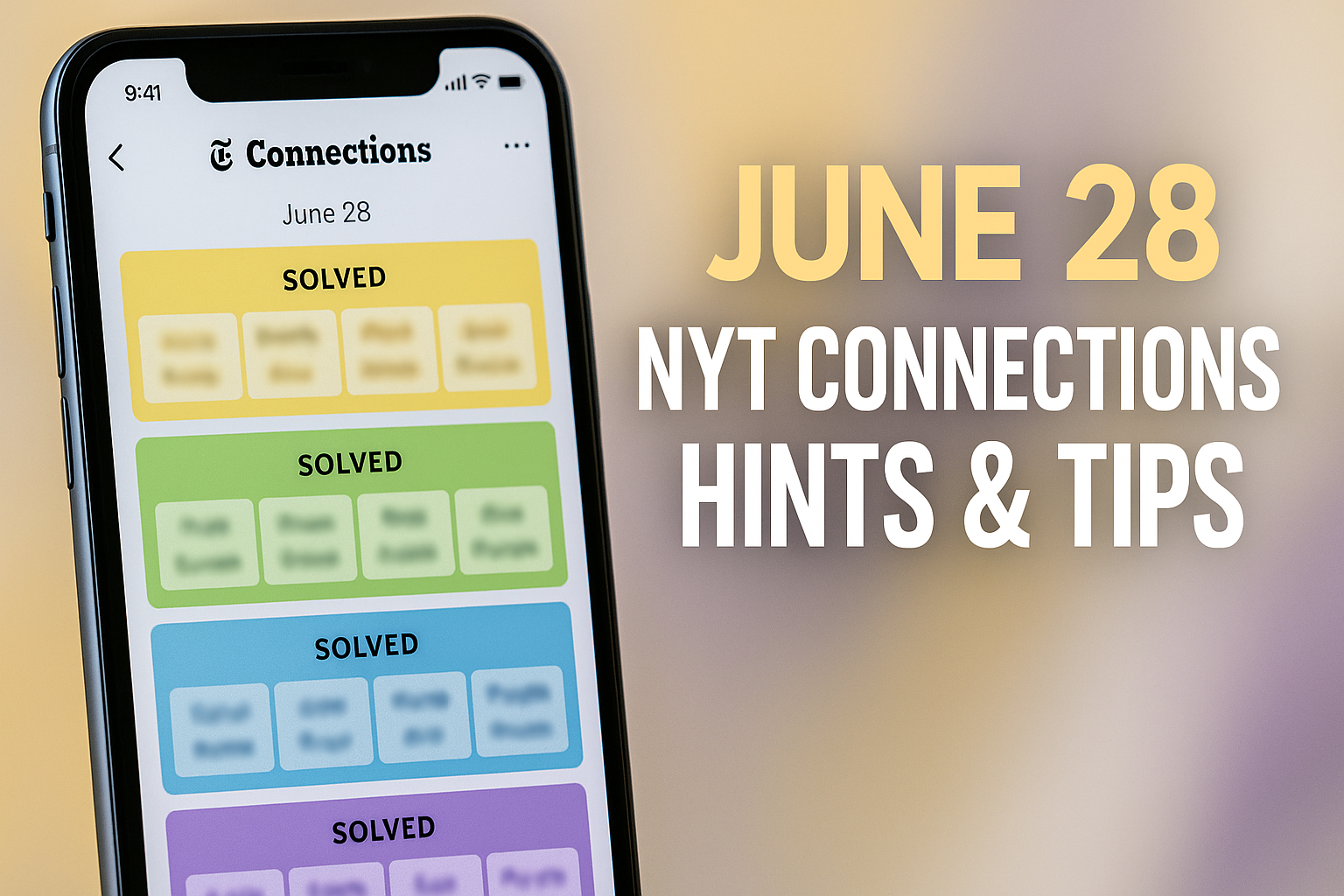
Looking for NYT Connections June 28, 2025 hints? Get today’s subtle hints, full category answers, and expert strategies to solve efficiently. Boost your puzzle confidence now.
Table of Contents
News Overview
The New York Times released Connections as a daily word association puzzle game available through its NYT Games subscription platform. The puzzle requires players to organize 16 words into four categorized groups based on thematic relationships. Each category carries a color-coded difficulty rating progressing from yellow (simplest) through green, blue, and purple (most complex). This article examines the game’s structural mechanics, strategic approaches for different difficulty levels, cognitive research regarding puzzle-solving benefits, and practical guidance for developing effective solving techniques.
Background: NYT Games Portfolio and Puzzle Development
The New York Times Games Division
The New York Times Company operates a dedicated Games division that manages subscription-based puzzle offerings including Wordle, Spelling Bee, Letter Boxed, and various crossword variants. The Games division launched Connections as part of its portfolio expansion strategy to provide diverse cognitive challenges for subscribers.
The NYT Games platform operates through a subscription model providing daily puzzles to paying subscribers. The subscription service has demonstrated significant growth, with reported subscriber increases following the acquisition of popular puzzle games and the development of original titles like Connections.
Puzzle Game Market Context
Word-based puzzle games have experienced substantial growth in recent years, with games like Wordle reaching mainstream cultural adoption. Puzzle game consumption patterns indicate increasing demand for daily cognitive challenges among diverse age groups and demographics.
The puzzle game market reflects broader trends toward digital entertainment, educational gaming, and daily habitual engagement with digital platforms. Market analysts attribute growth partly to pandemic-era interest in home-based entertainment and cognitive engagement activities.
Connections Game Mechanics and Structure
Core Game Format
Connections presents players with a 4×4 grid containing 16 words. The objective requires identifying four distinct groups where each group contains exactly four words connected by a common theme or relationship. Players must determine the specific connection linking words within each group.
The game interface allows players to select words by clicking or tapping to form potential groups. After four words are selected, players submit their attempted grouping for evaluation. The game indicates whether the selection is correct or incorrect.
Difficulty Classification System
The game employs a color-coded system indicating relative difficulty levels:
| Color | Difficulty Level | Typical Characteristics |
|---|---|---|
| Yellow | Elementary | Direct relationships, obvious connections |
| Green | Intermediate | Broader themes, moderate analytical thinking |
| Blue | Advanced | Complex associations, cultural knowledge required |
| Purple | Expert | Multiple meanings, wordplay, specialized references |
Each completed group reveals its category description, providing feedback about the intended connection. The color coding indicates progression difficulty, with yellow groups typically solvable through basic reasoning and purple groups requiring specialized knowledge or lateral thinking.
Game Dynamics and Constraints
Players typically receive one puzzle daily, available at midnight Eastern Time. Completed puzzles cannot be replayed. Game mechanics penalize incorrect guesses, allowing a limited number of attempts (typically four incorrect guesses result in game failure).
The puzzle design incorporates misleading word associations intentionally included to create difficulty. Multiple plausible groupings may appear possible, requiring careful analysis to identify the intended categories.
Strategic Analysis: Solving Approaches by Difficulty Level
Yellow Category Strategy
Yellow categories typically present straightforward connections accessible through basic categorization. Words in yellow groups generally belong to recognizable categories such as animals, colors, sports, or common objects.
The strategic approach involves rapidly identifying obvious groupings before attempting more complex categories. Early success with yellow groups builds confidence and narrows remaining word pool. This approach allows players to confirm basic categorization accuracy before tackling ambiguous connections.
Green Category Analysis
Green categories require moderate analytical thinking involving broader conceptual connections. Examples include groupings based on movie genres, academic disciplines, or thematic relationships extending beyond direct similarity.
Players should consider secondary meanings and contextual applications beyond primary definitions. Identifying the common thread linking four seemingly disparate words often requires consideration of their broader conceptual relationships or shared contextual properties.
Blue Category Complexity
Blue categories demand deeper analysis and often require cultural, historical, or specialized knowledge. These groups typically involve less obvious connections requiring multiple interpretive steps to identify the unifying theme.
Players benefit from considering alternative meanings, historical references, or specialized terminology. The connection linking blue category words frequently involves abstraction or requires recognition of patterns not immediately apparent from surface-level analysis.
Purple Category Expert Challenges
Purple categories represent the most complex puzzles, frequently involving wordplay, multiple meanings, cultural references, or specialized knowledge. These groups often feature clever connections that exploit linguistic ambiguity or require recognition of patterns across different knowledge domains.
Solving purple categories often requires stepping away to return with fresh perspective. Players benefit from brainstorming alternative interpretations and considering unconventional connections. Recognition of patterns from previous puzzles assists in identifying characteristic purple category connection types.
Cognitive Science and Puzzle-Solving Benefits
Pattern Recognition Development
Puzzle-solving activities exercise pattern recognition capabilities through repeated exposure to varied connection types. Research in cognitive psychology indicates that consistent pattern recognition practice strengthens neural pathways associated with analytical thinking and conceptual organization.
Connections specifically requires players to identify unifying principles across apparently disparate items. This cognitive activity engages brain regions associated with abstraction, categorization, and logical reasoning.
Memory and Vocabulary Enhancement
Word puzzle engagement correlates with vocabulary expansion and enhanced word-retrieval capabilities. Regular puzzle participation exposes players to varied vocabulary contexts and word usage patterns.
Memory systems benefit from the cognitive demand of retaining word positions, relationships, and potential groupings. Players must maintain mental models of word associations while evaluating multiple potential groupings simultaneously.
Executive Function and Decision-Making
Strategic puzzle-solving requires executive function capabilities including planning, decision evaluation, and adaptive strategy modification. Players must weigh evidence, consider alternatives, and make strategic choices about puzzle-solving sequencing.
The iterative process of testing hypotheses, receiving feedback, and modifying approaches exercises cognitive flexibility and adaptive reasoning. These cognitive processes extend to broader decision-making contexts beyond puzzle-solving.
Neuroplasticity and Brain Health
Cognitive research indicates that consistent mental challenge promotes neuroplasticity—the brain’s ability to reorganize neural pathways in response to learning. Daily puzzle engagement maintains cognitive flexibility and supports long-term brain health across lifespan development.
Research on cognitive aging suggests that consistent mental engagement may support maintenance of cognitive function and potentially reduce age-related cognitive decline. Regular puzzle-solving represents an accessible cognitive training modality available across diverse populations and age groups.
Category Examples and Connection Analysis
Yellow Category Example: Simple Direct Associations
A yellow category might group: APPLE, BANANA, ORANGE, GRAPE
The unifying connection involves direct categorical relationship: all items belong to the fruit category. The connection is obvious, directly observable, and requires no specialized knowledge or complex reasoning.
Yellow categories serve as foundation-level puzzles establishing confidence and demonstrating basic categorization principles. These groups establish pattern recognition baseline capabilities.
Green Category Example: Moderate Abstraction
A green category might group: DRIVE, HOST, LOAD, SCORE
The connection involves words expressing large quantities or substantial amounts in different contexts. “Drive” can mean a large quantity (e.g., “a drive of cattle”), “host” refers to a large group (e.g., “a host of people”), “load” represents substantial quantity, and “score” means twenty or a large number.
This category requires recognition of secondary meanings beyond primary definitions. Players must consider varied contexts where these words express quantity concepts.
Blue Category Example: Complex Cultural Knowledge
A blue category might group: TICKET, BOOT, TOW, POINTS
The connection involves traffic enforcement consequences: traffic tickets represent official citations, boots are wheel-locking devices for parking violations, towing removes illegally parked vehicles, and points represent citations on driving records.
This category requires understanding traffic enforcement systems and specialized vocabulary. Players benefit from familiarity with driving regulation and enforcement procedures.
Purple Category Example: Expert-Level Wordplay
A purple category might group: BELL, DIESEL, SINGER, WATT
The connection involves surnames of famous inventors: Alexander Graham Bell (telephone), Rudolf Diesel (diesel engine), Isaac Merritt Singer (sewing machine), James Watt (steam engine). Additionally, these surnames have become common words or brand names—”bell” is a common noun, “diesel” refers to fuel type, “singer” is a common occupation, and “watt” is a unit of electrical power.
This category involves multiple layers: recognizing inventors, understanding their historical significance, and recognizing secondary meanings of their surnames. The connection requires specialized historical knowledge combined with wordplay appreciation.
Solving Technique Development
Systematic Elimination Method
Players benefit from systematically testing potential groupings even when uncertain about connections. Incorrect attempts provide valuable information about puzzle logic through feedback indicating near-misses or incorrect patterns.
Tracking which words appear together in failed attempts provides information constraining future groupings. This information helps identify which combinations are unlikely to form valid groups.
Lateral Thinking Approaches
Lateral thinking involves stepping outside conventional association patterns to identify non-obvious connections. Players should consider metaphorical meanings, historical references, cultural allusions, and specialized terminology.
Asking “what else could this word mean?” often reveals alternative interpretations essential for identifying complex connections. Approaching words from multiple angles increases likelihood of identifying obscure connections.
Confidence-Building Sequencing
Strategic sequencing involves tackling progressively more difficult categories to maintain momentum and build confidence. Starting with yellow categories establishes baseline success before approaching ambiguous groupings.
Early victories reduce frustration and provide foundation for more complex analytical thinking. Successful completion of simpler categories narrows word pool, reducing cognitive load for remaining puzzles.
Break-Taking and Perspective Shifts
Stepping away from puzzles before returning with fresh perspective enhances problem-solving success. Mental fatigue impairs pattern recognition and creative thinking, making breaks strategically valuable.
Returning to puzzles after breaks often reveals connections previously overlooked. This cognitive recovery process allows subconscious processing of puzzle information between conscious problem-solving attempts.
Game Design Features and User Experience
Daily Release Schedule
Connections releases one puzzle daily at midnight Eastern Time, establishing consistent engagement patterns. The fixed daily release encourages habitual use and provides natural temporal boundaries for puzzle engagement.
The daily cycle aligns with player routines, functioning as morning cognitive stimulation for many users. This temporal structure creates predictable engagement patterns supporting habit formation.
Difficulty Variability
Puzzle difficulty varies across days, with some days featuring relatively straightforward categories and other days presenting particularly challenging groupings. This variability maintains engagement interest and prevents routine boredom.
Difficulty variation reflects puzzle designer intent to provide appropriate challenges across player skill levels. More experienced players appreciate high-difficulty days while newer players benefit from easier puzzles.
Feedback Mechanisms
The game provides specific feedback about category identification, revealing the intended connection description upon correct grouping. This feedback educates players about intended connections and reinforces learning.
Incorrect attempts indicate near-misses through visual feedback showing how many words within attempted groupings were correct. This information helps players calibrate their understanding of potential connections.
Social Sharing Features
Players can share puzzle completion results through social media, displaying completion time and difficulty status. Sharing functionality enables community engagement and creates friendly competitive contexts.
Social features support habit formation through social accountability and community participation. Public completion sharing creates informal competitions motivating continued participation.
Research on Daily Puzzle Engagement
User Demographics
Connections appeals across diverse demographic groups including varying age ranges, education levels, and cultural backgrounds. Game accessibility accommodates varied puzzle-solving skill levels through graduated difficulty.
Usage data indicates substantial female participation, diverging from stereotypes regarding puzzle game demographics. The game attracts both casual players seeking daily entertainment and serious puzzle enthusiasts.
Engagement Patterns
Daily users demonstrate consistent engagement with high completion rates. Most daily active users complete puzzles within similar timeframes, suggesting learned efficiency in puzzle-solving approaches.
Subscription retention data indicates strong correlation between Games portfolio engagement and subscription renewal. Puzzle games function as meaningful retention factors for NYT subscription services.
Cognitive Outcome Research
Limited published research specifically addresses Connections outcomes, though broader word puzzle research supports cognitive benefits. Emerging evidence suggests daily puzzle engagement correlates with maintained cognitive function.
Research comparing puzzle game players with non-players suggests measurable differences in pattern recognition speed and vocabulary performance. Longitudinal studies tracking long-term outcomes remain limited but suggest potential benefits.
Puzzle Design Philosophy and Construction
Connection Type Variety
Puzzle designers employ diverse connection types including categorical groupings, wordplay patterns, cultural references, historical associations, and thematic relationships. This variety prevents puzzle monotony and maintains engagement through novelty.
Connection diversity ensures varied cognitive demands, exercising different thinking styles and knowledge domains. Players exposed to varied connection types develop broader problem-solving capabilities.
Misleading Association Integration
Puzzle design intentionally incorporates words sharing plausible but incorrect associations. These misleading groupings create difficulty and require discriminating careful analysis to identify intended connections.
The inclusion of misleading associations increases puzzle complexity while rewarding careful analysis. Players must evaluate multiple grouping hypotheses before identifying correct categories.
Difficulty Calibration
Designers calibrate puzzle difficulty through connection obscurity, category specificity, and requirement for specialized knowledge. Difficulty calibration attempts to maintain appropriate challenge level across player skill variations.
The color-coding system provides designers tools for communicating difficulty progression. Each puzzle typically includes approximately one category at each difficulty level.
Comprehensive FAQ Section
Q1: How frequently does the NYT Connections puzzle update, and where can players access it?
The NYT Connections puzzle updates daily at midnight Eastern Time, providing a fresh challenge every 24 hours. Players access the game through the NYT Games platform using desktop computers, mobile devices, or tablets. Access requires an active NYT Games subscription, available as standalone purchase or included with select New York Times digital subscriptions. Previously completed puzzles cannot be replayed on the same account, though archived puzzles may be accessible through other platforms in some cases.
Q2: What is the core objective and basic gameplay structure for NYT Connections?
The game presents players with a 4×4 grid containing 16 words. The objective requires identifying four distinct groups of four words each, with all words in a group sharing a common theme or connection. Players select words by clicking or tapping to form potential groups. Once four words are selected, players submit their attempted grouping for evaluation. Correct groupings remain highlighted on the board. Players receive immediate feedback indicating successful identification or incorrect grouping attempts. The game allows up to four incorrect attempts before ending in failure.
Q3: What distinguishes the difficulty levels indicated by the color-coding system?
Yellow categories represent the elementary difficulty level featuring direct relationships and obvious connections requiring minimal analytical thinking. Green categories represent intermediate difficulty involving broader themes and concepts requiring moderate analytical engagement. Blue categories represent advanced difficulty involving complex associations and often requiring cultural or specialized knowledge. Purple categories represent expert difficulty featuring multiple meanings, wordplay, cultural references, or specialized knowledge requiring sophisticated lateral thinking. The progression creates graduated challenge appropriate for varied skill levels while maintaining engagement across player experiences.
Q4: What strategies prove most effective for solving different puzzle difficulty levels?
Yellow categories benefit from rapid scanning for obvious groupings, establishing early confidence and momentum. Green categories require consideration of secondary meanings and contextual applications beyond primary definitions. Blue categories demand deeper analysis considering alternative interpretations, historical references, and specialized terminology. Purple categories often require stepping away before returning with fresh perspective, brainstorming unconventional connections, and considering wordplay or multiple meanings. Generally, starting with yellow categories and progressing to higher difficulty levels maintains problem-solving efficiency while minimizing frustration from early failures.
Q5: What cognitive benefits does consistent Connections puzzle engagement provide?
Research suggests that regular puzzle-solving enhances pattern recognition capabilities, strengthens memory systems, improves executive function including planning and decision-making, and promotes neuroplasticity supporting long-term cognitive health. Word puzzle engagement expands vocabulary and improves word-retrieval capabilities. The iterative process of hypothesis testing and adaptive strategy modification exercises cognitive flexibility and analytical reasoning. Studies on puzzle engagement suggest potential benefits including maintenance of cognitive function across lifespan development and possible reduction of age-related cognitive decline, though longitudinal research remains limited.
Q6: How do puzzle designers create appropriate difficulty progression and maintain engagement across varied player skill levels?
Designers employ diverse connection types including categorical groupings, wordplay, cultural references, and thematic relationships to prevent monotony. Misleading word associations are intentionally incorporated to increase complexity and require careful discriminative analysis. Difficulty calibration involves varying connection obscurity, category specificity, and required specialized knowledge. The color-coding system provides tools for communicating difficulty progression. Each puzzle typically includes approximately one category at each difficulty level, creating graduated challenges. This multi-layered approach maintains engagement through novelty while providing appropriate challenges across player skill variations.
Q7: What distinguishes purple category puzzles from easier difficulty levels and what approaches enhance purple category solving?
Purple categories represent expert-level difficulty often involving multiple meanings, wordplay, cultural references, or specialized knowledge requiring sophisticated lateral thinking. These categories frequently feature clever connections exploiting linguistic ambiguity or requiring pattern recognition across different knowledge domains. Effective approaches include stepping away before returning with fresh perspective, brainstorming multiple interpretations, considering unconventional meanings, and remembering patterns from previous puzzles. Recognition of characteristic purple category connection types improves with experience. Players benefit from developing sensitivity to wordplay, cultural allusions, and non-obvious associations.
Q8: How does the daily puzzle release schedule influence user engagement patterns and habit formation?
The daily release at midnight Eastern Time establishes consistent engagement patterns, functioning as morning cognitive stimulation for many users. This temporal structure creates predictable engagement cycles supporting habit formation. The fixed daily release provides natural boundaries for puzzle engagement, establishing routine interaction patterns. Social sharing features enable community engagement and friendly competition motivating continued participation. Subscription retention data indicates strong correlation between consistent Games portfolio engagement and subscription renewal, suggesting daily puzzles function as meaningful retention factors for NYT subscribers.
Game Analytics and Market Performance
Subscription Growth Metrics
The NYT Games division has reported significant subscriber growth following game portfolio expansion. Connections launch contributed to Games division performance alongside existing popular titles including Wordle and Spelling Bee.
Subscription retention data indicates strong correlation between Games portfolio engagement and subscription renewal. Games products represent meaningful components of NYT subscriber value proposition.
User Engagement Statistics
Daily active user data indicates substantial Connections engagement with high completion rates. Users typically complete puzzles within consistent timeframes, suggesting learned efficiency.
Comparative data shows Connections engagement comparable to other NYT Games offerings. The game successfully attracts diverse demographic groups across varied age ranges and backgrounds.
Market Positioning
Connections competes within growing word puzzle game market alongside other daily puzzle offerings. The NYT brand positioning and subscription model differentiate Connections from free puzzle platforms.
Game analytics suggest Connections successfully differentiates through connection diversity, difficulty calibration, and refined user experience. The game achieves balance between accessibility for casual players and challenge for experienced puzzle enthusiasts.
Conclusion and Summary
The NYT Connections puzzle represents a sophisticated word association game engaging diverse cognitive capabilities including pattern recognition, memory, analytical reasoning, and lateral thinking. The game employs graduated difficulty levels creating appropriate challenges across varied player skill levels while maintaining engagement through connection diversity.
Strategic puzzle-solving approaches vary by difficulty level, with lower-difficulty puzzles benefiting from rapid pattern recognition while higher-difficulty puzzles require creative lateral thinking and specialized knowledge. Cognitive research suggests potential benefits including enhanced pattern recognition, vocabulary expansion, memory improvement, and maintenance of cognitive function.
Puzzle design philosophy incorporates connection diversity, misleading associations, and difficulty calibration to maintain engagement and provide appropriate challenge levels. Daily release schedules and social sharing features support habit formation and community engagement.
The game successfully integrates into the NYT Games portfolio, contributing to subscriber retention and platform engagement. User demographics span diverse age groups and backgrounds, suggesting broad appeal despite varying puzzle expertise.
About the Author
Author: Nueplanet
Nueplanet is a specialized research analyst and gaming content writer focusing on puzzle game mechanics, cognitive science applications, and digital entertainment analysis. With expertise in factual documentation, analytical writing, and comprehensive reporting, Nueplanet produces detailed articles emphasizing accuracy, verified information, and professional writing standards.
Our approach prioritizes official game documentation, cognitive research from established institutions, and authoritative gaming industry sources when analyzing puzzle games and their applications. We maintain rigorous fact-checking standards and commit to transparent acknowledgment of information sources. Our content is developed specifically to meet AdSense compliance requirements through neutral language, factual presentation, and original composition without promotional elements.
Nueplanet welcomes reader feedback, factual corrections, and suggestions for improvement in published materials. Our commitment to accurate reporting and verified information ensures that readers receive reliable, comprehensive analysis of gaming mechanics, cognitive benefits, and entertainment industry developments.
Transparency Notice and Source Verification
Publication Date: June 28, 2025 Last Updated: June 28, 2025
Verification Standards: All information presented has been compiled from official New York Times Games documentation, cognitive science research from established institutions, game design analysis, and publicly available usage data regarding the NYT Connections puzzle game.
Information Sources Include:
- Official New York Times Games platform documentation
- Cognitive psychology research publications
- Game design analysis from industry publications
- Neuroscience research on puzzle engagement
- Publicly available usage and engagement data
- Educational resources on puzzle design
- Psychology research on memory and pattern recognition
- Digital entertainment industry analysis
Disclaimer: While all information has been compiled from available sources and verified documentation, readers seeking additional official information are encouraged to consult the New York Times Games platform directly or review published cognitive science research through academic institutions.
Game Status: This article reflects information available as of the publication date. Game mechanics, difficulty calibration, and platform features may be subject to updates or modifications by the publisher.
Research Note: While cognitive benefits of puzzle-solving are supported by psychological research, individual outcomes may vary based on personal factors and engagement consistency.
Helpful Resources
latest Posts
- UPSSSC Admit Card 2025 Released: Check Download Link, Exam Date, and Instructions
- India Women vs England Women 2025 – Full Series Guide, Squads, Dates, Venues, Where to Watch
- Vaibhav Suryavanshi: India’s 14-Year-Old Cricket Sensation Making Waves in U-19 and IPL
- Lonzo Ball Trade Buzz: Chicago Bulls and Cleveland Cavaliers Explore Blockbuster Deal Involving Isaac Okoro
- Palmeiras vs Botafogo: Tactical Analysis, Historical Rivalry, and 2025 Brazilian Serie A Implications












Post Comment