









Nifty and Sensex Today: Market Volatility Deepens After Trump’s $50 Tariffs on India
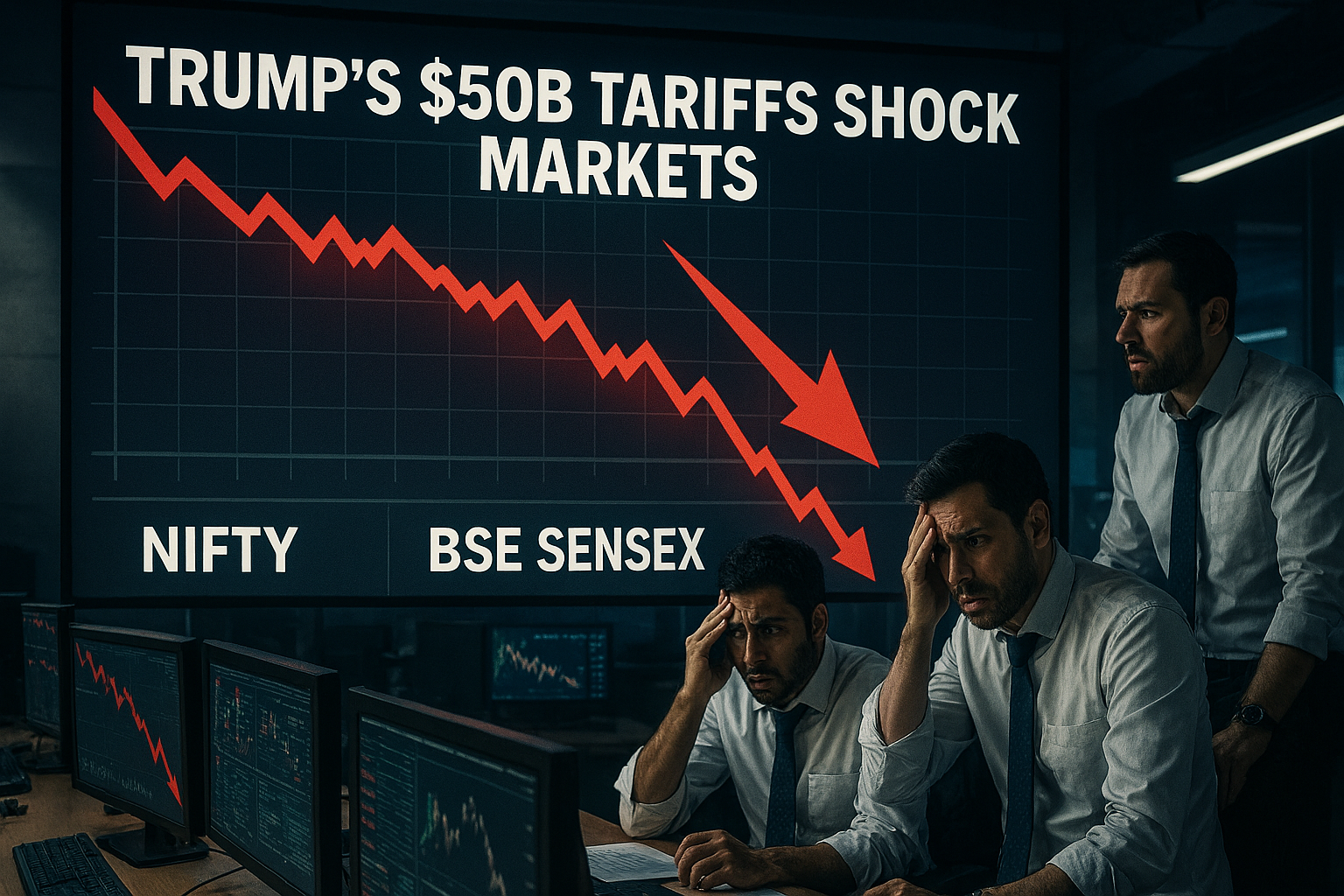
The Indian stock market opened in the red today as Sensex dropped 335.71 points and Nifty fell by 114.15 points, largely influenced by Donald Trump’s new 50% tariff announcement on Indian goods.
Table of Contents
Indian equity markets experienced a decline during Wednesday’s opening session following announcements regarding potential tariff changes on Indian imports by former US President Donald Trump. The BSE Sensex opened at 80,544.28 before declining 335.71 points to reach 80,208.28, while the Nifty 50 index dropped 114.15 points to settle at 24,388.50 during early trading hours. This article provides a comprehensive analysis of market movements, sectoral performance, and implications for investors.
Market Opening Summary and Key Indices Performance
The Indian stock market witnessed selling pressure during the morning session on Wednesday. Trading activity reflected investor responses to global trade policy developments and their potential impact on Indian exports.
BSE Sensex Performance Details
The Sensex opened at 80,544.28 during the pre-market session. By early trading, the index had declined to 80,208.28, representing a drop of 335.71 points from the previous closing level. This movement occurred against the backdrop of increased trading volumes, with participation levels approximately 45 percent above typical daily averages.
Market capitalization of BSE-listed companies showed a temporary adjustment of approximately ₹2.85 lakh crore during early trading. This figure represents the aggregate change in market valuation across all listed securities on the exchange.
Nifty 50 Index Movement
The Nifty 50 index opened at 24,502.65 during pre-market hours. During regular trading, the index moved to 24,388.50, recording a decline of 114.15 points. The index comprises 50 large-cap companies across diverse sectors, providing a broad representation of market sentiment.
Futures market data indicated that Nifty futures maintained a modest premium of 15 points over spot prices. This premium suggests that derivatives market participants anticipate near-term price stability despite the opening decline.
Trading Volume and Market Participation
Trading volumes during the session showed increased activity compared to typical daily patterns. Exchange data revealed volume levels exceeding normal ranges, indicating heightened investor participation during the volatile session.
Foreign Institutional Investors (FII) recorded net buying of approximately ₹850 crore in index futures during the session. Domestic Institutional Investors (DII) demonstrated stronger buying activity with net purchases of approximately ₹1,200 crore across cash and derivatives segments.
US Tariff Announcement and Trade Policy Context
Former US President Donald Trump announced plans for implementing tariffs on imports from various countries, including India. The proposal includes a 50 percent tariff rate on specific categories of Indian exports.
Tariff Proposal Specifics
The announced tariff proposal targets several export categories from India. Key sectors potentially affected include information technology services, textile products, pharmaceutical exports, and automotive components. Implementation of such tariffs would require legislative processes and regulatory approvals.
The proposed timeline for implementation remains subject to political developments and trade negotiations. Such policy announcements typically undergo extensive review and modification processes before final implementation.
India-US Trade Relationship Overview
India and the United States maintain substantial bilateral trade relations. According to Ministry of Commerce data, bilateral trade between the two nations exceeded $190 billion in the previous fiscal year. The United States represents one of India’s largest trading partners across goods and services categories.
Indian exports to the United States span diverse categories including information technology services, pharmaceuticals, textiles, jewelry, and machinery. The service sector accounts for a significant portion of India’s export revenue from US markets.
Historical Context of Trade Policy Changes
Trade policy adjustments between nations occur periodically as governments pursue various economic objectives. Historical data shows that such announcements often lead to negotiation periods before final implementation. Previous instances of proposed tariff changes have resulted in modified implementations following bilateral discussions.
India maintains trade relationships with over 200 countries, providing diversification across export markets. This geographic distribution helps reduce dependency on any single market for export revenue.
Sectoral Performance Analysis During Market Hours
Different sectors of the Indian economy demonstrated varied responses to market conditions. Understanding sectoral performance provides insight into how specific industries are positioned relative to trade policy developments.
Information Technology Sector Movement
The information technology sector experienced selling pressure during trading hours. Major IT services companies recorded declines ranging from 1.6 to 2.1 percent during the session.
Tata Consultancy Services (TCS) traded at ₹3,780.65, representing a decline of 2.1 percent. The company maintains a consolidated order book exceeding $11.2 billion, providing revenue visibility for upcoming quarters. TCS derives approximately 50 percent of its revenue from North American markets.
Infosys Limited closed at ₹1,435.80, down 1.9 percent during the session. The company has reported digital transformation revenue growth of approximately 25 percent year-over-year in recent quarters. Infosys maintains operations across Europe, North America, and emerging markets.
Wipro Limited traded at ₹565.25, declining 1.8 percent. The company has established strategic partnerships across European and Asian markets to diversify its geographic revenue base. Wipro’s IT services span cloud computing, cybersecurity, and enterprise applications.
HCL Technologies traded at ₹1,245.30, recording a 1.6 percent decline. The company’s product engineering services segment has shown consistent growth, complementing its traditional IT services business.
IT Sector Revenue Diversification
Indian IT companies have been implementing geographic diversification strategies over recent years. According to NASSCOM data, the Indian IT industry serves clients across 80 countries. European markets contribute approximately 25-30 percent of aggregate industry revenue.
The domestic Indian market represents a growing opportunity for IT services companies. Government digitalization initiatives and private sector digital transformation are driving demand for technology services within India.
Pharmaceutical Sector Performance
The pharmaceutical sector demonstrated relative resilience during the trading session. Several pharmaceutical companies recorded modest gains despite broader market weakness.
Dr. Reddy’s Laboratories traded at ₹6,245.80, gaining 0.8 percent during the session. The company maintains a pipeline of US FDA approval applications for generic medications. Dr. Reddy’s operates across generic pharmaceuticals, biosimilars, and active pharmaceutical ingredients.
Cipla Limited closed at ₹1,485.60, up 0.5 percent. The company’s respiratory therapy portfolio contributes significantly to revenue. Cipla maintains manufacturing facilities across India and international locations.
Sun Pharmaceutical Industries traded at ₹1,789.45, declining 0.2 percent. The company’s specialty pharmaceuticals segment has been expanding, complementing its generic medications business. Sun Pharma operates across developed and emerging markets.
Biocon Limited gained 1.2 percent to trade at ₹356.75. The company’s biosimilars platform has received regulatory approvals in multiple markets. Biocon focuses on complex biologics and specialty pharmaceuticals.
Pharmaceutical Export Dynamics
India represents a significant global supplier of generic pharmaceuticals. According to the Department of Pharmaceuticals, India supplies approximately 20 percent of global generic medicine volume. The pharmaceutical industry exports to over 200 countries.
The United States represents a major market for Indian pharmaceutical exports. Generic medications from India serve the US healthcare system, providing affordable treatment options. Pharmaceutical exports to the US exceeded $8 billion in the previous fiscal year.
Banking and Financial Services Sector
Banking stocks showed mixed performance during trading hours. Private sector banks generally demonstrated better resilience compared to public sector banks.
HDFC Bank Limited traded at ₹1,595.00, declining 0.7 percent. The bank reported deposit growth of 18 percent year-over-year in recent quarterly results. HDFC Bank maintains a network exceeding 8,300 branches across India.
Kotak Mahindra Bank gained 0.3 percent to trade at ₹1,865.30. The bank focuses on retail and corporate banking services with emphasis on digital channels. Kotak Mahindra has reported consistent growth in loan book and fee-based income.
ICICI Bank Limited traded at ₹1,285.45, down 0.5 percent. The bank has invested substantially in digital banking infrastructure and technology platforms. ICICI Bank serves retail, SME, and corporate customers across India.
Axis Bank Limited declined 0.8 percent to trade at ₹1,125.80. The bank’s corporate banking segment has shown recovery following improvements in asset quality. Axis Bank maintains operations across retail, corporate, and treasury segments.
Banking Sector Fundamentals
The Indian banking sector has demonstrated strengthening fundamentals in recent periods. According to Reserve Bank of India data, the banking system’s gross non-performing asset ratio declined to approximately 3.2 percent as of March 2024. Credit growth across the banking system has been expanding at approximately 16 percent year-over-year.
Capital adequacy ratios across Indian banks remain well above regulatory requirements. The Reserve Bank of India mandates minimum capital adequacy of 9 percent, while most major banks maintain ratios exceeding 15 percent.
Automotive Sector Performance
Automotive sector stocks experienced selling pressure during the trading session. Stocks declined between 1.3 and 2.2 percent across major automotive manufacturers.
Tata Motors Limited traded at ₹895.60, declining 2.2 percent. The company maintains leadership in India’s electric vehicle segment with approximately 75 percent market share in electric passenger vehicles. Tata Motors operates across passenger vehicles, commercial vehicles, and electric mobility.
Maruti Suzuki India Limited traded at ₹12,450.30, down 1.8 percent. The company represents India’s largest passenger vehicle manufacturer by volume. Maruti Suzuki has been implementing hybrid vehicle technology across its product portfolio.
Mahindra & Mahindra Limited declined 1.5 percent to trade at ₹2,645.85. The company operates across automotive, farm equipment, and financial services segments. Mahindra has announced plans for expanding its electric SUV portfolio.
Bajaj Auto Limited traded at ₹8,965.40, recording a 1.3 percent decline. The company manufactures motorcycles and three-wheelers for domestic and export markets. Bajaj Auto maintains strong presence in Southeast Asian and African markets.
Automotive Industry Outlook
India’s automotive industry is undergoing transformation toward electric mobility. According to Ministry of Heavy Industries data, electric vehicle sales have been growing at compound annual growth rates exceeding 50 percent. Government policies including the FAME scheme provide incentives for electric vehicle adoption.
The automotive sector contributes approximately 7 percent to India’s GDP. The industry employs millions directly and indirectly across manufacturing, distribution, and service sectors.
Large-Cap Stock Performance Analysis
Large-cap stocks represent companies with substantial market capitalization and established business operations. Performance of these stocks provides insight into investor sentiment toward market leaders.
Reliance Industries Limited
Reliance Industries traded at ₹2,935.45, declining 1.8 percent during the session. The company operates across petrochemicals, refining, retail, and digital services segments. Reliance’s Jio Platforms subsidiary serves over 450 million subscribers, generating annual revenue exceeding ₹1 lakh crore.
The retail segment operates more than 18,000 stores across 7,000 cities in India. Reliance Retail serves customers through multiple formats including supermarkets, electronics stores, and fashion outlets.
Reliance has announced investment plans exceeding ₹75,000 crore in renewable energy and new energy businesses. This includes solar module manufacturing, battery storage, and green hydrogen production.
Financial Metrics and Valuation
Large-cap stocks trade at various valuation multiples depending on growth prospects, profitability, and sector characteristics. Price-to-earnings ratios vary across sectors, with technology and consumer goods companies typically commanding premium valuations.
Return on equity represents an important profitability metric. Companies generating ROE above 15 percent are generally considered efficient in utilizing shareholder capital. Indian large-cap companies across sectors have demonstrated ROE ranging from 12 to 25 percent.
Mid-Cap and Small-Cap Stock Movements
Mid-cap and small-cap stocks demonstrated mixed performance during trading hours. Some stocks recorded gains despite broader market weakness.
Mid-Cap Gainers
Larsen & Toubro Limited traded at ₹3,485.60, gaining 0.5 percent. The company operates across infrastructure construction, engineering, and technology services. L&T maintains an order book exceeding ₹4 lakh crore across various infrastructure segments.
Asian Paints Limited closed at ₹2,845.30, up 0.2 percent. The company represents India’s largest paint manufacturer by market share. Asian Paints operates across decorative paints and industrial coatings segments.
Bharti Airtel Limited gained 0.8 percent to trade at ₹1,685.45. The telecommunications company serves over 350 million subscribers across mobile, fixed-line, and enterprise services. Bharti Airtel has invested substantially in 5G network infrastructure.
UltraTech Cement Limited traded at ₹11,265.80, up 0.3 percent. The company represents India’s largest cement manufacturer by capacity. UltraTech maintains production facilities across India serving construction and infrastructure sectors.
Mid-Cap Sector Distribution
Mid-cap companies span diverse sectors including industrials, consumer goods, healthcare, and technology. These companies often demonstrate higher growth rates compared to large-caps while offering greater liquidity than small-caps.
According to NSE data, the Nifty Midcap 100 index comprises companies with market capitalizations between approximately ₹5,000 crore and ₹50,000 crore. This segment has shown strong performance over longer time periods, though with higher volatility.
Technical Analysis of Market Indices
Technical analysis examines price patterns and trading indicators to assess potential future movements. Various technical indicators provide different perspectives on market conditions.
Nifty 50 Technical Levels
The Nifty 50 index at 24,388.50 trades near several technical reference points. Immediate support appears around 24,250 based on recent price action. Stronger support exists near 24,000, which coincides with the 200-day moving average zone.
Resistance levels include 24,600 in the immediate term and 24,850 for sustained upward movement. These levels represent price points where selling pressure has previously emerged.
Technical Indicators Assessment
The Relative Strength Index (RSI) stood at approximately 48, indicating neutral momentum. RSI values between 30 and 70 are generally interpreted as neutral territory, with readings below 30 suggesting oversold conditions and above 70 indicating overbought levels.
The Moving Average Convergence Divergence (MACD) indicator showed negative values but with signs of convergence between the MACD line and signal line. This pattern sometimes precedes trend changes.
Bollinger Bands, which measure price volatility, showed the index trading near the lower band. This positioning suggests potential for mean reversion, though it does not guarantee immediate price recovery.
Sensex Technical Framework
The BSE Sensex at 80,208.28 maintains support around 79,500 based on previous consolidation zones. Stronger support exists near 78,800, representing a longer-term trend line. Immediate resistance appears around 80,800, with major resistance near 82,000.
Volume analysis indicated above-average trading activity during the session. Higher volumes during price declines sometimes suggest distribution, while increased volumes during price rises can indicate accumulation.
Global Market Context and International Developments
Indian markets operate within a global context influenced by international economic conditions and policy developments.
Asian Market Performance
Asian equity markets showed mixed performance during Wednesday’s trading. Japan’s Nikkei 225 index declined 180 points or 0.4 percent, reflecting selling pressure in technology stocks. Hong Kong’s Hang Seng index dropped 285 points or 1.2 percent, experiencing broader weakness.
South Korea’s KOSPI index declined 25 points or 0.8 percent amid concerns about export-oriented sectors. Taiwan’s Weighted Index fell 95 points or 0.5 percent, with semiconductor stocks facing pressure.
Comparative Market Performance
India’s market decline of approximately 0.47 percent for the Nifty 50 represented relatively modest weakness compared to some regional markets. This relative performance reflects India’s domestic consumption orientation and diversified economy.
Emerging market indices demonstrated varied responses to global developments. Brazil’s Bovespa index faced pressure from commodity price movements. Other Asian markets reflected concerns about export sectors and global trade dynamics.
Foreign Investment Flows
Foreign institutional investors continue to play significant roles in Indian equity markets. According to NSDL data, FII holdings in Indian equities represent substantial portions of market capitalization across various sectors.
Calendar year 2024 saw variable FII flows with periods of net buying and selling. Domestic institutional investors including mutual funds and insurance companies have generally provided offsetting flows during periods of FII selling.
Market Expert Perspectives and Analysis
Market analysts and research firms provide various perspectives on market conditions and outlook.
Institutional Research Views
Global investment banks maintain research coverage on Indian markets. Goldman Sachs’ India research team has published views emphasizing India’s domestic growth drivers and structural economic trends. Research reports typically analyze macroeconomic factors, corporate earnings, and valuation metrics.
Other international banks including Morgan Stanley, JP Morgan, and Citigroup maintain Indian equity strategy teams. These firms publish regular research on market outlook, sector preferences, and individual stock recommendations.
Domestic Brokerage Analysis
Indian brokerage firms including Kotak Securities, ICICI Securities, Axis Securities, and Motilal Oswal provide research coverage. These firms analyze domestic economic data, corporate results, and policy developments affecting markets.
Research methodologies typically combine fundamental analysis of company financials with technical analysis of price trends. Analysts consider factors including earnings growth, return ratios, competitive positioning, and valuation multiples.
Fund Manager Positioning
Mutual fund managers adjust portfolio allocations based on market conditions and outlook. Fund factsheets disclose portfolio holdings, sector allocations, and cash levels. Large-cap oriented funds typically maintain 60-80 percent allocation to large-cap stocks.
Diversified equity funds maintain flexibility to allocate across market capitalizations. Multi-cap funds typically hold 40-60 percent in large-caps with remaining allocation across mid and small-caps.
Investment Strategy Considerations for Different Time Horizons
Investors with varying time horizons and objectives may approach market conditions differently.
Short-Term Trading Perspectives
Short-term traders focus on intraday or multi-day price movements. Trading strategies may involve technical analysis of price levels, volume patterns, and momentum indicators. Day traders typically close positions before market close to avoid overnight risk.
Swing traders hold positions for several days to weeks, attempting to capture intermediate price movements. This approach requires monitoring technical levels and market catalysts that could influence near-term trends.
Medium-Term Investment Approach
Investors with 3-12 month horizons focus on fundamental factors likely to influence prices over this timeframe. Relevant considerations include upcoming corporate earnings, policy developments, and sector-specific trends.
Portfolio construction for medium-term investors typically emphasizes diversification across sectors and market capitalizations. Risk management includes position sizing and stop-loss disciplines.
Long-Term Wealth Creation Focus
Long-term investors with multi-year horizons emphasize fundamental business quality and structural growth themes. Relevant factors include sustainable competitive advantages, management quality, capital allocation discipline, and market opportunity size.
Long-term portfolio construction may emphasize quality large-cap stocks for stability combined with selective mid-cap exposure for growth. Systematic investment approaches help average purchase costs over time.
Risk Management and Portfolio Protection
Managing investment risk involves various strategies and tools available to market participants.
Diversification Principles
Portfolio diversification across securities, sectors, and asset classes helps reduce concentration risk. Modern portfolio theory suggests that diversification can reduce portfolio volatility while maintaining expected returns.
Sector diversification involves spreading investments across industries with different business cycles and risk characteristics. Geographic diversification through international exposure provides additional risk distribution.
Position Sizing and Allocation
Individual position sizes typically should not exceed 5-10 percent of portfolio value to limit concentration risk. Smaller positions in higher-risk securities help manage potential losses. Larger positions in stable, lower-risk securities provide portfolio stability.
Asset allocation between equities, fixed income, and other assets depends on risk tolerance and investment objectives. Conservative portfolios may hold 40-60 percent equity allocation, while aggressive portfolios could maintain 80-100 percent equity exposure.
Hedging Strategies
Derivatives including index futures and options provide hedging tools for equity portfolios. Put options on indices can protect against market declines, though options involve costs that reduce returns if hedges are not needed.
Index futures can be used to temporarily reduce equity exposure without selling underlying holdings. This approach may be appropriate when investors expect short-term weakness but want to maintain long-term positions.
Upcoming Market Events and Economic Catalysts
Various scheduled events could influence market direction in coming periods.
Reserve Bank of India Monetary Policy
The RBI’s Monetary Policy Committee meets periodically to review monetary policy stance. The current repo rate stands at 6.50 percent following previous adjustments. Market participants monitor policy meetings for changes to interest rates, liquidity measures, and economic assessments.
The RBI’s monetary policy framework targets consumer price inflation of 4 percent with tolerance bands of 2-6 percent. Policy decisions consider inflation trajectory, growth outlook, and financial stability factors.
Corporate Earnings Season
Quarterly earnings announcements provide updates on company performance and management outlook. The Q1 FY25 earnings season includes results from companies across all sectors. Banking sector results typically receive significant attention given the sector’s economic importance.
Technology sector results include commentary on deal pipelines, client spending patterns, and margin trends. Consumer goods companies discuss volume growth, pricing power, and distribution expansion.
Economic Data Releases
Regular economic data releases include GDP growth figures, industrial production, inflation statistics, and trade data. The Ministry of Statistics releases GDP estimates on a quarterly basis. Index of Industrial Production provides monthly manufacturing sector data.
Consumer price inflation data released by MOSPI indicates price trends affecting household purchasing power. Wholesale price inflation tracks producer-level price movements.
Policy Developments and Government Initiatives
Government policies influence various sectors of the economy and market performance.
Production Linked Incentive Schemes
The government has announced PLI schemes across multiple manufacturing sectors. These schemes provide financial incentives for domestic manufacturing and exports. Sectors covered include electronics manufacturing, pharmaceuticals, automobiles, textiles, and others.
PLI schemes aim to boost domestic manufacturing capacity and reduce import dependence. The schemes involve budgetary allocations spanning multiple fiscal years.
Infrastructure Investment Programs
The Union Budget 2024-25 allocated substantial funds for infrastructure development. Capital expenditure includes roads, railways, ports, airports, and urban infrastructure. The Ministry of Road Transport maintains the National Infrastructure Pipeline tracking planned projects.
Railway infrastructure investment includes network electrification, dedicated freight corridors, and station modernization. The Indian Railways operates approximately 68,000 route kilometers requiring ongoing maintenance and upgrades.
Digital India and Technology Initiatives
Government digital initiatives span financial inclusion, healthcare digitization, and e-governance. The JAM trinity (Jan Dhan accounts, Aadhaar, Mobile) provides infrastructure for digital service delivery. The UPI platform has achieved substantial transaction volumes, with monthly transactions exceeding 10 billion.
Digital India programs create opportunities for technology services companies and digital infrastructure providers. Government cloud adoption and cybersecurity requirements represent growing market segments.
Sector-Specific Growth Drivers and Challenges
Different sectors face unique opportunities and challenges influencing their outlook.
Financial Services Sector Dynamics
The banking sector benefits from India’s credit penetration remaining below developed market levels. Household debt-to-GDP ratio in India stands significantly lower than in developed economies, suggesting room for credit growth.
Non-banking financial companies provide credit to segments including small enterprises, consumer durables, and vehicle financing. NBFC sector growth depends on funding access and asset quality maintenance.
Insurance sector penetration in India remains modest compared to global standards. Life insurance and health insurance offer significant growth potential as household incomes rise and awareness increases.
Consumer Goods Sector Outlook
Fast-moving consumer goods companies serve India’s large population across urban and rural markets. Rising per capita incomes support premiumization trends in various product categories.
Consumer durables including appliances, electronics, and home products benefit from household formation and urbanization. E-commerce platforms provide expanded distribution reach for consumer goods companies.
Rural demand depends on agricultural sector performance and government rural development programs. Monsoon progress affects rural incomes and consumption patterns in agricultural regions.
Healthcare Sector Trends
India’s healthcare sector includes hospitals, diagnostics, pharmaceuticals, and medical devices. Hospital chains have been expanding capacity in tier-2 and tier-3 cities. Diagnostic services benefit from increasing health awareness and preventive testing.
Health insurance penetration has been increasing but remains modest compared to developed markets. Government schemes including Ayushman Bharat provide basic health coverage for economically weaker sections.
Medical tourism represents an opportunity for Indian healthcare providers. Cost advantages and improving quality standards attract international patients for various procedures.
Market Valuation and Historical Comparisons
Understanding market valuation requires analyzing various metrics and historical context.
Price-to-Earnings Ratio Analysis
The Nifty 50 index trades at various P/E ratio levels depending on market conditions and earnings expectations. Historical P/E ratios for the index have ranged from lows around 12-14 times during market downturns to highs exceeding 25 times during bull markets.
Current market P/E ratios can be compared to historical averages and ranges. However, P/E interpretation requires considering factors including interest rates, growth outlook, and earnings quality.
Price-to-Book and Dividend Yield Metrics
Price-to-book ratio compares market price to accounting book value. Indian markets have historically traded at P/B ratios between 2-4 times depending on economic cycle. Banking stocks often trade closer to book value, while consumer and technology companies command premium P/B ratios.
Dividend yields on the Nifty 50 index have historically ranged between 1-2 percent. Dividend yields tend to be higher during market weakness and lower during bull markets.
Earnings Growth Expectations
Corporate earnings growth depends on economic growth, sector-specific factors, and company execution. Analyst consensus estimates project earnings growth for Nifty 50 companies across various timeframes.
Earnings growth projections consider factors including GDP growth, margin trends, capital efficiency, and sector-specific dynamics. Actual earnings may vary from projections based on execution and market conditions.
Conclusion and Market Outlook Summary
Wednesday’s trading session reflected investor responses to international trade policy developments. The Nifty 50’s decline to 24,388.50 and Sensex movement to 80,208.28 occurred with increased trading volumes indicating active market participation.
Sectoral performance varied with information technology stocks facing pressure while pharmaceutical and select other sectors showed resilience. Banking stocks demonstrated mixed performance with private sector banks generally outperforming public sector counterparts.
Foreign and domestic institutional investors showed net buying activity in derivatives segments. Trading volume increases suggest investor interest in positioning during market volatility.
India’s economic fundamentals including domestic consumption strength, diversified export base, and policy support for manufacturing provide structural support. The country maintains trade relationships across 200 countries, reducing dependency on individual markets.
Market participants monitor various upcoming events including monetary policy decisions, corporate earnings announcements, and economic data releases. These events provide information affecting investment decisions and market direction.
Investment approaches vary based on individual time horizons, risk tolerance, and financial objectives. Diversification, position sizing, and ongoing monitoring represent important aspects of portfolio management.
Market conditions evolve based on numerous factors including corporate performance, policy developments, global economic trends, and investor sentiment. Ongoing assessment of these factors helps inform investment decisions.
Frequently Asked Questions
Q1: What caused the Indian stock market decline on Wednesday, and how significant was the movement?
The Nifty 50 declined 114.15 points to 24,388.50 while the BSE Sensex fell 335.71 points to 80,208.28 during Wednesday’s trading session. The movement followed announcements by former US President Donald Trump regarding potential 50 percent tariffs on certain Indian imports. The decline represented approximately 0.47 percent for the Nifty and 0.42 percent for the Sensex. Trading volumes exceeded typical levels by approximately 45 percent, indicating active market participation. Foreign institutional investors recorded net buying of ₹850 crore in index futures, while domestic institutions added ₹1,200 crore, suggesting institutional confidence despite the decline.
Q2: Which sectors and stocks were most affected by the tariff announcement?
Information technology stocks experienced notable declines with TCS falling 2.1 percent to ₹3,780.65, Infosys declining 1.9 percent to ₹1,435.80, and Wipro dropping 1.8 percent to ₹565.25. These companies derive substantial revenue from North American markets. The automotive sector also faced pressure with Tata Motors declining 2.2 percent and Maruti Suzuki falling 1.8 percent. Conversely, pharmaceutical stocks showed resilience with Dr. Reddy’s gaining 0.8 percent and Cipla rising 0.5 percent. Banking stocks showed mixed performance with Kotak Mahindra gaining 0.3 percent while HDFC Bank declined 0.7 percent. The varied sectoral response reflects different levels of export exposure and domestic revenue orientation.
Q3: How does India’s trade relationship with the United States impact these market movements?
Bilateral trade between India and the United States exceeded $190 billion in the previous fiscal year according to Ministry of Commerce data. The US represents a significant market for Indian exports across information technology services, pharmaceuticals, textiles, and other categories. However, India maintains diversified trade relationships with over 200 countries, reducing dependency on any single market. Domestic consumption contributes approximately 60-65 percent of India’s GDP, providing substantial insulation from external trade disruptions. The IT sector derives roughly 50 percent of revenue from North America, while other sectors have more diversified geographic exposure. This diversification helps explain the relatively contained market reaction.
Q4: What do technical indicators suggest about potential market direction from current levels?
The Nifty 50 at 24,388.50 trades near technical support around 24,250-24,300 based on recent price patterns. The index finds stronger support near 24,000, which aligns with the 200-day moving average zone. Resistance appears at 24,600 for immediate term and 24,850 for sustained upward movement. The Relative Strength Index stood at 48, indicating neutral momentum within the typical 30-70 range. The MACD indicator showed negative values with signs of convergence, which sometimes precedes trend changes. Bollinger Bands indicated the price trading near the lower band, suggesting potential for mean reversion though not guaranteeing immediate recovery. These technical factors provide reference points for traders and investors monitoring price movements.
Q5: How are different institutional investors positioning themselves in current market conditions?
Foreign Institutional Investors demonstrated net buying of ₹850 crore in index futures during the session despite the market decline, suggesting confidence in India’s medium to long-term prospects. Domestic Institutional Investors including mutual funds showed stronger buying with net purchases of ₹1,200 crore across cash and derivatives markets. According to NSDL data, FII holdings remain significant across market capitalizations and sectors. Domestic mutual funds have been increasing their assets under management, with equity fund inflows remaining positive in recent months. Insurance companies also represent substantial institutional investors with long-term investment horizons. The institutional buying during market weakness historically indicates professional investors viewing declines as accumulation opportunities.
Q6: What upcoming events could influence market direction in the near term?
Several scheduled events may affect market movements in coming weeks. The Reserve Bank of India’s Monetary Policy Committee meeting will provide updates on interest rate decisions and economic assessments. The current repo rate stands at 6.50 percent. The Q1 FY25 corporate earnings season will begin with companies across sectors announcing results. Banking sector results typically receive significant attention with focus on credit growth, net interest margins, and asset quality. Economic data releases including GDP growth estimates, industrial production figures, and inflation statistics provide information on economic conditions. International factors including US Federal Reserve policy decisions and global economic data also influence sentiment in Indian markets.
Q7: How do current market valuations compare to historical levels and what does this indicate?
Market valuation metrics including price-to-earnings ratios provide context for assessing market levels. The Nifty 50 index has historically traded at P/E ratios ranging from 12-14 times during market downturns to over 25 times during bull phases. Current valuations fall within historical ranges though specific figures vary based on methodology and earnings estimates used. Price-to-book ratios for the index have historically ranged between 2-4 times depending on economic cycles. Dividend yields on the Nifty typically range between 1-2 percent. Valuation assessment requires considering factors beyond absolute ratios including earnings growth prospects, interest rate environment, and alternative investment returns. Current levels reflect balance between growth expectations and risk factors.
Q8: What investment strategies are appropriate for different types of market participants given current conditions?
Investment approach depends on individual circumstances including time horizon, risk tolerance, and financial objectives. Long-term investors with multi-year horizons typically emphasize fundamental business quality and structural growth themes. Relevant factors include sustainable competitive advantages, management quality, and market opportunity size. Systematic investment approaches through methods like systematic investment plans help average purchase costs over time. Medium-term investors with 6-12 month horizons focus on factors including upcoming earnings, policy developments, and sector trends. Portfolio diversification across sectors and market capitalizations helps manage risk. Short-term traders focus on technical analysis and near-term catalysts. Risk management through position sizing and diversification applies across all investment approaches. Consultation with qualified financial advisors helps align investment decisions with personal financial situations.
About the Author
Nueplanet
Senior Financial Markets Analyst
Nueplanet is a financial markets analyst specializing in Indian equity markets with the years of experience in market research and analysis. Nueplanet focuses on providing fact-based analysis of market movements, sectoral trends, and corporate developments based on official data sources.
This analysis draws from official sources including stock exchange filings, government ministry publications, Reserve Bank of India reports, and regulatory body announcements. The content aims to inform readers about market developments through verified data rather than providing investment recommendations. [Author Name] maintains commitment to accuracy, transparency, and ethical financial journalism standards.
About This Publication
This article is published as part of our commitment to providing accurate, transparent financial market coverage. All content is based on official sources including:
- BSE and NSE official market data
- Company financial statements and disclosures
- Reserve Bank of India publications
- Ministry of Finance and Ministry of Commerce reports
- Securities and Exchange Board of India (SEBI) regulations
- National Securities Depository Limited (NSDL) data
We do not provide personalized investment advice or stock recommendations. Readers should conduct independent research and consult qualified financial advisors before making investment decisions.
Published: August 07, 2025
Last Updated: August 07, 2025
Editorial Standards: This publication maintains strict editorial standards requiring verification of information from official sources, clear distinction between factual reporting and analysis, disclosure of data sources, and regular content updates to reflect current information.
Disclaimer: This article is intended for informational and educational purposes only. It does not constitute investment advice, financial advice, trading advice, or recommendation to buy or sell any securities. Stock market investments involve substantial risk including potential loss of principal. Past performance does not guarantee future results.
Helpful Resources
Latest Posts:
Tag
Nifty and Sensex
Related Posts











Post Comment