









The Ultimate Guide to the MSME Sector in India: Challenges, Reforms & Future Outlook
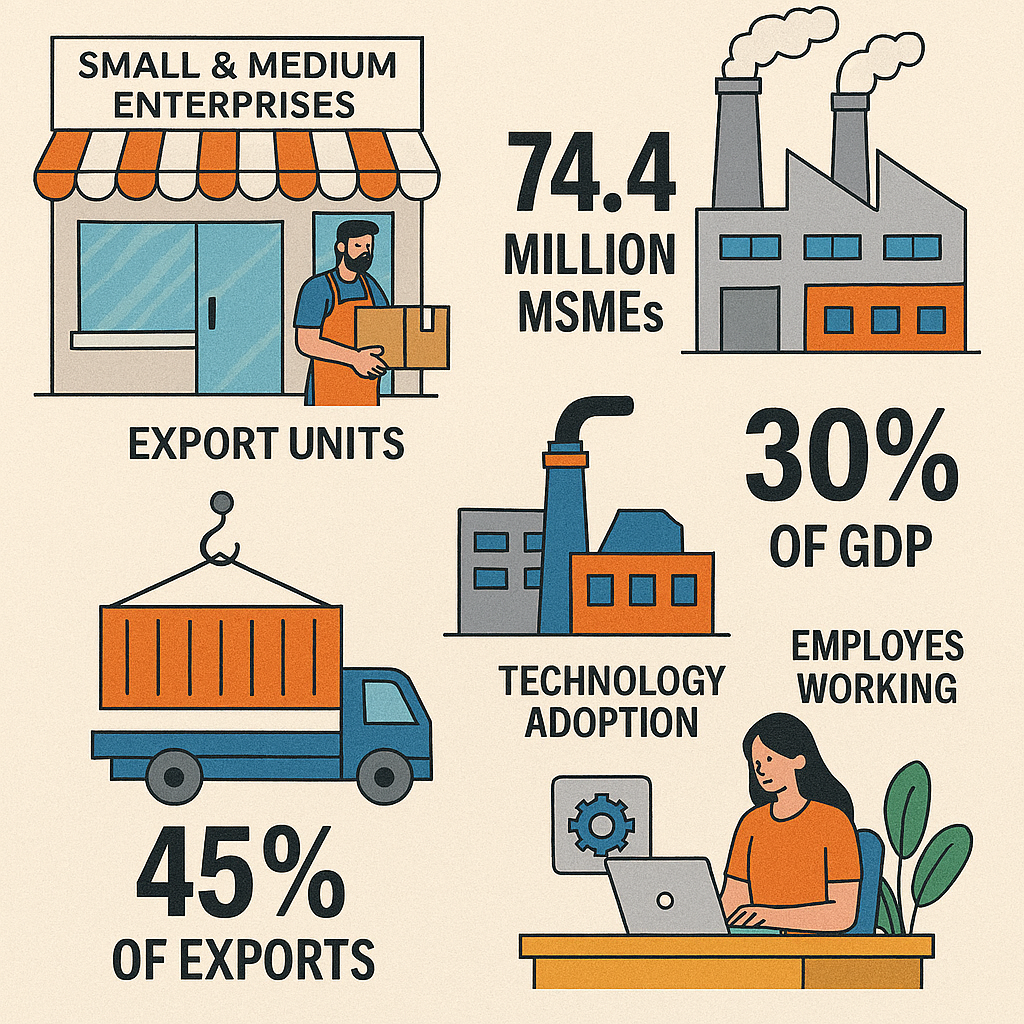
India’s MSME sector drives employment, innovation, and exports, forming a vital part of the economy. This blog examines current challenges, government reforms, and future opportunities for MSMEs.
Table of Contents
Published: September ,06 2025 | Last Updated: September 06, 2025
India’s Micro, Small, and Medium Enterprise (MSME) sector represents a critical component of the national economy, functioning as the primary engine for employment generation and industrial development. As of May 2025, official data indicates that over 6.44 crore MSMEs are registered across the country, employing approximately 26.77 crore individuals. This sector contributes 30% to India’s Gross Domestic Product (GDP) and accounts for 45.7% of total exports, demonstrating its substantial economic significance.
The MSME ecosystem encompasses diverse business activities ranging from traditional manufacturing to technology-driven services. These enterprises operate across urban and rural areas, facilitating regional economic development and reducing geographical disparities in industrial growth. Despite their economic importance, MSMEs face persistent challenges including limited access to formal credit, technological constraints, and skilled workforce shortages.
Recent government initiatives implemented during 2024-2025 aim to address these structural challenges through reforms in tax compliance, credit availability, and skill development programs. This analysis examines the current state of India’s MSME sector, evaluates recent policy measures, and assesses their impact on operational efficiency and competitive positioning.
Understanding India’s MSME Classification Framework
The Ministry of MSME classifies enterprises based on investment in plant and machinery or equipment combined with annual turnover thresholds. This classification system underwent revision to align with contemporary business requirements and inflation adjustments.
Micro enterprises maintain investment limits up to ₹1 crore with annual turnover not exceeding ₹5 crore. Small enterprises can invest up to ₹10 crore with turnover limits of ₹50 crore. Medium enterprises face investment caps of ₹50 crore and turnover restrictions of ₹250 crore.
This classification framework determines eligibility for various government schemes, credit facilities, and regulatory benefits. Understanding these categories helps entrepreneurs access appropriate support mechanisms and compliance requirements based on their business scale.
The classification system applies uniformly across manufacturing and services sectors, eliminating previous distinctions between these categories. This unified approach simplifies registration procedures and enhances transparency in government scheme implementation.
Current Registration and Employment Statistics
According to the latest data from the Ministry of MSME released in May 2025, total registered MSMEs reached 6.44 crore, representing a 12% increase from the previous fiscal year. This growth reflects improved registration processes through the Udyam portal and increased awareness about formalization benefits.
The employment figure of 26.77 crore workers makes MSMEs the largest employment provider in India after agriculture. Between 2023 and 2025, the sector generated over 2.5 crore new jobs, with notable increases in manufacturing, services, and retail segments.
Women’s participation in MSME employment increased by 15% during this period, indicating improved inclusivity in entrepreneurship and workforce engagement. Rural and semi-urban areas accounted for approximately 65% of new MSME registrations, supporting balanced regional development objectives.
Manufacturing MSMEs constitute 31% of registered enterprises, followed by services at 38%, and retail trade at 31%. This distribution reflects the sector’s diverse nature and its role across multiple economic activities.
Economic Contribution Analysis
GDP Contribution Metrics
The MSME sector’s 30% contribution to India’s GDP represents approximately ₹60 lakh crore in absolute terms for fiscal year 2024-25. This contribution has shown consistent growth over the past five years, increasing from 28.5% in 2020-21.
Government projections suggest potential growth to 35% of GDP by 2030, contingent on successful implementation of digitalization initiatives and enhanced credit availability. The manufacturing segment within MSMEs contributes 12% to total GDP, while services contribute 18%.
Productivity improvements through technology adoption could accelerate this growth trajectory. However, achieving these targets requires addressing structural constraints in credit access, skill availability, and market connectivity.
Export Performance Overview
MSME exports reached $180 billion in fiscal year 2024-25, representing 45.7% of India’s total export value. This performance demonstrates the sector’s competitive capabilities in international markets across multiple product categories.
Textile and apparel exports from MSMEs totaled $42 billion, maintaining their position as the largest export segment. Engineering goods contributed $38 billion, while pharmaceuticals and chemicals added $28 billion to MSME export earnings.
Emerging segments including electronics manufacturing, renewable energy components, and processed foods showed accelerated export growth. These segments recorded average annual growth rates exceeding 25% during 2023-2025, indicating diversification beyond traditional export categories.
Regional export patterns show concentration in specific states, with Gujarat, Maharashtra, Tamil Nadu, and Karnataka accounting for 58% of total MSME exports. This concentration suggests opportunities for expanding export capabilities across other regions through infrastructure development and market linkage programs.
Recent Government Policy Measures
GST Compliance Reforms
The government implemented significant GST compliance reforms during 2024-2025 to reduce administrative burdens on small enterprises. These measures include quarterly return filing for businesses with annual turnover up to ₹5 crore, replacing previous monthly requirements.
This change resulted in a 75% reduction in compliance filing frequency for eligible MSMEs, allowing reallocation of administrative resources toward business development activities. Official data indicates that affected enterprises save approximately 15-20 hours monthly on GST-related paperwork.
Digital compliance portals launched in January 2025 incorporate automated calculation systems and real-time error detection mechanisms. These technological improvements reduce compliance errors and minimize penalties resulting from inadvertent mistakes in tax calculations.
The composition scheme threshold was raised to ₹1.5 crore for goods suppliers and ₹75 lakh for service providers. This adjustment allows more small businesses to benefit from simplified tax payment mechanisms without detailed invoice-level tracking requirements.
Export Support Package
The export relief package announced in March 2025 allocates ₹50,000 crore for supporting export-oriented MSMEs. This package addresses challenges arising from global trade uncertainties and currency fluctuations affecting international competitiveness.
Key components include currency hedging support covering 70% of hedging costs, logistics subsidies reducing freight expenses by 15%, and duty drawback enhancements providing faster refund processing. These measures directly impact operational costs for enterprises engaged in international trade.
Preliminary data from April 2025 indicates that beneficiary MSMEs experienced an average 18% increase in export revenues within the first quarter of implementation. Textile manufacturers and engineering goods exporters reported the highest benefit utilization rates.
Market access initiatives under this package facilitate participation in international trade fairs and establish dedicated MSME zones in major global exhibitions. These initiatives enhance visibility for Indian products and enable direct buyer-seller interactions.
Credit Enhancement Initiatives
The Credit Guarantee Fund Trust for Micro and Small Enterprises (CGTMSE) expanded its coverage to over 1 crore MSMEs by June 2025, with total guaranteed credit reaching ₹5.2 lakh crore. This program enables collateral-free lending, addressing major barriers in credit access.
Banks and financial institutions show increased willingness to lend to MSMEs under this guarantee mechanism, as credit risk transfers partially to the guarantee fund. Non-performing asset (NPA) ratios for CGTMSE-covered loans remain below 4%, demonstrating effective risk assessment mechanisms.
The Small Industries Development Bank of India (SIDBI) launched the MSME Digital Lending Platform in February 2025, processing applications within 48 hours. This platform utilizes artificial intelligence algorithms for creditworthiness assessment, making lending decisions more efficient.
Approved lending through this digital platform exceeded ₹25,000 crore within five months of operation. Average loan processing time decreased from 15 days to 2 days, significantly improving working capital availability for small businesses.
Technology Adoption Support
The Digital MSME Scheme 2025 allocates ₹10,000 crore for technology upgradation across the sector. Subsidy coverage extends up to 70% of technology adoption costs for micro enterprises, reducing financial barriers to digital transformation.
Priority areas include cloud computing adoption, enterprise resource planning (ERP) systems, digital payment infrastructure, and e-commerce platform integration. Over 2.5 lakh MSMEs benefited from this scheme within the first six months of implementation.
Technology adoption impacts include improved inventory management, enhanced financial record-keeping, and better customer relationship management. Participating enterprises reported average productivity improvements of 23% following technology implementation.
Training programs accompanying technology subsidies ensure effective utilization of new systems. These programs cover basic digital literacy, software operation, and cybersecurity awareness for MSME owners and employees.
Critical Operational Challenges
Access to Formal Credit
Despite improvements through CGTMSE and digital lending platforms, 68% of MSMEs continue relying on informal financing sources according to surveys conducted in 2025. Informal lenders charge interest rates 3-5% higher than formal banking channels, increasing operational costs.
Working capital constraints affect 72% of surveyed MSMEs, limiting their ability to maintain inventory, fulfill large orders, and invest in business expansion. Seasonal businesses face acute challenges during off-peak periods when revenue generation decreases.
Collateral requirements remain prohibitive for many small enterprises lacking significant fixed assets. Real estate and machinery pledged as security often exceed loan values, making formal credit inaccessible despite business viability.
Credit history limitations affect newly established enterprises and businesses transitioning from informal to formal operations. Traditional lending models emphasize historical financial performance, disadvantaging enterprises with limited documented track records.
Technology Integration Gaps
Industry analysis reveals that only 35% of MSMEs adopted digital payment systems by 2025, while 22% utilize cloud-based software for business operations. This digital divide creates competitive disadvantages against larger corporations with comprehensive technology infrastructure.
Limited awareness about available technology solutions contributes to slow adoption rates. Many small business owners lack information about software options, implementation processes, and potential benefits from digitalization.
Financial constraints prevent technology investments despite awareness of potential benefits. Initial setup costs, annual subscription fees, and training expenses create barriers for enterprises operating on tight profit margins.
Infrastructure limitations including unreliable electricity supply and inadequate internet connectivity particularly affect rural and semi-urban MSMEs. These foundational constraints prevent effective technology utilization even when financial resources are available.
Market Access Constraints
MSMEs face competition from established corporations with superior marketing capabilities, distribution networks, and brand recognition. Limited marketing budgets restrict visibility and customer acquisition for small enterprises.
E-commerce platforms present opportunities but require technical capabilities and operational adjustments. Only 28% of MSMEs actively sell through digital channels as of 2025, compared to nearly universal adoption by large enterprises.
Dependency on limited customers or specific markets creates vulnerability to economic fluctuations. Enterprises serving single industries or geographic regions face significant risks when those markets experience downturns.
Supply chain integration challenges prevent participation in larger value chains where scale and reliability requirements exceed MSME capabilities. Long payment cycles from larger customers strain working capital availability.
Skilled Workforce Shortages
Current estimates indicate a shortfall of 1.2 crore skilled workers across the MSME sector. This gap is particularly acute in manufacturing, specialized services, and technology-driven businesses requiring technical expertise.
Training infrastructure often fails to align with industry requirements, producing graduates with theoretical knowledge but limited practical skills. Enterprises must invest significantly in on-the-job training to develop workforce capabilities.
Employee retention challenges affect MSMEs as skilled workers migrate toward larger corporations offering higher salaries and better benefits. This talent drain particularly impacts knowledge-intensive businesses.
Awareness about vocational training programs remains limited among potential workers and employers. Despite government initiatives, information gaps prevent effective matching of training supply with industry demand.
Regulatory Compliance Burden
MSMEs spend an average 12% of annual revenue on compliance-related activities, significantly exceeding the 3-4% spent by large corporations. This disproportionate burden arises from fixed compliance costs affecting smaller operations more severely.
Complex regulatory frameworks spanning GST, labor laws, environmental regulations, and industry-specific norms require specialized knowledge. Small enterprises often cannot afford dedicated compliance staff, forcing owners to manage these requirements personally.
Frequent regulatory changes create uncertainty and require continuous monitoring of policy updates. Implementation of new regulations often lacks adequate transition periods, creating immediate compliance pressures.
Penalties for non-compliance can be severe relative to business scale, threatening viability of small enterprises. The regulatory system often treats infractions uniformly regardless of business size or intent.
Sector Performance Across Industries
Manufacturing Segment
Manufacturing MSMEs constitute 31% of total registered enterprises, operating across traditional and modern industrial activities. This segment employs approximately 8.3 crore workers, making it crucial for industrial employment generation.
Food processing represents the largest manufacturing subsector, accounting for 18% of manufacturing MSMEs. Textiles and apparel follow at 16%, while metal products contribute 12% to the manufacturing MSME count.
Capital goods manufacturing by MSMEs supports larger industrial operations through component supplies and ancillary services. This ecosystem creates interdependencies between small and large enterprises across value chains.
Production capacity utilization averaged 68% during 2024-25, indicating scope for output expansion without significant capital investment. Demand constraints rather than supply limitations appear to restrict growth in many manufacturing segments.
Services Sector
Services MSMEs represent 38% of registered enterprises, covering professional services, hospitality, transportation, and technical services. This segment demonstrates strong growth potential given India’s evolving economic structure.
Information technology services provided by MSMEs contribute significantly to software development, digital marketing, and business process outsourcing. This subsector recorded 32% annual growth during 2023-2025, driven by increasing digitalization demand.
Professional services including accounting, legal advisory, and consulting activities employ highly skilled workers. These enterprises face limited capital requirements but depend heavily on human resource quality.
Hospitality and tourism-related MSMEs recovered strongly following pandemic disruptions, achieving 95% of pre-2020 revenue levels by March 2025. However, regional variations persist based on tourism infrastructure and destination attractiveness.
Retail Trade
Retail MSMEs account for 31% of registered enterprises, operating through traditional stores and emerging online channels. This segment serves as crucial distribution infrastructure connecting manufacturers with consumers.
Kirana stores and small retail outlets continue dominating neighborhood commerce despite e-commerce growth. These businesses provide employment to approximately 8 crore individuals, often as family enterprises.
Competition from organized retail chains and e-commerce platforms creates pressure on traditional retailers. Adaptation through digital payment acceptance and online presence becomes necessary for survival.
Value addition through personalized service, credit facilities, and home delivery helps small retailers maintain customer relationships. These competitive advantages sustain viability despite scale disadvantages.
Innovation and Patent Filing Trends
MSME patent filings reached 15,000 during 2024, representing a 40% increase from the previous year. This trend indicates growing innovation capabilities within the sector beyond traditional manufacturing activities.
Technology and engineering sectors account for 62% of MSME patent filings, followed by pharmaceuticals at 18% and agricultural innovations at 12%. These patterns reflect research and development investments in knowledge-intensive industries.
Government incentives for intellectual property protection encourage formal patent applications. Subsidized filing fees and assistance programs reduce financial and procedural barriers for small enterprises.
Patent commercialization remains challenging as MSMEs often lack resources for large-scale production or marketing of innovative products. Collaboration mechanisms with larger corporations could help translate innovations into market success.
Regional Distribution Patterns
Maharashtra hosts the highest MSME concentration with 82 lakh registered enterprises, followed by Uttar Pradesh at 74 lakh and Tamil Nadu at 56 lakh. These states benefit from established industrial infrastructure and market access.
Tier-2 and tier-3 cities accounted for 72% of new MSME registrations during 2024-25, indicating geographical dispersal of entrepreneurial activity. This trend supports balanced regional development objectives and reduces urban migration pressures.
North-eastern states show accelerating MSME growth rates despite lower absolute numbers. Focused government programs and infrastructure investments drive entrepreneurship in previously underserved regions.
State-level policy variations affect business environments significantly. States offering simplified approvals, dedicated industrial parks, and effective grievance redressal mechanisms attract higher enterprise formation rates.
Financial Performance Indicators
Average MSME profit margins range from 8-12% across sectors, with technology services achieving higher margins while retail operations operate on thinner spreads. These margins face pressure from input cost inflation and competitive pricing constraints.
Return on investment periods average 3-5 years for manufacturing enterprises and 2-3 years for service businesses. Capital intensity variations explain these differences, with manufacturing requiring higher initial investments.
Revenue growth rates averaged 14% annually during 2023-2025, exceeding GDP growth and indicating sectoral dynamism. However, significant variations exist across industries and individual enterprise performance.
Debt-to-equity ratios average 1.8:1 for MSMEs, indicating moderate leverage levels. Access to additional debt financing remains constrained despite reasonable existing debt loads.
Impact of Global Economic Factors
Global trade uncertainties including tariff adjustments by major economies affect export-oriented MSMEs significantly. Dependence on specific export markets creates vulnerability to international policy changes beyond domestic control.
Currency exchange rate fluctuations impact profitability for enterprises engaged in international transactions. Rupee depreciation benefits exporters but increases costs for import-dependent manufacturers.
Supply chain disruptions experienced during 2020-2022 demonstrated vulnerability of globally integrated MSMEs. Businesses are now diversifying supplier relationships and maintaining higher inventory buffers, increasing working capital requirements.
Emerging opportunities in alternative markets including Africa, Latin America, and Southeast Asia provide diversification options. Government trade promotion initiatives facilitate market exploration in these regions.
Future Growth Projections
Industry analysts project 15-18% annual MSME sector growth through 2030, driven by digitalization, credit expansion, and domestic demand increases. This growth trajectory would elevate GDP contribution to 35% by decade’s end.
Manufacturing MSME growth depends on successful implementation of production-linked incentive schemes and electronics manufacturing promotion. These initiatives aim to position India as a global manufacturing hub.
Services sector growth appears strongest in technology-enabled businesses, healthcare services, and professional consulting. These segments align with evolving economic structure and rising consumer incomes.
Export growth potential exists in pharmaceuticals, specialized engineering, and sustainable products. Global demand shifts toward environmental consciousness create opportunities for Indian MSMEs in green manufacturing.
Sustainability and Environmental Considerations
Environmental regulations increasingly affect MSME operations, particularly in manufacturing sectors. Compliance costs for pollution control equipment and waste management impact small enterprises disproportionately.
Adoption of sustainable practices offers competitive advantages in international markets where environmental standards influence purchasing decisions. Certifications demonstrating environmental compliance enhance export prospects.
Government subsidy programs for green technology adoption help offset transition costs. Solar power installation, energy-efficient equipment, and waste recycling systems receive financial support under these initiatives.
Circular economy principles present opportunities for innovative business models. Waste material recycling, product refurbishment, and biodegradable manufacturing inputs create new market segments for MSMEs.
Frequently Asked Questions (FAQs)
What is the current size of India’s MSME sector?
As of May 2025, India has over 6.44 crore registered MSMEs employing approximately 26.77 crore workers. This represents a 12% increase in registrations from the previous fiscal year. The sector contributes 30% to India’s GDP and accounts for 45.7% of total exports. Manufacturing enterprises constitute 31% of registered MSMEs, services account for 38%, and retail trade represents 31% of the total.
What government schemes support MSME credit access?
The Credit Guarantee Fund Trust for Micro and Small Enterprises (CGTMSE) provides collateral-free loan guarantees covering ₹5.2 lakh crore for over 1 crore MSMEs. The MSME Digital Lending Platform launched in February 2025 processes loan applications within 48 hours, approving over ₹25,000 crore in funding. SIDBI offers specialized lending facilities including working capital support and technology adoption loans with subsidized interest rates.
How do recent GST reforms benefit small businesses?
GST reforms implemented during 2024-2025 allow businesses with annual turnover up to ₹5 crore to file quarterly returns instead of monthly submissions, reducing compliance frequency by 75%. Digital portals with automated calculations and error detection save MSMEs approximately 15-20 hours monthly on compliance activities. The composition scheme threshold increased to ₹1.5 crore for goods and ₹75 lakh for services, simplifying tax payment for eligible enterprises.
What is the export performance of MSMEs?
MSME exports reached $180 billion in fiscal year 2024-25, representing 45.7% of India’s total export value. Textiles and apparel contribute $42 billion, engineering goods add $38 billion, and pharmaceuticals account for $28 billion in MSME exports. The export relief package announced in March 2025 allocates ₹50,000 crore for supporting international competitiveness, resulting in an average 18% revenue increase for beneficiary enterprises.
What are the major challenges facing MSMEs?
Primary challenges include limited access to formal credit (68% rely on informal financing), technology adoption gaps (only 35% use digital payments), skilled workforce shortages (1.2 crore worker deficit), restricted market access (only 28% sell through e-commerce), and regulatory compliance burdens (consuming 12% of annual revenue). These structural constraints limit growth potential despite favorable market conditions.
How does technology adoption impact MSME performance?
The Digital MSME Scheme 2025 allocates ₹10,000 crore for technology upgradation, subsidizing up to 70% of adoption costs for micro enterprises. Over 2.5 lakh MSMEs benefited within six months, reporting average productivity improvements of 23%. Technology adoption enhances inventory management, financial record-keeping, and customer relationships. However, only 22% of MSMEs currently utilize cloud-based software, indicating significant room for expansion.
What employment opportunities exist in the MSME sector?
The MSME sector employs 26.77 crore workers, making it India’s largest employer after agriculture. The sector created 2.5 crore new jobs between 2023-2025, with women’s participation increasing by 15%. Manufacturing employs 8.3 crore workers, while services and retail sectors provide employment to the remaining workforce. Skilled worker demand exceeds supply by 1.2 crore positions, creating opportunities for trained professionals.
What is the future outlook for India’s MSME sector?
Analysts project 15-18% annual growth through 2030, potentially increasing GDP contribution to 35%. Growth drivers include enhanced credit facilities, advanced technology integration, market diversification, comprehensive skill development, and sustainable manufacturing practices. Government support through policy reforms, financial schemes, and infrastructure development creates favorable conditions for continued expansion. Export opportunities in emerging markets offer additional growth avenues beyond domestic demand.
About the Author
Nueplanet
Financial Markets Analyst
Nueplanet is a financial content specialist with expertise in analyzing economic sectors, policy impacts, and market trends. With a commitment to providing accurate, data-driven insights, Nueplanet helps readers understand complex financial developments through clear, factual reporting.
All content is sourced from official government notifications, regulatory filings, and verified financial data published by authoritative institutions including the Ministry of MSME, Reserve Bank of India, and Securities and Exchange Board of India. The goal is to empower entrepreneurs, investors, and policymakers with reliable information supporting informed decision-making.
For the most current statistics and policy updates, readers should verify information through official government portals and regulatory authority announcements.
Disclaimer: This article provides general information about India’s MSME sector based on official sources available as of September 06, 2025. Business owners and investors should consult appropriate professionals for specific advice regarding their circumstances. Economic projections and growth estimates represent analytical assessments and may vary based on market conditions.
Image Attribution: All images used in this article are either created by the author or sourced from royalty-free stock photograph platforms with appropriate usage rights.
Market Impact: The information presented reflects successful government initiatives supporting MSME growth while highlighting persistent challenges requiring continued policy attention. Enhanced credit availability, technology adoption, and export support demonstrate positive momentum in addressing structural constraints affecting sector performance.
Helpful Resources
Ministry of Micro, Small and Medium Enterprises (MSME), Government of India
Credit Guarantee Fund Trust for Micro and Small Enterprises (CGTMSE)
Latest Posts
- IB ACIO Exam Date 2025: Complete Guide with Admit Card, Pattern & Updates
- Tata Cars After GST: How Price Cuts Are Reshaping the Indian Automobile Market
- Flood Situation Near Yamuna River: Delhi’s Crisis and the Road to Recovery
- VinFast in India: A New Era of Electric Mobility with VF 6 and VF 7 SUVs
- Apple iPhone 17 Pro: Price, Features, and Everything You Need to Know
Tag
MSME Sector
Related Posts












Post Comment