









Mobikwik Share Price: Latest Trends and Market Outlook
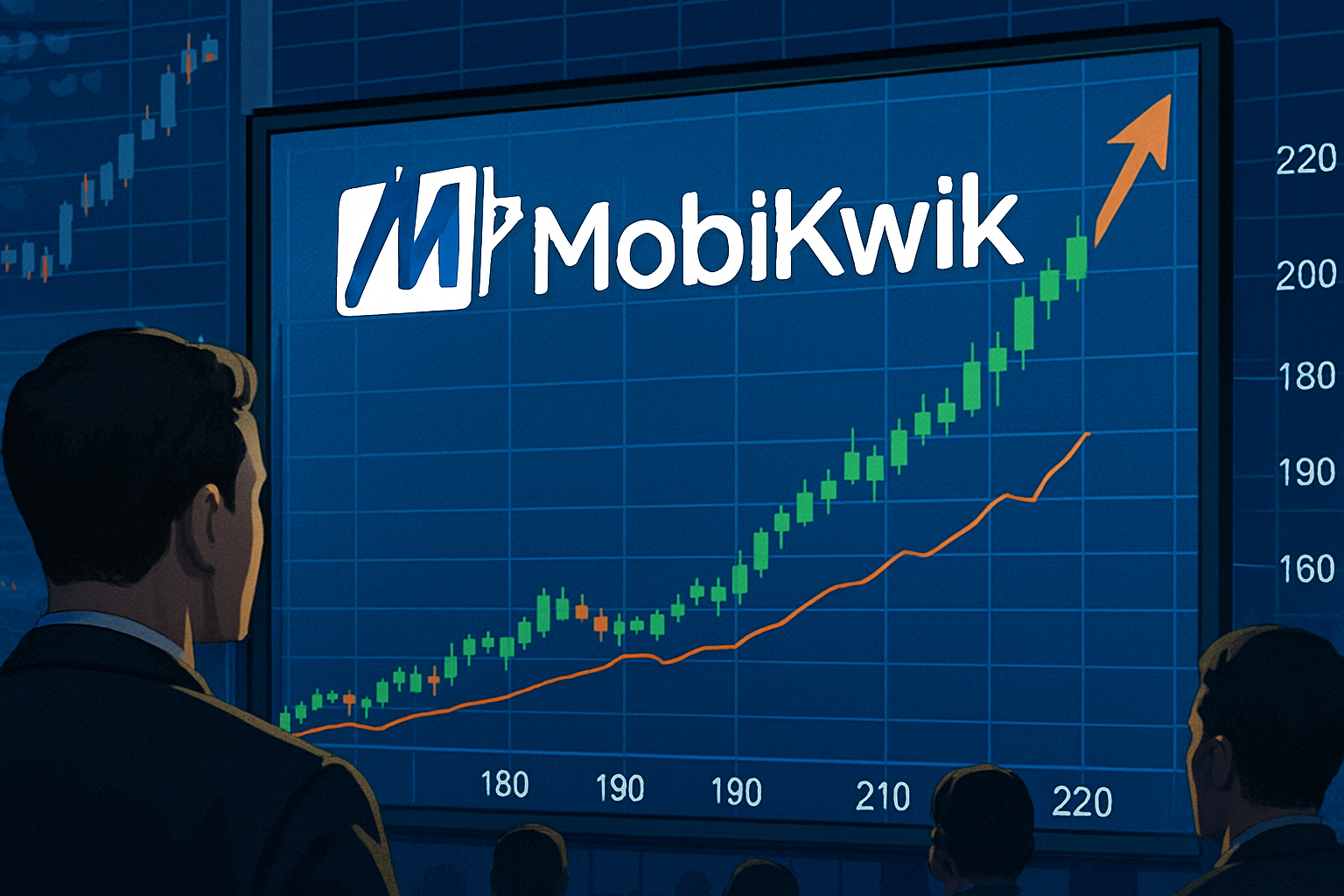
Mobikwik share price has surged with record trading volumes, attracting strong investor interest. This blog explores the latest market updates, performance trends, and future outlook for Mobikwik.
Table of Contents
Published: September 02, 2025 | Last Updated: September 02, 2025
Introduction to Mobikwik’s Recent Market Performance
Mobikwik’s stock experienced significant movement during September 2025, attracting attention from market participants across segments. The digital payments company recorded a notable single-day gain of 12.3% on September 28, 2025, with trading volumes reaching approximately 8.7 million shares. This represented the highest daily turnover for the stock since late July 2025.
The stock closed at ₹348 on September 28, 2025, compared to its opening level around ₹310 earlier in the week. This movement occurred against a backdrop of mixed signals in broader market indices. The Nifty 50 traded sideways with modest volatility during the same period.
Understanding the factors behind this price movement requires examining multiple aspects. These include the company’s operational metrics, the broader fintech sector environment, and specific corporate developments. This analysis provides a comprehensive examination of these elements based on publicly available information and market data.
Recent Stock Price Movement and Technical Indicators
Trading Activity Overview
The September 28, 2025 trading session showed several noteworthy characteristics. Volume expansion reached approximately four times the average daily level of 2.3 million shares recorded during the preceding consolidation phase. The turnover value exceeded ₹290 crore, compared to an average daily turnover of approximately ₹68 crore during the previous month.
Price action indicated the stock moved from a consolidation range between ₹285 and ₹310 maintained over three weeks. The breakout above ₹310 occurred with strong participation across trading segments. Market data suggests retail investors accounted for approximately 62% of buy-side volume during this session.
Technical Analysis Perspective
From a technical standpoint, several indicators provided context for the price movement. The 50-day moving average stood at ₹298, while the 200-day moving average was positioned at ₹276. The stock’s position above both these levels suggested an established uptrend pattern.
The relative strength index moved to 73, indicating strong momentum conditions. Options market activity showed increased open interest in monthly contracts. Implied volatility stood at 48%, reflecting market expectations of continued price fluctuations.
Key technical levels identified by market analysts include immediate support at ₹325-330 and stronger support at the 50-day moving average of ₹298. Resistance zones were noted at ₹365 and ₹390-400.
Medium-Term Price Trajectory
Over a broader timeframe, the stock appreciated approximately 67% from its 52-week low of ₹208 recorded in March 2025. The stock opened the year at ₹242. This performance contrasted with periodic corrections observed during the year.
The stock’s beta coefficient of approximately 1.4 indicates movements tend to exceed broader market fluctuations by 40% in either direction. This characteristic attracts momentum-oriented traders but requires careful position management.
Factors Contributing to Price Movement
Volume Analysis and Market Participation
The exceptional volume increase on September 28, 2025 provided insights into market dynamics. Analysis of trading patterns indicated institutional participation increased during this period. Domestic mutual funds initiated or expanded positions during July-August 2025.
Institutional ownership reached approximately 23% as of August 31, 2025, compared to 17% at the beginning of the fiscal year. Foreign portfolio investors held approximately 8% of shares. This institutional involvement typically indicates confidence in medium-term operational prospects.
Fintech Sector Environment
India’s digital payments ecosystem showed strong growth trends. According to National Payments Corporation of India data, Unified Payments Interface transactions crossed 10.5 billion in volume during August 2025. Transaction values exceeded ₹15.8 trillion, representing all-time highs.
Government initiatives supporting digital payments continued through programs like Digital India. Smartphone penetration exceeded 750 million users in India. Internet connectivity expansion, including 5G network rollout, removed infrastructure barriers to digital adoption.
The fintech sector experienced renewed institutional interest after a correction period during 2023-2024. Improving profitability timelines and stabilizing regulatory frameworks contributed to this shift in sentiment.
Company-Specific Developments
Several corporate announcements and operational updates occurred during September 2025. On September 15, 2025, the company announced a strategic collaboration with a private sector bank. This partnership focused on embedded finance solutions for small businesses, expanding addressable market opportunities.
Earlier in September 2025, the company announced a beta launch of an enhanced credit assessment platform utilizing artificial intelligence. This technology enables instant credit decisions while managing risk parameters.
The August 2025 operational update released on September 10 revealed monthly active users reached 12.5 million. This represented a 28% year-on-year increase. Transaction volumes grew 34% year-on-year to ₹4,850 crore for the month.
Earnings Expectations
Analyst estimates ahead of quarterly results scheduled for mid-October 2025 showed upward revisions. Consensus expectations pointed to revenue growth of approximately 41% year-on-year for Q2 FY2026. Loss reduction estimates approached 35% compared to the same quarter in the previous year.
Company Business Model and Operations
Digital Wallet Services
Mobikwik operates a digital wallet serving as the foundational product for user engagement. As of September 2025, registered users totaled 145 million. Monthly active users stood at 12.5 million, indicating engagement opportunities with dormant accounts.
Transaction frequency among active users improved to 4.7 transactions per user per month in August 2025. This compared to 3.9 transactions a year earlier. Average transaction value stood at approximately ₹387, reflecting focus on everyday transaction volumes.
The wallet provides an entry point for users into the platform’s broader financial services ecosystem. Product enhancements and changing consumer behavior contributed to improved engagement metrics.
Credit and Lending Operations
The credit vertical represented a significant business evolution. This segment contributed approximately 34% of total revenues as of Q1 FY2026. This compared to 18% two years earlier, demonstrating strategic focus on higher-margin products.
Buy Now Pay Later services, branded as “Mobikwik ZIP,” allowed installment purchases over 30 to 90 days. Over 5.2 million users activated this feature as of August 2025. Gross merchandise value processed through BNPL reached ₹1,840 crore for the quarter ended June 2025.
Default rates on BNPL products stood at approximately 2.8%. The company utilized traditional credit bureau data, alternative data sources, and proprietary algorithms for credit assessment. This approach enabled serving customers without traditional credit card access.
Personal loan products ranging from ₹5,000 to ₹60,000 targeted customers with short-term liquidity needs. The loan book stood at approximately ₹485 crore as of June 2025. Partnerships with non-banking financial companies and banks provided capital for lending operations.
Net interest margins on the lending portfolio averaged around 8.5%. This provided higher margins compared to payment processing services.
Merchant Network and Payment Gateway
The merchant network served 3.8 million businesses as of September 2025. This ranged from large e-commerce platforms to local retail stores. Merchant discount rates remained a key revenue source, though competitive dynamics created margin pressures.
The company processed merchant transactions worth approximately ₹14,200 crore in Q1 FY2026. This represented 38% year-on-year growth. Investments in point-of-sale devices and QR code solutions enabled offline merchants to accept digital payments.
Revenue Composition
Revenue diversification reduced dependence on single business segments. The current mix included payment services at 46% of revenue, covering wallet transactions, payment gateway fees, and UPI revenues. Credit products contributed 34%, including BNPL fees and interest income.
Advertising and other services represented 12% of revenue from merchant advertising and premium subscriptions. Financial services distribution contributed 8% through commissions from insurance, mutual funds, and other products.
This diversified structure provided resilience against regulatory changes or competitive pressures in individual segments.
Financial Performance Analysis
Revenue Growth Trends
Total revenues for fiscal year 2025 (ended March 31, 2025) reached ₹1,047 crore. This represented 44% growth over the previous fiscal year. Growth occurred despite competitive pressures and macroeconomic challenges.
For Q1 FY2026 (April-June 2025), revenues reached ₹298 crore, up 47% year-on-year. Preliminary indicators suggested Q2 revenues could exceed ₹320 crore. This trajectory indicated potential annual revenue run rate of approximately ₹1,300 crore.
Revenue growth appeared broad-based across segments. Credit products showed particularly strong performance with 63% year-on-year growth in Q1 FY2026. Payment gateway services grew 39% year-on-year.
Profitability Metrics
The company reported a net loss of ₹164 crore for FY2025. This represented improvement from the ₹265 crore loss in FY2024, demonstrating 38% reduction in losses. The improvement resulted from revenue growth and cost management initiatives.
Adjusted EBITDA losses narrowed to ₹87 crore in FY2025 from ₹152 crore in FY2024. The company achieved positive EBITDA in March 2025 for the first time, marking an operational milestone.
Both payments and credit products generated positive contribution margins. This meant incremental revenues contributed to fixed cost absorption, representing a critical inflection point.
Cost Management Initiatives
Several cost optimization measures showed results. Customer acquisition costs declined 22% year-on-year. Technology costs as a percentage of revenue decreased from 18% to 14% as infrastructure scaled. Administrative expenses remained flat despite revenue growth.
Management outlined a path to reaching breakeven at net income level by Q4 FY2026. Full-year profitability targets focused on FY2027. These timelines appeared achievable based on current trajectories and maintained cost discipline.
Capital Structure
The company completed a ₹350 crore funding round in November 2024. Cash and cash equivalents stood at approximately ₹420 crore as of June 30, 2025. This provided liquidity for planned operations and growth investments.
The balance sheet maintained minimal corporate-level debt. The lending business utilized debt capital from partner institutions. This capital-light approach to lending reduced capital requirements while capturing lending economics.
Competitive Landscape Analysis
Market Position
Founded in 2009, Mobikwik evolved from a digital wallet into a comprehensive financial services platform. The company served over 145 million registered users and partnered with more than 3.8 million merchants across India.
The platform’s diversified offerings included digital wallet services, payment gateway solutions, credit products, and small-ticket personal loans. This reduced dependence on single revenue streams.
Competitive Strengths
Technology infrastructure capable of handling high transaction volumes maintained uptime exceeding 99.7%. This proved critical for maintaining user trust and merchant relationships. The platform processed millions of daily transactions.
The lending franchise differentiated the company from payment-focused competitors. Over 5.2 million active BNPL users as of August 2025 demonstrated traction in credit products. This focus offered higher margins compared to traditional payment services.
Semi-urban and rural penetration efforts showed results. Approximately 43% of new user acquisitions in the last quarter came from tier-2 and tier-3 cities. This provided access to underserved markets with growth potential.
Strong merchant relationships created network effects. More merchants accepting Mobikwik payments increased wallet utility for consumers. This attracted additional merchants, strengthening platform advantages.
Competitive Challenges
The Indian fintech space remained intensely competitive. Paytm maintained significantly larger scale with substantial resources. PhonePe commanded the largest UPI transaction share, backed by Walmart. Google Pay leveraged its massive user base and ecosystem integration.
Well-funded startups continued entering fintech niches. Competition for customers and merchants intensified across segments. Despite these challenges, the company’s established brand and diversified model provided competitive resilience.
The strategic focus on profitable growth rather than market share at any cost represented a disciplined approach. This resonated with investors seeking sustainable business models.
Risk Factors and Challenges
Competitive Pressures
Price competition through aggressive incentives, cashbacks, or promotional offers could force matching strategies. This would pressure margins and potentially extend profitability timelines. Feature parity across fintech platforms could reduce differentiation and pricing power.
Larger competitors possessed greater resources for marketing, technology development, and strategic acquisitions. This resource disparity created competitive disadvantages requiring superior execution to overcome.
Regulatory Environment
Financial services remained heavily regulated. Changes to interchange fees, merchant discount rate caps, or transaction limits could affect business economics. Historical regulatory interventions in India’s payments space often favored consumer interests over platform profitability.
Tightening lending norms, increased capital requirements, or interest rate restrictions could constrain credit business growth. Regulators globally scrutinized BNPL products, and India could implement similar oversight.
Stricter data protection regulations could limit customer data usage for credit assessment or personalization. Compliance costs related to data privacy would likely increase as regulations evolved.
Operational Risks
Technology failures or cybersecurity breaches could damage customer trust and result in financial losses. While robust infrastructure existed, no system remained entirely immune to failures or attacks.
Asset quality management became increasingly important as the lending book grew. Economic downturns, job losses, or macroeconomic shocks could drive defaults beyond expectations. This would require provisions impacting profitability.
Customer acquisition costs across the industry increased. If customer lifetime value didn’t justify acquisition costs, growth could become value-destructive rather than value-creating.
Market Risks
Broader economic downturns affecting employment or consumer confidence could reduce transaction volumes. Simultaneously increasing credit defaults would create challenging operating conditions.
Fintech stocks globally experienced significant volatility. Stock price corrections disconnected from fundamentals could occur during broader market selloffs.
Tightening capital markets or deteriorating investor sentiment toward growth companies could constrain funding access. This might limit ability to compete with better-capitalized rivals.
Analyst Views and Market Sentiment
Analyst Coverage
Six brokerage firms actively covered the stock as of late September 2025. Ratings ranged from “Buy” to “Hold” with no “Sell” ratings. Price targets varied based on different assumptions about growth rates and profitability timelines.
The most bullish target stood at ₹425, implying 22% upside from the ₹348 level. The most conservative target was ₹310, implying 11% downside risk. Average target price reached ₹378, implying 9% upside.
Key variables driving target differences included profitability achievement assumptions, lending book growth estimates, and views on sustainable revenue growth rates. Comparisons to international fintech peer valuations also influenced targets.
Analysts highlighted improving fundamentals while cautioning about execution risks, competitive pressures, and valuation concerns following recent appreciation.
Investment Considerations
At current levels, the stock traded at approximately 4.2 times trailing twelve-month revenues. This represented a premium to some fintech peers but a discount to high-growth SaaS companies.
The valuation appeared reasonable if the company executed its profitability roadmap and maintained revenue growth in the 35-40% range. However, much optimism appeared priced into current levels following the September rally.
For momentum traders, the stock’s high beta of 1.4 and recent strong performance created opportunities but required disciplined risk management. Technical traders identified support at ₹325-330 and ₹298, with resistance at ₹365 and ₹390-400.
For long-term investors, the stock represented exposure to India’s digital transformation themes. The diversified business model, improving unit economics, and path to profitability provided fundamental support. However, competitive intensity, regulatory uncertainties, and execution risks remained material considerations.
Growth Opportunities and Future Outlook
Digital Economy Expansion
India’s digital economy stood at an inflection point. Smartphone users exceeded 750 million, with projections reaching 1 billion by 2027. Each new smartphone user represented potential demand for digital financial services.
5G network rollout and continued 4G expansion into rural areas removed infrastructure barriers. Improved connectivity enabled remote populations to access digital financial services.
Government initiatives including Digital India, Jan Dhan accounts, and Aadhaar-based authentication created foundational digital infrastructure. Continued government support for cashless transactions through incentives and policies supported sector growth.
Younger demographics, particularly millennials and Gen Z, showed strong preferences for digital-first financial services. As these demographics entered peak earning years, demand for platform services should accelerate.
Credit Market Opportunity
India’s retail credit market exceeded $400 billion, yet millions remained credit-underserved due to limited credit history or formal income documentation. Alternative credit assessment models leveraging digital footprints could unlock this market.
Regulatory frameworks like Account Aggregator and Open Credit Enablement Network facilitated easier credit access while maintaining consumer protection. These infrastructure developments benefited fintech lenders.
Product expansion beyond BNPL and small personal loans could include lines of credit, merchant cash advances, or secured loans. Each new product opened additional revenue streams.
Partnerships with banks, NBFCs, and financial institutions allowed scaling lending business without significant capital commitment. These partnerships provided access to lower-cost funding, improving unit economics.
Strategic Partnership Development
Integration with e-commerce platforms offering checkout financing and payment solutions could drive transaction volumes. Such integrations positioned the platform as default payment options for shoppers.
The banking partnership to serve small businesses opened large new market opportunities. Business transactions typically involved higher values and more intensive financial services usage, offering attractive unit economics.
Using the large user base to distribute third-party financial products like insurance, mutual funds, and fixed deposits created additional revenue streams. This asset-light business model generated high-margin commissions.
Technology Innovation
Artificial intelligence and machine learning enhanced credit underwriting. This allowed serving riskier customer segments profitably by better predicting default probability. These models improved continuously as data flows increased.
Using transaction data and behavioral insights to personalize product offerings improved conversion rates and customer lifetime value. Customers received offers aligned with transaction patterns and needs.
Sophisticated fraud detection systems protected the company and customers from financial crimes. As digital transactions grew, robust security became a key differentiator.
Investment Strategy Considerations
For Active Traders
Momentum strategies could prove effective given the stock’s high beta and recent strong performance. Trend-following approaches might involve buying pullbacks to support levels with tight stop losses. Target zones included ₹365-375.
Options strategies utilizing elevated implied volatility could generate income. Selling out-of-the-money put options might establish positions at lower prices if assigned. Covered calls could generate additional returns for existing positions.
Volume monitoring remained critical. Sustained high volumes suggested institutional participation and increased probability of continued momentum. Declining volumes after breakout might signal exhaustion.
Risk management required strict position sizing—risking no more than 1-2% of trading capital per position. Stop losses should be used consistently given volatility potential.
For Long-Term Investors
Dollar-cost averaging over 3-6 months reduced poorly-timed entry risk. Systematic investments took advantage of inevitable volatility while building positions gradually.
Thematic allocation within digital economy or fintech themes rather than isolated positions provided exposure while managing concentration risk. Allocating 3-5% of equity portfolio to fintech stocks, with this company as one holding among several, balanced opportunity and risk.
Monitoring progress toward operational and financial milestones remained essential. These included monthly active user growth, credit book expansion and asset quality, revenue growth rates and mix evolution, and profitability progress.
Valuation discipline required establishing price targets based on fair value analysis. Trimming positions when prices ran ahead of fundamentals, and adding during corrections while fundamentals remained intact, represented prudent approaches.
Tax Considerations
For Indian investors, tax implications required consideration. Short-term capital gains (held less than one year) faced 20% taxation. Long-term capital gains exceeding ₹1.25 lakh annually faced 12.5% taxation. These factors influenced holding period decisions.
Conclusion
The September 2025 price movement in Mobikwik shares reflected multiple converging factors. The 12.3% single-day gain on exceptional volumes of 8.7 million shares demonstrated renewed market interest in the fintech sector and this specific company.
For investors seeking exposure to India’s digital transformation, the company offered a comprehensive narrative. An established platform serving 145 million registered users, diversified business spanning payments and credit, improving unit economics, and a defined path toward profitability by fiscal year 2027 provided fundamental support.
However, success remained uncertain. Intense competitive landscape with well-funded rivals, regulatory uncertainties, and execution risks around technology, credit quality, and customer acquisition persisted. The recent strong performance also meant significant optimism was priced into current levels.
The September rally pushing the stock from ₹310 to ₹348 created both opportunity and caution. Momentum-oriented investors entering at these levels should prepare for volatility and employ disciplined risk management. Long-term investors might view periods of weakness as potential accumulation opportunities.
Ultimately, stock performance will depend on execution of the strategic roadmap. Growing users and transactions, expanding lending business profitably, maintaining credit quality, and achieving profitability milestones will determine outcomes. Investors understanding both opportunities and risks, sizing positions appropriately, and maintaining realistic expectations could benefit from India’s digital finance evolution.
The stock closed at ₹348 on September 28, 2025, representing substantial appreciation from its 52-week low of ₹208. Whether momentum sustains or consolidates will depend on upcoming quarterly results, management execution, and broader market sentiment toward growth stocks.
Disclaimer: This analysis is for informational purposes only and should not be construed as investment advice. Investors should conduct independent research and consult qualified financial advisors before making investment decisions. Past performance does not guarantee future results. All investments carry risk, including potential loss of principal.
Frequently Asked Questions (FAQs)
What caused the Mobikwik share price surge on September 28, 2025?
The 12.3% price increase on September 28, 2025 occurred on exceptional trading volumes of 8.7 million shares—the highest in over two months. Multiple factors contributed to this movement. These included renewed investor confidence in India’s fintech sector following strong UPI transaction data from NPCI showing 10.5 billion transactions in August 2025.
Company-specific catalysts included a strategic partnership announcement on September 15, 2025 with a private sector bank for embedded finance solutions. The August operational update released September 10 showed monthly active users reached 12.5 million, representing 28% year-on-year growth. Transaction volumes grew 34% year-on-year to ₹4,850 crore.
Technical factors also played a role. The stock broke out decisively above the ₹310 resistance level that had capped prices for three weeks. Volume expansion to four times normal levels confirmed genuine participation rather than low-liquidity moves. Analyst estimates ahead of Q2 results had been revised upward, creating positive sentiment.
What are the current technical support and resistance levels for Mobikwik stock?
As of the September 28, 2025 closing price of ₹348, several technical levels merit attention. Immediate support exists at ₹325-330, representing the recent consolidation zone before the breakout. Strong support stands at ₹298, which is the 50-day moving average.
Critical long-term support is positioned at ₹276, representing the 200-day moving average. The stock’s position above both moving averages suggests an established uptrend pattern. On the upside, resistance appears at ₹365, identified as the next Fibonacci extension level.
Stronger resistance exists at ₹390-400, representing the previous swing high from April 2025 and a psychological round number. The stock has appreciated 67% from its 52-week low of ₹208 recorded in March 2025. The relative strength index at 73 indicated overbought short-term conditions as of the recent rally.
Is Mobikwik profitable and when is profitability expected?
Mobikwik is currently not profitable at the net income level. However, significant progress has been made toward profitability. For fiscal year 2025 (ended March 31, 2025), the company reported a net loss of ₹164 crore. This represented 38% improvement from the ₹265 crore loss in FY2024.
Adjusted EBITDA losses narrowed to ₹87 crore in FY2025 from ₹152 crore in FY2024. The company achieved positive EBITDA in March 2025 for the first time, demonstrating operational viability at scale. Both payments and credit products now generate positive contribution margins.
Management has articulated a clear profitability timeline. Operational profitability (consistent positive EBITDA) is targeted for Q3 FY2026 (October-December 2025). Full-year net profitability is expected by FY2027. This timeline assumes revenue growth continues at 35-40% annually and cost discipline is maintained. Customer acquisition costs already declined 22% year-on-year, supporting this trajectory.
How does Mobikwik’s business model generate revenue?
Mobikwik operates a diversified revenue model across multiple business segments. Payment services contribute 46% of revenue, including fees from wallet transactions, payment gateway services for merchants, and UPI transaction revenues. While this segment faces margin pressures from competition and regulation, high volumes compensate.
Credit products now represent 34% of revenue—the fastest-growing and highest-margin segment. This includes Buy Now Pay Later fees, where over 5.2 million users processed ₹1,840 crore in gross merchandise value during Q1 FY2026. Interest income from personal loans ranging from ₹5,000 to ₹60,000 also contributes. Net interest margins on lending average around 8.5%.
Advertising and merchant services contribute 12% of revenue from merchant advertising and premium subscriptions. Financial services distribution adds 8% through commissions earned by distributing insurance, mutual funds, and other financial products to the 145 million registered user base.
This diversification reduces dependence on any single segment and provides resilience against regulatory changes or competitive pressures in individual areas. The strategic shift toward higher-margin credit products from 18% of revenue two years ago to 34% currently demonstrates intentional revenue mix improvement.
What are the major competitive threats facing Mobikwik?
Mobikwik faces intense competition across multiple dimensions. Paytm represents the dominant player with significantly larger scale, extensive resources, and aggressive expansion into financial services. PhonePe, backed by Walmart, commands the largest share of UPI transactions and leverages this position to cross-sell financial products.
Google Pay, while focused primarily on UPI, possesses a massive user base and integration with the broader Google ecosystem. Well-funded startups continue entering various fintech niches, intensifying competition for customers and merchants across segments.
Competitive pressures manifest in several ways. Price competition through aggressive incentives, cashbacks, or promotional offers forces matching strategies that pressure margins. Feature parity across platforms reduces differentiation, potentially turning payment services into commoditized utilities.
Scale advantages of larger rivals provide greater resources for marketing, technology development, and strategic acquisitions. This creates resource disadvantages that require superior execution to overcome. However, Mobikwik’s focus on profitable growth rather than market share at any cost, emphasis on credit products with developed lending franchise, and penetration in tier-2 and tier-3 cities (43% of new acquisitions) provide competitive differentiation.
What regulatory risks could impact Mobikwik’s business?
Financial services operate under extensive regulation, and regulatory changes could materially impact operations. Payment regulations including changes to interchange fees, merchant discount rate caps, or transaction limits could affect business economics. Historical regulatory interventions in India’s payments space often favored consumer interests over platform profitability.
Lending regulations present significant risk. Tightening norms, increased capital requirements for digital lenders, or restrictions on interest rates charged could constrain the credit business. Regulators globally have scrutinized BNPL products, and India could implement similar oversight measures. The lending segment contributes 34% of revenue and represents the highest-margin business.
Data privacy regulations could limit customer data usage for credit assessment, personalization, or targeted marketing. Compliance costs related to data protection will likely increase as regulations evolve. The company’s alternative credit assessment using digital footprints and proprietary algorithms depends on data access.
Licensing requirements might change, potentially requiring additional licenses, higher capital adequacy, or operational restrictions. Regulatory uncertainty makes long-term planning challenging. However, the company maintains engagement with regulators and adapts operations to comply with evolving requirements. Conservative balance sheet management with minimal corporate debt provides flexibility to meet potential capital requirement increases.
How should investors approach Mobikwik stock given recent price appreciation?
Investment approach should depend on individual risk tolerance, time horizon, and portfolio objectives. The stock’s 67% appreciation from its March 2025 low of ₹208 to the current ₹348 level, with a 12.3% gain in a single session, creates both opportunity and caution.
For active traders, momentum strategies utilizing the stock’s high beta of 1.4 could prove effective. This requires strict risk management including position sizing limits (1-2% of capital per trade), tight stop losses, and monitoring volume patterns. Technical levels at ₹325-330 support and ₹365 resistance provide reference points. Declining volumes after the breakout might signal exhaustion.
For long-term investors, dollar-cost averaging over 3-6 months reduces entry timing risk. Systematic investments take advantage of inevitable volatility. Consider this as part of a broader digital economy or fintech thematic allocation rather than concentrated positions. Allocating 3-5% of equity portfolio to fintech stocks, with this as one holding among several, provides exposure while managing risk.
Investors should monitor upcoming Q2 FY2026 results scheduled for mid-October 2025. Strong results beating analyst consensus of ₹320 crore revenue (41% year-on-year growth) could propel further gains. Disappointing results might trigger profit-booking after the recent rally. Tracking progress toward operational milestones—monthly active user growth, credit book expansion, asset quality metrics, and profitability timeline—remains essential.
Valuation at approximately 4.2 times trailing revenues appears reasonable if the company maintains 35-40% revenue growth and achieves profitability by FY2027. However, much optimism is priced into current levels following recent appreciation.
What should investors watch in the upcoming quarterly results?
The Q2 FY2026 results (July-September 2025) scheduled for mid-October 2025 will be critical for determining whether recent momentum sustains. Several key metrics warrant close attention.
Total revenue growth and whether it exceeds analyst consensus of approximately ₹320 crore (representing 41% year-on-year growth) will be closely watched. The revenue growth trajectory influences profitability timeline assumptions and valuation multiples.
Monthly active user additions and engagement trends indicate platform health. The company reported 12.5 million MAUs in August with 28% year-on-year growth. Continued strong user growth, particularly in tier-2 and tier-3 cities where 43% of new acquisitions originated, validates market expansion strategy.
Credit book size, asset quality metrics, and non-performing asset ratios remain critical given lending represents 34% of revenue and the highest-margin segment. Default rates on BNPL stood at 2.8% as of recent disclosure. Any deterioration could impact profitability timeline and investor confidence.
Payment transaction volumes and merchant network expansion indicate core business health. The company processed ₹14,200 crore in merchant transactions during Q1 with 38% year-on-year growth. Market share trends versus competitors like Paytm and PhonePe provide competitive positioning context.
Adjusted EBITDA and progress toward the Q3 FY2026 operational profitability target will be scrutinized. The company achieved positive EBITDA in March 2025 for the first time. Consistent positive EBITDA through multiple quarters would validate the business model’s viability at scale and support profitability timeline assumptions.
Management commentary on competitive environment, customer acquisition costs (which declined 22% year-on-year recently), and strategic partnership developments will provide forward guidance. Updates on the September 15, 2025 announced banking partnership for small business services and the AI-enhanced credit assessment platform beta launch will indicate execution progress.
About the Author
Nueplanet
This article is for informational purposes only and should not be considered investment advice. All information is based on publicly available data from company filings, stock exchange disclosures, and official announcements. Investors should conduct independent research and consult qualified financial advisors before making investment decisions.
Sources: Company operational updates, stock exchange data, National Payments Corporation of India (NPCI) statistics, analyst reports, and publicly available financial disclosures.
Helpful Resources
Latest Posts
Tag
Mobikwik Share
Related Posts












Post Comment