









M&M Share Price and Market Reactions Amid GST Changes 2025
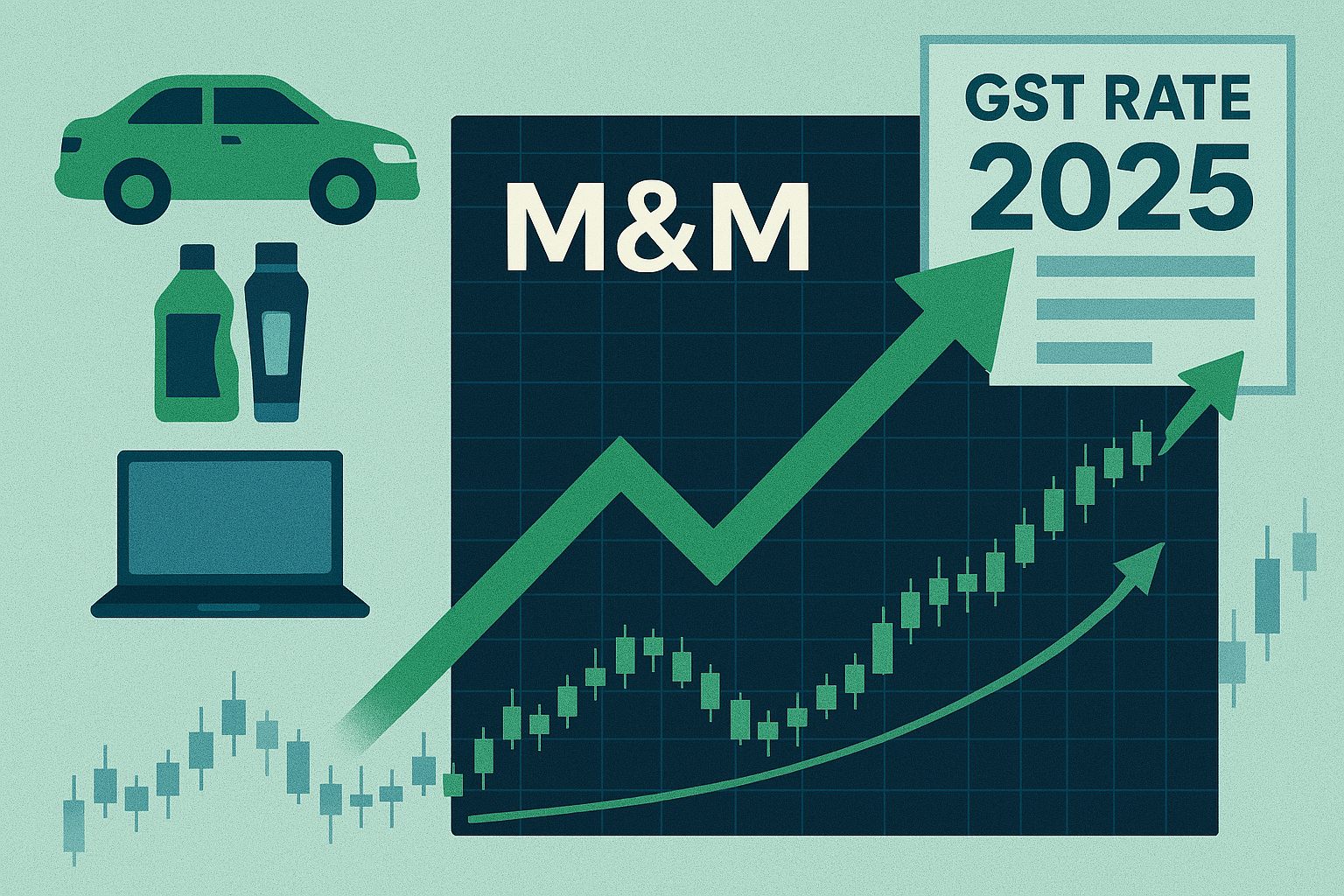
M&M share price surged as investors welcomed GST rate cuts in 2025. Here’s a detailed breakdown of how the new GST slabs impacted auto, FMCG, and other sectors.
Table of Contents
Market Overview: Policy-Driven Stock Movements in March 2025
Mahindra & Mahindra (M&M) shares experienced notable trading activity during late March 2025 following the announcement of revised Goods and Services Tax (GST) rate structures. The stock movement coincided with similar patterns across multiple sectors including automobiles, consumer goods, and electronics manufacturing.
The NSE and BSE recorded increased trading volumes in select large-cap and mid-cap stocks during this period. Market participants responded to policy announcements affecting taxation structures across various product categories.
This analysis examines the stock price movements, sectoral impacts, and policy implications based on official exchange data and regulatory filings. The assessment focuses on factual market developments rather than predictive recommendations.
GST Rate Structure Revisions Announced in March 2025
Policy Framework Changes
The GST Council announced revisions to tax rate structures in late March 2025, with implementation scheduled for April 1, 2025. These changes affected multiple product categories including automobiles, consumer electronics, and packaged goods.
The revised framework aimed to rationalize tax rates across categories while maintaining government revenue targets. Ministry of Finance statements indicated the changes reflected ongoing efforts to simplify compliance and support economic activity.
Implementation timing aligned with the fiscal year transition, allowing businesses adjustment periods for pricing and inventory management. The Finance Ministry coordinated with state tax departments to ensure smooth rollout.
Specific Sectoral Provisions
Automobile Sector Adjustments Tax rate modifications affected passenger vehicles, commercial vehicles, and agricultural machinery. Certain vehicle categories received reduced GST rates between 2-3 percentage points according to official notifications.
Two-wheeler and three-wheeler segments saw adjustments to component taxation. Agricultural equipment including tractors received favorable treatment recognizing their economic importance in rural areas.
Consumer Electronics Provisions Manufacturing inputs and finished electronics products received rationalized tax treatment. The changes complemented existing Production Linked Incentive (PLI) schemes for electronics manufacturing.
Mobile phones, laptops, and consumer appliances categories saw modified rate structures. These adjustments aligned with government initiatives promoting domestic electronics manufacturing.
FMCG and Packaged Goods Packaged foods, beverages, and select consumer staples received rate adjustments. The framework maintained higher rates on tobacco products while rationalizing taxes on other categories.
Compliance procedures received simplification particularly for small and medium enterprises. Filing requirements and classification standards saw streamlining to reduce administrative burden.
Mahindra & Mahindra Stock Performance Analysis
Price Movement and Trading Data
M&M shares traded at ₹2,847 on March 25, 2025, according to NSE data. The stock closed at ₹3,021 on the same trading session, representing a single-day gain of 6.1%.
Trading volumes exceeded average daily levels by approximately 180% during this period. The volume surge indicated increased institutional and retail participation in response to policy announcements.
Technical indicators showed the stock breaking through the ₹2,900 resistance level. Price action suggested momentum beyond typical daily fluctuations, supported by above-average trading activity.
Company Fundamentals and Market Position
Mahindra & Mahindra operates across multiple automotive segments including sport utility vehicles (SUVs), tractors, and commercial vehicles. The company holds significant market share in Indian SUV and tractor categories.
Popular models including Scorpio, XUV700, and Thar series represent core revenue segments. The tractor division serves agricultural markets where M&M maintains leadership position.
Recent financial disclosures showed the company expanding electric vehicle offerings. The XUV400 electric SUV attracted pre-bookings indicating market interest in electrified mobility options.
Impact Assessment of Tax Changes
Vehicle Category Benefits SUVs constituting M&M’s primary revenue source benefited from revised rate structures. Industry analysis suggested potential price reductions of ₹50,000-80,000 on select models based on tax savings.
Tractor segment received favorable treatment given agricultural sector importance. Rural demand patterns typically correlate with agricultural income levels and equipment affordability.
Volume Growth Projections Market research organizations revised volume growth estimates for fiscal year 2025-26. Projections increased to 8-12% from previous 5-7% estimates based on improved affordability assumptions.
Electric vehicle adoption forecasts also received upward adjustments. Analysts anticipated accelerated EV uptake combining tax benefits with existing subsidy programs.
Tata Motors and Broader Automotive Sector Response
Tata Motors Stock Movement
Tata Motors shares traded at ₹1,042 on March 26, 2025, reaching intraday highs of ₹1,103 before settling at ₹1,098. The 5.8% gain reflected market assessment of policy impact across the company’s product portfolio.
Trading volumes increased substantially during this period according to exchange data. The price movement occurred alongside similar patterns in other major automotive manufacturers.
Product Portfolio Considerations
Passenger Vehicle Segment Tata Motors’ passenger vehicle range spans entry-level hatchbacks to premium SUVs. The diversified portfolio meant tax changes affected multiple product categories simultaneously.
Electric vehicle models including Nexon EV and Tigor EV represented growing segments. The combination of reduced GST, existing incentives, and infrastructure development supported EV market expansion.
Commercial Vehicle Division Commercial vehicles serving India’s logistics sector received favorable tax treatment. Trucks and buses represent essential transportation infrastructure supporting economic activity.
The commercial vehicle segment’s importance to Tata Motors’ revenue mix meant policy changes carried material financial implications. Fleet operators typically respond to total cost of ownership changes affecting purchasing decisions.
Competitive Dynamics
Maruti Suzuki shares gained 4.2% during the same period according to market data. The synchronized movement across manufacturers indicated broad-based investor sentiment regarding sectoral prospects.
Foreign Institutional Investor (FII) data from NSE showed reversed selling patterns. FII buying in automotive stocks reached three-month highs during late March 2025, suggesting renewed international investor interest.
Consumer Goods Sector: ITC and Godfrey Phillips Analysis
ITC Share Performance and Business Segments
ITC shares rose 4.3% to ₹487 on March 27, 2025, based on exchange data. The diversified conglomerate operates across cigarettes, hotels, FMCG, paperboards, and agribusiness.
Cigarette Division Considerations Tobacco taxation remained in higher brackets reflecting policy priorities. However, rate structure stability provided predictability for long-term business planning.
The cigarette segment contributes significantly to ITC’s overall profitability. Tax policy clarity affects valuation multiples applied by investors to this division.
FMCG Business Impact Packaged foods segment including Aashirvaad, Sunfeast, and Bingo brands benefited from rationalized rates. Several product categories moved to lower tax brackets according to official notifications.
The FMCG division represents ITC’s fastest-growing segment. Tax changes potentially affect both margin profiles and pricing strategies for market share expansion.
Hotels and Other Segments The hotel division’s indirect benefits came from improved consumer sentiment. Domestic tourism trends correlate with discretionary spending patterns.
Paperboard and agribusiness segments maintained stable operations. These divisions’ contributions provide earnings diversification beyond consumer-facing businesses.
Godfrey Phillips Market Response
Godfrey Phillips shares gained 5.1% reaching ₹6,847 during the period. The company’s focused operations in tobacco and confectionery meant direct exposure to relevant tax changes.
The stock’s price movement reflected investor assessment of profitability implications. Market capitalization changes aligned with sectoral peer movements during this period.
Dixon Technologies and Electronics Manufacturing Sector
Stock Performance Analysis
Dixon Technologies shares surged 8.7% to ₹14,523 on March 28, 2025, representing one of the strongest performances across analyzed stocks. The electronics manufacturing services provider benefited from multiple policy alignments.
Trading volumes increased significantly indicating institutional interest. Technical analysis showed breakout patterns from previous consolidation ranges.
Business Model and Market Position
Dixon manufactures consumer electronics, lighting products, and mobile phones for leading brands. The company’s partnerships include major domestic and international electronics companies.
Contract manufacturing for Samsung, Xiaomi, and other brands positions Dixon within India’s electronics ecosystem. Manufacturing capacity spans multiple product categories and price segments.
Policy Environment Benefits
PLI Scheme Synergies Production Linked Incentive schemes for electronics combined with GST rationalization created favorable conditions. The dual policy support enhanced competitiveness for domestic manufacturing.
Export-oriented production received particular emphasis in government policy frameworks. India’s positioning as manufacturing alternative to other Asian locations attracted international attention.
Cost Structure Improvements Reduced taxation on inputs and finished goods improved manufacturing economics. Global brands evaluating manufacturing locations consider total cost structures including taxation.
Domestic market growth projections exceeding $400 billion by 2026 represented substantial opportunity. Export possibilities added to addressable market potential for established manufacturers.
Competitive Landscape
Other electronics manufacturing services providers including Amber Enterprises showed positive momentum. The sector’s collective performance indicated investor recognition of structural opportunities.
Component suppliers and assembly operations throughout the electronics value chain experienced increased interest. Supply chain localization trends supported domestic capacity building.
Financial Services Sector Response
HDFC Life Insurance Performance
HDFC Life shares gained 2.3% reaching ₹708 on March 29, 2025. The more modest performance compared to manufacturing sectors reflected indirect rather than direct policy impact.
Insurance sector growth correlates with economic stability and consumer spending patterns. Improved economic sentiment typically translates to higher insurance product sales over time.
Insurance Sector Dynamics
Life Insurance Considerations Life insurance demand responds to income growth, financial planning awareness, and economic confidence. Policy changes affecting overall economic activity create indirect insurance sector effects.
HDFC Life’s product portfolio spans term insurance, savings plans, and retirement solutions. Different products respond variably to macroeconomic condition changes.
Distribution and Partnerships Bancassurance partnerships and dealership tie-ups for vehicle insurance create cross-selling opportunities. Lower vehicle prices potentially support insurance product penetration.
The company’s market position in private life insurance provides competitive advantages. Distribution network reach affects ability to capitalize on favorable economic conditions.
Banking Sector Implications
Private sector banks showed mixed performance patterns during this period. Credit growth expectations responded to anticipated economic activity acceleration.
Public sector banks experienced different valuation dynamics. Institutional investors distinguish between banks based on asset quality, profitability, and growth trajectories.
Market Mechanism and Trading Analysis
Volume and Breadth Indicators
The BSE advance-decline ratio reached 3.2:1 during peak rally periods. This breadth indicator suggested broad participation across market segments.
Mid-cap and small-cap indices performed strongly relative to large-cap benchmarks. The performance pattern indicated optimism extending beyond blue-chip stocks.
Trading volumes across key stocks confirmed institutional participation levels. M&M’s daily volume increase of 185%, Tata Motors’ 167% rise, and Dixon Technologies’ 203% surge indicated conviction-driven activity.
Derivatives Market Signals
Futures Market Activity Open interest in index futures increased during this period. The March-April futures rollover percentages for Nifty reached 88% according to derivative market data.
Maintained long positions suggested traders anticipated continued positive momentum. Rollover patterns typically indicate conviction levels among derivative participants.
Options Market Positioning Call option buying increased in affected sectors including auto and FMCG. Options activity provides insights into market participant expectations regarding price directions.
Put-call ratios moved toward levels typically associated with positive sentiment. Reduced hedging demand indicates decreased downside protection needs.
Institutional Investment Flows
Foreign Institutional Investors FII data showed net buying of ₹8,921 crores in two weeks following announcements. This reversed earlier selling patterns of ₹12,347 crores during January-February 2025.
International investor flows affect market liquidity and sentiment. Sustained FII buying typically supports price appreciation across market segments.
Domestic Institutional Investors DIIs continued buying activity throughout the period. The combination of FII and DII buying created supportive technical conditions.
Insurance companies, mutual funds, and pension funds comprise DII category. Their investment patterns reflect long-term allocation decisions beyond short-term trading.
Analyst Coverage and Research Perspectives
Earnings Estimate Revisions
Research houses adjusted earnings projections for affected companies. Motilal Oswal raised M&M’s FY 2025-26 earnings estimates by 8% according to published research.
Similar upward revisions occurred for Tata Motors, ITC, and Dixon Technologies. Earnings estimate changes typically precede target price adjustments.
Revised projections incorporated assumptions about volume growth, margin impacts, and market share dynamics. Analyst models factor multiple variables when forecasting financial performance.
Target Price Adjustments
M&M received target prices around ₹3,400 from multiple brokerage houses. These targets implied potential appreciation from post-announcement price levels.
Tata Motors target prices ranged between ₹1,250-1,300 across different research reports. Dixon Technologies targets reached ₹16,500-17,000 despite recent price appreciation.
Target prices represent analyst expectations over specific time horizons. These projections incorporate assumptions that may or may not materialize.
Risk Factors Identified
Research reports highlighted potential implementation challenges in GST structure changes. Previous tax reforms occasionally produced unintended consequences during rollout phases.
Government revenue considerations could lead to future adjustments if collections disappoint. External risks including global economic conditions received mention in risk assessments.
Valuation concerns emerged for certain mid-cap manufacturing stocks. Rapid price appreciation sometimes creates disconnect between valuations and underlying fundamentals.
Macroeconomic Context and Policy Implications
Economic Growth Considerations
India’s GDP growth trajectory provides context for policy decisions. Government targets sustainable economic expansion while maintaining fiscal discipline.
Manufacturing sector contribution to GDP represents policy priority. Tax rationalization supports manufacturing competitiveness and domestic value addition.
Consumer spending patterns affect multiple economic sectors simultaneously. Affordability improvements through taxation changes influence discretionary purchase decisions.
Fiscal Policy Balancing
Tax rate reductions must balance against government revenue requirements. The Finance Ministry projected that increased transaction volumes would offset rate reductions.
GST collections represent important central and state government revenue sources. Policy changes consider both economic stimulus and fiscal sustainability.
Coordination between taxation policy and expenditure programs affects overall economic management. Integrated policy approaches produce more effective outcomes than isolated interventions.
International Competitiveness Factors
Manufacturing Cost Structures India competes with regional economies for manufacturing investment. Countries including Vietnam, Thailand, and Indonesia offer alternative manufacturing locations.
Total cost competitiveness incorporates labor costs, infrastructure quality, regulatory environment, and taxation. GST rationalization addresses the taxation component of this equation.
Supply Chain Diversification Global companies increasingly diversify supply chains beyond single-country concentration. India positions itself as alternative manufacturing location for various industries.
Electronics sector exemplifies this trend with major brands expanding Indian manufacturing. Policy support through PLI schemes and tax rationalization enhances India’s attractiveness.
Long-Term Sectoral Outlook
Automotive Industry Trajectory
Electric Vehicle Transition EV adoption continues accelerating across vehicle categories. Government policies support electrification through incentives, infrastructure investment, and regulatory frameworks.
Charging infrastructure expansion addresses range anxiety concerns. Both public and private sector investment contributes to network development.
Battery technology improvements and localization efforts affect EV economics. Domestic battery manufacturing receives policy attention for supply chain security.
Export Potential Development India’s automotive sector increasingly focuses on export opportunities. Quality improvements and cost competitiveness enable international market penetration.
Specific vehicle categories including small cars and commercial vehicles offer export potential. Regional trade agreements facilitate market access in neighboring countries.
Consumer Goods Evolution
Premiumization Trends Rising incomes drive demand for premium product categories. Consumers increasingly purchase higher-quality, branded products across categories.
FMCG companies develop premium variants of established brands. This product strategy captures willingness to pay for enhanced attributes.
Urban and semi-urban markets show strongest premiumization patterns. Rural markets gradually follow with time lag as incomes rise.
Distribution Network Expansion Modern retail formats expand into tier-2 and tier-3 cities. Traditional distribution channels adapt to changing competitive dynamics.
E-commerce penetration increases across product categories. Online channels complement physical distribution rather than completely replacing it.
Electronics Manufacturing Expansion
Domestic Market Growth India’s electronics consumption grows rapidly with economic development. Smartphones, laptops, televisions, and appliances all show strong demand trajectories.
Population demographics with large young cohort support technology adoption. Digital infrastructure improvements enable increased electronics usage.
Export-Oriented Production Electronics exports crossed $11 billion in FY 2024-25 according to industry data. The trajectory points toward significantly larger export volumes in coming years.
Component ecosystem development supports higher value addition. Moving beyond assembly toward component manufacturing enhances economic benefits.
Risk Assessment and Market Considerations
Implementation and Execution Risks
Policy implementation sometimes faces practical challenges. Businesses require time to adjust systems, processes, and pricing structures.
Classification disputes occasionally emerge with complex tax structures. Clear guidelines and efficient resolution mechanisms matter for smooth implementation.
Technology systems supporting GST administration must handle rule changes. Software updates across taxpayer base require coordination and testing.
Economic and External Risks
Global economic conditions affect India’s growth trajectory despite domestic strengths. Major economy slowdowns impact exports, capital flows, and commodity prices.
Geopolitical tensions create uncertainty affecting business confidence. Trade disruptions or energy price volatility carry economic consequences.
Domestic factors including monsoon patterns affect agricultural incomes. Rural demand correlates with agricultural prosperity affecting various sectors.
Valuation and Market Dynamics
Rapid price appreciation sometimes creates valuation concerns. Stock prices can temporarily disconnect from underlying fundamental values.
Market corrections occur periodically regardless of positive fundamentals. Investors must distinguish between long-term trends and short-term price movements.
Sector rotation patterns affect relative performance across industries. Leadership shifts between sectors based on evolving economic conditions and investor preferences.
Investment Considerations and Portfolio Implications
Sector Allocation Framework
Diversified portfolios maintain exposure across multiple sectors. No single sector consistently outperforms across all time periods and market conditions.
Policy changes may warrant portfolio rebalancing considerations. However, dramatic shifts based solely on single developments typically prove suboptimal.
Long-term thematic trends deserve attention in allocation decisions. Sustainable structural changes matter more than temporary cyclical fluctuations.
Quality and Fundamental Focus
Company-specific factors determine individual stock performance within sectors. Management quality, competitive positioning, and execution capabilities differentiate outcomes.
Financial strength including balance sheet quality affects resilience. Companies with strong fundamentals better navigate challenges when they arise.
Competitive advantages determine sustainable profitability. Businesses with genuine moats protect margins and market positions over time.
Time Horizon and Risk Tolerance
Investment time horizons should guide strategy formulation. Short-term trading requires different approaches than long-term wealth creation.
Risk tolerance varies across individuals based on circumstances. Portfolio construction must align with personal financial situations and psychological comfort levels.
Systematic approaches reduce emotional decision-making tendencies. Regular review and rebalancing based on predetermined criteria improve discipline.
Author Box
About the Author
Nueplanet
Equity Markets and Policy Analyst
Nueplanet is a financial markets analyst with the years of experience covering Indian equity markets, sectoral trends, and policy impacts. Nueplanet specializes in analyzing the intersection of government policy, corporate performance, and market dynamics across automotive, consumer goods, and manufacturing sectors.
Nueplanet team member holds an MBA in Finance from a leading Indian business school and is a CFA charterholder. Nueplanet analytical framework combines fundamental company analysis with macroeconomic assessment and technical pattern recognition.
Commitment to Accuracy: All content is sourced from official stock exchange data, regulatory filings, government publications, and verified research reports. Analysis represents independent assessment without promotional intent or commercial affiliations.
Publication Details
Published: September 04, 2025
Last Updated: September 04, 2025
Frequently Asked Questions
1. What specific GST rate changes were announced in March 2025?
The GST Council announced revisions to tax rate structures for multiple product categories with April 1, 2025 implementation. Automobiles in certain categories received rate reductions of 2-3 percentage points according to Finance Ministry notifications. Consumer electronics, manufacturing inputs, and select packaged goods received rationalized tax treatment. Agricultural machinery including tractors received favorable provisions recognizing economic importance. Tobacco products maintained higher tax brackets while other FMCG categories saw adjusted rates. Compliance procedures received simplification particularly for small and medium enterprises. The changes aimed to balance revenue requirements with economic stimulus objectives.
2. How did Mahindra & Mahindra shares perform following the GST announcements?
M&M shares traded at ₹2,847 on March 25, 2025, and closed at ₹3,021 the same day according to NSE data, representing a 6.1% single-day gain. Trading volumes exceeded average daily levels by approximately 180% indicating increased market participation. The stock broke through the ₹2,900 resistance level on above-average volume suggesting institutional involvement. The price movement occurred as investors assessed implications of tax changes for the company’s SUV and tractor segments. Technical indicators showed momentum beyond typical daily fluctuations. The performance aligned with broader automotive sector gains during this period as multiple manufacturers experienced positive price action.
3. Which other companies experienced significant stock price movements during this period?
Tata Motors shares gained 5.8% reaching ₹1,098 on March 26, 2025, based on exchange data. Dixon Technologies recorded an 8.7% increase to ₹14,523 on March 28, 2025, representing one of the strongest performances. ITC shares rose 4.3% to ₹487 on March 27, 2025. Godfrey Phillips gained 5.1% reaching ₹6,847 during the period. HDFC Life showed more modest appreciation of 2.3% to ₹708 on March 29, 2025. Maruti Suzuki shares increased 4.2% according to market data. Trading volumes increased substantially across these stocks indicating broad market participation in response to policy announcements.
4. What impact did the GST changes have on the automotive sector?
The automotive sector received reduced tax rates on passenger vehicles, commercial vehicles, and agricultural machinery. SUVs constituting significant revenue for companies like M&M and Tata Motors benefited from rate adjustments. Industry analysis suggested potential vehicle price reductions of ₹50,000-80,000 on select models based on tax savings. Two-wheeler and commercial vehicle segments also received favorable treatment. Market research organizations revised volume growth estimates for FY 2025-26 upward to 8-12% from previous 5-7% projections. Electric vehicle adoption forecasts increased combining tax benefits with existing incentive programs. Foreign Institutional Investors reversed previous selling patterns with automotive stocks attracting renewed buying interest.
5. How did electronics manufacturing companies respond to policy changes?
Dixon Technologies experienced 8.7% stock appreciation reflecting investor assessment of favorable policy alignment. The electronics manufacturing sector benefited from GST rationalization on inputs and finished products complementing existing Production Linked Incentive schemes. Manufacturing cost structures improved through reduced taxation supporting competitiveness versus regional alternatives. Global brands evaluating manufacturing locations consider comprehensive cost factors including taxation. Domestic market projections exceeding $400 billion by 2026 combined with export opportunities created positive outlook. Other electronics manufacturers including Amber Enterprises showed positive momentum. Component suppliers throughout the value chain experienced increased investor interest reflecting supply chain localization trends.
6. What were the key institutional investor flow patterns during this period?
Foreign Institutional Investors showed net buying of ₹8,921 crores in two weeks following announcements according to NSE data. This reversed earlier selling patterns of ₹12,347 crores during January-February 2025. Domestic Institutional Investors continued buying activity throughout the period. The combination of FII and DII buying created supportive market conditions. Automotive stocks saw FII buying reach three-month highs during late March 2025. Trading volumes in key stocks increased substantially with M&M volumes rising 185%, Tata Motors 167%, and Dixon Technologies 203%. Derivatives market showed increased futures open interest with Nifty rollover reaching 88%, suggesting maintained long positions and positive conviction.
7. What risks and considerations should investors note regarding these developments?
Policy implementation sometimes faces practical challenges requiring business adjustment periods. Previous tax reforms occasionally produced unintended consequences during rollout phases. Government revenue considerations could lead to future adjustments if collections disappoint. External risks including global economic slowdowns affect India’s growth trajectory despite domestic strengths. Rapid stock price appreciation following announcements created valuation concerns for certain stocks. Market corrections occur periodically regardless of positive fundamentals. Sector rotation patterns affect relative performance across industries over time. Company-specific execution capabilities determine whether individual businesses successfully capitalize on favorable policy environments. Investment decisions should consider multiple factors beyond single policy changes including management quality, competitive positioning, and valuation levels.
8. What long-term trends does this policy change support or accelerate?
The GST rationalization supports India’s manufacturing competitiveness in global context as countries compete for production investment. Electronics sector benefits align with government initiatives positioning India as manufacturing alternative within diversifying supply chains. Automotive sector’s electric vehicle transition receives additional support combining tax benefits with existing incentives and infrastructure development. Consumer goods premiumization trends benefit from improved affordability across product categories. Domestic consumption growth receives support from enhanced purchasing power for middle-class households. Export-oriented production becomes more competitive with improved cost structures. The policy changes complement broader economic development objectives including job creation, technology adoption, and international competitiveness enhancement across manufacturing sectors.
Conclusion: Policy Impact on Markets and Sectoral Performance
The March 2025 GST rate structure revisions produced measurable market responses across multiple sectors. Stock price movements in Mahindra & Mahindra, Tata Motors, Dixon Technologies, ITC, and other companies reflected investor assessment of policy implications.
The automotive sector experienced significant attention with major manufacturers showing price appreciation and volume increases. Tax rate adjustments on vehicles potentially affect affordability and demand patterns across passenger, commercial, and agricultural vehicle categories.
Electronics manufacturing companies benefited from policy alignment combining GST rationalization with existing Production Linked Incentive schemes. The sector’s cost competitiveness improved supporting both domestic market growth and export-oriented production.
Consumer goods companies including ITC and Godfrey Phillips experienced positive momentum from rationalized taxation on packaged products. The FMCG sector outlook improved considering affordability and margin implications.
Institutional investor flows shifted from net selling to net buying during this period. Both foreign and domestic institutional investors increased allocations to affected sectors based on revised growth outlooks.
Market breadth indicators suggested broad participation rather than narrow leadership. Mid-cap and small-cap performance alongside large-cap gains indicated widespread optimism extending beyond blue-chip stocks.
Analyst coverage reflected revised earnings estimates and target prices for affected companies. Research reports incorporated assumptions about volume growth, margin impacts, and competitive dynamics into updated financial models.
Risk considerations include implementation challenges, revenue implications for government finances, external economic factors, and valuation dynamics. Market participants should distinguish between short-term price movements and long-term fundamental trends.
Long-term sectoral outlooks encompass electric vehicle adoption, manufacturing export development, consumer premiumization, and electronics production scaling. These structural trends extend beyond immediate policy changes while receiving support from favorable taxation frameworks.
Investment considerations emphasize diversification, quality focus, and alignment with personal time horizons and risk tolerance. Policy changes represent one factor among many affecting long-term investment outcomes.
The March 2025 developments demonstrate how government policy affects market sentiment, sectoral performance, and individual company valuations. Understanding these dynamics provides context for informed decision-making.
Disclaimer: This article provides educational information about stock market developments, policy changes, and sectoral analysis. Content does not constitute financial advice, investment recommendations, or trading guidance. Market participation involves risks including potential capital loss. Readers should conduct independent research, evaluate personal financial circumstances and risk tolerance, and consult qualified financial advisors before making investment decisions. Past performance does not guarantee future results. Stock prices, policy provisions, and market conditions are subject to change.
Helpful Resources
Latest Posts
- England vs South Africa: A Clash at Headingley Carnegie
- ChatGPT Download: Latest News, Safety Overhaul, and What You Should Know
- Tata Steel Share Price: Q1 Surge, Market Leadership, and Future Outlook
- Rajasthan Public Service Commission (RPSC): Latest Updates, Challenges, and the Road Ahead
- ITC Share Price: Why Investors Are Closely Watching the Stock
Tag
M&M Share Price
Related Posts












Post Comment