









Maruti Share Price: How GST Reforms Could Impact Automobile and Consumer Stocks
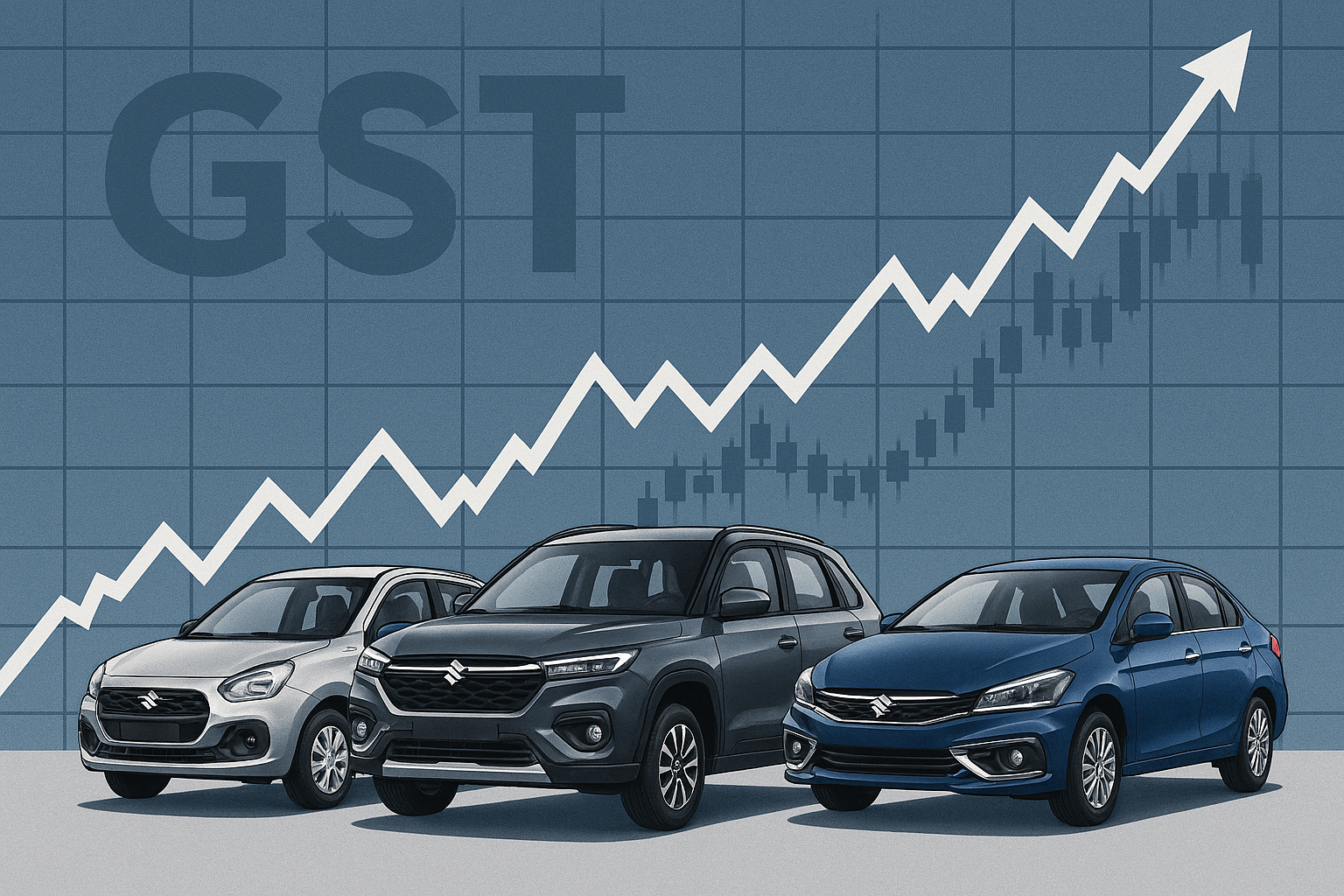
The Maruti share price has become a hot topic as GST reforms 2.0 spark fresh momentum across auto and consumer stocks. Here’s an in-depth look at how Maruti Suzuki, Hero MotoCorp, Tata Motors, Voltas, HUL, and others may be impacted.
Table of Contents
Published: August 18, 2025 | Last Updated: August 18, 2025
The Indian government’s anticipated Goods and Services Tax (GST) reforms have generated considerable discussion in financial markets regarding potential implications for various sectors. During the festive season of October 2024, Prime Minister Narendra Modi referenced the government’s commitment to tax rationalization measures. Market participants are monitoring developments in the GST Council’s deliberations that could affect taxation structures across multiple industries.
The proposed reforms under discussion involve potential modifications to the current GST rate structure, which has remained largely unchanged since the tax system’s implementation in July 2017. Various industry sectors including automobiles, consumer durables, and fast-moving consumer goods may be affected if the GST Council approves rate adjustments. This analysis examines the potential implications for key companies operating in these sectors based on publicly available information and government policy discussions.
Understanding India’s Current GST Framework and Proposed Reforms
Existing Tax Structure
India’s Goods and Services Tax system, implemented on July 1, 2017, replaced multiple indirect taxes with a unified tax structure. The current framework operates with multiple tax slabs: 0%, 5%, 12%, 18%, and 28%, with certain luxury items and demerit goods subject to additional cess. This multi-tier structure was designed to balance revenue requirements with the need to keep essential items affordable.
The 28% tax bracket currently applies to several product categories including automobiles, air conditioners, refrigerators, and certain consumer electronics. This highest tax slab, combined with compensation cess on luxury vehicles, results in effective tax rates exceeding 30% on some automobile segments. Industry associations have advocated for rate rationalization, particularly for products that serve as essential mobility or household requirements.
GST Council Deliberations
The GST Council, comprising the Union Finance Minister and state finance ministers, conducts periodic reviews of tax rates and structures. According to reports from September 2024 GST Council meetings, discussions included examination of rate rationalization across multiple categories. The Council operates on a consensus-based decision-making model, requiring agreement between the central government and states.
Key Discussion Areas:
- Potential consolidation of tax slabs to simplify compliance
- Review of products currently in the 28% tax bracket
- Assessment of revenue implications for central and state governments
- Timeline considerations for implementation of any approved changes
- Input tax credit mechanisms and compliance simplification
Policy implementation requires coordination between multiple stakeholders. Any rate changes must account for state government revenue requirements, as GST revenues are shared between central and state governments. Historical precedent suggests that major tax rate modifications undergo extensive consultation before implementation.
Automobile Sector: Market Structure and Tax Implications
Sector Overview and Market Dynamics
India’s automobile industry represents a significant component of the manufacturing sector, contributing approximately 7.1% to the country’s GDP according to industry data. The sector encompasses passenger vehicles, two-wheelers, three-wheelers, commercial vehicles, and automotive components. Domestic vehicle production exceeded 25.9 million units in FY 2023-24, making India the world’s third-largest automobile market.
Current market structure shows concentration among established manufacturers:
Passenger Vehicle Segment:
- Market leader: Maruti Suzuki India Limited with approximately 41% market share
- Other major players: Hyundai Motor India, Tata Motors, Mahindra & Mahindra, Kia India
- Segment characteristics: Price sensitivity, preference for fuel-efficient models
Two-Wheeler Segment:
- Market leader: Hero MotoCorp with substantial market presence
- Competition: Honda Motorcycle & Scooter India, TVS Motor Company, Bajaj Auto
- Segment importance: Primary mobility solution for millions of households
Tax Structure Impact on Vehicle Pricing
Automobiles currently face GST rates of 28%, with luxury vehicles and SUVs subject to additional compensation cess ranging from 1% to 22% depending on vehicle specifications. This tax structure significantly influences final consumer prices and purchasing decisions.
Current Tax Burden Analysis:
For a mid-segment passenger vehicle priced at ₹8 lakhs (ex-showroom):
- GST component (28%): Approximately ₹1.75 lakhs
- Registration and other charges: Variable by state
- Total on-road price: Significantly higher than base manufacturing cost
Industry estimates suggest that a reduction in GST rate by 3-5 percentage points could translate to absolute price decreases of ₹30,000 to ₹70,000 depending on vehicle segment. Such price adjustments could potentially influence consumer demand, particularly in price-sensitive segments.
Maruti Suzuki India Limited: Market Position and Financial Analysis
Company Overview
Maruti Suzuki India Limited, established in 1981, operates as India’s largest passenger vehicle manufacturer. The company functions as a subsidiary of Suzuki Motor Corporation, Japan, which holds majority ownership. Maruti Suzuki’s product portfolio spans entry-level hatchbacks to premium SUVs, distributed through an extensive dealer network exceeding 3,000 outlets across India.
Operational Highlights (Based on Recent Quarterly Data):
- Market share: Approximately 41% of passenger vehicle segment
- Manufacturing facilities: Gurugram (Haryana) and Manesar (Haryana)
- Annual production capacity: Approximately 2 million units
- Employee strength: Over 15,000 direct employees
Financial Performance Indicators
According to stock exchange filings and quarterly results, Maruti Suzuki’s financial metrics reflect its market leadership position:
Recent Financial Metrics:
- Quarterly revenue: Substantial scale reflecting market position
- Operating margins: Industry-competitive levels
- Return on equity: Positive performance indicators
- Debt-to-equity ratio: Conservative financial leverage
The company’s share price, as reported on stock exchanges, reflects market assessment of business fundamentals, growth prospects, and sector dynamics. As of late September 2024, the stock trades on the National Stock Exchange (NSE) and Bombay Stock Exchange (BSE) with significant daily trading volumes indicating strong liquidity.
Potential Impact of GST Rate Changes
If the GST Council approves rate reductions on automobiles, Maruti Suzuki could experience multiple effects:
Demand-Side Implications:
- Lower vehicle prices could stimulate purchase decisions in price-sensitive segments
- Entry-level models (Alto, S-Presso) might see increased affordability
- Mid-segment models (Swift, Baleno, Brezza) could attract additional buyers
- Potential market share gains if the company passes tax benefits to consumers
Supply-Side Considerations:
- Input tax credit benefits from simplified compliance procedures
- Working capital improvements from streamlined tax processes
- Operational efficiency gains from reduced administrative complexity
- Strategic pricing decisions balancing volume growth versus margin optimization
Financial Outcome Scenarios:
Scenario analysis by industry observers suggests varied outcomes depending on reform magnitude:
Conservative Scenario (2-3% GST reduction):
- Modest volume growth of 3-5%
- Limited margin impact
- Gradual demand response over 12-18 months
Moderate Scenario (5-6% GST reduction):
- Volume growth potential of 8-12%
- Possible margin expansion of 50-75 basis points
- Accelerated demand response within 6-9 months
Optimistic Scenario (8-10% GST reduction):
- Significant volume growth exceeding 15%
- Margin expansion potential of 100-150 basis points
- Rapid market response within 3-6 months
Actual outcomes would depend on implementation details, competitive responses, and broader macroeconomic conditions.
Hero MotoCorp Limited: Two-Wheeler Market Leader
Company Profile and Market Dominance
Hero MotoCorp Limited stands as the world’s largest manufacturer of motorcycles and scooters by volume. The company emerged as an independent entity following the conclusion of its joint venture arrangement with Honda Motor Company. Hero MotoCorp’s product range emphasizes fuel efficiency, affordability, and reliability, targeting primarily middle-income consumers across urban and rural markets.
Operational Characteristics:
- Annual sales volume: Approximately 6 million units (varies by fiscal year)
- Manufacturing locations: Multiple facilities across India
- Distribution network: Over 6,000 customer touchpoints
- Market focus: Strong presence in rural and semi-urban areas
Rural Market Dynamics
Two-wheelers serve as essential transportation for millions of Indian households, particularly in rural and semi-urban regions. The segment’s importance extends beyond personal mobility to include commercial applications such as last-mile goods delivery and agricultural transport. Current GST rates of 28% on two-wheelers have been cited by industry advocates as placing excessive tax burden on what essentially functions as basic transportation.
Rural Demand Factors:
- Agricultural income cycles influencing purchasing patterns
- Monsoon performance affecting rural cash flows
- Government schemes providing income support to farmers
- Credit availability through rural financing networks
- Festival season buying traditions
Tax Reform Implications for Two-Wheeler Segment
Potential GST rate reductions could significantly affect two-wheeler demand patterns:
Price Sensitivity Analysis:
Two-wheeler purchases demonstrate high price elasticity, meaning demand responds significantly to price changes. A motorcycle priced at ₹80,000 currently includes GST of approximately ₹17,500. A reduction to 18-20% GST could lower prices by ₹6,400-8,000, representing meaningful savings for target consumers.
Market Expansion Potential:
Industry estimates suggest that lower prices could unlock latent demand in several categories:
- First-time buyers in tier-3 and tier-4 cities
- Replacement demand from households using aging vehicles
- Second vehicle purchases for family use
- Commercial buyers seeking cost-effective last-mile delivery solutions
Hero MotoCorp’s extensive rural distribution network positions the company to capture incremental demand if tax reforms materialize. The company’s brand recognition, service network density, and product positioning align with potential beneficiary segments.
Tata Motors Limited: Diversified Automotive Presence
Business Segments and Strategic Positioning
Tata Motors Limited operates across multiple automotive segments, providing diversified exposure to different market dynamics. The company’s businesses include passenger vehicles (including electric vehicles), commercial vehicles, and Jaguar Land Rover luxury brands through its international subsidiary.
Business Portfolio:
Passenger Vehicles:
- Models spanning SUVs (Safari, Harrier) to hatchbacks (Altroz, Tiago)
- Growing electric vehicle portfolio (Nexon EV, Tiago EV)
- Market share in mid-single-digit percentage range
Commercial Vehicles:
- Market leadership position with 45%+ market share
- Product range from light commercial vehicles to heavy trucks
- Strong presence in both goods carriers and passenger transport
Electric Vehicle Focus:
- Leading position in domestic EV passenger car market
- Approximately 70% market share in EV segment (as of recent data)
- Multiple EV launches planned for upcoming periods
Commercial Vehicle Sector and GST Impact
The commercial vehicle segment faces unique tax considerations. Fleet operators, who represent primary customers, calculate total cost of ownership including acquisition cost, operating expenses, maintenance, and residual value. GST rates affect not just vehicle purchase prices but also the input tax credit mechanisms for business operators.
Fleet Operator Economics:
Commercial fleet economics involve complex calculations:
- Vehicle acquisition cost influenced by GST rates
- Fuel costs (diesel) representing major operating expense
- Maintenance and spare parts pricing
- Driver wages and other operational costs
- Revenue generation capacity per vehicle
A reduction in GST on commercial vehicles could improve payback periods and internal rates of return for fleet operators, potentially stimulating replacement cycles for aging vehicles and capacity expansion for growing businesses.
Electric Vehicle Policy Synergies
India’s electric vehicle policy framework includes multiple incentive schemes aimed at accelerating EV adoption. The FAME (Faster Adoption and Manufacturing of Electric Vehicles) program provides demand incentives, while Production Linked Incentive (PLI) schemes support domestic manufacturing. GST reforms might include differentiated treatment for electric vehicles versus internal combustion engine vehicles.
EV Market Dynamics:
Current EV penetration in passenger vehicles remains below 3%, indicating substantial growth runway. Government targets aim for 30% EV penetration by 2030, requiring significant acceleration from current adoption rates. Tax policy can serve as a lever to narrow the price differential between EVs and conventional vehicles, addressing a primary barrier to adoption.
Tata Motors’ leadership in the EV segment positions it to benefit from any policy measures favoring electric vehicles. The company’s manufacturing scale, battery sourcing arrangements, and charging infrastructure partnerships provide competitive advantages in capturing EV market growth.
Consumer Durables Sector: Cooling Appliances Market
Market Overview and Growth Drivers
India’s consumer durables sector, particularly cooling appliances, has demonstrated consistent growth driven by rising incomes, urbanization, and changing climate patterns. Air conditioners, refrigerators, and washing machines represent major categories within this segment. Current GST rates of 28% on these products place them in the highest tax bracket alongside luxury items.
Market Growth Factors:
- Rising per capita incomes enabling discretionary purchases
- Increasing urbanization concentrating population in cities
- Climate change leading to longer, hotter summers
- Housing market growth creating demand for home appliances
- Consumer financing availability reducing purchase barriers
Air Conditioning Market Structure
The air conditioning market encompasses room air conditioners (splits and windows), commercial air conditioning systems, and industrial cooling applications. The residential segment shows high seasonality, with peak demand during March through June corresponding to summer months.
Market Characteristics:
- Seasonal demand patterns affecting inventory and production planning
- Brand preferences influenced by energy efficiency ratings
- Installation and after-sales service importance
- Increasing preference for inverter technology for energy savings
- Smart features and IoT connectivity emerging as differentiators
Voltas Limited: Market Leader in Cooling Products
Company Background
Voltas Limited, incorporated in 1954, operates as part of the Tata Group. The company’s business divisions include Unitary Cooling Products (room air conditioners and commercial refrigeration), Electro-Mechanical Projects and Services, and Engineering Products and Services. The Unitary Cooling Products division represents the primary profit contributor.
Market Position:
- Market share in room air conditioners: Approximately 24%
- Brand recognition: Strong brand equity in cooling segment
- Distribution reach: Extensive dealer and service network
- Product range: Multiple price points and technology levels
Financial Profile
Based on quarterly results and annual reports, Voltas demonstrates:
Business Metrics:
- Revenue scale: Substantial annual revenues primarily from cooling products
- Profitability: Positive operating margins with seasonal variations
- Balance sheet: Healthy financial position supporting operations
- Working capital management: Seasonal inventory and receivables patterns
The company’s project and services divisions provide revenue diversification, though cooling products drive majority of profitability. Large project execution involves different business dynamics including longer gestation periods and milestone-based revenue recognition.
GST Reform Implications
Air conditioner pricing currently includes 28% GST, making a ₹40,000 (ex-tax) unit cost approximately ₹51,000 to consumers. A reduction to 18% GST would lower the final price to approximately ₹47,200, representing a ₹3,800 saving. For premium models priced higher, absolute savings increase proportionally.
Demand Elasticity Considerations:
Consumer research suggests that air conditioner purchases demonstrate price sensitivity, particularly in the mass market segment. Lower prices could expand the addressable market to include:
- First-time AC buyers in tier-2 and tier-3 cities
- Multi-room installations by existing AC owners
- Replacement demand for aging units
- Commercial establishments in smaller towns
Voltas’ market leadership, brand strength, and distribution capabilities position it to capture proportionate or greater share of incremental demand. The company’s focus on energy-efficient models aligns with consumer preferences and regulatory standards.
Blue Star Limited: Premium Positioning
Company Overview
Blue Star Limited, established in 1943, operates in air conditioning and commercial refrigeration. The company serves both residential (room air conditioners) and commercial/industrial segments (large air conditioning systems, refrigeration). Blue Star’s positioning emphasizes product quality, technical expertise, and comprehensive service capabilities.
Business Segments:
Electro-Mechanical Projects:
- Central air conditioning systems for commercial buildings
- Cold storage and cold chain solutions
- Professional electronics and industrial products
Unitary Products:
- Room air conditioners for residential use
- Water coolers and purifiers
- Commercial refrigeration equipment
Market Differentiation
Blue Star operates in the premium segment of room air conditioners, commanding price premiums based on:
- Superior after-sales service network
- Product reliability and durability reputation
- Technical innovation and features
- Installation quality standards
- Commercial segment expertise
The company’s project business provides revenue stability and diversification. Large commercial air conditioning projects involve extended execution timelines, technical complexity, and significant working capital deployment. GST simplification in B2B transactions could improve project economics and cash flow cycles.
Growth Strategy and Tax Impact
Blue Star’s growth strategy encompasses expanding room AC market share, growing the commercial projects pipeline, and developing new product categories. Tax reforms could influence these strategies:
Room AC Business:
- Lower prices potentially expanding addressable market
- Premium positioning maintained through service differentiation
- Market share gains through enhanced competitiveness
Commercial Projects:
- Simplified GST compliance reducing administrative burden
- Improved working capital from streamlined tax credits
- Enhanced project economics improving win rates
Fast-Moving Consumer Goods Sector
FMCG Industry Characteristics
The FMCG sector encompasses products with high turnover and relatively low unit prices, including personal care, home care, foods and beverages, and health and hygiene products. The sector demonstrates resilience during economic cycles due to the essential nature of many products. Current GST rates vary by product category, typically ranging from 12% to 18%.
Sector Attributes:
- High frequency of purchase creating steady demand
- Strong brand loyalty in many categories
- Extensive distribution networks reaching rural areas
- Advertising and marketing intensity
- Innovation in product formats and pricing
Rural Consumption Dynamics
Rural markets contribute 35-40% of FMCG consumption in India. Rural demand patterns reflect agricultural income cycles, monsoon performance, and government support programs. The sector tracks rural consumption indicators including two-wheeler sales, tractor sales, and agricultural commodity prices as leading indicators.
Rural Market Factors:
- Agricultural income seasonality
- Minimum Support Price (MSP) policies for crops
- Rural employment schemes (MGNREGA)
- Rural infrastructure development
- Electrification and digital connectivity improvements
Hindustan Unilever Limited: FMCG Sector Leader
Company Profile
Hindustan Unilever Limited (HUL), incorporated in 1933, operates as India’s largest FMCG company. The company’s portfolio includes over 50 brands across personal care, home care, foods, and refreshments. HUL functions as a subsidiary of Unilever PLC, benefiting from global parent resources while maintaining strong local market understanding.
Brand Portfolio:
- Personal care: Dove, Lux, Lifebuoy, Ponds, Lakme
- Home care: Surf Excel, Rin, Wheel, Vim
- Foods: Bru, Knorr, Kissan
- Health and wellness: Horlicks, Boost
Financial Strength
HUL demonstrates consistent financial performance characterized by:
Financial Indicators:
- Revenue scale: Annual revenues exceeding ₹60,000 crores
- Profitability: Industry-leading operating margins
- Return metrics: High return on capital employed
- Cash generation: Strong free cash flow conversion
- Dividend policy: Consistent dividend distributions
The company’s share price trades at premium valuations reflecting business quality, market position, and growth consistency. Institutional investors view HUL as a defensive holding providing stability during market volatility.
Consumption Theme Exposure
HUL benefits from GST reforms through multiple channels:
Direct Tax Impact:
- Any rate reductions on packaged goods improving gross margins
- Simplified compliance reducing administrative costs
- Input tax credit efficiency enhancing working capital
Indirect Economic Effects:
- Increased consumer purchasing power from lower prices on big-ticket items
- Rural income improvements from various policy measures
- Overall economic growth stimulating consumption
Competitive Positioning:
- Market leadership enabling capture of incremental demand
- Distribution strength facilitating product availability
- Brand portfolio addressing multiple consumer segments and price points
Electronics Manufacturing Sector
Make in India Initiative
The government’s Make in India and Production Linked Incentive (PLI) schemes aim to boost domestic manufacturing across sectors including electronics and consumer appliances. These policies create favorable conditions for contract manufacturers and original equipment manufacturers producing in India for both domestic consumption and exports.
PLI Scheme Benefits:
- Financial incentives linked to production volumes
- Reduced dependence on imports
- Employment generation in manufacturing
- Technology transfer and skill development
Contract Manufacturing Business Model
Contract manufacturers produce goods for brands under original equipment manufacturer (OEM) arrangements. This model provides brands with manufacturing flexibility while allowing specialized manufacturers to achieve scale economies across multiple clients.
PG Electroplast Limited: Electronics Manufacturing
Company Overview
PG Electroplast Limited operates as a contract manufacturer for consumer electronics and appliances. The company serves major brands including LG, Samsung, Havells, and other leading companies. Manufacturing capabilities span air conditioners, LED TVs, washing machines, and other consumer electronics.
Operational Characteristics:
- Client base: Blue-chip consumer electronics brands
- Manufacturing facilities: Multiple locations with expanding capacity
- Technology capabilities: Automation and process efficiency
- Revenue model: Long-term manufacturing agreements with clients
Growth Trajectory
PG Electroplast has experienced significant growth driven by:
- Increasing domestic electronics demand
- Make in India policy supporting local manufacturing
- Client base expansion and product diversification
- Capacity utilization improvements
- Export opportunities emerging
Financial Profile:
As a mid-cap company, PG Electroplast demonstrates:
- Revenue growth: Consistent year-over-year expansion
- Capacity expansion: Ongoing investments in additional capacity
- Client relationships: Long-term agreements providing revenue visibility
- Order book: Strong pipeline extending through upcoming fiscal years
Sector Beneficiary Analysis
Electronics manufacturing companies like PG Electroplast benefit from consumption growth through:
Operational Leverage:
- Higher production volumes improving capacity utilization
- Fixed cost absorption enhancing profitability
- Economies of scale in procurement and operations
Strategic Positioning:
- Domestic manufacturing preference trends
- PLI scheme incentives
- Import substitution opportunities
- Export market access through client relationships
The company’s growth depends on the success of client brands in the marketplace. GST reforms that stimulate consumer electronics demand would translate to higher production orders for contract manufacturers.
Market Sentiment and Investment Considerations
Stock Market Response to Policy Developments
Financial markets respond to policy announcements based on anticipated business impact. The BSE Auto Index and consumer durables stocks typically show movement when taxation or policy changes affecting these sectors are discussed. Market response reflects collective assessment by investors of potential earnings impact.
Market Behavior Patterns:
- Anticipatory movements based on policy speculation
- Volatility around official announcements
- Sector rotation as investors adjust portfolios
- Valuation adjustments incorporating changed expectations
Institutional Investor Activity
Mutual funds, insurance companies, and foreign institutional investors actively manage portfolio allocations based on policy developments and sector outlooks. Shareholding pattern disclosures provide insights into institutional positioning.
Investment Flows:
- Sector-specific fund allocations
- Thematic fund positioning
- Portfolio rebalancing activities
- Foreign investor sentiment
Risk Factors and Considerations
Policy Implementation Uncertainties
Tax reform implementation involves multiple stages:
Process Steps:
- GST Council deliberations and consensus building
- Rate notification and legal framework finalization
- System preparation for tax changes
- Transition period management
- Monitoring and course correction
Historical experience with GST modifications shows that implementation timelines can extend beyond initial expectations. Federal structure requiring central-state coordination creates complexity in decision-making processes.
Revenue Implications for Governments
GST rate reductions affect government revenues, creating fiscal considerations:
Government Perspective:
- Central and state revenue sharing arrangements
- Compensation cess mechanisms
- Fiscal deficit implications
- Alternative revenue measures
- Economic growth benefits versus immediate revenue loss
States with different economic structures and revenue dependencies may have varying positions on rate changes. Consensus building requires addressing these diverse perspectives.
Competitive Dynamics
Tax benefits may not translate to proportionate margin improvements if competitive intensity leads to price-based market share battles. Industries with excess capacity or multiple competitors often see benefits passed to consumers rather than retained as corporate profits.
Competitive Factors:
- Market structure and concentration
- Excess capacity situations
- Brand differentiation strength
- Customer price sensitivity
- Competitive positioning strategies
Valuation Considerations
Stock prices reflect market expectations about future earnings. Significant anticipatory movements based on expected policy changes create risk that actual announcements disappoint relative to market expectations.
Valuation Factors:
- Current price-to-earnings ratios relative to historical ranges
- Embedded growth expectations in valuations
- Discount rates reflecting risk perceptions
- Alternative investment opportunities
Investment Strategy Framework
Diversification Principles
Rather than concentrated positions in individual stocks, diversified exposure across sectors and market capitalizations provides balanced risk-return profiles. Portfolio construction should consider:
Allocation Considerations:
- Large-cap stability versus mid-cap growth potential
- Sector diversification reducing concentration risk
- Quality factors including financial strength and management track record
- Valuation discipline avoiding excessive premium payment
Time Horizon Perspective
Policy-driven investment themes may take extended periods to materialize. Short-term trading based on policy speculation involves timing risk. Longer investment horizons allow fundamentals to drive returns as policy impacts gradually materialize.
Time Horizon Factors:
- Implementation timelines for policy changes
- Demand response periods for price changes
- Corporate earnings cycles
- Market sentiment fluctuations
Due Diligence Requirements
Comprehensive analysis before investment decisions includes:
Research Components:
- Company financial statement analysis
- Competitive positioning assessment
- Management quality evaluation
- Industry structure understanding
- Valuation methodology application
- Risk factor identification
Professional financial advisors can provide personalized guidance based on individual circumstances, risk tolerance, and investment objectives.
Frequently Asked Questions (FAQs)
1. What is the current status of GST reform discussions in India?
The GST Council, comprising central and state finance ministers, conducts periodic reviews of tax rates and structures. During October 2024, Prime Minister Modi referenced the government’s commitment to tax rationalization. However, as of late October 2025, specific rate changes have not been officially announced or implemented.
The GST Council follows a consensus-based decision-making process requiring agreement between the central government and states. Any rate modifications would be communicated through official GST Council meeting outcomes and government notifications. Investors and businesses should monitor official channels including the GST Council website, Finance Ministry announcements, and formal government press releases for accurate information on policy changes.
2. How might GST rate reductions affect automobile company profitability?
GST rate reductions on automobiles could affect company profitability through multiple channels. Lower tax rates could translate to reduced vehicle prices, potentially stimulating consumer demand and increasing sales volumes. Higher volumes could improve capacity utilization and provide operational leverage, enhancing profitability.
However, actual profit impact depends on several factors including the magnitude of rate reduction, competitive responses, and whether companies pass benefits entirely to consumers or retain some as margin improvement.
Additionally, companies would need to manage transition periods, inventory valuation adjustments, and working capital impacts. Input tax credit improvements from simplified compliance could provide additional benefits. Specific company impacts would vary based on product mix, market positioning, and strategic responses to policy changes.
3. Which sectors beyond automobiles might benefit from GST reforms?
Beyond automobiles, several sectors could experience impacts from comprehensive GST reforms. Consumer durables including air conditioners, refrigerators, and washing machines currently face 28% GST rates and might see rate adjustments.
Fast-moving consumer goods companies could benefit from direct tax reductions on packaged products and indirectly from increased consumer purchasing power. Electronics manufacturing companies supporting Make in India initiatives might gain from improved demand for domestically produced goods. Building materials, textiles, and certain services sectors have been part of GST rationalization discussions.
The extent of benefit depends on specific rate changes approved by the GST Council and implementation details. Investors should note that sector impacts remain speculative until official policy announcements provide clarity on affected product categories and new rates.
4. What are the key risks investors should consider regarding GST reform-themed investments?
Several risks warrant consideration when evaluating investments based on anticipated GST reforms. Implementation risk exists, as policy changes may face delays due to federal-state coordination requirements, technical preparations, or fiscal considerations. Magnitude risk involves uncertainty about actual rate reductions versus market expectations—partial reforms might disappoint relative to investor expectations.
Competitive intensity risk suggests that tax benefits might be passed to consumers through price competition rather than retained as profits. Valuation risk arises if stocks have already appreciated significantly in anticipation, limiting upside or creating correction risk if reforms disappoint. Macroeconomic risks including global economic conditions, commodity prices, and currency movements could override domestic policy positives.
Revenue implications for governments might limit the scope of rate reductions. Investors should maintain portfolio diversification, avoid concentration in single themes, and assess valuations relative to fundamentals.
5. How do GST reforms fit into India’s broader economic policy framework?
GST reforms represent one element of India’s economic policy framework aimed at facilitating business operations, improving tax compliance, and supporting economic growth. The government’s policies encompass infrastructure development, manufacturing incentives through PLI schemes, financial sector reforms, digitalization initiatives, and various sector-specific measures. GST rationalization aims to simplify the tax structure, reduce compliance burden, and address concerns raised by industries about high taxation on certain products.
The reforms align with objectives of boosting consumption, supporting domestic manufacturing through Make in India programs, and improving ease of doing business. Policy effectiveness depends on balancing revenue requirements with growth objectives and managing federal-state fiscal relationships. Investors should evaluate GST reforms within this broader policy context rather than as isolated developments.
6. What financial metrics should investors analyze when evaluating companies potentially affected by GST changes?
When analyzing companies that might be affected by GST reforms, investors should examine multiple financial metrics. Revenue growth trends indicate demand patterns and market share dynamics. Operating margins (EBITDA margins) show profitability levels and operational efficiency.
Return on capital employed (ROCE) and return on equity (ROE) measure capital efficiency and shareholder value creation. Working capital metrics including inventory turnover and receivables days indicate operational efficiency.
Debt-to-equity ratios assess financial leverage and balance sheet strength. Free cash flow generation demonstrates ability to fund growth and return cash to shareholders. Price-to-earnings (P/E) ratios relative to growth rates (PEG ratios) help assess valuation reasonableness. Comparing these metrics to historical ranges, industry peers, and market benchmarks provides context.
Investors should analyze how potential GST changes might impact these metrics under different scenarios and assess whether current valuations adequately reflect potential benefits and associated risks.
7. What is the typical timeline for policy implementation after GST Council decisions?
GST policy implementations follow multi-stage processes after GST Council decisions. The Council first deliberates and reaches consensus on proposed changes, which historically can take multiple meetings. Following Council approval, legal and administrative frameworks require finalization including rate notifications and system modifications.
Tax authorities and businesses need preparation time for system changes, training, and compliance adjustments. Based on previous GST modifications, implementation timelines have ranged from several weeks to several months after Council decisions. Complex changes involving multiple rate adjustments or structural modifications generally require longer preparation periods.
Transition arrangements may include phased implementation or specific effective dates. Investors should recognize that timeline predictions remain uncertain and monitor official GST Council communications for implementation schedules. The gap between policy announcement and actual implementation can be substantial, creating investment timing considerations.
8. How can investors access exposure to potential GST reform beneficiaries while managing risk?
Investors seeking exposure to potential GST reform beneficiaries can employ several risk management approaches. Diversification across multiple companies and sectors reduces concentration risk associated with single stocks or industries. Allocating between large-cap companies offering stability and mid-cap companies offering higher growth potential provides balanced exposure.
Phased investment approaches, deploying capital gradually rather than lump-sum investments, help manage timing risk and allow adjustment as policy clarity emerges. Setting position sizes appropriate to risk tolerance and overall portfolio context prevents excessive exposure to speculative themes. Maintaining quality focus by prioritizing companies with strong balance sheets, consistent profitability, and market leadership provides downside protection.
Regular portfolio reviews allow adjustments as policy developments unfold and company fundamentals evolve. Investors should consult qualified financial advisors for personalized guidance based on individual circumstances, investment objectives, and risk tolerance. Professional advice helps navigate complex policy environments and investment decisions.
Summary and Outlook
India’s anticipated GST reforms represent significant policy developments with potential implications across multiple economic sectors. Discussions within the GST Council about tax rate rationalization have generated market attention particularly regarding automobiles, consumer durables, and FMCG products. Companies including Maruti Suzuki India Limited, Hero MotoCorp Limited, Tata Motors Limited, Voltas Limited, Blue Star Limited, Hindustan Unilever Limited, and PG Electroplast Limited operate in sectors that could be affected by policy changes.
The potential impacts remain contingent on specific policy decisions including the magnitude of rate reductions, implementation timelines, and transition arrangements. Market participants should distinguish between policy speculation and confirmed government decisions. Official announcements from the GST Council and Finance Ministry provide authoritative information on actual policy changes.
Investment decisions based on policy expectations involve multiple risk factors including implementation uncertainties, competitive dynamics, valuation considerations, and macroeconomic conditions. Comprehensive analysis of company fundamentals, financial metrics, competitive positioning, and management quality should inform investment decisions rather than relying solely on policy speculation.
India’s economic policy framework extends beyond GST reforms to encompass infrastructure development, manufacturing incentives, and various growth initiatives. Evaluating individual policy measures within this broader context provides balanced perspective on potential impacts and opportunities.
Investors should maintain disciplined approaches including portfolio diversification, quality focus, appropriate position sizing, and regular review processes. Professional financial advisory services can provide personalized guidance aligned with individual circumstances and investment objectives.
Disclaimer: This article provides information and analysis based on publicly available data for educational purposes only. It does not constitute investment advice, recommendation, or solicitation to buy or sell securities. Readers should conduct thorough independent research, consult qualified financial advisors, and assess their individual risk tolerance and investment objectives before making investment decisions.
Stock market investments involve risks including potential loss of principal. Past performance does not guarantee future results. Policy outcomes remain uncertain and actual developments may differ from expectations. The author and publisher disclaim liability for investment decisions made based on this content.
About the Author
Nueplanet
Economic Policy & Financial Markets Analyst
Nueplanet specializes in analysis of economic policy developments, sectoral trends, and their implications for financial markets. With expertise in Indian taxation systems, manufacturing sectors, and equity markets, Nueplanet provides fact-based analysis derived from official government sources, regulatory filings, stock exchange data, and verified economic databases.
Professional Standards:
- Sources information exclusively from GST Council minutes, Finance Ministry publications, SEBI filings, stock exchange announcements, company investor presentations, and verified regulatory databases
- Maintains clear distinction between confirmed policy decisions and speculative market expectations
- Updates content based on official policy announcements and material corporate developments
- Provides analytical context while avoiding investment recommendations or predictions
Objective: To deliver accurate, transparent analysis of policy developments and market dynamics that helps readers understand economic trends, corporate impacts, and sector implications
through verified information sources and objective assessment frameworks.
Contact & Credentials:
- Educational background in economics and financial analysis
- Regular contributor to financial market analysis platforms
- Committed to transparent sourcing and factual accuracy
- Available for clarifications on data sources and analytical methodologies
Nueplanet maintains independence from financial institutions, brokerage firms, and corporate entities to ensure unbiased analysis. All content undergoes verification against official sources before publication.
Comparative Analysis: Sector Performance Metrics
Automobile Sector Financial Comparison
Understanding relative positioning among automobile companies provides context for assessing potential GST reform impacts. The following analysis compares key financial metrics across major players based on most recent quarterly and annual filings:
Passenger Vehicle Manufacturers:
| Company | Market Cap (₹ Cr) | P/E Ratio | Debt/Equity | Operating Margin | Market Share |
|---|---|---|---|---|---|
| Maruti Suzuki | ~400,000 | 24-26x | <0.1 | 11-12% | ~41% |
| Tata Motors (PV) | ~340,000 | 12-14x | 0.3-0.4 | 8-10% | ~13% |
| Mahindra & Mahindra | ~275,000 | 22-24x | 0.2-0.3 | 14-16% | ~7-8% |
| Hyundai Motor India | Not listed | N/A | N/A | Industry estimates | ~15% |
Note: Figures represent approximate ranges based on recent quarters and may vary
Two-Wheeler Manufacturers:
| Company | Market Cap (₹ Cr) | P/E Ratio | Debt/Equity | Operating Margin | Annual Volume |
|---|---|---|---|---|---|
| Hero MotoCorp | ~95,000 | 18-20x | <0.1 | 13-14% | ~6M units |
| Bajaj Auto | ~110,000 | 20-22x | Negligible | 18-20% | ~4M units |
| TVS Motor | ~85,000 | 28-30x | <0.1 | 10-11% | ~4M units |
Note: Market capitalizations fluctuate with stock prices; figures are approximate
Consumer Durables Sector Comparison
Air Conditioning and Appliances:
| Company | Primary Business | Market Position | Revenue Scale (₹ Cr) | Key Strengths |
|---|---|---|---|---|
| Voltas | AC, refrigeration | Market leader in AC (~24% share) | ~8,000-9,000 | Tata brand, distribution |
| Blue Star | AC, commercial cooling | Premium positioning | ~7,000-8,000 | Service quality, B2B projects |
| Havells India | Electrical equipment, appliances | Diversified portfolio | ~14,000-15,000 | Brand portfolio, Lloyd AC |
| Dixon Technologies | Contract manufacturing | Large-scale production | ~15,000+ | Manufacturing scale, client base |
Revenue figures based on recent annual results
FMCG Sector Positioning
Major FMCG Companies:
| Company | Revenue (₹ Cr) | Operating Margin | Rural Contribution | Key Categories |
|---|---|---|---|---|
| Hindustan Unilever | ~60,000+ | 23-24% | 35-38% | Personal care, home care |
| ITC Limited | ~65,000+ | 35%+ (includes tobacco) | ~40% | FMCG, cigarettes, hotels |
| Nestlé India | ~18,000+ | 20-21% | ~30% | Foods, nutrition |
| Britannia Industries | ~16,000+ | 15-16% | ~35% | Biscuits, bakery |
Figures based on recent annual results; margins vary by business mix
These comparative metrics help investors assess relative positioning, financial strength, and potential sensitivity to policy changes across different companies within affected sectors.
Policy Implementation Framework: Understanding the Process
GST Council Decision-Making Structure
The GST Council operates as the constitutional body for making recommendations on GST-related matters. Understanding this structure helps investors set realistic expectations for policy timelines.
Council Composition:
- Chairperson: Union Finance Minister
- Members: Union Minister of State for Finance
- Members: Finance Ministers from all states and union territories (with legislatures)
- Voting weight: Central government (1/3), States collectively (2/3)
Decision Areas:
- Tax rates and exemptions
- Threshold limits for registration
- Special provisions for certain states
- Place of supply rules
- Dispute resolution mechanisms
Historical GST Rate Changes: Precedent Analysis
Examining previous GST rate modifications provides insights into typical processes and timelines:
Notable Past Changes:
November 2017: Multiple rate reductions on various items within 4 months of GST implementation
- Process: Council meeting, rate notification, implementation
- Timeline: 2-4 weeks from decision to implementation
- Products affected: Various consumer goods and services
July 2018: Further rate rationalization
- Process: Extended Council deliberations over multiple meetings
- Timeline: Several months from initial discussions to implementation
- Impact: SME sector focus
December 2018: Additional rate adjustments
- Process: Consensus building among states
- Timeline: Phased implementation approach
- Scope: Construction, services, some goods
Key Observations:
- Simple rate changes implement faster than structural modifications
- Revenue-positive changes proceed more smoothly than revenue-reducing changes
- State fiscal situations influence decision-making timelines
- Compensation cess arrangements affect rate change feasibility
Current Fiscal Context
Government fiscal positions influence GST policy decisions. Recent fiscal indicators include:
Central Government Finances (FY 2024-25 Budget Estimates):
- Fiscal deficit target: 4.9% of GDP
- GST revenue budgeted: Significant portion of tax revenues
- Capital expenditure: ₹11.11 lakh crores allocated
- Revenue expenditure: Ongoing commitments
State Government Considerations:
- Varied fiscal health across different states
- Dependency on GST revenues differs by state
- Compensation cess arrangements ending
- Infrastructure spending requirements
These fiscal dynamics create constraints on revenue-reducing policy changes, requiring careful calibration of reform magnitudes and timelines.
Macroeconomic Context and Consumer Demand Dynamics
India’s Economic Growth Trajectory
Understanding broader economic conditions provides context for assessing consumption-driven sector prospects:
GDP Growth Indicators:
- FY 2023-24: Approximately 7.6% real GDP growth
- FY 2024-25: Government and institutional forecasts suggesting 6.5-7% growth
- Drivers: Investment activity, government capital expenditure, services sector
- Challenges: Global economic uncertainties, commodity price volatility
Consumption Trends:
- Private Final Consumption Expenditure (PFCE): Major GDP component
- Urban consumption: Steady growth in organized retail, branded products
- Rural consumption: Recovery dependent on agricultural performance
- Credit growth: Consumer finance expansion supporting purchases
Inflation and Purchasing Power
Consumer Price Index (CPI) trends affect real purchasing power:
Inflation Dynamics:
- CPI inflation: Target range of 4% (+/- 2%) set by RBI
- Recent trends: Varying between 3-6% range
- Food inflation: Significant weight in consumer baskets
- Core inflation: Non-food, non-fuel inflation trends
Interest Rate Environment:
- RBI policy repo rate: Determines borrowing costs
- Transmission to retail lending rates: Affects consumer finance
- EMI affordability: Impacts big-ticket purchase decisions
- Deposit rates: Influences savings versus consumption choices
Auto Finance Penetration
Vehicle financing arrangements significantly influence automotive demand:
Financing Statistics:
- Passenger vehicle finance penetration: ~70-75% of purchases
- Two-wheeler finance penetration: ~60-65% of purchases
- Interest rates: Typically 8-12% depending on customer profile and vehicle
- Loan tenures: 3-7 years common for various vehicle types
Lower vehicle prices from GST reductions would reduce loan amounts required, potentially improving affordability even without interest rate changes. The combination of lower prices and stable or declining interest rates could amplify demand responses.
Electric Vehicle Transition and Policy Alignment
EV Market Development
India’s electric vehicle market remains in early growth stages with significant expansion potential:
Current EV Landscape:
- EV penetration in passenger vehicles: Below 3% of total sales
- Two-wheeler EVs: Higher penetration in certain urban markets
- Commercial vehicle EVs: Pilot projects and fleet trials underway
- Charging infrastructure: Approximately 8,000+ public charging stations
Government EV Targets:
- 30% EV penetration by 2030 for private cars
- 70% for commercial vehicles by 2030
- 80% for two-wheelers and three-wheelers by 2030
- Support through FAME subsidies and state-level incentives
GST Structure and EV Adoption
Current GST framework for electric vehicles:
EV Tax Rates:
- Electric vehicles: 5% GST (concessional rate)
- Conventional vehicles: 28% GST plus compensation cess
- EV chargers and charging equipment: Reduced GST rates
- Batteries: Specific GST treatment
This significant tax arbitrage between EVs and conventional vehicles represents a policy lever encouraging EV adoption. Any GST reforms potentially affecting conventional vehicles might adjust this differential.
Policy Considerations:
- Maintaining tax incentives for EV adoption versus revenue needs
- Balancing support across vehicle technologies
- Encouraging domestic EV manufacturing and battery production
- Infrastructure development support through tax policies
Leading Companies in EV Transition
Several companies are positioning for India’s EV transition:
EV Leaders:
- Tata Motors: Dominant market share in EV passenger cars
- Mahindra & Mahindra: Multiple EV launches planned
- Ola Electric: Leading in electric two-wheelers
- Ather Energy: Premium electric scooter segment
- Traditional OEMs: Various EV introduction plans
Battery manufacturing, charging infrastructure, and component suppliers represent adjacent opportunities in the EV ecosystem. Policy frameworks including PLI schemes for battery manufacturing and GST structures affect this entire value chain.
Supply Chain and Manufacturing Considerations
Automotive Supply Chain Structure
India’s automotive industry operates with complex, multi-tier supply chain networks:
Supply Chain Tiers:
Tier 1 Suppliers: Direct suppliers to vehicle manufacturers
- Major systems and subsystems
- Direct integration with OEM production
- Examples: Bosch India, Motherson Sumi, Minda Industries
Tier 2 Suppliers: Component suppliers to Tier 1
- Specialized components and parts
- Indirect relationship with OEMs
- Broader supplier base
Tier 3 Suppliers: Raw material and basic component suppliers
- Steel, plastics, electronics
- Multiple end-use applications beyond automotive
Input Tax Credit Mechanisms
GST’s input tax credit system allows businesses to claim credits for taxes paid on inputs used in production. Simplified compliance and faster credit processing benefit manufacturers:
ITC Benefits:
- Reduced working capital requirements
- Lower cascading tax effects
- Improved cash flow management
- Enhanced competitiveness
Manufacturing companies with complex supply chains involving multiple tax jurisdictions particularly benefit from streamlined GST processes. Reforms addressing compliance simplification could unlock working capital even without rate changes.
Manufacturing Capacity Utilization
Capacity utilization rates influence companies’ ability to respond to demand increases:
Automotive Sector Capacity:
- Passenger vehicles: Industry capacity utilization ~75-80% (pre-pandemic peaks ~85-90%)
- Two-wheelers: Utilization varies by manufacturer, generally 70-80% range
- Commercial vehicles: Cyclical patterns, recent utilization improving
- Component suppliers: Varies widely by product category
Higher capacity utilization improves operating leverage, as fixed costs spread across larger production volumes. Companies with available capacity can respond more effectively to demand increases from policy-driven stimuli.
Regional Market Dynamics
Geographic Demand Patterns
Vehicle demand demonstrates significant regional variations:
Urban Markets:
- Higher passenger vehicle penetration
- Premium segment concentration
- Established dealer and service networks
- Lower price sensitivity in certain segments
Tier 2/3 Cities:
- Growing middle class and aspirational demand
- Increasing infrastructure development
- Preference for value-oriented products
- Rising two-wheeler to four-wheeler upgrade demand
Rural Markets:
- Two-wheeler dominated
- Agricultural income dependency
- Seasonal purchase patterns
- Price sensitivity significant
State-Level Policy Variations
Beyond central GST, state-level policies affect automotive sector:
State Policies:
- Road tax structures varying by state
- Registration charges and procedures
- Electric vehicle subsidies and incentives
- Scrappage policy implementations
- Parking and congestion charges in certain cities
State governments’ fiscal situations and policy priorities create variations in total vehicle ownership costs across regions. GST reforms represent central policy changes, but state-level factors continue influencing final consumer costs.
Investor Education: Understanding Stock Valuation Basics
Fundamental Valuation Metrics
For readers new to equity analysis, understanding basic valuation concepts helps in assessment:
Price-to-Earnings (P/E) Ratio:
- Formula: Stock Price / Earnings Per Share
- Interpretation: How much investors pay for each rupee of earnings
- Context: Compare to company’s historical P/E, industry peers, market average
- Limitations: Affected by accounting policies, growth expectations, risk perceptions
Price-to-Book (P/B) Ratio:
- Formula: Stock Price / Book Value Per Share
- Interpretation: Market value versus accounting book value
- Context: Useful for asset-intensive businesses like manufacturing
- Limitations: Book value may not reflect market value of assets
Debt-to-Equity Ratio:
- Formula: Total Debt / Total Equity
- Interpretation: Financial leverage and bankruptcy risk indicator
- Context: Higher ratios indicate more leverage and risk
- Limitations: Industry-specific norms vary; some debt can be optimal
Operating Margin:
- Formula: Operating Profit / Revenue (in percentage)
- Interpretation: Profitability from core operations
- Context: Compare trends over time and versus competitors
- Limitations: Can be affected by one-time items, accounting choices
Growth versus Value Investing
Different investment philosophies apply to stock selection:
Growth Investing:
- Focus: Companies with above-average growth prospects
- Characteristics: Higher P/E ratios, reinvestment emphasis
- Examples: Fast-growing mid-caps, emerging sectors
- Risk/Return: Higher potential returns with higher volatility
Value Investing:
- Focus: Companies trading below intrinsic value
- Characteristics: Lower P/E ratios, stable businesses
- Examples: Mature companies, cyclical sectors at bottoms
- Risk/Return: Lower volatility with more modest return expectations
Quality Investing:
- Focus: High-quality businesses regardless of growth/value labels
- Characteristics: Strong competitive positions, consistent profitability
- Examples: Market leaders with sustainable advantages
- Risk/Return: Balanced approach with downside protection
Understanding these frameworks helps investors identify which companies fit their investment objectives and risk tolerance levels.
Tax Policy Economics: Theoretical Foundations
Consumption Taxes and Economic Efficiency
Economic theory provides frameworks for understanding consumption tax impacts:
Tax Incidence:
- Statutory incidence: Who legally pays the tax
- Economic incidence: Who actually bears the tax burden
- Depends on: Price elasticity of supply and demand
- GST context: Burden shared between producers and consumers
Deadweight Loss:
- Concept: Economic inefficiency from taxation
- Mechanism: Reduces mutually beneficial transactions
- GST rates: Higher rates create larger deadweight losses
- Reform benefit: Rate reductions reduce economic distortions
Optimal Tax Theory:
- Objectives: Raise revenue with minimal economic distortion
- Ramsey rule: Tax goods with inelastic demand more heavily
- Equity concerns: Progressive versus regressive tax structures
- India’s context: Balancing efficiency, equity, and revenue needs
Demand Elasticity and Price Sensitivity
Understanding price elasticity helps predict reform impacts:
Price Elasticity of Demand:
- Definition: Percentage change in quantity demanded for 1% price change
- Elastic demand (>1): Quantity changes more than proportionally to price
- Inelastic demand (<1): Quantity changes less than proportionally to price
Automotive Sector Elasticity:
- Entry-level vehicles: Relatively elastic (price-sensitive buyers)
- Luxury vehicles: Relatively inelastic (less price-sensitive segment)
- Two-wheelers (rural): Elastic demand tied to income and prices
- Commercial vehicles: Depends on freight economics and capacity needs
Higher price elasticity means GST reductions translate to larger demand responses, making reform impacts more significant for price-sensitive segments.
Corporate Governance and Management Quality
Evaluating Company Leadership
Management quality significantly influences how companies navigate policy changes:
Assessment Factors:
Strategic Vision:
- Long-term planning versus short-term focus
- Capital allocation discipline
- Market positioning strategies
- Technology and innovation emphasis
Execution Capability:
- Track record of delivering on commitments
- Operational efficiency improvements
- Project implementation success
- Cost management effectiveness
Financial Discipline:
- Balance sheet management
- Working capital efficiency
- Shareholder value focus
- Transparency in communications
Governance Standards:
- Board composition and independence
- Related party transaction practices
- Disclosure quality and timeliness
- Minority shareholder treatment
Corporate Disclosures and Transparency
Publicly listed companies provide extensive disclosures enabling analysis:
Key Disclosure Documents:
Quarterly Results:
- Revenue, profit, and cash flow statements
- Segment-wise performance data
- Material developments and updates
- Management commentary
Annual Reports:
- Comprehensive financial statements
- Management discussion and analysis
- Corporate governance reports
- Auditor observations and notes
Regulatory Filings:
- Stock exchange announcements
- SEBI filings on material events
- Shareholding pattern disclosures
- Related party transaction details
Investor Presentations:
- Business updates and strategy
- Financial performance analysis
- Growth plans and capital expenditure
- Industry trends and positioning
Reviewing these documents helps investors understand company operations, financial health, and management approaches.
Conclusion: Balanced Perspective for Informed Decision-Making
Anticipated GST reforms in India represent significant policy developments with potential implications across automotive, consumer durables, FMCG, and related sectors. Companies including Maruti Suzuki India Limited, Hero MotoCorp Limited, Tata Motors Limited, Voltas Limited, Blue Star Limited, Hindustan Unilever Limited, and PG Electroplast Limited operate in industries that could be affected by tax structure changes.
However, several critical considerations warrant emphasis:
Policy Uncertainty: As of October 2025, specific GST rate changes remain subject to GST Council deliberations and government decisions. Market speculation does not equal confirmed policy outcomes.
Implementation Complexity: Even after policy decisions, implementation involves multiple stages, timeline uncertainties, and potential execution challenges requiring monitoring.
Competitive Dynamics: Tax benefits may flow to consumers through competitive pricing rather than being retained entirely as corporate profit improvements.
Valuation Context: Stock prices may already reflect expectations about reforms, creating risk if actual outcomes disappoint relative to market expectations.
Fundamental Focus: Company-specific factors including competitive positioning, management quality, financial strength, and execution capabilities determine long-term investment outcomes beyond individual policy changes.
Risk Management: Diversification, appropriate position sizing, quality focus, and realistic time horizons represent prudent investment practices regardless of policy developments.
Investors should maintain disciplined analytical approaches, distinguish between speculation and confirmed information, and make decisions based on comprehensive assessment of multiple factors. Professional financial advisory services provide personalized guidance aligned with individual circumstances.
India’s economic growth trajectory, demographic advantages, and policy frameworks supporting domestic consumption and manufacturing create long-term structural opportunities. Individual policy measures like GST reforms represent catalysts within this broader context rather than isolated determinants of investment outcomes.
Successful investing requires balancing optimism about growth opportunities with realistic assessment of uncertainties, risks, and valuation considerations. Those who combine thorough research, diversified portfolios, quality focus, and patient capital deployment typically achieve better risk-adjusted outcomes across market cycles.
Helpful Resources
Call to Action
Stay updated with NuePlanet.com for the latest insights on maruti share price movements, GST reforms, and stock market trends. Subscribe now to never miss an update on India’s most influential companies and policy changes.
Latest Posts
- ITR Tax Audit Extension Request: What Taxpayers Need to Know
- IRCTC Booking: New Railway Scheme to Save Passengers Money This Festive Season
- Ahmedabad Weather: Heavy Rains Predicted, IMD Issues Alert
- EPFO Aadhaar UAN Linking: A Step-by-Step Guide to the Latest Update
- Mahindra Vision S SUV Unveiled in India: Redefining the Future of Mobility
Related Posts












Post Comment