







JoSAA Counselling 2025: Round 5 Seat Allotment Results Out Today – Here’s All You Need to Know
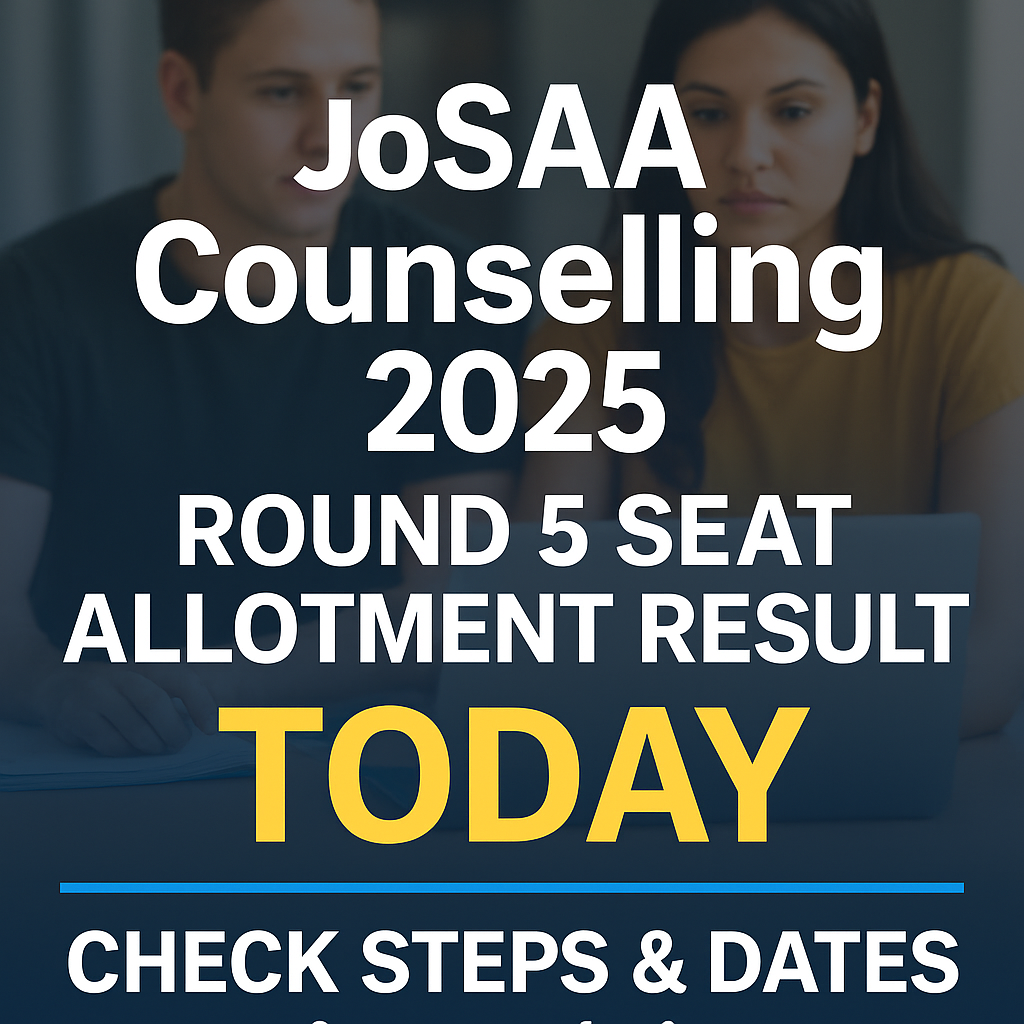
JoSAA Counselling 2025 Round 5 seat allotment results are out today. Check how to download the result, reporting deadlines, and what’s next in the admission process for IITs, NITs, IIITs, and GFTIs.
Table of Contents
The Joint Seat Allocation Authority (JoSAA) released the Round 5 seat allotment results for the 2025 counselling process on July 11, 2025. This announcement marks an important milestone in the admission process for engineering aspirants seeking entry into India’s premier technical institutions. Candidates who participated in Round 5 can now access their allotment status through the official portal at josaa.nic.in.
JoSAA manages the centralized admission process for 23 Indian Institutes of Technology (IITs), 31 National Institutes of Technology (NITs), Indian Institute of Science (IISc) Bangalore, 26 Indian Institutes of Information Technology (IIITs), and 38 other Government Funded Technical Institutes (GFTIs). With approximately 50,000 seats available across these institutions, the counselling process follows a systematic six-round allocation system based on merit and candidate preferences.
Understanding JoSAA and Its Role in Engineering Admissions
The Joint Seat Allocation Authority was established by the Ministry of Education, Government of India, to create a unified and transparent admission mechanism for top technical institutions. This centralized system replaced the previous practice where each institution conducted separate admission processes, making it significantly easier for students to secure seats based on their JEE Main and JEE Advanced ranks.
JoSAA conducts admissions based on the following entrance examinations. Candidates who qualified for JEE Advanced 2025 are eligible for IIT and IISc admissions. Those who cleared JEE Main 2025 can apply for NITs, IIITs, and GFTIs. The allocation process considers various factors including candidate rank, category, preference order, and seat availability.
The participating institutes span across India, ensuring geographic diversity in engineering education. Northern region includes institutions like IIT Delhi, IIT Roorkee, and NIT Kurukshetra. Western region hosts IIT Bombay, IIT Gandhinagar, and NIT Surathkal. Southern India features IIT Madras, IIT Hyderabad, NIT Trichy, and NIT Warangal, while the eastern region includes IIT Kharagpur and NIT Rourkela.
JoSAA 2025 Round 5 Result: Key Details and Timeline
According to the official notification on josaa.nic.in, the Round 5 seat allotment result became available on July 11, 2025. Candidates must log into the portal using their JEE Main or JEE Advanced application number and password to check their allotment status. The system displays whether a seat has been allocated and provides complete details about the institute and branch if allocation occurred.
The online reporting period for Round 5 extends from July 11 to July 13, 2025. During this window, candidates must complete several important tasks including document upload, seat acceptance fee payment, and selection of their preferred option among Freeze, Float, or Slide. Missing this deadline results in forfeiture of the allocated seat.
Document verification for Round 5 allottees concludes on July 14, 2025. The verification process happens online through the JoSAA portal, where candidates upload scanned copies of required documents. Authorities review these submissions and approve them if they meet the specified standards.
Eligibility Criteria for JoSAA 2025 Counselling
Candidates must satisfy specific eligibility requirements to participate in JoSAA counselling. For IIT and IISc admissions, qualification in JEE Advanced 2025 is mandatory. Candidates applying for NITs, IIITs, and GFTIs must have a valid JEE Main 2025 rank. All applicants need to have completed their 12th standard examination with Physics, Chemistry, and Mathematics as compulsory subjects.
Age requirements vary by institution type. Most IITs accept candidates born on or after October 1, 2000, with a relaxation of five years for reserved category students. NITs and other institutions may have slightly different age criteria, which candidates should verify from the official JoSAA brochure.
Category-wise reservations follow government guidelines. Approximately 27% of seats are reserved for Other Backward Classes (Non-Creamy Layer), 15% for Scheduled Castes, 7.5% for Scheduled Tribes, and 10% for Economically Weaker Sections. Additionally, 5% supernumerary seats are available for Persons with Disabilities across all categories.
How to Check JoSAA 2025 Round 5 Seat Allotment Result
Candidates should visit the official JoSAA website at josaa.nic.in to access their Round 5 results. The homepage displays a prominent link for seat allotment results during the counselling period. Clicking this link redirects users to the candidate login page.
Enter your JEE Main or JEE Advanced application number in the designated field. This number was provided when you registered for the respective entrance examination. Input your password carefully, ensuring correct case sensitivity. The system also requires a security pin for additional verification.
After successful login, the candidate dashboard displays your allotment status. If a seat has been allocated, complete details appear including institute name, branch, seat type, and category. Download the provisional allotment letter immediately, as this document is required for subsequent processes. Save multiple copies of this letter for your records.
Understanding Seat Acceptance Fee Structure
The seat acceptance fee varies based on candidate category. General and Other Backward Classes (Non-Creamy Layer) candidates must pay ₹35,000 as seat acceptance fee. This amount serves as a partial advance toward the total tuition fee and is adjusted against the first-year academic fee during physical admission at the institute.
Scheduled Caste, Scheduled Tribe, and Persons with Disabilities candidates benefit from a reduced seat acceptance fee of ₹15,000. This concession acknowledges the financial challenges faced by students from these categories. The payment must be completed through the online portal using net banking, debit card, credit card, or UPI payment methods.
The seat acceptance fee is refundable under specific circumstances. If a candidate receives a seat upgrade in subsequent rounds, the fee from the previous round is refunded to the original payment source. Processing of refunds typically takes 7-14 working days after the counselling process concludes.
Online Reporting Process for Round 5 Allottees
Online reporting consists of three main components that candidates must complete between July 11 and July 13, 2025. The first step involves uploading required documents in the specified format. These documents include Class 10 certificate for age proof, Class 12 certificate and mark sheet, JEE scorecard, category certificate (if applicable), and recent passport-size photographs.
Document quality standards are strictly enforced. Scanned copies must have a minimum resolution of 300 DPI to ensure text clarity. File format should be PDF for documents and JPEG for photographs. Each file must not exceed 2 MB in size. Authorities reject unclear or improperly formatted documents, requiring candidates to upload fresh copies.
The second step requires payment of the seat acceptance fee through the integrated payment gateway. Multiple payment options are available including all major banks’ net banking facilities, Visa and Mastercard credit/debit cards, and popular UPI platforms. After successful payment, download and save the transaction receipt for future reference.
Freeze, Float, and Slide Options Explained
Candidates must choose one of three options during online reporting, which determines their participation in future rounds. Understanding these options is critical for making informed decisions about seat acceptance. Each option carries different implications for the final round of counselling.
The Freeze option indicates complete acceptance of the allocated seat. Selecting this option withdraws the candidate from all subsequent counselling rounds. The seat is confirmed, and no further upgrades are possible. This option is suitable when the allocated seat matches the candidate’s top preferences.
Float option accepts the current seat while keeping the candidate active for potential upgrades in subsequent rounds. If an upgrade occurs based on preference order, the previous seat is automatically released. This involves calculated risk, as certain conditions in Round 6 might affect seat retention. Candidates typically choose Float when they anticipate better allocation possibilities.
Slide option accepts the allocated institute but seeks a better branch within the same institution. This is a lower-risk strategy compared to Float, as the institute remains constant. Only branch upgrades within the same institution are considered in subsequent rounds. This option suits candidates satisfied with their institute but preferring a different academic program.
Complete Document Checklist for JoSAA 2025
The Class 10 certificate serves as proof of date of birth and must be issued by a recognized education board. The certificate should clearly display the candidate’s name, father’s name, mother’s name, and date of birth. Any discrepancy in name spelling across documents can lead to verification delays.
Class 12 certificate and mark sheet confirm eligibility for engineering programs. The mark sheet must show Physics, Chemistry, and Mathematics as passed subjects. Candidates who appeared for 12th examinations in 2024 or 2025 are eligible. Those who passed earlier may face restrictions at certain institutions.
JEE Main or JEE Advanced scorecard contains the rank and percentile information used for seat allocation. Download the original scorecard from the NTA website for JEE Main or the official JEE Advanced portal. The scorecard must display the candidate’s roll number, rank, and category clearly.
Category certificate is mandatory for candidates claiming reserved category benefits. The certificate must be issued by a competent authority as specified in the JoSAA information brochure. For OBC candidates, the certificate should specifically mention Non-Creamy Layer status. The validity period of the certificate must cover the admission year.
Physical Disability certificate applies to candidates in the PwD category. The certificate must be issued by a medical board constituted by the Central or State Government. It should clearly state the nature and percentage of disability. Only disabilities specified in the Rights of Persons with Disabilities Act, 2016 are recognized.
Important Dates for Remaining JoSAA 2025 Rounds
The Round 5 online reporting period closes on July 13, 2025, at 11:59 PM. Candidates must complete document upload, fee payment, and option selection before this deadline. No extensions are granted under any circumstances, and incomplete reporting results in seat cancellation.
Document verification for Round 5 allottees concludes on July 14, 2025. During this period, authorities review uploaded documents and approve them if they meet quality standards. Candidates should regularly check the portal for verification status and respond promptly to any queries raised by officials.
Round 6, the final seat allotment round, will announce results on July 15, 2025. This represents the last opportunity for seat upgrades through the JoSAA process. Candidates who chose Float or Slide options in Round 5 automatically participate in Round 6 if upgrade possibilities exist based on their preference list.
The final online reporting period spans July 15 to July 17, 2025. All candidates allocated seats in Round 6 must complete their reporting formalities during this window. This includes candidates receiving fresh allocations as well as those who received upgrades from previous rounds.
Physical reporting at allocated institutes is scheduled between July 20 and July 25, 2025. Candidates must visit their allotted institution in person with original documents for verification and final admission. Each institute publishes specific dates and procedures on its official website.
Academic sessions for the 2025-26 batch commence on August 1, 2025, across most participating institutions. However, individual institutes may have slightly different start dates based on their academic calendars. Candidates should verify the exact date from their respective institute’s official communication.
Seat Allocation Statistics and Distribution
Approximately 50,000 total seats are available through the JoSAA process across all participating institutions. This includes roughly 16,000 seats in IITs, 23,000 seats in NITs, 5,000 seats in IIITs, and 6,000 seats in GFTIs. The exact number varies slightly each year based on institutional capacity and government approvals.
Computer Science and Engineering remains the most sought-after branch across all institute categories. This discipline typically has the highest cutoff ranks and most competitive allocation. Electrical Engineering, Electronics and Communication Engineering, and Mechanical Engineering follow in popularity.
Branch-wise seat distribution varies significantly across different institute types. IITs offer seats in traditional engineering disciplines as well as newer programs like Engineering Physics, Materials Science, and Energy Engineering. NITs provide a broader range including specialized branches like Production Engineering, Instrumentation Engineering, and Textile Technology.
Geographic distribution of candidates shows that a significant proportion of students opt for institutes in their home region when rank permits. However, premier institutions like IIT Bombay, IIT Delhi, and IIT Madras attract candidates from across India regardless of location. State quota provisions in NITs ensure regional representation in admissions.
Strategy for Round 6: Final Round Preparation
Candidates awaiting upgrades should analyze historical cutoff trends to assess realistic possibilities. Previous year’s opening and closing ranks for desired programs provide valuable insights. Cutoffs typically stabilize by Round 5, with only marginal changes expected in the final round.
Round 6 historically sees fewer seat movements compared to earlier rounds. Most satisfied candidates choose Freeze by Round 5, reducing the pool of seats available for upgrades. However, certain branches and institutes may experience significant changes based on candidate choices.
Candidates should prepare backup plans parallel to waiting for Round 6 results. This includes exploring spot counselling opportunities at individual institutes, state-level engineering counselling, and admissions at reputed private institutions. Keeping options open ensures no loss of admission year in case of unfavorable outcomes.
Financial planning for institute fees becomes crucial at this stage. Different institute types have varying fee structures. Annual tuition fee at IITs ranges from ₹2 to 2.5 lakhs, NITs charge between ₹1.5 to 2 lakhs, while IIITs and GFTIs have comparable fee structures. Additional expenses include hostel fees, mess charges, and other miscellaneous costs.
Document Verification Common Issues and Solutions
Name mismatch across different documents is one of the most frequent issues during verification. If your name appears differently in Class 10, Class 12, and JEE scorecards, prepare an affidavit on stamp paper explaining the variation. Obtain this affidavit from a notary public before document upload.
Low-quality scans lead to document rejection. Use a good scanner or scanning app that can produce clear, high-resolution images. Ensure the entire document is visible within the frame without any portions cut off. Text should be easily readable without zooming.
Category certificate issues often arise due to incorrect format or issuing authority. The certificate must be issued by a Tehsildar or higher-ranking revenue officer for OBC candidates. SC/ST certificates should come from District Magistrate or designated authority. Verify the correct format from the JoSAA information brochure before obtaining certificates.
Incorrect file format or oversized files cause upload failures. Always save documents as PDF files, which is the preferred format. If file size exceeds 2 MB, use compression tools to reduce it while maintaining readability. Test the upload process well before the deadline to identify and resolve technical issues.
Payment Gateway Issues and Troubleshooting
Transaction failures can occur due to various technical reasons during fee payment. If money is debited from your account but the payment status shows failed on JoSAA portal, do not retry immediately. Wait for 24 hours, as the amount usually gets reversed automatically. If the issue persists, contact the JoSAA helpline with transaction details.
Browser compatibility affects payment processing. Use updated versions of Google Chrome, Mozilla Firefox, or Microsoft Edge for optimal portal performance. Clear browser cache and cookies before initiating payment. Disable pop-up blockers that might interfere with the payment gateway.
Network connectivity problems can interrupt payment processing. Ensure stable internet connection throughout the payment process. Avoid making payments during peak hours (10 AM to 2 PM and 6 PM to 10 PM) when server load is high. Early morning or late evening hours typically experience better portal response.
Save payment confirmation immediately after successful transaction. Download the receipt in PDF format and take screenshots as additional backup. Note down the transaction ID, date, time, and amount paid. These details are essential if you need to raise any payment-related queries with JoSAA authorities.
Understanding Institute-Specific Requirements
IITs follow a uniform admission process coordinated through JoSAA, but each IIT may have specific requirements during physical reporting. Some IITs conduct medical examinations before final admission. Others may require additional documents like gap certificates if applicable. Check your allocated IIT’s website for detailed joining instructions.
NITs have state quota and other state quota distinctions affecting hostel allocation and fee structure. Home state quota students may receive priority in hostel allotment. Fee structure might vary slightly between quota types at some NITs. Verify these details from your allocated NIT’s admission office.
IIITs include both government-funded and public-private partnership (PPP) models. Fee structure differs significantly between these types. Government IIITs charge around ₹1.5 to 2 lakhs annually, while PPP IIITs may charge ₹3 to 6 lakhs. Confirm the exact fee structure before final admission.
GFTIs encompass diverse institutions with varying specializations. Some focus on specific engineering domains like mining, leather technology, or textile engineering. Research your allocated GFTI’s strengths, placement record, and infrastructure before making final decisions.
Rights and Responsibilities of Candidates
Candidates have the right to participate in all counselling rounds until they choose the Freeze option. Fair allocation based purely on merit, rank, and preference order is guaranteed. Access to complete information about participating institutes, available seats, and previous year cutoffs is provided through the official portal.
Transparency in the allocation process is maintained through clear documentation of each step. Candidates can track their allotment history across all rounds. Grievance redressal mechanisms exist for addressing genuine concerns, though the allocation algorithm itself cannot be challenged.
Candidates must respond to seat allotments within specified deadlines. Completing online reporting formalities honestly and accurately is mandatory. Providing genuine documents without any falsification is a legal requirement. Paying seat acceptance fees on time ensures seat retention.
Physical reporting at the allocated institute must occur during the designated period. Original documents must be presented for verification during physical reporting. Completing all admission formalities as specified by the institute is the candidate’s responsibility. Non-compliance with any requirement may result in admission cancellation.
Scholarship Opportunities for Admitted Students
Several government scholarship schemes support students admitted through JoSAA. The Post-Matric Scholarship for SC/ST students covers tuition fees and provides maintenance allowance. Eligible students from these categories can apply through the National Scholarship Portal after admission.
Central Sector Scheme of Scholarship for College and University Students provides financial support to meritorious students from economically weaker sections. Students with family income below ₹4.5 lakhs per annum can apply. The scholarship amount ranges from ₹10,000 to ₹20,000 per year based on the course level.
Merit-cum-Means scholarships are available at most IITs and NITs for students from low-income families. These scholarships may cover partial or full tuition fees based on family income and academic performance. Application processes vary by institution, and students should contact their institute’s scholarship cell.
Private scholarships from various foundations and corporate CSR initiatives offer additional support. Many IITs and NITs have tie-ups with specific scholarship programs. Students should explore these opportunities through their institute’s training and placement cell or student affairs office.
Career Prospects After Admission
Graduating from JoSAA-participating institutes opens diverse career pathways. Campus placements at IITs typically see average packages between ₹15 to 30 lakhs per annum, with top packages exceeding ₹1 crore. NITs report average packages around ₹8 to 15 lakhs, with significant variation based on branch and individual performance.
Core engineering companies, IT sector firms, consulting organizations, and finance institutions actively recruit from these institutes. Major recruiters include Microsoft, Google, Amazon, Goldman Sachs, McKinsey, and numerous domestic and international firms across sectors. Internship opportunities during undergraduate years provide valuable industry exposure.
Higher education prospects after undergraduate degree include master’s programs at top Indian institutions like IITs and IISc, as well as international universities. Students from these institutes regularly secure admissions to MIT, Stanford, UC Berkeley, and other prestigious global universities. Many receive full scholarships for graduate studies abroad.
Entrepreneurship support through incubation centers enables students to start their ventures. Several successful startups have emerged from IIT and NIT alumni. Access to mentorship, funding opportunities, and infrastructure provided by these institutes supports entrepreneurial aspirations.
Ragging Prevention and Student Safety
All participating institutes strictly prohibit ragging in any form. The University Grants Commission (UGC) regulations on curbing ragging are enforced stringently. Anti-ragging committees function at each institute to prevent and address any incidents. Students can report concerns through anti-ragging helplines and online platforms.
The National Anti-Ragging Helpline (1800-180-5522) operates 24×7 to address student complaints. The UGC maintains a web portal (antiragging.in) where students can report incidents anonymously. Strict disciplinary action including expulsion is taken against students found guilty of ragging.
Safety measures for students include campus security, hostel wardens, proctorial systems, and student counseling services. Most institutes have implemented women’s safety cells and grievance redressal mechanisms. Regular orientation programs educate students about campus rules and behavioral expectations.
Parents can access information about their ward’s safety through institute communication channels. Emergency contact numbers of hostel wardens, security office, and institute administration are provided during admission. Regular parent-teacher interactions help maintain transparency about student welfare.
Medical Facilities and Health Insurance
Most IITs and NITs have well-equipped health centers within campus providing basic medical care. Qualified doctors and nursing staff are available during working hours, with emergency services accessible 24×7. Common ailments, minor injuries, and routine health checkups are handled at these facilities.
Serious medical conditions requiring specialized treatment are referred to empaneled hospitals near the campus. Many institutes have tie-ups with multi-specialty hospitals for student healthcare. Emergency ambulance services ensure quick transportation to hospitals when needed.
Health insurance coverage is often included in the institute fees or offered as optional additional coverage. This insurance typically covers hospitalization expenses, surgical procedures, and specific treatments. Students should understand the coverage details, claim procedures, and network hospitals associated with their health insurance policy.
Mental health support through counseling services has become integral to student welfare. Professional counselors are available to help students manage academic stress, personal issues, and psychological challenges. Confidential counseling sessions provide a safe space for students to discuss concerns.
Hostel Allocation and Campus Life
Hostel accommodation is typically guaranteed for all first-year students at IITs and most NITs. Room allotment happens during physical reporting or shortly after admission. First-year students usually share rooms with one or two batchmates. Senior students may get single rooms based on availability and institute policy.
Hostel facilities include furnished rooms with basic amenities like bed, study table, chair, and cupboard. Common areas provide recreational facilities, reading rooms, and TV lounges. Most hostels have Wi-Fi connectivity, though speed and reliability vary. Mess facilities provide daily meals with fixed menus that typically include regional variety.
Mess charges are separate from hostel fees and cover breakfast, lunch, dinner, and evening snacks. Monthly mess bills range from ₹3,000 to ₹5,000 depending on the institute and meal plan. Some hostels allow students to opt out of mess services, while others make it mandatory for first-year students.
Campus life extends beyond academics with numerous extracurricular activities. Cultural festivals, technical competitions, sports events, and club activities provide holistic development opportunities. Student-run clubs covering diverse interests from robotics to photography create vibrant campus communities. Inter-IIT and inter-NIT competitions foster healthy competitive spirit.
Academic Structure and Curriculum
Most engineering programs follow a semester system with two semesters per academic year. Each semester typically spans 14-16 weeks of instruction followed by examination periods. Credit-based systems allow some flexibility in course selection, especially in later years of the program.
First-year curriculum usually includes common foundation courses in mathematics, physics, chemistry, and basic engineering subjects. Branch-specific courses begin from the second year. Practical learning through laboratory work, projects, and workshops complements theoretical instruction. Many programs mandate industrial training or internships during summer breaks.
Examination systems vary across institutes but generally include continuous assessment through quizzes, assignments, mid-semester exams, and end-semester exams. Attendance requirements are strictly enforced, with most institutes requiring minimum 75% attendance for examination eligibility. Academic performance is evaluated through grade point systems.
Faculty members at these institutes typically hold doctoral degrees from reputed Indian or international universities. Many are actively involved in research, bringing cutting-edge knowledge to classroom instruction. Office hours and teaching assistants provide additional academic support to students beyond regular classes.
Official Resources and Contact Information
The official JoSAA website (josaa.nic.in) serves as the primary information source for all counselling-related activities. The website publishes detailed information brochures, seat matrices, previous year statistics, and important notices. Candidates should check the website regularly for updates and announcements.
JoSAA helpdesk provides assistance through multiple channels. The telephone helpline operates during counselling periods with extended hours. Email support addresses written queries, typically responding within 48 hours. Live chat functionality on the website offers real-time assistance during peak counselling days.
Social media channels maintained by JoSAA and participating institutes share timely updates. However, candidates should rely primarily on official websites for authentic information rather than social media posts. Beware of fake news and unverified information circulating on various platforms.
Individual institutes publish specific joining instructions, fee structure details, and academic calendars on their official websites. Candidates should refer to their allocated institute’s website for accurate information about physical reporting requirements. Contact details of admission offices are available for direct communication.
Common Mistakes to Avoid
Delaying online reporting until the last day creates unnecessary stress and technical risks. Portal traffic increases significantly near deadlines, potentially causing slow loading times or temporary unavailability. Complete your reporting at least 24 hours before the deadline to avoid last-minute complications.
Not saving payment receipts and allotment letters leads to difficulties during subsequent processes. Create both digital and physical copies of all important documents. Organize these systematically in labeled folders for easy access during physical reporting.
Choosing options without proper research affects your final allocation outcome. Understand the implications of Freeze, Float, and Slide thoroughly before making selections. Consider your realistic upgrade possibilities based on historical data rather than optimistic assumptions.
Ignoring email and SMS communications from JoSAA results in missed updates. Check your registered email and phone regularly during the counselling period. Spam filters sometimes redirect official emails, so monitor your spam folder as well.
Providing incorrect mobile numbers or email addresses during registration creates communication gaps. Verify your contact details carefully and update them immediately if changes occur. JoSAA sends critical information through these channels.
Preparing for Institute Life
Academic preparation before classes begin helps ease the transition. Review basic mathematics, physics, and programming concepts that form foundations for engineering courses. Several online resources and MOOCs offer introductory courses in various engineering disciplines.
Connecting with seniors from your allocated institute provides valuable insights about campus life. Many institutes have official groups or forums where admitted students can interact with current students. These interactions help understand campus culture, academic expectations, and practical tips for freshers.
Financial planning should account for expenses beyond tuition and hostel fees. Budget for textbooks, stationery, electronic gadgets required for coursework, local transportation, and personal expenses. Opening a bank account near your institute facilitates financial management.
Packing appropriately for hostel life requires balancing between bringing essentials and avoiding excess luggage. Most items for daily use are available near campus areas. Focus on bringing important documents, basic clothing suitable for local climate, personal care items, and any specific medications if required.
Frequently Asked Questions (FAQs)
1. When will the JoSAA 2025 Round 6 results be announced?
The JoSAA 2025 Round 6 seat allotment results will be declared on July 15, 2025, as per the official schedule. This is the final round of seat allocation for the 2025 admission cycle. Candidates who selected Float or Slide options in previous rounds will automatically be considered for Round 6 if eligible for upgrades. The online reporting period for Round 6 will extend from July 15 to July 17, 2025.
2. What happens if I miss the online reporting deadline for Round 5?
Missing the online reporting deadline (July 13, 2025, 11:59 PM) results in automatic cancellation of your allocated seat. The seat becomes available for other candidates in subsequent rounds. No extension or grace period is provided under any circumstances. If this occurs, you can only participate in Round 6 if you had not completed any reporting in Round 5, but your Round 5 allotment will be forfeited. Therefore, completing reporting well before the deadline is crucial.
3. Can I get a refund of the seat acceptance fee if I don’t get admission in the final round?
Yes, the seat acceptance fee is fully refundable if you do not receive a seat allocation in the final round. Additionally, if you receive a seat upgrade in subsequent rounds, the fee paid in previous rounds is refunded after adjusting for the new round’s fee. Refunds are processed to the original payment source (bank account/card) within 7-14 working days after counselling concludes. Ensure you maintain accurate bank details in your JoSAA profile for smooth refund processing.
4. What is the difference between JoSAA and CSAB counselling?
JoSAA conducts the primary six rounds of counselling for IITs, NITs, IIITs, and GFTIs based on JEE Main and JEE Advanced ranks. After JoSAA rounds conclude, the Central Seat Allocation Board (CSAB) conducts special rounds for vacant seats in NITs, IIITs, and GFTIs only. CSAB does not allocate seats in IITs or IISc. Candidates who did not receive seats through JoSAA or wish to participate for NIT/IIIT/GFTI seats can register separately for CSAB rounds.
5. How are seats allocated if multiple candidates have the same rank?
In cases where candidates have identical ranks, the allocation follows a tie-breaking mechanism as specified in JEE examination rules. For JEE Main, priority is given based on mathematics marks, followed by physics marks, and then chemistry marks. If the tie persists, older candidates get preference. For JEE Advanced, similar subject-wise scoring is used for tie-breaking. The JoSAA allocation algorithm applies these rules automatically during seat allotment.
6. Can I change my preference order after Round 5 results are declared?
No, preference order modification is not permitted once any round’s seat allotment results are declared. The last date for filling and locking preferences was before Round 1 began. The same preference list applies to all six rounds of counselling. However, you can choose different acceptance options (Freeze, Float, Slide) in each round, which determines your participation in subsequent rounds based on your original preference order.
7. What documents are required during physical reporting at the institute?
During physical reporting, you must bring original copies of all uploaded documents including Class 10 and 12 certificates, JEE scorecard, category certificate (if applicable), transfer certificate from previous school, migration certificate, physical disability certificate (if applicable), and passport-size photographs. Additionally, carry the provisional allotment letter, fee payment receipts, and a medical fitness certificate as specified by your institute. Specific requirements may vary by institution, so check your allocated institute’s admission notice carefully.
8. Is hostel accommodation guaranteed for all admitted students?
Hostel accommodation is typically guaranteed for all first-year students at IITs and most NITs. However, capacity constraints at some newer IITs, certain IIIT campuses, and GFTIs may affect availability. Some institutes provide hostel accommodation on a priority basis or maintain waiting lists. Check your specific institute’s hostel policy during physical reporting. If on-campus hostel is not available immediately, institutes usually assist in arranging nearby accommodation options.
About the Author
Nueplanet
Education News Specialist
Nueplanet is an education journalist with over the years of experience covering engineering entrance examinations, admission processes, and higher education policies in India. Nueplanet specializes in analyzing JEE, NEET, and other competitive examination trends, providing accurate and timely information to students and parents.
Nueplanet has previously worked with leading education portals and newspapers. Nueplanet commitment is to deliver factual, well-researched content based exclusively on official sources including government notifications, university announcements, and authorized examination authorities.
All information presented in his articles is verified through official channels including NTA, JoSAA, Ministry of Education notifications, and participating institution websites. Content is updated regularly to reflect the latest changes and announcements.
Goal: To help students navigate complex admission processes through accurate, transparent, and timely information that empowers informed decision-making.
Contact: For queries regarding sources or content accuracy, readers can verify information directly through official portals mentioned in the article.
Published: July 11, 2025
Last Updated: July 11, 2025
Disclaimer: This article is based on official information available on josaa.nic.in and related government portals as of the publication date. Candidates are advised to verify all details from official sources and follow only authentic communications from JoSAA and participating institutes. The author and platform are not responsible for any decisions made based on this information.
Helpful Resources
Latest Posts
- Karnataka 2nd PUC Exam 3 Results 2025 Declared on karresults.nic.in
- JAC Result 2025 Declared: Check Class 11 Pass Percentage, Websites, and More
- National RailOne App: Indian Railways’ One-Stop Solution for Travellers
- HDB Financial Services IPO Allotment GMP: All You Need to Know
- TNPSC Admit Card 2025 Released: Everything You Need to Know
- Jharkhand Polytechnic Result 2025 Declared: Check Your Scores, Merit List, and Admission Process
Tag
josaa








Post Comment