









ITR Filing Deadline Extended: What Taxpayers Must Know
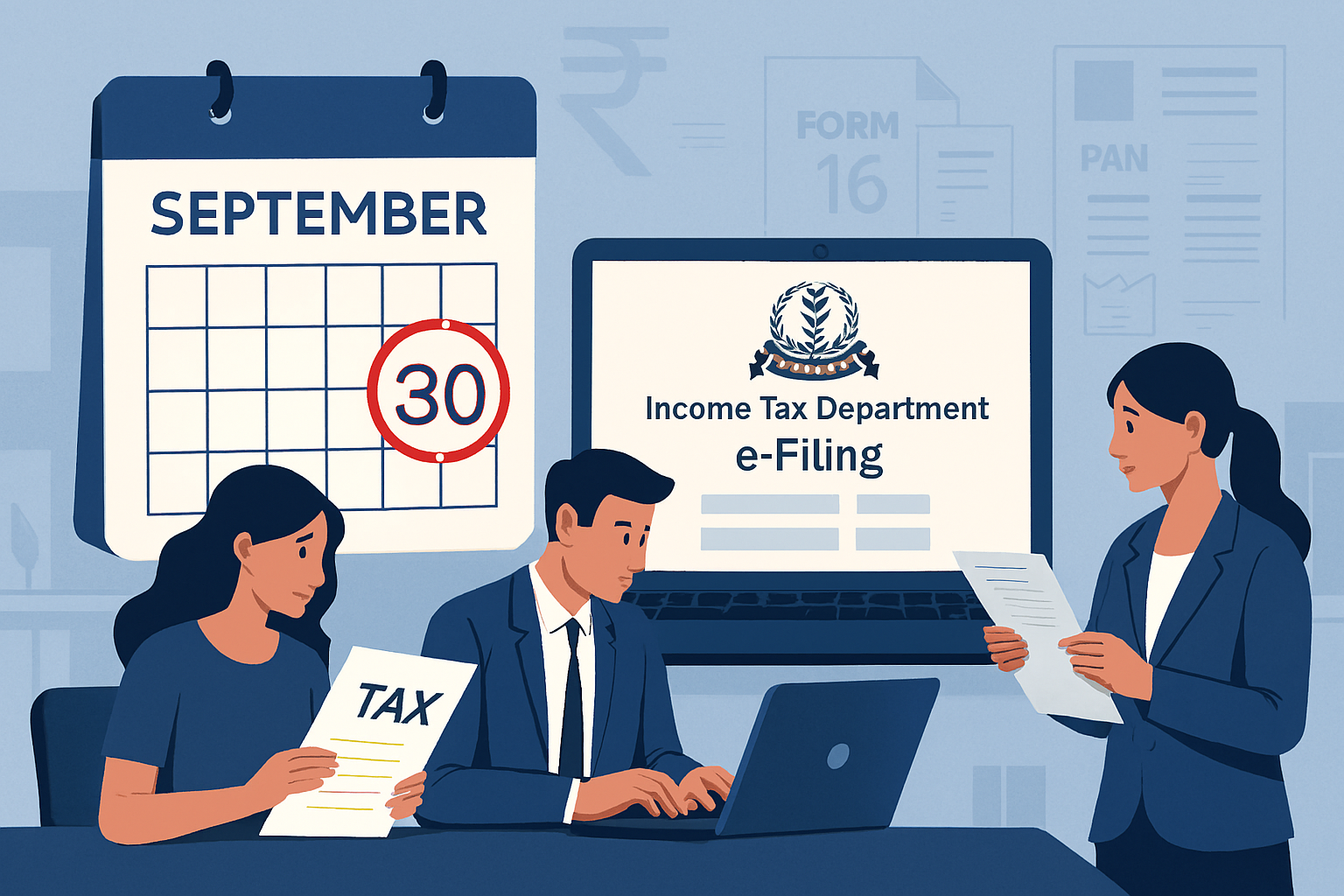
The government has extended the ITR filing deadline for FY 2024-25, giving taxpayers extra time to file without penalties. This blog explains the new dates, reasons for the extension, and the process for AY 2025-26.
Table of Contents
Introduction: Relief for India’s Taxpayers Amid Complex Filing Season
The Income Tax Department has announced an extension of the ITR filing deadline for Financial Year 2024-25 (Assessment Year 2025-26), moving the due date from July 31, 2025, to September 30, 2025. This decision affects millions of individual taxpayers, Hindu Undivided Families (HUFs), and non-audit cases across India.
The extension comes as a response to multiple challenges faced by taxpayers during the current filing season. Technical difficulties on the e-filing portal, implementation of revised tax structures, and professional capacity constraints have been cited as primary reasons for this administrative relief.
According to official communications from the Central Board of Direct Taxes (CBDT), the extension aims to facilitate accurate and complete tax compliance. The decision recognizes the practical difficulties taxpayers encounter when gathering documentation, understanding new tax provisions, and navigating digital filing systems.
This comprehensive guide provides detailed information about the extended deadline, filing procedures, documentation requirements, and strategic considerations for taxpayers in India. All information is based on official Income Tax Department notifications and statutory provisions as of October 2025.
Official Deadline Calendar for AY 2025-26
Extended Deadlines for Non-Audit Cases
The revised filing schedule provides clear timelines for different taxpayer categories. Individual taxpayers, HUFs, and businesses not subject to statutory audit requirements now have until September 30, 2025, to file their returns without penalty.
The original deadline of July 31, 2025, has been extended by two months. This applies specifically to taxpayers filing ITR-1, ITR-2, ITR-3, and ITR-4 forms who do not have audit obligations under Income Tax Act provisions.
Key dates for non-audit cases:
- Original deadline: July 31, 2025
- Extended deadline: September 30, 2025
- Applicable to: Salaried individuals, freelancers, consultants, and small businesses
Deadlines for Audit Cases Remain Unchanged
Taxpayers whose accounts require statutory audit under Section 44AB or other provisions must file by October 31, 2025. This deadline has not been modified and remains consistent with the original tax calendar.
Audit requirements typically apply to businesses and professionals with gross receipts or turnover exceeding specified thresholds. Companies, partnership firms, and individuals with business income above statutory limits fall under this category.
Audit case deadlines:
- ITR filing with audit reports: October 31, 2025
- Transfer pricing documentation: November 30, 2025
- Applicable to: Companies, firms, and high-turnover businesses
Belated Return Filing Window
Taxpayers who miss the September 30, 2025 deadline can still file belated returns until December 31, 2025. However, this option comes with financial penalties and certain restrictions on tax benefits.
Section 234F of the Income Tax Act imposes late filing fees ranging from ₹1,000 to ₹5,000 depending on total income. Additionally, Section 234A mandates interest at 1% per month on unpaid tax amounts from the original due date.
Belated return provisions:
- Filing window: October 1 to December 31, 2025
- Late fee: Up to ₹5,000 (₹1,000 if income below ₹5 lakh)
- Interest charges: 1% monthly on outstanding tax
- Loss carry-forward: Not permitted for belated returns
Reasons Behind the Extension: CBDT’s Official Position
Technical Infrastructure Challenges
The income tax e-filing portal experienced significant load during July 2025. Peak traffic hours resulted in system slowdowns, timeout errors, and delayed document processing. These technical issues prevented many taxpayers from completing their filings despite timely preparation.
The CBDT acknowledged these infrastructure constraints in official communications. Server capacity limitations during the final week of July affected portal accessibility. Metropolitan areas reported particularly high failure rates during business hours when tax professionals attempted bulk submissions.
System administrators implemented capacity upgrades and optimization measures. However, the volume of simultaneous users exceeded projected levels, leading to the decision to extend the deadline rather than penalize taxpayers for systemic failures.
Implementation of Tax Regime Changes
Financial Year 2024-25 marked significant changes in India’s personal tax structure. The revised tax regime became the default option, though taxpayers retained the right to choose the old regime with its associated deductions and exemptions.
These structural changes required taxpayers to perform detailed calculations comparing both regimes. The decision between old and new tax structures depends on individual investment patterns, deductions claimed, and income composition. Many taxpayers needed professional consultation to determine optimal choices.
Additional regulatory amendments included modified tax slabs, enhanced standard deduction limits, revised capital gains provisions, and new reporting requirements for digital assets. Each change demanded time for comprehension and accurate implementation in tax filings.
Professional Capacity Constraints
Tax professionals faced unprecedented workload during the traditional filing season. Chartered accountants, tax consultants, and financial advisors managed overlapping deadlines for GST returns, company audits, and income tax compliance.
The Institute of Chartered Accountants of India (ICAI) formally requested an extension. Their submission highlighted impossibility of maintaining quality standards while meeting compressed timelines. Industry representations emphasized that rushed filings increase error rates, subsequently generating notices and scrutiny cases.
Professional bodies argued that additional time serves both taxpayers and the department by improving filing accuracy. Quality documentation reduces subsequent correspondence, verification requests, and assessment proceedings.
Data Quality and Compliance Objectives
The Income Tax Department has shifted focus toward encouraging accurate, well-documented returns rather than simply meeting deadline targets. Extensions serve this objective by reducing pressure that leads to common mistakes.
Statistical analysis of previous years shows correlation between rushed filings and higher defect rates. Common errors include incorrect income reporting, missed deductions, mathematical mistakes, and incomplete disclosures. These defects generate processing delays and taxpayer notices.
By providing additional time, the department aims to:
- Reduce volume of defective returns requiring correction
- Minimize subsequent notices and scrutiny cases
- Improve voluntary compliance rates
- Enhance data quality in tax systems
- Build taxpayer confidence in filing processes
Step-by-Step ITR Filing Process for FY 2024-25
Document Collection Phase
Successful tax filing begins with systematic documentation. Taxpayers should gather all relevant documents at least two weeks before their intended filing date to avoid last-minute complications.
Employment documentation requirements:
- Form 16 from all employers during FY 2024-25
- Monthly salary slips for the entire financial year
- Bonus, incentive, and variable pay records
- Perquisite details including allowances and benefits
Tax credit verification documents:
- Form 26AS showing TDS across all income sources
- Annual Information Statement (AIS) from e-filing portal
- Tax Information Statement (TIS) with detailed breakup
- TDS certificates (Form 16A) from banks for interest income
- Rent TDS certificates if applicable
Investment and savings documentation:
- Life insurance premium payment receipts
- Public Provident Fund (PPF) account statements
- Equity Linked Savings Scheme (ELSS) investment confirmations
- National Pension System (NPS) contribution certificates
- Fixed deposit and recurring deposit interest certificates
Property and loan documents:
- Home loan interest certificate from lender
- Principal repayment statements for the year
- Property tax payment receipts
- Rental income details with tenant information
- HRA exemption calculation supporting documents
Additional income sources:
- Capital gains statements from brokers or AMCs
- Dividend income records from companies
- Interest income from various sources
- Business or professional income statements
- Freelance or consultancy income documentation
Selecting the Appropriate ITR Form
The Income Tax Department has designed specific forms for different taxpayer profiles. Choosing the correct form is fundamental to successful filing. Using an incorrect form results in rejection or processing delays.
ITR-1 (SAHAJ) eligibility criteria:
- Resident individuals only
- Total income up to ₹50 lakh
- Income from salary or pension
- One house property income
- Other sources (interest, family pension)
- Agricultural income up to ₹5,000
ITR-2 applicability:
- Individuals and HUFs without business income
- Income exceeding ₹50 lakh
- Capital gains from property, stocks, or mutual funds
- Multiple house properties
- Directorship fees
- Foreign income or assets
ITR-3 requirements:
- Income from business or profession
- Partnership firm income
- Combined salary and business income
- Applicable to individuals and HUFs
ITR-4 (SUGAM) provisions:
- Presumptive taxation scheme eligibility
- Section 44AD: Business turnover up to ₹2 crore
- Section 44ADA: Professional receipts up to ₹50 lakh
- Section 44AE: Goods carriage business
- Resident individuals, HUFs, and firms (excluding LLP)
E-Filing Portal Navigation
Access the official Income Tax e-filing portal at www.incometax.gov.in. Verify the website URL carefully to avoid phishing attempts and protect sensitive financial information.
Login credentials and access:
- Primary identifier: PAN (Permanent Account Number)
- Alternative login: Aadhaar number (if linked with PAN)
- Password: Registered password or new registration required
- Two-factor authentication: OTP sent to registered mobile
First-time user registration process:
- Provide basic personal details as per PAN database
- Verify mobile number through OTP
- Register email address for official communications
- Set security questions for password recovery
- Create strong, unique password
Security best practices:
- Use complex passwords combining letters, numbers, symbols
- Never share credentials with unauthorized persons
- Log out completely after session completion
- Avoid public computers or unsecured networks
- Enable additional security features when available
Pre-Filled Data Verification
The modern e-filing system automatically populates information from various sources. This feature reduces manual data entry but requires careful verification to ensure accuracy.
Pre-filled information sources:
- Salary income from Form 26AS
- TDS deducted by all deductors
- Interest income from banks and post offices
- Dividend income from companies
- Securities transactions reported by brokers
- Previous year’s carry-forward losses
Critical verification steps:
- Compare pre-filled data against actual documents
- Identify discrepancies in TDS amounts or income figures
- Check for missing income sources not reflected
- Verify timing of TDS credit posting
- Review updated returns from financial institutions
Handling data discrepancies:
- Correct data in return if supporting documentation exists
- Request correction from deductor for reporting errors
- Use AIS feedback mechanism for disputed entries
- Wait for updated Form 26AS if corrections are pending
Never accept pre-filled information without verification. Blind acceptance of incorrect data can trigger subsequent notices and assessment complications.
Claiming Deductions and Exemptions
Strategic deduction planning significantly impacts final tax liability. Understanding available deductions and claiming all eligible benefits results in legitimate tax savings.
Section 80C deductions (maximum ₹1.5 lakh annually):
- Employee Provident Fund (EPF) contributions
- Public Provident Fund (PPF) investments
- Life insurance premiums paid
- ELSS mutual fund investments
- Home loan principal repayment
- Children’s tuition fees for education
- National Savings Certificates (NSC)
- Sukanya Samriddhi Yojya deposits
Section 80D medical insurance deductions:
- Health insurance premiums: ₹25,000 for self and family
- Senior citizen coverage (above 60 years): ₹50,000
- Additional ₹25,000/₹50,000 for parents’ insurance
- Preventive health check-ups: ₹5,000 within overall limit
Section 24(b) home loan interest:
- Self-occupied property: up to ₹2 lakh per year
- Let-out property: entire interest without upper limit
- Under-construction property: claim over five years after completion
Section 10(13A) and 10(14) salary exemptions:
- House Rent Allowance based on actual rent paid
- Leave Travel Allowance for domestic travel
- Children’s education allowance
- Transport allowance for commuting
Section 80E education loan interest:
- Interest on loans for higher education
- No maximum limit on deduction amount
- Available for eight years from repayment commencement
- Applies to loans for self, spouse, or children
Section 80G charitable donations:
- Donations to eligible institutions and funds
- 50% or 100% deduction based on donee organization
- Requires receipts with registration details
- Verification of donee’s approval status necessary
Tax Computation and Payment
After entering all income and deductions, the portal automatically calculates tax liability. Review this computation carefully to ensure accuracy and completeness.
Tax calculation components:
- Gross Total Income from all sources
- Total deductions under Chapter VI-A
- Net Taxable Income after deductions
- Tax on taxable income per applicable rates
- Surcharge if income exceeds threshold
- Health and Education Cess at 4%
- Total tax liability for the year
- TDS and advance tax already paid
- Self-assessment tax due or refund amount
Payment of additional tax due:
- Navigate to e-pay tax section on portal
- Select Challan 280 for self-assessment tax
- Choose payment method: net banking, debit card, NEFT/RTGS, UPI
- Receive challan identification number after payment
- Wait for payment confirmation in portal (24-48 hours)
Refund claim procedures:
- Ensure bank account pre-validated on portal
- Provide correct account number and IFSC code
- Verify account holder name matches PAN database
- Refund processing typically takes 4-8 weeks
- Direct credit to registered bank account
- Notification via SMS and email upon dispatch
Return Submission and Verification
After thorough review, submit the return on the portal. You will receive an acknowledgment number confirming receipt. However, submission alone does not complete the filing process.
E-verification methods (immediate processing):
- Aadhaar OTP: Instant verification using OTP sent to Aadhaar-linked mobile
- Net banking: Through participating banks including SBI, HDFC, ICICI
- Bank account: Using pre-validated account number
- Demat account: Through NSDL or CDSL demat account
Physical verification (delayed processing):
- Print ITR-V acknowledgment form
- Sign physically in blue ink
- Send to: CPC, Income Tax Department, Bengaluru 560500
- Allow 4-6 weeks for postal delivery and processing
- Results in delayed refund processing
Verification timeline requirements:
- Complete verification within 30 days of submission
- Failure to verify renders return invalid
- Set reminder immediately after submission
- Check portal for verification status confirmation
Financial Consequences of Missing the Deadline
Late Filing Fees Under Section 234F
The Income Tax Act mandates specific penalties for returns filed after the due date. These fees apply regardless of whether any tax is payable, creating financial burden even for taxpayers with no outstanding liability.
Fee structure for late filing:
- ₹5,000 if filed after September 30 but before December 31, 2025
- ₹1,000 if total income does not exceed ₹5 lakh
- No fee if total income below basic exemption limit
- Fee added to tax liability and must be paid
Example calculation: A taxpayer with total income of ₹8 lakh who files on November 15, 2025, must pay ₹5,000 late fee in addition to any tax liability. This fee is non-negotiable and cannot be waived through appeals.
Interest on Outstanding Tax Under Section 234A
Beyond late fees, the Income Tax Act imposes interest on any unpaid tax amount. This interest accrues from the day following the original due date until actual payment is made.
Interest calculation parameters:
- Rate: 1% per month or part of month
- Calculated on: Outstanding tax amount only
- Starts from: October 1, 2025 (day after extended deadline)
- Continues until: Date of actual tax payment
Example scenario: If a taxpayer owes ₹50,000 in taxes and files three months late (December 2025), the interest calculation would be:
- Interest = ₹50,000 × 1% × 3 months = ₹1,500
- Total payment = ₹50,000 (tax) + ₹5,000 (late fee) + ₹1,500 (interest) = ₹56,500
Loss of Carry-Forward Benefits
Perhaps the most financially significant consequence affects taxpayers with losses during FY 2024-25. The Income Tax Act permits loss carry-forward for setoff against future profits, but only if returns are filed by the due date.
Business loss implications:
- Cannot carry forward for setoff against future years
- Applies to losses from business or profession
- Results in higher tax in subsequent profitable years
- No remedy available once deadline passes
Capital loss restrictions:
- Short-term capital losses: Cannot carry forward
- Long-term capital losses: Cannot carry forward
- Normal carry-forward period: Eight years
- Complete forfeiture if return filed late
Speculation and derivative losses:
- Separate carry-forward provisions apply
- More restrictive than regular business losses
- Complete loss of benefit if deadline missed
Financial impact example: A trader with ₹2 lakh capital losses in FY 2024-25 who files after deadline cannot offset these losses against future capital gains. If this trader makes ₹3 lakh capital gains in FY 2025-26, tax applies to the full ₹3 lakh instead of only ₹1 lakh (after setoff). At 15% LTCG rate, this represents ₹30,000 additional tax due to missing the filing deadline.
Increased Scrutiny Risk
The Income Tax Department employs risk-based assessment selection. Late filers receive higher risk scores in automated systems, increasing probability of scrutiny selection.
Scrutiny implications:
- Detailed examination of income sources
- Requests for additional documentation
- Verification of deductions and exemptions
- Investigation of discrepancies between AIS and return
- Time-consuming correspondence with department
Statistical likelihood: Data from previous assessment years indicates late filers face scrutiny rates 3-4 times higher than timely filers. While not punitive in intent, this increased attention creates administrative burden and potential stress.
Impact on Financial Applications
Many financial institutions and government processes require recent income tax returns. Late or non-filing creates complications in various scenarios.
Affected applications:
- Home loan applications and approvals
- Vehicle financing arrangements
- Credit card issuance or limit enhancements
- Educational loan processing
- Visa applications for foreign travel
- Business partnership documentation
- Government tender participation
- Subsidy and scheme eligibility
Example complications: A home loan applicant with excellent credit score but no current year ITR may face application rejection or processing delays. Lenders typically require last two years’ returns. Missing current year return creates documentation gap that can derail time-sensitive property transactions.
Key Changes in Tax Filing for AY 2025-26
New Tax Regime as Default Option
The revised tax regime now serves as the default option for all taxpayers. This represents significant shift in India’s personal taxation structure, though taxpayers retain the right to opt for the old regime.
New regime characteristics:
- Lower tax rates across most income brackets
- Simplified filing without investment proof requirements
- Reduced number of permissible deductions
- Standard deduction allowed for salaried employees
- No benefit for various allowances and exemptions
Old regime retention option:
- Access to 70+ deductions and exemptions
- Section 80C, 80D, 80G benefits available
- HRA, LTA, and other allowance exemptions
- Better for taxpayers with significant tax-saving investments
- Must be explicitly chosen during filing
Comparative analysis requirement: Taxpayers must calculate liability under both regimes to determine optimal choice. Factors influencing decision include:
- Total investment in tax-saving instruments
- Home loan interest and principal payments
- Medical insurance premiums
- Children’s education expenses
- Rent payments for HRA exemption
Enhanced Standard Deduction Provisions
The standard deduction for salaried employees has been increased to provide relief against inflationary pressures. This automatic deduction reduces taxable income without requiring any investment or expenditure.
Standard deduction features:
- Automatic deduction from salary income
- No documentation required for claiming
- Reduces taxable income before tax calculation
- Available under both old and new tax regimes
- Simplifies tax computation for salaried class
Impact on tax liability: For a taxpayer with ₹10 lakh gross salary, the enhanced standard deduction directly reduces taxable income. At 20% tax bracket, this translates to proportional tax savings without any additional investment requirement.
AI-Powered Compliance Systems
The income tax portal now employs artificial intelligence for error detection and compliance improvement. These systems analyze returns in real-time to identify potential issues before submission.
AI system capabilities:
- Compare AIS, Form 26AS, and return data automatically
- Identify unusual deductions or income patterns
- Flag mathematical errors and inconsistencies
- Suggest corrections with specific guidance
- Predict likely processing issues
Taxpayer benefits:
- Reduced post-filing notices and queries
- Faster processing of accurate returns
- Real-time error correction opportunity
- Improved filing quality and accuracy
- Decreased likelihood of scrutiny selection
Portal User Interface Improvements
The e-filing portal underwent comprehensive redesign to improve user experience and accessibility. These enhancements address previous complaints about navigation complexity and error messaging.
Interface improvements:
- Intuitive navigation with step-by-step guidance
- Mobile-responsive design for smartphone filing
- Clearer error messages with correction instructions
- Faster document upload processing
- Enhanced dashboard showing filing history
- Better progress tracking through filing process
Expanded Disclosure Requirements
New reporting mandates require additional disclosure of certain income sources and assets. These requirements aim to improve tax compliance and reduce information asymmetry.
New disclosure categories:
- Cryptocurrency and virtual digital asset transactions
- Detailed breakup of exempt income
- Enhanced foreign asset reporting
- Granular securities transaction details
- High-value transactions and acquisitions
Compliance impact: Taxpayers must gather additional documentation for these disclosures. Failure to report required information can trigger notices even if no tax is payable on such income or assets.
Likelihood of Additional Extension
Historical Extension Patterns
Analysis of previous years shows extensions typically occur once per assessment year. Multiple extensions are rare except during extraordinary circumstances such as natural disasters or widespread emergencies.
Previous extension data:
- AY 2020-21: Multiple extensions during COVID-19 pandemic
- AY 2021-22: One extension due to pandemic continuation
- AY 2022-23: No extension after situation normalized
- AY 2023-24: No extension granted
- AY 2024-25: No extension granted
Current assessment year: One extension has already been granted for AY 2025-26. Historical patterns suggest another extension is unlikely unless unforeseen circumstances emerge.
Factors That Could Trigger Further Extension
Certain specific situations could potentially warrant additional deadline extension. These circumstances would need to be substantial and affect large taxpayer populations.
Potential extension triggers:
- Persistent technical infrastructure failures
- Major natural disasters affecting multiple states
- Significant economic disruptions or emergencies
- Widespread medical or health crises
- Filing rates substantially below targets by mid-September
Technical issue threshold: For technology problems to justify extension, failures would need to be severe and prolonged. Minor slowdowns or isolated incidents do not meet threshold for systemic relief measures.
Arguments Against Further Extension
Several strong reasons suggest another extension is unlikely for AY 2025-26. These factors favor maintaining the September 30, 2025 deadline.
Revenue collection considerations:
- Government operates on strict fiscal schedules
- Delayed assessments affect budget planning
- Tax collection targets require timely processing
- Refund disbursement schedules depend on closure
Administrative capacity concerns:
- Extended filing seasons strain department resources
- Processing backlogs increase with longer windows
- Assessment year closure requires definite timelines
- Staff allocation and planning depend on schedules
Compliance discipline:
- Repeated extensions create expectation of flexibility
- May encourage procrastination rather than planning
- Undermines deadline seriousness and compliance culture
- Reduces pressure for timely documentation
Current technical status: As of October 2025, portal performance has improved significantly. Server capacity upgrades and optimization measures have reduced earlier technical issues. With infrastructure stabilized, technical justification for further extension has diminished.
Prudent Taxpayer Strategy
Regardless of extension speculation, taxpayers should treat September 30, 2025 as the final deadline. This conservative approach offers multiple advantages.
Risk mitigation benefits:
- No exposure to penalties or interest charges
- Adequate buffer time for corrections if needed
- Earlier refund processing for those entitled
- Legal compliance without deadline uncertainty
- Reduced stress and last-minute complications
Strategic advantages:
- Time for professional consultation if complexities arise
- Ability to address discrepancies calmly
- Opportunity for tax planning review
- Flexibility for unexpected documentation delays
Opportunity cost consideration: If additional extension is granted, early filers face no disadvantage. They have completed compliance obligations and can focus on other financial planning. Late filers, however, risk penalties if anticipated extension does not materialize.
Advantages of Timely ITR Filing
Accelerated Refund Processing
The Income Tax Department processes returns in chronological order. Early submissions receive priority in processing queues, resulting in faster refund disbursement for taxpayers with credit balances.
Processing timeline comparison:
- July-August filers: 4-6 weeks typical processing time
- September filers: 6-10 weeks typical processing time
- Late filers (October-December): 12-16 weeks processing time
Cash flow impact: For taxpayers expecting substantial refunds, early filing can make significant difference. A ₹50,000 refund received in August versus December represents three months of investment opportunity or debt reduction capacity.
Enhanced Credit Profile
Modern credit evaluation increasingly incorporates tax compliance as indicator of financial responsibility. Consistent timely filing demonstrates stability and improves overall creditworthiness assessment.
Credit score implications:
- Indirect positive impact on credit scores
- Demonstrates financial discipline to lenders
- Reduces perceived risk in loan applications
- May influence interest rate negotiations
- Shows stable income and compliance record
Lender evaluation factors: Banks and financial institutions review tax returns during loan processing. Timely filed returns suggest organized financial management. Late or missing returns raise questions about applicant’s financial discipline and documentation practices.
Streamlined Loan Applications
Home loans, business loans, and personal credit applications invariably require recent tax returns. Having filed returns readily available eliminates delays and simplifies documentation processes.
Application advantages:
- Immediate documentation availability
- Verified proof of income from official source
- Stable earnings demonstration over multiple years
- Reduced back-and-forth with lenders
- Faster approval processing times
Documentation efficiency: Rather than scrambling to file returns when loan opportunity arises, advance filers have documentation ready for immediate submission. This readiness can be decisive in time-sensitive property transactions or business opportunities.
Visa and Immigration Benefits
Many countries require tax return proof for visa applications. Timely filed, properly authenticated returns facilitate these applications and demonstrate compliance with Indian tax laws.
Visa categories requiring ITR:
- Tourist visas for European Union countries
- Business visas for United States
- Student visas for education abroad
- Employment visas for work permits
- Immigration applications for permanent residency
Embassy evaluation: Consular officers view tax compliance as indicator of applicant’s stability and likelihood of returning to India. Missing or late tax returns can raise concerns and potentially result in visa denials or additional scrutiny.
Legal Protection and Compliance
Timely filing ensures full compliance with Income Tax Act provisions. This compliance provides legal protection and eliminates risks associated with non-filing or delayed filing.
Compliance benefits:
- Complete adherence to statutory requirements
- Protection against prosecution for non-filing
- Reduced likelihood of scrutiny or investigation
- Peace of mind regarding tax obligations
- Clean record for future interactions with department
Legal security: Under various sections of the Income Tax Act, willful non-filing can attract prosecution. While rare for honest taxpayers facing genuine difficulties, timely filing completely eliminates this legal risk.
Future Financial Planning Foundation
Your ITR serves as official income documentation for numerous purposes throughout financial life. This document facilitates various transactions and opportunities beyond immediate tax compliance.
ITR utility in various scenarios:
- Government scheme and subsidy applications
- Insurance claim processing requiring income proof
- Legal proceedings where income verification needed
- Business partnership or investment opportunities
- Government tender participation requirements
- Professional license applications
- Property transactions and registrations
Loss Carry-Forward Eligibility
Timely filing is mandatory prerequisite for carrying forward losses. This provision can result in significant tax savings in subsequent profitable years.
Carry-forward provisions:
- Business losses: Eight years
- Capital losses: Eight years
- Speculation losses: Four years
- Unabsorbed depreciation: Indefinite period
Financial impact: A business owner with ₹5 lakh losses in FY 2024-25 who files timely can offset these losses against profits in next eight years. If business generates ₹7 lakh profit in FY 2025-26, taxable income reduces to ₹2 lakh instead of ₹7 lakh. At 30% tax rate, this represents ₹1.5 lakh tax savings directly attributable to timely filing.
Expert Filing Strategies and Tips
Early Preparation Methodology
Professional tax consultants consistently recommend beginning preparation well before deadline. This approach provides buffer time for addressing complications and ensures quality filing.
Optimal preparation timeline:
- First week of September: Complete document collection
- Second week of September: Verify pre-filled data and identify discrepancies
- Third week of September: Complete return preparation and review
- Fourth week of September: Submit and e-verify return
- Buffer time: One week for unexpected issues
Procrastination risks: Last-minute filing increases error probability, creates unnecessary stress, and exposes taxpayers to technical issues during peak traffic periods. Portal slowdowns typically worsen in final days before deadline.
Year-Round Documentation System
Rather than annual scrambling, establishing systematic documentation process throughout year simplifies filing and improves accuracy.
Recommended system:
- Create dedicated tax folder (physical or digital)
- File documents immediately upon receipt
- Scan important receipts and certificates
- Maintain spreadsheet tracking investments and expenses
- Monthly reconciliation of income and deductions
Digital documentation benefits:
- Permanent backup protection against physical loss
- Easy search and retrieval capability
- Space efficiency compared to physical storage
- Facilitates electronic filing process
- Enables quick sharing with tax consultants
AIS and Form 26AS Reconciliation
Discrepancies between AIS, Form 26AS, and actual records are common. Proactive reconciliation prevents filing complications and subsequent notices.
Reconciliation process:
- Download AIS and Form 26AS from portal
- Compare line-by-line against actual documents
- Identify missing TDS entries or incorrect amounts
- Contact deductors for corrections if needed
- Use AIS feedback mechanism for disputes
- Resolve major discrepancies before filing
Common discrepancy sources:
- Incorrect PAN quotation by deductors
- Timing differences in TDS reporting
- Updated corrections from financial institutions
- Manual reporting errors by deductors
- Duplicate entries requiring consolidation
Professional Consultation Criteria
While many taxpayers can file independently, certain situations warrant professional assistance. Recognizing when to seek expert help prevents costly mistakes.
Situations requiring professional help:
- Multiple income sources including business
- International income or foreign assets
- Substantial capital gains from property sales
- First-time business owners or freelancers
- Significant year-on-year income changes
- Complex investment portfolios
- Partnership or corporate income
Cost-benefit analysis: Chartered accountants charge ₹2,000-₹10,000 depending on complexity. Their expertise often saves more than their fee through proper tax planning, deduction optimization, and error prevention.
Pre-Submission Verification Checklist
Creating systematic checklist ensures thorough review before submission. This final verification catches errors that could trigger notices or processing delays.
Comprehensive checklist items:
- All income sources reported completely
- TDS entries reconciled with Form 26AS
- All eligible deductions claimed with documentation
- Bank account details correct for refund
- Contact information updated and accurate
- Mathematical calculations verified
- Appropriate ITR form selected
- Carry-forward losses claimed if applicable
Review methodology:
- Take break before final review (fresh perspective)
- Review printed copy rather than only screen
- Have another person review if possible
- Check calculation formulas in critical sections
- Verify totals match across schedules
Record Retention Protocol
After filing and verification, maintaining proper records protects against future inquiries and facilitates subsequent year filings.
Essential documents to retain:
- Filed ITR acknowledgment
- E-verification receipt
- Computation of income pages
- Tax payment challans
- All supporting documentation
- Correspondence with department
Retention period: Income Tax Act permits reopening assessments up to six years in certain circumstances. Maintaining complete documentation for minimum six years protects against any future inquiries or verification requests.
Storage recommendations:
- Digital backup in cloud storage
- Physical copies in organized filing system
- Clear labeling by assessment year
- Easy retrieval system for quick access
- Protection against physical damage or loss
Common Filing Errors to Avoid
Incorrect ITR Form Selection
Using inappropriate form results in automatic rejection during processing. Understanding form eligibility prevents this fundamental error.
Common selection errors:
- Using ITR-1 when capital gains exist
- Using ITR-2 for business income
- Not recognizing multiple house property requirement
- Ignoring directorship income implications
Verification method: Review form instructions carefully before selection. When in doubt, choose more comprehensive form rather than simpler option. ITR-2 or ITR-3 acceptance is broader than ITR-1.
Omitting Small Income Sources
Many taxpayers exclude minor income thinking it won’t matter. However, the department receives this information through AIS and discrepancies trigger automated notices.
Commonly omitted income:
- Savings account interest of ₹10,000-20,000
- Fixed deposit interest below TDS threshold
- Dividend income from equity investments
- Freelance or consultancy income under ₹50,000
- Rental income from property
Detection certainty: All banks, companies, and financial institutions report payments to income tax systems.
Common Filing Errors to Avoid (Continued)
Omitting Small Income Sources (Continued)
Detection certainty: All banks, companies, and financial institutions report payments to income tax systems. AIS aggregates this information automatically. Omissions are immediately visible during processing, creating presumption of deliberate concealment even when oversight was unintentional.
Proper reporting approach:
- Review AIS comprehensively before filing
- Include all income regardless of amount
- Report even if no tax liability results
- Maintain documentation for all income sources
- Verify reporting matches third-party information
Bank Account Detail Errors
Simple typographical errors in bank account information delay or misdirect refunds. These mistakes are easily preventable with careful verification.
Critical details requiring accuracy:
- Bank account number (verify digit by digit)
- IFSC code (confirm from bank statement)
- Account type (savings, current, or other)
- Account holder name (must match PAN database)
- Bank branch details
Prevention measures:
- Copy-paste account details from bank statement
- Use portal’s bank account pre-validation feature
- Double-check IFSC code against official sources
- Verify account holder name matches PAN exactly
- Cross-reference with previous year’s successful refund
Impact of errors: Refunds to incorrect accounts may be rejected and returned to department. Correction and reprocessing can take additional 8-12 weeks, significantly delaying receipt of funds.
Failure to Report Exempt Income
Several income categories are exempt from tax but must still be reported in the return. Omission suggests incomplete disclosure and can trigger verification queries.
Exempt income requiring reporting:
- Agricultural income above ₹5,000
- Long-term capital gains within exemption limits
- Dividends below taxable threshold (under old regime)
- Interest income within exemption limits
- Gift receipts within exemption provisions
Reporting rationale: Even though no tax applies, reporting demonstrates complete disclosure. It provides comprehensive income picture and prevents questions about income sources or lifestyle inconsistencies.
Proper procedure: Use designated schedules for exempt income reporting. These sections clearly mark income as exempt while maintaining transparency about all financial receipts during the year.
Claiming Deductions Without Documentation
Claims require supporting documentation. Inability to produce proof during scrutiny or processing can result in disallowance and additional tax demands.
Documentation requirements:
- Section 80C: Investment receipts, certificates, statements
- Section 80D: Insurance premium receipts with insurer details
- HRA exemption: Rent receipts, landlord PAN if applicable
- Section 80G donations: Receipts with organization registration
- Home loan interest: Certificate from lending institution
Retention period: Maintain all supporting documents for minimum six years from end of relevant assessment year. The department can request verification at any time during this period.
Best practices:
- Collect receipts and certificates before filing
- Organize documentation by deduction section
- Scan and digitally backup all physical documents
- Verify calculations match documentation
- Never claim deductions without valid proof
Neglecting Post-Submission Verification
Submitting return without completing verification within 30 days renders it invalid. This oversight nullifies the entire filing effort and requires fresh submission.
Verification importance:
- Confirms taxpayer’s identity and authorization
- Authenticates return as genuine submission
- Activates processing at CPC Bengaluru
- Enables refund processing if applicable
- Completes legal filing requirement
Common verification failures:
- Forgetting to verify after submission
- Missing 30-day verification deadline
- Technical issues during verification attempt
- Incorrect OTP or authentication details
Prevention strategy:
- Set calendar reminder immediately after submission
- Verify within 24-48 hours rather than waiting
- Confirm verification status on portal
- Save verification confirmation receipt
- Check email for verification success notification
Mathematical and Calculation Errors
Despite automated calculations, manual entries can contain errors. These mistakes delay processing and may result in incorrect tax liability determination.
Common calculation errors:
- Incorrect income aggregation from multiple sources
- Mathematical mistakes in deduction totals
- Wrong tax rate application
- Surcharge calculation errors
- Cess computation mistakes
Prevention methods:
- Use portal’s automatic calculation features
- Verify totals across multiple schedules
- Cross-check manually for critical figures
- Review computation summary carefully
- Have second person verify if possible
Mismatched Personal Information
Personal details must match official records exactly. Inconsistencies can cause processing delays or rejections requiring correction and resubmission.
Critical information requiring accuracy:
- Name as per PAN database
- Date of birth matching PAN records
- Address updated to current residence
- Mobile number for official communications
- Email address for notices and correspondence
Verification process:
- Cross-reference details with PAN card
- Update any changed information before filing
- Verify Aadhaar-PAN linkage if using Aadhaar
- Confirm contact details receive test communications
- Review personal information summary before submission
Understanding Post-Filing Processing
Immediate Acknowledgment Receipt
Upon successful submission, the system generates acknowledgment confirming receipt. This document serves as proof of filing and contains essential reference information.
Acknowledgment contents:
- Unique acknowledgment number
- Filing date and time
- Form type submitted
- Assessment year
- Taxpayer identification details
Acknowledgment importance:
- Proof of timely filing if disputes arise
- Reference for all future correspondence
- Required for verification process
- Needed for status tracking
- Evidence for loan applications or other purposes
Record retention: Save acknowledgment in both digital and physical formats. Include it in permanent tax records for the relevant assessment year.
Processing at Centralized Processing Center
After verification, returns move to CPC Bengaluru for processing. This facility handles all individual return processing for the country using automated systems.
Processing activities:
- Validation against database records (Form 26AS, AIS)
- Mathematical calculation verification
- TDS credit confirmation
- Deduction eligibility checking
- Final tax liability or refund computation
Processing duration:
- Normal cases: 4-8 weeks from verification
- Complex cases: 8-12 weeks for detailed review
- Defective returns: Additional time for rectification
- Peak season filings: Longer processing queues
Automated systems: Modern processing employs artificial intelligence to identify discrepancies, verify calculations, and flag potential issues. Most returns process without human intervention, expediting timeline significantly.
Intimation Under Section 143(1)
After processing completion, taxpayers receive intimation communicating assessment results. This document requires careful review to identify any adjustments or issues.
Intimation contents:
- Confirmation of income as filed or adjusted
- Tax liability as computed by department
- Refund amount if credit balance exists
- Demand amount if additional tax due
- Explanation of any adjustments made
- Interest charged if applicable
- Instructions for rectification if needed
Types of intimations:
- Acceptance without adjustment: Complete agreement with filed return
- Acceptance with adjustments: Minor corrections applied
- Partial acceptance: Significant differences requiring attention
- Defective return notice: Errors requiring correction
Response requirements: If adjustments seem incorrect, taxpayers can file rectification request under Section 154. This mechanism addresses computational errors, oversights, or misinterpretation of information provided.
Refund Disbursement Process
Taxpayers with excess TDS or advance tax over final liability receive refunds. The process follows standardized timeline and method.
Refund processing steps:
- Validation of bank account details
- Approval of refund amount
- Generation of refund voucher
- Transfer to taxpayer’s account via NEFT
- Confirmation notification to taxpayer
Typical timeline:
- Early filers (July-August): 4-6 weeks
- Mid-season filers (September): 6-10 weeks
- Late filers (October onwards): 12-16 weeks
- Scrutiny cases: Variable, often 6-12 months
Interest on delayed refunds: If refund processing exceeds specified timeline, department pays interest at 0.5% per month on delayed amount. This interest is automatically calculated and added to refund credit.
Refund tracking: Taxpayers can track refund status through:
- E-filing portal dashboard
- NSDL/TIN website refund status feature
- Income tax department mobile application
- TRACES website for detailed tracking
Scrutiny Selection and Assessment
A percentage of returns undergo detailed scrutiny for comprehensive verification. Selection can be random or risk-based depending on various factors.
Scrutiny selection factors:
- High-value transactions exceeding thresholds
- Significant year-on-year income variations
- Large refund claims requiring verification
- Mismatch between lifestyle and reported income
- Random selection for statistical purposes
- Specific issues flagged by AI systems
Scrutiny notice characteristics:
- Issued under Section 143(2) within prescribed timeline
- Requests detailed documentation and explanation
- Provides adequate response time (typically 30-45 days)
- May request personal appearance or authorized representative
- Conducted at jurisdictional assessment office
Scrutiny response strategy:
- Respond within stipulated timeline
- Provide complete documentation requested
- Maintain professional, cooperative approach
- Engage chartered accountant if complexity warrants
- Keep detailed records of all communications
- Follow up on any additional queries promptly
Scrutiny outcomes:
- Acceptance as filed: No changes to return
- Additions to income: Additional tax demand
- Disallowance of deductions: Increased liability
- Penalty imposition: For concealment or inaccuracies
- Appeal rights: Available if taxpayer disagrees
Tax Planning Strategies for Current and Future Years
Regime Selection Optimization
Choosing between old and new tax regimes significantly impacts tax liability. Strategic evaluation requires comprehensive analysis of individual circumstances.
Comparative evaluation factors:
- Total deductions available under old regime
- Investment capacity in tax-saving instruments
- Home loan interest and principal amounts
- Medical insurance premium expenditure
- HRA exemption eligibility and amount
- Other allowances and exemptions claimed
New regime advantageous when:
- Limited investments in tax-saving instruments
- No home loan or rental accommodation
- Minimal medical insurance coverage
- Preferring simplicity over optimization
- Income primarily from salary without major deductions
Old regime advantageous when:
- Substantial Section 80C investments (₹1.5 lakh)
- Significant home loan interest payments
- Health insurance for self and parents
- HRA exemption claims
- Multiple deductions and exemptions available
Calculation methodology: Prepare complete return under both regimes before making final selection. Compare final tax liability rather than tax rate alone, as deductions significantly impact effective taxation.
Investment Timing and Allocation
Strategic investment timing within financial year optimizes tax benefits while meeting financial goals. Planning prevents last-minute investments driven solely by tax considerations.
Optimal investment schedule:
- April-June: Plan annual tax-saving allocation
- July-September: Execute initial investments
- October-December: Monitor progress and adjust
- January-March: Complete remaining investments
Investment diversification for tax efficiency:
- ELSS mutual funds: ₹1.5 lakh under Section 80C with shortest lock-in
- PPF: ₹1.5 lakh with long-term safety and returns
- NPS: ₹50,000 additional deduction under Section 80CCD(1B)
- Life insurance: Protection with tax benefit
- Health insurance: Medical coverage with Section 80D benefit
Avoiding common pitfalls:
- March rush investments without evaluation
- Investing solely for tax saving without financial planning
- Ignoring investment performance and suitability
- Exceeding deduction limits unnecessarily
- Neglecting liquidity needs for tax savings
Salary Structure Optimization
Salaried employees can work with employers to structure compensation tax-efficiently. Proper structuring reduces tax liability without changing total compensation.
Tax-efficient components:
- HRA: Exemption for rent paid
- LTA: Tax-free travel allowance
- Food coupons: Tax-exempt up to limits
- Telephone and internet reimbursement
- Books and periodicals allowance
- Children education allowance
Employer-provided benefits:
- Company lease car: Taxable value often lower than cash
- Employer NPS contribution: Deductible for employer and employee
- Health insurance: Premium paid by employer
- Interest-free or concessional loans: Taxable benefit minimal
Restructuring timing: Discuss with employer at beginning of financial year or during annual compensation review. Changes typically require formal salary structure modification and impact monthly take-home.
Capital Gains Management
Strategic planning around capital asset sales minimizes tax impact and optimizes post-tax returns.
Holding period optimization:
- Equity: Hold beyond 12 months for LTCG treatment
- Real estate: Hold beyond 24 months for LTCG benefit
- Other assets: Varies by asset category
- Short-term gains face higher tax rates
Tax-saving strategies:
- Capital gains exemption for home purchase (Section 54)
- Capital gains bonds for property sales (Section 54EC)
- Tax harvesting: Book losses to offset gains
- Stagger sales across financial years if possible
Reinvestment provisions: Section 54 allows exemption on residential property sale if proceeds reinvested in another residential property within specified timeline. Planning major transactions around these provisions saves substantial tax.
Business Income Tax Efficiency
Business owners and professionals have additional planning opportunities beyond salaried individuals.
Presumptive taxation schemes:
- Section 44AD: 8% (digital receipts) or 6% deemed profit
- Section 44ADA: 50% deemed profit for professionals
- Section 44AE: Per vehicle deemed income for transport
- Simplified compliance with limited documentation
Business expense optimization:
- Document all legitimate business expenses
- Maintain proper bills and vouchers
- Separate business and personal expenses
- Depreciation claims on business assets
- Employee compensation and benefits
Professional guidance timing: Engage chartered accountant at financial year start for planning rather than only at filing time. Proactive planning throughout year maximizes legitimate tax efficiency.
Special Situations and Considerations
First-Time Filers
Individuals filing returns for the first time face unique challenges and considerations. Understanding the process reduces anxiety and ensures compliance.
Registration requirements:
- PAN card is mandatory prerequisite
- Aadhaar-PAN linkage now compulsory
- Email and mobile registration on portal
- Bank account pre-validation for refunds
Common first-time scenarios:
- Starting first job during financial year
- Beginning freelance or business income
- Inheritance requiring income declaration
- Sale of property or investments
- Foreign employment or income
Recommended approach: Consider professional assistance for first return. Learning proper procedures initially establishes good practices for future years. Cost of consultation is minimal compared to potential error implications.
Senior Citizens (Above 60 Years)
Senior citizens receive certain relaxations and benefits in tax filing procedures. Understanding these provisions ensures proper compliance and benefit utilization.
Age-based benefits:
- Higher basic exemption limit
- Enhanced medical insurance deduction (Section 80D)
- Interest income deduction (Section 80TTB)
- Simplified assessment procedures
Filing exemptions: Senior citizens with only pension and interest income below basic exemption may be exempt from mandatory filing. However, filing remains advisable for documentation and refund purposes.
Physical assistance: Many bank branches and chartered accountants offer special assistance to senior citizens. Income tax department help desks also provide dedicated support for elderly taxpayers.
NRI (Non-Resident Indian) Taxpayers
Non-residents face additional complexity in tax filing due to residential status determination and cross-border income considerations.
Residential status rules:
- Physical presence in India during financial year
- Number of days present in previous years
- Citizenship and historical presence factors
- Impacts tax treatment of global income
NRI-specific considerations:
- Indian-sourced income taxable in India
- Foreign income treatment depends on status
- TDS rates differ for NRI taxpayers
- DTAA (Double Taxation Avoidance Agreement) benefits
- Form 15CA and 15CB for foreign remittances
Documentation challenges: NRIs often struggle obtaining documents from India while abroad. Designating authorized representative or using professional services addresses this challenge effectively.
Multiple Employer Situations
Changing jobs during financial year creates complexity in tax filing and compliance. Proper handling prevents under-reporting or incorrect tax calculation.
Critical requirements:
- Obtain Form 16 from all employers
- Report entire year’s income in single return
- Aggregate TDS from all sources
- Consider advance tax if final employer’s TDS insufficient
Common mistake: New employers typically calculate TDS based only on current employment income without considering previous employment. This can result in under-deduction and tax payable at year-end.
Preventive measure: Inform new employer about previous employment income. Provide previous employer’s Form 16 to enable accurate TDS calculation for remaining months.
Business Loss Scenarios
Reporting business losses correctly ensures carry-forward eligibility and future tax benefits. Timely filing is mandatory for loss preservation.
Loss reporting requirements:
- File return by due date (not belated return)
- Use appropriate ITR form for business income
- Complete all income and loss schedules
- Maintain detailed business records
- Document loss computation methodology
Carry-forward limitations:
- Cannot carry forward if return filed late
- Eight-year limitation for most losses
- Four-year limitation for speculation losses
- Set-off rules vary by loss type
- Same business requirement for certain losses
Strategic importance: Business owners must file even with losses and no tax liability. Failing to file forfeits significant tax benefits in subsequent profitable years.
Foreign Asset and Income Disclosure
Taxpayers with foreign assets or income face additional reporting requirements under Black Money Act and Income Tax Act provisions.
Mandatory disclosures:
- Foreign bank accounts
- Foreign financial assets
- Immovable property abroad
- Foreign partnership interests
- Trusts and beneficial interests
Reporting schedules: Schedule FA (Foreign Assets) requires detailed information including:
- Asset location and identification
- Account numbers or property details
- Income earned from foreign assets
- Peak balance during year
- Investment cost and valuation
Penalty for non-disclosure: Failure to disclose foreign assets attracts severe penalties under Black Money Act. Penalties can equal or exceed asset value, making compliance critical.
Professional guidance: Foreign asset reporting involves complex legal and tax considerations. Professional assistance ensures complete, accurate disclosure and proper tax treatment.
Technology Tools and Resources
Official Income Tax Portal Features
The government’s e-filing portal offers comprehensive features beyond basic return filing. Utilizing these tools improves compliance and simplifies tax management.
Dashboard functionality:
- Filing history across assessment years
- Notice and intimation repository
- Refund status tracking in real-time
- Outstanding tax demand summary
- Response submission for notices
- Document upload facility
Pre-filled return advantages:
- Automatic population of salary income
- TDS details from Form 26AS
- Interest income from financial institutions
- Dividend and securities transactions
- Capital gains information
- Previous year data transfer
Compliance monitoring:
- Pending return filing alerts
- Verification deadline reminders
- Outstanding demand notifications
- Refund status updates
- Processing status information
Form 26AS and AIS Access
These documents provide comprehensive information about all tax-related transactions reported to the department. Regular review ensures accuracy and completeness.
Form 26AS components:
- Part A: TDS on salary and other income
- Part B: TDS on property transactions
- Part C: Tax collected at source
- Part D: Advance tax and self-assessment tax
- Part E: Refund received details
- Part F: AIR (Annual Information Return) details
Annual Information Statement (AIS):
- Comprehensive view of all information reported
- Salary details from employers
- Interest income from banks
- Dividend income from companies
- Securities transactions
- Property transactions
- Feedback mechanism for discrepancies
Verification importance: Compare these documents against actual records before filing. Discrepancies should be resolved or explained appropriately in return to avoid processing issues.
Mobile Applications
Official income tax mobile application provides convenient access to essential services and information on smartphones.
Application features:
- Return filing from mobile device
- Refund status checking
- Notice viewing and downloading
- Compliance tracking
- Calculation tools and utilities
- Help and FAQ sections
Convenience benefits: Mobile app enables filing and monitoring without desktop computer access. Particularly useful for simple returns and status tracking while traveling or away from office.
Third-Party Tax Software
Various commercial software solutions offer enhanced features and guidance for tax filing. These tools can simplify complex situations and improve accuracy.
Software advantages:
- Interview-style question approach
- Automatic form selection
- Error checking and validation
- Deduction optimization suggestions
- Multiple return comparison
- Direct portal integration
Evaluation criteria:
- User interface and ease of use
- Accuracy of calculations
- Customer support availability
- Data security measures
- Pricing structure
- Integration with portal
Caution note: While third-party software can help, taxpayer remains responsible for accuracy. Review all calculations and information before submission regardless of tool used.
Professional Service Platforms
Online platforms connect taxpayers with chartered accountants and tax professionals for remote consultation and filing assistance.
Platform benefits:
- Access to qualified professionals
- Competitive pricing through marketplace model
- Document upload and sharing capability
- Communication tracking and records
- Quality assurance mechanisms
Service selection:
- Verify professional qualifications
- Check reviews and ratings
- Confirm experience with similar cases
- Understand pricing and scope clearly
- Establish communication preferences
Author Information
About the Author
Nueplanet
This comprehensive guide has been prepared by financial content specialists with extensive experience in Indian taxation and regulatory compliance. Our team includes:
- Financial analysts specializing in Indian tax policy and regulatory frameworks
- Content researchers with focus on government notifications and statutory requirements
Our Commitment to Accuracy
All information in this article is sourced from:
- Official Income Tax Department notifications and circulars
- Central Board of Direct Taxes (CBDT) communications
- Income Tax Act, 1961 and applicable rules
- Finance Act 2024 and budget provisions
- Official e-filing portal documentation
Content Verification Process
Every fact, deadline, and procedure mentioned undergoes multiple verification stages:
- Cross-referencing with official government sources
- Validation against current statutory provisions
- Review by qualified tax professionals
- Regular updates reflecting latest changes
Transparency Statement
This article provides informational guidance only and does not constitute professional tax advice. Individual circumstances vary significantly, and taxpayers are encouraged to consult qualified chartered accountants for personalized guidance. We maintain no commercial relationships with any tax preparation services or financial institutions mentioned.
Last Updated: September 03, 2025
Publish Date: September 03, 2025
Frequently Asked Questions (FAQs)
1. What is the current ITR filing deadline for FY 2024-25 (AY 2025-26)?
The Income Tax Department has extended the filing deadline from July 31, 2025, to September 30, 2025, for individual taxpayers, HUFs, and non-audit cases. This two-month extension provides additional time for accurate return preparation and submission. For taxpayers whose accounts require statutory audit, the deadline remains October 31, 2025. Transfer pricing report submissions must be completed by November 30, 2025. These deadlines are based on official CBDT notifications issued in July 2025.
2. Can I file my income tax return after September 30, 2025?
Yes, belated returns can be filed until December 31, 2025. However, late filing attracts penalties under Section 234F ranging from ₹1,000 to ₹5,000 depending on total income. Additionally, Section 234A imposes interest at 1% per month on any unpaid tax liability. Most significantly, filing after the due date eliminates your ability to carry forward business losses or capital losses to future years. These carry-forward benefits can result in substantial tax savings and are permanently forfeited with late filing. Filing by September 30, 2025, avoids all these adverse consequences.
3. How do I choose between the old and new tax regimes?
The new tax regime is now the default option with lower tax rates but limited deductions. The old regime allows over 70 deductions and exemptions including Section 80C investments, HRA exemption, and home loan interest benefits. To determine which regime is beneficial, calculate your tax liability under both options. Consider your investments in tax-saving instruments, home loan payments, medical insurance premiums, and HRA claims. Taxpayers with substantial deductions typically benefit from the old regime, while those with minimal tax-saving investments often find the new regime more advantageous. Most tax preparation software and the official portal allow comparison before final selection.
4. What documents are essential for filing ITR for FY 2024-25?
Essential documents include Form 16 from your employer(s), Form 26AS and Annual Information Statement downloaded from the e-filing portal, all bank statements showing interest income, investment proofs for Section 80C deductions (PPF, ELSS, life insurance premiums), health insurance receipts for Section 80D claims, home loan certificates showing interest and principal components, capital gains statements from stock brokers or mutual fund houses, and documentation for any other income sources such as rent or freelance earnings. Having these documents organized before beginning your return preparation significantly streamlines the filing process and ensures accuracy.
5. Which ITR form should I use if I have salary income and capital gains?
You must file ITR-2 if you have both salary income and capital gains. ITR-1 (SAHAJ), while simpler, is only applicable to resident individuals with total income up to ₹50 lakh from salary, one house property, and other sources without capital gains. Any capital gains from sale of property, stocks, mutual funds, or other assets requires ITR-2 filing regardless of the gain amount or your total income level. ITR-2 also applies if you have multiple house properties, directorship fees, foreign income, or total income exceeding ₹50 lakh. Selecting the wrong form will result in processing rejection requiring correction and resubmission.
6. What happens if I miss the September 30, 2025 deadline?
Missing the deadline triggers multiple consequences. You must pay late filing fees of ₹5,000 under Section 234F (₹1,000 if total income is below ₹5 lakh). Interest at 1% per month applies under Section 234A on any unpaid tax from October 1, 2025, until actual payment. Most critically, you lose the ability to carry forward business losses and capital losses to offset against future income, which can cost tens of thousands in additional taxes over subsequent years. Additionally, late filing increases scrutiny probability and creates complications for loan applications, visa processing, and other financial transactions requiring recent tax returns. The department maintains records of filing compliance which impacts future interactions.
7. How can I track my refund status after filing?
After successful filing and e-verification, refund status can be tracked through multiple channels. Log into the e-filing portal and check your dashboard for real-time status updates. Alternatively, visit the NSDL-TIN website’s refund status section where you can search using your PAN. The income tax department’s mobile application also provides refund tracking functionality. Refunds are processed at the Centralized Processing Center in Bengaluru and typically take 4-8 weeks for early filers. You will receive email and SMS notifications when your refund is approved and when the amount is credited to your pre-validated bank account via NEFT.
8. Is professional help necessary for filing income tax returns?
Whether you need professional assistance depends on your situation’s complexity. Simple salaried individuals with one employer, standard deductions, and straightforward income can typically file independently using the e-filing portal. However, professional help becomes valuable for multiple income sources including business or freelance income, capital gains from property or significant stock transactions, foreign assets or income, first-time business owners, partnership income, or situations involving significant year-on-year changes. Chartered accountants charge ₹2,000-₹10,000 depending on complexity, and their expertise often saves more than their fee through proper planning, accurate filing, and deduction optimization. Even if filing independently, consider professional review for complex situations.
Conclusion: Taking Action on Your Tax Compliance
The extension of the ITR filing deadline to September 30, 2025, provides valuable additional time for accurate, complete tax compliance. This administrative relief recognizes practical challenges faced by taxpayers while maintaining the fundamental importance of timely, accurate reporting.
Whether you are a salaried professional, business owner, freelancer, or retiree, this extended timeline enables thorough documentation gathering, understanding of new tax provisions, comprehensive deduction claiming, and confident filing. The consequences of missing the deadline—penalties, interest charges, and loss of carry-forward benefits—remain substantial enough to merit serious attention.
Strategic approach involves treating September 30, 2025, as your definitive deadline rather than gambling on potential further extensions. Beginning preparation immediately, gathering complete documentation systematically, and leveraging professional assistance when situations demand expertise ensures compliance and optimizes legitimate tax benefits.
Your income tax return serves multiple purposes beyond legal obligation: it provides verified income proof for loans, supports visa applications, demonstrates compliance for business opportunities, and preserves legitimate loss carry-forward benefits. Approaching it with appropriate seriousness and attention establishes foundation for financial well-being and legal security.
Take action now by collecting essential documents, reviewing pre-filled portal information, calculating liability under both tax regimes if applicable, completing your return well before deadline, and maintaining comprehensive records for future reference. The relief provided by this extension maximizes when used for thoroughness and accuracy rather than procrastination.
Disclaimer: This article provides general information about income tax filing procedures and deadlines based on official government notifications as of October 2025. Tax laws and regulations are subject to change. Individual circumstances vary significantly, and this content should not be construed as professional tax advice. Readers are strongly encouraged to consult qualified chartered accountants or tax professionals for personalized guidance tailored to their specific situations. While every effort has been made to ensure accuracy, the authors and publishers assume no liability for errors, omissions, or consequences arising from use of this information.
Helpful Resources
Latest Posts
Related Posts













Post Comment