









Infosys Q1 Results: Net Profit Rises 9% YoY to ₹6,921 Crore; Revenue Up 8%
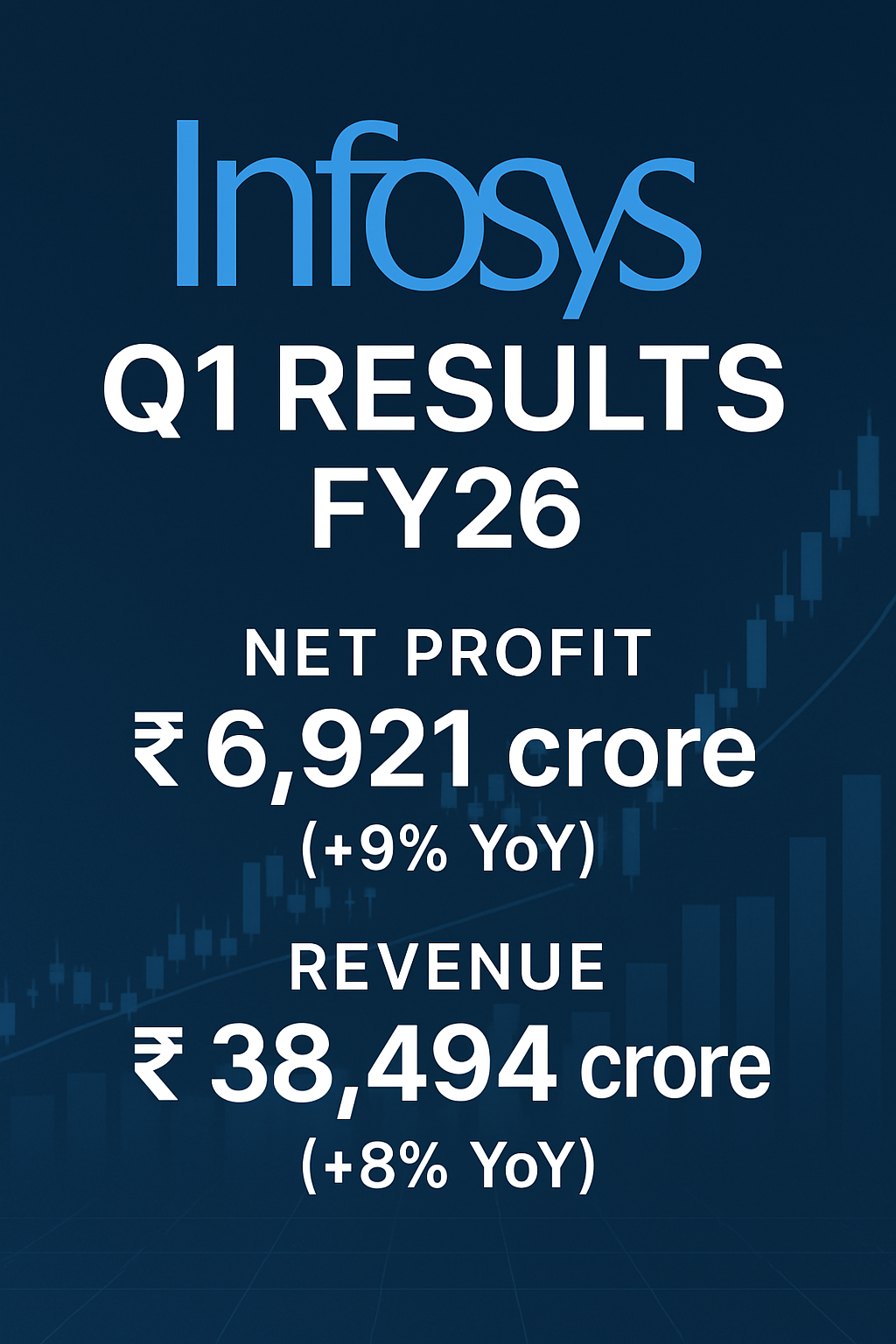
Infosys reported a strong Q1 FY26 performance with a 9% YoY rise in net profit and 8% growth in revenue. Read detailed insights, ADR performance, and market reactions here.
Table of Contents
Published: July 23, 2025 | Last Updated: July 23, 2025
Introduction
Infosys Limited released its first quarter results for fiscal year 2026 on July 20, 2025, showing growth in both revenue and profit despite challenging conditions in the global IT services sector. The Bangalore-based company reported a net profit of ₹6,921 crore, representing a 9% increase compared to the same period last year.
Total revenue reached ₹38,494 crore, marking an 8% year-on-year increase from ₹35,998 crore. The company maintained its operating margin at 20.6%, showing resilience in a difficult cost environment. These results come at a time when many IT services firms face budget constraints from enterprise clients and reduced discretionary spending.
The company also secured large deal wins worth $3.2 billion during the quarter. This indicates continued client confidence in Infosys’s service delivery capabilities. The results provide insights into how major IT services companies are navigating current market conditions.
Financial Performance Overview
Revenue and Profitability Metrics
Infosys’s financial performance in Q1 FY26 showed growth across key metrics. The company’s revenue of ₹38,494 crore represented an improvement from the previous year. In constant currency terms, revenue grew by 7.5%, which factors out the impact of exchange rate fluctuations.
Net profit increased to ₹6,921 crore from ₹6,345 crore in Q1 FY25. This translates to earnings per share growth of approximately 8.5%. The profit growth exceeded revenue growth, suggesting improvements in operational efficiency or favorable cost factors.
Operating margin stood at 20.6%, down 20 basis points from 20.8% in the same quarter last year. The company had guided for margins in the 20-22% range for the fiscal year. The margin performance reflects the balance between cost pressures and efficiency initiatives.
Key Performance Indicators
| Metric | Q1 FY26 | Q1 FY25 | Change |
|---|---|---|---|
| Total Revenue | ₹38,494 crore | ₹35,998 crore | +8.0% |
| Net Profit | ₹6,921 crore | ₹6,345 crore | +9.0% |
| Operating Margin | 20.6% | 20.8% | -20 bps |
| Constant Currency Growth | 7.5% | – | – |
| Large Deal Wins | $3.2 billion | – | – |
| Attrition Rate | 12.8% | 17.3% | -4.5% |
The attrition rate showed significant improvement, declining to 12.8% from 17.3% in the previous year. Lower attrition typically reduces recruitment and training costs while improving project continuity. This metric is closely watched as it affects both costs and service delivery quality.
Segment-Wise Performance Analysis
Banking, Financial Services, and Insurance (BFSI)
The BFSI segment remains Infosys’s largest vertical, contributing approximately 32% of total revenue. This translates to roughly ₹12,318 crore in Q1 FY26. The segment experienced moderated growth compared to some other verticals.
Growth in BFSI was affected by delayed decision-making among European financial institutions. Many banks and insurance companies have been cautious with IT spending due to economic uncertainty. However, regulatory compliance requirements and digital banking initiatives continue to drive demand for IT services.
Infosys provides services including core banking system modernization, regulatory reporting solutions, and digital customer engagement platforms to BFSI clients. The segment’s performance often reflects broader trends in financial services technology spending.
Retail Sector
The retail segment delivered strong performance with approximately 10% year-on-year growth. This outpaced the overall company growth rate. Digital transformation projects drove much of this growth as retailers invest in omnichannel capabilities and e-commerce platforms.
Retailers are implementing solutions for supply chain optimization, customer analytics, and personalized marketing. The shift toward online shopping and the need for integrated digital and physical retail experiences create ongoing demand for IT services.
Infosys offers retail-specific solutions including point-of-sale systems, inventory management, and customer data platforms. The segment’s strong performance suggests continued prioritization of technology investments by retail clients.
Manufacturing and Industrial
The manufacturing segment maintained steady growth through the quarter. Industry 4.0 initiatives, which involve automation, IoT, and data analytics in manufacturing, represent a key growth area. Companies are investing in smart manufacturing systems and predictive maintenance solutions.
Infosys provides manufacturing execution systems, quality management platforms, and supply chain digitization services. The trend toward sustainable manufacturing also creates opportunities for IT services related to energy management and environmental compliance.
Communication and Technology
The communication sector, which includes telecom operators and technology companies, showed relatively flat growth. Telecom clients have reduced discretionary IT spending as they focus capital on 5G network infrastructure investments.
Many telecom operators are facing competitive pressures and regulatory changes that affect their IT budgets. However, the transition to 5G and the need for network modernization may create future opportunities for IT services.
Life Sciences and Healthcare
The healthcare and life sciences segment grew approximately 12% year-on-year. This sector has shown resilience due to ongoing digital health initiatives, clinical trial optimization needs, and regulatory compliance requirements.
Telemedicine platforms, healthcare data analytics, and patient engagement systems represent growing areas. Pharmaceutical and medical device companies continue to invest in IT for research and development, manufacturing, and commercial operations.
Stock Market Performance
NSE Trading Activity
Infosys shares on the National Stock Exchange (NSE) closed at ₹1,525 on July 20, 2025, the day of the results announcement. This represented a gain of 1.0% from the previous closing price of ₹1,510. The modest positive movement reflected investor response to the quarterly results.
Trading volume and price movements in the days following the announcement provide insights into market sentiment. The stock’s performance is influenced by both company-specific factors and broader market trends affecting IT services companies.
ADR Performance
Infosys American Depository Receipts (ADRs) traded on the New York Stock Exchange at $17.78 on July 20, 2025. This was down 0.4% from $17.85 the previous day. The different reactions in Indian and US markets reflect varying investor perspectives and currency factors.
ADR performance is influenced by both the underlying share price in India and the USD-INR exchange rate. Global investors may have different expectations regarding IT services sector prospects compared to Indian investors.
Market Valuation Context
The market’s reaction to the results suggests investors are weighing positive factors like large deal wins and improved attrition against concerns about IT spending trends. Valuation multiples for IT services stocks have been under pressure industry-wide due to macroeconomic uncertainty.
Investor sentiment toward the sector reflects expectations for enterprise technology spending, which is influenced by corporate profit trends and economic conditions in major markets. Comparative performance against sector peers provides additional context for stock movements.
Operational Highlights
Large Deal Wins
The company secured $3.2 billion in large deal wins during Q1 FY26. Large deals typically refer to contracts with total contract value exceeding a certain threshold, often $50 million or more. These deals represent multi-year engagements with major enterprise clients.
Large deal wins serve as a leading indicator of future revenue as they translate into billing over the contract period. The quantum of deals won suggests continued client confidence despite budget pressures. The nature of these deals likely includes digital transformation, cloud migration, and application management services.
Workforce Metrics
Attrition improved significantly to 12.8% from 17.3% year-on-year. This 4.5 percentage point reduction is meaningful as high attrition has been a challenge for the IT services industry. Lower turnover reduces costs associated with recruiting, hiring, and training new employees.
Improved retention also enhances project stability and institutional knowledge preservation. The company likely achieved this through a combination of compensation adjustments, career development opportunities, and work environment improvements.
Total employee count and additions during the quarter provide additional context about the company’s capacity planning. The IT services industry has been adjusting workforce levels in response to automation and changing demand patterns.
Margin Management
Operating margin of 20.6% reflects the company’s ability to maintain profitability despite cost pressures. Wage inflation, particularly for technology talent, remains a significant cost factor. Annual salary increases affect the cost structure as do fresher hiring and lateral recruitment.
The company manages margins through several levers including automation, offshoring, pyramid optimization (maintaining appropriate ratios of junior to senior staff), and pricing strategies. Utilization rates, which measure the percentage of billable employee time, also impact margins.
Currency movements affect margins as a portion of costs are in Indian rupees while much revenue is in foreign currencies. The rupee’s depreciation against the dollar can provide some natural hedging benefit.
Technology and Innovation Initiatives
Generative AI Capabilities
Infosys has been investing in generative AI capabilities through its Infosys Topaz platform. This represents the company’s approach to integrating AI technologies into its service offerings. Generative AI has potential applications in software development, customer service automation, and business process optimization.
The company is positioning AI capabilities as a differentiator in competitive situations. Clients are exploring AI for productivity improvements and new capabilities. However, the revenue impact of AI services is still developing as the technology is relatively new.
AI investments require upfront costs for research and development, training, and platform development. The returns on these investments will depend on successful commercialization and client adoption.
Digital Transformation Services
Digital transformation remains a major category of IT services spending. This encompasses cloud migration, application modernization, data analytics, and cybersecurity. Infosys offers end-to-end transformation services across these areas.
Cloud services include strategy consulting, migration execution, and managed services for major cloud platforms. Many enterprises are moving workloads to cloud infrastructure for scalability, cost optimization, and agility benefits.
Application modernization involves updating legacy systems to modern architectures and technologies. This work is often necessary to enable other digital initiatives and improve operational efficiency.
Cybersecurity and Compliance
Cybersecurity services have grown in importance as enterprises face increasing threats and complex regulatory requirements. Infosys provides security consulting, implementation, and managed security services.
Compliance requirements vary by industry and geography. Financial services firms face regulations like GDPR in Europe and various data protection laws. Healthcare organizations must comply with HIPAA and similar regulations. These requirements create ongoing demand for compliance-related IT services.
Industry Context and Market Conditions
Global IT Services Market Trends
The global IT services market faces mixed conditions. While digital transformation and cloud adoption continue to drive growth, macroeconomic concerns have led to spending caution. Some analysts estimate global IT services market growth in the mid-single digits for 2025.
North America and Europe represent major markets for Indian IT services firms. Economic conditions in these regions significantly impact demand. Inflation, interest rates, and economic growth forecasts influence corporate IT budgets.
Certain verticals show stronger spending than others. While financial services and telecom face constraints, retail, healthcare, and manufacturing show relatively better momentum. Understanding vertical-specific trends helps contextualize company performance.
Competitive Landscape
Infosys competes with other major Indian IT services firms including Tata Consultancy Services (TCS), Wipro, HCL Technologies, and Tech Mahindra. Global competitors include Accenture, IBM, and others. Competitive factors include pricing, technical capabilities, domain expertise, and delivery track record.
Market share dynamics and relative growth rates provide insights into competitive positioning. Large deal wins are often competitive situations where multiple vendors compete. Win rates and deal structures indicate competitive strength.
Differentiation through technology capabilities, particularly in emerging areas like AI, cloud, and industry-specific solutions, influences competitive outcomes. Companies with strong relationships and proven delivery records often have advantages in large deals.
Macroeconomic Factors
Exchange rates significantly impact financial results for companies with international operations. The USD-INR exchange rate affects revenue realization and margins. Rupee depreciation generally benefits revenue in rupee terms when billing is in dollars.
Interest rate environments affect both client spending capacity and company financial management. Higher rates can constrain client budgets and increase borrowing costs. Inflation affects wage costs and operational expenses.
Geopolitical factors including trade policies, visa regulations, and global supply chain dynamics create additional considerations. Changes in visa regulations for the US market, for example, can affect operational models and costs.
Management Commentary and Outlook
CEO Perspective
According to company statements, CEO Salil Parekh highlighted the large deal wins as evidence of client trust. Management emphasized the company’s generative AI initiatives and digital transformation capabilities. The tone was measured, acknowledging the cautious client environment while expressing confidence in the company’s positioning.
Leadership commentary provides insights into management’s assessment of market conditions and the company’s strategic priorities. The emphasis on AI and digital transformation indicates where the company sees growth opportunities.
Financial Guidance
Infosys maintained its fiscal year 2026 revenue growth guidance of 7-9% in constant currency terms. This guidance reflects management’s expectations based on current visibility into the business pipeline and market conditions. Operating margin guidance remained at 20-22%.
Guidance maintenance suggests management confidence despite the uncertain environment. However, the relatively wide ranges reflect the difficulty in forecasting given economic uncertainty. Quarterly results and commentary help track progress against annual guidance.
Strategic Priorities
Management has indicated priorities including expanding AI capabilities, deepening client relationships, and optimizing operational efficiency. Geographic expansion in certain markets and selective capability acquisitions may be pursued where they support strategic goals.
Talent management remains a priority given the importance of skilled workforce to service delivery. Investments in training, particularly in emerging technologies, support both employee development and service capability enhancement.
Financial Analysis and Metrics
Profitability Ratios
Net profit margin of approximately 18% (calculated as net profit divided by revenue) indicates the company’s bottom-line profitability. This metric has remained relatively stable, reflecting consistent profitability management. Operating margin at 20.6% shows the profit from operations before interest and taxes.
Return on equity (ROE), which measures profitability relative to shareholder equity, is an important metric for assessing how effectively the company generates returns on invested capital. While not provided in the quarterly results, this metric from annual reports provides longer-term performance context.
Revenue Growth Analysis
The 8% reported revenue growth and 7.5% constant currency growth provide slightly different perspectives. Constant currency growth removes the effect of exchange rate movements, providing a better view of underlying business growth. The difference between the two reflects currency impacts on revenue translation.
Sequential growth (comparing Q1 FY26 to Q4 FY25) provides another perspective on momentum. Year-on-year comparisons can be affected by base effects and seasonal patterns. IT services typically show some seasonality with quarterly variations.
Cash Flow Considerations
While detailed cash flow statements are typically provided in complete quarterly reports, operating cash flow generation is crucial for IT services companies. Strong cash flow supports dividends, share buybacks, and investments in growth initiatives.
Days sales outstanding (DSO), which measures how quickly the company collects receivables, affects working capital requirements. Efficient collections are important for cash flow management. Capital expenditure requirements for IT services companies are generally lower than asset-intensive industries.
Risk Factors and Considerations
Demand Uncertainty
The primary risk factor remains uncertainty about client spending on IT services. If economic conditions deteriorate in major markets, discretionary IT spending could decline further. Clients may delay or scale back transformation projects, affecting growth rates.
Budget scrutiny is intense in the current environment. Clients are demanding strong ROI justification for IT investments. This increases pressure on pricing and requires clear value demonstration.
Margin Pressures
Wage inflation continues to affect costs. While attrition has improved, competition for skilled talent remains intense, particularly in emerging technology areas. The company must balance competitive compensation with margin objectives.
Pricing pressure in competitive bidding situations can affect margins. Clients seek cost savings and efficiency gains, which can translate to pricing constraints. The shift toward outcome-based pricing models changes the risk-reward dynamics.
Technology Disruption
While generative AI presents opportunities, it also creates uncertainty. If AI-powered automation significantly reduces the need for traditional IT services, it could disrupt business models. Companies must balance the opportunity to provide AI services against potential displacement of existing services.
The rapid pace of technology change requires continuous investment in capability development. Skills that are valuable today may become less relevant quickly. This affects both service offerings and workforce planning.
Geopolitical and Regulatory Factors
Changes in visa regulations, particularly in the US market, can affect operational models. Higher dependence on local hiring increases costs compared to offshore-based delivery. Trade policies and data localization requirements create additional complexity.
Tax regulations across multiple jurisdictions affect effective tax rates and compliance costs. Changes in corporate tax rates or international tax rules can impact profitability. The global minimum tax initiative represents one such change affecting multinational companies.
Comparative Sector Analysis
Peer Performance Context
Comparing Infosys’s results with other major IT services companies provides industry context. TCS, Wipro, HCL Technologies, and Tech Mahindra have reported or will report quarterly results around the same period. Relative performance across growth, margins, and deal wins indicates competitive positioning.
Similar trends across companies suggest industry-wide factors. Diverging performance may indicate company-specific strengths or challenges. Analysts often create peer comparison tables looking at growth rates, margins, and valuation multiples.
Industry Growth Rates
Understanding whether Infosys is gaining or losing market share requires comparing its growth to overall market growth estimates. Industry research firms publish market growth forecasts. Outperformance suggests market share gains while underperformance may indicate share loss.
Different segments of the IT services market grow at different rates. Cloud services and digital transformation typically show higher growth than traditional application maintenance. Portfolio mix affects overall growth rates.
Valuation Metrics
Price-to-earnings (P/E) ratios provide one measure of valuation. Comparing Infosys’s P/E to sector peers indicates whether it trades at a premium or discount. Differences may reflect growth expectations, profitability levels, or perceived quality differences.
Other valuation metrics include price-to-sales and enterprise value to EBITDA ratios. These provide different perspectives on valuation. Historical valuation ranges help assess whether current levels are high or low relative to the company’s own history.
Investment Considerations
Analyst Perspectives
Equity research analysts from various brokerage firms publish reports assessing company performance and providing investment recommendations. Common recommendations include “buy,” “hold,” or “sell” with variations in terminology. These reports typically include financial models and target price estimates.
Analyst consensus, which aggregates multiple analyst views, provides one perspective on market expectations. However, investors should form their own views based on their investment objectives and risk tolerance. Past analyst track records vary in accuracy.
Key Factors for Monitoring
Investors and analysts monitoring Infosys will track several key factors going forward. Quarterly revenue growth trends indicate whether momentum is accelerating or decelerating. Large deal wins provide visibility into future revenue but must convert to actual billing.
Margin trends show how effectively the company manages costs relative to revenue. Client concentration metrics indicate revenue diversification. Any client representing a very large percentage of revenue creates concentration risk.
Attrition and employee satisfaction metrics affect delivery capability and costs. Technology capability development in areas like AI influences competitive positioning. Geographic expansion and new market entry initiatives create growth opportunities but require investment.
Risk-Return Profile
Infosys represents a large-cap stock in the IT services sector. As an established company with significant scale, it typically exhibits lower volatility than smaller technology companies. However, it is still subject to sector-specific and market-wide risks.
The company’s growth profile, profitability, and cash generation support its position as a relatively stable large-cap investment option. However, growth rates are generally lower than high-growth technology companies. Dividend yield provides one component of total return.
Portfolio diversification considerations include sector exposure to IT services, geographic revenue concentration, and correlation with broader market indices. Investors should consider how Infosys fits within their overall portfolio strategy.
Industry Outlook and Trends
Digital Transformation Trajectory
Digital transformation is expected to remain a key driver of IT services demand over the medium term. While economic conditions affect the pace, the fundamental need for enterprises to modernize technology infrastructure and capabilities continues. Cloud adoption, data analytics, and automation represent multi-year trends.
The transition from traditional IT services to digital services continues. Application maintenance and support services are evolving toward platform-based models and increased automation. This shift affects both demand patterns and service delivery approaches.
Artificial Intelligence Impact
The impact of artificial intelligence on the IT services industry is still unfolding. AI could increase demand for services related to AI implementation and integration. Conversely, AI-powered automation could reduce demand for certain traditional services.
Successful IT services companies will likely need to integrate AI capabilities into their service offerings while managing the transition in business models. The balance between AI-driven growth opportunities and AI-enabled efficiency will vary by company and client segment.
Market Recovery Timeline
The timing of potential recovery in IT services spending depends on broader economic conditions. If economic uncertainty diminishes and corporate confidence improves, discretionary IT spending could accelerate. However, forecasting this timing involves significant uncertainty.
Different geographic markets and industry verticals may recover at different paces. Companies with diversified portfolios across regions and sectors may see more balanced performance. Client-specific factors also play a role in spending decisions.
Conclusion
Infosys’s Q1 FY26 results showed revenue and profit growth despite challenging conditions in the IT services sector. The company reported revenue of ₹38,494 crore and net profit of ₹6,921 crore, representing 8% and 9% year-on-year growth respectively.
Large deal wins of $3.2 billion and improved attrition to 12.8% represent positive operational indicators. Operating margin of 20.6% remained within the company’s guided range despite cost pressures. The company maintained its full-year revenue growth guidance of 7-9% in constant currency terms.
Segment performance varied with retail and healthcare showing stronger growth while BFSI and communications faced headwinds. The company continues to invest in generative AI and digital transformation capabilities to support future growth.
The results provide insights into how major IT services companies are navigating current market conditions characterized by cautious client spending and cost pressures. Investors and analysts will continue monitoring quarterly performance, deal wins, margin trends, and technology capability development to assess the company’s trajectory.
Frequently Asked Questions (FAQs)
What was Infosys’s net profit in Q1 FY26?
Infosys reported a net profit of ₹6,921 crore in Q1 FY26, which represented a 9% increase compared to ₹6,345 crore in Q1 FY25. The profit growth was accompanied by earnings per share growth of approximately 8.5%. This profitability was achieved while maintaining operating margins of 20.6%, within the company’s guided range of 20-22% for the fiscal year. The profit performance reflected both revenue growth and operational efficiency despite cost pressures from wage inflation and other factors.
How much revenue did Infosys generate in Q1 FY26?
The company reported total revenue of ₹38,494 crore in Q1 FY26, marking an 8% increase from ₹35,998 crore in the same quarter of the previous year. In constant currency terms, which removes the impact of exchange rate fluctuations, revenue grew 7.5% year-on-year. The revenue growth was driven by large deal wins totaling $3.2 billion and continued demand for digital transformation services. However, growth was moderated by cautious client spending in certain sectors, particularly in BFSI and telecommunications.
What is Infosys’s revenue guidance for FY26?
Infosys maintained its fiscal year 2026 revenue growth guidance at 7-9% in constant currency terms. The company also maintained its operating margin guidance of 20-22%. This guidance reflects management’s expectations based on current business visibility, pipeline, and market conditions. The continuation of previous guidance despite challenging market conditions suggests management confidence in achieving these targets. However, the relatively wide ranges reflect uncertainty in the business environment and potential variation in quarterly performance.
Which business segments showed the strongest growth?
The retail segment showed strong performance with approximately 10% year-on-year growth, driven by digital transformation projects and e-commerce initiatives. The life sciences and healthcare segment also performed well with around 12% growth, supported by digital health initiatives and compliance requirements. Manufacturing maintained steady growth through Industry 4.0 solutions. In contrast, BFSI, which represents about 32% of revenue, showed moderated growth due to delayed decision-making in European markets. The communication sector faced challenges with relatively flat growth due to reduced discretionary spending by telecom clients.
How did Infosys’s stock perform after the Q1 results?
On July 20, 2025, when the results were announced, Infosys shares on the NSE closed at ₹1,525, representing a 1.0% gain from the previous closing of ₹1,510. The modest positive movement reflected investor assessment of the results. However, the company’s American Depository Receipts (ADRs) on the NYSE traded at $17.78, down 0.4% from $17.85 the previous day. The difference in reaction between Indian and US markets reflects varying investor perspectives, currency factors, and different market dynamics. Stock performance is influenced by both company-specific results and broader IT sector sentiment.
What is Infosys’s current attrition rate and why does it matter?
Infosys’s attrition rate improved significantly to 12.8% in Q1 FY26 from 17.3% in the same quarter last year, representing a 4.5 percentage point reduction. Attrition rate measures the percentage of employees who leave the company annually. Lower attrition is beneficial as it reduces recruitment and training costs, improves project continuity, and helps retain institutional knowledge and client relationships. High attrition has been a challenge for the IT services industry, so this improvement represents positive operational progress. The reduction likely resulted from compensation adjustments, career development initiatives, and improved work environment.
What are the major risk factors affecting Infosys’s performance?
Key risk factors include uncertainty in client IT spending due to macroeconomic conditions, which could affect revenue growth if economic conditions deteriorate. Margin pressures from wage inflation and competitive pricing present ongoing challenges. Technology disruption, particularly from AI-powered automation, could affect demand for traditional IT services even as it creates new opportunities. Geopolitical factors including visa regulation changes and data localization requirements affect operational models and costs. Currency volatility creates translation risks given international operations. The company must also manage talent competition in emerging technology areas while maintaining cost competitiveness.
How is Infosys addressing artificial intelligence opportunities?
Infosys has developed its Infosys Topaz platform as part of its generative AI strategy. The company is integrating AI capabilities into its service offerings to help clients implement AI solutions and improve operational efficiency. AI applications span software development, customer service automation, and business process optimization. Management has emphasized AI as a key differentiator and growth driver. However, the revenue impact is still developing as the technology is relatively new. The company must balance investing in AI capabilities with managing potential disruption to traditional service models. Success will depend on effective commercialization and client adoption of AI services.
About the Author
Nueplanet
Nueplanet is a financial content writer specializing in Indian equity markets, corporate earnings analysis, and IT sector developments. With the years of experience covering public company results and market trends, Nueplanet focuses on providing factual, data-driven analysis based on official company disclosures and regulatory filings.
Nueplanet sources information from verified channels including stock exchange announcements (NSE/BSE), company investor presentations, SEBI filings, and official corporate communications. The analysis presented aims to help readers understand financial results and market developments through neutral, informative content.
Commitment to Accuracy: All financial data, company statements, and performance metrics are sourced from official company announcements, stock exchange filings, and verified regulatory disclosures. Content is updated regularly to reflect the latest available information.
Editorial Standards and Transparency
This article is based on information from Infosys Limited’s official Q1 FY26 results announcement dated July 20, 2025, along with stock exchange data from NSE and NYSE. Financial figures and company statements are sourced from official investor presentations and regulatory filings.
Sources:
- Infosys Limited Investor Relations (Official)
- National Stock Exchange of India (NSE)
- New York Stock Exchange (NYSE)
- Securities and Exchange Board of India (SEBI) Filings
Disclaimer: This content is for informational purposes only and should not be considered as investment advice. Readers should conduct their own research and consult with qualified financial advisors before making investment decisions. Past performance does not guarantee future results.
Last Verified: July 23, 2025
Helpful Resources
Latest Posts
- HBSE Compartment Exam 2025: Admit Cards Released for Haryana Class 10 and 12 – Check Full Details
- Karnataka 2nd PUC Exam 3 Results 2025 Declared on karresults.nic.in
- JAC Result 2025 Declared: Check Class 11 Pass Percentage, Websites, and More
- National RailOne App: Indian Railways’ One-Stop Solution for Travellers
- HDB Financial Services IPO Allotment GMP: All You Need to Know
Related Posts












Post Comment