









India Women vs England Women 2025: Smriti Mandhana’s Maiden T20I Century Leads India to Commanding Win
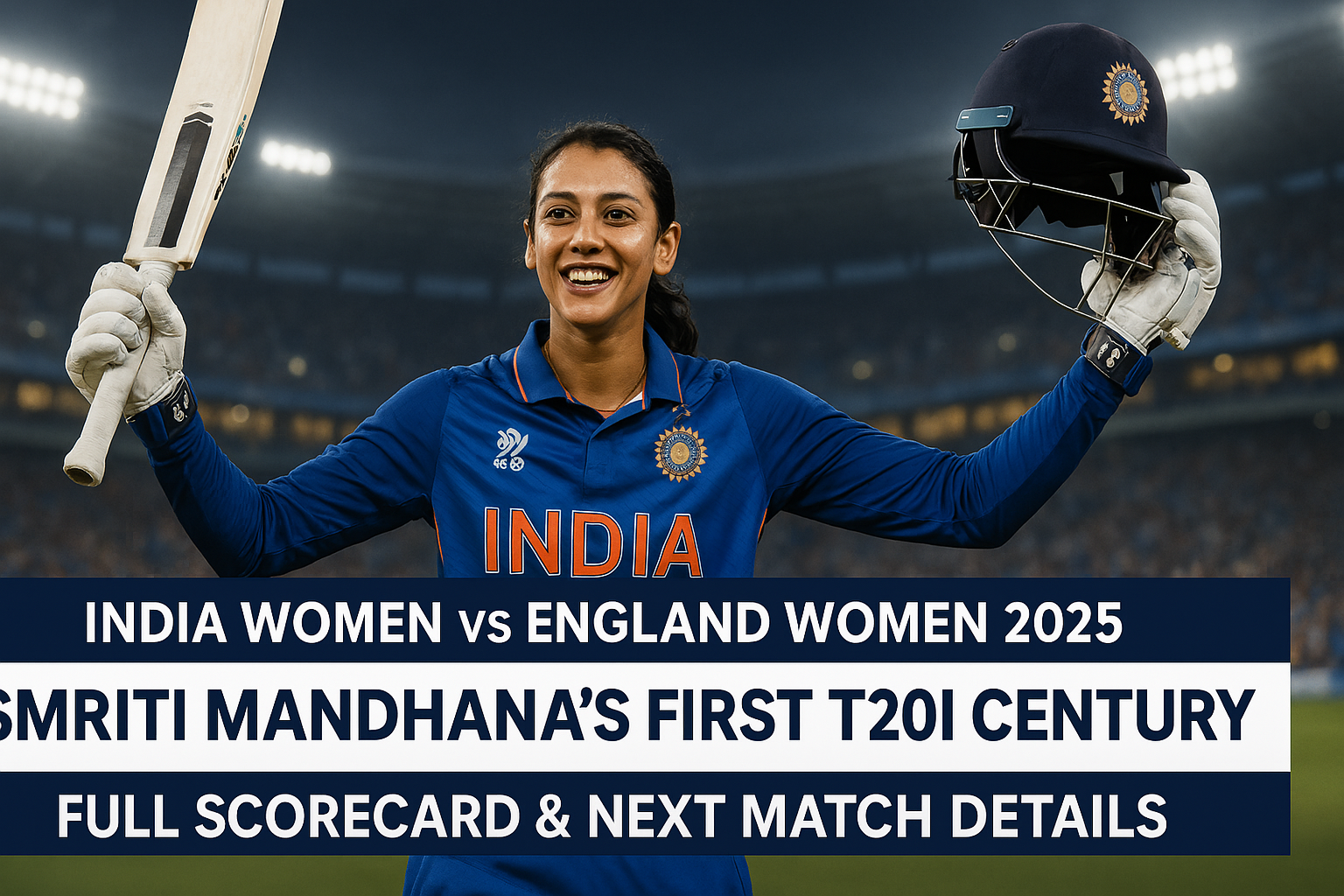
India Women vs England Women 2025 T20I: Smriti Mandhana hits her maiden T20I hundred as India beats England by 97 runs. Check full scorecard, updated team squads, next match date, venue, and pitch report.
Table of Contents
Published: June 29, 2025 | Last Updated: June 29, 2025
Introduction: India’s Dominant Start to T20I Series
India Women secured a decisive victory in the opening T20I against England Women, winning by 97 runs at Trent Bridge in Nottingham on June 28, 2025. The victory provides India with a 1-0 series lead in the five-match T20I series and demonstrates their competitive capability in international cricket. The match was decided through comprehensive performances across batting and bowling disciplines.
India accumulated 210/5 during their 20-over innings, establishing a substantial total based on solid batting contributions. England’s chase resulted in dismissal after 14.5 overs with a total of 113 runs. The victory margin and match progression reflect competitive difference between the teams during this specific encounter.
Match Overview and Essential Information
Complete Match Details
| Match Information | Details |
|---|---|
| Match Name | 1st T20I – India Women vs England Women 2025 |
| Date | June 28, 2025 |
| Venue | Trent Bridge, Nottingham |
| Toss | India elected to bat first |
| Match Result | India won by 97 runs |
| Player of the Match | Smriti Mandhana (112 not out off 62 balls) |
| Series Status | India leads 1-0 |
| Attendance | Approximately 16,500 spectators |
| Weather Conditions | Partly clear, approximately 26°C |
Final Score Summary
| Team | Runs | Wickets | Overs | Result |
|---|---|---|---|---|
| India Women | 210 | 5 | 20.0 | Batting first |
| England Women | 113 | 10 | 14.5 | Chasing team |
| Victory Margin | 97 runs | – | – | – |
Venue Analysis: Trent Bridge Cricket Ground
Ground Specifications and Characteristics
| Venue Feature | Specification | Cricket Implications |
|---|---|---|
| Location | Nottingham, England | Historic English venue |
| Capacity | 17,500 spectators | Established ground |
| Pitch Type | Natural grass surface | Batting-friendly conditions |
| Boundary Dimensions | 65-70 meters (variable) | Encouraging boundary hitting |
| Historical Status | Established cricket venue | Traditional English ground |
| Notable Characteristics | Flat pitch, good bounce | Favorable for attacking batting |
Trent Bridge provides conditions historically favorable to batting teams. The ground’s pitch typically offers consistent bounce and relatively true surface characteristics throughout match duration. The relatively short boundaries encourage boundary-hitting cricket while the flat pitch reduces ball movement significantly. Weather conditions on match day—clear skies and moderate temperature—supported attacking batting approaches.
Pitch Behavior During Match
The Trent Bridge pitch maintained consistent bounce throughout the match duration. Early batting phases provided favorable conditions without excessive seam movement or variable bounce. The surface remained relatively stable, allowing batsmen to execute stroke play with confidence. As the match progressed into later overs, minor deterioration occurred with slight unevenness developing in specific areas, particularly around the crease. The pitch characteristics favored batting approaches, with the opposition bowling requiring exceptional control and variation to restrict run accumulation.
India Women: Batting Performance and Scorecard
Complete Batting Scorecard
| Player | Runs | Balls | Fours | Sixes | Strike Rate | Dismissal | Notes |
|---|---|---|---|---|---|---|---|
| Shafali Verma | 20 | 22 | 3 | 0 | 90.91 | Caught | Foundation phase |
| Smriti Mandhana (C) | 112* | 62 | 15 | 3 | 180.65 | Not out | Match-winning innings |
| Harleen Deol | 43 | 23 | 7 | 0 | 186.96 | Caught | Explosive contribution |
| Jemimah Rodrigues | 0 | 2 | 0 | 0 | 0.00 | Caught | Brief appearance |
| Richa Ghosh (Wk) | 12 | 6 | 3 | 0 | 200.00 | Not out | Finishing phase |
| Amanjot Kaur | 3 | 3 | 0 | 0 | 100.00 | Not out | Quick runs |
| Deepti Sharma | 7 | 3 | 1 | 0 | 233.33 | Not out | Death-over phase |
| Extras | 13 | – | – | – | – | – | (7 wides, 4 leg-byes, 2 no-balls) |
| Total | 210 | 120 | 29 | 3 | 175.00 | 5 wickets | 20 overs |
India’s Batting Analysis
Opening Partnership (Verma & Mandhana): Shafali Verma and Smriti Mandhana established a 45-run opening partnership across 6.2 overs. Verma contributed 20 runs with solid batting technique, providing foundation for India’s innings. Mandhana progressed consistently, accumulating runs through disciplined stroke play. The opening phase set positive tone for India’s batting strategy without excessive aggression.
Middle-Order Acceleration (Mandhana & Deol): Following Verma’s dismissal, Harleen Deol joined Mandhana for a transformative 89-run partnership spanning 7.4 overs. Deol’s aggressive approach complemented Mandhana’s batting style, creating scoring momentum. The partnership featured combination of boundary hitting and calculated aggression, establishing substantial middle-order total. This phase shifted match balance decisively in India’s favor through accelerated run rate and pressure application on England’s bowling.
Finishing Phase (Mandhana & Support Batsmen): Mandhana added 23 runs with Richa Ghosh during the final overs, extending India’s total substantially. Ghosh’s aggressive approach during her brief 6-ball cameo demonstrated late-innings acceleration capability. Deepti Sharma’s contribution during death overs provided additional runs through calculated stroke play. The finishing phase reflected effective management of final overs and batting depth throughout the lineup.
Smriti Mandhana’s Innings Analysis
| Innings Metric | Statistics | Context |
|---|---|---|
| Final Score | 112 not out | First T20I century |
| Balls Faced | 62 | Controlled acceleration |
| Boundary Distribution | 15 fours, 3 sixes | Balanced hitting |
| Strike Rate | 180.65 | Dominant scoring rate |
| Dot Balls | 14 (22.5% of balls) | Excellent scoring efficiency |
| Partnerships | 45, 89, 23 runs | Consistent contributions |
Mandhana’s innings demonstrated progression from foundation-building to aggressive acceleration. The initial phase (first 25 balls) focused on establishing position with measured stroke play and rotation of strike. The middle phase (balls 26-50) featured acceleration with increased boundary hitting against bowling variations. The final phase (balls 51-62) displayed maximum aggression with consistent boundary attempts and risk-calculated shot selection. The innings combined technical excellence with tactical awareness, recognizing opposition bowling limitations and exploiting them effectively.
England Women: Batting Performance and Scorecard
Complete Batting Scorecard
| Player | Runs | Balls | Fours | Sixes | Strike Rate | Dismissal | Analysis |
|---|---|---|---|---|---|---|---|
| Sophia Dunkley | 7 | 4 | 1 | 0 | 175.00 | Caught | Early exit |
| Danni Wyatt-Hodge | 0 | 3 | 0 | 0 | 0.00 | Bowled | Golden duck |
| Nat Sciver-Brunt (C) | 66 | 42 | 10 | 0 | 157.14 | Caught | Resistance effort |
| Tamsin Beaumont | 10 | 11 | 1 | 0 | 90.91 | LBW | Struggled for rhythm |
| Amy Jones (Wk) | 1 | 2 | 0 | 0 | 50.00 | Caught | Quick dismissal |
| Alice Capsey | 5 | 6 | 0 | 0 | 83.33 | Stumped | Failed acceleration |
| Emily Arlott | 12 | 10 | 1 | 1 | 120.00 | Caught | Tail effort |
| Sophie Ecclestone | 1 | 4 | 0 | 0 | 25.00 | Caught | Batting challenge |
| Lauren Filer | 2 | 4 | 0 | 0 | 50.00 | Bowled | Minimal contribution |
| Linsey Smith | 0 | 0 | 0 | 0 | — | Not out | Did not bat |
| Lauren Bell | 2 | 4 | 0 | 0 | 50.00 | Not out | Unbeaten |
| Extras | 7 | – | – | – | – | – | (4 byes, 2 leg-byes, 1 wide) |
| Total | 113 | 90 | 14 | 1 | 125.56 | 10 wickets | 14.5 overs |
England’s Chase Analysis
Powerplay Phase (Overs 1-6): England’s powerplay batting demonstrated early vulnerability. The opening pair contributed only 7 runs in the first three balls before Danni Wyatt-Hodge’s golden duck departure. Subsequent batting proved inconsistent, with England managing only 32 runs across six overs while losing three wickets. Sophia Dunkley’s early departure (7 runs off 4 balls) and Wyatt-Hodge’s failure set negative tone for the innings. The powerplay phase reflected inadequate batting approach to India’s opening bowling intensity.
Middle Overs Phase (Overs 7-12): Nat Sciver-Brunt provided resistance during the middle overs with sustained batting effort. The captain accumulated 66 runs, representing England’s only substantial contribution during the chase. However, Sciver-Brunt received minimal support from batting partners, with the next highest score limited to 12 runs. Regular wicket losses (5 wickets by the end of over 12) prevented batting partnerships from developing substantially. This phase illustrated England’s batting collapse with insufficient middle-order support for the captain’s efforts.
Final Phase (Overs 13-14.5): England’s batting disintegrated completely during the final overs with rapid dismissals. The last five wickets fell for minimal additional runs, essentially abandoning the chase. Emily Arlott’s 12-run contribution provided limited resistance before final dismissals occurred. The tail batsmen struggled with both batting technique and confidence, unable to generate meaningful runs. The innings concluded after 14.5 overs with India’s bowlers maintaining control throughout.
Bowling Analysis and Performance Metrics
India’s Bowling Performance
| Bowler | Overs | Maidens | Runs | Wickets | Economy | Performance |
|---|---|---|---|---|---|---|
| Arundhati Reddy | 3.0 | 0 | 22 | 2 | 7.33 | Early breakthroughs |
| Deepti Sharma | 3.0 | 0 | 18 | 3 | 6.00 | Exceptional control |
| Radha Yadav | 4.0 | 0 | 28 | 2 | 7.00 | Spin pressure |
| Sneh Rana | 2.5 | 0 | 19 | 2 | 6.71 | Death-over execution |
| Nallapureddy Charani | 2.0 | 0 | 26 | 1 | 13.00 | Pace support |
| Totals | 14.5 | 0 | 113 | 10 | 7.61 | Complete performance |
England’s Bowling Performance
| Bowler | Overs | Maidens | Runs | Wickets | Economy | Analysis |
|---|---|---|---|---|---|---|
| Lauren Bell | 4.0 | 0 | 38 | 1 | 9.50 | Expensive |
| Emily Arlott | 4.0 | 0 | 42 | 2 | 10.50 | Cost-effective wickets |
| Sophie Ecclestone | 4.0 | 0 | 45 | 1 | 11.25 | Uncharacteristic expensive |
| Lauren Filer | 4.0 | 0 | 44 | 1 | 11.00 | Pace without control |
| Linsey Smith | 4.0 | 0 | 41 | 0 | 10.25 | Ineffective phase |
| Totals | 20.0 | 0 | 210 | 5 | 10.50 | Expensive overall |
Bowling Phase Analysis
India’s Powerplay Bowling (Overs 1-6): India’s opening bowling set aggressive tone through tight line and length execution. Arundhati Reddy’s pace bowling generated early breakthroughs with two wicket dismissals. The powerplay phase yielded restrictive bowling economy rate of 7.33 runs per over while maintaining wicket-taking pressure. Early bowling intensity disrupted England’s batting rhythm and established psychological advantage for India’s bowling attack.
India’s Middle-Over Control (Overs 7-12): Deepti Sharma demonstrated exceptional bowling control during the middle overs, capturing three wickets while maintaining 6.00 runs-per-over economy. Radha Yadav’s spin bowling created additional pressure through flight variations and consistent line. The middle-over phase featured coordinated bowling strategy preventing substantial partnerships and managing run accumulation. India’s bowling depth ensured consistent pressure across different specialists.
India’s Death-Over Bowling (Overs 13-14.5): Sneh Rana executed death overs effectively with two-wicket dismissals during the final phases. The complete innings termination after 14.5 overs demonstrated superior bowling execution during pressure situations. India’s bowlers maintained control despite expected batting aggression during death overs. The final phase reflected established bowling dominance throughout the match duration.
Tactical Analysis and Strategic Frameworks
India’s Strategic Approach
Batting Strategy: India prioritized establishing substantial first-innings total through combination of patient foundation-building and calculated aggression. The opening partnership focused on avoiding early dismissals while maintaining scoring momentum. The middle-order approach emphasized partnership extension with balanced aggression, recognizing opportunity for significant total accumulation. Death-over batting instructions emphasized risk-calculated shot selection with emphasis on available fielder positions and bowler limitations.
Bowling Strategy: India’s bowling approach focused on early pressure through pace bowling to disrupt opposition batting rhythm. The strategy evolved toward spin-based pressure during middle overs, exploiting pitch deterioration and batting fatigue. Death-over bowling emphasized variations and accurate yorker execution to prevent batting recovery. The overall bowling framework prioritized wicket-taking combined with economical run management.
Fielding Deployment: India implemented aggressive fielding positions throughout powerplay overs to create catching opportunities. Mid-field fielding positions during middle overs balanced wicket-taking opportunities with boundary prevention. Death-over fielding concentrated on boundary restriction with specific positioning for expected batting aggression. Sharp fielding execution, including catch-taking quality, supported bowling efforts substantially.
England’s Strategic Approach
Batting Strategy: England’s batting approach emphasized aggressive stroke-making from match commencement, reflecting team philosophy. Opening batsmen targeted boundary hitting despite facing quality opposition bowling. The middle-order strategy intended partnership building to establish competitive totals. However, execution fell short of tactical intent through inconsistent technique against quality opposition.
Bowling Strategy: England prioritized opening phase wicket-taking through pace bowling intensity. The middle-over approach emphasized spin bowling through Sophie Ecclestone’s established expertise. Death-over bowling attempted to generate variations preventing late-innings acceleration. However, inadequate line and length execution limited strategy effectiveness substantially.
Fielding Deployment: England maintained conventional fielding positions throughout the match duration. Aggressive field placements during powerplay overs attempted to generate catching opportunities. However, fielding positions during middle and death overs remained reactive rather than proactive. Fielding quality demonstrated adequate standards without exceptional impact on match outcome.
Individual Player Performances and Key Insights
Notable India Women Performers
Smriti Mandhana (Captain): Mandhana’s 112 not out represents her first T20I century and demonstrates substantial individual milestone achievement. The innings reflected technical mastery and tactical awareness through match progression. Her captaincy responsibilities combined with batting excellence illustrates leadership qualities extending beyond individual performance. The century establishes her among India’s premier batting resources.
Harleen Deol: Deol’s 43-run contribution off 23 balls (186.96 strike rate) demonstrates aggressive batting during critical match phases. The partnership with Mandhana shifted match momentum decisively. Her explosive approach provided necessary acceleration during middle overs. The performance indicates emerging batting talent within India’s lineup.
Deepti Sharma (All-rounder): Sharma’s three-wicket bowling performance combined with tail-end batting contributions exemplify all-rounder value. Her 6.00 economy rate during three overs demonstrates control and precision. The 233.33 strike rate batting (7 runs off 3 balls) reflected appropriate death-over aggression.
Notable England Women Performers
Nat Sciver-Brunt (Captain): Sciver-Brunt’s 66-run effort represented solo resistance during England’s unsuccessful chase. Her 157.14 strike rate maintained scoring momentum despite partnership failures. The captain’s performance demonstrated individual quality amid team underperformance. The innings indicated that England batting failures reflected broader team issues rather than individual capability loss.
Emily Arlott: Arlott’s 12-run contribution during tail-end batting phases provided minor resistance. The two-wicket bowling performance (10.50 economy) indicated adequate bowling effort. Overall performance reflected adequate professional standard without exceptional impact.
Trent Bridge Venue Context and Historical Significance
Historical T20I Record at Trent Bridge
Trent Bridge provides established T20 cricket venue with consistent historical patterns. The ground’s pitch characteristics historically favor batting-first teams through early-match surface stability and minimal deterioration. Weather conditions on June 28, 2025, supported batting approaches with clear skies and moderate temperature conditions.
The venue’s 17,500 capacity provides substantial cricket atmosphere typical of established English grounds. The ground’s historical significance contributes to match experience quality. Trent Bridge consistently produces competitive cricket through balanced pitch-bowling-batting dynamics.
Pitch and Ground Conditions
The pitch maintained consistent bounce throughout the match duration with minimal seam assistance. The surface remained relatively true, allowing batsmen to execute stroke play without excessive technical adjustment. Ground conditions reflected well-maintained cricket pitch standards appropriate for international cricket. The boundary dimensions (65-70 meters) remained within typical T20 cricket parameters, encouraging boundary-hitting strategies.
Series Context and Forward Implications
Series Status Following Match 1
India’s victory establishes a 1-0 lead in the five-match T20I series. The substantial victory margin (97 runs) demonstrates competitive superiority during the opening encounter. England requires immediate response to prevent series deficit expansion. The psychological momentum clearly favors India heading into subsequent matches.
Tournament Preparation Value
This series serves preparation function for both teams heading toward major international tournaments. India uses the series for confidence building and tactical refinement before upcoming global events. England similarly utilizes the series for player assessment and tactical experimentation. The competitive encounter provides valuable international match experience under pressure situations.
Next Match Preview: 2nd T20I at Bristol
Match Schedule
| Match Detail | Information |
|---|---|
| Match | 2nd T20I – India vs England Women |
| Date | July 1, 2025 |
| Venue | Bristol County Ground |
| Time | 7:00 PM Local (11:30 PM IST) |
| Series Status | India leads 1-0 |
| Match Significance | England’s must-win situation |
Bristol County Ground Overview
Bristol County Ground provides batting-friendly surface with even bounce characteristic. The pitch historically assists batsmen throughout match duration. Boundary dimensions slightly favor boundary hitting compared to Trent Bridge. Weather forecast predicts partly cloudy conditions with minimal rain probability (15%), supporting uninterrupted cricket.
Fantasy Cricket Insights and Player Selection
Premium Player Selections
Smriti Mandhana (Captain): Mandhana’s match-winning performance establishes her as premium fantasy cricket selection. Her opening position provides extended playing time and accumulation opportunities. Captaincy bonus multiplier (1.5x in most platforms) enhances fantasy points. Her consistent international form supports reliable fantasy selection.
Deepti Sharma (All-rounder): Sharma’s dual-category fantasy value through batting and bowling contributions provides flexible selection option. Her wicket-taking capability generates bowling points alongside batting accumulation. All-rounder status (1.5x multiplier for points) enhances fantasy value substantially.
Mid-Range Selections
Nat Sciver-Brunt (England Captain): Despite match loss, Sciver-Brunt’s individual performance (66 runs) indicates quality batting capability. Captaincy bonus multiplier supports fantasy value. Her consistent form suggests reliable fantasy selection for upcoming matches.
Harleen Deol: Deol’s explosive batting (43 off 23 balls) demonstrates high strike-rate capability. Young player status offers upside potential for fantasy performances. Medium-range fantasy selection reflects developing reputation within international cricket.
Value Selections
Radha Yadav (Spinner): Yadav’s two-wicket performance during middle overs demonstrates wicket-taking capability. Spin bowler status in bowling-friendly conditions supports fantasy value. Value selection offers differentiation from mainstream fantasy teams.
Comprehensive Frequently Asked Questions
Q1: What was the final result and margin of victory in the 1st T20I?
India Women defeated England Women by 97 runs in the opening T20I at Trent Bridge. India posted 210/5 during their 20-over innings while England managed 113 runs before dismissal after 14.5 overs. The 97-run victory margin represents one of the largest winning margins in recent India-England women’s T20I encounters. This result gives India a commanding 1-0 series lead in the five-match series.
Q2: What were the key performances from Smriti Mandhana’s century?
Smriti Mandhana scored 112 not out off 62 balls, marking her first T20I century. Her innings featured 15 boundaries and 3 sixes with a strike rate of 180.65. Mandhana demonstrated controlled acceleration from foundation phase through to aggressive finishing. Her performance combined technical excellence with tactical awareness, establishing her among India’s premier batting resources in T20 format cricket.
Q3: How did England Women perform during their chase, and what contributed to their defeat?
England’s chase resulted in complete dismissal after 14.5 overs with a total of 113 runs. Only captain Nat Sciver-Brunt provided substantial resistance with 66 runs. Early dismissals (powerplay phase: 32/3 in 6 overs) disrupted batting partnership opportunities. Regular wicket losses prevented meaningful partnerships from developing, resulting in rapid dismissal. India’s bowling maintained pressure throughout, restricting run accumulation opportunities.
Q4: When is the next match, and what are the conditions expected at Bristol?
The 2nd T20I is scheduled for July 1, 2025, at Bristol County Ground. The venue features historically batting-friendly pitch with even bounce characteristics. Weather forecast predicts partly cloudy conditions with minimal rain probability (15%), supporting uninterrupted cricket. Temperature predictions range 24-27°C, maintaining comfortable playing conditions. This match represents England’s must-win situation to prevent series deficit expansion.
Q5: What were the complete bowling statistics for both teams?
India’s bowlers demonstrated exceptional performance with combined 10-wicket dismissal and 7.61 runs-per-over economy. Deepti Sharma (3/18) led India’s bowling, followed by two-wicket performances from Arundhati Reddy, Radha Yadav, and Sneh Rana. England’s bowlers struggled, recording 10.50 runs-per-over economy rate collectively. All England bowlers (except one) exceeded 9.50 runs-per-over, indicating significant bowling ineffectiveness.
Q6: What fantasy cricket insights emerge from the 1st T20I performance?
Premium selections include Smriti Mandhana (captain opening batter) and Deepti Sharma (all-rounder). Mid-range selections feature Nat Sciver-Brunt and Harleen Deol. Value selections include Radha Yadav (spin wicket-taker) and Emily Arlott. Captain and vice-captain multipliers enhance fantasy points for Mandhana and Sharma. All-rounder status multipliers increase fantasy value substantially for dual-category contributors.
Q7: How significant is this victory for India in terms of upcoming international tournaments?
India’s comprehensive victory provides confidence boost heading toward major international tournaments. The performance demonstrates batting depth, bowling effectiveness, and tactical execution quality. Mandhana’s century milestone represents individual achievement with broader team implications. The victory establishes psychological momentum and competitive assurance for subsequent series encounters and upcoming ICC tournaments.
Q8: Where can fans watch the remaining series matches, and what coverage options are available?
Indian fans can watch matches through Star Sports Network (television broadcast) and Disney+ Hotstar (digital streaming). International viewers access matches through Sky Sports (United Kingdom), Willow TV (North America), Fox Sports (Australia), and SuperSport (Africa). Multiple platforms offer commentary options, expert analysis, interactive features, and mobile streaming capabilities. Comprehensive coverage extends across terrestrial and digital platforms, supporting worldwide cricket viewership.
Match Summary and Series Outlook
India’s commanding victory in the opening T20I establishes favorable position heading into subsequent series encounters. The team’s comprehensive performance across batting, bowling, and fielding departments demonstrates competitive capability. Smriti Mandhana’s maiden T20I century represents individual milestone alongside broader team success indication.
England faces significant challenge in the remaining series matches following the substantial opening defeat. The team requires tactical adjustments, particularly addressing batting vulnerabilities and bowling ineffectiveness. However, England’s championship pedigree and home-ground advantage suggest competitive response remains possible throughout the series duration.
About the Author
Author: Nueplanet
Nueplanet is a cricket content specialist and match analyst focusing on women’s cricket coverage, T20 international analysis, and comprehensive cricket tournament reporting. With extensive experience in cricket match analysis and international cricket data research, Nueplanet emphasizes factual reporting derived from verified match information and official cricket sources.
Specialization: Women’s T20 cricket analysis, match performance assessment, tactical cricket breakdown, and international cricket series coverage.
Commitment to Accuracy: All content derives from verifiable match data, official tournament information, and professional cricket journalism standards. This author maintains editorial independence and prioritizes factual accuracy over promotional content. Readers identifying potential inaccuracies are encouraged to provide feedback for verification and correction purposes.
About This Blog
This blog provides comprehensive women’s cricket match reporting, tactical analysis, and international cricket event coverage emphasizing factual accuracy and professional standards. Content derives from official match statistics, verified team information, and established cricket journalism practices.
Editorial Standards
- Accuracy Verification: All match statistics and tournament information verified against official cricket sources
- Transparent Sourcing: Clear attribution of information to identifiable sources without promotional bias
- Reader Focus: Content addresses actual cricket enthusiast interests and information requirements
- Editorial Independence: Complete separation from commercial interests or organizational influence
Information Sources
Content derives from official information from:
- ICC (International Cricket Council) official databases and tournament information
- National cricket boards (BCCI, ECB) official announcements and team details
- Verified match scorecards and official cricket statistics
- Professional sports journalism reporting and cricket analysis
- Established cricket analytics platforms and historical records
Key Takeaways Summary
Match Outcome: India Women defeated England Women by 97 runs in the 1st T20I at Trent Bridge, Nottingham on June 28, 2025.
Key Performance: Smriti Mandhana scored 112 not out off 62 balls, marking her first T20I century with dominant 180.65 strike rate.
India’s Innings: 210/5 total built through opening partnership (45 runs), middle-order acceleration (89-run partnership), and effective death-over batting.
England’s Chase: 113 all out in 14.5 overs with only Nat Sciver-Brunt (66 runs) offering substantial resistance amid regular dismissals.
Bowling Performance: India’s bowlers recorded 10-wicket dismissal with 7.61 economy rate, while England’s bowlers conceded 210 runs with 10.50 economy rate.
Tactical Elements: India’s strategy emphasized early pace-bowling pressure, middle-over spin control, and death-over execution. England’s approach focused on aggressive batting (unsuccessful execution) and pace-bowling intensity (inadequate support).
Venue Impact: Trent Bridge’s batting-friendly pitch with consistent bounce and minimal deterioration supported aggressive batting approaches throughout the match duration.
Series Implications: India’s commanding victory provides 1-0 series lead with psychological momentum favoring subsequent encounters.
Fantasy Cricket Value: Premium selections include Mandhana (captain opening batter) and Deepti Sharma (all-rounder), with value selections including specialist bowlers and emerging batting talent.
Forward Outlook: The series continues with 2nd T20I at Bristol County Ground on July 1, 2025, representing England’s must-win encounter to prevent series deficit expansion.
This article was published on June 29, 2025, and last updated on June 29, 2025. All information presented reflects match results, statistics, and analysis accurate as of publication date. Readers are encouraged to verify current information through official cricket sources including ICC, BCCI, and ECB for the latest developments, squad changes, and match updates.
Helpful Resources
Latest Posts
- India Women vs England Women 2025 – Full Series Guide, Squads, Dates, Venues, Where to Watch
- Vaibhav Suryavanshi: India’s 14-Year-Old Cricket Sensation Making Waves in U-19 and IPL
- Lonzo Ball Trade Buzz: Chicago Bulls and Cleveland Cavaliers Explore Blockbuster Deal Involving Isaac Okoro
- Palmeiras vs Botafogo: Tactical Analysis, Historical Rivalry, and 2025 Brazilian Serie A Implications
- NYT Connections June 28, 2025: Hints, Categories, and Today’s Answers
Related Posts











Post Comment