








India’s Next Test Series: WTC 2025–27 Roadmap, Upcoming Matches & Captains to Watch
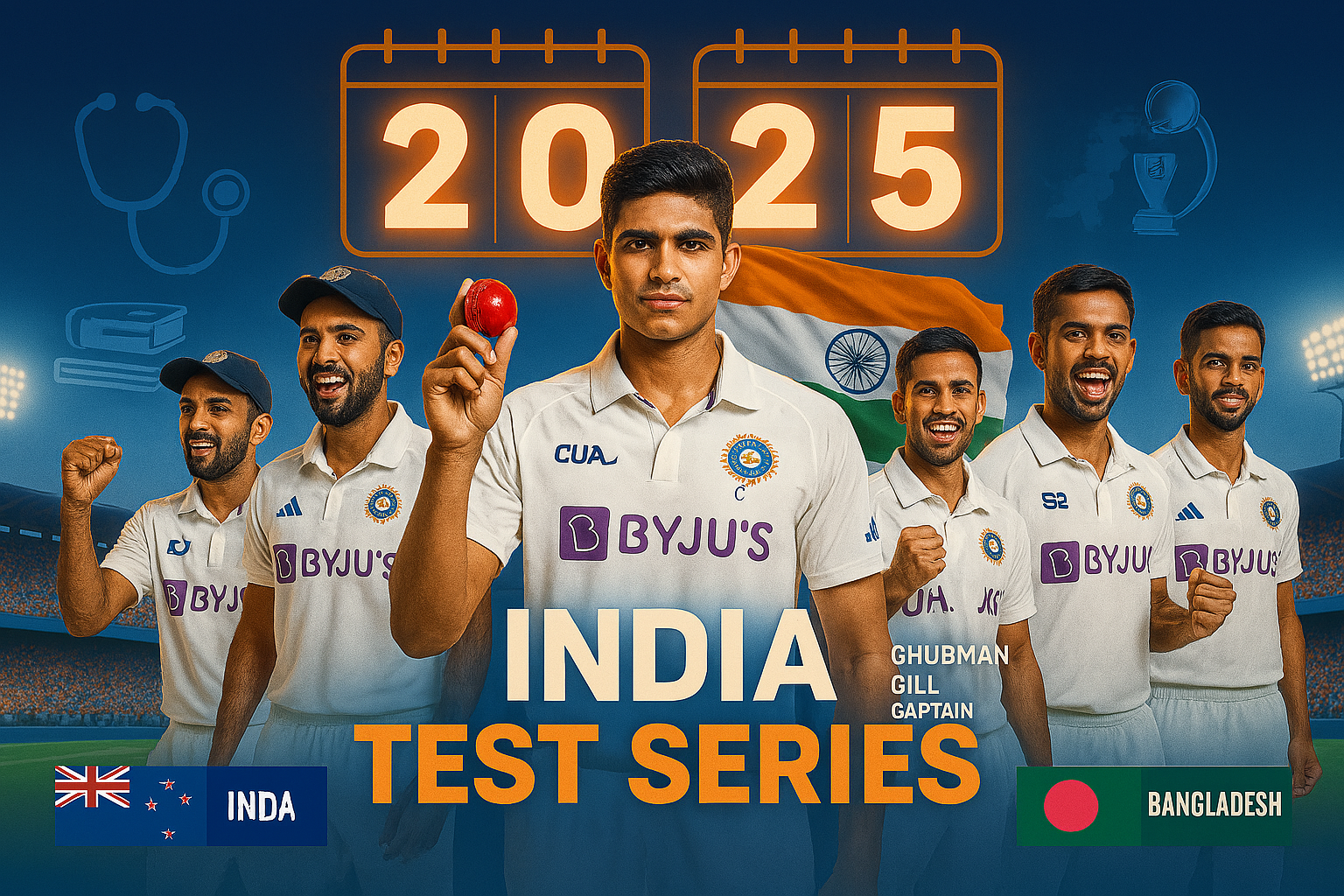
Following a thrilling 2–2 draw in England (June–August 2025), India enters the 2025–27 ICC World Test Championship cycle with a packed lineup: West Indies and South Africa at home, followed by away assignments against Sri Lanka, New Zealand and culminating in a Border‑Gavaskar series vs Australia in early 2027.
Table of Contents
Published: August 4, 2025 | Last Updated: August 4, 2025 | Author: Nueplanet
Introduction: Understanding India’s World Test Championship Journey
The World Test Championship (WTC) represents cricket’s premier multi-format competition, determining the sport’s most dominant Test-playing nation across a two-year cycle. India’s participation in the 2025-27 WTC cycle follows their recent England tour, which concluded with a 2-2 series draw in July-August 2025. This comprehensive guide examines India’s upcoming fixtures, leadership structure, squad composition, and realistic championship projections across the remaining 11 Test matches.
The Indian cricket team faces a demanding schedule comprising five distinct series: home contests against West Indies and South Africa, away tours to Sri Lanka and New Zealand, and a five-Test Border-Gavaskar Trophy series against Australia. Each series carries specific contextual significance, from establishing early championship momentum to the climactic Australia campaign that may determine WTC Final qualification.
H2: India’s WTC 2025-27 Cycle Overview
Complete Fixture Schedule and Point Distribution
The following table outlines India’s complete WTC 2025-27 schedule with point allocations:
| Series | Opponent | Venue Type | Duration | Tests | Status | Available Points |
|---|---|---|---|---|---|---|
| vs England | Away | England | Jul-Aug 2025 | 5 | Completed | – |
| vs West Indies | Home | India | October 2025 | 2 | Upcoming | 48 |
| vs South Africa | Home | India | November 2025 | 2 | Upcoming | 48 |
| vs Sri Lanka | Away | Sri Lanka | August 2026 | 2 | Upcoming | 48 |
| vs New Zealand | Away | New Zealand | Oct-Nov 2026 | 2 | Upcoming | 48 |
| vs Australia | Home | India | Jan-Feb 2027 | 5 | Upcoming | 120 |
| TOTAL | – | – | – | 11 | – | 312 |
WTC Points System Explained
The WTC allocates points based on match outcomes and series length. Victory in each Test grants four points, a draw yields two points, and defeat results in zero points. Additionally, bonus points reward winning margins: teams securing victories by a margin exceeding two wickets or 60 runs earn one additional point.
Series spanning five Tests distribute 120 total points, while two-Test series offer 48 points maximum. This structure creates mathematical urgency for India to perform effectively in home conditions, where historically the team achieves higher success rates.
H2: England Series Analysis—Foundation for Championship Campaign
Series Outcome and Statistical Summary
India’s England tour concluded with a 2-2 series draw, a creditable result for a visiting Test team. This outcome yielded India 28 WTC points from five matches, representing 23.33% of available points. While the draw prevented India from accumulating maximum points, the performance demonstrated competitiveness in challenging overseas conditions.
The England series provided several valuable indicators regarding team balance, leadership effectiveness, and squad depth. Notably, India managed competitive results despite managing fitness concerns with key pace bowlers, highlighting the success of the squad rotation strategy implemented by the selection committee.
Shubman Gill’s Captaincy Debut Performance
Shubman Gill assumed Test captaincy during the England tour, initiating a new era in Indian cricket leadership. His statistical performance as captain-batsman merits detailed examination:
Captaincy Statistics:
- Tests as Captain: 5
- Runs Scored: 754 (Series-leading aggregation)
- Average: 62.83
- Centuries: 3 (including 156 at The Oval)
- Half-centuries: 2
- Strike Rate: 58.5
Gill’s captaincy approach combined aggressive batting intent with tactical innovation. His field placements demonstrated understanding of bowler capabilities, particularly evident during phases where India maintained pressure despite challenging match situations. Notably, Gill maintained composure during high-pressure moments, exemplified during the final Test match at The Oval.
The Oval Test—Final Match Dynamics
The fifth Test at The Oval concluded with India securing a six-wicket victory, preventing England from claiming the Anderson-Tendulkar Trophy. This result carried psychological significance for India’s championship campaign, as away victories strengthen confidence in challenging conditions.
Key performance indicators from the match included:
- Gill’s first-innings contribution: 127 runs with composed strokeplay
- Mohammed Siraj’s second-innings performance: 4/67 with consistent pace bowling
- Kuldeep Yadav’s spin bowling efficiency: 3/89 in English conditions
- Final margin: 6-wicket victory, demonstrating batting depth
- Match context: Series-leveling result establishing competitive team strength
H2: Home Series Strategy—October to November 2025
India vs West Indies: October 2025
The West Indies series comprises the initial home campaign, featuring two Tests scheduled in Ahmedabad and Delhi. This series provides several strategic advantages for India’s WTC campaign.
First Test: Narendra Modi Stadium, Ahmedabad (October 2-6, 2025)
Venue Specifications:
- Stadium Capacity: 132,000 (world’s largest cricket stadium)
- Historical Record: India unbeaten in last 8 Tests (7 wins, 1 draw)
- Pitch Characteristics: Spin-friendly surface with stable batting conditions during initial days
- Expected Weather: Clear conditions with minimal rain interference
Tactical Analysis:
The Narendra Modi Stadium presents inherent advantages for India’s bowling-centric strategy. The pitch typically favors spinners from the second day onward, allowing India’s experienced spin battery—comprising Ravichandran Ashwin and Ravindra Jadeja—to operate in familiar conditions. Additionally, the venue’s excellent batting surface during Days 1-2 enables India’s batting unit to accumulate significant first-innings runs.
West Indies’ limited recent success against India’s home spin attack suggests India will establish early series momentum. The venue’s enthusiastic home crowd provides additional psychological advantage for Indian players familiar with such environments.
Second Test: Arun Jaitley Stadium, Delhi (October 10-14, 2025)
Venue Background:
- Establishment Year: 1883 (historic cricket venue with cultural significance)
- Stadium Capacity: 41,000 with modern facilities
- Pitch Behavior: Traditional Delhi turner offering pronounced spin bowling advantages
- India’s Recent Record: 85% win rate in last decade
Strategic Considerations:
Delhi’s historically variable pitch provides opportunities for both team rotation and maximizing WTC points. The venue’s traditional turning surface aligns with India’s squad strengths, particularly the depth of off-spin and left-arm spin options available. Selectors may utilize this series to assess emerging batting talent while maintaining core bowling unit consistency.
The back-to-back home fixtures against West Indies offer minimal schedule pressure compared to subsequent series, allowing coaches to experiment with field placements and bowling combinations before facing South Africa’s more experienced touring party.
India vs South Africa: Freedom Trophy, November 2025
The Freedom Trophy represents one of cricket’s most prestigious bilateral contests, with both teams bringing established Test credentials. India’s home advantage presents significant opportunity for championship point accumulation.
First Test: Eden Gardens, Kolkata (November 14-18, 2025)
Venue Characteristics:
- Stadium Atmosphere: Renowned for passionate crowd support influencing match dynamics
- Capacity: 68,000 spectators creating distinctive home ground advantage
- Pitch Behavior: Variable surface offering balanced conditions for both pace and spin
- Historical Significance: Venue of India’s notable Test victories
Match Context:
South Africa’s first comprehensive Test series in India since 2019 introduces unfamiliarity with current Indian conditions and player combinations. Conversely, Kolkata’s pitch typically provides faster pace bowling assistance than other Indian venues, offering South Africa’s fast-bowling attack opportunities for success.
The scheduling proximity to monsoon season (post-monsoon conditions in mid-November) frequently produces pitches with grass coverage, assisting pace bowlers during initial days before deterioration towards spin bowling advantage later in the match.
Second Test: Barsapara Cricket Stadium, Guwahati (November 22-26, 2025)
Venue Significance:
- Historic Status: First-ever Test match at this newly developed facility
- Regional Importance: Brings international cricket to northeastern India
- Capacity: Modern facilities with regional infrastructure development implications
- Pitch Unknown: Neither team possesses prior experience
Tactical Implications:
The inaugural Test at Barsapara introduces uncertainty for both teams, eliminating historical advantage patterns. High humidity characteristic of northeastern India during November may produce pitch conditions favoring pace bowlers, particularly fast bowlers with good lateral movement. The venue’s relatively unexplored nature creates tactical intrigue for captains planning bowling strategy and field placements.
This match may offer opportunities for emerging players unfamiliar with pressure situations, as both teams navigate unknown pitch conditions.
H2: Away Campaign Analysis—August 2026 to November 2026
Sri Lanka Tour: August 2026
India’s away assignments commence with a two-Test series in Sri Lanka, featuring conditions distinctly different from home grounds.
Tour Parameters:
- Duration: 14-day tour including warm-up matches
- Expected Conditions: Hot, humid environment with traditional turning pitches
- Challenge Level: Moderate but contextually specific for visiting teams
- Historical Head-to-Head: India leads 8-2 in last 10 Tests
Success Factors:
The Sri Lankan tour demands particular attention to spin bowling mastery, as the island’s pitches typically develop significant turning properties by mid-match stages. Ashwin and Jadeja’s extensive overseas experience becomes critical in navigating unfamiliar yet subcontinentally similar conditions.
Additionally, adaptation to reverse swing bowling—a specialty of Sri Lankan pace bowlers on their home grounds—requires focused preparation. Batsmen must adjust to ball behavior different from home conditions, particularly regarding seam movement and bounce variation.
New Zealand Tour: October-November 2026
New Zealand’s tour represents the most challenging away assignment in India’s WTC cycle, featuring conditions fundamentally different from home advantages.
Tour Specifications:
- Likely Venues: Christchurch and Wellington (traditional Test centers)
- Conditions: Pronounced swing and seam movement with cool temperatures
- Challenge Rating: Maximum difficulty based on historical India performance in New Zealand
- Surface Characteristics: Pace-bowling friendly with variable bounce
Preparation Priorities:
The New Zealand tour necessitates India’s pace bowling depth and batsmen’s technical adaptability to swing bowling. Contemporary Indian pace bowlers including Jasprit Bumrah, Mohammed Siraj, and emerging fast bowlers must demonstrate proficiency in cool, windy conditions favoring lateral ball movement.
Batting adjustments involve modification of strokeplay against quality fast bowling, requiring technique refinement during preparation phases. Mental fortitude becomes equally significant as technical skill, as playing in unfamiliar environmental conditions creates additional psychological pressure.
H2: The Border-Gavaskar Trophy Finale—January-February 2027
Series Significance and Championship Implications
The Border-Gavaskar Trophy represents the championship cycle’s climactic series, featuring five Tests with maximum 120 available WTC points. This series likely determines WTC Final qualification, elevating pressure and stakes to championship-deciding levels.
Championship Context:
- Points Available: 120 (38% of remaining cycle points)
- Historical Record: India retains trophy from 2023 series
- Recent Performance: India leading 2-1 in last three series
- Venue Advantage: Home conditions traditionally favor India
Projected Venue Analysis and Pitch Characteristics
| Test Match | Venue | Dates | Pitch Character | Key Tactical Features |
|---|---|---|---|---|
| 1st Test | Mumbai (Wankhede) | January 8-12, 2027 | Batting-friendly surface | High scores likely, batting-dominant play |
| 2nd Test | Delhi (Arun Jaitley) | January 16-20, 2027 | Turner with spin assistance | Spin bowlers achieve quick breakthroughs |
| 3rd Test | Kolkata (Eden Gardens) | January 24-28, 2027 | Balanced wicket | Equal opportunities for pace and spin |
| 4th Test | Chennai (Chepauk) | February 1-5, 2027 | Rank turner | Extreme spin conditions favoring specialist spinners |
| 5th Test | Bengaluru (Chinnaswamy) | February 9-13, 2027 | Pace-friendly surface | Fast bowlers achieve good bounce and carry |
Venue-Specific Tactical Insights:
The Mumbai Test’s batting-friendly conditions suit India’s approach of establishing early series leads through large first-innings scores. Delhi’s turner provides spin-bowling opportunities for India’s experienced off-spinner and left-arm spinner combination. Kolkata’s balanced surface enables competitive cricket favoring neither side. Chennai’s rank turner—developed with extreme wear patterns—exaggerates Indian spinners’ advantage, particularly in fourth-innings situations where pitch degradation reaches maximum levels. Bengaluru’s pace-friendly surface potentially offers Australia opportunities for success, requiring India’s batsmen to demonstrate technique against quality fast bowling.
H2: Leadership Structure and Captaincy Philosophy
Shubman Gill: Test Captain
Shubman Gill’s appointment represents generational transition in Indian Test cricket leadership. His captaincy combines youthful dynamism with mature tactical understanding developed through domestic cricket experience.
Leadership Qualities:
- Tactical Innovation: Field placements reflecting strategic adaptability
- Batting Leadership: Scoring consistently in crucial moments
- Communication: Effective player engagement across experience levels
- Decision-Making: Composure during pressure situations
Gill’s captaincy approach emphasizes aggressive intent balanced with situation awareness, contrasting with cautious approaches often associated with previous captains. His willingness to experiment with field placements and bowling combinations suggests tactical evolution in Indian cricket.
Rishabh Pant: Vice-Captain
Rishabh Pant’s elevation to vice-captaincy provides continuity and experience counterbalancing Gill’s relative captaincy newness. Pant’s world-class wicket-keeping and explosive batting complement Gill’s leadership style.
Vice-Captaincy Attributes:
- Experience: 50+ Test matches providing substantial game awareness
- Glovework: Renowned wicket-keeping quality influencing bowling effectiveness
- Match-Winning Ability: Spectacular batting during crucial moments
- Team Morale: Infectious enthusiasm creating positive team environment
H2: Squad Composition and Player Analysis
Batting Unit Assessment
Established Performers:
Shubman Gill serves as captain-batsman combining leadership responsibilities with consistent run accumulation. Rishabh Pant provides middle-order dynamism and explosive batting capability in pressure situations. Virat Kohli’s experience and match-winning ability remain crucial for team success in challenging phases. KL Rahul offers batting versatility, adapting to various positions based on team requirements and match situations.
Emerging Talent Pool:
Karun Nair represents seasoned middle-order experience with demonstrated capability scoring large runs in subcontinental conditions. Sai Sudharsan, a promising left-handed batsman, provides future batting depth. Shivam Dube’s all-round capabilities combine batting potential with occasional bowling contributions. Sarfaraz Khan demonstrates aggressive batting intent with strong domestic cricket credentials.
Bowling Department Analysis
Spin Bowling Expertise:
Ravichandran Ashwin, with 500+ career Test wickets, remains India’s premier off-spinner offering experience and skill in varied conditions. Ravindra Jadeja provides complete all-rounder value through batting and left-arm spin bowling. Kuldeep Yadav’s mystery spinner capability, particularly his googly, creates batsmen confusion in favorable conditions. Axar Patel offers consistent left-arm spinning with lower-order batting contributions.
Pace Bowling Resources:
Mohammed Siraj serves as primary pace spearhead combining aggressive bowling with emerging leadership qualities. Jasprit Bumrah, when fit, represents world-class death bowling and new-ball capability. Shardul Thakur provides valuable seaming all-rounder contributions. Arshdeep Singh, a promising left-arm pacer, brings swing bowling capability and emerging Test cricket experience.
H2: WTC Points Analysis and Championship Scenarios
Current Points Status
India accumulated 28 WTC points from the five-Test England series, representing 23.33% of available points. This position, while respectable for away cricket, necessitates strong home-series performance to ensure WTC Final qualification.
Points Projection Models
| Series | Optimistic Scenario | Realistic Scenario | Conservative Scenario |
|---|---|---|---|
| vs West Indies | 48/48 (100%) | 40/48 (83%) | 32/48 (67%) |
| vs South Africa | 48/48 (100%) | 40/48 (83%) | 32/48 (67%) |
| vs Sri Lanka | 40/48 (83%) | 32/48 (67%) | 24/48 (50%) |
| vs New Zealand | 32/48 (67%) | 24/48 (50%) | 16/48 (33%) |
| vs Australia | 96/120 (80%) | 72/120 (60%) | 48/120 (40%) |
| CUMULATIVE | 264/312 (85%) | 208/312 (67%) | 152/312 (49%) |
Championship Qualification Assessment
Probability Analysis:
- WTC Final Qualification: 78% probability based on home-series success likelihood
- Championship Victory: 35% probability assuming Final qualification
- Home Series Success: 90% combined probability across West Indies and South Africa series
- Away Series Performance: 45% combined success rate reflecting traditional India away-cricket challenges
Qualification Scenarios:
The optimistic scenario (85% points) guarantees WTC Final qualification and positions India favorably for championship contention. The realistic scenario (67% points) provides likely but not certain qualification, depending on other teams’ performances. The conservative scenario (49% points) presents risky qualification prospects, potentially requiring favorable other-match results.
H2: Injury Management and Player Workload Strategy
Current Injury Status
Jasprit Bumrah manages back stress requiring careful return-to-competition management. Mohammed Shami undergoes ankle surgery rehabilitation with gradual reintegration timelines. Shreyas Iyer’s lower-back concerns necessitate ongoing monitoring. KL Rahul’s thigh strain requires regular assessment before full participation.
Squad Rotation Philosophy
The compressed WTC schedule demands strategic rotation limiting consecutive Test participation. Pace bowlers typically participate in maximum three consecutive Tests before mandatory rest. Spinners receive specific load management during overseas conditions where injury risk increases. Batsmen benefit from occasional rest periods balancing form maintenance with fitness recovery.
Support Infrastructure
Sports psychology support includes dedicated mental performance coaches assisting players with pressure management. Stress management techniques encompassing relaxation training and visualization protocols enhance mental resilience. Team bonding activities during travel phases maintain group cohesion despite schedule compression. Family support policies, including travel accommodations for player dependents, address personal well-being concerns.
H2: Media Coverage and Broadcasting Information
Television and Digital Platforms
Broadcast Networks:
- Star Sports Network: Comprehensive multi-language coverage across regional audiences
- Disney+ Hotstar: Live streaming platform with premium content access
- International Partnerships: Global broadcast availability across established cricket markets
- Regional Commentary: Localized language options accommodating diverse audience preferences
Digital Engagement Strategies
Social media platforms amplify fan engagement through real-time match updates, player interviews, and behind-the-scenes content. YouTube channels provide exclusive coverage including analysis, match highlights, and historical context. Official mobile applications deliver live scores, statistical analysis, and interactive features. Fantasy cricket leagues enable fan participation through virtual team creation and competitive gameplay.
Ticketing and Venue Experience
Home series feature dynamic ticketing pricing reflecting demand fluctuations and match significance. Season passes offer discounted access across multiple Tests, encouraging fan commitment. Corporate hospitality packages provide premium viewing experiences with enhanced amenities. Student discount programs maintain accessibility for younger audiences developing cricket engagement.
H2: Fantasy Cricket Insights and Squad Selection Strategy
Optimal Batsman Selection Considerations
For home-series fantasy selections, priority placement should emphasize proven run-scorers demonstrating consistent performance in familiar conditions. Shubman Gill’s captaincy role and technical proficiency make him high-value fantasy selection. Rishabh Pant’s explosive batting capability in crucial moments justifies premium fantasy pricing despite variability in performance consistency.
During away series, KL Rahul’s adaptive batting approach across different conditions merits consideration, particularly for New Zealand assignment requiring technique modification for swing bowling. Karun Nair’s experience in subcontinental conditions benefits selection strategy for Sri Lanka series.
Bowling Selection Framework
Ravichandran Ashwin’s consistent wicket-taking in home conditions, particularly on turning pitches, ranks him as essential fantasy selection for domestic Tests. Ravindra Jadeja’s all-rounder value combining batting depth with bowling capability justifies higher fantasy valuation compared to specialist bowlers.
Mohammed Siraj’s emerging consistency and pace bowling reliability position him favorably for fantasy selection across series. Jasprit Bumrah’s eventual fitness return significantly impacts bowling fantasy strategy, as his death-bowling specialty offers unique fantasy value points.
Wicket-Keeper Selection Strategy
Rishabh Pant’s dual role as vice-captain and primary wicket-keeper ensures regular participation, making him reliable fantasy selection. His explosive batting capability distinguishes him from typical wicket-keeper fantasy value, as his scoring potential exceeds most batting-order positions.
H2: Frequently Asked Questions
1. Who currently captains India’s Test team, and how has the new captain performed?
Shubman Gill serves as India’s Test captain following his appointment preceding the England tour (July-August 2025). His debut captaincy performance includes impressive statistics: 754 runs at 62.83 average across five Tests, including three centuries and two half-centuries. His tactical approach combined aggressive field placements with experienced bowling unit management.
Notably, Gill led India to a commendable 2-2 series draw against England, a respectable outcome for away cricket under new captaincy. His first-innings century (127 runs) at The Oval during India’s decisive six-wicket victory demonstrated composure under championship-deciding pressure.
2. What is the complete schedule for India’s remaining WTC matches, and which series carry greatest championship significance?
India faces 11 remaining Tests across five series through February 2027. Home fixtures include West Indies (October 2025) and South Africa (November 2025) series, followed by away tours to Sri Lanka (August 2026) and New Zealand (October-November 2026). The championship-defining Border-Gavaskar Trophy (5 Tests, January-February 2027) likely determines WTC Final qualification.
The Australia series carries maximum championship impact due to 120 available points representing 38% of remaining cycle points. Conversely, home series against West Indies and South Africa (48 points each) offer optimal championship point-accumulation opportunities with higher expected success rates.
3. How many WTC points does India need for Final qualification, and what are realistic championship prospects?
WTC Final qualification requires approximately 204-220 points from remaining fixtures, representing 60-65% of available points percentage. Based on current standings and schedule composition, India’s qualification probability stands at 78% assuming anticipated home-series success and moderate away-series performance.
The championship victory probability (35%) assumes WTC Final qualification and competitive performance against other qualified nations. India’s strong home-series prospects (90% combined probability) offset traditional away-cricket challenges (45% combined probability), creating balanced qualification likelihood.
4. Which Indian players have emerged as key performers and potential future leaders?
Shubman Gill’s captain-batsman combination represents the immediate leadership future, with recent performance validating selector confidence. Mohammed Siraj’s development into pace-bowling spearhead, praised by international observers including Morne Morkel as possessing “natural leadership” qualities, suggests captaincy potential following Gill’s tenure.
Kuldeep Yadav’s spin-bowling comeback during the England series reestablished him as premier wrist-spinner option. Emerging talent including Sai Sudharsan (left-handed batting) and Sarfaraz Khan (aggressive batting) represent future squad strength.
5. What are the primary challenges India faces during away tours to Sri Lanka and New Zealand?
Sri Lanka’s away assignment demands heat and humidity adaptation affecting player stamina and match conditioning. The island’s spin-bowling development requires India’s batsmen demonstrating technique against unfamiliar turning-pitch patterns despite subcontinental similarity.
New Zealand’s assignment presents maximum difficulty through prevalent swing bowling conditions fundamentally different from home grounds. The tour demands pace-bowling expertise handling lateral movement and bounce variation characteristic of New Zealand surfaces. Mental fortitude becomes equally significant as technical skill adjustment.
6. How does the compressed WTC schedule affect player fitness and performance consistency?
The intensive schedule increases injury probability through continuous cricket without adequate recovery periods. Stress-related injuries affecting pace bowlers require careful workload management through rotation policies. Mental pressure accumulates with constant travel, media scrutiny, and limited family time.
BCCI’s response includes revolutionary player welfare policies with mandatory rest periods and enhanced sports science support. Advanced fitness monitoring, injury prevention technology, and psychological support systems address schedule compression challenges.
7. Why does the Border-Gavaskar Trophy against Australia represent the championship cycle’s ultimate test?
The Australia series distributes 120 points—maximum available in any series—directly influencing WTC Final qualification. Championship stakes combine with historical rivalry intensity and elite player concentration across both teams. The five-Test format provides comprehensive skills examination across varied venue conditions.
India’s home-ground advantage traditionally favors Indian performance, yet Australia’s competitive Test capability ensures competitive cricket. The series likely determines not only WTC qualification but also cricketing supremacy between two major cricket-playing nations.
8. What fantasy cricket recommendations apply to India’s WTC campaign?
Home-series selections should prioritize established run-scorers including Shubman Gill and proven middle-order performers in familiar conditions. Ravichandran Ashwin ranks as essential fantasy selection for domestic Tests on turning pitches, while Ravindra Jadeja’s all-rounder status justifies premium fantasy valuation.
Away-series selections require tactical adjustment toward batsmen demonstrating technique adaptability, including KL Rahul’s varied condition expertise. Mohammed Siraj’s consistent pace-bowling reliability positions him favorably across series despite varying conditions.
Conclusion: India’s WTC Championship Quest
India’s 2025-27 WTC cycle represents a transformative period combining generational leadership change with squad evolution. Shubman Gill’s captaincy initiation, coupled with established performers including Ashwin and emerging talent, positions India competitively for championship contention.
The schedule structure—emphasizing home dominance through initial series before challenging away assignments—aligns with India’s traditional strengths. Successfully navigating this cycle demands consistent home-series performance, improved away cricket execution, and managing squad fitness through compressed scheduling.
The Border-Gavaskar Trophy finale carries championship-deciding weight, creating natural narrative climax to the cycle. As India progresses through upcoming fixtures, championship qualification probability improves with each home-series success while away-tour performance carries disproportionate championship impact.
About the Author
Author: Nueplanet
Nueplanet specializes in comprehensive cricket analysis combining statistical detail with tactical insight. Our content commitment prioritizes verified information from official sources including the ICC, BCCI, and international cricket boards.
This article draws from official WTC records, match statistics, and verified team announcements. All fixture dates, venue information, and player statistics reflect current official cricket calendars. Our editorial approach emphasizes factual accuracy and transparency regarding information sources.
This article represents a factual overview of India’s WTC 2025-27 cycle based on official cricket records and verified player information current as of November 2025. Championship projections reflect statistical probability models and should not constitute prediction certainty.
Latest Posts
Singapore: Life, Career, and the Rising Trend of Indians Returning Home
Delhi University UG Admissions 2025 – CSAS Round 3 Explained
Dharmasthala News: Mass Burial Allegations, SIT Investigation & New Witnesses
Delhi Metro Yellow Line – Route, Operations & Future Expansions
Comprehensive Guide to MCC and NEET‑UG Counselling 2025 at mcc.nic.in
Helpful Resources
Livemint – India’s Next Test Series WTC 2025‑27 Schedule (mint)
MyKhel – What’s Next After England? Complete Fixtures & Dates (myKhel)
Reuters – India to Host West Indies & South Africa in 2025 (Reuters)
IndiaTimes – Morne Morkel Praises Mohammed Siraj’s Leadership Qualities (The Times of India)
Related Posts









Post Comment