








IBPS Clerk Notification 2025: Complete Guide to 10,277 Vacancies, Pattern & Dates
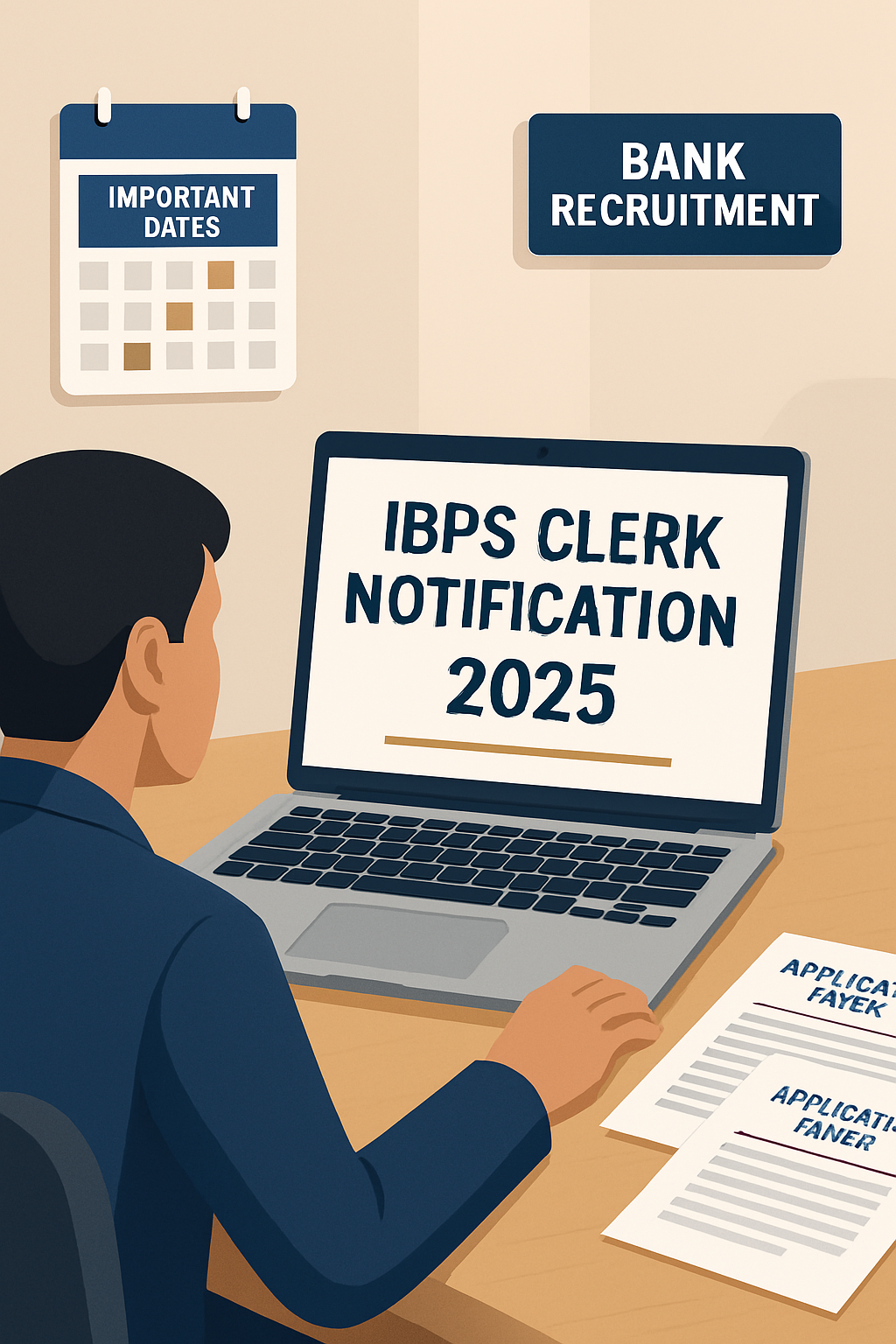
The IBPS Clerk Notification 2025 (CRP CSA‑XV) is out with 10,277 vacancies across 11 public sector banks. Registration opens on 1–21 August 2025, with Prelims in October and Mains in November—read on for eligibility, pattern, syllabus, and application guidance.
Table of Contents
The Institute of Banking Personnel Selection has released the official notification for Clerk recruitment 2025 under the Common Recruitment Process for Clerical Cadre Customer Service Associates (CRP CSA-XV). This recruitment drive offers 10,277 positions across 11 public sector banks in India. The notification was published on 31 July 2025, with the application window opening on 1 August 2025.
This article provides comprehensive information about the IBPS Clerk 2025 recruitment, including eligibility criteria, examination pattern, important dates, syllabus details, and preparation guidance. All information presented here is based on the official IBPS notification and government guidelines.
Overview of IBPS Clerk Recruitment 2025
The IBPS Clerk examination represents a significant opportunity for graduates seeking employment in India’s public sector banking system. The Institute of Banking Personnel Selection conducts this examination annually to fill clerical positions across participating nationalized banks.
The 2025 recruitment cycle designates these positions as Customer Service Associates, reflecting the modern banking environment where clerical staff engage directly with customers. Selected candidates will handle customer queries, process transactions, maintain records, and support various banking operations.
The examination follows a standardized format designed to assess candidates’ aptitude, reasoning skills, language proficiency, and awareness of current affairs. Understanding the complete examination structure helps candidates prepare effectively.
About the Institute of Banking Personnel Selection
The Institute of Banking Personnel Selection functions as an autonomous body established in 1975 under the Ministry of Finance. The organization conducts recruitment examinations for clerical and officer-level positions in public sector banks and regional rural banks across India.
IBPS maintains transparent selection procedures and merit-based recruitment standards. The institute’s examinations serve as the primary pathway for candidates seeking careers in nationalized banking institutions. Each year, several hundred thousand candidates participate in IBPS examinations.
The organization coordinates with participating banks to determine vacancy requirements and conducts centralized examinations. This standardized approach ensures uniformity in the selection process across different banking institutions.
Important Dates for IBPS Clerk 2025
Candidates must track all critical dates to ensure timely completion of application procedures and examination preparation. Missing any deadline can result in disqualification from the recruitment process.
Complete Timeline
| Event | Date/Period |
|---|---|
| Official Notification Publication | 31 July 2025 |
| Application Registration Opens | 1 August 2025 |
| Last Date for Application Submission | 21 August 2025 |
| Application Fee Payment Deadline | 21 August 2025 |
| Preliminary Exam Admit Card Release | September 2025 (Expected) |
| Preliminary Examination Dates | 4, 5, 11 October 2025 |
| Preliminary Exam Results | October 2025 (Expected) |
| Main Examination Date | 29 November 2025 |
| Main Exam Results | December 2025 (Expected) |
| Provisional Allotment | January-February 2026 (Expected) |
The application window remains open for 21 days. Candidates should complete their applications several days before the deadline to avoid technical issues or payment gateway problems.
Admit cards for the preliminary examination typically become available two weeks before the examination date. Candidates must download these documents from the official IBPS website using their registration credentials.
Total Vacancies and Distribution
The recruitment notification specifies 10,277 clerical positions distributed across participating banks and various states. The vacancy allocation considers factors such as regional banking infrastructure, population density, and individual bank requirements.
Participating Banks
Eleven public sector banks participate in this recruitment cycle:
- Bank of Baroda
- Bank of India
- Bank of Maharashtra
- Canara Bank
- Central Bank of India
- Indian Bank
- Indian Overseas Bank
- Punjab & Sind Bank
- Punjab National Bank
- UCO Bank
- Union Bank of India
State Bank of India conducts independent recruitment and does not participate in the IBPS Common Recruitment Process.
State-wise Vacancy Pattern
Vacancy distribution varies significantly across states. States with larger populations and extensive banking networks typically receive higher allocations. Some approximate distributions include:
- Uttar Pradesh receives approximately 1,315 positions
- Maharashtra accounts for roughly 1,117 vacancies
- Karnataka has approximately 1,170 openings
- Gujarat includes around 753 positions
- West Bengal contains about 685 vacancies
Smaller states and union territories receive proportionately fewer allocations based on banking requirements and infrastructure.
Category-wise Reservation
Vacancies follow Government of India reservation policies:
- Unreserved/General category: 40-42%
- Other Backward Classes (Non-Creamy Layer): 27%
- Scheduled Caste: 15%
- Scheduled Tribe: 7.5%
- Economically Weaker Section: 10%
- Persons with Benchmark Disabilities: Horizontal reservation across categories
The official notification provides detailed category-wise breakdowns for each state and participating bank.
Eligibility Criteria
Candidates must meet specific requirements related to educational qualifications, age limits, nationality, and language proficiency. Understanding these criteria ensures candidates apply appropriately.
Educational Qualifications
Applicants must possess a bachelor’s degree in any discipline from a recognized university. The degree must be from an institution recognized by the Government of India or equivalent as per Central Government standards.
The educational qualification must be completed with final results declared on or before the registration date. Candidates awaiting results or with pending examinations cannot apply. All semester examinations must be completed for semester-based degree programs.
Professional qualifications equivalent to bachelor’s degrees are acceptable if recognized by government authorities. Candidates with foreign degrees must provide equivalence certificates from the Association of Indian Universities.
Age Requirements
Candidates must be between 20 and 28 years of age as calculated on 1 August 2025. This means:
- Minimum age requirement: Born not later than 1 August 2005
- Maximum age requirement: Born not earlier than 1 August 1997
Age Relaxation Provisions
Government regulations provide age relaxations for specific categories:
| Category | Relaxation Period | Effective Maximum Age |
|---|---|---|
| Scheduled Caste/Scheduled Tribe | 5 years | 33 years |
| Other Backward Classes (NCL) | 3 years | 31 years |
| Economically Weaker Section | As per norms | Varies |
| Persons with Benchmark Disabilities | 10 years | 38 years |
| PwBD + SC/ST | 15 years | 43 years |
| Ex-Servicemen | Service period + 3 years | Up to 48 years |
| Widows/Divorced Women | 9 years | Up to 35 years |
Candidates claiming age relaxation must provide valid certificates from competent authorities during document verification.
Language Proficiency
Clerical positions require proficiency in the official language of the state or union territory where candidates will work. This requirement exists because bank clerks interact extensively with customers and maintain documentation in regional languages.
Candidates must demonstrate the ability to read, write, and speak the local language. A Local Language Proficiency Test (LLPT) verifies this capability before final appointment. Basic computer knowledge is also required for all candidates.
Nationality Requirements
Indian citizens are eligible to apply. Additionally, the following categories may apply:
- Subjects of Nepal
- Subjects of Bhutan
- Tibetan refugees who entered India before 1 January 1962
- Persons of Indian origin from Pakistan, Burma, Sri Lanka, East African countries, or Vietnam
Categories other than Indian citizens must obtain eligibility certificates from the Government of India.
Application Process
The application submission occurs entirely online through the official IBPS website. Candidates must complete several steps carefully to ensure successful registration.
Step-by-Step Registration Guide
Initial Registration:
Visit the official IBPS website at www.ibps.in. Locate the CRP Clerk XV notification section. Click the “Apply Online” option to access the registration portal.
Provide basic information including your name, email address, and mobile number. The system generates a unique registration number and password. These credentials arrive via email and SMS. Save this information securely for future access.
Application Form Completion:
Log into the application portal using your registration credentials. The form contains multiple sections requiring accurate information.
Personal Details Section requires your name exactly as shown on graduation certificates, date of birth, parent names, gender, category, and nationality information.
Contact Information section needs your current address, permanent address, email, and mobile number. All official communications use these contact details.
Educational Qualifications section requires degree details including university name, year of completion, percentage or CGPA, and roll number. Keep certificates available for accurate data entry.
Category and Reservation Details determine age relaxation and fee structure. Select your category carefully, as incorrect information leads to disqualification.
Document Upload Requirements
Candidates must upload scanned documents meeting specific technical specifications:
Photograph Requirements:
- Recent passport-sized color photograph
- Dimensions: 4.5 cm × 3.5 cm
- Light background
- File size: 20-50 KB
- Format: JPG/JPEG
Signature Requirements:
- Signed with black ink pen on white paper
- File size: 10-20 KB
- Format: JPG/JPEG
Left Thumb Impression:
- Clear scan of left thumb
- File size: 20-50 KB
- Format: JPG/JPEG
Handwritten Declaration:
- Download format from IBPS website
- Write in your handwriting on white paper
- Scan the document
- File size: 50-100 KB
- Format: JPG/JPEG
Documents not meeting specifications may result in application rejection. Verify all uploads before final submission.
Application Fee Structure
The fee varies by category:
General, EWS, and OBC candidates: ₹850 (including GST)
This amount covers examination fees for both preliminary and main examinations.
SC, ST, and PwBD candidates: ₹175 (including GST)
This represents intimation charges only. These categories receive fee exemptions per government policy.
Payment Methods
Accepted payment options include:
- Debit cards (RuPay, Visa, MasterCard, Maestro)
- Credit cards (Visa, MasterCard, American Express)
- Net banking from major banks
- UPI payments
Complete payment by 21 August 2025. After successful payment, save the transaction reference number and payment confirmation. The fee is non-refundable under any circumstances.
Final Submission
Review the entire application thoroughly before final submission. No changes are possible after submission. Download and print:
- System-generated application form
- Payment receipt
- Registration confirmation
Store these documents securely for examination and verification stages.
Examination Pattern and Structure
The IBPS Clerk 2025 examination consists of two stages: Preliminary Examination and Main Examination. Both stages use computer-based testing formats.
Preliminary Examination Details
The preliminary examination functions as a qualifying test. Candidates who clear this stage proceed to the main examination.
| Section | Questions | Marks | Time Limit |
|---|---|---|---|
| English Language | 30 | 30 | 20 minutes |
| Numerical Ability | 35 | 35 | 20 minutes |
| Reasoning Ability | 35 | 35 | 20 minutes |
| Total | 100 | 100 | 60 minutes |
Key Features:
Each section has a separate 20-minute time allocation. Candidates cannot switch between sections during the examination. This sectional timing requires effective time management within each segment.
The examination uses negative marking. Each incorrect answer reduces the score by 0.25 marks. Unattempted questions receive no penalty.
The preliminary examination score does not contribute to final merit ranking. However, candidates must achieve minimum qualifying marks in each section and overall to advance to the main examination.
Questions appear in English and Hindi languages, except for the English Language section. The computer-based format allows candidates to navigate within their assigned section during the allocated time.
Main Examination Details
The main examination determines final selection and merit ranking. This comprehensive test covers broader topics and requires deeper knowledge.
| Section | Questions | Marks | Time Limit |
|---|---|---|---|
| General/Financial Awareness | 50 | 50 | 35 minutes |
| General English | 40 | 40 | 35 minutes |
| Reasoning Ability & Computer Aptitude | 50 | 60 | 45 minutes |
| Quantitative Aptitude | 50 | 50 | 45 minutes |
| Total | 190 | 200 | 160 minutes |
Important Aspects:
The Reasoning Ability & Computer Aptitude section carries 60 marks for 50 questions, giving it higher weightage per question. This section requires thorough preparation in both reasoning concepts and computer fundamentals.
Each section maintains fixed time allocations. Candidates cannot borrow time between sections. This structure requires balanced preparation across all areas.
The main examination score directly determines final merit ranking and bank allotment. Higher scores provide better choices during the selection process.
Negative marking applies uniformly. Each wrong answer deducts 0.25 marks across all sections.
Local Language Proficiency Test
After qualifying the main examination, candidates undergo the Local Language Proficiency Test (LLPT) before receiving provisional allotment.
The LLPT assesses reading, writing, and comprehension abilities in the official language of the candidate’s preferred state. This computer-based test typically contains approximately 50 questions with a 30-minute duration.
The test functions as a qualifying examination. Scores do not affect merit ranking, but candidates must pass to receive allotment. Failure in LLPT results in ineligibility for appointment despite qualifying the main examination.
Some exemptions exist for candidates who studied the concerned language in Class X or graduation. Documentation proving language study must be submitted for exemption consideration.
Detailed Syllabus Breakdown
Understanding the complete syllabus guides effective preparation strategies. Each section covers specific topics requiring focused study.
Preliminary Examination Syllabus
English Language Topics:
Reading Comprehension includes passages from various subjects with questions testing factual understanding, inference ability, and vocabulary knowledge.
Vocabulary topics cover synonyms, antonyms, word meanings, idioms, and phrases commonly used in formal and informal contexts.
Grammar sections test error identification, sentence improvement, and appropriate word usage based on grammatical and contextual requirements.
Verbal Ability includes paragraph jumbles, sentence rearrangement, and cloze test passages requiring logical and grammatical understanding.
Numerical Ability Topics:
Simplification and Approximation problems test calculation speed using BODMAS rules, percentage calculations, and square or cube root estimations.
Number Series questions require identifying patterns and finding missing or incorrect numbers in sequences.
Data Interpretation presents information in tables, bar graphs, line graphs, and pie charts. Questions test analytical ability and calculation accuracy.
Arithmetic topics include percentage, profit and loss, ratio and proportion, simple and compound interest, time-speed-distance relationships, and time-work problems.
Reasoning Ability Topics:
Puzzles form a significant portion, including linear seating arrangements, circular arrangements, rectangular seating, floor-based puzzles, and scheduling problems.
Syllogism questions use statement-conclusion formats requiring logical deduction using Venn diagram approaches.
Inequality problems test ability to determine relationships between quantities using coded inequality statements.
Coding-Decoding includes letter shifting patterns, mixed letter-number codes, and symbol substitution problems.
Additional topics cover direction sense, blood relations, order and ranking, and alphanumeric series patterns.
Main Examination Syllabus
General/Financial Awareness:
Current Affairs coverage includes national and international events from the preceding six months, with emphasis on banking and financial sector developments.
Banking Awareness topics cover banking terminology, products, services, innovations, and digital banking initiatives.
Financial Markets sections include stock market basics, mutual funds, insurance sector developments, Reserve Bank of India policies, and monetary policy concepts.
Economic Terms encompass GDP, inflation measures, fiscal deficit, balance of payments, and major government economic schemes.
Static General Knowledge includes important days, organizational headquarters, international currencies, and national capitals.
Recent Awards and Honors in various fields require current awareness.
Government Schemes particularly focus on financial inclusion initiatives, digital India programs, and banking sector reforms.
General English:
All preliminary examination topics appear with increased complexity. Reading comprehension passages become longer and more nuanced.
Error Detection questions test grammatical, contextual, and spelling accuracy.
Phrase Replacement identifies incorrect phrases requiring correction for clarity and accuracy.
Sentence Improvement questions test ability to enhance sentence construction while maintaining meaning.
Advanced vocabulary includes contextual usage of synonyms and antonyms in complex sentences.
Reasoning Ability & Computer Aptitude:
Reasoning Component includes advanced puzzles with multiple variables, input-output sequences based on defined rules, data sufficiency questions, and complex syllogisms.
Computer Aptitude Component covers:
Computer Fundamentals including generations, hardware components, software types, and input-output devices.
MS Office basics encompassing Word, Excel, and PowerPoint functionalities.
Internet and Email concepts including web browsers, search engines, and email protocols.
Networking fundamentals covering LAN, WAN, internet protocols, and basic security concepts.
Computer Abbreviations commonly used in technology contexts.
Database Concepts providing basic DBMS understanding.
Computer Security including viruses, malware, firewalls, and protection methods.
Banking Technology specifically addresses core banking solutions, ATM operations, NEFT, RTGS, IMPS, and UPI systems.
Quantitative Aptitude:
All preliminary topics appear with increased difficulty levels. Advanced Data Interpretation includes mixed graph formats, caselet-based problems, and comparative analysis questions.
Data Sufficiency questions test ability to determine whether provided information adequately solves problems.
Advanced Arithmetic covers complex problems in mixtures, partnerships, stocks and shares, and business mathematics.
Mensuration topics include area and volume calculations for two-dimensional and three-dimensional shapes.
Basic Probability concepts and applications appear in the syllabus.
Expected Cut-off Marks
Cut-off marks vary based on examination difficulty, number of applicants, vacancy numbers, and normalization procedures when multiple examination shifts occur.
Preliminary Examination Cut-offs
Expected qualifying marks for different categories:
| Category | Expected Cut-off Range | Expected Sectional Minimum |
|---|---|---|
| General | 72-76 marks | 7-9 per section |
| OBC | 68-72 marks | 7-9 per section |
| SC | 58-62 marks | 6-8 per section |
| ST | 52-56 marks | 5-7 per section |
| EWS | 70-74 marks | 7-9 per section |
| PwBD | 45-52 marks | 5-7 per section |
These ranges represent approximate expectations based on previous year patterns. Actual cut-offs depend on current year examination difficulty and candidate performance.
Candidates must achieve both sectional qualifying marks and overall qualifying marks simultaneously. Strong performance in one section cannot compensate for failing to achieve minimum marks in another section.
Main Examination Cut-offs
Main examination cut-offs typically range higher due to comprehensive syllabus coverage and increased difficulty:
| Category | Expected Cut-off Range |
|---|---|
| General | 115-125 marks |
| OBC | 108-118 marks |
| SC | 95-105 marks |
| ST | 88-98 marks |
| EWS | 112-122 marks |
The main examination score determines final merit ranking. Candidates scoring above minimum qualifying marks receive ranking based on total marks. Higher ranks provide better options during bank and state allotment.
State-wise Cut-off Variations
Competition levels vary across states, affecting cut-off ranges:
States with limited vacancies and high candidate numbers typically see elevated cut-offs. Metropolitan areas like Delhi, Chandigarh, and urban regions of Maharashtra and Karnataka often experience higher competition.
States with larger vacancy allocations relative to candidate numbers may have comparatively lower cut-offs. Understanding these variations helps candidates make strategic state preference decisions.
Preparation Strategy
Effective preparation requires systematic planning, consistent execution, and strategic time management. The following approach provides a structured framework.
Foundation Phase
Begin preparation by assessing current knowledge levels. Take a diagnostic test covering all sections to identify strengths and weaknesses.
Create a comprehensive topic checklist mapping all syllabus areas. This checklist serves as a progress tracker throughout preparation.
Gather quality study materials including standard textbooks for quantitative aptitude and reasoning, grammar reference books for English, current affairs magazines, and previous year question papers.
Focus on understanding fundamental concepts rather than memorizing formulas. Build strong foundations in basic mathematical operations, core grammar rules, fundamental reasoning patterns, and computer terminology.
Topic-wise Learning Phase
Develop a structured daily routine allocating specific time blocks for different subjects:
Morning sessions work well for quantitative aptitude, covering 2-3 topics daily with adequate practice questions.
Afternoon periods suit reasoning ability practice, including puzzle-solving and logical problem work.
Evening hours benefit English language development through newspaper reading, comprehension practice, and grammar exercises.
Night time serves well for current affairs review and note-making.
For each topic, follow this progression: learn theoretical concepts, solve basic difficulty problems, advance to moderate difficulty questions, practice previous year questions, and conduct regular revision.
Speed and Accuracy Development
After completing topic-wise preparation, focus on improving solving speed while maintaining accuracy.
Conduct section-wise practice tests under strict 20-minute time constraints matching preliminary examination conditions.
Attempt full-length preliminary mock tests twice weekly to build examination stamina.
Analyze every mock test thoroughly, identifying mistake patterns, time consumption per question type, and areas requiring additional focus.
Maintain an error analysis journal documenting questions answered incorrectly, reasons for mistakes, important formulas, shortcuts discovered, and personal mistake patterns.
Mock Test Phase
Intensive mock testing phase begins approximately one month before the preliminary examination.
Attempt full-length preliminary mock tests 3-4 times weekly under simulated examination conditions. This includes timed environment, no breaks, and maintaining examination posture.
Track performance systematically using spreadsheets or notebooks. Monitor section-wise scores, overall performance trends, and time management effectiveness.
Target scores should reach approximately 75+ marks for preliminary examination and 130+ marks for main examination practice tests.
Revision Strategy
Regular revision prevents forgetting previously learned material. Implement daily formula revision, weekly comprehensive topic reviews, and focused current affairs revision covering the preceding six months.
Computer awareness requires thorough revision before the main examination given its high weightage relative to questions asked.
Subject-specific Approaches
Quantitative Aptitude:
Focus heavily on Data Interpretation and Simplification topics. These areas offer maximum marks relative to preparation time investment.
Practice mental mathematics daily to improve calculation speed. Learn calculation shortcuts for percentages, square roots, and multiplication.
Solve previous year papers to understand question patterns and difficulty levels.
Reasoning Ability:
Master seating arrangement and puzzle-solving techniques first. These topics constitute 50-60% of reasoning sections.
Develop systematic problem-solving approaches: reading complete problems carefully, listing given information, creating basic frameworks, filling known positions, and using logical deduction for ambiguous cases.
English Language:
Read editorial sections of quality newspapers daily. This single practice improves reading speed, comprehension ability, vocabulary, and grammatical understanding simultaneously.
Maintain a vocabulary diary noting new words with meanings and contextual usage examples.
Practice different question types regularly including reading comprehension, error spotting, and sentence improvement.
General Awareness:
Create monthly current affairs compilations organized by topics: Banking, Economy, Government Schemes, International Relations, Sports, Awards, Appointments, and Obituaries.
Revise these compilations at least three times before the main examination.
Focus particularly on banking sector developments, Reserve Bank of India policy changes, and economic indicators.
Computer Aptitude:
Create concise notes covering all computer abbreviations, hardware components, software types, MS Office features, and banking technology terms.
This section offers relatively easy scoring opportunities with focused preparation. Dedicate 30 minutes daily to computer concepts.
Review banking technology terms thoroughly as these appear frequently in examinations.
Study Resources
Quality study materials accelerate preparation and provide structured learning paths.
Recommended Reference Books
For Quantitative Aptitude: Standard competitive examination mathematics textbooks covering arithmetic, algebra, geometry, and data interpretation provide comprehensive topic coverage.
For Reasoning Ability: Verbal and non-verbal reasoning reference books covering puzzles, seating arrangements, coding-decoding, and logical reasoning prove beneficial.
For English Language: Grammar reference books and vocabulary builders help strengthen language skills. Reading editorial sections of quality newspapers supplements formal study.
For General Awareness: Monthly current affairs magazines and banking awareness compilations provide organized information. Daily newspapers covering economic and banking news are essential.
For Computer Aptitude: Computer awareness books focusing on banking examinations cover relevant topics comprehensively.
Online Resources
Official IBPS website provides previous year notifications and sample papers showing exact examination formats.
Banking awareness websites offer daily current affairs updates, banking terminology explanations, and examination guidance.
Educational video platforms provide concept explanations and problem-solving shortcuts through free and paid content.
Test Series
Quality online test series provide examination pattern simulation, detailed performance analytics, all-India rank estimation, and section-wise strength-weakness reports.
Regular mock test practice under simulated examination conditions builds confidence and improves time management skills.
Post-examination Process
After qualifying examinations, candidates proceed through document verification and allotment processes.
Document Verification
Qualified candidates must submit original documents for verification:
- Class X certificate for age and name verification
- Graduation degree and mark sheets
- Category certificates (SC/ST/OBC-NCL/EWS) from competent authorities
- PwBD certificates from authorized medical boards if applicable
- Recent passport-sized photographs
- Identity proof documents
Ensure all certificates show consistent name spelling. If name variations exist, carry supporting documents like gazette notifications or affidavits.
Category certificates for OBC candidates must be recently issued, typically within the preceding 6-12 months.
Bank and State Preference Filling
After document verification, candidates fill preferences for banks and states. This preference order determines eventual posting locations.
Consider multiple factors when selecting preferences:
Home state proximity provides family access and local language comfort.
Metropolitan versus rural locations affect lifestyle and career progression opportunities.
Individual bank work culture and technology adoption levels vary.
Future transfer policies differ across banks, affecting long-term location flexibility.
Fill at least 15-20 preferences to maximize allotment probability. Higher merit ranks receive preference fulfillment more readily than candidates near cut-off marks.
Provisional Allotment
Based on merit ranking and stated preferences, candidates receive provisional allotment to specific banks and locations. This allotment notification provides joining instructions and required documentation.
Selected candidates then undergo training programs before assuming clerical duties. Training duration and format vary by individual banks.
Career Prospects After Selection
Understanding career pathways and growth opportunities provides motivation and long-term perspective.
Initial Appointment
Selected candidates join as Clerk or Customer Service Associate with starting monthly emoluments ranging from approximately ₹23,700 to ₹42,000. This includes basic pay, dearness allowance, house rent allowance, and other benefits.
Exact salary depends on the allotted bank, posting location classification (metro, urban, semi-urban, rural), and current dearness allowance rates.
Additional benefits include provident fund contributions, pension schemes, medical insurance coverage, leave travel concessions, housing loans at concessional rates, and children’s education allowances.
Career Progression
Clerical positions offer vertical growth opportunities:
Initial years focus on customer service, cash handling, documentation, account opening, and loan processing support.
With experience and performance, clerks advance to Senior Clerk positions.
Internal promotional examinations enable progression to Officer Scale-I positions, typically achievable after 5-7 years of service.
Further advancement to Manager, Senior Manager, and Chief Manager levels occurs through subsequent internal examinations and performance assessments.
Many current senior banking officials began careers in clerical positions, demonstrating genuine advancement possibilities within public sector banking.
Employment Benefits
Public sector bank positions provide job security significantly exceeding private sector alternatives. Fixed working hours, weekend holidays, and defined leave policies support work-life balance.
Banking positions carry substantial social prestige in Indian society. Employees gain exposure to financial products, customer relationship management, and operational banking knowledge.
Post-retirement, defined pension schemes ensure financial security. Banks offer location stability after initial posting periods, with many institutions considering employee preferences for subsequent transfers.
Common Preparation Mistakes to Avoid
Learning from common errors prevents costly setbacks during preparation and examination.
Preparation Phase Errors
Starting preparation too close to examination dates prevents adequate revision cycles. Begin preparation at least 4-6 months before preliminary examinations.
Focusing exclusively on strong subjects while neglecting weak areas leads to sectional cut-off failures. Balanced preparation across all sections is essential.
Avoiding mock tests during preparation results in poor time management during actual examinations. Regular mock testing builds examination temperament.
Learning shortcuts without understanding underlying concepts creates problems when questions present unfamiliar variations.
Postponing current affairs coverage until the final weeks makes retention difficult. Daily current affairs reading from the beginning ensures better assimilation.
Collecting excessive study materials without completing any resource thoroughly wastes time and creates confusion. Select limited quality resources and complete them fully.
Application Phase Errors
Waiting until the final application date creates risks of technical issues, payment problems, or server overload. Complete applications at least 3-4 days before deadlines.
Uploading documents not meeting specified size and format requirements results in application rejection. Verify all uploads against official specifications.
Selecting incorrect category benefits leads to disqualification during document verification. Choose categories accurately based on valid certificates.
Providing wrong email addresses or mobile numbers causes missed communications regarding examination schedules and results.
Examination Day Errors
Spending excessive time on difficult questions leaves easy questions unattempted. Attempt easy questions first to maximize scores.
Panicking when encountering tough sections affects performance in remaining sections. Maintain composure and focus on solvable questions.
Excessive random guessing to increase attempt rates raises negative marking penalties. Guess only when reasonably confident or can eliminate wrong options.
Using final minutes to review already-solved questions instead of attempting new questions reduces total scores. Prioritize unattempted questions over verification.
Official Resources and Updates
Candidates should rely exclusively on official sources for accurate information and updates.
Primary Official Source
The Institute of Banking Personnel Selection official website at www.ibps.in serves as the authoritative source for all notifications, announcements, admit cards, and results.
Regularly check this website for updates throughout the recruitment cycle. Subscribe to email notifications if available to receive automatic updates.
Official Notification Documents
Download and read the complete official notification PDF thoroughly. This document contains definitive information regarding eligibility, examination pattern, syllabus, and procedures.
The detailed FAQ section within official notifications addresses common queries and clarifies ambiguous points.
Admit Card and Result Checking
Admit cards for preliminary and main examinations become available for download on the official website. Candidates must use their registration number and password or date of birth for access.
Results appear on the official website following examination evaluation. The website provides score cards showing section-wise and total marks along with cut-off information.
Avoiding Misinformation
Numerous websites and coaching institutions publish information about IBPS examinations. Always verify any information against official IBPS notifications.
Do not rely on unofficial sources for critical information regarding eligibility, examination dates, or results. Rumors and speculation often circulate on social media platforms without factual basis.
Conclusion
The IBPS Clerk Recruitment 2025 notification for 10,277 positions represents a significant opportunity for graduates seeking stable careers in public sector banking. The examination scheduled for October 2025 (Preliminary) and November 2025 (Main) provides sufficient preparation time for dedicated candidates.
Success requires understanding complete eligibility criteria, following correct application procedures, preparing systematically across all syllabus areas, practicing extensively through mock tests, and maintaining consistent effort throughout the preparation period.
The examination tests aptitude, reasoning ability, language skills, and general awareness through standardized computer-based tests. Both preliminary and main examinations require clearing sectional and overall qualifying marks.
Candidates should begin preparation immediately, focusing on building strong conceptual foundations before advancing to speed development and mock testing phases. Regular revision, error analysis, and strategic time management determine ultimate success.
The career prospects following selection include stable employment, competitive salary packages, growth opportunities through internal promotions, and substantial employment benefits. These positions provide long-term financial security and professional development within India’s banking sector.
Complete your application between 1 and 21 August 2025, prepare systematically using quality resources, practice regularly under examination conditions, and approach the examination with confidence based on thorough preparation.
All information should be verified against official IBPS notifications and communications. Track official website updates regularly for any modifications or additional announcements regarding the recruitment process.
About the Author
Nueplanet
Nueplanet is an educational content writer specializing in competitive examination guidance and government recruitment notifications. With the years of experience covering banking sector examinations, Nueplanet focuses on providing accurate, verified information sourced directly from official notifications and government publications.
This blog aims to help examination aspirants access reliable, comprehensive information about recruitment opportunities. All content published here undergoes verification against official sources before publication, ensuring readers receive accurate guidance for their career preparation.
Nueplanet maintains regular contact with official examination conducting authorities to ensure content accuracy and timeliness.
Commitment to Accuracy: All articles published on this platform are researched using official notifications, government websites, and authorized publications. Information is updated regularly to reflect any changes or modifications announced by examination authorities.
Frequently Asked Questions (FAQs)
1. When does registration for IBPS Clerk 2025 open and close?
Registration for IBPS Clerk 2025 opens on 1 August 2025 and closes on 21 August 2025. The application window remains open for exactly 21 days. Candidates must complete both registration and fee payment within this period. Applications submitted after the deadline will not be accepted. It is recommended to complete the application process at least 3-4 days before the closing date to avoid last-minute technical difficulties or payment gateway issues.
2. How many total vacancies are available and which banks are participating?
The IBPS Clerk 2025 recruitment notification announces 10,277 clerical positions. Eleven public sector banks participate in this Common Recruitment Process: Bank of Baroda, Bank of India, Bank of Maharashtra, Canara Bank, Central Bank of India, Indian Bank, Indian Overseas Bank, Punjab & Sind Bank, Punjab National Bank, UCO Bank, and Union Bank of India. Vacancies are distributed across these banks based on their individual requirements and geographical presence. State Bank of India conducts separate independent recruitment and does not participate in the IBPS CRP.
3. What is the application fee structure for different categories?
General, Economically Weaker Section (EWS), and Other Backward Classes (OBC) candidates must pay ₹850 as application fee, including GST. This amount covers both preliminary and main examination fees. Scheduled Caste (SC), Scheduled Tribe (ST), an
d Persons with Benchmark Disabilities (PwBD) candidates pay ₹175, representing intimation charges only as these categories receive fee exemption per government policy. Payment can be made through debit cards, credit cards, net banking, or UPI. The fee is non-refundable once paid, regardless of application status or examination outcomes.
4. What are the age limits and available relaxations?
Candidates must be between 20 and 28 years of age as calculated on 1 August 2025, meaning birth dates should fall between 1 August 1997 and 1 August 2005. Age relaxations are provided as follows: SC/ST candidates receive 5 years relaxation (maximum age 33 years), OBC (Non-Creamy Layer) candidates get 3 years (maximum age 31 years), Persons with Benchmark Disabilities receive 10 years (maximum age 38 years), and PwBD candidates from SC/ST categories get cumulative 15 years relaxation (maximum age 43 years). Ex-servicemen receive relaxation equal to their service period plus 3 years, subject to a maximum age of 48 years. Widows, divorced women, and women judicially separated receive 9 years relaxation up to a maximum age of 35 years.
5. What is the complete examination pattern for both preliminary and main exams?
The Preliminary Examination contains 100 questions for 100 marks with 60 minutes total duration, divided into three sections: English Language (30 questions, 30 marks, 20 minutes), Numerical Ability (35 questions, 35 marks, 20 minutes), and Reasoning Ability (35 questions, 35 marks, 20 minutes). Each section has a separate 20-minute time limit with no switching allowed between sections.
The Main Examination contains 190 questions for 200 marks with 160 minutes total time, comprising four sections: General/Financial Awareness (50 questions, 50 marks, 35 minutes), General English (40 questions, 40 marks, 35 minutes), Reasoning Ability & Computer Aptitude (50 questions, 60 marks, 45 minutes), and Quantitative Aptitude (50 questions, 50 marks, 45 minutes). Both examinations use negative marking where 0.25 marks are deducted for each incorrect answer. Candidates must achieve sectional qualifying marks in each section plus overall qualifying marks to succeed.
6. When are the preliminary and main examinations scheduled?
The Preliminary Examination is scheduled to be conducted on 4, 5, and 11 October 2025 across multiple shifts and examination centers nationwide. Candidates receive specific examination date, shift timing, and center location details when they download their admit cards, expected to be available in mid-to-late September 2025.
The Main Examination is scheduled for 29 November 2025. Preliminary examination results are expected in late October 2025, approximately 3-4 weeks after the examination. Main examination results are expected in late December 2025 or early January 2026, within 4-6 weeks of the examination date. Provisional allotment to banks and states is expected during January-February 2026. All dates beyond the examination dates are tentative and subject to official confirmation from IBPS.
7. What documents are required during the application process?
During online application, candidates must upload scanned copies of several documents meeting specific technical requirements. A recent passport-sized color photograph (4.5 cm × 3.5 cm) with light background in JPG/JPEG format (20-50 KB) is mandatory. A signature made with black ink pen on white paper, scanned in JPG/JPEG format (10-20 KB) is required. A clear left thumb impression scanned in JPG/JPEG format (20-50 KB) must be uploaded. A handwritten declaration using the format downloadable from IBPS website, written on white paper in the candidate’s handwriting and scanned in JPG/JPEG format (50-100 KB) is necessary.
Additionally, candidates should keep ready their educational certificates proving graduation completion, valid photo identity proof such as Aadhaar card, PAN card, passport, driving license, or voter ID, category certificate if claiming SC/ST/OBC/EWS reservation, and PwBD certificate from authorized medical board if applicable. Original documents must be produced during document verification after qualifying the main examination.
8. What is the Local Language Proficiency Test and when is it conducted?
The Local Language Proficiency Test (LLPT) is a mandatory qualifying examination conducted after the Main Examination for candidates provisionally selected for specific state allocations. This computer-based test verifies whether candidates possess adequate proficiency in reading, writing, and speaking the official language of the state or union territory where they will be posted. The test typically contains approximately 50 questions with a 30-minute duration and functions as a pass/fail examination—scores do not affect merit ranking but passing is mandatory for final appointment.
The LLPT tests reading comprehension and basic writing skills in the concerned regional language. Candidates who studied the concerned language as a subject in Class X or higher education, or those who obtained degrees with that language as the medium of instruction, may receive exemption from LLPT subject to providing documentary proof. Exemption policies vary by state and bank. Failure in LLPT results in ineligibility for appointment in that state despite qualifying the main examination, making language preparation essential for candidates targeting specific states. The test is conducted only for states where regional language proficiency is mandated by participating banks.
9. How is the final merit list prepared and what determines bank allotment?
The final merit list is prepared based exclusively on the Main Examination scores. The Preliminary Examination serves only as a qualifying stage and its scores do not contribute to final ranking. Candidates are ranked according to their total marks obtained in the Main Examination across all four sections.
Bank and state allotment depends on multiple factors: the candidate’s final merit rank, their stated preferences for banks and states during the preference filling stage after document verification, the number of vacancies available in each bank and state combination, and the category-wise reservation requirements. Higher-ranked candidates receive preference in allotment and have better chances of getting their top preferences fulfilled.
Candidates fill at least 15-20 preferences for different bank-state combinations to maximize allotment probability. The allotment process uses merit-based allocation where the highest-ranked candidates are allotted first according to their preferences, followed by subsequent ranks. Candidates near the cut-off marks may receive allotment to banks or states lower in their preference order depending on availability. After provisional allotment, candidates must clear the Local Language Proficiency Test and complete document verification before final appointment.
10. What are the expected cut-off marks for different categories?
Cut-off marks vary annually based on examination difficulty, number of applicants, total vacancies, and performance distribution. For the Preliminary Examination, expected qualifying marks are approximately 72-76 marks for General category, 68-72 marks for OBC, 58-62 marks for SC, 52-56 marks for ST, 70-74 marks for EWS, and 45-52 marks for PwBD category candidates. Section-wise minimum qualifying marks typically range between 7-9 marks per section for General/OBC/EWS categories and 5-8 marks for reserved categories.
For the Main Examination, expected cut-offs are approximately 115-125 marks for General category, 108-118 marks for OBC, 95-105 marks for SC, 88-98 marks for ST, and 112-122 marks for EWS category candidates out of the total 200 marks. These ranges represent approximate expectations based on historical patterns. Actual cut-offs depend on the current year’s examination difficulty and overall candidate performance.
State-wise variations also affect cut-offs. States with fewer vacancies relative to candidate numbers typically experience higher competition and elevated cut-offs, particularly metropolitan areas and union territories like Delhi and Chandigarh. States with larger vacancy allocations may have comparatively lower cut-offs. Candidates must clear both sectional qualifying marks in each section and the overall qualifying marks simultaneously to succeed in both preliminary and main examinations.
11. What is the salary structure and what benefits do selected candidates receive?
Selected candidates join as Clerk or Customer Service Associate with starting monthly emoluments ranging approximately from ₹23,700 to ₹42,000. This comprehensive package includes basic pay, dearness allowance (DA), house rent allowance (HRA), and other applicable allowances. The exact amount varies based on the specific bank of allotment, the posting location classification (metropolitan, urban, semi-urban, or rural area), and current dearness allowance revision rates issued periodically by the government.
Beyond base salary, selected candidates receive substantial benefits including provident fund contributions where both employee and employer contribute toward retirement savings, pension schemes ensuring post-retirement financial security, comprehensive medical insurance covering the employee and family members, leave travel concession for vacation travel, housing loans at concessional interest rates significantly lower than market rates, and children’s education allowances supporting dependent education expenses.
Additional benefits include fixed working hours with defined schedules, weekend holidays (mostly Saturdays and Sundays), national and festival holidays as per bank calendar, paid leave entitlements including casual leave, sick leave, and earned leave, job security far exceeding private sector employment, and opportunities for internal career advancement through promotional examinations. The overall compensation package, combining monetary and non-monetary benefits, makes public sector bank positions highly attractive career options.
12. What career progression opportunities exist after joining as a clerk?
Clerical positions in public sector banks offer substantial vertical growth opportunities rather than being terminal appointments. The typical career progression path begins with Clerk or Customer Service Associate as the entry position for 2-3 years, handling customer service, cash transactions, documentation, account opening, and loan processing support.
With experience and satisfactory performance, employees advance to Senior Clerk positions based on seniority and performance assessments. After 5-7 years of service, clerks become eligible for internal promotional examinations to Officer Scale-I positions (also known as JMGS-I grade), representing the first step into officer-level positions. This promotion requires clearing competitive internal examinations but provides existing employees with advantages in banking knowledge and operational experience.
Further advancement continues through internal promotion examinations and performance-based assessments to higher officer scales including Manager, Senior Manager, and Chief Manager positions. Top-level positions such as Assistant General Manager (AGM), Deputy General Manager (DGM), and General Manager (GM) are achievable through continued excellent performance and clearing higher-level promotional examinations, though these positions involve significant competition.
Many current senior banking officials and branch managers began their careers in clerical positions, demonstrating that genuine advancement opportunities exist within the public sector banking system. The career path depends on individual performance, commitment to professional development, clearing internal examinations, and gaining experience across various banking functions.
13. Can final year graduation students apply for IBPS Clerk 2025?
No, final year graduation students awaiting results cannot apply for IBPS Clerk 2025. The eligibility criteria explicitly state that candidates must possess a completed bachelor’s degree in any discipline from a recognized university with final results declared on or before the date of registration (1 August 2025).
Candidates whose final semester or year examinations have been completed but results have not been declared by 1 August 2025 are not eligible to apply. All semester examinations for semester-based programs must be completed with results declared. Candidates with pending backlogs or incomplete degrees cannot submit applications.
Universities conducting semester-based examinations must have published final semester results for candidates to qualify. The degree must be from an institution recognized by the Government of India or possess equivalent recognition as per Central Government standards. Candidates should verify their result declaration dates with their universities before attempting to apply. Applying with incomplete educational qualifications leads to disqualification during document verification even if the candidate qualifies all examinations.
14. How should candidates prepare for the Computer Aptitude section?
The Computer Aptitude section within the Reasoning Ability & Computer Aptitude segment of the Main Examination carries 60 marks for 50 questions, giving it higher per-question weightage. This section offers excellent scoring opportunities with focused, systematic preparation.
Preparation should cover computer fundamentals including generations of computers, hardware components (input devices, output devices, storage devices, processing units), software types (system software, application software, utility software), and basic computer architecture. Study MS Office applications thoroughly, including Microsoft Word basic features and formatting, Excel spreadsheet operations and formula applications, and PowerPoint presentation creation basics.
Internet and email concepts require understanding including web browser functionality, search engine operations, email protocols, and internet security basics. Networking fundamentals cover LAN (Local Area Network), WAN (Wide Area Network), internet protocols, and basic network security concepts. Learn all important computer abbreviations commonly used in technology and banking contexts such as RAM, ROM, CPU, HTML, HTTP, URL, PDF, and many others.
Database concepts providing basic DBMS (Database Management System) understanding are important. Computer security topics include viruses, malware types, firewalls, antivirus software, and protection methods. Most critically for banking examinations, thoroughly study banking technology terms including Core Banking Solutions (CBS), ATM operations, NEFT (National Electronic Funds Transfer), RTGS (Real Time Gross Settlement), IMPS (Immediate Payment Service), and UPI (Unified Payments Interface).
Create concise revision notes covering all topics for quick review before examinations. Practice multiple-choice questions from banking-specific computer awareness books. Dedicate 30 minutes daily to computer concepts during preparation. This section, with systematic preparation, can significantly boost overall main examination scores.
15. Where can candidates find official updates and authentic information?
The sole authentic source for all official information, notifications, updates, announcements, admit cards, and results is the Institute of Banking Personnel Selection official website: www.ibps.in. Candidates should bookmark this website and check it regularly throughout the recruitment cycle for any updates or modifications.
The complete official notification PDF published on this website contains comprehensive details regarding eligibility criteria, examination pattern, syllabus, application procedures, fee structure, important dates, and frequently asked questions. Download this document and read it thoroughly as it serves as the definitive reference for all recruitment-related information.
Admit cards for both preliminary and main examinations become available for download exclusively through the official IBPS website. Candidates must use their registration number and password or date of birth to access and download these documents. Results following examinations are published on the official website, providing score cards with section-wise marks, total marks, and cut-off information.
Avoid relying on unofficial websites, coaching institutions’ announcements, or social media posts for critical information. While numerous sources discuss IBPS examinations, always verify any information against official IBPS notifications and announcements. Misinformation and speculation often circulate through unofficial channels without factual basis.
For specific queries not addressed in official notifications or FAQs, candidates can contact IBPS through official contact channels provided on the website. Maintain regular monitoring of the official website, particularly as examination dates approach and during result declaration periods, to ensure no critical communication is missed.
Last Updated: August 01, 2025
Published: August 01, 2025
Verification Status: All information presented in this article has been verified against the official IBPS Clerk CRP CSA-XV notification dated 31 July 2025, available at www.ibps.in. Readers are encouraged to cross-verify critical information with official sources before making application decisions.
Disclaimer: This article provides informational guidance based on official notifications. The author and website hold no responsibility for any changes, modifications, or updates made by IBPS after publication. Candidates must verify all information with official IBPS communications and notifications before taking action.
Latest Posts
Here are relevant prior posts on NuePlanet.com:
- Perth Glory vs AC Milan
- India vs England 5th Test 2025
- TN Results 2025 (SSLC & HSE +1 Supplementary)
- Maharaja Ganga Singh University (MGSU) PhD Admissions 2025
- Malegaon Blast Case Verdict
- Trump’s 25% Tariffs on India
Helpful Resources
Times of India – IBPS Clerk Recruitment 2025: Registration Begins at ibps.in (The Times of India)
Economic Times – IBPS Clerk Exam Dates 2025 & Selection Process (The Economic Times)
Career Power – Online Application, Fee, Step-by-Step Apply Guide (Career Power)
Adda247 – Eligibility Criteria & Age Limits for IBPS Clerk 2025 (Adda247)









Post Comment