







IB ACIO Recruitment 2025: Notification Released for 3717 Vacancies – Check Eligibility, Application Process and Details
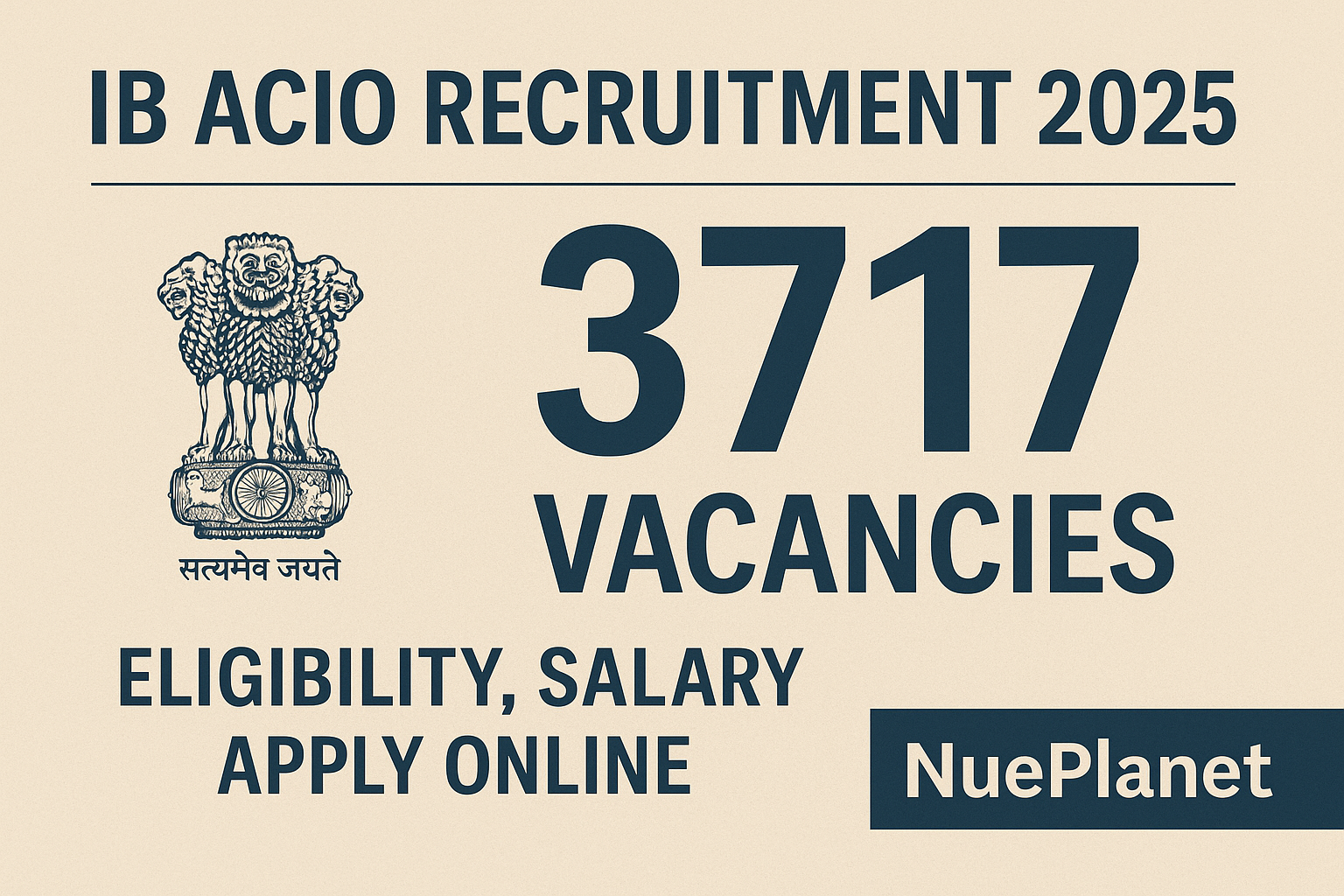
The Intelligence Bureau (IB) has released its much-awaited ACIO 2025 notification, announcing over 3700 vacancies. Here is everything you need to know about eligibility, selection, exam pattern, and application process.
Table of Contents
The Intelligence Bureau (IB) has announced recruitment for 3717 Assistant Central Intelligence Officer (ACIO) Grade-II Executive positions under the Ministry of Home Affairs, Government of India. This article provides verified information about eligibility requirements, application procedures, examination structure, and career prospects for the IB ACIO 2025 recruitment.
Understanding the Intelligence Bureau and ACIO Position
The Intelligence Bureau operates as India’s primary internal intelligence agency under the Ministry of Home Affairs. Established in 1887, the IB handles internal security matters, counter-intelligence operations, and intelligence gathering activities across the country.
The Assistant Central Intelligence Officer position represents an entry-level executive role classified under General Central Service, Group ‘C’ (Non-Gazetted, Non-Ministerial). Officers in this position contribute to national security operations through intelligence analysis, field investigations, and coordination with other security agencies.
The ACIO role involves systematic collection and analysis of intelligence information related to internal security threats. Officers work on counter-terrorism initiatives, cyber security monitoring, and coordination between various law enforcement agencies. This position provides exposure to diverse aspects of intelligence operations and internal security management.
Official Notification Overview
The Ministry of Home Affairs released the official notification on July 18, 2025, through its website mha.gov.in. The notification outlines comprehensive details regarding vacancy distribution, eligibility criteria, and selection procedures.
Key Recruitment Details
| Parameter | Information |
|---|---|
| Recruiting Authority | Intelligence Bureau, Ministry of Home Affairs |
| Position | Assistant Central Intelligence Officer (ACIO) |
| Grade | Grade-II Executive |
| Service Classification | General Central Service, Group ‘C’ |
| Total Vacancies | 3717 |
| Employment Type | Permanent Government Service |
| Notification Release | July 18, 2025 |
| Application Period | July 19 – August 10, 2025 |
| Official Website | mha.gov.in |
The recruitment follows Government of India guidelines for public sector hiring. The selection process maintains transparency through computer-based testing and structured interviews. All stages follow standardized evaluation criteria established by the recruiting authority.
Vacancy Distribution and Reservation Policy
The 3717 positions are distributed according to constitutional reservation provisions. The Intelligence Bureau implements Government of India’s reservation policy to ensure equitable representation across different categories.
Category-wise Allocation
The reservation structure follows established government norms:
- General Category: Approximately 50% of total positions
- Other Backward Classes (OBC): 27% reservation
- Scheduled Caste (SC): 15% reservation
- Scheduled Tribe (ST): 7.5% reservation
- Economically Weaker Sections (EWS): 10% reservation
Horizontal reservations apply for persons with disabilities and ex-servicemen as per applicable guidelines. Candidates claiming reservation benefits must provide valid certificates issued by competent authorities during document verification.
The distribution ensures representation while maintaining merit-based selection standards. Each category has specific qualifying benchmarks that candidates must achieve for consideration in final merit lists.
Eligibility Requirements
Understanding eligibility criteria prevents application rejection and ensures candidates meet all necessary conditions. The Intelligence Bureau has established clear parameters regarding education, age, and citizenship.
Educational Qualifications
Candidates must possess a bachelor’s degree from a university recognized by the University Grants Commission (UGC) or equivalent regulatory authority. The degree can be in any discipline including arts, science, commerce, engineering, or professional courses.
No minimum percentage requirement is specified in the official notification. However, the degree must be completed before document verification. Final year students awaiting results were eligible to apply during the application window.
Professional qualifications such as Chartered Accountancy, Company Secretaryship, or technical degrees from recognized institutions are acceptable. Foreign degrees must have recognition from the Association of Indian Universities (AIU) for equivalence purposes.
Age Limit Specifications
The age calculation date was August 10, 2025 (last date of application). Candidates must have completed 18 years and not exceeded 27 years as of this reference date.
Age Relaxation by Category:
| Category | Relaxation Period | Effective Maximum Age |
|---|---|---|
| General | No relaxation | 27 years |
| OBC (Non-Creamy Layer) | 3 years | 30 years |
| SC/ST | 5 years | 32 years |
| PwD (Persons with Disabilities) | 10 years | 37 years |
| Ex-Servicemen | 3 years + service period | Variable |
| PwD + OBC | 13 years | 40 years |
| PwD + SC/ST | 15 years | 42 years |
Age relaxation applies according to Government of India guidelines. Candidates must provide appropriate certificates to claim relaxation benefits during document verification stages.
Citizenship and Character Requirements
Applicants must be Indian citizens with no criminal record or pending cases. Background verification is conducted for all selected candidates as part of security clearance procedures. Candidates must demonstrate loyalty to the Constitution of India and commitment to national security objectives.
Application Process and Timeline
The application window operated from July 19 to August 10, 2025, exclusively through online mode. The process required systematic completion of registration, form filling, document upload, and fee payment.
Critical Dates
| Event | Date | Status |
|---|---|---|
| Notification Release | July 18, 2025 | Completed |
| Application Start | July 19, 2025 | Completed |
| Application Deadline | August 10, 2025 | Completed |
| Fee Payment Last Date | August 10, 2025 | Completed |
| Admit Card Release | September 5, 2025 | Completed |
| Tier-I Examination | September 16-18, 2025 | In Progress |
Step-by-Step Application Procedure
Registration Phase:
Candidates visited the official Ministry of Home Affairs website at mha.gov.in. The recruitment notification link directed applicants to the online application portal. New users created accounts by providing basic information including name, email address, and mobile number.
The system generated unique registration numbers upon successful account creation. Email and mobile verification occurred through one-time passwords sent to registered credentials. Candidates received login credentials for accessing the application form.
Form Completion:
The application form required comprehensive personal information, educational qualifications, and category details. Candidates entered academic information including degree details, university name, year of passing, and marks obtained.
Work experience details were optional but could be included if relevant. Address information required both permanent and correspondence addresses with complete postal codes. Category selection required careful attention as this determined fee structure and reservation benefits.
Document Upload Requirements:
The portal required specific documents in prescribed formats:
- Recent passport-size color photograph (4.5 cm × 3.5 cm) in JPG/JPEG format
- Signature on white paper (3.5 cm × 1.5 cm) in JPG/JPEG format
- Maximum file size: 50KB for photograph, 20KB for signature
- Clear, unblurred scanned images meeting technical specifications
Fee Payment:
Application fees varied by category with exemptions for specific groups:
| Category | Fee Amount |
|---|---|
| General/OBC/EWS | ₹100 |
| SC/ST | Exempted |
| PwD (All Categories) | Exempted |
| Female Candidates | Exempted |
Payment methods included net banking, credit cards, debit cards, and UPI systems. Candidates received payment confirmation receipts that should be preserved for future reference.
Final Submission:
Before final submission, candidates reviewed all entered information for accuracy. The system provided preview options to verify details. After submission, candidates downloaded the completed application form and fee receipt for record-keeping purposes.
Examination Structure and Pattern
The selection process consists of three distinct stages, each designed to evaluate different competencies required for intelligence work. All stages are eliminatory, requiring qualification to proceed further.
Tier-I Examination Details
The Tier-I examination is a computer-based test scheduled for September 16, 17, and 18, 2025. The examination uses objective multiple-choice questions to assess foundational knowledge across five subjects.
Examination Specifications:
| Component | Details |
|---|---|
| Mode | Computer-Based Test (CBT) |
| Duration | 60 minutes |
| Total Questions | 100 |
| Total Marks | 100 |
| Question Type | Multiple Choice (4 options) |
| Marking Scheme | +1 for correct, -0.25 for incorrect |
| Languages | English and Hindi |
Subject-wise Distribution:
| Subject | Questions | Marks | Approximate Time |
|---|---|---|---|
| General Awareness/Current Affairs | 20 | 20 | 12 minutes |
| Quantitative Aptitude | 20 | 20 | 12 minutes |
| Logical/Analytical Reasoning | 20 | 20 | 12 minutes |
| English Language & Comprehension | 20 | 20 | 12 minutes |
| General Studies | 20 | 20 | 12 minutes |
The negative marking system penalizes incorrect responses by deducting 0.25 marks. Unanswered questions receive no penalty. Candidates should attempt questions strategically, balancing speed with accuracy to maximize scores.
Tier-II Examination Format
The Tier-II examination tests written communication and comprehension abilities through descriptive questions. This stage evaluates candidates’ capacity to express ideas clearly in written English.
The examination duration is one hour with a maximum of 50 marks. Question types include essay writing, precis writing, and comprehension exercises. Only English language is permitted for responses. Minimum qualifying marks must be achieved to proceed to the interview stage.
Interview and Personality Assessment
The final selection stage involves personal interviews conducted by expert panels. Interviews assess personality traits, communication abilities, general awareness, and suitability for intelligence work.
Each interview typically lasts 15-20 minutes. The interview panel evaluates candidates on multiple parameters including articulation, reasoning ability, presence of mind, and understanding of current affairs. The interview carries 50 marks contributing to final merit determination.
Comprehensive Syllabus Coverage
Effective preparation requires thorough understanding of topics covered in each subject area. The syllabus encompasses diverse knowledge areas relevant to intelligence operations.
General Awareness and Current Affairs
This section tests knowledge of recent developments and established facts:
Current Events: National and international developments from the past 12 months including political changes, economic policies, and significant events
Government Initiatives: Central and state government schemes, policy announcements, and developmental programs
Indian History: Ancient civilizations, medieval period, freedom struggle, and post-independence developments
Geography: Physical features, climate patterns, natural resources, and economic geography of India and world regions
Indian Polity: Constitutional framework, fundamental rights, governance structures, and political processes
Economic Concepts: Indian economy fundamentals, banking system, budget provisions, and financial institutions
Science and Technology: Recent discoveries, technological advances, space programs, and research developments
Environmental Issues: Climate change, conservation efforts, pollution control, and sustainable development
Sports and Culture: Major tournaments, achievements by Indian athletes, cultural events, and artistic developments
Quantitative Aptitude
Mathematical and numerical ability assessment covers:
Number Systems: Properties of numbers, divisibility rules, HCF, LCM, and number theory concepts
Arithmetic: Percentage calculations, profit and loss problems, simple and compound interest, ratio and proportion
Algebra: Basic equations, inequalities, linear equations, and algebraic expressions
Geometry: Properties of shapes, theorems, area and perimeter calculations, coordinate geometry
Mensuration: Volume, surface area, and measurements of two-dimensional and three-dimensional objects
Data Interpretation: Analysis of tables, bar charts, line graphs, pie charts, and data sets requiring quantitative reasoning
Time and Work: Problems involving work efficiency, combined work, and time calculations
Speed and Distance: Problems involving relative speed, average speed, and distance-time relationships
Logical and Analytical Reasoning
Reasoning ability evaluation includes:
Pattern Recognition: Number series, letter series, and symbol series requiring pattern identification
Verbal Reasoning: Analogies, classifications, and relationships between words or concepts
Non-Verbal Reasoning: Figure patterns, visual series, and spatial reasoning problems
Coding-Decoding: Various encoding patterns using letters, numbers, or mixed symbols
Blood Relations: Family tree problems requiring relationship identification
Direction and Distance: Problems involving direction sense and distance calculations
Arrangements: Linear and circular seating arrangements with multiple constraints
Logical Puzzles: Grid-based puzzles, scheduling problems, and constraint-based reasoning
Syllogisms: Logical deductions from given statements using Venn diagrams or direct methods
Critical Reasoning: Strengthening and weakening arguments, assumptions, and inferences
English Language and Comprehension
Language proficiency assessment covers:
Reading Comprehension: Passages requiring understanding, interpretation, and inference
Grammar: Parts of speech, tenses, subject-verb agreement, articles, and prepositions
Vocabulary: Synonyms, antonyms, word meanings, and contextual usage
Sentence Correction: Identifying and correcting grammatical errors in sentences
Fill in the Blanks: Context-based word selection to complete sentences meaningfully
Idioms and Phrases: Common expressions and their appropriate usage
Para Jumbles: Arranging sentences in logical sequence to form coherent paragraphs
Cloze Tests: Completing passages with appropriate words based on context
Error Detection: Identifying grammatical or syntactical errors in given sentences
General Studies
This section encompasses:
Indian Constitution: Fundamental rights and duties, directive principles, constitutional amendments
Historical Events: Significant movements, leaders, and developments in Indian history
Geographical Knowledge: Indian states, capitals, major rivers, mountain ranges, and geographical features
Economic Development: Five-year plans, economic reforms, financial inclusion initiatives
Scientific Principles: Basic physics, chemistry, and biology concepts applicable to everyday situations
Defense and Security: Indian armed forces structure, security challenges, and defense policies
Awards and Honors: National and international awards, recipients, and their contributions
Important Dates: National days, international observances, and their significance
Admit Card and Examination Guidelines
The admit card serves as the entry pass for examination centers. Released on September 5, 2025, it contains essential information about examination timing and venue.
Admit Card Download Process
Candidates accessed admit cards through the official website using registration numbers and dates of birth. The admit card displayed personal details, photograph, examination date, shift timing, and center address.
Verification of printed details is essential immediately after download. Any discrepancies require prompt communication with the helpdesk. Multiple printouts should be taken as backup copies.
Examination Day Protocols
Mandatory Requirements:
- Printed admit card
- Original valid photo identity proof (Aadhaar card, PAN card, driving license, passport, or voter ID)
- Additional writing materials only if specified
Prohibited Items:
- Mobile phones and electronic devices
- Calculators and smartwatches
- Books, notes, and study materials
- Any communication devices
Reporting Instructions:
Candidates must reach examination centers at least 30 minutes before the scheduled time. Entry gates close according to specified timings without exceptions. Late arrivals cannot access examination halls under any circumstances.
Biometric verification procedures occur at entry points. Candidates cooperate with center staff and follow all instructions provided by invigilators. Violation of examination rules may result in disqualification and cancellation of candidature.
Salary Structure and Compensation
The ACIO position offers competitive compensation aligned with 7th Pay Commission recommendations. The salary structure includes basic pay and multiple allowances based on posting location.
Pay Scale Components
Basic Salary: ₹44,900 per month at Pay Level-7 in the pay matrix
Allowances:
| Allowance Type | Rate/Amount |
|---|---|
| Dearness Allowance (DA) | 46% of basic pay |
| House Rent Allowance (HRA) | 8-24% based on city classification |
| Transport Allowance | Fixed amount based on location |
| Special Security Allowance | Variable based on assignment |
Estimated Monthly Compensation:
- Gross monthly salary: ₹78,000 to ₹85,000 (varies by location and allowances)
- In-hand salary: ₹65,000 to ₹72,000 (after statutory deductions)
- Annual gross package: ₹9.36 to ₹10.2 lakhs
Additional Benefits
Statutory Benefits:
- Employee Provident Fund with 12% contribution from employee and employer
- National Pension System (NPS) with government contribution
- Gratuity as per government norms after qualifying service period
- Leave encashment provisions
Medical and Healthcare:
- Comprehensive medical coverage under Central Government Health Scheme (CGHS)
- Reimbursement for medical expenses for self and dependent family members
- Access to government hospitals and empaneled private facilities
Leave and Travel:
- Earned leave, casual leave, and medical leave as per rules
- Leave Travel Concession for family travel within India
- Travel allowances for official duties
Housing and Accommodation:
- Priority allocation of government quarters based on availability
- House Rent Allowance if government accommodation not occupied
- House Building Advance at concessional interest rates
Career Development:
- Regular training programs for skill enhancement
- Opportunities for specialized courses and certifications
- Deputation possibilities to other government agencies
- Clear promotion pathways with defined timelines
Career Progression and Growth
The ACIO position provides a structured career path with proven advancement opportunities. Performance-based promotions ensure deserving officers progress to higher responsibilities.
Promotional Hierarchy
Officers advance through clearly defined levels:
Entry Level: Assistant Central Intelligence Officer (Pay Level 7) – Starting position after recruitment
Officer Level: Central Intelligence Officer (Pay Level 8) – Typically after 4-6 years with satisfactory performance
Senior Officer: Senior Central Intelligence Officer (Pay Level 10) – After 8-12 years with demonstrated competence
Supervisory Level: Assistant Director (Pay Level 12) – After 15-20 years in management roles
Executive Level: Joint Director and Additional Director (Pay Levels 13-14) – Senior management positions
Leadership Level: Director and above (Pay Level 15+) – Top executive positions
Promotions consider factors including performance evaluations, seniority, specialized training completion, and organizational requirements. Officers demonstrating exceptional abilities may receive accelerated advancement opportunities.
Training and Development
Initial training after selection lasts 6-12 months covering intelligence operations, legal frameworks, technology usage, and field procedures. Continuous professional development occurs through regular training modules and skill upgrade programs.
Specialized training areas include cyber intelligence, counter-terrorism, technical surveillance, and analytical techniques. Officers receive exposure to advanced methodologies and international best practices through collaborative programs.
Deputation and Lateral Opportunities
Experienced officers may obtain deputation to various organizations including:
- Central Bureau of Investigation (CBI)
- National Investigation Agency (NIA)
- Research and Analysis Wing (RAW)
- National Security Guard (NSG)
- Various ministries and government departments
Deputation assignments provide diverse exposure and enhance career profiles. Officers return with expanded skill sets and broader perspectives on security operations.
Effective Preparation Strategy
Successful candidates typically follow systematic preparation approaches covering all examination components. Strategic planning maximizes performance across different subjects and examination stages.
Preparation Timeline
Foundation Phase (30-40 days):
Begin with thorough syllabus analysis to understand all topics. Collect quality study materials including standard textbooks and reference books. Establish daily study routines allocating specific time slots for each subject. Start current affairs compilation from reliable sources. Take diagnostic tests to identify strengths and weaknesses.
Intensive Practice Phase (30-40 days):
Focus on topic-wise practice for each subject area. Solve previous year question papers to understand patterns. Attempt sectional mock tests regularly to build speed and accuracy. Concentrate on weak areas requiring additional attention. Learn shortcut methods for quantitative and reasoning sections.
Revision and Testing Phase (20-30 days):
Conduct comprehensive revision of all subjects systematically. Take full-length mock tests under timed conditions. Analyze performance in each test to identify improvement areas. Review important formulas, concepts, and current affairs. Focus on speed optimization while maintaining accuracy levels.
Subject-specific Approaches
General Awareness Preparation:
Read quality newspapers daily focusing on editorial sections. Maintain monthly current affairs notes covering major events. Study government initiatives and policy announcements systematically. Prepare static GK notes on history, geography, and polity. Use reliable monthly magazines for consolidated updates.
Quantitative Aptitude Development:
Master fundamental concepts and formulas in each topic. Practice mental calculation techniques for faster solving. Solve diverse problem types to build versatility. Focus on data interpretation requiring analytical skills. Time yourself while practicing to improve speed.
Logical Reasoning Enhancement:
Practice different reasoning patterns regularly for familiarity. Develop systematic approaches for puzzle-solving. Work on both verbal and non-verbal reasoning types. Learn elimination techniques for faster problem-solving. Build pattern recognition abilities through consistent practice.
English Language Improvement:
Read English newspapers and magazines daily for language exposure. Build vocabulary through systematic word learning. Study grammar rules and practice application exercises. Solve comprehension passages to improve understanding speed. Practice writing skills for descriptive examination preparation.
Proven Study Resources
Standard Reference Books:
- Quantitative Aptitude by R.S. Aggarwal provides comprehensive mathematical coverage
- Analytical Reasoning by M.K. Pandey covers logical reasoning patterns effectively
- Word Power Made Easy by Norman Lewis supports vocabulary development
- Lucent’s General Knowledge offers consolidated GK information
- NCERT textbooks for classes 6-12 provide foundation knowledge
Digital Resources:
Official government websites including PIB for authentic information. Educational YouTube channels offering concept explanations. Mobile applications for current affairs and practice questions. Online mock test platforms providing examination simulation. Government publications like Employment News and Yojana magazine.
Mock Test Strategy
Begin taking mock tests after completing syllabus coverage. Schedule tests weekly during practice phase, increasing frequency during final preparation. Analyze each test thoroughly identifying mistakes and learning patterns. Focus on time management while attempting different sections. Maintain performance logs tracking progress over time.
Key Takeaways
The IB ACIO Recruitment 2025 provides 3717 opportunities for careers in India’s premier intelligence agency. The recruitment follows transparent selection procedures including computer-based examinations and personal interviews. Successful preparation requires systematic coverage of diverse subject areas and consistent practice.
The position offers competitive compensation with Pay Level-7 basic salary and comprehensive allowances. Clear career progression pathways exist with proven advancement opportunities to senior positions. Benefits include job security, professional training, and the privilege of contributing to national security.
Understanding examination patterns and syllabus coverage is essential for effective preparation. Strategic study planning, regular practice, and mock test analysis improve success probability. Candidates should rely exclusively on official sources for accurate information and updates.
Frequently Asked Questions
Q1: What was the application deadline for IB ACIO 2025 recruitment?
The application window operated from July 19, 2025, to August 10, 2025. Online applications were accepted exclusively through the official Ministry of Home Affairs website at mha.gov.in. The application portal closed at midnight on August 10, 2025. Late applications were not accepted under any circumstances.
Q2: When is the IB ACIO 2025 Tier-I examination scheduled?
The Tier-I computer-based examination is scheduled for September 16, 17, and 18, 2025. Multiple shifts operate on each examination day. Candidates receive specific date and shift information on their admit cards released on September 5, 2025. The examination duration is 60 minutes with 100 questions carrying 100 marks.
Q3: What educational qualifications are required for IB ACIO positions?
Candidates must possess a bachelor’s degree in any discipline from a university recognized by the University Grants Commission (UGC) or equivalent authority. No minimum percentage requirement is specified. Professional degrees including engineering, medical, CA, CS, and other recognized qualifications are acceptable. Foreign degrees require AIU recognition for equivalence.
Q4: What is the complete selection process for IB ACIO recruitment?
The selection process comprises three stages: Tier-I objective examination (100 marks, 60 minutes) covering five subjects, Tier-II descriptive examination (50 marks, 1 hour) testing written communication, and personal interview (50 marks) assessing personality and suitability. Each stage is eliminatory requiring minimum qualifying marks. Final merit lists are based on combined performance across all stages.
Q5: What salary can IB ACIO officers expect?
ACIO officers receive basic pay of ₹44,900 per month at Pay Level-7. Including allowances like DA (46% of basic), HRA (8-24% based on location), transport allowance, and special security allowance, gross monthly salary ranges from ₹78,000 to ₹85,000. Annual gross package is approximately ₹9.36 to ₹10.2 lakhs. Additional benefits include PF, pension, medical coverage, and LTC.
Q6: Is there age relaxation for reserved category candidates?
Yes, age relaxation follows Government of India norms. OBC candidates receive 3 years (maximum age 30 years), SC/ST candidates receive 5 years (maximum age 32 years), PwD candidates receive 10 years (maximum age 37 years), and ex-servicemen receive 3 years plus service period. Combined relaxations apply for candidates in multiple categories like PwD+OBC or PwD+SC/ST.
Q7: How is negative marking implemented in the examination?
The Tier-I examination follows a negative marking scheme where each correct answer receives +1 mark and each incorrect answer results in -0.25 marks deduction. Unanswered questions carry no penalty. This system emphasizes accuracy over guesswork. Candidates should attempt questions strategically, ensuring reasonable confidence before selecting answers to optimize scores.
Q8: Where can candidates check official updates about the recruitment?
All authentic information is available on the official Ministry of Home Affairs website at mha.gov.in. Candidates should access the recruitment section for notifications, admit cards, results, and announcements. Avoid unofficial websites or social media pages claiming to provide information. The official website remains the only reliable source for verified updates and communications.
About the Author
Nueplanet
Education sector content specialist focusing on government recruitment examinations and career guidance. Dedicated to providing accurate, verified information exclusively from official government sources and authorized publications. All content undergoes rigorous verification against official notifications before publication.
Verification Process: Information is cross-referenced with official Ministry of Home Affairs announcements, government notifications, and authorized public communications. Content is regularly reviewed and updated to reflect the latest official developments.
Professional Commitment: Maintaining transparency and accuracy in educational content to help aspirants make informed decisions based on reliable information.
Published: July 14, 2025
Last Updated: July 14, 2025
Primary Source: Ministry of Home Affairs Notification dated July 18, 2025
Disclaimer: This article provides informational guidance based on official IB ACIO recruitment notifications available as of publication. Candidates must verify all details from the official Ministry of Home Affairs website (mha.gov.in) before taking any action. The author and publisher bear no responsibility for changes made by authorities after publication. This content is for educational purposes only and does not constitute official recruitment advice.
Helpful Resources
Latest Posts
- National RailOne App: Indian Railways’ One-Stop Solution for Travellers
- HDB Financial Services IPO Allotment GMP: All You Need to Know
- TNPSC Admit Card 2025 Released: Everything You Need to Know
- Jharkhand Polytechnic Result 2025 Declared: Check Your Scores, Merit List, and Admission Process
- 7th July Public Holiday India: Is Muharram 2025 a National Holiday?







Post Comment