









Stock Market Holidays 2025 – NSE & BSE Holiday List for Traders
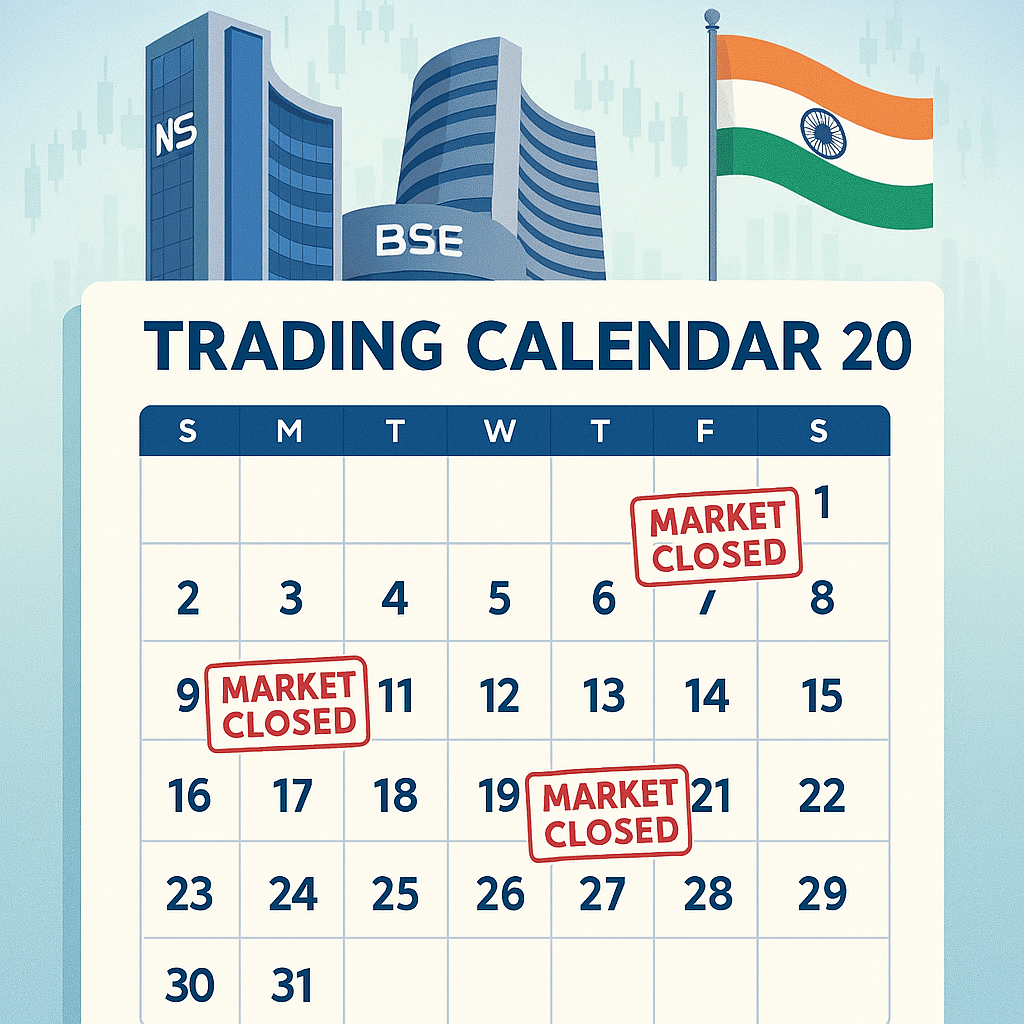
Check the full list of stock market holidays in 2025, including share market holidays for NSE and BSE. Find out if markets are closed on Independence Day and plan your trades accordingly.
Table of Contents
The National Stock Exchange (NSE) and Bombay Stock Exchange (BSE) observe designated trading holidays throughout the calendar year based on national and regional celebrations. For 2025, both exchanges have announced 14 scheduled non-trading days, excluding regular weekends, affecting equity, derivatives, and commodity market operations.
Market participants including institutional investors, retail traders, and portfolio managers require accurate holiday information for position management, settlement planning, and risk mitigation strategies. Trading holidays impact order execution, settlement cycles, margin requirements, and liquidity conditions across all market segments.
This comprehensive analysis provides the complete 2025 trading holiday schedule, regulatory framework, market impact considerations, and strategic planning guidelines based on official exchange notifications and SEBI regulations.
Official Trading Holiday Schedule for 2025
The NSE and BSE follow a synchronized holiday calendar established in consultation with the Securities and Exchange Board of India (SEBI). Both exchanges remain closed on the same dates to maintain market uniformity and settlement consistency.
Complete Holiday List
The following table presents all scheduled trading holidays for 2025:
| Date | Day | Occasion | Market Status |
|---|---|---|---|
| February 26, 2025 | Wednesday | Maha Shivratri | All segments closed |
| March 14, 2025 | Friday | Holi | Trading suspended |
| March 31, 2025 | Monday | Id-ul-Fitr | Market holiday |
| April 14, 2025 | Monday | Ram Navami | No trading |
| April 18, 2025 | Friday | Good Friday | Complete closure |
| May 1, 2025 | Thursday | Maharashtra Day | Trading holiday |
| August 15, 2025 | Friday | Independence Day | National holiday |
| October 2, 2025 | Thursday | Gandhi Jayanti | Market closed |
| October 21, 2025 | Tuesday | Diwali Laxmi Pujan | Special Muhurat Trading |
| November 5, 2025 | Wednesday | Pratihar Shashthi/Diwali | Trading suspended |
| December 25, 2025 | Thursday | Christmas | Market holiday |
Weekend and Additional Considerations
Regular weekly holidays occur on Saturdays and Sundays throughout 2025. Certain festivals falling on Saturdays, such as Parsi New Year (August 16) and Guru Nanak Jayanti (November 15), do not require separate market closures as exchanges already remain closed on weekends.
The total number of non-trading days in 2025, including weekends and announced holidays, affects the available trading sessions for annual market activity. This impacts liquidity accumulation, settlement cycles, and annual trading volume calculations.
Special Trading Sessions in 2025
Beyond regular trading days and holidays, exchanges schedule special sessions for specific occasions based on tradition or government announcements.
Muhurat Trading Session
Muhurat Trading takes place during Diwali, the festival of lights, which in 2025 falls on October 21. This special evening session typically lasts approximately one hour, usually scheduled between 6:00 PM and 7:15 PM, though exact timings are announced closer to the date.
The Muhurat Trading session holds cultural significance in Indian financial markets. Many market participants make token transactions during this period, which marks the beginning of the Hindu calendar’s new financial year. Trading volumes during this session typically remain lower than regular sessions.
All equity segments, derivatives, and related instruments remain available during Muhurat Trading. Settlement for these transactions follows the standard T+1 settlement cycle applicable to regular trading days.
Budget Day Special Session
The Union Budget presentation for fiscal year 2025-26 is scheduled for February 1, 2025, which falls on a Saturday. The exchanges may announce a special trading session to allow market participants to respond to budget proposals and policy announcements.
Budget day sessions have variable timing and scope depending on the presentation schedule and regulatory approvals. Traders should monitor official exchange circulars for confirmed timing and operational details.
Regulatory Framework and Holiday Declarations
Trading holiday schedules follow established regulatory processes involving multiple authorities and advance notification requirements.
SEBI Guidelines and Approval Process
The Securities and Exchange Board of India (SEBI) provides the regulatory framework for trading holiday declarations. Exchange-proposed holiday calendars require SEBI approval before official announcement to market participants.
SEBI regulations mandate advance notification of trading holidays to ensure adequate preparation time for market infrastructure, clearing corporations, depositories, and trading members. This advance notice period typically spans several months before the calendar year begins.
Clearing corporations including National Securities Clearing Corporation Limited (NSCCL) and Indian Clearing Corporation Limited (ICCL) adjust settlement cycles around holidays. The standard T+1 settlement cycle may experience timing modifications when holidays affect consecutive trading days.
Exchange Notification Procedures
Both NSE and BSE issue official circulars announcing the trading holiday calendar. These circulars are published on exchange websites, distributed to trading members, and communicated through various channels including email notifications and mobile applications.
Trading members receive detailed operational instructions regarding pre-holiday obligations, margin requirements, and post-holiday procedures. Risk management departments at exchanges adjust margin collection and monitoring processes around extended market closures.
Depositories Coordination
National Securities Depository Limited (NSDL) and Central Depository Services Limited (CDSL) align their operational schedules with exchange holidays. Depository services including account opening, securities transfer, and pledge/unpledge operations follow the trading holiday calendar.
Settlement-related depository activities may occur on days when trading is suspended, particularly for completing previous trading day settlements. Market participants should verify depository service availability through official channels for specific requirements.
Market Impact Analysis During Holiday Periods
Trading holidays affect market dynamics, liquidity conditions, and price discovery mechanisms in observable patterns documented through historical data analysis.
Pre-Holiday Trading Patterns
Trading sessions immediately preceding holidays typically exhibit distinct characteristics. Volume analysis shows increased activity as market participants adjust positions before market closures. This volume increase ranges from 10-20% above average daily volumes depending on the holiday duration.
Volatility measurements using standard deviation and average true range indicators often show elevation during pre-holiday sessions. Uncertainty regarding potential news or events during market closure contributes to wider price ranges and increased intraday fluctuations.
Institutional investors frequently adjust portfolio holdings before extended closures. Foreign Institutional Investors (FIIs) and Domestic Institutional Investors (DIIs) may reduce exposure or implement hedging strategies to manage overnight risk during market closures.
Post-Holiday Market Behavior
Market reopening after holidays presents unique trading conditions. Gap openings occur when the opening price differs significantly from the previous closing price, reflecting accumulated news, events, and sentiment changes during the closure period.
Liquidity conditions immediately after holidays may experience temporary reduction as participants assess accumulated information and adjust positions. Price discovery can require additional time during the opening session as buy and sell orders achieve equilibrium.
Historical data indicates that longer holiday periods (three-day weekends or consecutive holidays) create more pronounced post-holiday effects compared to single-day closures. Market participants should anticipate potentially wider bid-ask spreads and greater price volatility during initial post-holiday trading hours.
Settlement Cycle Considerations
The T+1 settlement cycle, implemented by Indian stock exchanges, means trades executed on a given day settle on the next trading day. Holidays disrupt this cycle by extending the time between trade execution and settlement completion.
Trades executed on the day before a holiday settle on the first trading day after the holiday. This extension affects fund availability, securities delivery timelines, and working capital requirements for market participants.
Multiple consecutive holidays can create significant settlement delays. Market participants must plan cash flow and securities availability around these extended settlement periods to avoid delivery failures or funding shortfalls.
Commodity and Currency Market Holiday Schedules
While equity market holidays receive primary attention, commodity and currency markets follow related but sometimes distinct schedules.
Multi Commodity Exchange (MCX) Calendar
The Multi Commodity Exchange (MCX) generally aligns its holiday schedule with NSE and BSE for consistency across Indian financial markets. Commodity trading in gold, silver, crude oil, base metals, and agricultural products suspends on equity market holidays.
However, commodity markets have international linkages that can create exceptions. Crude oil and base metals trade on global exchanges that operate on different holiday calendars. MCX may adjust trading hours or provide special sessions when international market developments warrant domestic market access.
Agricultural commodity trading follows additional state-specific considerations. Regional festivals affecting agricultural regions may influence commodity trading schedules for products like soybeans, wheat, and cotton.
Currency Derivatives Market
Currency derivatives trading on NSE, BSE, and Metropolitan Stock Exchange of India (MSEI) follows the equity market holiday calendar for most currency pairs. Trading in USD-INR, EUR-INR, GBP-INR, and JPY-INR suspends during equity market holidays.
International currency market operations continue during Indian holidays, creating potential for significant price movements during domestic market closures. The foreign exchange market operates globally with continuous trading across different time zones.
GIFT City (Gujarat International Finance Tec-City) operates under separate guidelines with different holiday considerations due to its positioning as an international financial services center. Market participants trading on GIFT City exchanges should refer to specific schedules for that venue.
Strategic Considerations for Different Market Participants
Trading holidays require different strategic approaches depending on participant type, investment horizon, and market exposure.
Day Traders and Intraday Participants
Day traders who square off all positions before market close face specific pre-holiday considerations. The inability to trade during holidays eliminates intraday opportunities but also removes overnight risk from holding positions.
Pre-holiday sessions may present increased volatility and volume, potentially offering more trading opportunities. However, wider spreads and faster price movements also increase execution risk and slippage potential.
Day traders must ensure all positions close before the trading session ends on pre-holiday days. Failure to square off positions converts them to delivery-based trades, triggering margin requirements and settlement obligations.
Swing Traders and Short-Term Investors
Swing traders holding positions for days or weeks must evaluate overnight risk during holidays. Market closures prevent position adjustments in response to news or events occurring during the holiday period.
Risk management strategies for swing traders include:
- Reducing position sizes before extended holidays
- Adjusting stop-loss orders to account for potential gap openings
- Evaluating the risk-reward ratio of holding positions versus closing and re-entering
- Using options strategies to hedge directional positions during holidays
The decision to hold or close positions depends on conviction level, technical chart patterns, overall market conditions, and specific holiday duration.
Long-Term Investors and Portfolio Managers
Long-term investors with multi-year horizons experience minimal impact from individual trading holidays. Portfolio construction, asset allocation, and rebalancing strategies operate on longer timeframes that absorb short-term holiday effects.
However, portfolio managers should consider holiday schedules for:
- Systematic Investment Plan (SIP) execution timing
- Portfolio rebalancing implementation
- Tax planning and year-end transactions
- Dividend reinvestment processing
- Corporate action participation
Institutional portfolio managers coordinate with custodians, clearing members, and back-office operations to ensure smooth processing around holidays.
Derivatives Traders and Option Writers
Derivatives traders face specific considerations due to time decay (theta) and expiration schedules. Options lose time value continuously, including during market closures when trading cannot occur.
Weekly options expiring during weeks with holidays experience compressed trading days, affecting time decay rates and volatility calculations. Monthly derivatives typically expire on the last Thursday of each month, which may coincide with or follow holidays.
Margin requirements for derivatives positions may increase before extended holidays as risk management systems account for potential gap risk. Traders should maintain adequate margin cushions to avoid forced position liquidation.
Technology and Information Systems Around Holidays
Modern trading infrastructure requires specific protocols and procedures around market holidays to maintain system integrity and data accuracy.
Trading Platform Maintenance
Exchanges and brokers often schedule technology maintenance and system upgrades during holiday periods when markets remain closed. These maintenance windows allow infrastructure improvements without disrupting trading operations.
Trading platforms undergo testing, software updates, and hardware maintenance during extended closures. Market participants may experience system downtime or limited functionality during maintenance periods, even though markets are closed.
Brokers typically communicate maintenance schedules in advance through email notifications, SMS alerts, and platform announcements. Traders should verify system availability before placing orders on post-holiday trading sessions.
Order Management During Closures
Most trading platforms do not accept market orders during holidays when exchanges are closed. However, order management systems may allow entry of Good Till Cancelled (GTC) or Good Till Date (GTD) orders that activate when trading resumes.
After-market orders (AMO) placed during holidays enter the order queue for execution at market opening on the next trading day. These orders execute based on opening prices and market conditions at the session start.
Limit orders placed before holidays remain active in the system unless explicitly cancelled. Stop-loss orders similarly remain in effect and trigger if market prices reach specified levels upon market reopening.
Data Feed and Market Information
Real-time market data feeds cease during trading holidays as no transactions occur. Historical data services, research platforms, and analysis tools remain operational for accessing previous trading session data.
News aggregation services, corporate announcement platforms, and financial information systems continue operating during holidays. Significant corporate or economic developments occurring during holidays become available through these channels.
Market participants should monitor news sources during holidays to stay informed about developments that may affect positions or trading strategies upon market reopening.
International Market Correlation and Holiday Arbitrage
Indian market holidays occur while other global markets continue operating, creating information asymmetry and potential arbitrage situations.
Global Market Operations During Indian Holidays
Major international markets including the United States, Europe, and other Asian markets follow different holiday calendars. When Indian markets close while global markets operate, international developments cannot be reflected in Indian securities prices until market reopening.
Singapore Exchange (SGX) Nifty futures continue trading during Indian market holidays. These offshore derivatives provide price discovery for Indian indices even when domestic markets are closed. The SGX Nifty often indicates the likely opening direction for Indian markets post-holiday.
Foreign Institutional Investors (FIIs) continue operating in other markets during Indian holidays. Portfolio decisions and global allocation strategies made during Indian market closures can affect FII flows and sentiment upon market reopening.
GIFT City Trading During Holidays
Gujarat International Finance Tec-City (GIFT City) operates as an international financial services center with some operational independence from domestic market schedules. Certain GIFT City trading platforms may operate on different holiday calendars.
The NSE International Exchange (NSE IX) operates at GIFT City with extended trading hours and potential for operations during some domestic holidays. Market participants with GIFT City access should verify specific holiday schedules for international segments.
GIFT City’s positioning as an offshore financial center creates arbitrage possibilities between domestic and GIFT City prices during Indian market holidays.
Sector-Specific Holiday Considerations
Different economic sectors experience varying effects from trading holidays based on their business characteristics and operational patterns.
Financial Services Sector
Banking stocks and financial services companies experience operational impacts during holidays. Transaction volumes, payment processing, and customer activity patterns change during festival periods.
Digital payment companies and fintech platforms often report increased transaction volumes during major festivals when consumer spending rises. These operational trends can affect investor sentiment and stock prices for financial technology companies.
Insurance companies experience sales spikes during specific festivals considered auspicious for major purchases. Life insurance and general insurance sectors monitor these seasonal patterns for business planning and investor communication.
Consumer Goods and Retail
Fast-Moving Consumer Goods (FMCG) companies anticipate increased demand during festival seasons. Production planning, inventory management, and distribution strategies align with holiday calendars to capture seasonal demand.
E-commerce platforms and retail companies experience sales concentration around major festivals. Diwali, in particular, generates significant consumer spending that appears in quarterly earnings reports following the festival period.
Investor focus on consumer sector stocks intensifies around holidays as market participants evaluate likely sales performance and its impact on quarterly results.
Automotive Sector
Automobile manufacturers and dealers experience seasonality linked to festival periods. Vehicle purchases traditionally increase during festivals considered auspicious for major acquisitions, particularly Navratri and Dussehra period.
Two-wheeler and passenger vehicle sales data released after festival periods provides insights into consumer demand and rural purchasing power. These metrics influence investor sentiment toward automotive sector stocks.
Commercial vehicle demand shows less festival correlation, instead tracking economic activity, infrastructure development, and logistics sector growth.
Mutual Funds and Systematic Investment Plans
Trading holidays affect mutual fund operations, Net Asset Value (NAV) calculations, and systematic transaction processing.
NAV Calculation and Declaration
Mutual funds calculate NAV based on closing prices of portfolio securities on each trading day. During market holidays, mutual fund NAVs are not calculated or declared as portfolio securities do not have updated prices.
Purchase and redemption requests received on holidays process using the NAV of the next trading day. The effective NAV date shifts to accommodate market closures, affecting the price at which units are issued or redeemed.
Investors should consider holiday schedules when planning large mutual fund transactions, particularly for equity-oriented schemes sensitive to market movements.
SIP Processing During Holidays
Systematic Investment Plans (SIP) scheduled on market holidays typically process on the next trading day. The investment amount debits from the investor’s bank account, but unit allocation occurs at the next available NAV.
Automatic debit mandates may execute on scheduled dates even if markets are closed, with fund houses processing the investment when markets reopen. Investors should maintain adequate bank balances to honor SIP commitments regardless of holiday timing.
Some fund houses and platforms allow investors to modify SIP dates to avoid regular holiday occurrences. This flexibility helps optimize SIP execution timing according to individual preferences.
Equity vs. Debt Fund Considerations
Debt mutual funds experience less holiday impact than equity funds since bond markets also close during exchange holidays. Both equity and debt fund NAVs remain unchanged during market closures.
Liquid funds and overnight funds maintain stability during holidays as underlying money market instruments continue to accrue interest. These funds typically show steady NAV progression regardless of market holidays.
Hybrid funds combining equity and debt experience holiday effects proportional to their equity allocation. Aggressive hybrid funds with higher equity exposure show greater sensitivity to holiday-related market gaps than conservative hybrid funds.
Tax Planning and Calendar Year-End Considerations
Trading holidays near financial year-end or calendar year-end create specific considerations for tax planning and portfolio management.
March Year-End Planning
The financial year ending March 31 requires attention to trading holiday schedules for tax optimization. Capital gains and losses must be realized during the financial year for inclusion in that year’s tax computation.
Tax-loss harvesting strategies require execution before the financial year ends. Trading holidays in March, including Holi, affect available trading days for year-end portfolio adjustments.
Long-term capital gains thresholds and holding period calculations require accurate date tracking. Market holidays do not extend holding periods but reduce available trading sessions for planned transactions.
December Calendar Year Considerations
December holidays, particularly Christmas falling on December 25, affect calendar year portfolio reviews and year-end institutional rebalancing. Global institutional investors often conduct portfolio realignment in December, affecting FII flows.
Annual reports, performance reviews, and strategy planning for the upcoming year typically occur around December holidays. Market participants should monitor institutional activity patterns during this period.
Risk Management and Position Monitoring
Effective risk management requires specific protocols and procedures around trading holidays to protect capital and manage exposure.
Margin Requirements and Risk Parameters
Risk management systems at exchanges and brokers may implement enhanced margin requirements before extended holidays. Value-at-Risk (VaR) calculations incorporate additional risk premiums for potential gap movements during market closures.
SPAN (Standard Portfolio Analysis of Risk) margin calculations account for worst-case scenarios including extended market closures. Traders should maintain margin cushions above minimum requirements to avoid forced liquidation on post-holiday gap openings.
Intraday margin benefits typically do not apply to positions held through holidays. Delivery margin requirements apply to all positions carried beyond the trading session close.
Stop-Loss Order Execution
Stop-loss orders placed before holidays remain active in the system. Upon market reopening, these orders trigger if prices reach specified levels, but execution occurs at prevailing market prices which may differ significantly from stop-loss levels due to gap openings.
Traders should recognize that stop-loss orders do not guarantee execution at specific prices during gap scenarios. Market orders generated from stop-loss triggers execute at available market prices, potentially resulting in slippage.
Alternative risk management approaches include using options for downside protection or reducing position sizes before holidays rather than relying solely on stop-loss orders.
Communication and Information Flow
Maintaining information awareness during market holidays helps market participants stay prepared for post-holiday trading sessions.
Exchange Communications
NSE and BSE maintain communication channels during holidays for urgent announcements or regulatory updates. Exchange websites, mobile applications, and social media channels remain active.
Corporate announcements, board meeting outcomes, and material developments may be disclosed during holidays through stock exchange filing systems. These announcements become accessible through exchange platforms even when markets are closed.
Trading members receive critical communications regarding technical issues, system maintenance, or regulatory changes through designated channels regardless of market status.
News Monitoring Services
Financial news platforms, business channels, and market information services operate continuously including during holidays. Global market developments, economic data releases, and geopolitical events receive coverage.
Earnings announcements from companies may occur during holidays. These results become available through company websites, exchange filings, and news services, providing information for post-holiday trading decisions.
Economic indicators, policy announcements, and regulatory changes can occur during market holidays. Monitoring these developments helps market participants anticipate potential market reactions upon reopening.
Broker Communication
Brokers provide customer support and account services during holidays, though trading operations remain suspended. Account-related queries, margin calculations, and technical support typically remain available.
Mobile trading applications may allow portfolio viewing, order status checking, and historical transaction review during holidays. New order placement for execution upon market reopening depends on broker-specific policies and technological capabilities.
Frequently Asked Questions
What happens to derivative contracts during market holidays?
Derivative contracts including futures and options continue to exist during market holidays but cannot be traded or modified. Time decay for options continues during holidays, eroding time value even though no trading occurs. Futures positions maintain their contract specifications unchanged. Margin requirements apply throughout the holiday period, and margin calls for deficit accounts must be met despite market closure. Upon market reopening, all positions resume trading at prevailing market prices, which may differ from pre-holiday levels.
How are SIP investments processed when the scheduled date falls on a market holiday?
Systematic Investment Plan (SIP) installments scheduled on market holidays typically process on the next trading day. The investment amount may debit from the bank account on the scheduled date or the next business day depending on the fund house and banking arrangements. Unit allocation occurs at the Net Asset Value (NAV) of the next trading day when markets reopen. Investors do not lose their SIP installment; it simply shifts to the next available trading session for execution.
Can investors place orders during holidays that execute when markets reopen?
Most brokers allow After Market Orders (AMO) placement during holidays. These orders enter the exchange system when markets reopen and execute based on opening prices and order priority. Good Till Cancelled (GTC) and Good Till Date (GTD) orders placed before holidays remain active. However, market orders cannot be executed during closure periods as no trading occurs. Limit orders may execute if market prices meet specified conditions upon market reopening. Investors should verify AMO capabilities with their specific brokers.
Do international markets affect Indian stocks during Indian holidays?
International market movements during Indian holidays can significantly impact domestic stocks upon market reopening. Singapore Exchange (SGX) Nifty futures continue trading during Indian holidays, providing price discovery for index direction. Global news events, economic data releases, and geopolitical developments during Indian holidays accumulate and affect sentiment when markets reopen. Foreign Institutional Investor decisions made during Indian holidays influence subsequent FII activity in Indian markets. Monitoring global markets during holidays helps anticipate likely opening directions.
What special considerations apply to the Muhurat Trading session?
Muhurat Trading operates for approximately one hour during the evening of Diwali, scheduled for October 21, 2025. This session allows symbolic trading marking the Hindu new year. Trading volumes typically remain low with limited liquidity and wider bid-ask spreads compared to regular sessions. All equity and derivative segments are available for trading. Settlement follows the standard T+1 cycle. The session holds cultural significance rather than representing significant trading opportunities. Participants should adjust expectations regarding liquidity and execution quality during this special session.
How do commodity markets align with equity market holidays?
Multi Commodity Exchange (MCX) generally follows the equity market holiday calendar, closing commodity trading for gold, silver, crude oil, and other products on NSE/BSE holidays. However, commodity markets maintain international linkages that can create exceptions. Crude oil and base metals trade globally on exchanges operating on different calendars. MCX may announce special sessions or timing adjustments when international developments warrant. Agricultural commodity traders should also consider state-specific holidays affecting particular products. Investors should verify specific commodity segment schedules through official MCX communications.
What risk management adjustments should traders make before extended holidays?
Traders should implement several risk management measures before extended market closures. Position sizing should decrease to account for gap risk and reduced liquidity upon reopening. Stop-loss orders should be adjusted to accommodate potential gap movements beyond specified levels, or positions should be closed entirely. Cash reserves should increase to provide flexibility for post-holiday opportunities and to meet potential margin calls. Hedging strategies using options can protect directional positions during market closures. Portfolio concentration should be reviewed to avoid excessive exposure to individual securities or sectors that may experience specific news during holidays.
How do trading holidays affect capital gains tax calculations?
Trading holidays affect transaction timing but do not alter holding period calculations for capital gains tax purposes. Holding periods count calendar days, not trading days, so holidays are included in the calculation. Long-term capital gains eligibility requires holdings exceeding one year (365 days) regardless of intervening holidays. Tax-loss harvesting must occur during the financial year, requiring attention to holiday schedules near March 31 year-end. Securities sold on the last trading day before year-end qualify for that financial year’s tax computation. Delivery of shares follows the T+1 settlement cycle, which extends when holidays occur after transaction dates.
Conclusion
The 2025 NSE and BSE holiday calendar includes 14 scheduled market closures affecting all trading segments. These holidays create specific considerations for different market participants depending on trading strategies, holding periods, and risk management approaches.
Understanding the complete holiday schedule allows appropriate planning for position management, settlement timing, and strategic decision-making. Market participants should monitor official exchange communications for any schedule modifications or special session announcements throughout the year.
Trading holidays affect market dynamics through liquidity changes, volatility patterns, and settlement cycle disruptions. Awareness of these effects enables better preparation and risk mitigation around market closures.
The regulatory framework established by SEBI ensures coordinated holiday schedules across exchanges, maintaining market integrity and operational consistency. Coordination between exchanges, clearing corporations, and depositories facilitates smooth market functioning around holidays.
Disclaimer: This article provides informational content about stock market trading holidays and does not constitute investment advice, trading recommendations, or financial guidance. Market participants should verify all dates and procedures through official NSE and BSE communications. Trading and investment decisions should be based on individual circumstances, risk tolerance, and professional consultation with SEBI-registered advisors. The author and publisher assume no responsibility for financial decisions made based on this information.
About the Author
Nueplanet
Capital Markets Analyst
Nueplanet is a capital markets analyst specializing in market structure, trading regulations, and operational procedures within Indian financial markets. With the years of experience analyzing exchange operations and regulatory frameworks, Nueplanet provides educational content helping market participants understand trading mechanics and compliance requirements.
Nueplanet’s research methodology emphasizes official sources including SEBI regulations, exchange circulars, and regulatory guidelines. All content undergoes verification through multiple authoritative sources to ensure accuracy and reliability.
Content Standards: All articles are based on official notifications from stock exchanges, SEBI communications, and publicly available regulatory documents. Information presented focuses on factual accuracy rather than speculation or opinion.
Commitment to Accuracy: Content updates occur promptly when exchanges announce schedule changes or issue clarifications. Readers are encouraged to verify critical information through official NSE and BSE channels for their specific circumstances.
Transparency: Nueplanet maintains no financial interests that could create conflicts with objective content creation. No compensation or consideration is received from exchanges, brokers, or other entities discussed in articles.
Published: August 14, 2025
Last Updated: August 14, 2025
Sources for Verification:
- NSE Official Website: www.nseindia.com
- BSE Official Website: www.bseindia.com
- SEBI Official Website: www.sebi.gov.in
- MCX Official Website: www.mcxindia.com
Disclaimer on Information Accuracy: While this article is based on officially announced holiday schedules as of the publication date, market participants should verify all dates through direct exchange notifications. Exchanges reserve the right to modify schedules based on government announcements or exceptional circumstances. Always consult official exchange circulars for the most current information.
Helpful Resources
Latest Posts
- Bombay High Court Forms Expert Committee on Pigeon Feeding and Public Health
- IRCTC Ticket: 20% Discount Offer Comes with a Catch
- IFFCO AGT Admit Card 2025 Released: Download Hall Ticket for September 4 Exam
- Apollo Hospital Share Price Hits All-Time High at ₹7,842.50
- Vikram Solar IPO GMP: What Investors Need to Know Ahead of Listing
Tag
Stock Market
Related Posts











Post Comment