









HDFC Bank vs ICICI Bank 2025: Market Performance, Growth Outlook & Analyst Views
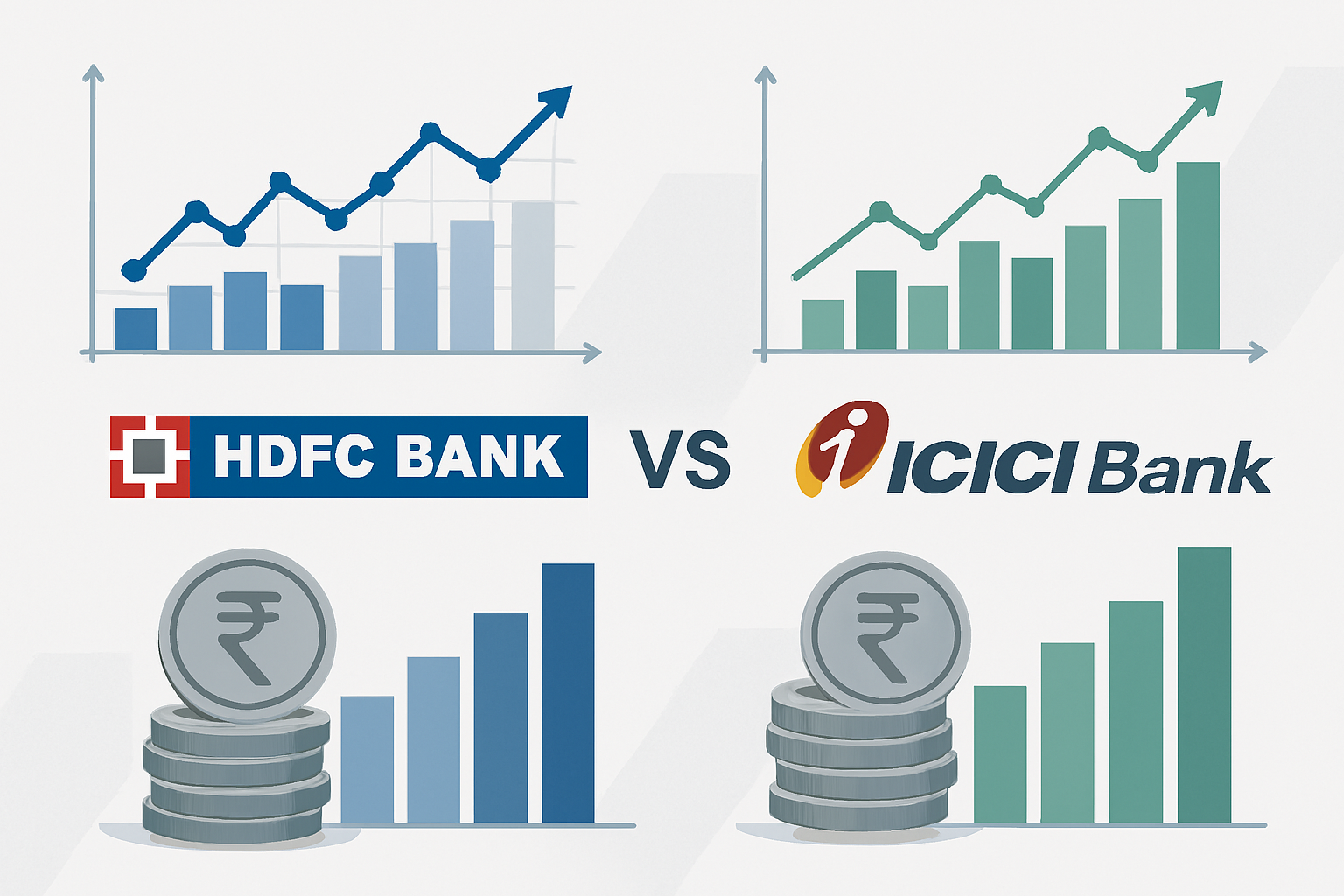
This blog explores HDFC Bank vs ICICI Bank, comparing their market performance, financial growth, and 2025 investment outlook. Investors get a deep dive into analyst views, share price trends, and sector dynamics.
Table of Contents
Understanding the Banking Sector Comparison
India’s private banking sector continues to attract significant investor attention in 2025. Two institutions stand at the forefront of this landscape: HDFC Bank and ICICI Bank. These organizations represent substantial portions of the banking sector’s market capitalization and serve as indicators of broader financial sector health.
This analysis examines the operational performance, financial metrics, strategic positioning, and investment considerations for both banks. The comparison draws on publicly available financial data, regulatory filings, and market performance indicators to provide an objective assessment of these institutions.
The examination covers recent quarterly results, technological initiatives, asset quality metrics, and analyst projections. It aims to provide factual information to help investors understand the current state of these major banking institutions.
Significance of Comparing Major Private Sector Banks
Market Position and Economic Influence
Private sector banks play a crucial role in India’s financial ecosystem. HDFC Bank holds the position as India’s largest private sector bank by market capitalization, according to stock exchange data. The institution has maintained this leadership through consistent operational performance and extensive branch networks.
ICICI Bank represents the second-largest private sector banking entity. The bank has demonstrated notable improvements in operational efficiency and digital service delivery over recent years. Both institutions contribute significantly to credit disbursement, deposit mobilization, and payment system infrastructure.
The Reserve Bank of India designates both banks as Domestic Systemically Important Banks (D-SIBs). This classification reflects their substantial impact on the financial system. Their combined assets represent a significant portion of private banking sector resources.
Investment Benchmark Status
Financial analysts and institutional investors utilize these banks as sector benchmarks. Their quarterly performance reports influence broader market sentiment regarding banking stocks. Fund managers frequently compare allocation decisions between these institutions based on specific performance metrics.
Stock market indices assign substantial weightage to both banks. Their price movements affect index performance and sector-specific exchange-traded funds. Retail and institutional investors monitor their results for insights into overall banking sector trends.
HDFC Bank: Operational Overview and 2025 Performance
Corporate Background and Strategic Position
HDFC Bank commenced operations in 1994 and has grown to operate an extensive network across India. As of March 2025, the bank maintains operations through thousands of branches and ATMs nationwide. The institution serves retail, corporate, and rural banking segments.
In 2023, HDFC Bank completed a merger with HDFC Ltd., its parent housing finance company. This consolidation created one of India’s largest banking entities by balance sheet size. The integration process continues to influence operational priorities and resource allocation.
The bank’s business model emphasizes retail banking services, including deposits, loans, and transaction services. Corporate banking and treasury operations constitute additional revenue streams. The institution maintains focus on asset quality and risk management protocols.
First Quarter 2025 Financial Performance
The bank released its Q1 FY2025 results in April 2025. Net interest income showed moderate growth compared to the previous quarter. However, net interest margins experienced pressure due to rising deposit costs, a trend observed across the banking sector.
The loan portfolio expanded during the quarter. Retail lending segments, including personal loans and credit cards, contributed to growth. Small and medium enterprise (SME) lending also showed positive momentum. Housing loans remained a significant component of the lending book.
Deposit growth continued but at varying rates across different deposit categories. Current and savings account (CASA) ratios faced pressure as customers shifted toward higher-yielding fixed deposits. This shift reflects broader market conditions and competitive dynamics.
Non-performing assets (NPAs) remained within manageable ranges. The gross NPA ratio stood at approximately 1.2-1.4% according to recent disclosures. Provision coverage ratios indicated adequate buffers against potential credit losses.
Digital Banking Initiatives and Technology Investments
HDFC Bank has invested in digital infrastructure improvements. The PayZapp platform received enhancements to improve user experience and transaction capabilities. Mobile banking application updates focused on security features and interface improvements.
Unified Payments Interface (UPI) transactions through HDFC Bank’s platforms showed volume increases. The bank processes significant UPI transaction volumes monthly. These digital payment systems represent growing revenue opportunities through transaction fees and customer engagement.
The institution has deployed data analytics tools for credit assessment and customer service. Artificial intelligence applications support fraud detection and operational efficiency improvements. Cybersecurity investments aim to protect customer information and transaction integrity.
Branch network optimization continues alongside digital expansion. The bank opens new branches in underserved markets while enhancing digital capabilities at existing locations. This dual approach addresses both physical access requirements and digital service preferences.
ICICI Bank: Performance Analysis and Strategic Direction
Institutional Background and Market Approach
ICICI Bank began operations in 1994 as a commercial banking arm of ICICI Ltd. The bank has evolved through various strategic phases, including periods of rapid expansion followed by asset quality consolidation. Currently, it operates through an extensive branch and ATM network across India.
The institution serves retail, business banking, corporate, and treasury segments. Recent strategic focus has emphasized retail lending, digital banking capabilities, and operational efficiency. The bank has invested substantially in technology infrastructure and mobile banking platforms.
ICICI Bank’s business model incorporates traditional banking services alongside digital-first approaches. The institution has developed partnerships with fintech companies and e-commerce platforms. These collaborations aim to expand customer reach and service capabilities.
Financial Performance Indicators
Recent quarterly results demonstrate consistent profitability growth. Net profit figures have shown improvement compared to year-ago periods. Return on equity (ROE) metrics have strengthened, indicating improved capital efficiency.
The bank’s lending portfolio has expanded across multiple segments. Retail loans, including personal loans, auto loans, and credit cards, have grown substantially. Corporate lending activities have also increased, with focus on creditworthy borrowers and sector diversification.
Asset quality metrics have improved significantly over recent years. Gross NPA ratios have declined to levels comparable with sector leaders. The bank’s recovery rates on stressed assets have exceeded industry averages. Provision coverage remains robust, providing cushion against potential deteriorations.
Net interest margins have remained relatively stable. The bank has managed funding costs through deposit mix optimization and competitive pricing strategies. Fee-based income from transaction services, wealth management, and insurance distribution contributes to revenue diversification.
Technology Integration and Digital Capabilities
ICICI Bank has prioritized digital banking development. Its mobile banking application receives regular updates and has won industry recognition for features and user interface design. The platform supports comprehensive banking transactions, investment services, and account management.
The bank operates digital lending platforms that streamline loan application and approval processes. These systems utilize automated credit assessment tools and reduce processing times. Small business lending has particularly benefited from these digital initiatives.
Artificial intelligence and machine learning applications support various operational functions. Customer service chatbots handle routine inquiries. Credit risk models incorporate machine learning algorithms for improved accuracy. Fraud detection systems utilize pattern recognition technologies.
Corporate banking clients access dedicated digital platforms for trade finance, cash management, and treasury services. These business-to-business (B2B) solutions differentiate the bank’s corporate banking capabilities. Integration with enterprise resource planning (ERP) systems facilitates seamless transaction processing.
Comparative Financial Analysis
Market Capitalization and Valuation Metrics
As of October 2025, HDFC Bank maintains larger market capitalization compared to ICICI Bank. Stock market valuations reflect investor perceptions of growth prospects, risk profiles, and competitive positioning. Both stocks trade on major Indian stock exchanges.
Price-to-book (P/B) ratios provide insights into market valuations relative to book values. HDFC Bank historically trades at premium P/B multiples, reflecting its market leadership and consistent performance track record. ICICI Bank’s P/B ratios have improved alongside operational performance enhancements.
Price-to-earnings (P/E) ratios indicate market expectations for future earnings growth. Comparative P/E analysis reveals investor sentiment regarding growth trajectories. Current ratios for both banks remain within historical ranges, adjusted for market conditions.
Dividend yields provide income return perspectives for investors. Both banks have maintained dividend payment track records. HDFC Bank has demonstrated consistency in dividend distributions. ICICI Bank has increased dividend payments in recent years, reflecting improved profitability.
Profitability Metrics Comparison
Return on assets (ROA) measures profit generation efficiency relative to total assets. ICICI Bank has shown improvement in ROA metrics over recent quarters. HDFC Bank maintains stable ROA levels, though affected by merger-related balance sheet changes.
Return on equity (ROE) indicates returns generated for shareholders. ICICI Bank’s ROE has strengthened to competitive levels. HDFC Bank’s ROE remains solid but faces pressure from capital requirements and margin dynamics.
Cost-to-income ratios reflect operational efficiency. ICICI Bank has achieved favorable cost-to-income ratios through technology investments and process optimization. HDFC Bank maintains competitive efficiency ratios despite integration-related costs.
Net interest margin (NIM) trends influence profitability assessments. Both banks face margin pressures from competitive deposit pricing and lending rate dynamics. HDFC Bank’s NIM has compressed slightly due to funding cost increases. ICICI Bank has managed margins through asset-liability management strategies.
Asset Quality and Risk Management
Gross NPA ratios measure asset quality health. HDFC Bank maintains low NPA levels, reflecting conservative lending practices. ICICI Bank has substantially reduced NPAs from peak levels observed in previous years. Current metrics for both banks approximate 1.2-1.5% ranges.
Net NPA ratios, which account for provisions, demonstrate actual balance sheet impact. Both banks maintain adequate provision coverage ratios. These provisions protect against potential losses from non-performing loans.
Credit cost trends indicate the expense of maintaining asset quality. ICICI Bank’s credit costs have declined as asset quality improved. HDFC Bank maintains stable, low credit costs. Both banks employ robust credit assessment procedures.
Recovery rates on written-off assets provide additional asset quality insights. ICICI Bank has demonstrated strong recovery capabilities through various resolution mechanisms. HDFC Bank maintains structured recovery processes and legal procedures.
Strategic Initiatives and Competitive Positioning
HDFC Bank’s Strategic Priorities
Following the HDFC Ltd. merger, integration activities represent key operational priorities. Management has outlined multi-year integration roadmaps covering technology systems, branch networks, and product portfolios. Successful integration aims to capture cost synergies and revenue opportunities.
The bank continues expanding retail lending products. Mortgage lending receives particular emphasis given the merged entity’s strengths in housing finance. Personal loan and credit card portfolios target middle-income customer segments.
Digital transformation initiatives aim to enhance customer experience and operational efficiency. Investments in core banking systems support transaction processing capabilities. Mobile and internet banking platforms receive continuous upgrades.
Branch network expansion focuses on emerging urban centers and semi-urban markets. Physical presence complements digital channels, particularly for complex banking needs. Branch formats vary based on location demographics and service requirements.
ICICI Bank’s Growth Strategy
Digital banking leadership represents a core strategic objective. The bank positions itself as a technology-driven institution with modern banking solutions. Mobile-first approaches target younger customer demographics and digital natives.
Retail lending growth drives overall business expansion. Personal loans, credit cards, and consumer durable financing show strong growth momentum. Housing loan portfolios compete directly with specialized housing finance companies.
Corporate banking relationships provide stable revenue streams and cross-selling opportunities. The bank targets quality corporate borrowers with comprehensive banking solutions. Trade finance and cash management services support corporate customer needs.
Operational efficiency improvements continue through process automation and digital adoption. Cost optimization efforts focus on manual process reduction and technology leverage. Efficiency gains support competitive pricing and profitability enhancement.
Analyst Perspectives and Price Target Analysis
HDFC Bank Investment Outlook
Financial research firms publish regular analysis and price targets for HDFC Bank. Leading brokerages have established price targets suggesting moderate upside potential from current levels. Target ranges typically span ₹1,900 to ₹2,050 based on discounted cash flow and relative valuation methodologies.
Analysts identify several growth drivers supporting positive outlooks. Merger synergy realization represents significant long-term value creation potential. Retail lending expansion in recovering economic conditions supports loan growth projections.
Risk factors identified include margin pressure from competitive deposit markets. Integration execution challenges could affect operational efficiency. Regulatory changes impacting banking operations represent additional considerations.
Recommendation distributions among analysts show predominantly positive ratings. “Buy” or “Accumulate” recommendations dominate coverage. “Hold” recommendations typically cite valuation considerations or near-term uncertainty.
ICICI Bank Investment Analysis
Analyst coverage of ICICI Bank reflects optimism regarding operational momentum. Price targets from major brokerages suggest upside potential ranging from 15-20%. Target prices typically range from ₹1,300 to ₹1,450 based on current market valuations.
Key investment themes include digital banking leadership and market share gains. Continued asset quality improvement provides confidence in risk management capabilities. Operating leverage potential from technology investments supports profitability projections.
Analysts highlight competitive advantages in digital customer acquisition and engagement. Superior mobile banking capabilities attract younger customer segments. Fintech partnerships expand service offerings and market reach.
Identified risks include sustaining growth momentum amid increasing competition. Technology investment returns require continued demonstration. Macroeconomic conditions affecting credit demand represent external risk factors.
Banking Sector Context and Macroeconomic Factors
Industry Trends Affecting Both Banks
India’s economic growth trajectory influences credit demand across sectors. GDP growth projections for 2025 remain positive, supporting loan growth opportunities. Consumer spending patterns affect retail lending segments.
Reserve Bank of India (RBI) monetary policy significantly impacts banking operations. Interest rate decisions affect lending rates, deposit costs, and net interest margins. Liquidity management policies influence funding strategies.
Regulatory framework evolution continues to shape banking practices. Capital adequacy requirements ensure financial stability but affect growth capacity. Compliance costs and operational procedures respond to regulatory updates.
Competition from alternative financial service providers intensifies. Fintech companies offer specialized services in payments, lending, and wealth management. Non-banking financial companies (NBFCs) compete in specific lending segments.
Digital Transformation and Technology Disruption
India’s digital payment ecosystem has expanded rapidly. UPI transaction volumes continue growing, transforming payment behaviors. Banks adapt business models to capture value from digital transactions.
Mobile banking adoption accelerates across customer segments. Smartphone penetration and internet connectivity improvements enable digital banking access. Banks invest in mobile applications and digital service capabilities.
Fintech partnerships provide technology access and market reach. Banks collaborate with fintech firms for specific capabilities while maintaining customer relationships. Regulatory frameworks facilitate controlled innovation through sandbox approaches.
Cybersecurity concerns grow alongside digital adoption. Banks invest substantially in security infrastructure and monitoring systems. Data protection regulations establish customer information safeguarding requirements.
Risk Assessment for Investors
Sector-Wide Risk Considerations
Banking sector performance correlates with economic cycles. Credit quality deteriorates during economic downturns as borrower repayment capacity weakens. Both banks maintain exposure to economic conditions affecting asset quality.
Interest rate risk affects profitability through asset-liability mismatches. Rising interest rates may pressure margins as funding costs increase faster than lending rate adjustments. Both institutions employ asset-liability management practices.
Regulatory risk stems from potential policy changes affecting operations. Capital requirement increases reduce funds available for lending or dividends. Compliance costs rise with regulatory complexity.
Competition risk intensifies from traditional banks, fintech firms, and NBFCs. Market share defense requires continuous innovation and competitive pricing. Customer acquisition and retention costs may increase.
Bank-Specific Risk Factors
HDFC Bank faces integration execution risks from the HDFC Ltd. merger. Technology system integration, cultural alignment, and operational harmonization require successful management. Integration challenges could temporarily affect performance.
The bank’s size creates advantages but also operational complexity. Managing large-scale operations efficiently requires robust systems and processes. Coordination across extensive branch networks demands effective management.
ICICI Bank must sustain recent performance momentum. Maintaining asset quality during growth phases requires disciplined credit processes. Technology investment returns need continued demonstration to justify expenditures.
The bank’s digital-first strategy exposes it to technology disruption risks. Rapid technological change requires continuous adaptation and investment. Cybersecurity threats represent ongoing operational risks.
Investment Considerations and Portfolio Strategy
Investor Profile Alignment
Conservative investors seeking stability may prefer HDFC Bank’s established track record. The institution’s market leadership position and consistent performance history appeal to risk-averse portfolios. Long-term wealth preservation and steady growth align with conservative investment objectives.
Growth-oriented investors might favor ICICI Bank’s momentum and innovation focus. The bank’s improving operational metrics and digital leadership attract growth-seeking portfolios. Higher growth potential accompanies somewhat elevated risk profiles.
Balanced portfolios may incorporate both banks for diversification benefits. Different risk-return profiles complement each other within banking sector allocations. Combined positions provide exposure to both stability and growth characteristics.
Fundamental Analysis Factors
Financial statement analysis reveals operational health and performance trends. Revenue growth rates, profitability margins, and balance sheet strength inform investment decisions. Comparing quarterly and annual results identifies momentum and consistency.
Asset quality metrics indicate credit risk exposure. NPA trends, provision requirements, and recovery rates affect profitability sustainability. Monitoring these indicators helps assess risk management effectiveness.
Capital adequacy ratios demonstrate financial strength and growth capacity. Both banks maintain capital levels above regulatory minimums. Strong capital positions support lending growth and dividend distributions.
Valuation analysis compares current prices to historical ranges and peer benchmarks. P/E and P/B ratios contextualize current valuations. Discounted cash flow models estimate intrinsic values.
Market Timing and Entry Points
Stock price volatility creates varying entry point opportunities. Market corrections may provide attractive valuation levels for long-term investors. Dollar-cost averaging reduces timing risk through systematic investments.
Quarterly result announcements influence short-term price movements. Results exceeding expectations typically generate positive price reactions. Disappointing results may create temporary price weakness and potential entry opportunities.
Broader market conditions affect banking stock performance. Market-wide corrections impact valuations despite individual bank fundamentals. Patient investors may capitalize on market volatility.
Future Outlook and Long-Term Projections
HDFC Bank’s Long-Term Prospects
The merged entity’s scale provides competitive advantages in various markets. Extensive branch networks enable customer reach in underserved geographies. Housing finance capabilities strengthen offerings in mortgage segments.
Technology investments aim to modernize infrastructure and enhance customer experience. Digital channel improvements support operational efficiency and customer convenience. Legacy system upgrades position the bank for future requirements.
Market leadership defense requires continuous innovation and service quality maintenance. Customer retention and acquisition strategies respond to competitive pressures. Brand strength and trust support customer loyalty.
Merger synergy realization over coming years affects valuation assessments. Cost synergies from operational integration enhance profitability. Revenue synergies from cross-selling opportunities provide growth avenues.
ICICI Bank’s Growth Trajectory
Digital banking leadership positions the institution for future market evolution. Technology-savvy customer segments represent significant growth opportunities. First-mover advantages in digital services provide competitive differentiation.
Operational efficiency improvements drive profitability enhancement. Process automation reduces costs and improves service delivery. Technology leverage enables scalable growth without proportional cost increases.
Market share gains in retail and corporate segments support growth projections. Competitive products and services attract customers from other institutions. Geographic expansion and segment penetration provide growth vectors.
Asset quality maintenance during growth phases demonstrates risk management capabilities. Disciplined lending practices sustain profitable growth. Recovery capabilities support through-the-cycle performance.
Regulatory Compliance and Governance
Regulatory Framework Adherence
Both banks operate under RBI’s regulatory supervision. Capital adequacy, liquidity, and asset quality norms establish minimum operational standards. Regular reporting and disclosure requirements ensure transparency.
Basel III implementation affects capital planning and risk management. Risk-weighted asset calculations influence capital requirements. Both banks maintain comfortable buffers above minimum thresholds.
Know Your Customer (KYC) and Anti-Money Laundering (AML) regulations govern customer onboarding and monitoring. Compliance systems detect suspicious transactions and ensure regulatory adherence. Regular audits verify compliance effectiveness.
Data protection regulations govern customer information handling. Both banks implement security measures and privacy policies. Cybersecurity standards protect against data breaches and unauthorized access.
Corporate Governance Practices
Board structures include independent directors providing oversight. Audit committees review financial reporting and internal controls. Risk management committees monitor exposure and mitigation strategies.
Management teams comprise experienced banking professionals. Leadership continuity affects strategic execution and institutional stability. Succession planning ensures smooth leadership transitions.
Stakeholder communication occurs through quarterly results, annual reports, and investor presentations. Transparency in financial reporting builds investor confidence. Regulatory disclosures provide operational insights.
Frequently Asked Questions
What are the key differences between HDFC Bank and ICICI Bank?
HDFC Bank operates as India’s largest private sector bank by market capitalization. The institution emphasizes retail banking, conservative risk management, and extensive branch networks. Recent merger with HDFC Ltd. has expanded balance sheet size significantly.
ICICI Bank ranks as the second-largest private bank. The institution focuses on digital banking innovation, operational efficiency, and technology integration. Recent years have seen substantial asset quality improvements and profitability growth.
Both banks serve retail, corporate, and SME segments. Different strategic emphases create distinct competitive positions and investor appeal profiles.
How do asset quality metrics compare between the two banks?
Current gross NPA ratios for both banks approximate 1.2-1.5% according to recent regulatory filings. HDFC Bank has maintained consistently low NPA levels through conservative lending practices. ICICI Bank has substantially reduced NPAs from higher historical levels.
Provision coverage ratios for both institutions remain adequate. These provisions protect balance sheets against potential credit losses. Recovery rates on stressed assets show healthy levels at both banks.
Asset quality metrics indicate effective risk management at both institutions. Current levels support continued lending growth and profitability.
Which bank offers better returns for long-term investors?
Historical returns vary based on investment timing and holding periods. HDFC Bank has delivered consistent long-term returns through steady operational performance. ICICI Bank has shown stronger recent momentum as operational improvements materialized.
Analyst projections suggest different growth trajectories. ICICI Bank projections indicate 15-20% potential upside based on current valuations. HDFC Bank targets suggest 12-15% upside potential.
Long-term returns depend on successful strategy execution, market conditions, and sector dynamics. Both banks represent quality franchises with growth prospects.
How do digital banking capabilities compare?
ICICI Bank has established leadership in mobile banking applications and digital services. The platform receives industry recognition for features and user experience. Fintech partnerships expand service capabilities.
HDFC Bank possesses strong UPI transaction volumes and extensive digital customer base. PayZapp platform provides comprehensive digital banking services. Technology investments focus on infrastructure modernization.
Both banks invest substantially in digital capabilities. ICICI emphasizes digital-first approaches while HDFC leverages scale advantages in digital adoption.
What impact has the HDFC merger had on HDFC Bank?
The 2023 merger with HDFC Ltd. created one of India’s largest banking entities. Balance sheet expansion provides scale advantages and diversified business mix. Housing finance capabilities strengthened through merged operations.
Integration activities continue across technology, operations, and branch networks. Management focuses on capturing cost synergies and revenue opportunities. Integration complexity affects near-term operational priorities.
Long-term merger benefits include market position strengthening and cross-selling opportunities. Successful integration execution remains key to realizing projected value creation.
How do funding costs and net interest margins differ?
Both banks face competitive deposit market conditions. Rising deposit costs pressure net interest margins across the banking sector. CASA ratio maintenance affects overall funding costs.
HDFC Bank has experienced margin compression due to funding cost increases. The bank manages these pressures through asset-liability strategies and pricing adjustments.
ICICI Bank maintains relatively stable margins through deposit mix optimization. Competitive deposit pricing balances growth and profitability objectives.
Industry-wide margin pressures require ongoing management attention at both institutions.
What are the dividend payment track records?
HDFC Bank maintains consistent dividend payment history. The institution typically distributes dividends based on profitability and capital requirements. Current dividend yields approximate 1.2-1.5% based on market prices.
ICICI Bank has increased dividend payments in recent years. Improved profitability enables enhanced shareholder returns. Dividend yields remain comparable to sector averages.
Both banks balance dividend distributions with capital retention for growth financing. Dividend policies consider regulatory requirements and business expansion needs.
Which bank is better positioned for India’s economic growth?
Both banks participate in India’s economic expansion through lending and banking services. HDFC Bank’s extensive retail presence positions it for consumer segment growth. Mortgage lending capabilities benefit from housing sector demand.
ICICI Bank’s corporate banking relationships support industrial and infrastructure financing. Digital capabilities attract younger demographics entering banking systems.
India’s economic growth benefits both institutions through credit demand and transaction volume increases. Differentiated strategies enable participation across various growth segments.
Author Information
Author Name: Nueplanet team
Bio: Our team comprises financial analysts with extensive experience covering Indian banking and capital markets. We focus on providing objective, data-driven analysis based on publicly available financial information, regulatory filings, and market data. Our commitment is to deliver accurate, transparent, and unbiased financial content.
About Our Approach: This analysis utilizes official sources including stock exchange filings, company financial statements, Reserve Bank of India publications, and Securities and Exchange Board of India (SEBI) disclosures. We prioritize factual accuracy and objective assessment over promotional content or stock recommendations.
Last Updated: September 01, 2025
Published: September 01, 2025
Disclaimer: This content is for informational purposes only and does not constitute investment advice, financial guidance, or stock recommendations. Investors should conduct independent research and consult qualified financial advisors before making investment decisions. Past performance does not guarantee future results. All financial data is derived from publicly available sources and subject to change.
Helpful Resources
Latest Posts
- Al Akhdoud vs Al-Ittihad: Benzema’s Hat-Trick Seals Dominant 5-2 Saudi Pro League Victory
- August: India’s Economic Growth and Key Developments
- CG Power Share Price — A Turning Point for India’s Industrial Powerhouse
- LNMU UG Admission 2025: Latest Updates on Registration, Merit Lists, and Vacant Seats
- Ather Energy Share Price: Innovation Sparks a Market Rally
Related Posts












Post Comment