









GST Meeting 2025: Key Highlights, Decisions, and Impact on Economy
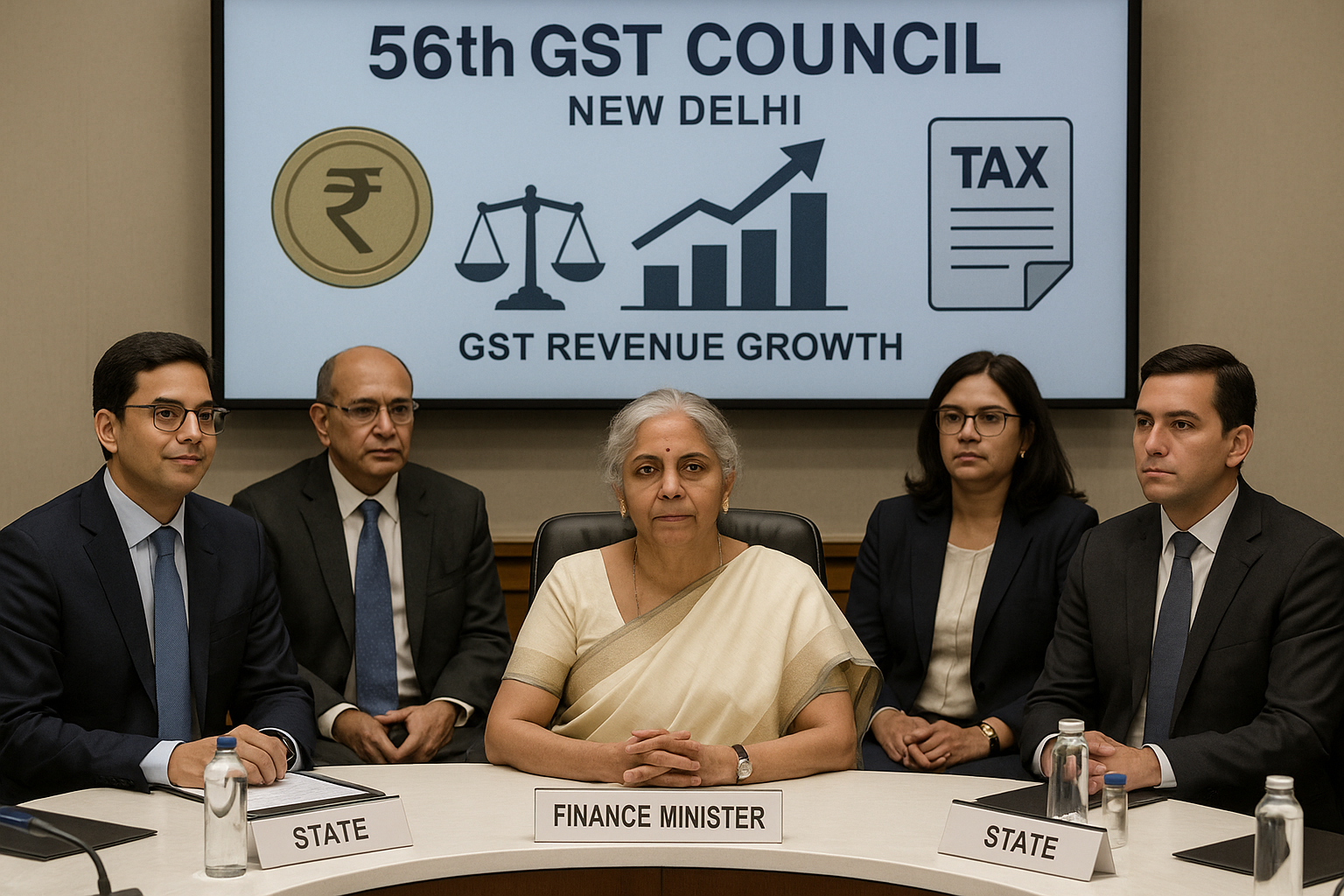
The 56th GST Council meeting has brought several important policy decisions impacting businesses and consumers. Here’s a comprehensive breakdown of updates, reforms, and implications from the latest GST meeting.
Table of Contents
Published: September 03, 2025 | Last Updated: September 03, 2025
Overview of the 56th GST Council Meeting
The 56th GST Council meeting concluded with several policy decisions affecting India’s indirect tax framework. Finance Minister Nirmala Sitharaman chaired the session, which included state finance ministers and tax administration officials. The meeting addressed tax rate adjustments, compliance procedures, and sector-specific issues.
The Council discussed proposals related to rate rationalization across multiple sectors. Decisions were made regarding compliance simplification measures for different business categories. State governments and the central government reached consensus on revenue-sharing mechanisms and implementation timelines.
This analysis examines the decisions announced during the meeting. It covers implications for businesses, consumers, and the broader economy based on official statements and government releases.
Understanding India’s GST Framework
Background of GST Implementation
The Goods and Services Tax was implemented on July 1, 2017, replacing multiple indirect taxes. The previous system included central excise duty, service tax, value-added tax, and various state-level levies. GST created a unified national market by eliminating tax barriers between states.
The tax structure operates under a dual model. The Central GST applies to intra-state transactions, while State GST applies simultaneously. Integrated GST covers inter-state transactions, with revenue distributed between central and state governments.
The GST Council serves as the decision-making body for tax policy. It consists of the Union Finance Minister as chairperson and state finance ministers as members. Decisions require a three-fourths majority for approval.
GST Rate Structure
GST applies in five rate slabs: 0%, 5%, 12%, 18%, and 28%. Essential items like food grains and healthcare services are exempt or taxed at lower rates. Luxury goods and demerit goods attract the highest tax rates. Additional cess applies to certain items like automobiles and tobacco products.
The multi-rate structure aims to balance revenue collection with affordability. Lower rates apply to necessities, while higher rates target non-essential consumption. This progressive structure addresses equity concerns while maintaining revenue adequacy.
Key Decisions from the Recent GST Council Meeting
Tax Rate Adjustments
The Council announced rate modifications across several product categories. These adjustments addressed inverted duty structures where input tax rates exceeded output tax rates. Such inversions create working capital challenges for manufacturers due to accumulated input tax credits.
Manufacturing Sector Changes:
- Textile products received rate adjustments to address long-standing duty inversion issues
- Pharmaceutical items saw clarifications on classification and applicable rates
- Automotive components received revised rates to support domestic manufacturing
- Electronic goods rates were modified to encourage local production
Service Sector Modifications:
- Information technology services received definitional clarity on taxable services
- Financial services taxation framework was refined for banking and insurance operations
- Transportation and logistics services saw rate optimizations
- Hospitality sector received targeted relief measures
The rate changes aim to reduce compliance complexity and improve tax credit flows. Industry associations had requested these modifications through formal representations to the Council.
Compliance Procedure Reforms
The meeting announced several measures to simplify tax compliance procedures. These reforms target reducing the time and cost businesses spend on tax administration. Digital infrastructure improvements formed a core component of these changes.
Return Filing Simplifications:
- Consolidation of multiple return formats into streamlined versions
- Extended timelines for small taxpayers to file returns
- Automated input tax credit reconciliation systems
- Reduced frequency of return filing for eligible businesses
E-invoicing Expansion: The mandatory e-invoicing threshold was adjusted. Businesses below certain turnover limits received exemptions or phased implementation timelines. The e-invoicing system generates unique invoice reference numbers for real-time tracking.
Digital Interface Improvements:
- Mobile applications for return filing and tax payment
- Simplified registration processes with reduced documentation
- Online grievance redressal mechanisms
- Automated notices and communication systems
These changes address long-standing industry demands for reduced compliance burden. Small businesses particularly benefit from simplified procedures and extended timelines.
MSME Support Measures
The Council announced a relief package for Micro, Small, and Medium Enterprises. MSMEs contribute approximately 30% of India’s GDP and employ over 110 million people. The sector faced challenges with GST compliance due to limited administrative capacity.
Turnover Threshold Changes: The composition scheme turnover limit was increased. This scheme allows businesses to pay tax at a fixed percentage of turnover instead of regular GST rates. Eligible businesses can file quarterly returns instead of monthly submissions.
For goods traders and manufacturers, the limit increased to ₹3 crore annual turnover. Service providers received an increased limit of ₹75 lakh annual turnover. These changes expand the number of businesses eligible for simplified compliance.
Payment and Filing Relief:
- Extended payment cycles for registered small businesses
- Reduced interest rates on delayed payments for MSMEs
- Conditional penalty waivers for first-time procedural violations
- Dedicated helpdesks and support systems for technology adoption
Implementation Support: The government announced training programs for MSME owners and staff. These programs cover GST compliance procedures, software usage, and documentation requirements. Industry associations will partner with tax authorities for outreach activities.
Sector-Specific Impact Analysis
Healthcare and Pharmaceutical Sector
Healthcare taxation received focused attention during the meeting. The sector’s importance increased during the pandemic, highlighting the need for affordable healthcare access. Tax rates on medical equipment and pharmaceutical products affect healthcare costs significantly.
Medical Equipment and Devices: GST rates on critical care equipment were reviewed. Items like ventilators, oxygen concentrators, and diagnostic devices have significant import content. Rate adjustments aimed to reduce the overall cost of healthcare delivery.
Essential medical devices received rate rationalizations. The inverted duty structure on medical equipment imports was addressed through input tax credit clarifications. This should reduce working capital requirements for healthcare facilities.
Pharmaceutical Products: Essential medicines taxation was examined for affordability improvements. Generic drug manufacturers requested rate rationalization to improve competitiveness. The Council provided clarity on classification disputes affecting various drug categories.
Healthcare Services: Telemedicine and digital health services received definitional clarity. The expanding digital health sector required guidelines on service classification and applicable tax rates. Traditional healthcare services continued under existing exemption frameworks.
Industry estimates suggest these changes could reduce healthcare delivery costs by 3-5% across various services. Improved affordability should increase healthcare access, particularly in tier-2 and tier-3 cities.
Real Estate and Construction Industry
Real estate taxation has evolved significantly since GST implementation. The sector transitioned from service tax to GST in 2017. Under-construction property sales attract GST, while completed property sales are exempt.
Under-Construction Properties: The Council reviewed tax treatment of ongoing residential projects. Builders purchase construction materials and services with GST input tax credits. The output tax on property sales should ideally cover these input credits to avoid cost accumulation.
The current 5% GST rate on affordable housing and 5% without input tax credit on other residential properties continued. The Council addressed specific implementation issues raised by developers and state governments.
Commercial Real Estate: Commercial property transactions received clarification on tax applicability. Lease and rental arrangements for commercial properties operate under defined tax frameworks. The meeting addressed disputes regarding classification and valuation methods.
Construction Materials: Rates on cement, steel, and other building materials significantly impact construction costs. Any rate modifications affect overall property prices. The Council examined duty structures across the construction material value chain.
Industry representatives estimate these measures could reduce property costs by 2-4% depending on project specifications. Improved clarity should reduce litigation and disputes between taxpayers and tax authorities.
Digital Economy and E-commerce
The digital economy’s rapid growth necessitated updated tax frameworks. E-commerce platforms operate as intermediaries between sellers and buyers. Tax collection responsibility and compliance procedures require clear definitions.
E-commerce Marketplace Taxation: Platforms facilitating third-party sales have specific tax collection obligations. The Tax Collection at Source mechanism requires platforms to collect 1% of transaction value. This ensures tax compliance by sellers operating through digital platforms.
The Council reviewed threshold limits and exemptions for small sellers. Compliance burden on small businesses selling through e-commerce platforms was examined. Simplified procedures were announced for specific seller categories.
Digital Services and Products: Software services, digital content, and online subscriptions received definitional clarity. Cloud computing services, streaming platforms, and digital advertising operate under specified tax frameworks. Cross-border digital service taxation aligns with international standards.
Online Gaming and Entertainment: The online gaming industry’s taxation framework received attention. The distinction between games of skill and games of chance affects tax treatment. The Council provided guidance on valuation methods and applicable rates.
These clarifications should reduce disputes and litigation in the growing digital economy sector. Industry associations welcomed the definitional clarity for business planning purposes.
Textile and Garment Industry
The textile sector faced significant challenges due to inverted duty structures. Cotton and synthetic fiber taxation at higher rates than finished garments created working capital issues. The industry is labor-intensive, employing over 45 million people directly and indirectly.
Inverted Duty Structure Resolution: The Council addressed rate anomalies across the textile value chain. Fiber, yarn, fabric, and garment taxation was examined comprehensively. Changes aimed to ensure smooth input tax credit flows without accumulation.
Rate adjustments balanced revenue considerations with industry competitiveness. Export-oriented units received special attention due to their foreign exchange contribution. Refund procedures for accumulated credits were streamlined.
Garment Manufacturing: Ready-made garment taxation affects both domestic consumption and export competitiveness. India’s garment exports compete with countries like Bangladesh and Vietnam. Tax policies influence manufacturing costs and global competitiveness.
The sector welcomed measures to improve credit availability and reduce compliance costs. Industry estimates suggest potential cost reductions of 3-6% through improved tax credit flows.
Economic Impact Assessment
Revenue Collection Trends
GST collections have shown steady growth since implementation. Monthly collections crossed ₹1.7 lakh crore in recent months, indicating strong economic activity. The seven-year collection trend shows increasing compliance and economic growth.
Historical Performance: Average monthly collections grew from approximately ₹90,000 crore in FY 2017-18 to over ₹1.65 lakh crore in FY 2024-25. This growth reflects expanding tax base, improved compliance, and economic expansion. Collection efficiency improved through technology implementation.
Revenue Projections: Government estimates suggest collections could reach ₹2.0 lakh crore monthly within 18-24 months. This projection assumes continued economic growth and improved compliance rates. Rate rationalizations are expected to expand the tax base by bringing more transactions into formal channels.
State Revenue Impact: State governments depend on GST collections for fiscal operations. The compensation cess mechanism ended in June 2022, requiring states to rely entirely on GST collections. Revenue-sharing arrangements between center and states continue under the constitutional framework.
Impact on Inflation and Prices
GST rate changes affect consumer prices across categories. Lower rates on essential items reduce inflationary pressures. Higher rates on luxury goods minimize impact on common households while maintaining revenue adequacy.
Consumer Price Dynamics: Rate reductions on healthcare, education, and essential items directly benefit consumers. The Consumer Price Index basket includes items affected by GST rate changes. Monetary policy considerations factor in GST’s impact on inflation trends.
Recent rate adjustments aimed at moderating prices in specific sectors. Healthcare cost reductions improve affordability without compromising quality. Essential commodity taxation remained stable to maintain price predictability.
Producer Price Effects: Input cost changes affect manufacturing costs and competitiveness. Inverted duty structure corrections reduce working capital requirements. Manufacturers can price products more competitively when input tax credits flow smoothly.
Business Competitiveness
GST’s impact on business competitiveness operates through multiple channels. Simplified compliance reduces administrative costs. Improved logistics efficiency from removing inter-state barriers enhances competitiveness.
Manufacturing Sector Competitiveness: Domestic manufacturers compete with imports in many product categories. GST rates affect the landed cost of imports relative to domestic production. Input tax credit availability influences manufacturing economics significantly.
Rate rationalizations addressing inverted duties improve manufacturer cash flows. Accumulated credits previously locked in working capital become available for productive use. This improves return on investment and encourages capacity expansion.
Services Sector Dynamics: Service exports contribute significantly to foreign exchange earnings. IT services, business process outsourcing, and professional services operate in competitive global markets. Tax frameworks affect service delivery costs and pricing strategies.
Compliance simplifications reduce administrative overhead for service providers. Digital interfaces improve efficiency in tax-related processes. These improvements enhance India’s competitiveness in global service markets.
Employment and Enterprise Creation
GST’s structural impact on employment operates through formal sector expansion. Simplified compliance encourages business formalization. Registered businesses access formal credit markets and growth opportunities.
MSME Employment Effects: Small businesses account for significant employment generation. MSME support measures announced in the Council meeting should encourage enterprise creation. Simplified registration and compliance procedures reduce entry barriers for new businesses.
Quarterly return filing options free up time for productive activities. Reduced compliance costs improve profitability, enabling business expansion. Each growing MSME generates direct and indirect employment opportunities.
Formal Sector Expansion: GST incentivizes business formalization through input tax credit mechanisms. Unregistered businesses cannot claim credits, creating disadvantages in formal supply chains. This encourages voluntary registration and compliance.
Formal sector jobs typically offer better social security and working conditions. The transition from informal to formal employment improves overall job quality. Social security coverage expands with formal sector growth.
Federal Fiscal Relations
Center-State Revenue Sharing
GST operates under constitutional provisions for cooperative federalism. Revenue sharing between central and state governments follows established formulas. The GST Council serves as the forum for resolving fiscal disputes.
Constitutional Framework: The 101st Constitutional Amendment enabled GST implementation. It provided for a GST Council to make recommendations on tax rates and policies. States retained their taxation powers within the GST framework through State GST legislation.
Revenue from Integrated GST on inter-state transactions is divided between origin and destination states. The settlement mechanism operates through electronic credit ledgers. This ensures efficient revenue distribution without physical fund transfers.
Compensation Mechanism: The original GST design included a five-year compensation guarantee to states. This protected states from revenue losses during the transition period. The compensation cess on luxury and demerit goods funded these payments.
The compensation period ended in June 2022. States now rely entirely on their share of GST collections. Revenue performance varies across states based on economic activity and consumption patterns.
State-Specific Considerations
Different states have varied economic structures affecting GST revenue. Manufacturing states generate substantial IGST collections. Consumption-oriented states benefit from destination-based taxation principles.
Manufacturing States: States with significant manufacturing bases generate revenue through production activities. However, destination-based taxation means final revenue accrues to consuming states. Manufacturing states advocated for origin-based components in revenue sharing.
The GST design balanced these interests through the IGST mechanism. Manufacturing states retain CGST and SGST on intra-state sales. Inter-state sales generate IGST, which is distributed based on destination.
Consuming States: States with high consumption but limited manufacturing benefit from destination-based taxation. Tourism-oriented states, for example, generate revenue from visitor consumption. Urban states with high-income populations see strong GST collections.
Special Category States: Northeastern states and hill states received special consideration in GST design. These states have limited industrial bases and depend on central transfers. Special provisions ensure adequate revenue for state operations.
Technology Integration in GST Administration
Digital Infrastructure Development
GST implementation accelerated digital transformation in tax administration. The GSTN (Goods and Services Network) provides the technology backbone. All registrations, return filings, and payments occur through digital interfaces.
GSTN Architecture: The network handles millions of daily transactions from businesses nationwide. Cloud-based infrastructure ensures scalability and reliability. Data security protocols protect taxpayer information while enabling analytics.
Application Programming Interfaces allow software developers to create GST-compliant solutions. Businesses can integrate GST compliance into their accounting systems. This seamless integration reduces manual data entry and errors.
Mobile-First Approach: Mobile applications enable GST compliance from smartphones. Small businesses without computer access can fulfill obligations through mobile devices. Voice-enabled features improve accessibility for diverse user groups.
The government emphasized universal digital access in compliance design. Public computer centers and business facilitators assist businesses lacking digital infrastructure. This inclusive approach ensures compliance capability across business segments.
Data Analytics and Compliance
Digital tax administration generates massive data on economic transactions. Analytics capabilities enable pattern recognition and compliance monitoring. Artificial intelligence applications improve tax administration efficiency.
Risk-Based Assessment: Data analytics identify high-risk taxpayers requiring detailed scrutiny. Compliance history, transaction patterns, and industry benchmarks inform risk scoring. This enables efficient deployment of limited administrative resources.
Automated systems flag transactions requiring verification. Fake invoice generation, circular trading, and other evasion schemes show specific patterns. Technology-enabled detection improves significantly over manual methods.
Compliance Improvement: Analytics identify systemic compliance issues requiring policy intervention. Common errors in return filing can be addressed through interface improvements. Taxpayer education focuses on frequently occurring mistakes.
Real-time data availability enables faster policy feedback loops. The impact of rate changes or compliance modifications can be assessed quickly. This evidence-based approach improves policy effectiveness.
Blockchain Technology Exploration
The government announced pilot programs exploring blockchain applications in GST. Distributed ledger technology offers potential benefits for transaction verification. Immutable records could reduce disputes and litigation.
Potential Applications: Invoice authenticity verification could occur through blockchain timestamps. Supply chain tracking using distributed ledgers would provide end-to-end visibility. Input tax credit matching could be automated through smart contracts.
Pilot projects will test these applications in controlled environments. Scalability, cost-effectiveness, and integration with existing systems require evaluation. Successful pilots could lead to broader implementation.
Challenges and Implementation Considerations
Transition Management
Policy changes require careful transition management to minimize disruption. Businesses need time to understand new requirements and adjust systems. Tax authorities require training on updated procedures and classifications.
Phased Implementation: Complex changes are implemented in phases based on business size or sector. Large taxpayers typically adopt changes first, followed by smaller businesses. This staged approach allows learning from early implementation experiences.
Adequate notice periods enable businesses to prepare for changes. Software vendors update their products to reflect new requirements. Training programs familiarize users with modified procedures.
Stakeholder Communication: Clear communication of changes through multiple channels ensures awareness. Official notifications, press releases, and social media announcements reach different audiences. Industry associations disseminate information to their members.
Helpdesks and support systems address implementation queries. FAQs and guidance documents clarify ambiguous provisions. This comprehensive support structure facilitates smooth transitions.
Compliance Monitoring
Simplified compliance procedures must be balanced with adequate monitoring. Revenue protection requires effective verification mechanisms. Technology enables this balance through smart compliance monitoring.
Verification Systems: Automated cross-matching of purchase and sale data identifies discrepancies. Input tax credit claims are verified against corresponding output tax liability. Mismatches generate alerts for investigation.
Risk-based verification focuses resources on high-risk cases. Compliant taxpayers face minimal interference in operations. This differentiated approach improves both compliance and taxpayer satisfaction.
Penalty Frameworks: Penalty structures balance deterrence with reasonableness. Genuine mistakes receive different treatment than deliberate evasion. First-time violations by small businesses may receive warnings rather than penalties.
Progressive penalty structures escalate with repeat violations. This encourages voluntary compliance while providing fair treatment for minor infractions.
Inter-State Coordination
Effective GST administration requires coordination among central and state tax authorities. Information sharing enables comprehensive taxpayer visibility. Coordinated enforcement prevents jurisdiction shopping by taxpayers.
Integrated Scrutiny: Joint scrutiny teams with central and state representatives examine complex cases. Shared databases provide complete transaction visibility across jurisdictions. Coordinated action prevents duplicate proceedings on the same issues.
Dispute resolution mechanisms address jurisdictional conflicts. The GST Council provides forums for resolving inter-state disputes. Clear guidelines minimize conflicts requiring escalation.
Global Comparisons and Best Practices
International VAT/GST Models
Many countries operate Value Added Tax or GST systems. India’s model draws on global experiences while addressing local requirements. Comparative analysis provides insights for continuous improvement.
European Union VAT: The EU operates a coordinated VAT system across member states. Standard rates, reduced rates, and exemptions follow community guidelines. Cross-border trade uses specific mechanisms for tax collection.
India’s IGST resembles EU’s intra-community supply mechanisms. Both systems aim to ensure taxation at the destination. However, India’s integrated approach within a single country differs from EU’s multi-country coordination.
Canadian GST/HST: Canada operates federal GST with some provinces harmonizing their sales taxes. This dual system resembles India’s CGST/SGST structure. Canadian experiences with harmonization informed India’s GST design.
Australian GST: Australia implemented GST in 2000, replacing multiple indirect taxes. The system uses a single rate with limited exemptions. Revenue is collected federally and distributed to states. Australia’s simplified structure offers lessons for potential Indian reforms.
Lessons for India
International experiences suggest several areas for potential improvement. These include rate structure simplification, broader tax base, and comprehensive digitalization. Learning from other countries’ challenges avoids repeating mistakes.
Rate Simplification: Multiple rates create classification disputes and compliance complexity. International trend favors fewer rates with broader bases. India could consider gradual rate consolidation as revenue stability permits.
Base Broadening: Many international systems have narrower exemption lists than India. Broader bases allow lower rates for equivalent revenue. India exempts petroleum products and alcohol, limiting base comprehensiveness.
Administrative Efficiency: Best international practices emphasize taxpayer services alongside enforcement. Self-assessment with smart compliance monitoring reduces administrative burden. India’s digital-first approach aligns with global best practices.
Future Reform Roadmap
Potential Rate Structure Changes
Long-term GST evolution may involve rate structure simplification. The current five-slab system could consolidate toward fewer rates. This would require careful revenue impact assessment and stakeholder consultation.
Rate Consolidation Possibilities: International experience suggests 2-3 rate slabs suffice for most economies. A standard rate, reduced rate for essentials, and zero rate for specific items could work. Transition would require managing revenue implications carefully.
Rate rationalization could reduce classification disputes. Clear distinctions between rate categories minimize litigation. Simpler structures improve compliance and reduce administrative costs.
Inclusion of Excluded Items
Petroleum products and alcohol remain outside GST currently. Their inclusion would complete the GST framework. However, revenue considerations and pricing sensitivities create challenges.
Petroleum Products: States derive significant revenue from petroleum taxes. GST inclusion requires alternative revenue arrangements for states. Politically sensitive pricing makes reform timing crucial.
Technical preparation for petroleum inclusion continues. Rate structures, revenue sharing, and implementation mechanisms are under study. Future GST Council meetings may address this progressively.
Alcoholic Beverages: Alcohol remains under state excise systems. Public health considerations and revenue needs complicate GST inclusion. States with prohibition policies face unique challenges.
Compliance Further Simplification
Ongoing technological advancement enables additional compliance simplifications. Return processes could be further streamlined. Real-time compliance monitoring might reduce periodic filing requirements.
Return Process Evolution: Future systems may eliminate separate return filing through continuous transaction reporting. E-invoicing data could auto-populate returns. Taxpayers would verify rather than manually enter data.
Pre-filled returns based on vendor-reported data could become standard. Taxpayers would confirm or modify pre-filled information. This approach reduces compliance burden substantially.
Conclusion and Summary
The 56th GST Council meeting addressed multiple aspects of India’s indirect tax system. Rate adjustments across sectors aimed to resolve duty inversions and compliance issues. Simplification measures particularly benefit small and medium enterprises.
Healthcare, real estate, digital economy, and manufacturing sectors received focused attention. Changes should reduce costs and improve competitiveness in these industries. Consumer prices may moderate in categories receiving rate reductions.
Federal cooperation between center and states continues through the GST Council framework. Revenue sharing mechanisms balance diverse state interests. Implementation support ensures smooth transition to modified procedures.
Technology integration strengthens compliance monitoring while simplifying procedures. Digital infrastructure enables data-driven policy making. Future reforms may further streamline the rate structure and expand the tax base.
The decisions reflect ongoing GST evolution based on implementation experience. Stakeholder feedback informs policy refinements. India’s GST system continues developing toward greater efficiency and simplicity.
Note: This analysis is based on publicly available information about GST Council decisions. Businesses should refer to official notifications for specific compliance requirements. Professional tax advice is recommended for business-specific situations.
Frequently Asked Questions (FAQs)
What is the GST Council and what role does it play?
The GST Council is a constitutional body established under Article 279A of the Indian Constitution. It consists of the Union Finance Minister as chairperson and state finance ministers as members. The Council makes recommendations on GST rates, exemptions, threshold limits, and other policy matters.
Decisions require a three-fourths majority vote, with the central government having one-third voting power and states having two-thirds collectively. This structure ensures cooperative federalism in indirect tax policy. The Council typically meets every two to three months to review implementation and make necessary policy adjustments.
All GST policy changes go through the Council’s recommendation process before implementation. This collaborative approach balances central government and state government interests. The Council also has standing committees examining specific issues between plenary meetings.
How do GST rate changes affect consumer prices?
GST rate changes directly impact the final price consumers pay for goods and services. When rates decrease, businesses can pass on cost savings to consumers through lower prices. However, competitive dynamics and market conditions determine actual price transmission.
For essential items like healthcare and education, rate reductions improve affordability for common households. The impact varies by product category and market structure. Highly competitive markets typically see faster price adjustments than oligopolistic sectors.
Inverted duty structure corrections benefit consumers indirectly. Manufacturers with better cash flows from smooth credit flows may price products more competitively. Reduced compliance costs for businesses could also translate to consumer benefits over time.
Tax rate increases on luxury or demerit goods affect primarily higher-income consumers. This progressive structure protects lower-income households from tax burden. Overall price impact depends on the specific items affected and their weight in household consumption baskets.
What compliance simplifications were announced for small businesses?
Small businesses received several compliance relief measures in the recent GST Council meeting. The composition scheme turnover threshold increased to ₹3 crore for goods and ₹75 lakh for services. This allows more businesses to use simplified compliance procedures with quarterly return filing.
Eligible small businesses can now file returns quarterly instead of monthly. This reduces the administrative burden and associated costs. The composition scheme allows paying tax at a fixed percentage of turnover rather than regular GST rates and procedures.
Penalty waiver provisions for first-time procedural violations provide relief for genuine mistakes. Reduced interest rates on delayed payments specifically for MSMEs improve working capital management. Extended payment timelines give small businesses more flexibility in tax payment.
Digital support systems and training programs help small businesses adopt technology for compliance. Simplified registration processes with reduced documentation requirements lower entry barriers. These measures collectively reduce compliance costs while maintaining revenue integrity.
How does GST impact India’s manufacturing competitiveness?
GST significantly impacts manufacturing competitiveness through multiple channels. The elimination of cascading taxes (tax on tax) reduces production costs. Input tax credit mechanism ensures manufacturers don’t bear tax burden on their inputs.
Inverted duty structure corrections announced in Council meetings improve cash flows. When input tax rates exceed output rates, manufacturers accumulate credits. These corrections free up working capital previously locked in accumulated credits.
Seamless inter-state movement without check-posts reduces logistics costs and time. Manufacturers can optimize their supply chain nationally rather than establishing units in each state. This creates economies of scale and improves efficiency.
However, imported goods compete with domestic manufactures under the same GST regime. Customs duty provides protection for domestic industry from imports. The combined impact of customs duty and GST determines competitiveness vis-à-vis imports.
Export-oriented industries benefit from zero-rated exports under GST. All input taxes on exported goods can be refunded, ensuring Indian exports compete without domestic tax burden. Simplified refund procedures improve working capital availability for exporters.
What is the inverted duty structure problem and how does GST address it?
Inverted duty structure occurs when tax rates on inputs exceed tax rates on finished products. This creates accumulated input tax credits that manufacturers cannot utilize against output tax liability. The excess credits get locked as working capital, affecting business cash flows.
For example, if raw material attracts 18% GST but finished product attracts 12% GST, the difference accumulates. Manufacturers must seek refunds for these accumulated credits. Refund processes, though improved, still involve procedural steps and time delays.
The GST Council addresses inversions by rationalizing rates across value chains. Rate adjustments ensure smooth credit flow from inputs to outputs. Recent textile sector changes specifically addressed long-standing inversion problems.
When inversions cannot be eliminated through rate changes, refund procedures are streamlined. Automated refund processing reduces time from claim to credit. Electronic verification replaces physical document submission in many cases.
Industry representations to the GST Council frequently highlight inversion problems. The Council examines these sector-by-sector and announces corrections. This iterative approach gradually resolves structural issues in the tax system.
How does GST revenue get distributed between central and state governments?
GST revenue distribution follows a dual structure with central and state components. For intra-state transactions, both Central GST and State GST apply at equal rates. The selling state government receives SGST while the central government receives CGST.
For inter-state transactions, Integrated GST applies. IGST approximately equals CGST plus SGST rates. The destination state (where consumption occurs) ultimately receives the state’s share of IGST. The origin state receives only CGST on inter-state sales.
An electronic credit ledger system settles IGST between states without physical fund transfers. The purchaser state claims credit for IGST paid to supplier state. This mechanism ensures destination-based taxation without complex fund movements.
The GST compensation cess was collected separately on luxury and demerit goods. This funded guaranteed revenue compensation to states for five years after GST implementation. The compensation period ended in June 2022.
States now depend entirely on their GST collection share without guaranteed compensation. Revenue performance varies across states based on economic activity and consumption patterns. The GST Council addresses state concerns about revenue adequacy.
What technology improvements are being implemented in GST administration?
Digital infrastructure forms the backbone of GST administration through the GSTN platform. All registrations, return filings, and payments occur electronically. Cloud-based architecture handles millions of daily transactions from nationwide businesses.
E-invoicing mandates real-time invoice reporting for specified businesses. Each invoice receives a unique identification number from the Invoice Registration Portal. This enables real-time tracking and automated credit matching between buyers and sellers.
Artificial intelligence and data analytics identify compliance risks and anomalies. Automated systems flag suspicious transactions for verification. Pattern recognition detects fake invoice generation, circular trading, and other evasion schemes.
Mobile applications enable compliance from smartphones, benefiting small businesses. Voice-enabled features improve accessibility for users unfamiliar with digital interfaces. Multi-language support ensures nationwide accessibility.
Blockchain technology pilot programs explore distributed ledger applications. Potential uses include invoice authentication, supply chain transparency, and automated credit reconciliation. Successful pilots could lead to broader implementation.
What are the future reform possibilities for India’s GST system?
Long-term GST evolution may include rate structure simplification. The current five-slab system could consolidate toward fewer rates similar to international models. This requires careful revenue impact assessment and stakeholder consensus.
Petroleum products and alcohol currently remain outside GST. Their inclusion would complete the GST framework and create a truly unified national market. However, state revenue dependencies and pricing sensitivities complicate this reform.
Further compliance simplifications through technology advancement remain possible. Continuous transaction reporting might eventually replace periodic return filing. Pre-filled returns based on vendor-reported data could become standard.
Threshold limits for various compliance requirements may be adjusted based on revenue and compliance data. Micro-enterprises might receive additional relaxations. Risk-based differentiation could allow compliant taxpayers greater procedural flexibility.
International cooperation on tax matters continues developing. Digital economy taxation requires international coordination. India participates in global forums addressing cross-border tax challenges.
About the Author
Nueplanet
This article analyzes publicly announced GST Council decisions based on official government releases, Finance Ministry statements, and established tax policy frameworks. All information is derived from authoritative sources including GST Council meeting outcomes, CBIC notifications, and state government communications. The analysis aims to provide factual, neutral information to help readers understand policy implications.
Disclaimer: This content is for informational purposes only and should not be considered as tax advice. Businesses should consult qualified tax professionals for specific compliance requirements. While every effort has been made to ensure accuracy based on available information at publication time, readers should refer to official government notifications for authoritative guidance.
Sources: Ministry of Finance Press Releases, GST Council Official Communications, Central Board of Indirect Taxes and Customs (CBIC) Notifications, State Finance Department Releases
Helpful Resources
Latest Posts
Tag
GST Meeting
Related Posts












Post Comment