









Goel Construction IPO GMP – Investor Insights, Subscription Trends & Market Buzz
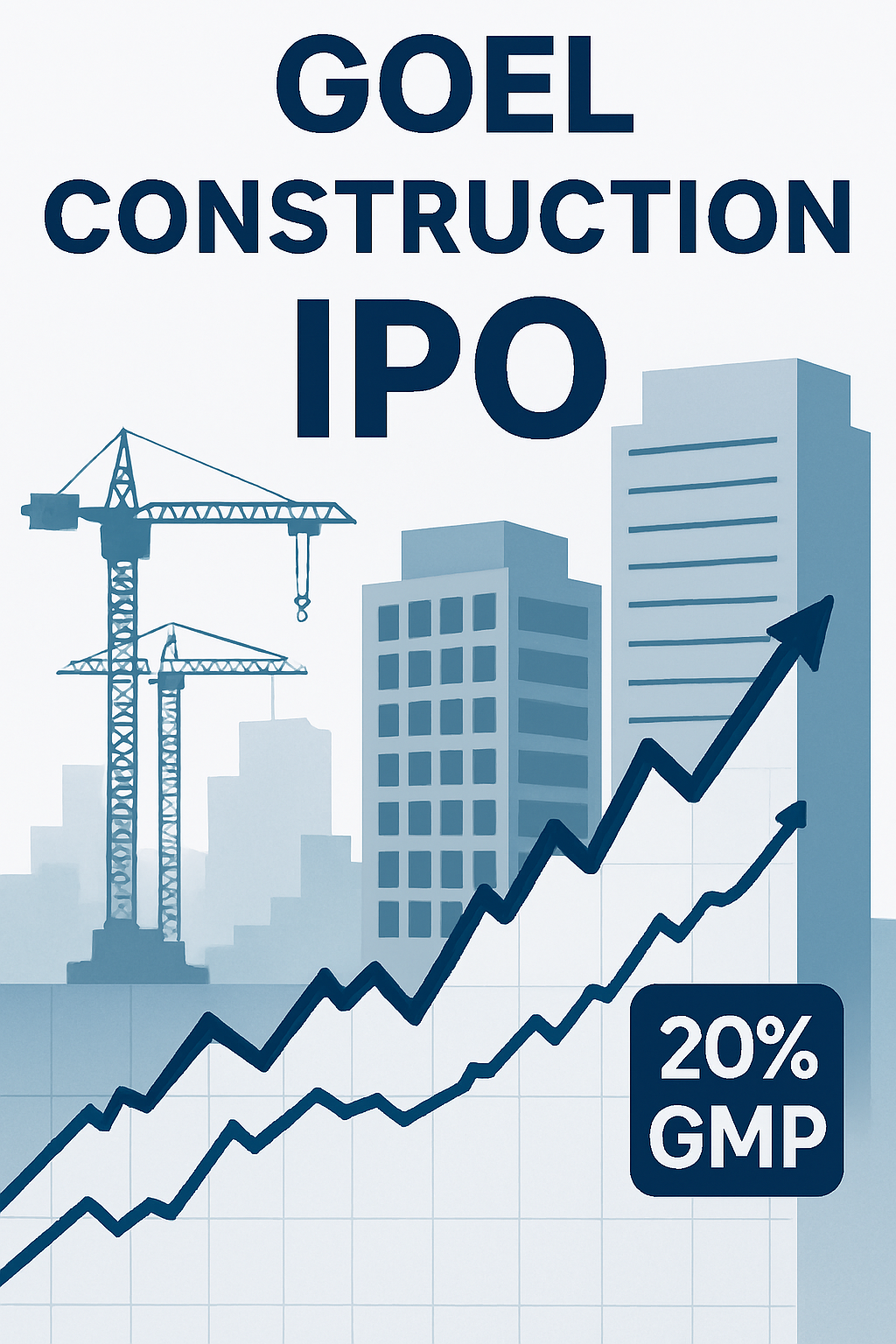
Goel Construction IPO GMP has gained strong attention in the stock market with investors tracking premium trends and subscription updates. This blog provides a detailed analysis of the IPO, GMP performance, day-wise highlights, and expert insights.
Table of Contents
Published: September 04, 2025 | Last Updated: September 04, 2025
The Goel Construction initial public offering has attracted significant attention in India’s primary equity markets during September 2025. The infrastructure and real estate development company’s public issue concluded on September 4, 2025, with notable participation across investor categories.
This analysis examines the subscription data, grey market indicators, company fundamentals, and relevant considerations for market participants. Information presented is based on official filings, market data, and publicly available company disclosures.
India’s infrastructure sector continues to benefit from government capital expenditure programs and urbanization trends. The National Infrastructure Pipeline and related policy initiatives have created opportunities for companies operating in construction and development segments.
Understanding Grey Market Premium Indicators
The grey market represents an unofficial trading mechanism where shares of upcoming initial public offerings change hands before official stock exchange listing. This parallel market operates through informal broker networks based on anticipated demand and supply dynamics.
For the Goel Construction offering, grey market indications suggested a premium of approximately 20% during the subscription period. This translates to roughly ₹50-52 per share above the upper price band of ₹262, indicating expected listing levels around ₹310-314 per share.
Several factors influence grey market pricing patterns:
Fundamental assessment: Market participants evaluate business operations, financial metrics, growth prospects, and valuation multiples when determining willingness to pay premiums before listing.
Supply-demand dynamics: Limited share availability relative to investor interest creates upward pressure on unofficial market prices during the pre-listing phase.
Broader market conditions: Overall equity market sentiment, sectoral momentum, and recent IPO performance patterns affect grey market pricing behavior.
Institutional participation: Strong interest from qualified institutional buyers and anchor investors typically correlates with elevated grey market premium levels.
Grey market premiums serve as sentiment indicators rather than guaranteed listing outcomes. Historical data shows instances where stocks with elevated premiums listed below expectations due to market corrections or valuation concerns. Conversely, some offerings with modest premiums delivered stronger listing gains when fundamentals exceeded market expectations.
The 20% premium level for Goel Construction reflects measured optimism rather than speculative excess. This positioning suggests market participants are factoring genuine business prospects into their assessments.
Issue Structure and Key Details
Company Information:
- Name: Goel Construction
- Sector: Infrastructure and Real Estate Development
- Issue Size: ₹99.77 crore
- Price Band: ₹250-262 per share
- Lot Size: 400 shares (minimum investment ₹104,800 at upper band)
Timeline:
- Subscription Opening: September 2, 2025
- Subscription Closing: September 4, 2025
- Allotment Finalization: September 8, 2025
- Expected Listing: September 10, 2025
Listing Venues: National Stock Exchange (NSE) and Bombay Stock Exchange (BSE)
Registrar: Link Intime India Private Limited manages the application processing and share allotment activities.
Issue Allocation Framework
The Securities and Exchange Board of India mandates specific reservation categories for initial public offerings:
- Qualified Institutional Buyers: Up to 50% of total issue size
- Non-Institutional Investors: Minimum 15% of issue size
- Retail Individual Investors: Minimum 35% of issue size
This allocation structure ensures participation opportunities across different investor segments while maintaining regulatory compliance.
Utilization of Proceeds
According to company disclosures, the IPO proceeds will support several business objectives:
Debt management: Repayment of existing borrowings to improve balance sheet metrics and reduce interest expenses, enhancing financial flexibility for future operations.
Project financing: Capital allocation toward ongoing and planned construction projects across residential, commercial, and infrastructure segments.
Market expansion: Establishing operational presence in new geographic markets across India to diversify revenue sources and capture growth opportunities in emerging regions.
Working capital: Meeting operational requirements including material procurement, labor payments, and day-to-day business activities.
Corporate initiatives: Strategic investments in technology adoption, organizational development, and business enhancement activities.
Subscription Performance Analysis
Day 1 Results (September 2, 2025)
The opening day recorded measured investor response as market participants evaluated the offering characteristics. By market close, overall subscription reached approximately 0.75 times the offered shares.
Retail investors demonstrated early interest with subscriptions near 1.2 times their allocated portion. Qualified institutional buyers maintained a cautious approach on the first day, conducting detailed due diligence before committing capital. Non-institutional investors recorded 0.6 times subscription during initial trading hours.
Grey market premium indicators remained stable around the 20% level, suggesting the measured first-day response reflected evaluation processes rather than lack of interest.
Day 2 Performance (September 3, 2025)
The second subscription day brought accelerated momentum as institutional participants and high net-worth individuals increased participation. Overall subscription crossed 1.8 times by market close.
Retail investors maintained strong interest with subscriptions reaching approximately 2.5 times their allocation. The non-institutional segment recorded 2.1 times subscription, indicating wealthy individuals found the risk-reward proposition favorable.
Qualified institutional buyer participation improved to 0.9 times as domestic mutual funds and insurance companies submitted substantial bids during the day. Market analysts noted that positive broker research and favorable sectoral commentary contributed to the increased momentum.
Final Day Results (September 4, 2025)
The closing day witnessed significant subscription acceleration. Final numbers showed total oversubscription of 10.75 times the offered shares.
Category-wise final subscription:
- Retail Individual Investors: 8.2 times
- Non-Institutional Investors: 6.8 times
- Qualified Institutional Buyers: 18.3 times
The retail category received over 1.2 lakh applications, indicating broad-based participation. The qualified institutional buyer segment delivered particularly strong performance, with mutual funds, insurance companies, and foreign portfolio investors competing for allocations.
The 18.3 times institutional subscription carries significance as these investors typically conduct rigorous fundamental analysis before capital deployment. Strong institutional participation often correlates with positive underlying business assessment.
Company Business Overview
Goel Construction operates in infrastructure development and real estate sectors with operations spanning over two decades. The company has evolved from regional contractor status to a diversified construction enterprise with presence across multiple Indian states.
Business Segments
Residential development: The company develops housing projects in mid-segment and premium categories across metropolitan areas and tier-2 cities. Projects typically range from 200 to 800 residential units.
Commercial real estate: Development of office complexes, retail spaces, and mixed-use properties catering to India’s expanding services sector and domestic business growth.
Industrial and institutional construction: Engineering, procurement, and construction contracts for factories, warehouses, educational institutions, and government facilities providing steady revenue through long-term contracts.
Sustainable infrastructure: Integration of green building practices, energy-efficient designs, and sustainable construction methods. Several projects have received environmental certifications.
Geographic Presence
Current operations extend across Maharashtra, Gujarat, Madhya Pradesh, Rajasthan, and Karnataka. The company plans to utilize IPO proceeds for expansion into high-growth markets including the National Capital Region and other major metropolitan areas.
Competitive Positioning
The construction and infrastructure sector includes both large national players and regional specialists. Goel Construction’s market positioning reflects several operational characteristics:
- Track record of project completion within scheduled timelines and budgets
- Quality standards maintenance and regulatory compliance
- Working capital management and financial discipline
- Regional market knowledge and local supply chain relationships
- Client relationships across government, corporate, and institutional segments
Financial Performance Review
Financial metrics provide insight into business operations and growth trajectory. The company has demonstrated revenue expansion with operational efficiency improvements during recent fiscal periods.
Revenue Trends
The company achieved approximately 18% compound annual growth rate over fiscal years 2022 through 2025:
- FY2023 Revenue: ₹287 crore
- FY2024 Revenue: ₹342 crore
- FY2025 Revenue (Projected): ₹405 crore
This growth trajectory reflects successful project execution, order book conversion, and new client acquisitions. The revenue expansion occurred despite periodic challenges including pandemic-related disruptions and raw material cost volatility.
Profitability Metrics
Net profit margin: Maintained at 8-10% across the review period, demonstrating operational efficiency. Infrastructure and construction businesses typically operate on moderate margins due to competitive intensity.
EBITDA margin: The company maintains 14-16% margins, reflecting cost management capabilities and procurement efficiencies.
Return on equity: Averaging 16-18%, indicating capital utilization effectiveness and value generation for shareholders.
Balance Sheet Position
Debt-to-equity ratio: Currently standing at approximately 1.2:1, with IPO proceeds designated for debt reduction expected to improve this ratio to around 0.8:1 post-offering.
Working capital management: Construction operations require careful working capital oversight given cash-intensive nature and payment cycles. The company maintains structured receivables collection and vendor payment practices.
Order Book Status
Current order book: Approximately ₹850 crore as of August 2025, representing roughly 2.1 times the FY2025 projected revenue. This provides revenue visibility for the next 18-24 months.
Order book composition:
- Residential projects: 45%
- Commercial developments: 30%
- Industrial and institutional contracts: 25%
The diversified order book reduces dependency on single segments and provides revenue stability.
Valuation Assessment
Based on the upper price band and FY2025 earnings projections, the post-issue price-to-earnings ratio stands at approximately 18-20x, compared to industry average of 22-25x for comparable firms.
The offering values the company at roughly 2.5x book value, aligned with peer valuations for companies with similar growth profiles. Enterprise value to EBITDA stands at approximately 12x, within reasonable parameters for growing infrastructure companies.
Grey Market Premium Evolution
The grey market premium remained relatively stable throughout the subscription period, ranging between 18-22% with most trading around the 20% level.
Timeline Observations
Pre-opening period (Late August 2025): Initial grey market indications emerged around 15-18% as preliminary research circulated among market participants.
September 2: Premium opened at 18% and strengthened to 20% by market close as retail participation exceeded initial expectations.
September 3: Premium remained anchored around 20% despite increased subscription levels, indicating measured pricing discipline.
September 4: Morning trading saw premium spike to 22% as subscription accelerated, before settling back to 20% by afternoon.
Premium Interpretation
A 20% grey market premium suggests several market conditions:
Expected listing range: Based on upper price band of ₹262, a 20% premium indicates anticipated listing around ₹314-315 per share.
Potential returns: For retail investors allocated one lot (400 shares), this translates to potential listing gains of approximately ₹20,800-21,200 before transaction costs.
Risk-reward assessment: The 20% premium provides meaningful upside while avoiding speculative overheating. Historical patterns suggest IPOs with 15-25% premiums tend to show more consistent listing gains compared to those with 50%+ premiums.
Sectoral Context and Market Opportunity
India’s infrastructure and real estate sectors are experiencing structural transformation driven by multiple factors:
Growth Drivers
Urbanization trends: India’s urban population is projected to reach 600 million by 2031, creating substantial demand for housing, commercial spaces, and supporting infrastructure.
Government programs: Initiatives including Housing for All, Smart Cities Mission, and AMRUT (Atal Mission for Rejuvenation and Urban Transformation) channel significant investments into construction and development.
Economic expansion: India’s GDP growth trajectory supports rising household incomes, commercial expansion, and industrial infrastructure requirements.
Infrastructure investment: The National Infrastructure Pipeline allocates over ₹111 lakh crore for infrastructure development, creating opportunities across multiple sectors.
Real estate recovery: After consolidation periods, residential and commercial real estate markets show improving sales velocity and price stability.
Sector Challenges
Cyclical nature: Real estate and construction experience pronounced cycles driven by economic conditions, interest rates, and regulatory changes.
Regulatory complexity: Projects require multiple approvals from various authorities including environmental clearances and building permissions.
Input cost volatility: Construction profitability remains sensitive to raw material prices, particularly cement, steel, and aggregates.
Competitive intensity: Numerous players compete for projects, with large national companies possessing scale advantages while regional players compete on pricing.
Interest rate sensitivity: Rising interest rates affect both housing affordability and borrowing costs for construction companies.
Risk Considerations
Market participants should evaluate several risk factors before investment decisions:
Business Risks
Execution challenges: Growth depends on successfully delivering existing order book and securing new projects. Execution issues including labor shortages or supply chain disruptions could impact performance.
Client concentration: Significant revenue dependence on limited clients could create vulnerability if key client relationships change or payment delays occur.
Debt management: While IPO proceeds will reduce leverage, the company will continue carrying debt for working capital and growth. Cash flow management remains critical.
Quality and safety: Construction involves inherent safety risks. Accidents or quality defects could result in liabilities and reputation damage.
Market Risks
Valuation sensitivity: If the infrastructure sector falls out of favor or peer company valuations compress, the stock could face pressure regardless of company-specific performance.
Liquidity considerations: Mid-cap stocks may experience limited liquidity during market stress, potentially affecting exit opportunities.
Lock-in expirations: When promoter and pre-IPO investor lock-in periods expire, potential selling pressure could emerge.
Sector Risks
Demand cyclicality: Economic downturns or rising interest rates could significantly impact order book and profitability, particularly in the residential segment.
Raw material costs: Sudden increases in cement, steel, or other construction materials on fixed-price contracts could compress margins.
Regulatory changes: Tightening of environmental regulations or changes in approval processes could extend project timelines and increase costs.
Investment Considerations by Profile
Different investor categories may approach this offering based on varying objectives and risk tolerance levels:
Short-term Oriented Investors
Market participants seeking listing gains might consider the 10.75x subscription and 20% grey market premium as indicators of potential near-term price appreciation. Historical patterns suggest IPOs with strong institutional participation and measured premiums show reasonable probability of listing gains.
However, market conditions on listing day will ultimately determine outcomes. Broader equity market sentiment, peer stock performance, and opening demand-supply dynamics all influence listing prices.
Medium-term Investors
Those with 1-3 year horizons might evaluate the company’s order book, revenue visibility, and sectoral growth trends. The infrastructure sector benefits from government spending programs and urbanization momentum, potentially supporting medium-term performance.
Monitoring quarterly results, order book additions, and margin trends will be important for assessing whether the business trajectory meets expectations.
Long-term Investors
Participants focused on 3-5 year horizons would assess the company’s competitive positioning, management quality, and ability to capture market opportunities during India’s infrastructure development phase.
Long-term value creation depends on successful project execution, market share gains, operating leverage, and maintaining financial discipline while growing the business.
Conservative Investors
Risk-averse participants might consider waiting for listing to observe price discovery and stabilization before making investment decisions. Post-listing corrections often provide entry opportunities at more favorable valuations.
Gradual accumulation through systematic investment approaches could reduce timing risk while building positions over several months.
Due Diligence Framework
Before making investment decisions, market participants should conduct comprehensive evaluation:
Document Review
- Read the Red Herring Prospectus for complete business, financial, and risk factor information
- Analyze at least three years of audited financial statements
- Review management discussion and analysis sections for strategic insights
- Examine order book composition, quality, and execution timelines
Comparative Analysis
- Benchmark valuation multiples against listed peers in infrastructure and construction sectors
- Compare growth rates, profitability margins, and return ratios with industry averages
- Assess competitive positioning relative to both large national players and regional specialists
Risk Assessment
- Identify company-specific vulnerabilities including client concentration and geographic exposure
- Evaluate sector cyclicality and current position in the business cycle
- Consider macroeconomic factors including interest rate trajectory and commodity prices
Personal Financial Review
- Ensure investment aligns with portfolio diversification objectives
- Confirm adequate risk tolerance for infrastructure sector volatility
- Verify sufficient financial capacity without using emergency reserves or borrowed funds
- Define clear investment objectives and exit strategies before participation
Allotment Process and Mechanics
Given the 10.75x oversubscription, many applicants will receive partial allotments or no shares.
Retail Investor Allotment
With 8.2x retail oversubscription, SEBI regulations mandate minimum allotment of one lot to maximize number of successful applicants. Approximately 12% of retail applicants will receive one lot allotment through computerized lottery system. The remaining 88% will receive no allotment.
Non-Institutional Allotment
HNI category follows proportionate allotment based on application size. With 6.8x oversubscription, an application for 10 lots might receive approximately 1-2 lots (proportionate allocation of 10/6.8 = 1.47 lots).
Institutional Allotment
QIB category receives proportionate allotment determined by book running managers. With 18.3x oversubscription, institutional investors receive reduced proportionate allocations based on bid size.
Refund Process
Unallocated or partially allocated applicants receive refunds by September 9, 2025. Blocked amounts return to bank accounts within 7 working days. Successful allottees receive share credit to demat accounts by September 9, 2025.
Applicants can check allotment status on the registrar’s website (Link Intime India) starting September 8, 2025, using application number or PAN details.
Post-Listing Considerations
Shares will begin trading on September 10, 2025, on both NSE and BSE exchanges. Market participants with allotments can sell immediately when trading commences.
Listing Day Dynamics
Opening prices reflect demand-supply balance, overall market sentiment, and peer stock performance. Initial trading hours typically show higher volatility as various market participants execute their strategies.
Historical patterns show IPOs with strong institutional participation and measured grey market premiums tend to show relatively stable listing day performance, though outcomes vary based on prevailing market conditions.
Ongoing Monitoring
Post-listing, market participants should track:
- Quarterly financial results and management commentary
- Order book additions and project execution updates
- Sector developments and policy changes
- Analyst coverage and research recommendations
- Peer company performance and sectoral trends
Regular reassessment of the investment thesis based on new information helps inform portfolio management decisions.
Frequently Asked Questions
What does the 20% grey market premium indicate for Goel Construction IPO?
The grey market premium of 20% suggests unofficial trading of shares is occurring at approximately ₹52-53 above the upper price band of ₹262 per share. This indicates market participants anticipate listing around ₹314-315 per share on September 10, 2025.
Grey market premiums reflect sentiment and demand expectations but do not guarantee actual listing outcomes. Actual listing prices depend on market conditions, demand-supply dynamics, and overall sentiment on listing day. Historical data shows IPOs with 15-25% premiums demonstrate more consistent listing gains compared to those with extremely high or very low premiums.
How significant is the 10.75x oversubscription for this IPO?
The 10.75x oversubscription indicates strong demand across all investor categories. The breakdown shows retail investors subscribed 8.2 times, non-institutional investors 6.8 times, and qualified institutional buyers 18.3 times their allocated portions.
Particularly notable is the 18.3x institutional subscription, as mutual funds, insurance companies, and foreign portfolio investors typically conduct rigorous due diligence before committing capital. Strong institutional participation often correlates with positive fundamental assessment. However, oversubscription alone doesn’t guarantee profitable outcomes—overall market conditions and valuation reasonableness matter equally.
What are the primary risks associated with investing in this offering?
Several risk factors warrant consideration. Sector cyclicality poses challenges as real estate and construction experience pronounced cycles driven by economic conditions, interest rates, and regulatory changes. Execution risk involves successfully delivering projects on time and within budget.
Raw material cost volatility affects profitability, particularly for fixed-price contracts. Debt and working capital management remain important as construction businesses are capital-intensive. Regulatory hurdles including environmental clearances and building permissions can extend project timelines. Market volatility could affect listing performance regardless of company fundamentals.
When will shares be credited and trading begin?
The allotment process will be finalized on September 8, 2025. Successful allottees will receive share credits to their demat accounts by September 9, 2025. Trading on NSE and BSE exchanges is scheduled to begin on September 10, 2025.
Unallocated or partially allocated applicants will receive refunds by September 9, 2025, with amounts returning to bank accounts within 7 working days. Applicants can check allotment status on the Link Intime India website starting September 8, 2025.
How does Goel Construction’s valuation compare to industry peers?
Based on the upper price band and FY2025 earnings projections, the post-issue price-to-earnings ratio stands at approximately 18-20x. This compares to an industry average of 22-25x for mid-cap infrastructure companies, suggesting relative value compared to peers.
The company trades at roughly 2.5x book value, aligned with comparable firms having similar growth profiles. Enterprise value to EBITDA at approximately 12x remains within reasonable parameters for growing infrastructure companies. The 18% revenue CAGR over recent years compares favorably to many mid-sized peers in the sector.
What happens if I don’t receive allotment in the IPO?
With 10.75x oversubscription, many applicants will not receive allotment, particularly in retail and HNI categories. If unallocated, your blocked funds will be unblocked or refunded by September 9, 2025, returning to your bank account within 7 working days.
You can purchase shares from the secondary market once trading begins on September 10, 2025. Some investors use this approach—applying for IPO allocation while also planning to purchase additional shares post-listing based on price discovery and market conditions.
Should investors target listing gains or consider long-term holding?
This decision depends on individual investment objectives, risk tolerance, and financial goals. Market participants seeking short-term gains might consider the strong subscription and grey market premium as indicators of potential listing appreciation, though outcomes depend on market conditions on listing day.
Those with longer investment horizons might evaluate the company’s fundamentals, sectoral growth trends, and competitive positioning. Some investors adopt hybrid strategies—booking partial profits if listing gains materialize while retaining exposure for potential long-term appreciation. The appropriate approach aligns with personal circumstances and investment philosophy.
What factors could influence listing day performance?
Multiple factors affect listing prices beyond grey market premiums and subscription data. Overall equity market sentiment—whether Nifty and Sensex show positive or negative movement—significantly influences IPO debuts. Performance of peer infrastructure and real estate stocks in days preceding listing affects sentiment.
Material news flow regarding the company, sector, or macroeconomic environment between allotment and listing can shift expectations. Lower allotment ratios often correlate with stronger listing performance as unallocated investors seek to buy on listing day. Global market cues and commodity price movements (especially steel and cement) also influence outcomes.
About the Author
Nueplanet
Financial markets analyst specializing in primary market research, IPO analysis, and infrastructure sector coverage. Over the years of experience tracking Indian equity markets with focus on providing fact-based, research-driven insights for informed investment decision-making.
This analysis is based on publicly available information including company filings, regulatory disclosures, and market data. The content serves educational purposes and does not constitute investment advice. Readers should conduct independent due diligence and consult qualified financial advisors before making investment decisions.
Commitment to Accuracy: All information presented is verified against official sources including SEBI filings, stock exchange data, and company disclosures. Content is updated as new information becomes available to maintain accuracy and relevance.
Disclaimer: This article provides information for educational purposes only and should not be considered investment advice. Investors must conduct their own due diligence, assess personal financial situations, and consult qualified financial advisors before making investment decisions. Past performance and grey market premiums do not guarantee future results. The author and publisher bear no responsibility for investment outcomes based on this content. Market conditions change rapidly, and readers should verify all information before taking action.
Helpful Resources
Latest Posts
- Rajasthan Public Service Commission (RPSC): Latest Updates, Challenges, and the Road Ahead
- ITC Share Price: Why Investors Are Closely Watching the Stock
- M&M Share Price and Market Reactions Amid GST Changes 2025
- Moschip Share Price: Latest Trends, Analysis, and Investor Outlook
- HUL Share Price: Latest Trends, Market Analysis, and Outlook
Related Posts











Post Comment