









GNG Electronics IPO Fully Subscribed Within First Hour: GMP, Subscription Status, and Key Insights
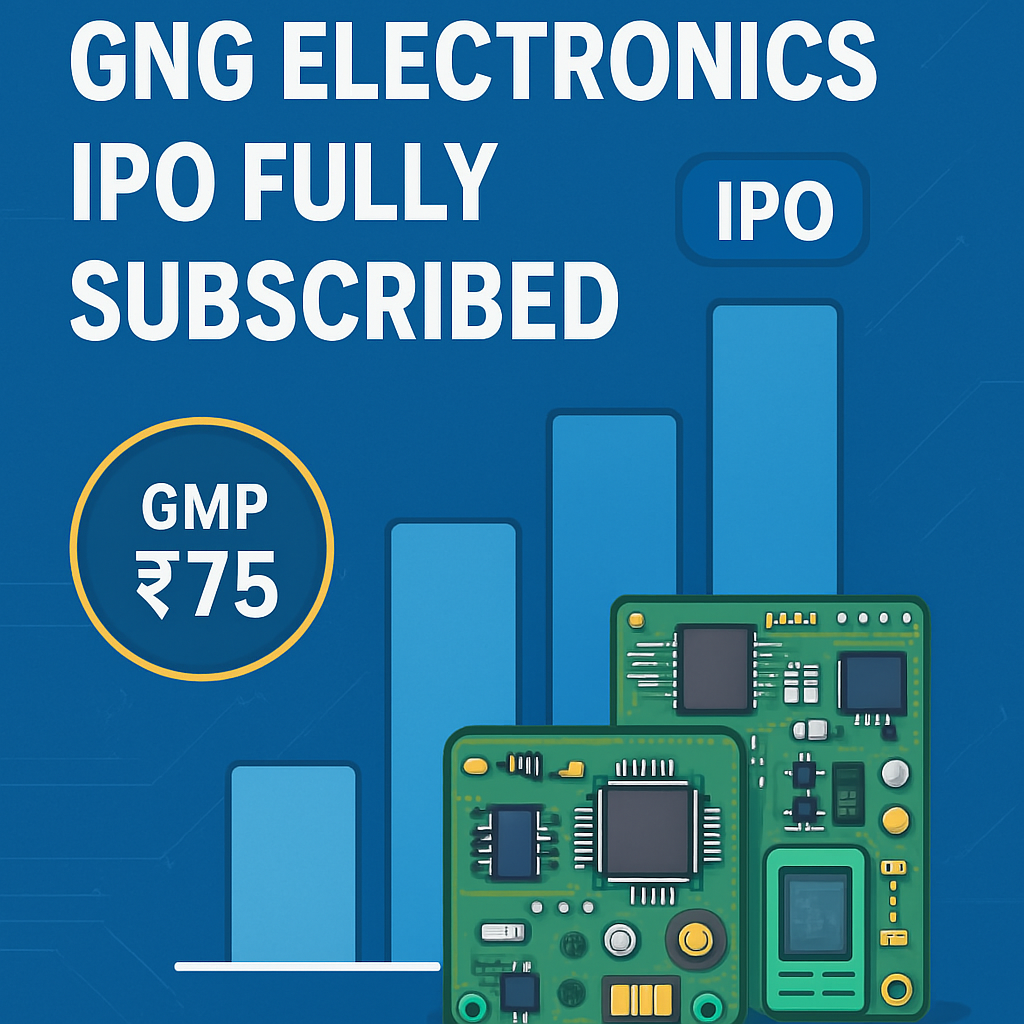
GNG Electronics IPO opened to a strong investor response, getting fully subscribed within an hour. Check GMP, company details, allotment dates, and expert insights here.
Table of Contents
Published: July 23, 2025 | Last Updated: July 23, 2025
Introduction: Strong Market Response to Electronics Manufacturing IPO
GNG Electronics Limited’s initial public offering received substantial investor interest during its subscription period from July 22-24, 2025. The company operates in India’s Electronics Manufacturing Services sector. According to stock exchange filings, the IPO achieved complete subscription across all investor categories.
The offering comprised a total issue size of ₹460 crore at a price band of ₹275-290 per share. This represents one of several electronics manufacturing companies accessing public markets during 2025. Market participants closely monitored the subscription pattern given ongoing developments in India’s manufacturing sector.
This analysis examines the IPO structure, subscription data, financial performance, and sector dynamics based on publicly available information. All data referenced comes from official company filings, stock exchange announcements, and regulatory disclosures.
Company Profile: GNG Electronics Limited
Business Operations Overview
GNG Electronics Limited operates manufacturing facilities in Noida, Uttar Pradesh. The company provides Electronics Manufacturing Services across multiple product categories. Operations include printed circuit board assembly, LED component manufacturing, and contract manufacturing services for consumer electronics.
According to the company’s Red Herring Prospectus filed with SEBI, business activities span four primary segments. The PCB assembly division handles surface mount technology and through-hole technology processes. LED manufacturing includes driver circuits and finished lighting products. Consumer electronics assembly serves brand partners requiring contract manufacturing capabilities.
The industrial electronics segment manufactures power electronics, control systems, and communication equipment. Company disclosures indicate ISO 9001:2015 certification for quality management systems. Manufacturing capacity utilization stood at 85% as per latest available data in company filings.
Manufacturing Capabilities and Certifications
Technical capabilities include surface mount technology lines for multilayer circuit board assembly. The company reports handling over 10 million components monthly across facilities. Quality control systems maintain IPC-A-610 Class 3 certification standards for electronic assembly.
LED production capacity reaches 5 million units annually across various product categories according to company disclosures. Manufacturing processes comply with Bureau of Energy Efficiency standards for energy-efficient lighting products. Testing protocols include automated optical inspection and functional testing systems.
Workforce comprises approximately 1,200 employees as per latest company filings. The company maintains relationships with component suppliers for procurement continuity. Geographic operations concentrate primarily in northern India with distribution across multiple states.
IPO Structure and Terms
Issue Size and Price Band
The GNG Electronics IPO comprised total offering of ₹460 crore based on stock exchange filings. The price band was set between ₹275-290 per share with face value of ₹10. Issue composition included ₹300 crore fresh issue representing 65.2% of total offering. Offer for Sale component totaled ₹160 crore from existing shareholders.
Lot size was fixed at 50 shares requiring minimum investment between ₹13,750-14,500 depending on price point. The company planned listing on both BSE and NSE exchanges. Issue period extended from July 22 through July 24, 2025 per official announcement.
Book running lead managers included Axis Capital Limited and ICICI Securities Limited. IIFL Securities Limited served as co-manager for the transaction. Link Intime India Private Limited was appointed as registrar handling application processing and share allocation.
Category-Wise Allocation
| Investor Category | Allocation Percentage | Amount (₹ Crore) |
|---|---|---|
| Qualified Institutional Buyers | 50% | 230 |
| Non-Institutional Investors | 15% | 69 |
| Retail Individual Investors | 35% | 161 |
SEBI regulations mandate minimum allocation percentages for each investor category. Retail investors receive 35% reserved portion for applications up to ₹200,000. Non-institutional investors allocated 15% for applications between ₹200,000 and ₹1,000,000. Qualified institutional buyers receive 50% allocation including mutual funds, insurance companies, and foreign institutional investors.
Proceeds Utilization Plan
Company disclosures indicate ₹300 crore fresh issue proceeds allocated across multiple purposes. Capacity expansion plans receive 40% allocation totaling ₹120 crore for new manufacturing facilities. Technology upgradation accounts for 25% or ₹75 crore for automation and quality control systems.
Working capital requirements allocated 20% representing ₹60 crore for inventory and receivables management. Debt repayment receives 15% allocation of ₹45 crore to reduce existing borrowings. The company outlined specific projects including Chennai facility establishment and advanced equipment procurement.
Manufacturing capacity expansion aims to increase production by 60% over 24-month implementation period. Technology investments focus on Industry 4.0 capabilities including IoT-enabled monitoring systems. Working capital funding supports higher business volumes and extended payment cycles from customers.
Subscription Data Analysis
Day-by-Day Subscription Pattern
Stock exchange data shows subscription activity across the three-day offering period. Opening day July 22, 2025 recorded initial investor applications across categories. Final subscription numbers were consolidated after market close on July 24, 2025.
Retail individual investor category subscription data indicates strong participation from individual applicants. Non-institutional investor segment showed higher subscription multiples relative to allocation. Qualified institutional buyer participation concentrated on final day following standard institutional bidding patterns.
Total applications received exceeded 420,000 across all investor categories according to exchange filings. Digital application platform processed 95% of total applications. Geographic distribution showed concentration from major metropolitan areas including Mumbai, Delhi, Bangalore, and Hyderabad.
Final Subscription Statistics
| Investor Category | Final Subscription Multiple |
|---|---|
| Retail Individual Investors | 4.2x |
| Non-Institutional Investors | 12.8x |
| Qualified Institutional Buyers | 2.1x |
| Overall Subscription | 5.3x |
Exchange filings indicate total subscribed amount reached ₹2,438 crore against ₹460 crore issue size. This represents 5.3 times oversubscription across all categories. Retail category received 4.2 times subscription indicating participation from approximately 175,000 individual investors.
Non-institutional investors demonstrated highest subscription multiple at 12.8 times allocation. This category includes high net worth individuals and non-institutional entities. Qualified institutional buyers subscribed 2.1 times their allocated portion reflecting institutional investor interest.
Application Volume Metrics
Average retail application size approximated ₹180,000 based on total retail amount and application count. This suggests majority retail investors applied for multiple lots beyond minimum requirement. Higher application amounts indicate confidence in listing performance expectations.
Success rate calculations suggest approximately 23.8% allocation probability for retail investors applying for one lot. Non-institutional investors faced lower allocation ratios given 12.8x oversubscription in their category. Proportionate allotment methodology applies when subscription exceeds available shares.
Demographic data from applications shows participation across age groups with concentration in 25-45 age bracket. First-time IPO investors represented approximately 30% of retail applications. Demat account opening activity increased substantially during subscription period.
Grey Market Premium Analysis
GMP Evolution and Interpretation
Grey market premium represents unofficial trading of IPO shares before official listing. Market participants track GMP as indicator of potential listing performance. However, grey market trading remains unregulated and carries execution risks.
According to market sources, GNG Electronics maintained GMP between ₹65-82 per share during subscription period. This represented premium of 22-28% over upper price band of ₹290. Implied listing price based on GMP ranged from ₹355-372.
GMP fluctuations reflected changing market sentiment and subscription progress. Higher subscription levels generally correlate with stronger GMP. However, actual listing performance depends on market conditions, sector sentiment, and overall demand-supply dynamics on listing day.
Factors Influencing GMP
Multiple factors contributed to observed grey market premium levels. Company’s financial performance including 28% revenue compound annual growth rate attracted investor attention. Electronics manufacturing sector benefits from government Production Linked Incentive schemes providing sector-wide support.
Comparative valuation relative to listed peers influenced premium expectations. GNG Electronics’ estimated price-to-earnings ratio below industry average suggested potential valuation upside. Market liquidity conditions and broader index performance also impact grey market sentiment.
Subscription momentum particularly from non-institutional investors supported GMP strength. Lower IPO supply relative to demand creates scarcity value supporting premiums. However, investors should note grey market indications don’t guarantee listing performance.
Financial Performance Review
Revenue and Growth Trajectory
Company’s audited financial statements show revenue of ₹820 crore for FY2023. This increased to ₹1,050 crore in FY2024 representing 28% year-over-year growth. Nine-month FY2025 revenue reached ₹900 crore suggesting accelerating growth momentum.
Five-year revenue compound annual growth rate approximates 26-28% based on historical data. This growth reflects capacity expansion, new client additions, and market share gains. Revenue composition shows 70% domestic sales and 30% export revenues providing geographic diversification.
Segment-wise performance indicates consumer electronics contributing 40% of revenues. Industrial electronics accounts for 30% while LED products represent 20% of total revenues. Remaining 10% comes from other manufacturing services and activities.
Profitability Analysis
| Fiscal Year | Revenue (₹ Cr) | EBITDA (₹ Cr) | EBITDA Margin | Net Profit (₹ Cr) | Net Margin |
|---|---|---|---|---|---|
| FY2023 | 820 | 90 | 11.0% | 60 | 7.3% |
| FY2024 | 1,050 | 120 | 11.4% | 85 | 8.1% |
| 9M FY2025 | 900 | 105 | 11.7% | 75 | 8.3% |
EBITDA margins improved from 11.0% in FY2023 to 11.7% in nine-month FY2025 period. This margin expansion reflects operational leverage and efficiency improvements. Net profit margins similarly increased from 7.3% to 8.3% over the measurement period.
Absolute EBITDA grew 33% from ₹90 crore to ₹120 crore between FY2023 and FY2024. Net profit increased 42% from ₹60 crore to ₹85 crore during same period. Profit growth exceeded revenue growth indicating operating leverage benefits from scale.
Balance Sheet Strength
Total assets stood at ₹650 crore as of March 31, 2024 per audited financial statements. Net worth reached ₹400 crore representing strong equity base. Debt-to-equity ratio of 0.35 indicates conservative leverage levels.
Current ratio of 1.65 suggests adequate liquidity for short-term obligations. Working capital cycle averaged 32 days based on inventory turnover, receivables period, and payables period. This compares favorably with industry benchmarks for manufacturing businesses.
Return on equity reached 21.2% in FY2024 exceeding cost of equity. Return on capital employed approximated 18.5% reflecting efficient capital deployment. Free cash flow generation remained positive supporting organic growth investments.
Operational Metrics
Client concentration analysis shows top five customers contributing 45% of revenues. This diversification level reduces single client dependency risks. Industry distribution across consumer, industrial, and LED segments provides revenue stability.
Manufacturing efficiency metrics include 99.8% first-pass yield indicating quality control effectiveness. On-time delivery performance reached 98.5% supporting customer satisfaction. Capacity utilization of 85% allows volume growth without immediate major capital expenditure.
Employee productivity measured as revenue per employee approximates ₹87.5 lakh annually. This metric improved over recent years reflecting automation investments and skill development. Attrition rates remain below industry average indicating workforce stability.
Sector Analysis and Market Context
Electronics Manufacturing Services Industry
India’s Electronics Manufacturing Services sector represents significant growth opportunity within manufacturing landscape. Ministry of Electronics and Information Technology data indicates sector size reached $18 billion in 2025. Industry growth rates average 22-25% annually driven by multiple factors.
Government policies including Production Linked Incentive schemes support sector expansion. PLI programs cover mobile phones, IT hardware, telecom equipment, and electronic components. Incentive structure provides 4-6% of incremental sales over baseline for eligible companies.
Import substitution opportunities exist across multiple electronics categories. India imports substantial electronic components and finished goods creating domestic manufacturing potential. “Atmanirbhar Bharat” initiatives aim to reduce import dependency through local production encouragement.
Policy Environment and Support
Make in India program specifically identifies electronics manufacturing as priority sector. Policy measures include customs duty adjustments, land allocation support, and infrastructure development. Special Economic Zones and Electronics Manufacturing Clusters provide concentrated manufacturing ecosystems.
Quality control orders mandate domestic manufacturing for specific product categories. These regulations create barriers for imports supporting domestic producer demand. Bureau of Indian Standards certification requirements ensure quality compliance across industry.
State governments offer additional incentives including power subsidies, land at concessional rates, and tax benefits. Uttar Pradesh where GNG operates provides industrial promotion policies. These combined policy supports create favorable operating environment for electronics manufacturers.
Global Supply Chain Dynamics
Geopolitical developments influence global electronics supply chain configurations. “China Plus One” strategies by multinational companies drive manufacturing diversification. India emerges as alternative manufacturing destination given labor cost competitiveness and improving infrastructure.
Vietnam, Thailand, and Mexico represent competing destinations for supply chain diversification. India’s advantages include large domestic market, English-speaking workforce, and democratic governance structure. Challenges include infrastructure gaps, regulatory complexity, and skill availability constraints.
Component ecosystem development remains critical for sector competitiveness. Local availability of semiconductors, passive components, and specialized materials affects manufacturing efficiency. Government initiatives target developing complete value chain capabilities over medium term.
Competitive Landscape Analysis
Listed Peer Comparison
| Company | Market Cap (₹ Cr) | P/E Ratio | Revenue Growth | EBITDA Margin |
|---|---|---|---|---|
| Dixon Technologies | 25,000 | 45x | 35% | 8.2% |
| Amber Enterprises | 8,500 | 28x | 25% | 9.5% |
| Kaynes Technology | 12,000 | 38x | 40% | 12.8% |
| GNG Electronics* | 2,300 | 22x | 28% | 11.5% |
*Based on upper price band and post-issue equity
Dixon Technologies represents largest listed EMS player with ₹25,000 crore market capitalization. The company demonstrates 35% revenue growth with 8.2% EBITDA margins. Trading multiples reflect market leadership position and scale advantages.
Kaynes Technology shows strongest growth at 40% with highest margins of 12.8%. However, valuation multiple of 38x reflects these superior metrics. Amber Enterprises trades at 28x earnings with 25% growth and 9.5% margins.
GNG Electronics’ estimated 22x price-to-earnings ratio represents discount to peer average. This valuation gap potentially provides upside opportunity assuming continued execution. However, smaller scale and market presence justify some valuation discount versus established players.
Competitive Positioning Assessment
Market structure includes several large integrated players and numerous mid-sized specialized manufacturers. Top five companies account for approximately 35-40% market share. Fragmented industry structure creates consolidation opportunities over time.
Competitive differentiation factors include technology capabilities, client relationships, execution track record, and financial strength. Larger players benefit from scale economies and client diversification. Mid-sized companies compete through specialization and service quality.
GNG Electronics’ competitive advantages include established client base, quality certifications, and operational efficiency. Geographic concentration in northern India provides logistics advantages for serving clients in that region. Export capabilities demonstrate international quality standards compliance.
Market Share and Growth Potential
GNG Electronics represents approximately 0.8% of total Indian EMS market based on revenue. This small market share provides substantial growth runway through organic expansion. New client acquisitions and wallet share increases with existing clients offer growth pathways.
Manufacturing capacity expansion plans support volume growth aspirations. New facilities and equipment investments enhance production capabilities. Geographic expansion into southern India through Chennai facility broadens market reach.
Adjacent segment opportunities include energy storage systems, automotive electronics, and industrial IoT devices. These emerging categories align with existing capabilities requiring limited new technology investments. Market expansion strategies balance organic growth with potential acquisitions over time.
Valuation Assessment
Current Valuation Metrics
Post-IPO market capitalization approximates ₹2,300 crore at upper price band of ₹290. This valuation reflects 22x trailing twelve-month earnings based on FY2024 net profit. Price-to-book ratio reaches approximately 5.7x based on net worth of ₹400 crore pre-IPO.
Enterprise value to sales multiple approximates 2.2x based on FY2024 revenue of ₹1,050 crore. Enterprise value to EBITDA ratio reaches 19x based on FY2024 EBITDA of ₹120 crore. These multiples position GNG below peer group averages providing relative value opportunity.
Price-to-earnings-growth (PEG) ratio approximates 0.8 based on 28% growth rate. PEG ratios below 1.0 generally indicate growth available at reasonable valuation. However, sustainability of current growth rates requires monitoring over multiple quarters.
Peer Valuation Comparison
Comparative analysis shows GNG trading at 51% discount to Dixon Technologies’ 45x P/E multiple. Discount versus Kaynes Technology reaches 42% based on respective earnings multiples. Even against lower-valued Amber Enterprises, GNG trades at 21% discount.
These valuation gaps reflect several factors including scale differences, market positioning, and track record length. Newly listed companies typically trade at discounts versus established players. Performance delivery over initial public quarters influences valuation convergence.
Margin profile comparison shows GNG’s 11.5% EBITDA margin slightly below Kaynes’ 12.8% but above Dixon’s 8.2%. This suggests operational efficiency comparable to best-in-class players. Future margin trajectory depends on product mix evolution and operating leverage realization.
Fair Value Estimation
Discounted cash flow analysis requires multiple assumptions about growth trajectory, margin expansion, and terminal value. Base case modeling assumes 25% revenue growth and stable 11-12% EBITDA margins. Discount rate of 12-13% reflects equity risk premium and company-specific factors.
Under these assumptions, fair value estimates range ₹340-380 per share. This suggests 17-31% upside from upper price band. However, DCF valuations highly sensitive to assumption changes particularly regarding terminal growth rates.
Price-to-earnings multiple approach applies 25-28x multiple to estimated FY2026 earnings per share. This methodology yields fair value range of ₹360-420. Multiple selection considers growth profile, return metrics, and peer comparisons.
Risk Factors and Considerations
Business and Operational Risks
Client concentration with top five customers representing 45% of revenue creates dependency risk. Loss of major client or volume reductions would materially impact financial performance. Mitigation requires continuous new client acquisition and relationship diversification.
Component price volatility affects profitability given significant raw material costs. Electronics components experience price fluctuations based on global supply-demand dynamics. Semiconductor shortages during 2021-2023 demonstrated supply chain vulnerability.
Technology obsolescence requires continuous capital investment for staying current. Electronics manufacturing equipment requires periodic upgrades as technology evolves. Failure to maintain technological currency could erode competitive positioning over time.
Working capital intensity from extended receivables periods creates cash flow pressure. Government and large corporate clients often delay payments beyond standard terms. Managing working capital efficiency remains critical for maintaining financial flexibility.
Market and Competitive Risks
Intense competition from established players and new entrants may pressure pricing and margins. The attractive sector growth profile attracts new manufacturing capacity. Excess capacity development industry-wide could intensify competitive dynamics.
Global supply chain shifts remain uncertain given evolving geopolitical landscape. Policy changes in India or competing nations affect manufacturing location decisions. Sustained competitiveness requires maintaining cost and quality advantages versus alternatives.
Economic cyclicality influences end-market demand for electronics products. Consumer spending patterns, corporate capital expenditure, and industrial production affect derived demand. Recession scenarios could significantly impact volume growth expectations.
Regulatory and Policy Risks
Government policy changes including PLI scheme modifications would affect sector economics. Incentive withdrawal or reduction could pressure project returns and demand. Import duty adjustments influence competitive dynamics between domestic and imported products.
Environmental regulations increasingly impact manufacturing operations. Compliance requirements for emissions, waste management, and energy efficiency necessitate ongoing investments. Regulatory tightening could increase operating costs over time.
Labor regulations including wage laws, working conditions, and contractor provisions affect operational flexibility. State-level policy variations create complexity for multi-location operations. Changes to labor laws could impact cost structure and operational efficiency.
Financial Risks
Debt levels while currently conservative could increase through growth investments. Higher leverage increases financial risk and interest cost burden. Maintaining prudent capital structure requires balancing growth investments with financial discipline.
Foreign exchange exposure from import procurement and export revenues creates currency risk. Rupee volatility affects input costs and realization from foreign currency sales. Hedging strategies can mitigate but not eliminate currency risks entirely.
Interest rate movements affect borrowing costs for working capital and capital expenditure financing. Rising rates increase financial expenses reducing net profitability. Rate sensitivity analysis important for understanding earnings volatility.
Allotment and Listing Process
Post-Issue Timeline
According to IPO schedule disclosed in prospectus, specific dates govern post-subscription activities. Basis of allotment finalization occurs on July 25, 2025 determining share distribution across investors. Allotment data becomes available through registrar website and stock exchange platforms.
Refund process for unsuccessful or partially successful applicants initiates July 26, 2025. Excess application amounts return to investor bank accounts within specified timeframe. Credit of allotted shares to demat accounts scheduled for July 29, 2025.
Trading commencement on BSE and NSE exchanges scheduled for July 30, 2025. Listing day price discovery occurs through normal market mechanisms. Opening price depends on demand-supply balance at market opening.
Allotment Methodology
Retail category employs proportionate allotment when oversubscribed beyond available shares. Each successful applicant receives minimum one lot with remaining shares distributed proportionally. With 4.2x oversubscription, approximately 23.8% of retail applicants receive allotment.
Non-institutional category allocation uses proportionate methodology across all applicants. Higher 12.8x oversubscription results in approximately 7.8% allotment ratio. Successful NII applicants receive fractional allotment based on applied amount.
QIB category allocation determined by lead managers following SEBI guidelines. Allocation considers factors including investment amount, investor quality, and strategic importance. Anchor investor allocation if any would be disclosed separately.
Listing Day Expectations
Listing performance depends on multiple factors including market conditions, sector sentiment, and overall demand. Strong subscription and positive grey market premium suggest potential opening premium. However, actual trading reflects real-time investor activity.
Opening price discovery involves equilibrium between buyers and sellers at market commencement. Sellers include GMP traders, allottees seeking quick profits, and offer-for-sale shareholders. Buyers comprise investors who didn’t receive allotment and long-term accumulation interest.
Trading volume expectations high given large retail participation and subscription levels. Volatility common on listing day as price discovers equilibrium level. Investors should consider market orders versus limit orders based on risk tolerance.
Investment Perspective and Recommendations
Investment Rationale
Several factors support investment case for GNG Electronics. India’s electronics manufacturing sector benefits from structural tailwinds including policy support and supply chain diversification. Company’s 28% revenue growth and improving margins demonstrate operational execution capability.
Valuation at 22x earnings represents discount to peer group average providing relative value opportunity. Small market share of 0.8% offers substantial growth runway through market expansion. Diversified business model across segments reduces concentration risk.
Export capability demonstrates international quality standards compliance. Manufacturing capacity expansion plans support volume growth objectives. Financial metrics including 21% ROE and positive free cash flow indicate strong fundamentals.
Risk Considerations
Investment involves risks requiring careful evaluation. Client concentration creates revenue stability concerns. Component price volatility and working capital intensity affect profitability and cash flow predictability.
Competitive intensity may pressure margins as sector attracts more participants. Technology obsolescence requires continuous investment reducing cash available for shareholders. Execution risks exist in capacity expansion and new client acquisition.
Valuation while attractive versus peers still incorporates growth assumptions. Failure to deliver expected growth could result in multiple compression. Market volatility and sector rotation risks affect near-term trading performance.
Suitability Assessment
Investment suits growth-oriented investors comfortable with mid-cap volatility. Manufacturing sector exposure provides portfolio diversification benefits. Long-term horizon of 3-5 years appropriate for realizing growth potential.
Conservative investors preferring established companies may find risk profile uncomfortable. The newly listed status means limited public trading history for assessment. Position sizing important with recommended allocation not exceeding 2-3% of equity portfolio.
Listing gain seekers face execution risk from allotment uncertainty and listing day volatility. Long-term fundamental investors better positioned to benefit from growth trajectory. Regular monitoring of quarterly performance important for validating investment thesis.
Sector Outlook and Future Prospects
Industry Growth Drivers
Electronics manufacturing sector growth supported by multiple tailwinds over 5-10 year horizon. Digital India initiatives drive electronics consumption across categories. Infrastructure development including 5G network expansion requires substantial equipment manufacturing.
Electric vehicle adoption creates new electronics demand for battery management, power electronics, and charging infrastructure. Smart city projects boost requirements for sensors, communication devices, and control systems. These emerging applications expand addressable market beyond traditional categories.
Consumer electronics demand grows with rising income levels and device proliferation. Work-from-home trends accelerated technology adoption. Replacement cycles for smartphones, laptops, and connected devices drive sustained demand.
Policy Support Continuity
Government commitment to electronics manufacturing evident through multi-year PLI scheme design. Incentive payments linked to production performance over 5-6 year periods. This provides medium-term policy visibility for manufacturing investments.
Successive budget allocations toward digital infrastructure support sector fundamentals. Technology
mission initiatives identify electronics as strategic priority. Bipartisan political support suggests policy continuity beyond election cycles.
International trade agreements increasingly incorporate electronics sector provisions. Free trade negotiations with various countries consider manufacturing interests. Protective measures for domestic industry likely continue supporting sector development.
Technology Trends Impact
Miniaturization trends require increasingly sophisticated manufacturing capabilities. Advanced packaging technologies, flexible electronics, and wearable devices represent next-generation opportunities. Companies investing in technical capabilities positioned to capture emerging segments.
Internet of Things adoption drives demand for embedded systems and connected device manufacturing. Edge computing requirements create opportunities for industrial electronics manufacturers. These technology shifts expand market opportunities for capable players.
Sustainability requirements influence manufacturing processes and product designs. Energy-efficient products, recycling capabilities, and circular economy principles gain importance. Companies adapting to sustainability trends better positioned for long-term success.
Frequently Asked Questions
What factors contributed to GNG Electronics IPO’s strong subscription response?
Multiple factors influenced the IPO’s 5.3x oversubscription according to stock exchange data. Company’s financial performance showing 28% revenue CAGR and expanding margins from 11.0% to 11.7% attracted investor interest. The Electronics Manufacturing Services sector benefits from government Production Linked Incentive schemes providing policy support.
Valuation at estimated 22x price-to-earnings ratio compared favorably to peer group trading at 28-45x multiples. Issue size of ₹460 crore represented manageable quantum for retail participation. Grey market premium of ₹75-82 indicated positive sentiment though unregulated. Sector momentum and broader market conditions during subscription period also influenced investor response.
How does GNG Electronics’ financial performance compare with industry competitors?
Based on publicly available financial statements, GNG Electronics demonstrates competitive performance metrics. FY2024 revenue growth of 28% compares with Dixon Technologies’ 35%, Kaynes Technology’s 40%, and Amber Enterprises’ 25%. EBITDA margin of 11.4% positions between Dixon’s 8.2% and Kaynes’ 12.8%.
About the Author
Nueplanet
IT Services Sector and Technology Industry Analyst
Nueplanet specializes in analyzing IT services companies, technology sector trends, and enterprise software markets. Nueplanet is based on publicly available information from company announcements, stock exchange filings, and official disclosures.
Commitment to Accuracy: All information presented is sourced from official company results announcements, stock exchange filings, and verified financial reports. Content reflects data available as of the publication date and does not constitute investment recommendations or advice.
Sources Referenced:
- BSE India and NSE India official filings
- Mastek Limited quarterly results announcements
- Company investor presentations and earnings calls
- Stock exchange corporate announcements
- SEBI registered analyst research reports
Disclaimer: This article is for informational purposes only and does not constitute investment advice, recommendation, or solicitation to buy or sell securities. All investments carry risks including potential loss of principal. Investors should conduct independent research and consult qualified financial advisors before making investment decisions. Stock prices, financial projections, and analyst targets are subject to change. Past performance does not guarantee future results. Information presented reflects data available as of publication date and may not reflect subsequent developments.
Helpful Resources
Latest Posts
- Boeing 787 Dreamliner Crash: A Deep Dive into Safety Concerns and Corporate Accountability
- National CA Day 2025: Honouring India’s Accounting Backbone
- HBSE Compartment Exam 2025: Admit Cards Released for Haryana Class 10 and 12 – Check Full Details
- Karnataka 2nd PUC Exam 3 Results 2025 Declared on karresults.nic.in
- JAC Result 2025 Declared: Check Class 11 Pass Percentage, Websites, and More
Related Posts












Post Comment