









Gujarat Mineral Development Corporation (GMDC) Share Price: Surge, Strategy & Outlook
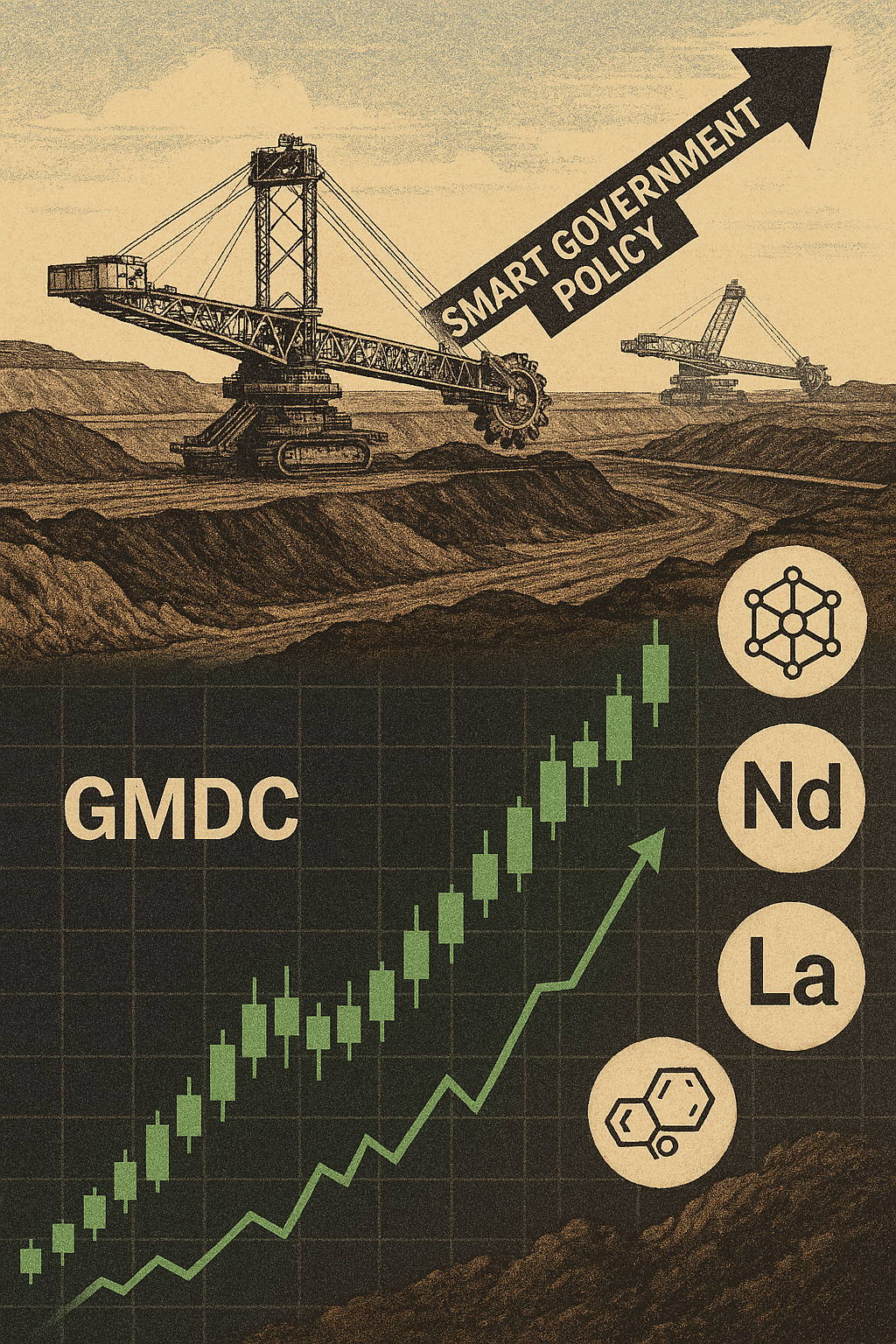
The GMDC share price surged sharply, fueled by rare-earth buzz and strong volumes. In this deep dive, we unpack the rally, fundamentals, and what lies ahead for investors in mining equities.
Table of Contents
Published: September 03, 2025
Last Updated: September 03, 2025
Category: Stock Market Analysis | Mining Sector
Market Overview
Gujarat Mineral Development Corporation (GMDC) experienced significant price movement during September 2025, attracting attention from market participants across institutional and retail categories. The stock reached new 52-week highs during this period, reflecting broader developments in India’s mining and minerals sector.
This analysis examines the factors contributing to GMDC’s market performance, including government policy initiatives, sector trends, and company-specific developments. Understanding these elements provides context for evaluating the stock’s trajectory and positioning within India’s evolving resource landscape.
The following sections provide detailed examination of price movements, financial metrics, operational factors, and risk considerations relevant to investors assessing GMDC’s current valuation and future prospects.
Stock Performance Review
Price Movement Analysis
GMDC shares traded in the range of ₹461-₹463 on September 15, 2025, according to exchange data. The stock had established a 52-week low of ₹226 in October 2024, representing substantial appreciation over the twelve-month period.
Market data indicates the stock reached a 52-week high near ₹472 during September 2025. This represented the culmination of sustained upward movement that began in late 2024 and continued through 2025.
The year-to-date performance through September 2025 showed significant gains compared to broader market indices. Price action demonstrated periods of consolidation followed by breakout movements at various technical levels.
Trading Volume Characteristics
Trading volumes increased substantially during the September rally. Exchange data shows average daily volumes rising to approximately 2.8 million shares, representing a notable increase from historical averages.
Peak trading activity occurred on September 12, 2025, when approximately 8.2 million shares changed hands. This elevated volume accompanied the price advance toward 52-week highs, indicating broad market participation.
Volume analysis suggests a mix of institutional and retail investor activity. Higher volumes during price advances typically indicate genuine demand rather than purely speculative trading patterns.
Market Capitalization Growth
The stock’s appreciation resulted in significant market capitalization expansion. Based on exchange data, GMDC’s market cap increased from approximately ₹7,200 crores in October 2024 to approximately ₹14,700 crores by September 2025.
This market cap growth reflects changing investor perceptions regarding the company’s business prospects and strategic positioning. Valuation expansion of this magnitude typically requires supporting fundamental developments beyond technical factors.
Company Background
Corporate Structure and Operations
Gujarat Mineral Development Corporation was established in 1963 as a Gujarat state government undertaking focused on systematic mineral resource development. The company operates under the administrative control of the state’s industries department.
GMDC maintains listings on both the Bombay Stock Exchange and National Stock Exchange. Government shareholding represents a significant portion of equity ownership, providing stability and access to policy-level engagement.
The company’s operational footprint spans multiple districts across Gujarat. Mining leases and exploration rights constitute core assets supporting current operations and future expansion potential.
Business Segment Overview
GMDC operates a diversified business model across multiple mineral and energy categories. Lignite mining represents the largest revenue contributor, accounting for approximately 45% of total revenues according to recent disclosures.
Silica sand operations contribute approximately 18% of revenues, serving glass manufacturing and foundry industries. Bauxite mining accounts for roughly 12% of revenues, supplying aluminum industry raw materials.
Power generation through lignite-based thermal plants represents approximately 15% of revenues. Specialty minerals including fluorspar, manganese, and limestone contribute the remaining revenue share across various industrial applications.
Government Ownership and Policy Linkages
As a state government enterprise, GMDC benefits from close coordination with government industrial development initiatives. This positioning provides advantages in securing mining rights, regulatory approvals, and policy support.
Government ownership also creates expectations regarding employment generation, regional development, and environmental stewardship. Balancing commercial objectives with public sector responsibilities influences strategic decision-making.
The company participates in various government initiatives related to mineral security, domestic sourcing, and strategic resource development. These relationships provide both opportunities and operational frameworks.
Strategic Minerals Development
Rare Earth Elements Initiative
India’s focus on reducing dependence on imported rare earth elements has created opportunities for domestic producers. Rare earths serve as critical inputs for advanced technologies including electric vehicle motors, wind turbines, and defense electronics.
GMDC has announced exploration and development programs targeting rare earth resources within Gujarat and potentially in other states through partnerships. These initiatives align with national objectives for strategic mineral self-sufficiency.
The global rare earth market is valued at approximately $8.2 billion with projected annual growth rates near 12%. Supply concentration in few countries has prompted multiple nations to develop alternative sources.
Successful development of rare earth capabilities would represent a significant business transformation for GMDC. Processing and refining capabilities command substantially higher margins than basic mining operations.
Critical Minerals Framework
The Indian government has designated several minerals as “critical” based on economic importance and supply risk assessments. This designation triggers policy support including expedited approvals and potential financial incentives.
GMDC’s existing mineral portfolio includes materials that may fall under critical minerals frameworks. Additionally, exploration activities target resources identified as strategically important.
International cooperation agreements on critical minerals supply chains may create export opportunities for Indian producers. Government-to-government arrangements could facilitate market access beyond traditional commercial channels.
Partnership Strategies
GMDC has indicated intentions to collaborate with other public sector entities including National Aluminium Company (NALCO) and Indian Rare Earths Limited (IREL). Such partnerships leverage complementary capabilities and reduce individual project risks.
Technology partnerships with international entities may prove necessary for advanced processing capabilities. Rare earth separation and purification require specialized expertise not widely available domestically.
Joint ventures could accelerate development timelines while sharing capital requirements. Collaborative approaches align with government preferences for coordinated public sector actions on strategic initiatives.
Infrastructure Demand Drivers
National Infrastructure Pipeline
India’s National Infrastructure Pipeline targeting investments of ₹111 lakh crores creates sustained demand for construction materials and industrial minerals. Highway development, railway expansion, and port modernization all require significant mineral inputs.
Silica sand demand for concrete and construction glass continues growing with urban development. Limestone consumption for cement production correlates directly with construction activity levels.
Industrial corridor developments including dedicated freight corridors require extensive material inputs over multi-year construction periods. This provides visibility for mineral demand beyond short-term economic cycles.
Housing and Urban Development
Government housing programs including Pradhan Mantri Awas Yojana target construction of millions of residential units. Each housing unit requires significant quantities of construction materials sourced from mining operations.
Smart Cities Mission encompassing 100 cities creates demand for both basic construction materials and specialized products. Urban infrastructure including water systems, transportation, and utilities all require mineral-based materials.
Commercial real estate development in tier-2 and tier-3 cities supplements residential construction demand. Expanding urban footprints translate to sustained mineral consumption across multiple product categories.
Energy Sector Requirements
Power sector expansion to meet growing electricity demand requires substantial material inputs. Thermal power plants require limestone for flue gas desulfurization and other pollution control systems.
Renewable energy installations create demand for specialized materials. Solar panel manufacturing requires high-purity silica for glass production. Wind turbines utilize rare earth elements in permanent magnet generators.
Grid infrastructure expansion for integrating renewable capacity requires aluminum and other minerals for transmission lines. Energy storage systems under development will require various battery materials and supporting infrastructure.
Financial Performance Analysis
Revenue Trends
Based on available financial disclosures, GMDC’s revenue showed growth trajectory over recent fiscal years. FY2024 revenues reached approximately ₹4,320 crores according to company filings.
Revenue composition reflects the diversified business model with contributions from multiple segments. Lignite operations represent the largest single contributor, while other minerals provide diversification benefits.
Year-over-year growth rates have varied based on commodity price movements, production volumes, and operational factors. Multi-year trends indicate generally positive momentum subject to commodity cycle impacts.
Profitability Metrics
Operating profit margins reflect a mix of high-volume lower-margin products like lignite and smaller-volume specialty minerals with better margins. Overall profitability depends on operational efficiency and product mix management.
Return on Equity (ROE) stood at approximately 11.2% based on recent financial data. This metric indicates efficiency in generating profits from shareholder equity deployed in the business.
Return on Capital Employed (ROCE) reached approximately 14.3% according to available disclosures. This measure reflects returns generated on total capital invested including both equity and debt.
Balance Sheet Strength
GMDC maintains a relatively strong balance sheet with modest debt levels. Total debt of approximately ₹850 crores against net worth of ₹16,200 crores results in a debt-to-equity ratio near 0.05x.
Cash and equivalents of approximately ₹4,200 crores provide significant financial flexibility. This liquidity supports operational requirements and potential strategic investments without immediate financing needs.
Fixed assets of approximately ₹12,800 crores reflect the capital-intensive nature of mining operations. Asset base includes mining equipment, processing facilities, and land holdings for current and future operations.
Capital Allocation Approach
The company maintains dividend payments while retaining substantial earnings for growth investments. Recent dividend payout ratios in the 25-30% range balance shareholder returns with reinvestment requirements.
Capital expenditure needs include maintenance of existing operations and development of new projects. Mine development requires upfront investments before production commencement and revenue generation.
Working capital requirements vary with commodity prices and production levels. Inventory management and receivables collection influence cash conversion cycles and operational liquidity needs.
Sector Context and Comparisons
Indian Mining Industry Overview
India’s mining sector contributes approximately 1.75% of GDP with government targets to increase this contribution to 2.5%. The National Mineral Policy 2019 aims to encourage investment while improving regulatory clarity.
Organized sector players benefit from increasing environmental and safety compliance requirements. Smaller informal operations face challenges meeting evolving standards, potentially consolidating market share toward larger companies.
The sector provides direct employment to hundreds of thousands with additional indirect employment through ancillary activities. Regional economic development in mining areas depends significantly on sector health.
Competitive Landscape
Coal India Limited represents the largest mining company by production volume and market capitalization. However, Coal India focuses primarily on coal production while GMDC maintains broader mineral diversification.
NMDC operates as another major government-owned mining company focused on iron ore. Hindustan Zinc, though privately controlled, represents significant competition in certain mineral categories.
State-level mining companies in other states compete in regional markets while national players compete across geographies. Each company’s cost structure, resource quality, and logistical positioning influence competitive dynamics.
Comparative Valuation Analysis
GMDC’s valuation metrics can be compared against sector peers to assess relative pricing. Price-to-earnings ratios vary based on growth expectations, profitability levels, and risk perceptions.
At approximately 18.5x estimated FY2025 earnings, GMDC trades at levels reflecting market expectations for future performance. Historical averages and peer comparisons provide context for evaluating current multiples.
Enterprise value to EBITDA ratios account for debt levels and cash holdings. GMDC’s strong balance sheet may justify premium valuations compared to leveraged competitors.
Technical Analysis Perspective
Chart Pattern Evaluation
Technical analysis of GMDC’s price charts reveals patterns that traders use for decision-making. The stock demonstrated clear uptrend characteristics over the review period with higher highs and higher lows.
Support levels formed around the ₹440-450 range based on trading activity. These levels represented previous resistance that transitioned to support after being breached with volume confirmation.
Resistance near the ₹472 level marked recent 52-week highs. Breakout above this level would require volume confirmation to suggest continuation potential rather than false breakout patterns.
Moving Average Analysis
The stock traded above major moving averages including 20-day, 50-day, 100-day, and 200-day averages during the rally. This alignment typically indicates positive momentum and trending behavior.
Golden cross patterns where shorter-term moving averages cross above longer-term averages occurred during the uptrend. These technical signals often attract momentum-focused traders.
Moving average support levels provide reference points for technical traders managing positions. Breaks below key moving averages might trigger automated selling from technical trading systems.
Momentum Indicators
Relative Strength Index (RSI) readings near 68 indicated strong momentum without reaching extremely overbought levels above 80. RSI interpretation depends on broader market context and individual stock characteristics.
MACD (Moving Average Convergence Divergence) showed bullish configuration with positive histogram bars. This momentum indicator suggests continuing positive price pressure based on moving average relationships.
Volume trends accompanying price movements provide confirmation signals. Higher volume during advances and lower volume during pullbacks typically indicate healthy trending behavior.
Policy and Regulatory Environment
Mining Policy Framework
The Mines and Minerals (Development and Regulation) Act governs mining activities in India. Recent amendments aimed to improve transparency and encourage investment while protecting environmental interests.
Auction-based allocation systems have replaced discretionary approvals for mining leases. This framework creates more predictable processes for acquiring mining rights subject to meeting technical and financial criteria.
State governments maintain significant authority over mining activities within their jurisdictions. Gujarat’s state policies influence GMDC’s operational environment and expansion opportunities.
Environmental Regulations
Environmental clearances require comprehensive impact assessments and public consultations. Increasingly stringent standards reflect growing environmental consciousness and regulatory evolution.
Mine closure and rehabilitation requirements mandate planning and financial provisioning for post-mining restoration. Companies must demonstrate environmental responsibility throughout mining lifecycles.
Water usage, air quality, and waste management standards continue evolving. Compliance requires ongoing investment in pollution control and environmental monitoring systems.
Strategic Sectors Classification
Designating certain minerals as strategic influences regulatory treatment and policy support. Government procurement preferences may favor domestic sources for strategic materials.
Export restrictions on strategic minerals ensure domestic availability. Companies mining strategic resources may face limitations on international sales requiring government approvals.
Public sector companies often receive priority consideration for strategic mineral development. GMDC’s government ownership positions it advantageously for designated strategic projects.
Renewable Energy Linkages
Solar Industry Requirements
India’s solar capacity expansion targets require significant glass production for panel manufacturing. High-purity silica serves as primary raw material for solar glass production.
GMDC’s silica sand operations potentially benefit from solar sector growth. Quality specifications and processing capabilities determine suitability for solar applications versus other industrial uses.
Localization initiatives in solar manufacturing create domestic demand for quality raw materials. Import substitution policies favor domestic mineral suppliers meeting required specifications.
Wind Power Sector
Wind turbine manufacturing requires rare earth elements for permanent magnet generators. Neodymium and dysprosium enable high-efficiency motors in modern turbine designs.
GMDC’s rare earth development initiatives align with wind power sector requirements. Successful development would position the company as domestic supplier for this growing market segment.
Wind energy capacity additions continue at significant pace under government renewable targets. Sustained turbine manufacturing activity creates ongoing rare earth demand.
Energy Storage Applications
Battery storage systems for grid stabilization and electric vehicles require various minerals. Lithium, cobalt, nickel, and graphite serve different battery chemistry requirements.
While GMDC doesn’t currently produce primary battery materials, processing capabilities under development may extend to battery material processing. Value chain participation could evolve as technologies mature.
Energy transition creates multi-decade demand growth for various minerals. Companies with processing capabilities and strategic positioning may capture significant value from this transition.
Risk Factors and Considerations
Commodity Price Volatility
Mining companies face inherent exposure to commodity price cycles. Lignite, silica, bauxite, and other products experience price fluctuations based on supply-demand dynamics.
Price volatility affects revenue stability and profitability. Long-term contracts provide some protection but typically don’t eliminate exposure to market movements.
Global economic conditions influence commodity prices through demand impacts. Economic slowdowns reduce industrial activity and construction, decreasing mineral consumption.
Regulatory and Compliance Risks
Mining operations face extensive regulatory requirements across environmental, safety, and land use domains. Regulatory changes can impose additional costs or operational restrictions.
Environmental liabilities from mining activities require careful management. Legacy issues or unforeseen contamination can create significant remediation costs.
Permit renewals and expansion approvals involve regulatory processes with uncertain timelines. Delays in approvals can impact production plans and growth initiatives.
Operational Challenges
Mining operations encounter geological uncertainties affecting resource quality and extraction costs. Actual conditions may differ from initial assessments impacting project economics.
Equipment reliability and maintenance requirements influence operational efficiency. Capital-intensive equipment requires significant maintenance investment to ensure consistent operations.
Labor relations and workforce management affect operational continuity. Mining operations require skilled labor whose availability and cost influence competitiveness.
Competition and Market Dynamics
Private sector entry into mining following policy reforms increases competitive intensity. Efficient private operators may pressure margins and market share for public sector companies.
Substitute materials and technological changes can reduce demand for specific minerals. Innovation in downstream industries affects long-term demand trajectories.
Import competition affects domestic pricing when international supplies become available at competitive costs. Logistical advantages help domestic producers but don’t eliminate competitive pressures entirely.
Financial Market Risks
Equity market volatility affects stock prices independent of company-specific fundamentals. Broader market corrections can impact even fundamentally strong companies.
Investor sentiment toward public sector enterprises fluctuates based on governance perceptions and policy directions. Sentiment changes affect valuations through multiple expansion or contraction.
Liquidity considerations influence investor participation. Stocks with lower trading volumes may experience higher volatility and wider bid-ask spreads affecting execution prices.
Investment Considerations
Valuation Assessment
Current valuation metrics require analysis against historical ranges and peer comparisons. Premium or discount valuations should correspond to relative strengths or weaknesses in growth prospects and execution capabilities.
Earnings projections incorporate assumptions about production volumes, commodity prices, and operational efficiency. Sensitivity analysis helps understand valuation implications under different scenarios.
Asset-based valuation approaches consider resource base values. Mining companies’ asset values include proven reserves and exploration potential beyond current operations.
Growth Prospects Evaluation
Rare earth development represents potentially transformational growth opportunity. However, execution risks include geological uncertainties, technology challenges, and market development requirements.
Infrastructure demand provides multi-year visibility for traditional mineral products. Volume growth depends on government infrastructure spending following through on announced plans.
Margin expansion potential exists through operational efficiency improvements and higher-value product mix shifts. Premium products and processing capabilities command better margins than basic mining operations.
Dividend Income Potential
Current dividend yield near 2.1% at recent price levels provides modest income component. Yields should be evaluated against broader market alternatives and growth-income tradeoff preferences.
Dividend sustainability depends on cash flow generation and capital requirement balances. Strong cash positions support dividend continuity even during temporary earnings volatility.
Progressive dividend policies aim for gradual payout increases over time. Historical patterns provide insights into management’s capital allocation philosophy.
Time Horizon Considerations
Short-term trading approaches focus on technical patterns and momentum. These strategies require active monitoring and disciplined risk management through stop-losses.
Medium-term investors assess business development progress including project execution and market share trends. 3-5 year horizons align with strategic initiative implementation timeframes.
Long-term investors evaluate structural positioning within India’s development trajectory. Decade-long perspectives emphasize sustainable competitive advantages and management quality.
Market Outlook
Near-Term Catalysts
Quarterly financial results provide regular catalysts for stock movement. Revenue growth, margin trends, and management commentary influence investor sentiment.
Policy announcements regarding strategic minerals or mining sector reforms can trigger significant reactions. Government decisions directly affect operating environments and growth opportunities.
Project milestone achievements in rare earth or other strategic initiatives would likely generate positive market responses. Demonstrable progress validates investment theses and reduces uncertainty.
Medium-Term Drivers
Infrastructure spending trajectories over next 2-3 years will influence demand for GMDC’s products. Budget allocations and project execution rates determine actual mineral consumption.
Rare earth program development through exploration, pilot processing, and commercial production phases extends over several years. Each phase completion represents potential catalyst for valuation re-rating.
Operational efficiency improvements and margin expansion provide earnings growth beyond volume increases. Technology adoption and process optimization initiatives require time to implement and demonstrate results.
Long-Term Structural Trends
India’s economic development trajectory creates multi-decade growth opportunity for resource companies. Rising per capita income and urbanization drive sustained mineral demand.
Energy transition toward renewables creates demand shifts across mineral categories. Companies positioned in growing segments benefit while traditional markets may face slower growth.
Manufacturing sector development under various government initiatives increases industrial mineral consumption. Production-linked incentive schemes aim to boost domestic manufacturing across multiple industries.
Environmental and Social Governance
Sustainability Initiatives
Mining companies face increasing scrutiny regarding environmental impact. Proactive environmental management creates competitive advantages with ESG-focused investors while reducing regulatory risks.
Water conservation and recycling systems reduce operational vulnerabilities to water scarcity. Mining operations require significant water with availability constraints in many regions.
Carbon emission reduction initiatives align with national climate commitments. Mine electrification and renewable energy integration can reduce operational emissions.
Community Relations
Mining activities affect local communities through employment, environmental impacts, and land use. Positive community relationships reduce operational risks and improve social license to operate.
Corporate social responsibility programs in mining regions address education, healthcare, and infrastructure needs. These investments build goodwill and contribute to regional development.
Employment generation in mining areas provides economic opportunities. Preference for local employment strengthens community support while accessing available labor pools.
Governance Standards
Public sector governance frameworks include oversight from government departments and audit agencies. Multiple layers of monitoring aim to ensure accountability and proper resource utilization.
Board composition includes government nominees and independent directors. Governance quality affects operational efficiency and strategic decision-making effectiveness.
Transparency in disclosures builds investor confidence. Regular reporting of operational metrics, financial performance, and strategic developments enables informed investment decisions.
Author Information
Name: Nueplanet
Nueplanet with the years of experience covering Indian mining, metals, and natural resources sectors
About the Author:
Nueplanet specializes in analysis of India’s mining and minerals sector with extensive experience evaluating public and private companies across coal, metals, and industrial minerals segments. Nueplanet research focuses on combining operational understanding with financial analysis to provide comprehensive sector insights.
This analysis relies exclusively on publicly available information from official sources including stock exchange filings, company announcements, government policy documents, and regulatory disclosures. All data has been verified against authoritative sources including BSE, NSE, SEBI filings, and official company communications.
Commitment to Accuracy:
Content is updated regularly to reflect latest developments and verified against official sources. All financial data and statistics are sourced from regulatory filings and reliable financial databases. The author maintains no commercial relationships with covered companies and provides objective analysis based on publicly available information.
Frequently Asked Questions
1. What factors contributed to GMDC reaching 52-week highs in September 2025?
Multiple factors supported GMDC’s price appreciation during September 2025. Government initiatives regarding strategic mineral development, particularly rare earth elements, created positive sentiment around domestic mining companies positioned in these areas. The stock benefited from improving fundamentals including revenue growth and strong balance sheet characteristics. Sector-wide momentum in mining stocks contributed to broader interest in companies like GMDC.
Trading volumes increased substantially during the advance, suggesting broad-based participation rather than isolated buying. Technical breakouts above resistance levels attracted momentum-focused traders. The confluence of fundamental developments, policy tailwinds, and technical factors created conditions supporting the rally to new 52-week highs.
2. How does GMDC’s diversified business model affect its risk profile compared to single-commodity miners?
GMDC’s operations across multiple minerals—including lignite, silica sand, bauxite, and specialty minerals—provide diversification benefits relative to companies focused on single commodities. Different minerals respond to different demand drivers with varying sensitivities to economic cycles. Silica demand connects to construction and manufacturing while lignite relates to power generation.
This diversity reduces vulnerability to any single market downturn. However, diversification also limits upside exposure to specific commodity price spikes compared to pure-play operators. Operational complexity increases with multiple product lines requiring different technical expertise and market knowledge. Overall, diversification typically reduces earnings volatility while potentially limiting explosive upside compared to concentrated positions.
3. What timeline and milestones should investors monitor for GMDC’s rare earth development program?
Rare earth development involves multi-year processes from exploration through commercial production. Initial phases include geological surveys and resource estimation requiring 12-24 months for comprehensive assessment. Following resource confirmation, pilot processing facilities test separation and purification technologies, typically requiring 2-3 years for development and optimization. Technology partnerships may accelerate this phase but require time for arrangement and implementation.
Commercial production facilities require additional capital investment and 3-5 years for construction and commissioning. Key milestones include resource estimate announcements, technology partnership agreements, pilot facility results, and commercial production commencement dates. Investors should track official company disclosures regarding progress at each phase while maintaining realistic expectations about development timelines.
4. How sustainable is GMDC’s current dividend policy given capital requirements for growth initiatives?
GMDC maintains dividend payout ratios in the 25-30% range, balancing shareholder returns with retained earnings for growth. This policy appears sustainable given the company’s strong cash position of approximately ₹4,200 crores and minimal debt obligations. Cash flow generation from existing operations supports current dividend levels even during periods of heavy capital investment.
However, major project developments including rare earth facilities would require substantial capital deployment potentially affecting future payout ratios. Management statements regarding progressive dividend policy suggest intentions to grow payouts gradually as earnings expand. Sustainability depends on balancing growth capital requirements with shareholder return expectations.
Strong balance sheet provides buffer for maintaining dividends during temporary earnings volatility or elevated investment periods.
5. What are key risks that could negatively impact GMDC’s share price performance?
Primary risks include commodity price volatility affecting lignite and other mineral revenues, with prices influenced by global supply-demand dynamics beyond company control. Regulatory changes in mining or environmental policies could impose additional compliance costs or operational restrictions. Delays in rare earth program development would disappoint investors and potentially trigger valuation de-rating.
Competition from private sector miners with potentially superior operational efficiency could pressure margins. Economic slowdown reducing infrastructure spending would decrease mineral demand. Execution risks on major projects including cost overruns or technical challenges affect returns on invested capital. Environmental incidents or compliance failures create financial and reputational damage. Governance issues sometimes affecting public sector enterprises could undermine investor confidence.
Investors should monitor operational metrics, policy developments, and project execution indicators to assess evolving risk profiles.
6. How do GMDC’s financial metrics compare to peer companies in India’s mining sector?
GMDC’s ROE near 11.2% and ROCE near 14.3% position it mid-range among Indian mining companies. Coal India reports similar or slightly higher returns depending on coal price cycles. NMDC typically shows comparable profitability metrics in iron ore segments. Private sector miners like Hindustan Zinc often report higher returns reflecting operational efficiency but carry greater financial leverage. GMDC’s debt-to-equity ratio near 0.05x represents one of the strongest balance sheets in the sector, providing financial flexibility many peers lack.
Dividend yields vary based on payout policies with GMDC’s 2.1% yield moderate compared to some higher-yielding mining stocks. Asset-light strategies enable higher returns for some competitors, while GMDC’s capital-intensive model requires different evaluation frameworks. Overall, GMDC demonstrates solid financial metrics with particular strength in balance sheet characteristics.
7. What role does government ownership play in GMDC’s strategic direction and operational performance?
Government ownership provides advantages including preferential access to mining rights, policy coordination, and strategic project participation. Public sector status can facilitate partnerships with other government entities and ensure consideration for strategic mineral development initiatives. However, government ownership also creates constraints including employment obligations, pricing considerations, and approval requirements for major decisions. Public procurement preferences may benefit GMDC in certain contracts while mandated social spending affects operational flexibility.
Governance structures involve oversight from multiple government departments affecting decision-making speed. Strategic direction balances commercial objectives with public sector responsibilities including regional development and employment generation. Investor perception of government ownership varies with some viewing it positively for stability and others concerned about efficiency. On balance, government ownership creates both advantages and constraints requiring nuanced evaluation.
8. What technical indicators suggest potential future price movements for GMDC shares?
Technical analysis as of the review period showed GMDC trading above major moving averages including 20-day, 50-day, 100-day, and 200-day averages, typically indicating positive momentum. RSI near 68 suggested strong momentum without extremely overbought conditions above 80. MACD showed bullish configuration with positive histogram. Support levels formed around ₹440-450 based on previous trading activity and resistance near ₹472 at recent highs. Breakout above ₹472 on strong volume would suggest continuation potential toward higher levels.
However, technical analysis provides probabilities rather than certainties, with patterns failing regularly. Volume confirmation remains critical for validating price movements. Investors should combine technical analysis with fundamental assessment rather than relying solely on chart patterns. Technical indicators change continuously requiring regular monitoring for active trading strategies.
Summary and Outlook
Gujarat Mineral Development Corporation’s market performance during September 2025 reflected multiple converging factors including government strategic mineral initiatives, sector momentum, and company-specific developments. The stock’s advance to 52-week highs represented significant appreciation from October 2024 levels.
GMDC operates a diversified minerals business providing exposure to infrastructure development, industrial demand, and emerging opportunities in strategic minerals. The balance sheet demonstrates financial strength with minimal debt and substantial cash holdings. Profitability metrics align with sector standards while valuation multiples reflect market expectations for growth.
Rare earth development represents potentially transformational opportunity but involves execution risks and multi-year timelines. Traditional mineral operations provide current cash flows and dividend support while strategic initiatives develop. Infrastructure spending trends influence near-term demand across product categories.
Investment considerations depend on individual time horizons, risk tolerance, and portfolio objectives. Long-term investors may view current positioning favorably given structural demand drivers and strategic initiatives. Shorter-term perspectives require attention to technical factors and near-term catalysts.
Risk factors including commodity price volatility, regulatory changes, and execution challenges require ongoing monitoring. Diversification across mineral categories provides some risk mitigation compared to single-commodity exposure.
Market participants should track quarterly results, project development milestones, and policy developments affecting the mining sector. Official company disclosures and regulatory filings provide authoritative information for investment analysis.
Disclaimer: This analysis is for informational purposes only and does not constitute investment advice. Investors should conduct independent research and consult qualified financial advisors before making investment decisions. Past performance does not guarantee future results. Stock investments involve risks including potential loss of principal.
Sources:
- Bombay Stock Exchange (BSE) official data
- National Stock Exchange (NSE) market information
- Securities and Exchange Board of India (SEBI) filings
- Company annual reports and investor presentations
- Ministry of Mines policy documents
- Reserve Bank of India economic data
Last Data Verification: September 03, 2025
This content is maintained with commitment to accuracy and regular updates based on official sources. For latest information, readers should refer to regulatory filings and company announcements.
Helpful Resources
Latest Posts
Related Posts












Post Comment