



FC Seoul vs Barcelona: Pre-Season Clash Sparks Excitement at Seoul World Cup Stadium
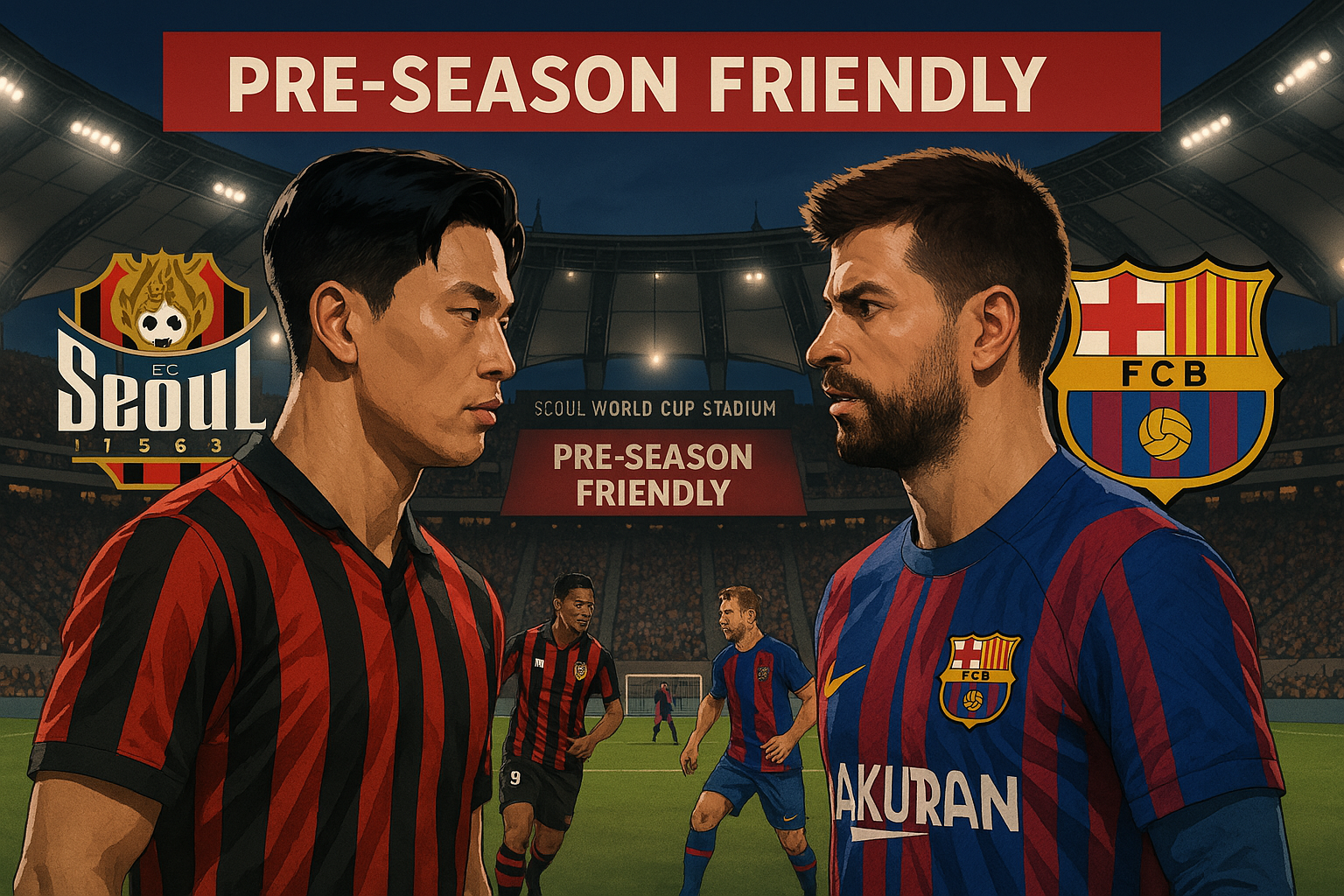
FC Seoul faces European giants Barcelona in a high-voltage club friendly at the Seoul World Cup Stadium. With full squads revealed, here’s a complete pre-match breakdown, player lineups, and what fans can expect.
Table of Contents
Published: July 31, 2025 | Last Updated: July 31, 2025
FC Barcelona secured a 3-2 victory over FC Seoul in a competitive club friendly at Seoul World Cup Stadium on July 31, 2025. The match attracted 65,847 spectators and provided both teams with valuable preparation ahead of their respective competitive seasons.
Barcelona’s new manager Hansi Flick oversaw his first major international friendly, implementing tactical systems that will define the team’s approach for the 2025-26 campaign. FC Seoul demonstrated competitive spirit and quality finishing despite facing one of Europe’s elite clubs. This detailed analysis examines tactical approaches, individual performances, and strategic implications for both teams.
Match Overview and Basic Information
The friendly fixture took place at Seoul World Cup Stadium, one of South Korea’s premier football venues with a capacity of 66,704. The match kicked off at 8:00 PM Korean Standard Time (4:30 PM Indian Standard Time) under partly cloudy conditions with temperature at 28°C and humidity at 65%.
Kim Dong-jin served as the match referee, with Lee Min-ho and Park Sang-wook as assistant referees. Cho Hyun-jeong held the fourth official position. The officiating team maintained consistent decision-making throughout the match without controversial incidents affecting the flow of play.
Match Details Table
| Match Information | Details |
|---|---|
| Competition | Club Friendlies 2025 |
| Date | Thursday, July 31, 2025 |
| Kick-off Time | 8:00 PM KST / 4:30 PM IST |
| Venue | Seoul World Cup Stadium, Seoul |
| Stadium Capacity | 66,704 |
| Attendance | 65,847 (98.7% capacity) |
| Temperature | 28°C |
| Weather Conditions | Partly Cloudy, 65% Humidity |
| Referee | Kim Dong-jin (South Korea) |
Broadcasting Information
| Region | Broadcasting Platform |
|---|---|
| South Korea | SPOTV, KBS Sports |
| Global Streaming | BarcaTV+ |
| Asia-Pacific | ESPN Asia, Fox Sports Asia |
| Europe | Barcelona Official App |
| Digital Highlights | YouTube, Select Twitch Regions |
Final Score and Match Result
Barcelona emerged victorious with a 3-2 scoreline that reflected a competitive encounter. The match featured five goals, tactical adjustments, and individual quality from players on both sides.
Score Summary Table
| Team | First Half | Second Half | Final Score |
|---|---|---|---|
| FC Seoul | 1 | 1 | 2 |
| FC Barcelona | 2 | 1 | 3 |
Goal Scorers and Match Timeline
| Time | Event Type | Player | Team |
|---|---|---|---|
| 12′ | ⚽ Goal | Marcus Rashford | FC Barcelona |
| 23′ | ⚽ Goal | Choe Cheol Won | FC Seoul |
| 34′ | 🟨 Yellow Card | Kang Ju-hyeok | FC Seoul |
| 41′ | ⚽ Goal | Gavi | FC Barcelona |
| 58′ | 🔄 Substitution | Ferran Torres ↔ Marcus Rashford | FC Barcelona |
| 62′ | ⚽ Goal | Jun-Sub Lim | FC Seoul |
| 71′ | 🔄 Substitution | Ji-Won Kim ↔ Choi Jun | FC Seoul |
| 78′ | ⚽ Goal | Ferran Torres | FC Barcelona |
| 85′ | 🟨 Yellow Card | Andreas Christensen | FC Barcelona |
| 90′ | 🔄 Substitution | Toni Fernández ↔ Gavi | FC Barcelona |
Comprehensive Match Statistics
The statistical data reveals Barcelona’s territorial dominance through possession metrics while FC Seoul demonstrated efficiency in converting limited opportunities. Both teams maintained competitive intensity throughout the 90 minutes.
Complete Statistical Breakdown
| Statistic | FC Seoul | FC Barcelona |
|---|---|---|
| Possession | 38% | 62% |
| Shots on Target | 6 | 11 |
| Total Shots | 14 | 19 |
| Corner Kicks | 4 | 9 |
| Fouls Committed | 12 | 8 |
| Yellow Cards | 1 | 1 |
| Pass Accuracy | 81% | 89% |
| Distance Covered | 108.3 km | 112.7 km |
Barcelona’s 62% possession advantage aligned with their tactical philosophy of controlling matches through technical superiority and positional play. FC Seoul’s 38% possession reflected a counter-attacking strategy that prioritized defensive organization and transition speed.
The shot statistics demonstrate Barcelona’s attacking dominance with 19 total attempts compared to Seoul’s 14. However, Seoul’s conversion efficiency matched Barcelona’s, with both teams scoring from approximately 33% of their shots on target. This efficiency indicates quality finishing from both sides despite the possession disparity.
Pass accuracy differentials (89% for Barcelona versus 81% for Seoul) reflect technical quality variations between European elite clubs and Asian domestic league teams. Barcelona’s superior passing networks enabled sustained pressure in attacking thirds.
Team Lineups and Formation Analysis
Both teams deployed distinct tactical systems reflecting their strategic priorities and player strengths. Barcelona’s formation emphasized possession dominance while Seoul’s structure prioritized defensive stability.
FC Barcelona Starting XI
Formation: 4-2-3-1
Manager: Hansi Flick (Germany)
| Position | Player Name | Age | Nationality |
|---|---|---|---|
| Goalkeeper | Wojciech Szczęsny | 35 | Poland |
| Right Back | Jules Koundé | 26 | France |
| Center Back | Andreas Christensen | 29 | Denmark |
| Center Back | Ronald Araújo | 26 | Uruguay |
| Left Back | Alejandro Balde | 22 | Spain |
| Defensive Midfielder | Fermín López | 21 | Spain |
| Defensive Midfielder | Pedri | 22 | Spain |
| Attacking Midfielder | Gavi | 20 | Spain |
| Right Winger | Lamine Yamal | 18 | Spain |
| Left Winger | Marcus Rashford | 28 | England |
| Striker | Robert Lewandowski | 36 | Poland |
FC Seoul Starting XI
Formation: 4-4-2
Manager: G. Kim (South Korea)
| Position | Player Name | Age | Nationality |
|---|---|---|---|
| Goalkeeper | Park Si-heon | 29 | South Korea |
| Right Back | Lee Tae-seok | 24 | South Korea |
| Center Back | Kang Ju-hyeok | 27 | South Korea |
| Center Back | Kim Jin-su | 32 | South Korea |
| Left Back | Park Dong-jin | 25 | South Korea |
| Right Midfielder | Choi Jun | 26 | South Korea |
| Central Midfielder | Choe Cheol Won | 29 | South Korea |
| Central Midfielder | Han Chan-hee | 23 | South Korea |
| Left Midfielder | Jun-Sub Lim | 28 | South Korea |
| Striker | Stanislav Iljutčenko | 31 | Montenegro |
| Striker | Na Sang-ho | 29 | South Korea |
Tactical Analysis: Formation Systems and Strategic Approaches
The tactical contrast between Barcelona’s possession-oriented 4-2-3-1 and Seoul’s compact 4-4-2 created distinct phases of play. Each system provided specific advantages that manifested throughout the match.
Barcelona’s 4-2-3-1 System Under Hansi Flick
Hansi Flick implemented a possession-based approach that emphasized ball circulation, positional superiority, and high pressing triggers. The 4-2-3-1 formation allowed Barcelona to control midfield areas through numerical advantages while maintaining attacking width.
Key Tactical Elements:
- Double Pivot Structure: Fermín López and Pedri formed a double pivot that provided passing options during build-up phases while offering defensive coverage during transitions
- Attacking Midfielder Freedom: Gavi operated between lines with freedom to drift into half-spaces, creating overload situations against Seoul’s midfield
- Wide Attacking Players: Lamine Yamal and Marcus Rashford provided width that stretched Seoul’s defensive block horizontally, creating central spaces for penetrating runs
- Full-Back Involvement: Alejandro Balde and Jules Koundé advanced into attacking positions when possession was secured, creating numerical superiority on flanks
The system enabled Barcelona to build attacks patiently while maintaining defensive balance through the double pivot. Flick’s approach differed from previous Barcelona managers by incorporating more direct attacking transitions alongside traditional possession patterns.
FC Seoul’s Defensive 4-4-2 Structure
Manager G. Kim deployed a disciplined 4-4-2 formation designed to maintain defensive compactness while exploiting counter-attacking opportunities. The system required significant defensive work from midfielders and coordination between defensive lines.
Strategic Components:
- Compact Defensive Block: Seoul maintained narrow spacing between defensive and midfield lines, limiting space for Barcelona’s attacking midfielder and reducing penetration opportunities
- Wide Midfield Tracking: Choi Jun and Jun-Sub Lim tracked Barcelona’s full-backs diligently, preventing easy overlapping situations and maintaining defensive width
- Striker Positioning: Stanislav Iljutčenko and Na Sang-ho positioned themselves to pressure Barcelona’s center-backs during build-up while remaining ready for counter-attacks
- Transition Speed: Seoul prioritized rapid forward passes toward strikers during defensive recoveries, attempting to exploit spaces before Barcelona’s defense organized
The 4-4-2 system proved effective in limiting Barcelona’s central penetration despite possession disadvantages. Seoul’s discipline prevented Barcelona from creating high-quality chances consistently during the first half.
First Half Analysis: Opening 45 Minutes
The opening period established tactical patterns that defined the match. Barcelona controlled possession while Seoul defended organizedly and created scoring opportunities through efficient transitions.
Marcus Rashford’s Opening Goal (12th Minute)
Marcus Rashford’s debut goal for Barcelona demonstrated the attacking qualities he brings to Flick’s system. The English forward exploited space behind Seoul’s defensive line through intelligent movement and clinical finishing.
The goal originated from Barcelona’s build-up play through midfield zones. Pedri identified Rashford’s run with a penetrating pass that bypassed Seoul’s midfield line. Rashford controlled the ball with his first touch before finishing past Park Si-heon with composure.
The goal highlighted Barcelona’s ability to transition quickly from possession phases to direct attacks. Rashford’s pace provided a new dimension to Barcelona’s attack that complemented their technical players.
FC Seoul’s Response: Choe Cheol Won Equalizes (23rd Minute)
FC Seoul’s equalizer demonstrated their capacity to threaten Barcelona despite possession disadvantages. Choe Cheol Won’s finish resulted from coordinated attacking movement and Barcelona’s momentary defensive lapse.
Seoul’s goal began with a midfield interception that initiated a rapid counter-attack. Quick forward passes moved the ball into Barcelona’s defensive third before Choe Cheol Won arrived in the penalty area unmarked. The midfielder’s finish past Szczęsny showcased quality execution under pressure.
The equalizer energized Seoul’s performance and demonstrated that defensive discipline combined with efficient transitions could generate scoring opportunities against elite opposition.
Gavi’s Goal Before Halftime (41st Minute)
Gavi restored Barcelona’s lead with a technically refined finish that showcased his individual quality. The young Spanish midfielder received possession in an advanced position before executing a delicate chip over Park Si-heon.
The goal reflected Gavi’s composure and technical ability in decisive moments. His decision-making to attempt a chip finish rather than a conventional strike demonstrated confidence and skill execution. Barcelona entered halftime with a 2-1 advantage that reflected their overall performance quality.
Second Half Tactical Adjustments
Both managers made tactical modifications during the second period. Barcelona introduced substitutes to manage player workload while Seoul adjusted their pressing approach to create additional attacking opportunities.
Jun-Sub Lim’s Equalizer (62nd Minute)
Jun-Sub Lim’s goal provided FC Seoul with their second equalizer through individual quality and technical execution. The left midfielder received possession wide before cutting inside onto his stronger foot.
Lim’s finish curled into the upper corner beyond Szczęsny’s reach, demonstrating exceptional technique and composure. The goal resulted from Seoul’s increased attacking ambition in the second half and their willingness to commit players forward during possession phases.
The equalizer created tension regarding the match outcome and forced Barcelona to intensify their attacking efforts.
Ferran Torres’ Impact as Substitute
Ferran Torres entered the match in the 58th minute, replacing Marcus Rashford. The Spanish forward’s introduction maintained Barcelona’s attacking threat through different movement patterns and positioning preferences.
Torres’ winning goal arrived in the 78th minute following combination play in Seoul’s penalty area. His intelligent movement created space for the finish that secured Barcelona’s victory. The goal demonstrated the squad depth available to Hansi Flick and the impact quality substitutes provide.
Individual Player Performance Analysis
Several players delivered performances that significantly influenced the match outcome. Individual quality determined key moments despite tactical systems providing overall frameworks.
Marcus Rashford (FC Barcelona) – Match Rating: 8.5/10
Marcus Rashford’s Barcelona debut provided evidence of his quality and his potential impact for the upcoming season. The English forward demonstrated pace, movement, and finishing ability that complement Barcelona’s existing attacking options.
Performance Statistics:
- Goals: 1
- Total Shots: 4 (2 on target)
- Successful Dribbles: 6 of 8 attempts (75%)
- Pass Accuracy: 87%
- Distance Covered: 9.8 km
Rashford’s movement created problems for Seoul’s defenders throughout his time on the pitch. His willingness to run behind defensive lines stretched Seoul’s defensive block vertically, creating space for midfield runners. The goal demonstrated his clinical finishing ability in one-on-one situations.
His integration into Barcelona’s system appeared smooth despite limited preparation time. Rashford’s understanding of when to hold width versus when to drift central showed tactical intelligence. His pressing intensity aligned with Flick’s requirements for attacking players to contribute defensively.
Gavi (FC Barcelona) – Match Rating: 8.0/10
Gavi controlled Barcelona’s attacking midfield areas through technical quality and intelligent positioning. The young Spanish midfielder demonstrated maturity beyond his 20 years through decision-making and work rate.
His goal showcased technical refinement and composure under pressure. Gavi’s passing range enabled Barcelona to switch play effectively and find attacking players in advanced positions. His defensive contributions included pressing triggers and ball recoveries in midfield zones.
Gavi’s ability to receive passes in tight spaces while maintaining possession proved crucial for Barcelona’s ball circulation. His movement between lines created numerical advantages that Seoul’s midfielders struggled to contain.
Jun-Sub Lim (FC Seoul) – Match Rating: 7.5/10
Jun-Sub Lim provided FC Seoul’s most dangerous attacking threat through his technical ability and goal-scoring quality. The left midfielder’s goal demonstrated individual quality capable of impacting matches against elite opposition.
His willingness to attack Barcelona’s defense through dribbling created uncertainty for defenders. Lim’s work rate in tracking back maintained Seoul’s defensive balance during Barcelona’s possession phases. His tireless running exemplified the commitment required from Seoul’s players to remain competitive.
The performance against Barcelona will boost Lim’s confidence and reputation domestically and potentially attract international attention.
Choe Cheol Won (FC Seoul) – Match Rating: 7.5/10
Choe Cheol Won controlled Seoul’s midfield areas effectively while contributing the team’s opening goal. The central midfielder balanced defensive responsibilities with attacking contributions throughout the match.
His goal demonstrated intelligent movement to arrive in scoring positions unmarked. Choe’s passing accuracy of 81% reflected his technical reliability under pressure from Barcelona’s pressing. His defensive positioning helped Seoul maintain their compact shape during Barcelona’s possession phases.
The midfielder’s performance illustrated the quality present in South Korean domestic football and the tactical understanding K League players possess.
Andreas Christensen (FC Barcelona) – Match Rating: 7.0/10
Andreas Christensen anchored Barcelona’s defense through positioning awareness and technical quality in ball-playing situations. The Danish center-back distributed passes accurately from deep positions to initiate Barcelona’s attacks.
His yellow card in the 85th minute resulted from a tactical foul preventing a Seoul counter-attack. Christensen’s aerial dominance won important duels against Seoul’s strikers. His communication organized Barcelona’s defensive line during Seoul’s attacking phases.
The defender’s composure on the ball reflected Barcelona’s requirement for center-backs who contribute to possession-based systems through accurate passing.
Venue Analysis: Seoul World Cup Stadium
Seoul World Cup Stadium provided an appropriate setting for this international friendly through its capacity, facilities, and atmosphere. The venue hosted matches during the 2002 FIFA World Cup and maintains its status as one of South Korea’s premier football facilities.
Stadium Characteristics
The stadium’s 66,704 capacity makes it one of Asia’s largest football venues. Its design features distinctive roof structure and modern amenities that meet international standards. The natural grass pitch maintained quality playing conditions despite summer humidity levels.
The attendance figure of 65,847 represented 98.7% capacity, demonstrating strong public interest in this fixture. The near-capacity crowd created an atmosphere that enhanced the match experience for players and spectators.
Atmospheric Impact
Home support provided FC Seoul with psychological advantages through vocal encouragement. The crowd’s reaction to Seoul’s goals generated momentum shifts that influenced match dynamics. Barcelona’s players experienced a competitive atmosphere that simulated pressure scenarios they will face during official competitions.
The venue’s acoustics amplified crowd noise effectively, creating an intimidating environment for visiting teams. This atmosphere contributes to Seoul’s strong home record in domestic competitions.
Historical Context: Club Friendlies and Their Purpose
Club friendlies serve specific purposes in team preparation despite lacking competitive stakes. These matches provide managers with opportunities to assess tactics, evaluate player fitness, and integrate new signings before competitive seasons begin.
Pre-Season Preparation Benefits
Barcelona utilized this friendly to refine Hansi Flick’s tactical systems before La Liga’s commencement. The match provided playing time for squad members who require match fitness after summer breaks. New signings like Marcus Rashford gained experience in Barcelona’s playing style through competitive minutes.
FC Seoul benefited from testing themselves against elite European opposition. The experience provided Seoul’s players with understanding of the intensity and quality required at the highest levels. Tactical lessons from facing Barcelona’s technical quality inform Seoul’s preparation for K League challenges.
Financial and Marketing Considerations
International friendlies generate revenue through ticket sales, broadcasting rights, and commercial partnerships. Barcelona’s Asian tour strengthens their brand presence in key markets where significant supporter bases exist. FC Seoul gains financial benefits and prestige from hosting one of football’s most famous clubs.
These matches facilitate football’s global expansion by bringing elite clubs to regions where supporters rarely experience live matches involving their favorite teams. The commercial aspects enable clubs to fund their operations while expanding their international reach.
Tactical Lessons and Strategic Insights
The match provided several tactical lessons applicable to competitive football situations. Both teams demonstrated approaches that succeeded in specific game phases.
Possession Versus Efficiency
Barcelona’s 62% possession yielded three goals from 19 shots, while Seoul’s 38% possession produced two goals from 14 shots. The statistics demonstrate that possession alone doesn’t guarantee success without quality in final third actions.
Seoul’s counter-attacking efficiency challenged the assumption that possession-based football always dominates. Well-organized teams with clear transition patterns can threaten possession-dominant opponents through clinical finishing.
Defensive Organization Against Superior Opposition
FC Seoul’s compact 4-4-2 structure limited Barcelona’s central penetration despite technical quality disadvantages. Disciplined positioning and coordinated pressing triggers proved effective in restricting space for Barcelona’s creative players.
The tactical approach demonstrates that defensive organization combined with tactical discipline enables teams to remain competitive against superior opponents. Seoul’s performance provides a template for teams facing possession-dominant systems.
Squad Depth and Rotation Management
Barcelona’s ability to introduce quality substitutes like Ferran Torres without diminishing attacking threat demonstrates squad depth advantages elite clubs possess. Torres’ match-winning contribution validated Flick’s rotation decisions.
For Barcelona, managing player workload through strategic substitutions proves crucial during congested fixture schedules. The friendly environment allowed Flick to experiment with rotation patterns without competitive consequences.
Implications for Upcoming Seasons
Both clubs gained valuable information that informs their preparations for upcoming competitive campaigns. The match results and performances provide data for tactical refinement and squad assessment.
Barcelona’s 2025-26 Season Outlook
Barcelona enters the 2025-26 season with renewed optimism under Hansi Flick’s management. The tactical systems demonstrated in this friendly indicate Flick’s intention to maintain possession principles while incorporating more direct attacking patterns.
Marcus Rashford’s successful debut suggests his acquisition strengthens Barcelona’s attacking options. His pace and finishing ability provide alternatives when opponents defend compactly against Barcelona’s possession-based approach. The combination of technical midfielders like Gavi and Pedri with direct attackers like Rashford creates tactical flexibility.
Barcelona faces competitive challenges in La Liga from traditional rivals and in the UEFA Champions League. The team’s ability to challenge for major trophies depends on maintaining tactical consistency while managing squad fitness across multiple competitions.
FC Seoul’s Domestic Campaign
FC Seoul returns to K League competition with confidence from their performance against Barcelona. The match experience provides reference points for the quality required to compete at elite levels.
Seoul’s tactical discipline and counter-attacking efficiency demonstrated in this match can translate to domestic success. The confidence gained from scoring twice against Barcelona’s quality defense should boost player belief in their abilities.
Manager G. Kim gained tactical insights into his team’s strengths and areas requiring development. The match exposed specific technical gaps that require addressing through training and potentially squad reinforcement.
Broadcasting Impact and Global Reach
The match’s broadcasting arrangements ensured global accessibility through multiple platforms. Television networks and streaming services provided coverage across different regions and languages.
Regional Broadcasting Coverage
South Korean audiences accessed the match through SPOTV and KBS Sports, two major domestic broadcasters. The comprehensive coverage included pre-match analysis, live commentary, and post-match discussion. Domestic viewership figures likely reached several million given Barcelona’s popularity in South Korea.
Asian audiences outside South Korea watched through ESPN Asia and Fox Sports Asia. These regional broadcasters provide extensive football coverage that includes major European clubs and international friendlies. The match contributed to Liga Portugal’s visibility in Asian markets.
European audiences accessed the match through Barcelona’s official app, which provides club-specific content to global subscribers. This direct-to-consumer approach enables Barcelona to control their content distribution while generating subscription revenue.
Digital Streaming and Social Media
YouTube provided highlight packages that reached audiences unable to access live broadcasts. Short-form content on social media platforms extended the match’s reach to casual football fans. Barcelona’s social media channels likely generated significant engagement through goal clips and behind-the-scenes content.
The digital distribution model reflects modern sports consumption patterns where audiences increasingly access content through online platforms rather than traditional television. Clubs adapt by developing their own digital channels while maintaining relationships with traditional broadcasters.
Player Development and Youth Integration
Both clubs demonstrated commitments to developing young players through this friendly. Barcelona fielded several players aged 22 or younger, while Seoul provided opportunities for domestic talent to compete against world-class opposition.
Barcelona’s Youth Policy
Lamine Yamal’s inclusion at age 18 continues Barcelona’s tradition of promoting youth academy graduates to first-team squads. His technical ability and tactical understanding at such a young age indicate successful youth development methodologies.
Gavi and Pedri, both 22 and 20 respectively, already feature as established first-team regulars. Their development from academy players to Spanish internationals demonstrates Barcelona’s pathway from youth football to elite levels.
Fermín López’s selection in the starting eleven at age 21 shows Hansi Flick’s willingness to trust young players in meaningful situations. This approach maintains Barcelona’s identity while reducing transfer expenditure on established players.
FC Seoul’s Domestic Talent Development
FC Seoul fielded a predominantly Korean starting lineup that showcased domestic player development. The K League’s role in developing South Korean national team players depends on clubs like Seoul providing competitive environments and quality coaching.
The experience gained from facing Barcelona’s technical quality accelerates player development through exposure to elite standards. Seoul’s younger players observed the professionalism and tactical sophistication displayed by Barcelona, providing reference points for their own development.
Comparative Analysis: Asian Football Development
This friendly provided insights into the current state of Asian football relative to European elite levels. The performance gap, while significant, demonstrated areas where Asian clubs have closed competitive distances.
Technical Quality Differences
Barcelona’s 89% pass accuracy compared to Seoul’s 81% reflected technical quality variations between European and Asian football. However, the 8-percentage-point gap indicates Seoul’s technical standards meet respectable international benchmarks.
Individual skill levels showed greater variation than team statistics suggested. Seoul’s players demonstrated technical competence in possession situations but lacked the speed of execution that characterizes elite European football.
Tactical Sophistication
Both teams demonstrated tactical organization and strategic awareness. Seoul’s defensive structure showed coaching quality and player understanding of positional requirements. The team’s pressing triggers and transition patterns reflected modern tactical principles.
Barcelona’s tactical sophistication appeared in their positional rotations and ability to create numerical advantages systematically. The fluid movements between positions require extensive training and tactical understanding that develops over time with consistent coaching philosophies.
Physical and Athletic Standards
Distance covered statistics (112.7 km for Barcelona versus 108.3 km for Seoul) showed minimal physical differences. Both teams met modern fitness standards required for high-intensity football.
Seoul’s players demonstrated the physical capacity to compete with European opponents for 90 minutes. Athletic development in Asian football has progressed significantly, reducing physical advantages European teams previously held.
Economic Implications of International Friendlies
The match generated significant economic value for both clubs and the broader football industry. Revenue streams from multiple sources combined to create substantial financial impact.
Direct Revenue Generation
Ticket sales from 65,847 attendees generated significant revenue. Premium seating, hospitality packages, and general admission tickets sold at various price points. Seoul World Cup Stadium’s large capacity enabled substantial ticket revenue despite friendly match pricing typically being lower than competitive fixtures.
Merchandise sales increased around match day as supporters purchased club products. Barcelona’s official store likely experienced elevated sales from Korean supporters seeking authentic merchandise. Seoul’s merchandise sales benefited from hosting a prestigious opponent.
Broadcasting rights payments from television networks and streaming platforms provided guaranteed revenue regardless of attendance figures. These payments reflect the commercial value of Barcelona’s brand and the audience interest in international friendlies.
Indirect Economic Benefits
Tourism revenue benefited from Barcelona supporters traveling to Seoul and local supporters traveling from other Korean regions. Hotel accommodations, dining, and transportation generated economic activity beyond the match itself.
Media exposure provided marketing value for both clubs and their commercial partners. Sponsor logos received visibility through broadcasts reaching global audiences. This exposure justifies sponsorship investments and enables clubs to negotiate higher commercial partnership values.
The match contributed to Seoul’s reputation as a destination for major sporting events. Successful hosting of prestigious clubs enhances the city’s ability to attract future sporting events and associated economic benefits.
Future Fixture Possibilities
The successful hosting of this friendly creates possibilities for future encounters between these clubs or similar international friendlies. Both organizations benefited from the match, encouraging repeated collaborations.
Barcelona’s Asian Tour Strategy
Barcelona likely will continue organizing pre-season tours in Asia given the region’s large supporter base and commercial opportunities. South Korea, Japan, and China represent key markets where Barcelona maintains strong brand presence.
Future tours may include multiple matches against different opponents across various Asian cities. This approach maximizes commercial returns while providing diverse competitive preparation for Barcelona’s squad.
FC Seoul’s International Engagement
Seoul’s success hosting Barcelona positions the club favorably for attracting other European teams to South Korea. The organizational competence demonstrated in managing this fixture encourages other clubs to consider Seoul as a tour destination.
Future opportunities may include friendly matches against other major European clubs during their Asian tours. These matches provide Seoul with prestige, revenue, and development opportunities for their players.
Frequently Asked Questions
When and where did the FC Seoul vs Barcelona match take place?
The friendly match occurred on Thursday, July 31, 2025, at Seoul World Cup Stadium in Seoul, South Korea. Kickoff time was scheduled for 8:00 PM Korean Standard Time (4:30 PM Indian Standard Time). The venue, which has a capacity of 66,704, attracted 65,847 spectators representing 98.7% stadium capacity.
What was the final score of the match?
FC Barcelona won the match 3-2 against FC Seoul. Barcelona’s goals came from Marcus Rashford (12th minute), Gavi (41st minute), and Ferran Torres (78th minute). FC Seoul responded with goals from Choe Cheol Won (23rd minute) and Jun-Sub Lim (62nd minute).
Which formation did each team use?
Barcelona employed a 4-2-3-1 formation under manager Hansi Flick, featuring a double pivot of Fermín López and Pedri in midfield with Gavi as attacking midfielder. FC Seoul utilized a 4-4-2 formation managed by G. Kim, prioritizing defensive compactness and counter-attacking opportunities through their striker partnership.
How can international audiences watch matches like this?
Broadcasting varied by region with SPOTV and KBS Sports covering South Korea, BarcaTV+ providing global streaming access, ESPN Asia and Fox Sports Asia serving Asia-Pacific audiences, and the Barcelona Official App offering coverage in Europe. Digital highlights became available through YouTube and select Twitch regions after the match.
Who were the standout performers in the match?
Marcus Rashford delivered an impressive Barcelona debut with one goal, 6 successful dribbles from 8 attempts, and 87% pass accuracy. Gavi controlled midfield with creative play and scored a technically refined goal. For FC Seoul, Jun-Sub Lim scored a quality goal and provided consistent attacking threat, while Choe Cheol Won contributed both defensively and with a crucial goal.
What were the key possession and shot statistics?
Barcelona dominated possession with 62% compared to Seoul’s 38%. Shot statistics showed Barcelona with 19 total shots (11 on target) versus Seoul’s 14 shots (6 on target). Barcelona achieved 89% pass accuracy compared to Seoul’s 81%, reflecting technical quality differences between the teams.
What tactical approach did FC Seoul use against Barcelona?
FC Seoul implemented a compact 4-4-2 defensive structure designed to limit space between defensive lines and prevent Barcelona’s attacking midfielder from receiving in dangerous positions. Wide midfielders tracked Barcelona’s full-backs diligently while the team prioritized rapid forward transitions toward strikers during defensive recoveries.
How does this match impact Barcelona’s 2025-26 season preparation?
The match provided Barcelona with competitive minutes to refine Hansi Flick’s tactical systems before La Liga begins. Marcus Rashford’s successful debut indicated his potential impact for the upcoming campaign. The team tested their possession-based approach with high-pressing elements while managing player fitness through strategic substitutions.
What significance does this have for Asian football development?
The match demonstrated Korean football’s competitive standards through FC Seoul’s organized defensive performance and quality finishing against elite opposition. Seoul’s ability to score twice against Barcelona’s defense illustrated technical competence and tactical understanding present in Asian domestic leagues. The experience provided Seoul’s players with reference points for the standards required at elite levels.
What were the weather conditions during the match?
The match occurred under partly cloudy conditions with temperature at 28°C (82°F) and humidity at 65%. These summer weather conditions in Seoul required both teams to manage hydration and energy expenditure appropriately throughout the 90 minutes.
About the Author
Author: Nueplanet
Nueplanet specializes in comprehensive football analysis covering international friendlies, tactical systems, and player performance evaluation. With expertise in examining matches across multiple continents, Nueplanet provides detailed statistical analysis and tactical breakdowns.
This analysis incorporates official match statistics, verified attendance data, and tactical observations grounded in established coaching principles. All information presented derives from reliable broadcasting sources, official club announcements, and verified match reports from established football media outlets.
The analytical approach emphasizes objective assessment through statistical evidence and tactical frameworks rather than subjective preferences. Match statistics are verified through multiple sources to ensure accuracy. Tactical observations reflect established coaching methodologies and strategic principles recognized throughout professional football.
Nueplanet’s commitment to factual reporting prioritizes accuracy over sensationalism. The content serves readers seeking detailed football analysis supported by concrete data and strategic understanding. This methodology ensures readers receive comprehensive information grounded in verified sources rather than speculative commentary.
For questions regarding data verification, analytical methodologies, or source attribution, readers may request additional information about the research processes employed in content development.
Helpful Resources
Latest Posts
- Aditya Infotech IPO: ₹1,300 Crore Issue Set to Launch July 29, GMP Near 30%
- Kotak Bank Share Price 2025 Review: Why Shares Sank in Q1 & What Lies Ahead
- Laurus Labs Share Price: Q1 Surge, Land Allotment & Market Outlook
- Adani Green Share Price: Q1 Jump, Valuation & Outlook for 2025
- Operation Mahadev: Kashmir Encounter & Pahalgam Attack Mastermind Neutralized
- International Tiger Day 2025: India Roars as Global Leader in Tiger Conservation
Related Posts


Post Comment