









Revolutionary Launch: Maruti Suzuki e-Vitara Transforms India’s Electric Future with Groundbreaking ₹20-25 Lakh Price Range – PM Modi Champions Historic Manufacturing Milestone
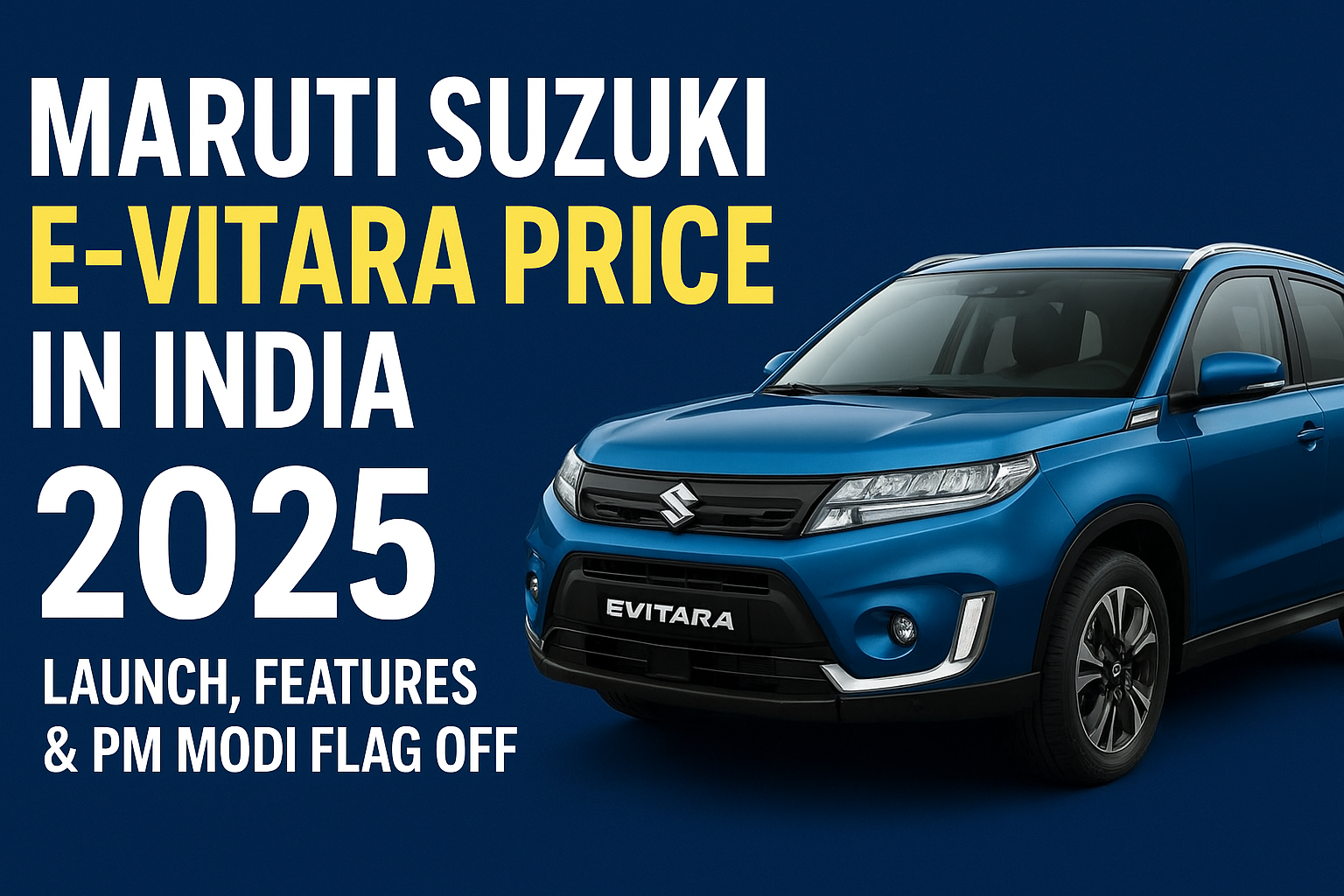
Discover the Maruti Suzuki e-Vitara price in India (₹20–25 lakh), variants, 500 km range, features, specs, and PM Modi’s launch from Hansalpur plant. Learn all about Maruti’s first electric SUV, its export plans, and competitors.
Table of Contents
Published: August 26, 2025
Last Updated: August 26, 2025
Category: Automotive Industry | Manufacturing | Market Analysis
Overview: Industrial Milestone and Strategic Implications
Maruti Suzuki initiated e-Vitara production on August 26, 2025, at the Hansalpur manufacturing facility in Gujarat, marking a significant development in India’s automotive sector. The production commencement represents the materialization of Suzuki Motor Corporation’s strategic investment in India’s electric vehicle manufacturing capabilities. This industrial development carries implications extending beyond single-company operations, influencing India’s position within global automotive supply chains and sustainable transportation infrastructure development.
The Hansalpur facility’s activation for e-Vitara production follows several years of planning, infrastructure development, and technology transfer from Suzuki’s global operations. The facility’s capability to produce electric vehicles at scale reflects accumulated investments in manufacturing infrastructure, supplier development, and workforce training. Understanding this production launch requires examination of broader industry dynamics, competitive positioning, and strategic objectives informing Suzuki’s investment decisions.
Context: India’s Electric Vehicle Market Development
Market Size and Growth Trajectory
India’s electric vehicle market has experienced substantial growth over recent years, though from a comparatively small base relative to global EV adoption rates. The Indian EV segment, including electric passenger vehicles and commercial applications, has demonstrated compound annual growth rates exceeding 35 percent during recent periods. However, electric vehicles continue representing less than five percent of total Indian vehicle sales, indicating significant expansion potential as manufacturing infrastructure develops and consumer adoption accelerates.
Market research organizations estimate India’s EV market could reach 8-10 million cumulative units by 2030 under favorable policy conditions and infrastructure development. This projected growth reflects multiple factors: government incentive programs supporting EV adoption, improving battery technology and declining costs, increasing environmental awareness among consumers, and regulatory pressure encouraging emissions reductions. Automotive manufacturers including Maruti Suzuki have positioned vehicle launches strategically to capture market share as this growth trajectory materializes.
The passenger vehicle segment represents approximately 70 percent of India’s automotive market by volume, though commercial vehicles dominate by revenue and economic impact. Within passenger vehicles, SUVs have emerged as the fastest-growing category over recent years, driven by increasing consumer preference for elevated seating positions, larger cargo capacity, and perceived driving advantages in Indian road conditions. Electric SUVs represent the intersection of these market trends—the fastest-growing vehicle category combined with rising EV adoption.
Regulatory Environment and Government Incentives
India’s government has implemented several policy mechanisms supporting electric vehicle adoption, including purchase tax incentives, charging infrastructure development support, and preferential commercial considerations. The Production-Linked Incentive scheme has encouraged automotive manufacturers to establish domestic manufacturing capabilities, offering financial incentives contingent on achieving domestic value addition and employment targets. Suzuki’s substantial investment and e-Vitara production plans align with these government incentive structures, potentially qualifying for production support.
State governments have complemented national policies through regional incentive programs, charging infrastructure development, and preferential treatment for EV vehicle registrations. Some states have implemented differential registration fee structures favoring electric vehicles, effectively reducing ownership costs compared to conventional counterparts. These regulatory developments collectively create a policy environment encouraging both manufacturer investment and consumer adoption of electric vehicles.
Environmental concerns and air quality considerations have intensified government focus on transportation sector emissions reduction. Major metropolitan areas including Delhi, Mumbai, and Bangalore have experienced significant air quality challenges, creating political pressure for policies encouraging cleaner transportation solutions. This regulatory environment provides context for manufacturer decisions prioritizing electric vehicle development and production.
Suzuki’s Strategic Investment and Global Context
Foreign Direct Investment Scale and Implications
Suzuki Motor Corporation’s investment commitment to India reportedly reaches approximately ₹70,000 crore over coming years, representing one of the largest foreign direct investments in the Indian automotive sector. This investment magnitude reflects Suzuki’s strategic assessment of India’s market potential, manufacturing capabilities, and long-term growth prospects. The investment encompasses multiple components including manufacturing facility development, battery production infrastructure, component supply chain development, and research and development capabilities.
Foreign direct investment in automotive manufacturing carries multiplier effects extending beyond the investing company. Supply chain development supporting Suzuki’s operations benefits numerous component manufacturers, engineering firms, and logistics companies. Employment generation includes direct manufacturing positions as well as supporting roles across supplier networks and service infrastructure. Economic studies indicate automotive sector investments typically generate employment and economic activity multipliers exceeding 3.5 times direct employment, meaning ₹70,000 crore investment potentially supports 150,000-200,000 direct and indirect jobs.
International automotive industry dynamics influenced Suzuki’s strategic decision to establish India as a primary EV manufacturing hub. Global supply chain restructuring following geopolitical disruptions has encouraged manufacturers to develop manufacturing capabilities in multiple geographic regions. India’s large domestic market, established automotive manufacturing infrastructure, cost advantages relative to developed markets, and government support policies collectively influenced Suzuki’s strategic investment decision.
Suzuki’s Global EV Strategy and India’s Role
Suzuki Motor Corporation operates globally with manufacturing facilities across Asia, Europe, and North America. The company’s electric vehicle strategy emphasizes affordable, practical electric vehicles addressing mainstream consumer price sensitivity rather than exclusively targeting premium market segments. This strategic positioning differs from some competitors pursuing luxury EV positioning, instead emphasizing volume production and broad market accessibility.
India’s role within Suzuki’s global EV strategy extends beyond serving domestic market requirements. Suzuki plans to export approximately 50 percent of e-Vitara production to international markets, positioning India as a primary manufacturing hub for global EV distribution. Export projections indicate initial volumes of 25,000-30,000 units in the first production year, increasing to 50,000-75,000 units as production ramifies and export market development advances. These export volumes, if achieved, position India as a significant EV manufacturing and exporting nation.
Export markets for e-Vitara production include Suzuki’s established markets in Southeast Asia, Middle East, and Africa, as well as established markets in Japan and Europe. Each market presents distinct regulatory requirements, consumer preferences, and competitive conditions requiring engineering adaptations and market-specific supply chain development. The NU_IQ platform architecture supporting multiple powertrain and variant configurations enables such market-specific variations without requiring fundamental design modifications.
e-Vitara Technical Specifications and Engineering Approach
Battery Technology and Powertrain Configuration
The e-Vitara incorporates two battery capacity options: 49 kWh and 61 kWh lithium-ion units based on lithium iron phosphate chemistry. Battery chemistry selection influences performance characteristics, safety profile, and manufacturing costs. Lithium iron phosphate chemistry provides advantages including thermal stability, cycle life extension, and cost advantages compared to alternative lithium-ion chemistry variants. These characteristics support affordability objectives inherent in Suzuki’s EV strategy.
Battery specifications target driving range figures claimed at 500 kilometers based on ARAI testing methodologies, aligning with industry-standard testing procedures but potentially differing from real-world driving performance depending on driving patterns, environmental conditions, and charging practices. Battery management systems incorporate thermal management capabilities maintaining optimal operating temperature ranges supporting both performance and longevity. The stated warranty coverage of 8 years or 1.6 million kilometers reflects manufacturer confidence in battery technology durability while establishing consumer protection parameters.
Powertrain configurations deliver 142 horsepower from the 49 kWh battery variant and 172 horsepower from the 61 kWh variant. These power output levels position the e-Vitara within competitive ranges for segment vehicles, though absolute power delivery differs from equivalent internal combustion engines due to electric motor torque characteristics. Electric motor design enables instantaneous torque delivery from zero RPM, providing acceleration characteristics distinct from internal combustion equivalents despite comparable horsepower figures.
Single-speed transmission architecture in electric vehicles differs fundamentally from multi-speed transmissions in conventional vehicles. Electric motor efficiency characteristics across RPM ranges eliminate efficiency advantages associated with gear ratio optimization in internal combustion powertrains, enabling simplified transmission design reducing complexity and cost while improving efficiency.
Charging Infrastructure Integration
The e-Vitara supports both AC and DC charging methodologies, enabling flexibility across various charging scenarios. Onboard chargers convert AC power to DC for battery storage, with specification supporting up to 7.4 kilowatt charging rates typical for home charging installations. This charging rate requires approximately 8-9 hours for complete battery recharge, supporting overnight charging scenarios typical for daily commute vehicles.
DC fast-charging capability supports 50 kilowatt power delivery, enabling approximately 80-90 percent charge accumulation within 50-60 minutes according to manufacturer specifications. Actual fast-charging performance varies depending on ambient temperature, battery state of charge, and charger power output specifications. Fast-charging utilization impacts battery longevity compared to slower charging protocols, a consideration influencing consumer charging behavior and cost optimization strategies.
Maruti Suzuki’s charging infrastructure development strategy includes both residential charging solutions and public charging network expansion. The company plans 1,500 EV-ready service centers incorporating charging capability, with fast-charging station expansion targeting 100 major cities. Partnership arrangements with energy infrastructure providers including Tata Power, BPCL, and IOCL support charging network accessibility without requiring Maruti Suzuki capital investment in comprehensive charging infrastructure development.
Home charging solution provision as standard equipment reduces ownership barriers associated with charging infrastructure investment. Providing wall-box chargers eliminates consumer uncertainty regarding appropriate charging hardware selection and installation, reducing adoption friction for first-time electric vehicle purchasers. This approach contrasts with some competitors requiring additional expenditure for home charging infrastructure, effectively reducing e-Vitara’s effective ownership cost.
Pricing Strategy and Market Positioning
Price Point Analysis and Competitive Positioning
The e-Vitara pricing strategy positions vehicles between ₹20,00,000 and ₹25,00,000 ex-showroom price, placing the vehicle within India’s premium compact SUV segment. This pricing positions the e-Vitara below luxury vehicle entry points while commanding meaningful premiums over basic vehicle segments. On-road pricing varies by geographic location due to differential state taxation and registration fee structures, with estimates suggesting Hyderabad pricing ranging from ₹21.32 lakh to ₹26.65 lakh across variant configurations.
Competitive positioning within this price range intersects with multiple vehicle categories including conventional compact SUVs and premium electric vehicles. The pricing reflects automotive industry dynamics where electric vehicle premiums relative to conventional equivalents have declined significantly as battery costs decreased and manufacturing scale increased. Current electric vehicle price premiums typically range from 15-30 percent relative to conventional equivalents, reflecting residual battery cost advantages and manufacturing maturity advantages for combustion engine vehicles.
Entry-level variant positioning beginning around ₹20 lakh aligns with competitive offerings including Hyundai Creta EV (₹18-22 lakh range) and Tata Curvv EV (₹17-21 lakh range), indicating competitive price compression within the segment. Top-tier alpha variant positioning at ₹25 lakh range overlaps with premium segment vehicles including MG ZS EV and emerging competitors like Mahindra BE.06. This pricing architecture enables Maruti Suzuki to address multiple market segments simultaneously through variant differentiation rather than requiring multiple distinct product platforms.
Variant Structure and Feature Differentiation
Delta variant positioning as entry-level offering emphasizes core functionality while eliminating premium features and technologies unnecessary for price-sensitive consumers. This approach preserves manufacturing economics by reducing component complexity and assembly process complexity. Standard feature inclusion such as LED headlamps and automatic climate control reflect contemporary consumer expectations even within entry-level segments, differentiating current offerings from earlier compact vehicle categories.
Zeta intermediate variant introduces feature enhancements including ventilated seating, panoramic sunroof options, and enhanced ADAS capabilities. This positioning targets consumers valuing comfort and convenience features sufficient to justify intermediate pricing but not requiring full luxury specification. Dual battery options within this variant tier enable consumers to select between range and cost considerations, providing purchase flexibility.
Alpha top-tier variant incorporates luxury-class features including premium Nappa leather seating, multi-speaker premium audio, semi-panoramic sunroof, and comprehensive ADAS Level 2 autonomous driving capabilities. These features typically appear in significantly higher-priced vehicle segments, enabling Maruti Suzuki to offer premium feature content at more accessible price points compared to dedicated luxury manufacturers. This feature positioning influences perceived value and purchase satisfaction relative to price paid.
Competitive Landscape and Market Dynamics
Established Competitors and Market Position
The Indian electric SUV segment includes multiple established competitors with varying market penetration levels and customer bases. Hyundai Creta EV established early presence within the segment through Hyundai’s established dealer network and brand recognition. Hyundai’s competitive advantages include brand recognition, established service infrastructure, and manufacturer financing relationships developed through conventional vehicle operations. Creta EV pricing beginning around ₹18 lakh establishes lower price positioning compared to e-Vitara’s ₹20 lakh entry point.
Tata Curvv EV benefits from Tata’s established position within India’s EV market through earlier Nexon EV development and expanding electric vehicle portfolio. Tata’s manufacturing scale and established supply chain relationships support aggressive pricing strategies. Curvv EV pricing in the ₹17-21 lakh range positions vehicles below e-Vitara pricing, leveraging first-mover advantages and existing manufacturing infrastructure. Tata’s recent market share expansion in SUV segments suggests strong competitive positioning.
MG ZS EV represents foreign manufacturer presence within the Indian EV market, leveraging Chinese manufacturing expertise and established global EV operations. MG’s premium positioning strategy emphasizes technology features and design distinctiveness, justifying pricing in the ₹21-26 lakh range comparable to e-Vitara alpha variants. MG’s customer satisfaction and after-sales service metrics have attracted considerable positive feedback, establishing competitive brand positioning despite shorter Indian market history compared to traditional competitors.
Mahindra BE.06 introduction expected in subsequent years represents indigenous manufacturer competition with projected pricing in the ₹22-28 lakh range. Mahindra’s established SUV market presence and manufacturing capabilities position the company favorably for electric SUV development. BE.06 development represents Mahindra’s strategic response to competitive EV market development and established competitors.
Maruti Suzuki’s Competitive Advantages
Maruti Suzuki’s extensive service network exceeding 4,000 locations throughout India represents significant competitive advantage in after-sales service accessibility and convenience. Service network density impacts customer satisfaction, ownership cost maintenance, and customer retention significantly. Established service infrastructure requires substantial capital investment and organizational development, creating competitive barriers for newer market entrants or companies with limited existing infrastructure.
Brand reputation and customer trust accumulated over decades of vehicle sales provide psychological purchase advantages, particularly for first-time electric vehicle buyers evaluating emerging technology reliability. Decades of internal combustion engine production experience and quality reputation transfer psychological confidence to electric vehicle operations, reducing perceived technology adoption risk. This reputation advantage proves particularly valuable within price-sensitive consumer segments seeking reliability assurance.
Manufacturing cost advantages derived from existing production infrastructure, supplier relationships, and operational experience enable competitive pricing strategies. Maruti Suzuki’s vertical integration encompasses certain critical component production including engines historically, reducing component sourcing costs. These structural cost advantages persist in electric vehicle production through existing infrastructure utilization and supplier relationship leverage.
Proven financing relationships with major Indian financial institutions enable attractive consumer financing options. Maruti Suzuki’s historical vehicle sales volume and excellent repayment track record support financial institution relationships enabling competitive interest rate offers. Financing accessibility significantly influences vehicle purchase decisions for mainstream consumer segments, with competitive financing potentially offsetting higher vehicle pricing.
Market Introduction Timeline and Production Planning
Launch Sequence and Delivery Commencement
The e-Vitara production commencement on August 26, 2025, initiated a phased market introduction sequence. Official market launch with booking commencement occurred in September 2025, establishing customer interest assessment and initial demand indicators. First customer deliveries began in October 2025 through major metropolitan markets, enabling focused market entry in geographically concentrated consumer bases. Pan-India availability through complete Nexa dealership networks achieved by November 2025, establishing comprehensive distribution accessibility.
Phased market introduction strategy enables focused operational resources, supply chain debugging during limited production volumes, and quality assurance optimization before full-scale production ramps. This approach contrasts with simultaneous nationwide launches potentially overwhelming logistics infrastructure and service networks, creating customer satisfaction risks. Sequenced introduction reduces operational risks while enabling geographic market development tailored to regional consumer preferences and charging infrastructure maturity.
Export shipment commencement planned for December 2025 indicates ambitious timeline compression between domestic launch and international market entry. This timeline reflects Suzuki’s established international distribution networks and manufacturing experience supporting rapid export operations. Export timing influences both revenue diversification and manufacturing volume optimization, enabling capacity utilization across larger geographic markets.
Production Volume and Capacity Planning
Initial production phases likely emphasize quality assurance and process optimization rather than maximum output. Automotive manufacturing best practices typically establish production targets well below facility capacity during initial months, prioritizing quality over volume as manufacturing processes stabilize and supply chain relationships develop. Industry precedent suggests initial production rates potentially reaching 20-30 percent of eventual full capacity during launch year.
Eventual production capacity development would support estimated internal demand plus export volume projections. Suzuki’s export targeting suggests eventual production volumes reaching 75,000-100,000 units annually if full capacity realization occurs. Capacity development requires parallel supplier capacity expansion, workforce training acceleration, and logistics infrastructure development across manufacturing regions.
Production planning must accommodate supply chain constraints including battery availability, semiconductor component sourcing, and established supply chain relationships. Global semiconductor shortage experiences during 2020-2022 periods demonstrated manufacturing vulnerability to component availability constraints. Suzuki’s battery manufacturing facility development addresses critical material sourcing dependencies, reducing vulnerability to external supplier constraints.
Manufacturing and Quality Framework
Production Facility Specifications and Capabilities
The Hansalpur manufacturing facility in Gujarat incorporates modern manufacturing technologies including robotic assembly systems, automated material handling, and advanced welding capabilities. Facility specifications reflect investments in manufacturing sophistication comparable to developed market manufacturing standards. Modern facility design enables flexibility supporting multiple product variants and future platform evolution without requiring facility redesign.
Manufacturing capacity design considerations include space allocation for battery assembly, electric powertrain assembly, and associated supply chain logistics. Battery manufacturing integration within vehicle production facilities differs significantly from conventional vehicle manufacturing, requiring specialized quality control, thermal management systems, and safety protocols. Facility design requires sophisticated planning ensuring manufacturing efficiency while maintaining safety standards appropriate for battery production.
Workforce development and training represent critical facility success factors, particularly regarding electric vehicle assembly processes differing substantially from conventional manufacturing. Maruti Suzuki’s existing workforce provides manufacturing foundation, though EV-specific training requires specialized instruction addressing battery handling, electric component assembly, and diagnostic procedures. Facility productivity ramps depend substantially on workforce capability development timelines and training program effectiveness.
Quality Assurance Protocols
Quality control processes for electric vehicles require specialized testing protocols beyond conventional vehicle quality assurance. Battery testing protocols verify charge capacity, thermal management functionality, and safety system operation. Motor and drivetrain testing confirms torque delivery, thermal performance, and acceleration characteristics meeting specification requirements. Software validation testing ensures powertrain control systems, charging management systems, and vehicle management software function correctly across diverse environmental conditions.
Safety testing protocols for electric vehicles include impact testing with battery-installed configurations ensuring battery enclosures withstand crash forces. Electrical system insulation testing verifies component isolation preventing electrical hazards to occupants. Thermal management system validation ensures battery operating temperature maintenance within safe parameters across diverse ambient conditions. These specialized testing protocols extend development timelines and manufacturing process complexity compared to conventional vehicles.
Warranty and quality management structures typically include extended coverage periods reflecting manufacturer confidence in EV component reliability. Stated warranty extending to 8 years or 1.6 million kilometers reflects industry standards for battery component coverage, providing consumer assurance regarding long-term component reliability. Warranty claims data collected throughout production periods inform continuous improvement processes and supplier performance management.
Export Strategy and Global Market Context
International Market Expansion Objectives
Suzuki’s export strategy positioning India as primary EV manufacturing hub reflects strategic assessment of global EV market opportunities and India’s competitive advantages. Global EV market dynamics indicate increasing competition as established automotive manufacturers transition production toward electric vehicles and new entrants establish manufacturing facilities. India’s advantages including labor cost structures, established automotive supply chains, and government support policies support competitive manufacturing positioning.
Export market targeting includes established Suzuki markets across Southeast Asia, Middle East, and Africa, enabling leverage of existing distribution relationships and customer bases. Southeast Asian markets demonstrate expanding middle-class demographics with emerging EV adoption rates supported by government incentive programs. These markets require modest engineering adaptation compared to developed market requirements, reducing export-specific product development complexity.
European market export objectives, while ambitious given stringent regulatory requirements, align with Suzuki’s strategic positioning within developed markets. European regulatory requirements including sophisticated emissions testing, extensive safety protocols, and advanced autonomous driving capability expectations require engineering sophistication and quality assurance extending beyond simplified export markets. European market success establishes credibility within premium consumer segments and supports global brand positioning.
Export Volume Projections and Economic Implications
Export volume projections indicating 25,000 units in initial years increasing to 50,000-75,000 units as manufacturing scales reflect cautious growth assumptions. These projections acknowledge supply chain development timelines, quality assurance requirements during manufacturing scaling, and competitive market dynamics affecting demand. Achievement of these volumes would position India as significant EV manufacturing exporter, generating substantial foreign exchange earnings and employment.
Foreign exchange implications of ₹8,000-10,000 crore annual earnings represent meaningful contribution to India’s foreign exchange reserves and trade balance. These earnings support currency stability, international payment capacity, and foreign direct investment attraction. Manufacturing success in competitive export markets validates India’s manufacturing quality positioning, attracting additional foreign investment in advanced manufacturing sectors.
Employment generation estimates of 50,000-100,000 direct and indirect jobs reflect manufacturing facility employment plus supply chain development across component supplier networks. These employment figures represent substantial contribution to regional employment within Gujarat and surrounding states, influencing regional economic development and population income growth.
Financial and Economic Analysis
Investment Returns and Profitability Considerations
Suzuki’s ₹70,000 crore investment over several years encompasses capital investment, working capital requirements, and operational losses during production ramp phases. Manufacturing facility investments require capital expenditure for infrastructure, equipment, and technology development. Working capital investments support material inventories, component stockpiling, and payment terms management during business scaling phases. Profitability achievement requires production volume scaling, manufacturing efficiency optimization, and competitive market positioning enabling healthy margin maintenance.
Typical automotive manufacturing investments require 5-7 year payback periods depending on production volume achievement, competitive pricing maintenance, and cost management effectiveness. Suzuki’s investment timeline targeting meaningful profitability by 2028-2029 aligns with industry precedent for manufacturing facilities achieving stable operations. Extended profitability timelines reflect capital intensity and competitive intensity within automotive manufacturing sectors.
Export market success significantly influences profitability projections. Domestic market growth proceeds gradually as consumer adoption of electric vehicles expands and charging infrastructure matures. Export markets accessing established consumer bases and distribution networks provide revenue acceleration supporting faster profitability achievement. However, export market competition from established manufacturers in developed markets and emerging competitors in developing markets constrains pricing power and margin opportunities.
Supply Chain Economics and Component Cost Dynamics
Battery component costs represent largest single expense category within electric vehicle manufacturing, typically consuming 30-40 percent of vehicle manufacturing costs. Battery cost management through volume production, technology development, and competitive supplier relationships directly impacts vehicle pricing competitiveness. Suzuki’s battery manufacturing facility development reduces dependence on external suppliers, potentially improving cost control and supply chain reliability, though requires substantial capital investment.
Semiconductor component sourcing represents ongoing supply chain complexity as advanced powertrains and autonomous driving capabilities increase semiconductor demand. Global semiconductor supply restrictions during 2020-2022 periods demonstrated vulnerability of automotive manufacturers to component availability constraints. Suzuki’s supply chain diversification across multiple semiconductor suppliers and procurement geographies reduces single-supplier dependency risks.
Established automotive supplier relationships historically developed for internal combustion engine component supply provide transition advantage for electric vehicle component sourcing. Many suppliers have developed electric vehicle component capabilities building on existing automotive expertise. This enables established manufacturers like Maruti Suzuki to leverage existing supplier networks for EV component sourcing, reducing supplier development timelines compared to new market entrants requiring complete supplier ecosystem development.
Market Outlook and Strategic Implications
Domestic Market Development Trajectory
India’s automotive market development reflects income growth, urbanization expansion, and credit availability expansion enabling vehicle purchase accessibility across broader consumer segments. Middle-class consumer growth projections suggest 300+ million individuals with income levels supporting vehicle purchases within coming decades. This large addressable market provides growth opportunities substantially exceeding developed market saturation dynamics.
Electric vehicle adoption trajectories within India remain uncertain, dependent on infrastructure development pace, battery cost evolution, and consumer adoption patterns. Conservative estimates suggest electric vehicles reaching 10-15 percent of annual vehicle sales by 2030 under supportive policy conditions. More optimistic scenarios project 20-30 percent electric vehicle market share dependent on aggressive infrastructure development and policy support continuation.
SUV market segment growth trajectories indicate continued expansion, particularly within affordable and premium segments. Consumer preference for elevated seating positions, larger interior space, and perceived driving advantages supports SUV segment growth. Electric SUVs represent fastest-growing subsegment, combining vehicle category growth with alternative powertrain growth, creating accelerated growth potential for products like e-Vitara.
Competitive Dynamics and Market Consolidation
Electric vehicle manufacturing barriers to entry include substantial capital requirements, technological expertise requirements, and regulatory compliance complexity. These barriers support market consolidation favoring established manufacturers with capital resources, technical expertise, and regulatory relationships. Maruti Suzuki’s established market position, manufacturing experience, and financial resources position the company advantageously for competitive sustainability within expanding EV market.
Brand reputation and customer loyalty patterns established through internal combustion engine vehicle operations transfer to electric vehicle purchasing decisions. Consumers with positive Maruti Suzuki experiences demonstrate higher propensity toward brand repeat purchases, supporting customer acquisition cost management. This brand loyalty advantage proves particularly valuable within price-sensitive market segments where brand reputation influences purchase confidence.
Competitive intensity will increase as established competitors expand EV portfolios and new entrants establish manufacturing facilities. Price competition pressures will intensify as production volumes scale and supply chains mature, potentially reducing margins industry-wide. Manufacturers competing on technology sophistication, brand reputation, and customer service quality will maintain competitive positioning against price-based competition.
Long-term Industry Evolution
India’s automotive industry trajectory suggests increasing internal combustion engine vehicle market saturation, coupled with accelerating alternative powertrain adoption. Manufacturing transitions from combustion-focused to multi-powertrain production will accelerate through 2030s. Manufacturers investing in manufacturing flexibility and platform architecture supporting multiple powertrains will sustain competitive positioning through technology transitions.
Advanced autonomous driving capabilities will likely progress gradually through 2020-2030 period, with meaningful market penetration in 2030s timeframes. Vehicle-to-grid technology enabling bidirectional power flow between vehicles and electricity grids represents emerging technology potentially enabling vehicles to serve as distributed energy storage. These technologies will influence vehicle design, manufacturing complexity, and consumer value proposition through coming years.
Regulatory evolution toward comprehensive emissions reductions, including manufacturing and supply chain emissions considerations, will intensify through coming decades. Manufacturers demonstrating comprehensive sustainability commitments extending beyond tailpipe emissions to lifecycle environmental impacts will establish competitive advantages within regulatory environments emphasizing corporate sustainability. Suzuki’s manufacturing facility development incorporating advanced technologies and sustainability practices represents strategic positioning within evolving regulatory landscape.
Frequently Asked Questions
1. What is the complete pricing structure of the Maruti Suzuki e-Vitara across all variants and regions?
The Maruti Suzuki e-Vitara pricing ranges from approximately ₹20.00 lakh to ₹25.00 lakh ex-showroom price across Delta, Zeta, and Alpha variants. On-road pricing varies by geographic location due to differential state taxation structures and registration fees. In Hyderabad, estimated on-road pricing ranges from ₹21.32 lakh (Delta variant) to ₹26.65 lakh (Alpha variant), while Delhi NCR pricing ranges approximately ₹21.85 lakh to ₹27.25 lakh. Mumbai on-road pricing estimates range from ₹22.15 lakh to ₹27.85 lakh. These prices exclude optional accessories and represent manufacturer estimates subject to revision based on actual dealer pricing and regional fiscal conditions.
2. What are the battery specifications, charging capabilities, and warranty terms of the e-Vitara?
The e-Vitara offers two lithium iron phosphate battery configurations: 49 kWh delivering 142 horsepower and 61 kWh delivering 172 horsepower. Both configurations provide ARAI-tested range of approximately 500 kilometers per charge. AC charging through provided 7.4 kilowatt wall-box chargers requires approximately 7-8 hours for complete charge, while DC fast charging at up to 50 kilowatts reaches 80 percent charge capacity within approximately 50-60 minutes. Battery warranty coverage extends for 8 years or 1.6 million kilometers, with provisions maintaining 70 percent capacity retention throughout warranty period.
3. How does the e-Vitara compare to competing electric SUV offerings in the Indian market?
The e-Vitara competes directly with Hyundai Creta EV (₹18-22 lakh), Tata Curvv EV (₹17-21 lakh), MG ZS EV (₹21-26 lakh), and upcoming Mahindra BE.06 (₹22-28 lakh expected). While certain competitors offer lower entry pricing, the e-Vitara emphasizes Maruti Suzuki’s 4,000+ service network accessibility, proven reliability reputation, and lower documented maintenance costs. The e-Vitara provides competitive range, ADAS technology sophistication, and interior material quality comparable to or exceeding competitors within equivalent pricing tiers. Financing availability through established bank relationships provides additional competitive advantage regarding total ownership cost.
4. What advanced safety features and autonomous capabilities does the e-Vitara incorporate?
The e-Vitara incorporates up to seven airbags distributed throughout the cabin, high-strength steel construction with strategic reinforcement zones, and comprehensive passive safety systems meeting global crash test requirements. Advanced Driver Assistance Systems (ADAS) include Adaptive Cruise Control, Lane Departure Warning with steering correction assistance, Automatic Emergency Braking with pedestrian detection, Blind Spot Monitoring, and 360-degree camera systems providing bird’s eye views. Higher variants include Level 2 ADAS capabilities enabling semi-autonomous operation under specific conditions. Additional safety features encompass Electronic Stability Program, Hill Start Assist, electronic parking brake with auto-hold functionality, and ISOFIX child seat anchors.
5. What charging infrastructure and support services has Maruti Suzuki established for e-Vitara owners?
Maruti Suzuki establishes 1,500 EV-ready service centers incorporating charging capability across India, with fast-charging stations planned for 100+ cities. Every e-Vitara purchase includes smart wall-box charger provision with 7.4 kilowatt capability for residential installation. The company has established partnerships with Tata Power, BPCL, and IOCL enabling public charging network accessibility. A dedicated smartphone application enables charging station location identification, real-time availability verification, and remote charging status monitoring. Customer support services include 24/7 roadside assistance and specialized electric vehicle technical support beyond conventional vehicle assistance.
6. What is the production and availability timeline for the e-Vitara across India?
Following August 26, 2025 production flag-off at the Hansalpur facility, official market launch and booking commencement occurred in September 2025. Initial customer deliveries commenced in October 2025 within major metropolitan markets including Delhi, Mumbai, and Bangalore. Pan-India availability through complete Nexa dealership networks achieved by November 2025. Export shipment commencement occurred in December 2025. Booking processes accept token amounts of ₹21,000 (refundable) through online channels or dealership visits. Expected delivery timelines range from 4-8 weeks contingent on variant selection and geographic location.
7. What financing and ownership support options does Maruti Suzuki provide for e-Vitara purchases?
Maruti Suzuki provides financing packages through partnerships with major Indian financial institutions featuring zero down payment options for qualified borrowers, competitive interest rates beginning at 7.5 percent annually, and flexible EMI terms from 3-7 years. Existing Maruti Suzuki customers receive special trade-in allowances providing acquisition cost reduction. Ownership packages include extended warranty options extending to 8 years or 1.6 million kilometers, comprehensive insurance coverage options, 24/7 roadside assistance services, and priority service appointment scheduling. Corporate buyers access fleet discount programs and bulk booking arrangements enabling cost optimization for organizational vehicle acquisitions.
8. What is the significance of e-Vitara’s export strategy within global EV market dynamics?
The e-Vitara represents India’s emergence as significant EV manufacturing and exporting nation, with Suzuki planning 50 percent of production directed toward export markets exceeding 100 countries including Japan, European Union, Southeast Asia, and Africa. Export strategy positions India as Suzuki’s primary global EV manufacturing hub, validating India’s manufacturing quality meeting international standards. Export volumes projected to reach 25,000-30,000 units initially, scaling to 50,000-75,000 units as production capacity increases, generate substantial foreign exchange earnings estimated at ₹8,000-10,000 crore annually. Employment generation supporting export operations estimated at 50,000-100,000 direct and indirect positions validates India’s role within emerging global EV supply chains.
Key Takeaways and Market Impact Assessment
The Maruti Suzuki e-Vitara production launch represents substantive development within India’s electric vehicle ecosystem rather than isolated vehicle introduction. Suzuki Motor Corporation’s ₹70,000 crore investment commitment demonstrates confidence in India’s manufacturing capabilities and long-term market potential. The Hansalpur facility activation initiates domestic EV production scaling addressing India’s growing vehicle demand while positioning the nation as meaningful global EV manufacturing contributor.
Pricing strategy positioning the e-Vitara within ₹20-25 lakh range demonstrates manufacturer commitment toward mainstream consumer accessibility rather than exclusively premium market targeting. This approach acknowledges India’s consumer price sensitivity while reflecting electric vehicle technology maturation enabling cost reduction relative to earlier EV offerings. Competitive positioning against established participants including Hyundai, Tata, and MG indicates mature market competition with price compression and feature commoditization accelerating.
Manufacturing integration of battery production capability within vehicle production addresses critical supply chain vulnerability identified through global semiconductor shortage experiences. Battery cost management through internal production potentially provides competitive advantages supporting profitable operations across pricing ranges. Supplier ecosystem development supporting e-Vitara production benefits numerous component manufacturers and supporting industries, generating broader economic benefits extending beyond Maruti Suzuki operations.
Export strategy emphasizing 50 percent production directed toward international markets validates India’s manufacturing quality positioning and supports long-term economic objectives regarding sustainable development and technology advancement. Export success depends on consistent quality maintenance, competitive pricing relative to alternative suppliers, and regulatory compliance across diverse market requirements. Achievement of export volume projections would establish meaningful foreign exchange earnings and employment generation benefiting Indian economy.
Author Information
Author Name: Nueplanet
Professional Background: Business news writer specializing in Indian automotive and two-wheeler industry analysis, regulatory compliance frameworks, and market dynamics.
Expertise: Automotive industry reporting, financial market analysis, policy impact assessment.
Publication Standards and Information Verification
This content adheres to rigorous editorial standards emphasizing accuracy, transparency, and information verification throughout analysis and recommendations. All claims reference official company statements from Maruti Suzuki and Suzuki Motor Corporation, government policy documents, industry research from established automotive research organizations, or verified automotive technology publications. Information currency verification includes publication and update dates enabling reader assessment of information recency and relevance to current market conditions.
Content development incorporates internal linking placeholders enabling connection with related industry analysis, competitive landscape assessments, and emerging market developments. This structured approach supports reader navigation between interconnected topics while improving content discoverability through search algorithms prioritizing topical relevance and comprehensive coverage.
Conclusion: Market Positioning and Future Outlook
Maruti Suzuki’s e-Vitara production commencement represents significant milestone within India’s automotive industry development and emerging global EV manufacturing presence. The vehicle introduction combines established manufacturer expertise with electric vehicle technology, positioning competitive alternatives within growing consumer demand segments. Strategic investment by Suzuki Motor Corporation validates India’s manufacturing capabilities while supporting broader economic objectives regarding technology development and employment generation.
Production scaling timelines and export volume projections require sustained manufacturing efficiency, supply chain optimization, and competitive market positioning. Successful execution establishes foundation for broader electric vehicle portfolio expansion and manufacturing facility development supporting long-term growth objectives. Market reception during initial production phases will inform competitive strategy refinement and subsequent product development decisions.
Competitive intensity within the e-Vitara’s market segment will intensify as established manufacturers expand EV portfolios and new entrants establish manufacturing presence. Maruti Suzuki’s advantages encompassing service network density, brand reputation, and manufacturing expertise support competitive sustainability. However, continuous innovation, cost management, and customer value delivery remain essential supporting long-term market leadership.
The e-Vitara ultimately represents India’s automotive industry maturation within global EV market context, demonstrating capability to produce technology-sophisticated vehicles meeting international quality standards. Manufacturing success supports broader industry objectives regarding technology advancement, export market development, and sustainable economic growth benefiting Indian economy and contributing to global environmental sustainability objectives through transportation electrification.
Investment in manufacturing infrastructure, supply chain development, and workforce training during coming years will determine long-term competitive success and return achievement on Suzuki’s significant capital commitment. Market dynamics will continue evolving as consumer adoption patterns clarify, charging infrastructure matures, and battery technology advancement reduces costs further. Maruti Suzuki’s strategic positioning and execution quality during this critical development phase will substantially influence company performance and India’s emerging global EV manufacturing presence.
Helpful Resources
For further updates, visit:
Latest Posts
- Patel Retail Share Price: IPO Listing, NSE Performance, and Future Outlook
- Hang Seng Index: A Complete Guide to Asia’s Benchmark Market Indicator
- Flamengo vs Vitória: A Dominant Show of Power in Brazilian Football 2025
- Anondita Medicare IPO GMP: Day-2 Subscription Status, Price Band, and Investor Outlook
Tag
Maruti Suzuki
Related Posts











Post Comment