







DFCCIL Answer Key 2025 Released for MTS, Executive, and Other Posts: Download Direct Link and Objection Details
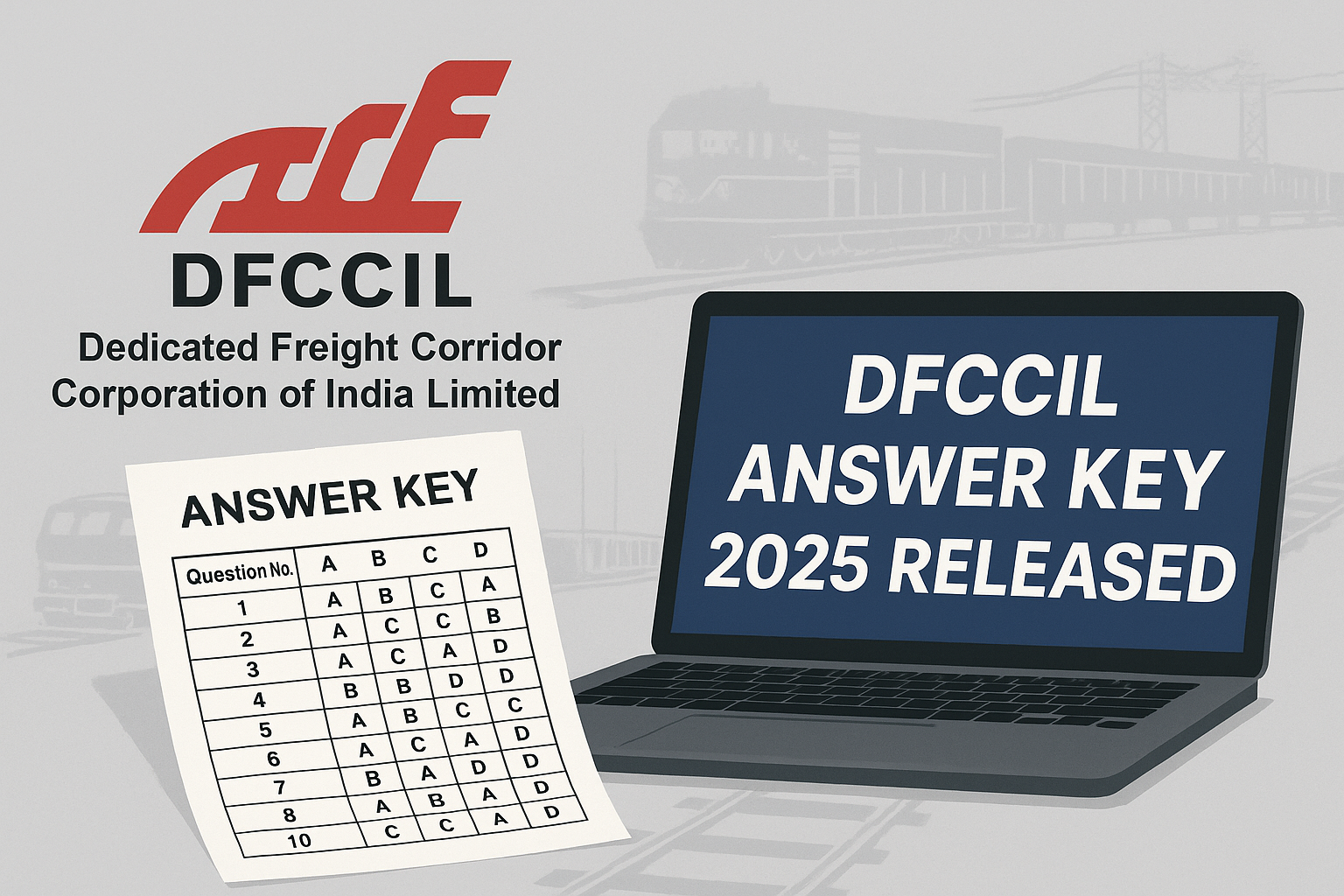
The Dedicated Freight Corridor Corporation of India Limited (DFCCIL) has released the answer key for MTS, Executive, and various posts recruitment 2025. Here are details on how to download, raise objections, and the next selection stages.
Table of Contents
The Dedicated Freight Corridor Corporation of India Limited (DFCCIL) has officially released the Answer Key for its 2025 recruitment examination on July 18, 2025. This release marks an important milestone for candidates who appeared for the Computer-Based Test conducted between July 15-18, 2025. The answer key is now available on the official DFCCIL website for all positions including Multi-Tasking Staff (MTS), Executive, and Junior Executive posts.
This comprehensive guide provides verified information about the DFCCIL Answer Key 2025, including detailed download procedures, objection submission guidelines, expected cut-off marks, selection process stages, and career opportunities. All information presented here is based on official notifications and government sources.
About DFCCIL: Understanding the Organization
The Dedicated Freight Corridor Corporation of India Limited operates under the Ministry of Railways, Government of India. Established in 2006, the organization focuses on developing and managing dedicated freight corridors across India. DFCCIL’s primary objective is to enhance freight transportation efficiency through modern infrastructure and advanced technology.
The organization currently manages two major corridor projects. The Eastern Dedicated Freight Corridor spans 1,856 kilometers from Ludhiana in Punjab to Dankuni in West Bengal. The Western Dedicated Freight Corridor covers 1,504 kilometers from Dadri in Uttar Pradesh to Jawaharlal Nehru Port in Maharashtra. Both corridors utilize double-line electric systems with high axle load capacity.
DFCCIL has implemented the European Train Control System (ETCS) Level 2 signaling, making it the first Indian railway organization to adopt this advanced safety technology. The corridors support 32.5-tonne axle load capability and enable average freight train speeds of 25 km/h. These technical specifications significantly improve cargo transportation efficiency compared to conventional railway lines.
DFCCIL Recruitment 2025: Examination Overview
Recruitment Notification Details
The DFCCIL Recruitment 2025 notification was released earlier this year for 1,200+ positions across various categories. The recruitment drive covers technical and non-technical positions suitable for candidates with different educational qualifications. The examination process follows standard government recruitment procedures with Computer-Based Testing as the primary selection method.
Basic Recruitment Information:
| Parameter | Details |
|---|---|
| Conducting Authority | Dedicated Freight Corridor Corporation of India Limited |
| Total Vacancies | 1,200+ positions |
| Examination Mode | Computer-Based Test (CBT) |
| Test Duration | 90 minutes |
| Total Questions | 100 objective-type questions |
| Marking System | +1 for correct answer, -0.25 for incorrect answer |
| Examination Dates | July 15-18, 2025 (multiple shifts) |
| Answer Key Release Date | July 18, 2025 |
| Official Website | www.dfccil.com |
Position-Wise Vacancy Details
Multi-Tasking Staff (MTS) – 650+ Vacancies
The MTS positions require candidates to have passed 10th grade or equivalent examination from a recognized board. The age limit ranges from 18 to 27 years with relaxation applicable as per government norms for reserved categories. Selected candidates receive Level 1 pay as per 7th Pay Commission with a salary range of ₹18,000 to ₹56,900 per month.
Job responsibilities include office assistance, file management, basic administrative support, and maintenance activities. The position offers career growth opportunities with promotion to clerical and assistant positions after completing the required service period.
Executive Posts – 350+ Vacancies
Executive positions are available in Civil, Electrical, Mechanical, Signal & Telecom, and Operations disciplines. Candidates must possess a Bachelor of Technology (B.Tech) or Bachelor of Engineering (B.E.) degree in the relevant engineering discipline from a recognized university. The age limit is 20 to 30 years with category-wise relaxation as per government rules.
The salary structure follows Level 6 of the 7th Pay Commission with a monthly pay range of ₹44,900 to ₹1,42,400. Responsibilities include technical design work, construction supervision, project management, and implementation of railway technologies. The position provides opportunities for leadership roles and international collaboration projects.
Junior Executive Posts – 200+ Vacancies
Junior Executive positions are available in Accounts, Human Resources, General Administration, and Information Technology specializations. Candidates need a Bachelor’s degree in the relevant field from a recognized university. The age limit is 20 to 28 years with applicable relaxation for reserved categories.
Compensation is structured under Level 4 of the 7th Pay Commission with salaries ranging from ₹35,400 to ₹1,12,400 per month. Work involves financial management, human resource operations, administrative coordination, and IT system management. Career progression includes advancement to middle management positions through departmental examinations and performance-based promotions.
DFCCIL Answer Key 2025: Download Process
Official Website Access Method
Candidates can access the DFCCIL Answer Key 2025 through the official website using their registered credentials. The process requires a stable internet connection and a device capable of viewing PDF documents. Follow these verified steps to download your answer key.
Step-by-Step Download Guide:
- Visit the official DFCCIL website at www.dfccil.com using a web browser
- Navigate to the “Career” or “Recruitment” section from the main menu
- Locate and click on the “DFCCIL Answer Key 2025” link for your respective post
- Enter your registered User ID and Password in the login portal
- Select your specific examination shift and question paper set
- Click on the download button to access the PDF file
- Save the document to your device for offline reference
Technical Requirements
Ensure your device meets the following technical specifications for smooth access. Use updated web browsers including Chrome version 90 or higher, Firefox version 88 or higher, Safari version 14 or higher, or Microsoft Edge version 90 or higher. A minimum internet speed of 2 Mbps is recommended for uninterrupted download.
The answer key PDF file size typically ranges from 5 to 10 MB. Ensure adequate storage space is available on your device. Install Adobe Acrobat Reader or any compatible PDF viewing software to open and read the document properly.
Answer Key Document Structure
The official answer key document is organized systematically for easy reference. Each examination shift has a separate answer key section. Different question paper sets (Set A, Set B, Set C, Set D) are clearly marked with corresponding answer keys.
Questions are numbered sequentially from 1 to 100 with correct answer options clearly indicated. Subject-wise sections are maintained for General Intelligence, Numerical Aptitude, General Awareness, Technical Knowledge, and other relevant subjects based on the post applied for. The document carries official DFCCIL authentication marks and verification stamps.
Objection Submission Process: Challenge Answer Key
Objection Timeline and Deadlines
DFCCIL provides a structured mechanism for candidates to challenge potentially incorrect answers. The objection window opens on July 18, 2025, at 6:00 PM immediately after the answer key release. Candidates have 72 hours to submit objections until July 21, 2025, at 11:59 PM.
Important Dates for Objection Process:
| Activity | Date and Time | Duration |
|---|---|---|
| Objection Window Opens | July 18, 2025, 6:00 PM | Start |
| Last Date for Objection | July 21, 2025, 11:59 PM | 72 hours |
| Expert Review Period | July 22-25, 2025 | 4 days |
| Final Answer Key Publication | July 26, 2025 | Official release |
| Result Declaration | August 5, 2025 | Merit list |
Detailed Objection Submission Procedure
Begin by thoroughly analyzing each question and the provided answer in the official answer key. Compare answers with authentic reference materials including standard textbooks, government publications, and recognized academic sources. Focus on questions where you have strong evidence supporting an alternative answer.
Access the DFCCIL recruitment portal using your original login credentials. Navigate to the “Challenge Answer Key” or “Raise Objection” section in your candidate dashboard. Select specific questions you wish to challenge from the list provided. For each question, provide detailed justification explaining why the official answer might be incorrect.
Upload supporting documents as proof of your claim. Acceptable evidence includes scanned pages from standard reference books, screenshots of official government publications, research papers, or expert opinions. Ensure all uploaded documents are clear, legible, and directly relevant to your objection.
Objection Fee Structure
DFCCIL charges a processing fee for each question objection submitted. The typical fee is ₹100 to ₹200 per question based on the post category. Payment can be made through online methods including net banking, credit cards, debit cards, or UPI platforms.
The objection fee is refundable if your challenge is accepted by the expert committee after review. Refunds are processed automatically within 15 days of the final answer key publication. There is no upper limit on the number of objections a candidate can submit, but fees apply to each individual question challenged.
After completing the objection submission and fee payment, save the confirmation receipt. This document serves as proof of your objection submission and is necessary for tracking the status and potential refund.
Guidelines for Effective Objection Submission
Submit objections only for questions where you have credible supporting evidence. Avoid frivolous or speculative challenges that lack proper documentation. Use formal and professional language when writing objection justifications. Clearly explain your reasoning in a logical and structured manner.
Provide references from multiple authoritative sources to strengthen your case. Cross-verify information from at least two to three different standard sources before submitting an objection. Follow the prescribed format strictly as specified in the objection submission portal.
The expert committee reviews all objections thoroughly based on the evidence provided. Their decision on accepting or rejecting objections is final. The final answer key incorporates all accepted changes and serves as the basis for result preparation.
Expected Cut-off Marks: Category-Wise Analysis
Multi-Tasking Staff (MTS) Cut-off Predictions
Cut-off marks represent the minimum qualifying scores required for merit list preparation. These predictions are based on examination difficulty level, total number of candidates, available vacancies, and historical recruitment data. Actual cut-offs may vary slightly based on final normalization procedures.
MTS Category-Wise Expected Cut-offs:
| Category | Expected Cut-off Range | Safe Score Benchmark | Selection Probability |
|---|---|---|---|
| General | 65-72 marks | 75+ marks | High above 75 |
| OBC-NCL | 60-67 marks | 70+ marks | High above 70 |
| SC | 55-62 marks | 65+ marks | High above 65 |
| ST | 50-57 marks | 60+ marks | High above 60 |
| EWS | 62-69 marks | 72+ marks | High above 72 |
Candidates scoring within the safe score range have significantly higher chances of appearing in the final merit list. These benchmarks consider the moderate to challenging difficulty level reported by candidates and the 2,50,000+ total examination participants.
Executive Posts Cut-off Predictions
Executive position examinations include technical knowledge questions specific to engineering disciplines. The difficulty level is generally higher compared to MTS examinations. Cut-off marks reflect this increased complexity and technical subject requirements.
Executive Category-Wise Expected Cut-offs:
| Category | Expected Cut-off Range | Safe Score Benchmark | Selection Probability |
|---|---|---|---|
| General | 75-82 marks | 85+ marks | High above 85 |
| OBC-NCL | 70-77 marks | 80+ marks | High above 80 |
| SC | 65-72 marks | 75+ marks | High above 75 |
| ST | 60-67 marks | 70+ marks | High above 70 |
| EWS | 72-79 marks | 82+ marks | High above 82 |
Technical questions carry significant weightage in the Executive examination pattern. Candidates with strong technical preparation and subject knowledge typically score higher marks. The safe score benchmark accounts for competition levels and vacancy distribution across different engineering disciplines.
Junior Executive Posts Cut-off Predictions
Junior Executive examinations test candidates on their specialization subjects including Accounts, Human Resources, Administration, and Information Technology. The question pattern balances technical knowledge with general aptitude and awareness.
Junior Executive Category-Wise Expected Cut-offs:
| Category | Expected Cut-off Range | Safe Score Benchmark | Selection Probability |
|---|---|---|---|
| General | 70-77 marks | 80+ marks | High above 80 |
| OBC-NCL | 65-72 marks | 75+ marks | High above 75 |
| SC | 60-67 marks | 70+ marks | High above 70 |
| ST | 55-62 marks | 65+ marks | High above 65 |
| EWS | 67-74 marks | 77+ marks | High above 77 |
Factors Affecting Cut-off Determination
Several factors influence the final cut-off marks for DFCCIL recruitment. The examination difficulty level is assessed based on candidate feedback, question complexity, and expert analysis. Higher difficulty generally results in lower cut-offs, while easier examinations may see higher qualifying marks.
The total number of candidates appearing for each position category significantly impacts cut-off determination. With approximately 2,50,000+ candidates appearing across all shifts and positions, competition levels remain substantial. Higher competition typically pushes cut-offs upward.
Total vacancy numbers for each category affect the qualifying marks. With 1,200+ confirmed positions distributed across MTS, Executive, and Junior Executive categories, the selection ratio determines how many candidates proceed to the next stage. Normalization procedures for multi-shift examinations ensure fairness across different examination sessions.
Historical cut-off trends from previous DFCCIL recruitment cycles (2020-2024) provide baseline references for current predictions. Consistent patterns in cut-off movements help establish reasonable expectation ranges. However, year-specific factors such as vacancy changes and question pattern modifications can cause variations.
Subject-Wise Performance Analysis
MTS Examination Pattern
The MTS examination consists of 100 questions divided into four main subject areas. General Intelligence and Reasoning includes 25 questions testing logical thinking, pattern recognition, and analytical abilities. Candidates typically attempt 20-22 questions correctly, scoring between 15-20 marks in this section.
Numerical Aptitude comprises 25 questions covering basic mathematics, arithmetic operations, percentages, ratios, and simple calculations. Expected good attempts range from 18-20 questions with scores between 14-18 marks. This section requires fundamental mathematical skills without advanced calculus or algebra.
General Awareness includes 25 questions about current events, Indian history, geography, politics, economy, and general knowledge. Candidates generally answer 16-18 questions correctly, scoring 12-16 marks. Regular current affairs reading and general knowledge preparation help in this section.
General Science covers 25 questions from Physics, Chemistry, and Biology at the 10th standard level. Expected correct attempts are 17-19 questions yielding 13-17 marks. Basic scientific concepts and principles form the core of these questions.
Executive Examination Pattern
Executive examinations emphasize technical knowledge in the candidate’s engineering discipline. Technical Knowledge comprises 50 questions specific to Civil, Electrical, Mechanical, Signal & Telecom, or Operations engineering. Well-prepared candidates attempt 40-45 questions correctly, scoring 35-42 marks in this crucial section.
General Aptitude includes 30 questions covering quantitative aptitude, logical reasoning, and problem-solving abilities. Expected good attempts are 25-27 questions with scores ranging from 20-25 marks. This section tests analytical thinking and numerical problem-solving skills.
General Awareness consists of 20 questions about current affairs, railway sector developments, government policies, and general knowledge. Candidates typically answer 16-18 questions correctly, scoring 12-16 marks. Focus on railway-related news and infrastructure developments proves beneficial.
Junior Executive Examination Pattern
Junior Executive examinations focus on specialization subjects based on the applied position. Accounts specialists face questions on financial accounting, cost accounting, taxation, and financial management. HR candidates answer questions about human resource management, labor laws, and organizational behavior.
General Administration questions cover office procedures, administrative principles, and government rules. IT specialists tackle questions on computer fundamentals, programming basics, database management, and information systems. Each specialization area requires focused preparation in the respective domain.
General aptitude and awareness sections follow similar patterns to other position categories. The balance between specialization knowledge and general sections determines overall performance. Candidates scoring well across all sections achieve higher total marks.
Selection Process: Complete Procedure
Stage 1: Computer-Based Test (CBT)
The Computer-Based Test serves as the initial screening mechanism for candidate selection. All applicants must appear for this examination conducted at designated test centers across India. The CBT consists of 100 objective-type multiple-choice questions to be completed in 90 minutes.
Each correct answer awards 1 mark while incorrect answers result in a negative marking of 0.25 marks. Unattempted questions carry no penalty. The examination is conducted in multiple shifts to accommodate the large number of candidates. Normalization procedures are applied when examinations occur across different sessions.
Question papers are generated in multiple sets to ensure examination integrity. Each set maintains similar difficulty levels and subject distribution. Candidates receive their specific set randomly through the computer system at the test center.
The CBT evaluates candidates on technical knowledge (for Executive posts), general aptitude, reasoning ability, numerical skills, and general awareness. Post-specific syllabus determines the question pattern and subject weightage. Results are prepared based on normalized scores and category-wise cut-off marks.
Stage 2: Document Verification
Candidates who qualify the CBT based on cut-off marks are called for document verification. This stage authenticates the educational qualifications, age, category, and other credentials claimed in the application form. DFCCIL conducts document verification at designated centers in major cities including Delhi, Mumbai, Kolkata, Chennai, and other locations.
Required Documents for Verification:
- Original and photocopies of 10th standard mark sheet and certificate
- Original and photocopies of 12th standard mark sheet and certificate (if applicable)
- Original and photocopies of Bachelor’s degree certificate and all semester mark sheets
- Original and photocopies of government-issued photo identity proof (Aadhaar Card, PAN Card, Passport, Voter ID)
- Category certificate (SC/ST/OBC-NCL/EWS) issued by competent authority
- Age proof document (10th certificate or birth certificate)
- Recent passport-size photographs (as specified in the call letter)
- Domicile certificate (if required for specific positions)
- Experience certificates (if applicable for certain positions)
The verification process takes approximately 2-3 hours per candidate batch. Officials scrutinize each document for authenticity and compliance with eligibility criteria. Any discrepancy or submission of fake documents leads to immediate disqualification and potential legal action.
Candidates must bring original documents along with self-attested photocopies. Documents must be clearly legible without any damage or alterations. Certificates issued by recognized boards, universities, and government authorities are mandatory. Private or unrecognized institutions’ certificates are not accepted.
Stage 3: Medical Examination
Qualified candidates after successful document verification undergo medical fitness examination. DFCCIL follows Railway Board medical standards for assessing candidate fitness. The examination covers general health parameters, vision testing, hearing assessment, and overall physical fitness.
Medical examinations are conducted at Railway hospitals or authorized medical facilities across India. The process typically takes one to two days depending on the medical center’s schedule and candidate volume. Candidates receive advance notification about the medical examination date, time, and location.
Medical Fitness Categories:
- A1: Fit for all categories of railway work including safety categories
- A2: Fit for all categories except safety-related work
- B1: Fit for specific categories with certain restrictions
- B2: Fit with minor restrictions on specific duties
- C1: Temporarily unfit (may be reassessed after specified period)
- C2: Permanently unfit for railway service
Vision standards require specific visual acuity levels. Candidates must meet the prescribed standards for distant vision, near vision, and color vision depending on the post category. Hearing standards ensure candidates can perceive normal conversation and warning signals.
General health examination includes checking blood pressure, cardiovascular fitness, respiratory function, and absence of communicable diseases. Candidates with chronic conditions may require additional specialist evaluation. The medical board’s decision on fitness is final and binding.
Stage 4: Final Merit List and Appointment
DFCCIL prepares the final merit list based on CBT scores of candidates who successfully complete document verification and medical examination. Separate merit lists are created for General, OBC-NCL, SC, ST, and EWS categories as per reservation norms.
Candidates are ranked according to their normalized CBT scores within their respective categories. The number of selected candidates equals the number of available vacancies in each category. In case of tie situations where multiple candidates have identical scores, age seniority or other prescribed criteria determine the selection order.
Selected candidates receive appointment letters through postal mail or email notification. The appointment letter specifies the joining date, designated location, initial posting station, and other relevant joining instructions. Candidates must report on or before the specified joining date.
The joining process includes completing administrative formalities, submitting joining report, and undergoing initial induction training. New appointees serve a probation period as specified in service rules. Successful completion of probation leads to confirmation in service and eligibility for various employment benefits.
Salary Structure and Benefits
Multi-Tasking Staff (MTS) Compensation
MTS positions follow Level 1 of the 7th Central Pay Commission pay matrix. The basic pay starts at ₹18,000 per month in the entry grade and increases through annual increments up to ₹56,900 per month. Besides basic pay, employees receive various allowances and benefits.
MTS Salary Components:
| Component | Calculation Basis | Monthly Amount Range |
|---|---|---|
| Basic Pay | Level 1 Pay Matrix | ₹18,000 – ₹56,900 |
| Dearness Allowance | 42% of Basic Pay | ₹7,560 – ₹23,898 |
| House Rent Allowance | 8-24% of Basic (location-based) | ₹1,440 – ₹13,656 |
| Transport Allowance | Fixed as per rules | ₹1,600 – ₹3,200 |
Additional benefits include medical facilities for self and family members through government hospitals and empaneled private hospitals. Provident Fund contributions of 12% are made by both employee and employer, creating retirement savings. Leave Travel Concession provides free railway travel for the employee and family members once in a block period.
Annual increments increase the basic pay by approximately 3% each year, subject to satisfactory service performance. Promotion to higher levels brings substantial salary increases and expanded responsibilities. Career progression opportunities exist through departmental examinations and seniority-based promotions.
Executive Level Compensation
Executive positions receive Level 6 of the 7th Pay Commission with basic pay ranging from ₹44,900 to ₹1,42,400 per month. The compensation package is substantially higher than MTS positions, reflecting the technical qualifications and responsibilities involved.
Executive Salary Components:
| Component | Calculation Basis | Monthly Amount Range |
|---|---|---|
| Basic Pay | Level 6 Pay Matrix | ₹44,900 – ₹1,42,400 |
| Dearness Allowance | 42% of Basic Pay | ₹18,858 – ₹59,808 |
| House Rent Allowance | 8-24% of Basic (location-based) | ₹3,592 – ₹34,176 |
| Transport Allowance | Fixed as per rules | ₹3,600 – ₹7,200 |
| Technical Allowance | As per qualifications | ₹2,000 – ₹5,000 |
Technical allowances recognize specialized engineering qualifications and skills. Executives working on specific projects may receive project allowances as per DFCCIL policy. Housing facilities are provided based on availability and posting location, with HRA applicable when government accommodation is not provided.
Professional development opportunities include sponsored training programs, workshops, and seminars. Executives can pursue higher education with study leave provisions. International collaboration projects offer exposure to global railway technologies and practices.
Junior Executive Compensation
Junior Executive positions follow Level 4 of the 7th Pay Commission with basic pay from ₹35,400 to ₹1,12,400 per month. The compensation balances the requirement of graduate-level qualifications with administrative and specialized functional responsibilities.
Junior Executive Salary Components:
| Component | Calculation Basis | Monthly Amount Range |
|---|---|---|
| Basic Pay | Level 4 Pay Matrix | ₹35,400 – ₹1,12,400 |
| Dearness Allowance | 42% of Basic Pay | ₹14,868 – ₹47,208 |
| House Rent Allowance | 8-24% of Basic (location-based) | ₹2,832 – ₹26,976 |
| Transport Allowance | Fixed as per rules | ₹3,200 – ₹6,400 |
Junior Executives receive specialized allowances based on their functional area. Accounts specialists may receive handling allowances for cash management. IT professionals receive special computer allowances. HR personnel get allowances for recruitment and training activities.
Common Benefits for All Categories
All DFCCIL employees regardless of position category receive comprehensive benefit packages. The New Pension Scheme (NPS) provides retirement benefits with government contribution. Leave provisions include earned leave, casual leave, sick leave, and special leaves as per service rules.
Medical facilities extend to spouse, dependent children, and dependent parents. Cashless treatment is available at empaneled hospitals for specified medical conditions. Emergency medical assistance is provided through railway medical services. Life insurance coverage through government schemes offers financial security to families.
Children education benefits include fee reimbursement up to specified limits for school education. Hostel allowances are provided for children studying away from the place of posting. Educational institutions run by Railways give admission preference to employees’ children.
Recreation facilities include club memberships, sports facilities, and cultural programs. Subsidized canteen services provide affordable meals at workplace locations. Staff welfare programs organize health camps, recreational tours, and family events.
Career Growth Opportunities
Promotion Pathways
DFCCIL offers structured career advancement opportunities through well-defined promotion policies. Employees can progress through departmental examinations, time-bound promotions, and performance-based selections. The promotion system balances seniority with merit to ensure fairness.
MTS employees can advance to clerical positions in Level 2 after completing four years of service and passing departmental examinations. Further progression to Level 4 positions occurs through competitive departmental tests. Specialized training in computer skills and office procedures enhances promotion prospects.
Executive employees advance to Assistant Manager positions after 5-7 years of satisfactory service. Progression to Deputy General Manager typically occurs after 12-15 years with excellent performance records. Senior positions including General Manager are reached after 20+ years of distinguished service.
Junior Executives follow similar progression patterns with opportunities to move into middle management positions. Specialization in specific functional areas creates paths for expert-level positions. Cross-functional experience through job rotations broadens career opportunities.
Training and Development Programs
DFCCIL invests significantly in employee development through regular training programs. Technical training updates employees on latest railway technologies, construction methodologies, and operational procedures. Management development programs build leadership and decision-making capabilities.
New employees undergo comprehensive induction training covering organizational structure, work processes, safety procedures, and service rules. On-the-job training provides practical experience under senior guidance. Refresher courses ensure skills remain current with technological advancements.
Specialized training opportunities exist for advanced railway technologies including signaling systems, rolling stock management, and infrastructure maintenance. Employees can attend training programs at Railway Staff Colleges, technical institutes, and specialized training centers.
International training programs provide exposure to global best practices. Collaborations with foreign railway organizations facilitate knowledge exchange and technology transfer. Selected employees represent DFCCIL at international conferences and technical seminars.
Deputation and Special Assignments
DFCCIL employees can apply for deputation to the Ministry of Railways, other public sector organizations, and government departments. Deputation assignments provide diverse experience and career development opportunities. Duration typically ranges from one to five years with provision for extension.
Special project assignments offer opportunities to work on critical infrastructure projects, technology implementation programs, and organizational development initiatives. These assignments provide visibility and recognition for high-performing employees. Successful project completion enhances career advancement prospects.
International assignments through bilateral railway cooperation programs enable employees to work with foreign railway organizations. Such experiences contribute to professional growth and bring global perspectives to Indian railway operations.
DFCCIL’s Technological Initiatives
European Train Control System (ETCS) Level 2
DFCCIL has become India’s first railway organization to implement ETCS Level 2 signaling technology. This advanced system enhances safety by providing automatic train protection against collisions and derailments. The technology enables trains to run at higher speeds while maintaining superior safety standards.
ETCS Level 2 uses continuous digital radio communication between trains and control centers. The system automatically applies brakes if trains exceed speed limits or receive conflicting signals. Real-time monitoring ensures immediate response to any safety concerns. Implementation required investment exceeding ₹8,000 crores in signaling infrastructure.
The technology enables higher line capacity by reducing headway between consecutive trains. Efficiency improvements reduce transit times for freight movement. Energy optimization features minimize power consumption while maintaining operational requirements. Future expansion plans will extend ETCS coverage across the entire freight corridor network.
Intelligent Transportation Systems
DFCCIL employs GPS-based tracking systems for real-time train location monitoring. Control centers maintain continuous visibility of all freight trains operating on the corridor. The monitoring system provides data on speed, location, and operational status. Automated alerts notify operators about any deviations from scheduled operations.
Predictive maintenance systems use artificial intelligence to analyze equipment health data. Sensors installed on critical components continuously monitor performance parameters. Data analytics identify potential failures before they occur. Preventive maintenance schedules reduce unplanned downtime and improve reliability.
Energy management systems optimize power consumption across the corridor network. Smart grid technology integrates renewable energy sources with conventional power supply. Solar power installations at stations and maintenance facilities reduce dependency on grid electricity. Energy-efficient systems contribute to environmental sustainability goals.
Fiber optic communication networks provide high-bandwidth data transmission capabilities. Digital communication systems support voice, data, and video transmission for operational coordination. Network redundancy ensures communication availability during emergencies. Cybersecurity measures protect critical infrastructure from digital threats.
Environmental Sustainability Measures
Complete electric traction eliminates diesel locomotive emissions on freight corridors. Electric operations significantly reduce air pollution and greenhouse gas emissions. Environmental impact studies demonstrate substantial benefits compared to conventional freight transportation methods.
Solar power generation facilities installed at stations and maintenance depots generate renewable energy. Solar panels mounted on buildings and dedicated solar farms contribute to power requirements. The renewable energy program aims to make DFCCIL operations carbon-neutral in the long term.
Noise reduction technologies minimize environmental impact on communities near freight corridors. Acoustic barriers along track sections reduce noise levels in residential areas. Vibration control measures prevent disturbance to nearby structures. Environmental monitoring systems track compliance with prescribed standards.
Green construction practices minimize environmental damage during infrastructure development. Eco-friendly materials are preferred for construction activities. Water conservation measures recycle water used in construction and maintenance. Afforestation programs compensate for tree removal during construction through plantation of native species.
Future Expansion Plans
Upcoming Corridor Projects
DFCCIL is developing three additional major freight corridors to expand the national network. The East Coast Corridor will connect Kharagpur to Vijayawada covering approximately 1,100 kilometers. This corridor will facilitate coal transportation from eastern coalfields to southern industrial regions.
The East-West Corridor spanning 1,337 kilometers from Bhusawal to Kharagpur will connect central and eastern India. This route enhances connectivity between major industrial centers and ports. Construction is expected to create 1,500+ employment opportunities across technical and non-technical categories.
The North-South Corridor from New Delhi to Chennai covering 1,425 kilometers represents the longest planned freight corridor. This project will integrate northern and southern India’s industrial production with ports and consumption centers. Expected employment generation exceeds 1,800 positions across various specializations.
Total investment in these three corridors is projected at over ₹5,00,000 crores. Construction timelines span 5-7 years for each corridor depending on complexity and terrain challenges. Phased implementation ensures continuous employment opportunities and career stability for professionals joining DFCCIL.
Technology Integration Opportunities
Future recruitment will include specialized positions for emerging technologies. Artificial Intelligence specialists will be required for developing predictive analytics, automated decision systems, and smart operations management. Expected positions in AI domain exceed 500 across different grades.
Internet of Things (IoT) implementation requires engineers for sensor network deployment, data collection systems, and integration platforms. IoT engineers will work on real-time monitoring, asset tracking, and condition-based maintenance systems. Approximately 300+ positions are anticipated in this domain.
Automation systems specialists will implement automated freight handling, robotic maintenance systems, and unmanned operations capabilities. This technology area offers 400+ positions for qualified engineers and technicians. Training programs will prepare existing employees for automation-related responsibilities.
Cybersecurity assumes critical importance as railway operations become increasingly digital. Information security professionals protect infrastructure from cyber threats, ensure data privacy, and maintain system integrity. Around 200+ dedicated cybersecurity positions will be created over the coming years.
International Collaboration Initiatives
DFCCIL collaborates with leading international railway organizations for technology transfer and knowledge sharing. Partnerships with European, Japanese, and Chinese railway companies bring advanced technologies to Indian operations. These collaborations create opportunities for employees to work on international standards and practices.
Technical exchange programs send DFCCIL engineers to partner organizations for training and exposure. Foreign experts visit India to provide training on specialized technologies. Joint research projects develop solutions for India-specific operational challenges. International conferences provide platforms for presenting Indian railway innovations.
Joint venture projects with foreign companies offer career opportunities in technology implementation and project management. Employees gain experience in international project execution methodologies. Cross-cultural working environments enhance professional capabilities and global perspectives.
Document Verification Preparation
Essential Documents Checklist
Candidates should organize all required documents well before the verification date. Educational certificates must be original copies issued by recognized boards and universities. Any damage, alteration, or suspected tampering leads to disqualification.
Identity proofs must be government-issued documents with photographs. Aadhaar Card, PAN Card, Passport, and Voter ID Card are generally accepted. The name on identity documents should match exactly with the application form. Minor spelling variations require supporting explanations.
Category certificates for SC/ST/OBC-NCL/EWS must be recent and issued by competent authorities. OBC certificates should specifically mention non-creamy layer status. Certificates older than six months may not be accepted. Check current validity requirements on the official website.
Experience certificates are required if the position mandates prior work experience.
Experience certificates must be on the employer’s letterhead with proper signatures and official stamps. Self-employment or freelance work typically requires additional proof such as income tax returns or business registration documents.
Document Validity Requirements
Educational certificates issued by state boards or national boards must show clear marks, grades, and passing status. Provisional certificates are generally not accepted unless specifically mentioned in the official notification. Degree certificates should clearly indicate the subject, specialization, and year of completion.
Age proof documents must establish the candidate’s date of birth clearly. The 10th standard mark sheet or birth certificate issued by municipal authorities serves as primary age proof. In case of discrepancies between different documents, the 10th certificate takes precedence for government employment purposes.
Caste certificates for reserved category candidates must follow the prescribed government format. The issuing authority must be a designated revenue official of appropriate rank. Certificates issued by authorities outside the candidate’s jurisdiction are typically not valid. Online verification may be conducted for certificates issued through e-governance systems.
Recent passport-size photographs should match the specifications mentioned in the call letter. Background color, dimensions, and photo quality must meet prescribed standards. Wearing glasses or head coverings should follow the guidelines provided. Carry extra photographs as backup for any documentation requirements.
Common Document Verification Issues
Name spelling variations between different certificates create verification problems. Minor differences in spellings require submission of an affidavit explaining the variation. Significant name changes due to marriage or other reasons need supporting documentation such as marriage certificates or gazette notifications.
Degree certificates showing different names than school certificates require legal proof of name change. Court orders or gazette publications serve as acceptable evidence. Without proper documentation, name mismatches lead to rejection during verification.
Missing semester mark sheets from engineering or graduate programs cause verification delays. Candidates must obtain all semester mark sheets from their universities before the verification date. Consolidated mark sheets alone may not suffice if individual semester sheets are specifically requested.
Damaged or torn certificates present authenticity concerns. Candidates should obtain duplicate certificates from issuing authorities if original documents are significantly damaged. Laminated certificates are generally acceptable if all details remain clearly visible.
Preparation Tips for Smooth Verification
Create a complete checklist based on the official notification. Arrange documents in the order specified in the verification call letter. Use transparent file folders to organize documents for easy presentation. Make multiple photocopies of each document and carry them along with originals.
Verify that all photocopies are clear, complete, and legible. Self-attest each photocopy by signing across your photograph or important details. Attestation by gazetted officers may be required for certain documents as specified in instructions.
Review all documents carefully for any inconsistencies or issues well before the verification date. Address any problems by obtaining corrected certificates or supporting documents in advance. Last-minute document procurement creates unnecessary stress and potential delays.
Arrive at the verification center well before the scheduled time. Carry the verification call letter, admit card, and any additional documents mentioned in the instructions. Maintain professional behavior and cooperate with verification officials throughout the process.
Medical Examination Preparation
Vision Standards and Requirements
Railway medical standards specify minimum visual acuity levels for different position categories. Distant vision requirements typically range from 6/6 to 6/9 in the better eye with or without glasses. Near vision standards ensure candidates can read documents and operate equipment effectively.
Color vision testing identifies deficiencies that may affect safety-sensitive work. Candidates must correctly identify colors used in railway signals and operational indicators. Complete color blindness or significant color perception deficiencies may result in restrictions on certain job categories.
If you wear corrective lenses, ensure your prescription is current and glasses are in good condition. Carry your prescription and previous eye examination reports to the medical examination. Contact lens users should bring their lens case and solution for removal during examination if required.
Candidates with eye conditions such as squint, night blindness, or progressive eye diseases should consult eye specialists before the medical examination. Understanding your condition and obtaining medical opinions helps in addressing concerns during the railway medical assessment.
Hearing Standards and Assessment
Hearing tests evaluate the ability to perceive normal conversation and warning sounds at specified distances. Pure tone audiometry measures hearing threshold at different frequencies. Candidates must detect sounds within prescribed decibel ranges across frequency spectrum.
Speech discrimination tests assess the ability to understand verbal instructions and communication. Railway work requires clear comprehension of operational messages and safety instructions. Significant hearing impairment affects suitability for certain operational roles.
If you have any hearing difficulties, consult an ENT specialist beforehand. Wax accumulation or minor infections can temporarily affect hearing test results. Treating such conditions before the examination ensures accurate assessment of hearing capability.
Avoid exposure to loud noises for at least 24 hours before the hearing test. Temporary hearing threshold shifts due to noise exposure can affect test results. Adequate rest and avoiding loud music or machinery noise help maintain normal hearing sensitivity.
General Health Assessment
Blood pressure measurement checks for hypertension or hypotension. Railway medical standards specify acceptable blood pressure ranges. Candidates with borderline readings may require repeat measurements or additional evaluation. Managing stress and maintaining healthy lifestyle habits support normal blood pressure levels.
Cardiovascular examination includes heart rate assessment, heart sound auscultation, and electrocardiogram testing. The examination identifies heart conditions that might affect physical work capability. Pre-existing heart conditions require proper medical documentation and specialist opinions.
Respiratory function tests evaluate lung capacity and breathing efficiency. Chest X-ray examination screens for lung diseases and abnormalities. Chronic respiratory conditions may require additional evaluation by pulmonologists. Smoking habits and respiratory health significantly influence medical fitness categorization.
General physical examination assesses overall body condition, musculoskeletal fitness, and absence of communicable diseases. Chronic conditions such as diabetes, thyroid disorders, or other metabolic diseases require ongoing treatment documentation. Well-managed chronic conditions with proper medical records may not necessarily disqualify candidates.
Pre-Medical Examination Health Tips
Maintain regular sleep schedule and avoid staying awake late in the days before medical examination. Adequate rest ensures accurate assessment of health parameters. Fatigue and lack of sleep can temporarily affect blood pressure, heart rate, and other vital signs.
Eat balanced meals and stay properly hydrated. Avoid excessive caffeine or stimulant consumption before the medical examination. Dehydration or excessive stimulant intake can affect various health parameters measured during examination.
If you have any chronic medical conditions, ensure they are well-controlled with prescribed medications. Carry complete medical records, prescription details, and doctor’s opinions about your condition. Transparency about health conditions helps medical boards make informed decisions.
Avoid alcohol consumption for at least 48 hours before medical examination. Smoking should be minimized or stopped as it affects respiratory and cardiovascular parameters. Substance use can lead to abnormal test results and potential medical unfitness classification.
Important Official Resources
DFCCIL Official Communication Channels
The official DFCCIL website at www.dfccil.com serves as the primary source for all recruitment-related information. The website publishes notifications, answer keys, results, and important updates. Candidates should bookmark the official website and check it regularly for updates.
The Career or Recruitment section contains detailed information about current and upcoming recruitment drives. Job notifications provide complete details about vacancies, eligibility criteria, examination patterns, and application procedures. All official announcements are published in this section first.
DFCCIL’s official email address for recruitment queries is provided in notification documents. Candidates can send specific questions or concerns to this email. Response times vary depending on query volume, but officials address legitimate concerns systematically.
Social media presence on platforms like Twitter and Facebook provides quick updates and announcements. However, candidates should verify all information from the official website rather than relying solely on social media posts. Unofficial pages or groups may contain inaccurate information.
Ministry of Railways Resources
The Ministry of Railways website provides policy documents, service rules, and general information about railway employment. Understanding broader railway employment frameworks helps candidates prepare better for DFCCIL careers. Service conditions, promotion policies, and benefit structures follow railway department guidelines.
Railway Board circulars and notifications provide information about medical standards, reservation policies, and employment regulations. These documents are publicly accessible through the Railway Board website. Candidates can reference these materials for detailed information about various employment aspects.
Employment News and Government Portals
Employment News, the official publication of the Government of India, publishes DFCCIL recruitment notifications and important updates. The weekly publication covers various government job opportunities. Subscription to Employment News ensures candidates receive timely information about recruitment drives.
The National Career Service portal aggregates government job postings including DFCCIL opportunities. Registration on this portal provides job alerts and career guidance resources. The portal also offers information about skill development programs relevant to railway employment.
Verification and Authentication
Always verify information authenticity before taking any action. Cross-check important updates from multiple official sources. Beware of fake websites, unauthorized coaching centers, or individuals claiming to influence recruitment outcomes.
DFCCIL never charges fees for recruitment processing beyond the prescribed application fee. Any request for additional payments for result processing, document verification, or appointment should be reported as fraudulent. Government recruitment follows transparent procedures without any scope for influence or favoritism.
Candidates should not share login credentials, personal information, or financial details with unauthorized persons. Phishing attempts and fraudulent websites often target job seekers. Use official website URLs carefully and avoid clicking on suspicious links received through emails or messages.
Frequently Asked Questions (FAQs)
When was the DFCCIL Answer Key 2025 released and how can I download it?
The DFCCIL Answer Key 2025 was officially released on July 18, 2025, at 6:00 PM. You can download it by visiting the official DFCCIL website at www.dfccil.com, navigating to the Career or Recruitment section, and locating the Answer Key link for your specific post category (MTS, Executive, or Junior Executive). Login using your registered User ID and Password, select your examination shift and question paper set, and download the PDF document. Save the file to your device for calculating your score and submitting objections if needed.
What is the deadline for submitting objections to the DFCCIL Answer Key 2025?
The objection window opened on July 18, 2025, at 6:00 PM and closes on July 21, 2025, at 11:59 PM. This provides candidates with a 72-hour window to review the answer key and submit challenges for questions they believe have incorrect answers. After the objection deadline, an expert committee reviews all submissions from July 22-25, 2025. The final answer key incorporating accepted changes will be published on July 26, 2025. Result declaration is scheduled for August 5, 2025.
How much is the objection fee and is it refundable?
The objection fee is typically ₹100 to ₹200 per question depending on the post category. Payment can be made through online methods including net banking, credit cards, debit cards, or UPI platforms. The objection fee is fully refundable if your challenge is accepted by the expert committee after review. Refunds are processed automatically within 15 days of the final answer key publication. There is no limit on the number of questions you can challenge, but the fee applies separately to each question objected to.
What are the expected cut-off marks for DFCCIL Recruitment 2025?
Expected cut-off marks vary by position and category. For MTS positions, General category candidates should aim for 75+ marks (expected range 65-72), while OBC candidates should target 70+ marks (expected range 60-67). For Executive positions, General category candidates should score 85+ marks (expected range 75-82), and OBC candidates should aim for 80+ marks (expected range 70-77). These predictions are based on examination difficulty, 2,50,000+ candidates, 1,200+ vacancies, and historical trends. Actual cut-offs depend on final normalization procedures for multi-shift examinations.
What documents are required for the document verification stage?
Essential documents include original and photocopies of: 10th, 12th, and Bachelor’s degree certificates with all mark sheets; government-issued photo identity proof (Aadhaar, PAN, Passport, or Voter ID); category certificate (SC/ST/OBC-NCL/EWS) issued by competent authority; age proof document; recent passport-size photographs as specified; domicile certificate if required; and experience certificates if applicable. All documents must be original copies without damage or alterations. Self-attest all photocopies and arrange documents in the order specified in the verification call letter.
What is the complete selection process for DFCCIL recruitment?
The selection process consists of four stages: (1) Computer-Based Test (CBT) with 100 questions in 90 minutes covering technical knowledge, aptitude, reasoning, and general awareness with +1 marking for correct answers and -0.25 for incorrect answers; (2) Document Verification at designated centers to authenticate educational qualifications, identity, and category certificates; (3) Medical Examination following Railway Board medical fitness standards including vision, hearing, and general health assessment; (4) Final Merit List preparation based on CBT scores and successful completion of all stages, leading to appointment letters and joining formalities.
What salary and benefits can DFCCIL employees expect?
MTS employees receive ₹3.5-6 lakh per annum under Level 1 of 7th Pay Commission with basic pay ₹18,000-₹56,900 plus DA, HRA, and transport allowance. Executive employees earn ₹12-18 lakh per annum under Level 6 with basic pay ₹44,900-₹1,42,400 plus allowances. Junior Executives receive ₹8-14 lakh per annum under Level 4 with basic pay ₹35,400-₹1,12,400. Additional benefits include Provident Fund, New Pension Scheme, comprehensive medical coverage for family, Leave Travel Concession with free railway travel, children education allowances, housing facilities or HRA, subsidized canteen, and recreation facilities.
What are the Railway medical fitness standards for DFCCIL recruitment?
Railway medical standards include vision requirements (typically 6/6 to 6/9 distant vision in better eye with or without glasses, adequate near vision, and proper color vision for identifying signals), hearing standards (ability to perceive normal conversation and warning sounds at specified distances through pure tone audiometry), cardiovascular fitness (normal blood pressure, heart function, and ECG), respiratory fitness (adequate lung capacity and chest X-ray clearance), and absence of communicable diseases or conditions affecting work capability. Medical fitness is categorized from A1 (fit for all work) to C2 (permanently unfit). Examination is conducted at Railway hospitals or authorized medical facilities.
How can I prepare effectively for the document verification and medical examination?
For document verification, organize all certificates in advance, obtain duplicate copies if any documents are damaged, resolve name spelling variations with supporting affidavits, collect all semester mark sheets from your university, self-attest all photocopies, and arrive early with the verification call letter. For medical examination, maintain regular sleep schedule, eat balanced meals and stay hydrated, ensure chronic conditions are well-controlled with medical documentation, avoid alcohol for 48 hours before examination, minimize smoking, consult specialists if you have vision or hearing concerns, treat temporary conditions like ear wax or infections, and carry complete medical records and prescriptions.
What are the career growth opportunities in DFCCIL?
DFCCIL offers structured career advancement through departmental examinations, time-bound promotions, and performance-based selections. MTS employees can progress to Level 2 clerical positions after 4 years and higher through examinations. Executive employees advance to Assistant Manager (5-7 years), Deputy General Manager (12-15 years), and General Manager (20+ years) positions. Professional development includes technical training on latest railway technologies, management development programs, international exposure through collaboration projects, study leave for higher qualifications, and deputation opportunities to Ministry of Railways and other organizations. Future expansion projects will create 5,800+ additional positions with opportunities in AI, IoT, automation, and cybersecurity.
When will DFCCIL 2025 results be declared?
Based on the official schedule, DFCCIL 2025 results are expected to be declared on August 5, 2025. This follows the final answer key publication on July 26, 2025. Results will include category-wise merit lists for all positions. Document verification is scheduled for August 15-30, 2025, at multiple cities across India. Medical examination will occur from September 1-15, 2025, at Railway hospitals and authorized medical facilities. The final merit list will be published on September 20, 2025, followed by appointment letters from October 1-15, 2025, with joining from November 1, 2025 onwards.
Is DFCCIL recruitment process transparent and merit-based?
Yes, DFCCIL follows completely transparent and merit-based selection procedures as per Government of India recruitment guidelines. The Computer-Based Test is conducted at authorized test centers with standardized question papers. Normalization procedures ensure fairness across multiple shifts. Answer keys are published publicly for candidate verification. Objection mechanisms allow challenging potentially incorrect answers with proper evidence. Document verification authenticates all credentials thoroughly. Medical examinations follow prescribed Railway Board standards. Final merit lists are prepared based solely on CBT scores and category reservations. No external influence or payment affects recruitment outcomes. The entire process is monitored and subject to government audit.
Key Takeaways and Next Steps
Important Points to Remember
The DFCCIL Answer Key 2025 is now available on the official website for all candidates who appeared in the July 15-18, 2025 examinations. Download the answer key immediately using your login credentials and calculate your expected score considering the negative marking scheme of 0.25 marks per incorrect answer.
The objection submission window closes on July 21, 2025, at 11:59 PM. If you have strong evidence supporting different answers for any questions, submit objections with proper documentation before the deadline. Pay the applicable objection fee which is refundable if your challenge is accepted.
Expected cut-off marks provide guidance for assessing your selection chances. Compare your calculated score against the category-wise expected cut-offs and safe score benchmarks. Candidates scoring above safe benchmarks have higher probability of appearing in the final merit list.
Begin preparing for document verification and medical examination stages immediately. Organize all required certificates, obtain missing documents, and address any discrepancies in advance. Schedule health check-ups if you have concerns about meeting Railway medical fitness standards.
Recommended Actions for Candidates
Monitor the official DFCCIL website regularly for result announcement on August 5, 2025. Results will be published online with category-wise merit lists and cut-off marks. Check your result using your registration number and date of birth.
Qualified candidates should prepare for document verification scheduled for August 15-30, 2025. Carry all original certificates along with self-attested photocopies arranged in proper order. Ensure documents meet validity requirements and resolve any issues beforehand.
Medical examination preparation should start immediately for qualified candidates. Maintain good health, manage chronic conditions properly, and consult specialists if needed. The medical examination scheduled for September 1-15, 2025 determines final fitness for appointment.
Stay alert for fraudulent communications or fake websites. DFCCIL never requests additional payments beyond prescribed application and objection fees. Verify all information from official sources and report suspicious activities to authorities.
Long-term Career Planning
DFCCIL offers excellent long-term career prospects in India’s rapidly expanding freight transportation sector. Successful candidates join an organization at the forefront of railway technology implementation with opportunities for continuous professional development.
The investment of over ₹1,50,000 crores in existing corridors and additional ₹5,00,000 crores planned for future expansion ensures sustained employment stability and growth opportunities. New technologies including AI, IoT, and automation will create specialized positions for career advancement.
Attractive compensation packages, comprehensive benefits, and job security make DFCCIL careers highly desirable. Promotion opportunities through structured career progression policies enable advancement to senior management positions over time.
Contributing to India’s infrastructure development provides professional satisfaction beyond financial rewards. DFCCIL employees play crucial roles in enhancing national freight transportation efficiency, supporting economic growth, and implementing world-class railway technologies.
About the Author
Nueplanet
Educational Content Writer & Exam Guide Specialist
Nueplanet is an experienced educational content writer specializing in government recruitment examinations and career guidance. With the years of experience analyzing recruitment patterns and examination trends, Nueplanet provides accurate, verified information to help candidates navigate complex government job application processes.
Nueplanet ‘s work focuses on delivering factual, transparent information sourced exclusively from official government notifications, recruitment board announcements, and verified public sector undertaking communications. All content undergoes rigorous fact-checking against official sources before publication.
Nueplanet has successfully guided thousands of candidates through various government recruitment processes. The commitment to accuracy and timely information helps aspirants make informed decisions about their career paths.
Our Commitment
This website is dedicated to providing verified, up-to-date information about government recruitment examinations, results, answer keys, and career opportunities. We source all information exclusively from official government portals, recruitment board websites, and authenticated public announcements.
Our content undergoes multiple verification stages to ensure accuracy. We do not promote coaching centers, sell courses, or engage in affiliate marketing. Our sole purpose is delivering reliable information to help candidates access authentic resources for their career advancement.
Every article includes publication and last updated dates for transparency. When information changes or updates are released by official authorities, we promptly revise our content to reflect accurate current information.
Last Updated: July 18, 2025
Published: July 18, 2025
Source: Official DFCCIL notifications and Ministry of Railways announcements
Disclaimer: This article is based on official information available from DFCCIL and Government of India sources as of the publication date. Candidates should verify all information from the official DFCCIL website (www.dfccil.com) for the most current and accurate details. The author and website assume no liability for decisions made based on this information. Cut-off predictions are estimates based on analysis and may differ from actual cut-offs declared by DFCCIL.
For more information on government recruitment examinations, railway careers, and official notifications, visit our [Related Articles section] and subscribe to our updates for timely information delivery.
Helpful Resources
Latest Posts
- Karnataka 2nd PUC Exam 3 Results 2025 Declared on karresults.nic.in
- JAC Result 2025 Declared: Check Class 11 Pass Percentage, Websites, and More
- National RailOne App: Indian Railways’ One-Stop Solution for Travellers
- HDB Financial Services IPO Allotment GMP: All You Need to Know
- TNPSC Admit Card 2025 Released: Everything You Need to Know
- Jharkhand Polytechnic Result 2025 Declared: Check Your Scores, Merit List, and Admission Process









Post Comment