









CEE Kerala Releases KEAM 2025 Seat Allotment Lists: Phase 2 Engineering, Phase 1 Architecture
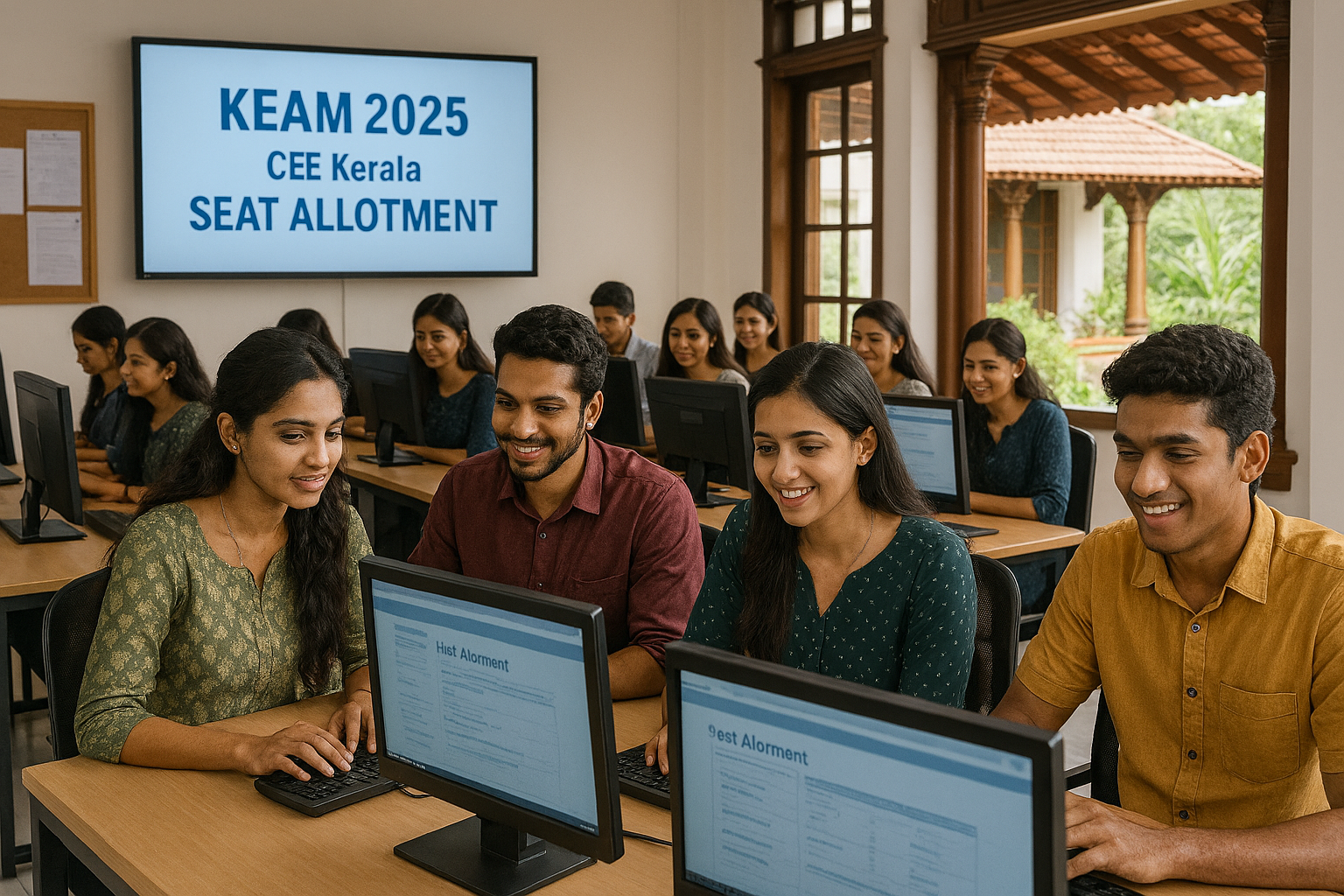
CEE Kerala has announced the KEAM 2025 seat allotment lists for Phase 2 Engineering and Phase 1 Architecture. Candidates can now check their allotment status at cee.kerala.gov.in.
Table of Contents
The Commissioner for Entrance Examinations (CEE) Kerala has announced the KEAM 2025 seat allotment results for Phase 2 Engineering and Phase 1 Architecture programs. This announcement affects thousands of students who appeared for the Kerala Engineering Architecture Medical entrance examination and completed their option registration process. The allotment lists are now accessible through the official portal at cee.kerala.gov.in.
The seat allotment process represents a critical stage in the admission cycle for engineering and architecture aspirants in Kerala. CEE Kerala manages the entire admission process, from conducting entrance examinations to final seat allocation across government, aided, and self-financing institutions. Understanding the complete procedure, documentation requirements, and deadlines ensures smooth admission completion for allotted candidates.
Understanding KEAM and Its Purpose
What is KEAM?
The Kerala Engineering Architecture Medical (KEAM) examination is a state-level entrance test conducted annually by the Commissioner for Entrance Examinations, Kerala. The examination determines eligibility for admission to undergraduate engineering, architecture, and pharmacy programs in participating institutions across Kerala. The test assesses candidates’ knowledge in Physics, Chemistry, and Mathematics for engineering courses, while architecture aspirants also undergo aptitude testing.
KEAM serves as the primary gateway to Kerala’s technical education institutions. The examination maintains standardized evaluation criteria, ensuring merit-based admissions across participating colleges. Both government and private institutions accept KEAM scores for their admission processes, making it essential for students seeking technical education in Kerala.
Examination Structure and Evaluation
The KEAM examination consists of separate papers for different courses. Engineering aspirants appear for Paper 1 (Physics and Chemistry) and Paper 2 (Mathematics), while architecture candidates take an additional aptitude test. Each paper carries specific weightage in the final rank calculation, along with marks from qualifying examinations (Class 12 or equivalent).
The evaluation process follows transparent methodologies with clear marking schemes. CEE Kerala publishes answer keys after examinations, allowing candidates to estimate their performance. The final rank list considers both entrance test scores and qualifying examination marks, with different weightage formulas for engineering and architecture streams.
KEAM 2025 Seat Allotment Details
Current Allotment Phase Information
Phase 2 Engineering Allotment:
This phase addresses candidates who either did not receive allotments in Phase 1 or chose to participate in option rearrangement for better opportunities. The allotment covers various engineering disciplines across participating institutions. Students can secure seats in multiple specializations including Computer Science, Electronics and Communication, Mechanical Engineering, Civil Engineering, Electrical Engineering, and emerging fields like Artificial Intelligence and Data Science.
Phase 1 Architecture Allotment:
The first major allotment round for Bachelor of Architecture (B.Arch) programs includes seats in government architecture colleges, aided institutions, and NAAC-accredited private colleges. Architecture admissions remain highly competitive due to limited seat availability across Kerala. The selection process follows merit-based criteria while implementing government-mandated reservation policies.
Participating Institution Categories
Government Engineering Colleges:
State-run institutions offering engineering programs with government-subsidized fee structures. These colleges maintain high academic standards and receive significant infrastructure investments from the state government.
Aided Institutions:
Privately managed colleges receiving financial assistance from the government. These institutions offer moderate fee structures compared to self-financing colleges while maintaining quality educational standards.
Self-Financing Colleges:
Private institutions operating without government financial assistance. These colleges charge higher fees but often provide modern infrastructure and industry-connected learning environments.
Critical Dates and Timeline
August 2025 Schedule
Understanding and adhering to the official timeline is essential for successful admission completion. Missing any deadline may result in seat forfeiture without exceptions.
Important Deadlines:
| Date | Activity | Details |
|---|---|---|
| August 8, 2025 | College Joining Deadline | Final date for reporting to allotted institution |
| August 8, 2025 | Document Submission | Last date for submitting required certificates |
| August 10-12, 2025 | Option Registration | Expected window for next round registration |
| August 15, 2025 | Next Allotment | Tentative release date for subsequent lists |
| August 20, 2025 | Final Phase | Projected commencement of closing rounds |
These dates are subject to official confirmation through CEE Kerala notifications. Students should regularly check the official website for any schedule modifications or additional announcements.
Planning Your Actions
Candidates should create a personal checklist immediately upon receiving allotment notifications. Organize all required documents, arrange transportation to the allotted college, and prepare for fee payment well before deadlines. Early completion of formalities prevents last-minute complications and ensures secure seat confirmation.
Step-by-Step Allotment Result Checking Process
Accessing Your Seat Allotment
The result checking process requires specific credentials provided during the KEAM application process. Follow these steps systematically to access your allotment information:
Detailed Procedure:
Navigate to Official Portal: Open a web browser and visit cee.kerala.gov.in. Ensure you are accessing the official website by verifying the URL carefully.
Locate Candidate Portal: Find the “KEAM 2025 Candidate Portal” link prominently displayed on the homepage. This section contains all candidate-related services and information.
Login with Credentials: Enter your Application Number and Password exactly as registered. These credentials were provided during the initial application process and should be kept confidential.
Access Allotment Results: Click on “Allotment Result” or the relevant link for Phase 2 Engineering or Phase 1 Architecture results. The system displays your allocation details if you received a seat.
Download Official Memo: Save the seat allotment memo in PDF format to your device. This document serves as official proof of seat allocation and is mandatory for college reporting.
Verify Information: Carefully check all details including college name, course allocated, category under which allocated, and fee structure. Report any discrepancies immediately to CEE Kerala helpline.
Troubleshooting Common Access Issues
Students may encounter technical difficulties during result access. If the portal shows errors, try clearing browser cache and cookies before attempting again. Using alternate browsers or devices sometimes resolves compatibility issues. During peak traffic periods, the server may experience slow response times; patience and repeated attempts usually succeed.
For login credential problems, use the password recovery option available on the portal. If issues persist, contact CEE Kerala technical support through official helpline numbers provided on the website.
Mandatory Documentation for College Reporting
Primary Academic Documents
Proper documentation is critical for admission completion. Missing or incorrect documents may lead to seat cancellation regardless of merit position or rank.
Essential Certificates Required:
KEAM 2025 Allotment Memo:
The official allocation letter downloaded from the CEE Kerala portal. This document serves as primary proof of seat allotment and must be presented in original during college reporting.
KEAM Admit Card:
Original admit card used during the entrance examination. The admit card contains important identifiers linking the candidate to examination records.
Class 10 Certificate:
SSLC (Secondary School Leaving Certificate) or equivalent examination certificate showing date of birth and educational qualification. This serves as age proof and basic educational qualification verification.
Class 12 Certificate:
Higher Secondary or equivalent examination marksheet showing qualifying examination performance. For engineering admissions, this certificate must show Physics, Chemistry, and Mathematics subjects with prescribed minimum marks.
Transfer Certificate:
Original TC from the last attended educational institution. The certificate should be recent and issued by the authorized school or college administration.
Conduct Certificate:
Character certificate from the previous educational institution confirming satisfactory conduct. This document should be issued on official letterhead with proper authentication.
Additional Required Certificates
Category Certificates:
SC/ST/OBC candidates must present valid caste or community certificates issued by competent authorities. These certificates must follow prescribed formats and contain all mandatory details including taluk, district, and issuing officer information.
Income Certificate:
Required for candidates seeking fee concessions or scholarships. The certificate should be recent (typically issued within the current financial year) and issued by revenue authorities.
Nativity Certificate:
Proof of Kerala residence for state quota seats. This certificate establishes the candidate’s domicile status and eligibility for state quota benefits.
Medical Fitness Certificate:
Certificate from a registered medical practitioner confirming physical fitness for pursuing the course. Some institutions may have specific health requirement formats.
Migration Certificate:
Students who completed qualifying examinations from boards outside Kerala must present migration certificates. This document is issued by the respective educational board authorizing transfer to Kerala institutions.
Document Verification Standards
All certificates must be original documents with attested photocopies. Attestation should be done by gazetted officers, notary public, or authorized institutional heads. Self-attested copies may not be accepted by institutions. Ensure all documents are clearly legible without damage or alterations.
CEE Kerala maintains strict verification protocols. Any discrepancy between submitted documents and registered information may result in immediate allotment cancellation. Students should verify document accuracy well before the reporting deadline to address any issues.
Seat Confirmation and Fee Payment Process
Online Seat Acceptance
After viewing allotment results, candidates must complete online seat acceptance through the KEAM portal. This digital confirmation creates a binding commitment between the student and allotted institution.
Acceptance Procedure:
Login to the KEAM candidate portal using your credentials. Navigate to the seat acceptance section and select “Accept Seat” option. The system displays complete details about your allotted course, institution, and fee structure. Review all information carefully before final confirmation.
Once accepted, the seat becomes provisionally secured pending physical reporting and document verification. Students must complete this online acceptance within the stipulated timeframe mentioned in the allotment notification.
Fee Payment Methods and Structure
The admission process requires payment of prescribed fees within the deadline. CEE Kerala facilitates online payment through multiple secure channels.
Available Payment Options:
- Net banking through major nationalized and private banks
- Credit card and debit card payments via secure gateways
- UPI (Unified Payments Interface) transactions
- Government payment portals for official transactions
Students should note that different institution categories have varying fee structures. Government colleges typically charge lower fees compared to aided and self-financing institutions. The complete fee breakup including tuition fees, development fees, and other charges appears during the payment process.
Physical Reporting Requirements
After completing online confirmation and fee payment, candidates must physically report to their allotted college. The reporting process includes multiple verification stages:
Document Verification:
College authorities verify original certificates against submitted photocopies and data registered with CEE Kerala. Any inconsistency may halt the admission process.
Biometric Registration:
Many institutions conduct biometric registration (fingerprint or photograph) for attendance tracking and security purposes.
Institutional Formalities:
Students complete institution-specific formalities including ID card issuance, library registration, and hostel allocation (if applicable).
Failure to complete physical reporting before the deadline results in automatic seat cancellation. Extensions are typically not granted except in extraordinary circumstances with proper documentation.
Commissioner for Entrance Examinations: Organizational Overview
CEE Kerala’s Role and Responsibilities
The Commissioner for Entrance Examinations, Kerala, functions as an autonomous body managing entrance examinations for various professional courses. Beyond KEAM, the organization conducts entrance tests for medical admissions, law programs, and postgraduate courses. This centralized system ensures standardized evaluation and transparent admissions across Kerala’s higher education landscape.
CEE Kerala operates under government regulations while maintaining operational independence. The organization coordinates with participating institutions, educational boards, and government departments to execute admission processes efficiently.
Technological Infrastructure
CEE Kerala has invested substantially in digital infrastructure supporting large-scale online operations. The systems handle thousands of simultaneous users during critical periods like result announcements and seat allotment releases. Server capacity and network bandwidth have been enhanced to prevent technical failures during peak usage.
Security measures protect candidate data and prevent unauthorized access. Encryption protocols secure sensitive information during transmission and storage. Regular security audits identify and address potential vulnerabilities.
Communication Channels
The organization maintains multiple communication channels ensuring students receive timely information:
Official Website:
The primary information source at cee.kerala.gov.in contains notifications, schedules, and procedural guidelines.
SMS Notifications:
Registered mobile numbers receive automated SMS alerts about important updates and deadlines.
Email Alerts:
Candidates receive email notifications at registered addresses for critical announcements.
Helpline Support:
Dedicated helpline numbers operate during business hours to address candidate queries and technical issues.
Understanding the Allotment Methodology
Merit-Based Allocation System
CEE Kerala follows a transparent merit-based system for seat allocation. The process considers multiple factors including entrance examination performance, qualifying examination marks, and category-based reservations.
Rank Calculation:
The final rank list incorporates KEAM entrance test scores with specific weightage. For engineering courses, Paper 1 (Physics and Chemistry) and Paper 2 (Mathematics) contribute to the rank calculation. Qualifying examination marks (Class 12 or equivalent) also carry prescribed weightage in the final rank determination.
Reservation Implementation:
Government-mandated reservation policies for SC/ST/OBC and other categories are implemented during seat allocation. Each institution maintains separate seat matrices for different categories, ensuring equitable distribution as per policy guidelines.
Option Registration and Preference System
Before seat allotment, candidates complete option registration indicating their preferred colleges and courses. The system allows registration of multiple options in order of preference. During allotment, the software allocates seats based on rank and registered preferences.
Higher-ranked candidates receive preference over lower-ranked candidates for the same seat. If a candidate’s first preference is unavailable, the system automatically considers subsequent preferences. This automated process ensures fair and efficient seat distribution.
Seat Matrix and Availability
CEE Kerala maintains a dynamic seat matrix showing real-time availability across all participating institutions. The matrix reflects total sanctioned seats, filled seats, and available seats for each course and category. This transparency helps candidates make informed decisions during option registration and rearrangement phases.
Seat availability changes with each allotment round as students confirm or decline seats. The updated matrix becomes the basis for subsequent allotment rounds.
Multiple Allotment Rounds and Future Opportunities
Upcoming Allotment Phases
The current announcement represents one phase in a multi-round allotment process. CEE Kerala conducts several rounds to maximize seat utilization and provide additional opportunities.
Scheduled Future Rounds:
Phase 3 Engineering:
Expected in late August 2025 for candidates who did not receive satisfactory allotments in previous phases or for seats that became available due to non-joining.
Phase 2 Architecture:
Scheduled for early September 2025, addressing remaining architecture seats and candidates awaiting better options.
Spot Admission Rounds:
Final phases conducted to fill remaining vacant seats. These rounds typically have shortened timelines with quick decision requirements.
Special Category Allocations:
Separate rounds may occur for specific quota seats including NRI, management, and other special categories as applicable.
Option Rearrangement Facility
Students dissatisfied with current allotments can participate in option rearrangement for subsequent rounds. This facility allows modification of college and course preferences based on changed circumstances or better understanding of available options.
Rearrangement Process:
Candidates login to the KEAM portal during the specified option rearrangement window. The system allows modification of previously registered options, including addition or removal of preferences and reordering of priority. Updated preferences apply to the next allotment round.
Important considerations include that participating in rearrangement may result in better, similar, or lower preference allotments depending on seat availability and competition. Students should carefully evaluate before modifying options.
Seat Surrender and Upgradation
Candidates holding seats from earlier rounds can choose to surrender those seats if they receive better options in subsequent rounds. The surrender process releases the seat back into the available pool for other candidates.
Upgradation occurs automatically when a candidate holding a seat receives a better preference in a later round. The system handles this transition, canceling the previous allotment and confirming the new one.
Strategic Guidance for Admission Success
Time Management and Prompt Action
The compressed timeline between allotment announcement and reporting deadline demands efficient time management. Create a detailed schedule allocating specific time slots for each required activity including document collection, travel arrangements, and fee payment.
Prioritize immediate actions upon receiving allotment notification. Delay in starting the process increases risk of missing deadlines due to unexpected complications like document unavailability or technical payment issues.
Document Organization and Preparation
Advance preparation of required documents significantly reduces admission completion time. Collect all certificates, obtain necessary attestations, and organize them systematically well before allotment announcements.
Create multiple sets of attested photocopies for different purposes. Keep original documents in protective folders to prevent damage during handling. Maintain digital scans as backup copies in case physical documents are misplaced.
Financial Planning and Preparation
Understanding complete fee structures helps in better financial planning. Contact allotted institutions directly for detailed fee breakdowns including tuition fees, development charges, caution deposits, and any other mandatory payments.
Explore available scholarship programs and fee concession schemes. Many government schemes provide financial assistance to students from economically disadvantaged backgrounds. Research eligibility criteria and application procedures for relevant schemes.
Arrange payment methods before the deadline. Ensure sufficient balance in bank accounts for online payments. Keep backup payment options ready in case primary methods encounter issues.
Support Systems and Student Resources
Technical Assistance Services
CEE Kerala provides comprehensive technical support during the admission process. Dedicated helpline numbers operate during business hours to address candidate queries.
Available Support Channels:
- Phone helpline for immediate query resolution
- Email support for detailed questions requiring documentation
- Live chat facility during peak periods (when available)
- Comprehensive FAQ sections on the official website
Students should use official support channels rather than relying on third-party services or unofficial sources. Official support ensures accurate information based on current policies.
Academic and Career Counseling
Understanding different engineering and architecture specializations helps in making informed course choices. Many institutions offer pre-admission counseling sessions explaining course structures, career prospects, and industry requirements.
Counseling Services Include:
- Course curriculum explanations and subject details
- Career pathway discussions for different specializations
- Industry requirement briefings and skill development insights
- Alumni interactions sharing real-world experiences
- Placement statistics and employment trend analyses
Students should attend counseling sessions when available to gain better understanding of their chosen field before confirming admissions.
Financial Aid and Scholarship Information
Various scholarship programs support students pursuing technical education. Government schemes, institutional scholarships, and private sector initiatives provide financial assistance based on merit, need, or specific criteria.
Scholarship Categories:
Merit-Based Scholarships:
Awarded to high-performing students based on entrance examination ranks or qualifying examination marks. These scholarships typically cover partial or full tuition fees.
Need-Based Financial Aid:
Supports students from economically disadvantaged backgrounds. Eligibility depends on family income and other socioeconomic factors.
Category-Specific Schemes:
Special scholarship programs for SC/ST/OBC and minority community students. These schemes follow government guidelines with specific eligibility and application procedures.
Students should actively research available scholarships and apply within specified deadlines. Institution admission offices typically provide information about applicable schemes.
Quality Assurance in the Admission Process
Data Verification and Validation
CEE Kerala implements multiple verification layers ensuring data accuracy throughout the admission process. Automated validation systems check for data inconsistencies and errors during option registration and document submission.
Cross-verification with educational boards and issuing authorities confirms certificate authenticity. This prevents fraudulent admissions and maintains the integrity of the selection process.
Institution Accreditation and Standards
All participating institutions undergo evaluation to ensure they meet prescribed standards. Criteria include infrastructure adequacy, faculty qualifications, laboratory facilities, library resources, and overall academic environment.
Institutions must maintain accreditation from relevant bodies like NAAC (National Assessment and Accreditation Council) or NBA (National Board of Accreditation). Regular inspections verify continued compliance with established standards.
Anti-Malpractice Measures
CEE Kerala maintains strict anti-malpractice protocols throughout the examination and admission process. Automated systems minimize human intervention, reducing opportunities for unfair practices.
Any detected irregularities result in immediate action including candidate disqualification and institutional penalties. The organization maintains transparency in handling malpractice cases, publishing outcomes of investigations when appropriate.
Impact on Kerala’s Education Sector
Engineering Education Landscape
Kerala maintains a robust network of engineering institutions offering diverse specializations. The systematic admission process through KEAM ensures fair access to quality technical education across different socioeconomic segments.
Recent years have seen expansion in emerging technology programs including Artificial Intelligence, Data Science, Cyber Security, and Robotics. Institutions are adapting curricula to meet evolving industry requirements and global technology trends.
Architecture Education Development
Architecture programs in Kerala combine traditional design principles with modern sustainable development concepts. Limited seat availability makes architecture admissions highly competitive, attracting top-performing students.
The curriculum emphasizes practical design studios, site visits, and industry internships alongside theoretical knowledge. Graduates from Kerala’s architecture programs contribute to the state’s urban development and architectural landscape.
Industry-Academia Collaboration
Growing collaboration between educational institutions and industry partners enhances practical learning opportunities. Many engineering colleges have established partnerships with technology companies for internships, projects, and placement activities.
These collaborations help align academic curricula with industry requirements, improving graduate employability. Students gain exposure to real-world challenges and contemporary technology applications during their studies.
Frequently Asked Questions (FAQs)
Q1: What is the official website for checking KEAM 2025 seat allotment results?
A1: The official website is cee.kerala.gov.in. Students should access allotment results only through this authentic portal maintained by the Commissioner for Entrance Examinations, Kerala. Avoid unofficial websites that may provide incorrect information or compromise personal data security.
Q2: What documents must I bring when reporting to my allotted college?
A2: Mandatory documents include the KEAM 2025 allotment memo, original admit card, Class 10 and 12 certificates, transfer certificate, conduct certificate, category certificate (if applicable), income certificate (for fee concessions), nativity certificate, and medical fitness certificate. Bring both original documents and attested photocopies. Missing any required document may result in admission denial.
Q3: Can I change my college preference after receiving Phase 2 Engineering allotment?
A3: Yes, you can participate in option rearrangement during specified windows announced by CEE Kerala for subsequent rounds. However, this facility is available only during designated periods, typically before each new allotment round. You must meet eligibility criteria and follow the announced schedule for option modifications.
Q4: What happens if I cannot report to my allotted college by August 8, 2025?
A4: Missing the reporting deadline results in automatic forfeiture of your allotted seat. You may also become ineligible for subsequent counseling rounds depending on your category and CEE Kerala policies. Extensions are rarely granted except in exceptional circumstances with proper documentation and prior approval from CEE Kerala.
Q5: How do I pay admission fees after seat allotment?
A5: Admission fees must be paid online through the KEAM portal or directly to the allotted institution using available payment methods including net banking, credit/debit cards, UPI, or government payment gateways. Cash payments are not accepted. Complete the payment before the specified deadline to confirm your seat. Keep payment receipts for verification during physical reporting.
Q6: Are there additional allotment rounds after Phase 2 Engineering and Phase 1 Architecture?
A6: Yes, CEE Kerala conducts multiple rounds including Phase 3 Engineering, Phase 2 Architecture, and spot admission rounds to fill remaining seats. Students who miss current rounds or seek better options can participate in subsequent phases based on seat availability and their eligibility. Check the official website regularly for announcements about upcoming rounds.
Q7: What is the process for claiming fee concessions under reserved categories?
A7: Students eligible for fee concessions must submit valid documents during college reporting including income certificates, caste certificates, or other relevant certificates as specified by the institution. Fee concessions are processed according to government guidelines. Verify your eligibility criteria and required documentation before the reporting deadline to ensure smooth processing.
Q8: How can I verify if my admission is successfully completed?
A8: After document verification and fee payment, the allotted institution provides confirmation of successful admission. The KEAM portal also updates your admission status in the candidate login section. You will receive SMS and email notifications confirming admission completion. Collect admission confirmation documents from your college for future reference.
Q9: What should I do if I find errors in my allotment memo?
A9: If you notice any discrepancies in your allotment memo including incorrect name spelling, category, course, or institution details, immediately contact CEE Kerala helpline before proceeding with admission. Report such errors through official channels and obtain written confirmation of corrections. Do not proceed with admission using incorrect documentation.
Q10: Can I withdraw from my current allotment to participate in future rounds?
A10: Yes, if you wish to participate in subsequent rounds for better options, you may be able to surrender your current seat following CEE Kerala procedures. However, understand that surrendering your seat does not guarantee allotment in future rounds. Carefully evaluate your options and seat availability trends before making withdrawal decisions. Check official guidelines about withdrawal procedures and eligibility for future rounds.
Important Reminders and Best Practices
Verification of Information
Always verify information through official CEE Kerala sources. During admission season, numerous unofficial websites and social media accounts circulate information that may be inaccurate or outdated. Rely exclusively on cee.kerala.gov.in for authentic updates.
Cross-reference important information with official notifications published on the website. Contact CEE Kerala helpline if you need clarification about any procedure or requirement.
Document Security and Backup
Keep original documents secure during the entire admission process. Create multiple attested copies for different purposes to avoid repeatedly handling originals. Store documents in waterproof, tear-resistant folders during travel to the allotted institution.
Maintain digital scans of all documents as backup. Email these scans to yourself or store them in secure cloud storage for emergency access if physical documents are lost or damaged.
Communication Records
Maintain records of all communications with CEE Kerala and educational institutions. Save emails, SMS messages, and note details of phone conversations including date, time, and person contacted. These records can be valuable if disputes or clarifications become necessary.
Screenshot important pages from the KEAM portal showing your allotment, payment confirmations, and status updates. These screenshots serve as evidence of completed steps in the admission process.
Seeking Assistance
Don’t hesitate to seek help when facing difficulties. Contact CEE Kerala helpline, consult with school counselors, or reach out to admission offices of allotted institutions for guidance. Most complications arise from misunderstanding procedures, which can be resolved through proper communication with authorities.
Connect with other candidates through official student groups or forums for peer support and information sharing. However, verify any information received from peers through official sources before acting on it.
Conclusion: Next Steps for KEAM 2025 Candidates
The announcement of KEAM 2025 Phase 2 Engineering and Phase 1 Architecture seat allotments represents a significant milestone for thousands of aspiring engineers and architects in Kerala. Students who received allotments must act promptly to complete admission formalities within the stipulated timeframe. The structured process established by CEE Kerala ensures fair opportunities for all eligible candidates.
Those who secured satisfactory allotments should immediately begin organizing required documents, arranging for fee payments, and planning their college reporting visit. Adhering to deadlines and following prescribed procedures ensures smooth admission completion without complications.
Candidates awaiting better options or who missed current allotments should prepare for upcoming rounds. Monitor the official website regularly for announcements about subsequent phases, option rearrangement windows, and any schedule modifications. Keep all documents ready for quick action when the next opportunity arrives.
The comprehensive support systems, transparent processes, and robust technological infrastructure provided by CEE Kerala demonstrate the state’s commitment to accessible quality technical education. Students should utilize available resources including helpline support, counseling services, and financial aid information to make informed decisions about their academic future.
As you embark on your engineering or architecture journey, remember that success in admission is just the beginning. Your dedication to learning, skill development, and professional growth will determine your ultimate success in these fields. Kerala’s technical institutions offer strong foundations for building rewarding careers in engineering and architecture.
Stay connected with official updates from CEE Kerala through cee.kerala.gov.in for the latest information on subsequent allotment rounds, counseling schedules, and important notifications. Best wishes for successful admission completion and a productive academic journey ahead.
About the Author
Name: Nueplanet
Credentials: Educational Content Specialist
Bio: Nueplanet specializes in technical education admissions and entrance examination content. With the years of experience covering state-level engineering and architecture entrance processes, Nueplanet provides accurate information sourced from official notifications and government portals to help students navigate admission procedures successfully.
Commitment to Accuracy: All published content is verified through official sources including CEE Kerala notifications, government announcements, and authorized educational institution information. Content is regularly updated to reflect the latest procedural changes and policy modifications.
Mission: To provide students and parents with reliable, comprehensive guidance about entrance examinations, admission processes, and educational opportunities through well-researched, factual content based exclusively on official sources.
Contact: For content corrections, updates, or questions about information accuracy, please use the contact form available on the About page.
Published: August 05, 2025
Last Updated: August 05, 2025
Source References: Commissioner for Entrance Examinations Kerala (cee.kerala.gov.in), official KEAM notifications, CEE Kerala admission guidelines
Disclaimer: This article is based on information available from official CEE Kerala sources as of the publication date. Students should verify all specific details, deadlines, and requirements through the official website at cee.kerala.gov.in and their respective allotted institutions. Procedures and schedules may change based on administrative decisions, and readers must refer to the latest official notifications for current information.
Helpful Resources
Call to Action
Stay tuned for more KEAM 2025 updates. Bookmark our page or subscribe to our newsletter for real-time seat allotment news, counselling tips, and more educational updates from NuePlanet.com.
Latest Posts:
- “India’s Next Test Series: Full Schedule After WTC”
- “CBSE Class 10th Compartment Result Declared”
- “JSW Cement IPO: Everything You Need to Know”
- “KSRTC Bus Strike in Karnataka: Full Story”
- “Federal Bank Share Price After Q1 FY26 Results”
- Satya Pal Malik: Life, Legacy, and Political Journey of a Controversial Statesman
Tag
CEE Kerala













Post Comment