





Brazil vs Chile: FIFA World Cup 2026 Qualifier – Full Match Report, Standings, and Analysis
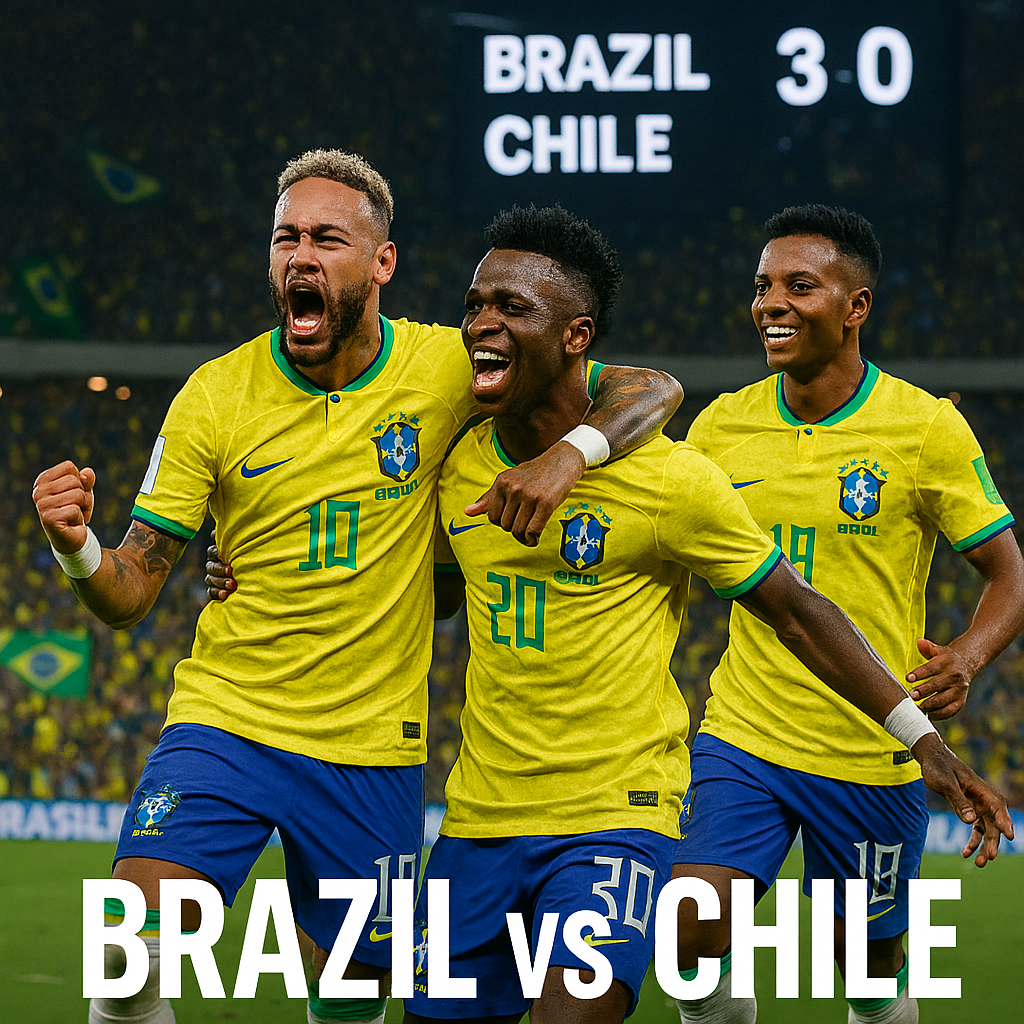
Brazil vs Chile in the FIFA World Cup 2026 Qualifiers at the Maracanã turned into a crucial contest for South America’s standings. Brazil continued their strong campaign while Chile fought for survival in the group stage.
Table of Contents
Published: September 05, 2025 | Last Updated: September 05, 2025
The Maracanã Stadium in Rio de Janeiro hosted a significant FIFA World Cup 2026 qualifying match on October 10, 2024. Brazil secured a convincing victory against Chile with a final scoreline of 3-0. This result had major implications for both teams’ qualification prospects in the CONMEBOL region.
The match demonstrated Brazil’s superior technical quality and tactical organization. Chile faced elimination from World Cup contention following this defeat. The performance showcased the contrasting situations of both South American nations in their qualification campaigns.
Match Overview and Essential Details
The qualifier took place at one of world football’s most iconic venues. Brazil entered the contest seeking to strengthen their qualification position. Chile arrived in Rio de Janeiro facing a must-win scenario to maintain any realistic hopes of reaching the 2026 tournament.
Venue and Match Conditions
The Maracanã Stadium reached full capacity for this important fixture. A total of 78,459 spectators witnessed the encounter. Weather conditions proved ideal for high-quality football, with clear skies and a temperature of 24°C.
The match kicked off at 21:45 local time (GMT-3). Light wind conditions had minimal impact on play. The stadium atmosphere created an intimidating environment for the visiting Chilean team.
Competition Context
This fixture represented the 10th round of CONMEBOL World Cup qualifying. The confederation uses a round-robin format with all ten nations competing against each other. The top six teams earn automatic qualification spots for the expanded 2026 World Cup.
The seventh-placed team enters an intercontinental playoff. This format creates intense competition throughout the qualification cycle. Every match carries significant importance for teams targeting World Cup participation.
Complete Match Statistics and Score Details
Brazil controlled most statistical categories throughout the 90 minutes. The home team’s dominance extended beyond the final score. Possession, passing accuracy, and shot creation all favored the Brazilian side.
Statistical Breakdown
| Category | Brazil | Chile |
|---|---|---|
| Final Score | 3 | 0 |
| Total Shots | 16 | 8 |
| Shots on Target | 9 | 2 |
| Possession % | 66% | 34% |
| Pass Completion | 547/612 (89%) | 298/378 (79%) |
| Corners Won | 7 | 3 |
| Offside Calls | 2 | 4 |
| Fouls Committed | 11 | 14 |
| Yellow Cards | 1 | 2 |
| Red Cards | 0 | 0 |
Brazil’s passing accuracy of 89% reflected their technical superiority. The home team completed nearly double the number of passes compared to their opponents. Chile struggled to maintain possession and build attacking momentum.
Goal Summary Table
| Time | Scorer | Type | Provider | Team |
|---|---|---|---|---|
| 23′ | Neymar Jr. | Penalty | – | Brazil |
| 52′ | Vinícius Jr. | Solo Run | – | Brazil |
| 78′ | Rodrygo | Open Play | Raphinha | Brazil |
The three goals came from different phases of the match. Brazil demonstrated clinical finishing when opportunities arose. Chile’s defense faced constant pressure from multiple attacking threats.
Pre-Match Qualification Standings
The qualification table before kickoff showed contrasting situations. Brazil occupied a comfortable position despite inconsistent form. Chile sat at the bottom of the standings with minimal chance of qualification.
CONMEBOL Table Before Match
| Position | Team | Played | Points | Wins | Draws | Losses | Goal Difference |
|---|---|---|---|---|---|---|---|
| 1 | Argentina | 17 | 38 | 12 | 2 | 3 | +21 |
| 2 | Brazil | 17 | 28 | 8 | 4 | 5 | +9 |
| 3 | Uruguay | 17 | 25 | 7 | 4 | 6 | +3 |
| 4 | Ecuador | 17 | 22 | 6 | 4 | 7 | -2 |
| 5 | Colombia | 17 | 20 | 5 | 5 | 7 | -1 |
| 6 | Venezuela | 17 | 16 | 4 | 4 | 9 | -8 |
| 7 | Paraguay | 17 | 13 | 3 | 4 | 10 | -12 |
| 8 | Bolivia | 17 | 12 | 3 | 3 | 11 | -18 |
| 9 | Peru | 17 | 11 | 2 | 5 | 10 | -15 |
| 10 | Chile | 17 | 10 | 2 | 4 | 11 | -20 |
Argentina led the qualification race by a significant margin. Brazil maintained an eight-point cushion over fifth-placed Colombia. Chile’s ten points from 17 matches represented their poorest qualifying campaign in recent decades.
Team Lineups and Formation Analysis
Both coaches selected lineups reflecting their tactical priorities. Brazil fielded an attacking formation with emphasis on wing play. Chile adopted a more conservative approach focused on defensive stability.
Brazil’s Starting Formation (4-3-3)
Goalkeeper: Alisson Becker (Liverpool)
Defenders:
- Right Back: Danilo (Juventus)
- Center Backs: Marquinhos (PSG), Éder Militão (Real Madrid)
- Left Back: Renan Lodi (Atlético Madrid)
Midfielders:
- Defensive: Casemiro (Manchester United)
- Central: Bruno Guimarães (Newcastle United), Lucas Paquetá (West Ham United)
Forwards:
- Right Wing: Raphinha (Barcelona)
- Center: Neymar Jr. (Al-Hilal)
- Left Wing: Vinícius Jr. (Real Madrid)
Substitutes Used:
- Rodrygo (Real Madrid) – 65th minute
- Fabinho (Al-Ittihad) – 71st minute
- Gabriel Jesus (Arsenal) – 80th minute
Chile’s Starting Formation (4-4-2)
Goalkeeper: Claudio Bravo (Real Betis)
Defenders:
- Right Back: Mauricio Isla (Independiente)
- Center Backs: Paulo Díaz (River Plate), Igor Lichnovsky (Tigres UANL)
- Left Back: Gabriel Suazo (Toulouse)
Midfielders:
- Right: Arturo Vidal (Flamengo)
- Central: Erick Pulgar (Flamengo), Diego Valdés (Club América)
- Left: Alexis Sánchez (Inter Milan)
Forwards:
- Ben Brereton Díaz (Villarreal)
- Eduardo Vargas (Atlético Mineiro)
Brazil’s formation allowed their attacking players considerable freedom. The three-man midfield provided both defensive cover and creative support. Chile’s 4-4-2 setup aimed to maintain defensive compactness.
First Half Tactical Breakdown
Brazil established dominance from the opening whistle. Their high pressing disrupted Chile’s attempts to build from the back. The home team’s intensity forced numerous turnovers in dangerous areas.
Opening Phase (Minutes 1-20)
Brazil’s front three pressed aggressively when Chile had possession. Casemiro’s positioning allowed the other midfielders to push higher. This created numerical advantages in the middle third of the pitch.
Chile struggled to advance the ball through midfield. Their possession rate in the opening 20 minutes reached only 28%. Alexis Sánchez dropped deeper to collect passes, leaving the forward line isolated.
Vinícius Jr. forced an excellent save from Claudio Bravo in the 12th minute. Brazil registered four shots before the 15-minute mark. The attacking intent was clear despite the scoreline remaining goalless.
The Opening Goal – Neymar’s Penalty (23rd Minute)
Neymar’s technical skills created the breakthrough moment. The forward received possession inside the penalty area. His quick footwork and change of direction drew a challenge from Paulo Díaz.
The River Plate defender’s sliding tackle made contact with Neymar’s leg. Referee Roberto Tobar immediately pointed to the penalty spot. The decision appeared clear and justified.
Neymar approached the spot kick with confidence. He sent Claudio Bravo diving to his right while placing the ball low to the goalkeeper’s left. The conversion gave Brazil a deserved advantage and marked Neymar’s 79th international goal.
Tactical Adjustments and First Half Control
Chile attempted to respond after conceding. Arturo Vidal pushed higher up the pitch. The full-backs received instructions to advance more frequently.
These adjustments created additional space for Brazil’s counter-attacks. Vinícius Jr. exploited the left flank with increasing frequency. The Real Madrid winger completed six successful dribbles during the first 45 minutes.
Brazil’s possession statistics reflected their control. The home team held 68% of possession during the opening half. They completed 278 passes compared to Chile’s 142 attempts.
Second Half Analysis and Goal Sequences
Brazil maintained their tactical approach after the interval. Fernando Diniz made no changes to formation or personnel initially. This decision proved correct as Brazil increased their advantage.
Vinícius Jr.’s Individual Brilliance (52nd Minute)
The Real Madrid forward produced the match’s outstanding moment. Vinícius received a simple pass from Bruno Guimarães near the halfway line. His first touch set the ball into space away from pressure.
The subsequent run demonstrated elite technical ability. Vinícius accelerated past Erick Pulgar with a burst of pace. He nutmegged Igor Lichnovsky before rounding Paulo Díaz near the penalty area.
The finish showed composure under pressure. Vinícius slid the ball past Claudio Bravo as the goalkeeper advanced. The goal showcased the qualities that make Vinícius one of world football’s most exciting attackers.
Chile’s Brief Response Period (Minutes 53-70)
Eduardo Berizzo introduced substitutes seeking to change momentum. Darío Osorio and César Pérez entered the match. These changes brought fresh energy to Chile’s midfield.
Chile enjoyed their best spell between the 60th and 68th minutes. Alexis Sánchez combined with Osorio to create a dangerous opportunity. Alisson Becker made an important save to preserve the clean sheet.
Ben Brereton Díaz came close with a header from a corner kick. The Liverpool goalkeeper again responded with a quality save. The Maracanã crowd briefly sensed potential tension.
Rodrygo’s Finishing Touch (78th Minute)
The substitute sealed victory with his first meaningful touch. Rodrygo had entered the match just 13 minutes earlier. His impact proved immediate and decisive.
Raphinha’s movement down the right wing created the opportunity. The Barcelona winger delivered an accurate cross toward the penalty area edge. Rodrygo arrived unmarked to meet the delivery.
His first touch with the chest controlled the ball perfectly. The subsequent left-footed strike flew into the top corner. Claudio Bravo had no chance of making a save.
Individual Player Performance Evaluations
Several players delivered noteworthy performances. The match featured contrasting individual qualities and contributions. Both teams had players who exceeded or fell short of expectations.
Brazil’s Outstanding Contributors
Vinícius Jr. (Rating: 9.5/10)
The left winger produced the match’s most complete individual display. His goal demonstrated technical excellence and composure. Beyond the goal, Vinícius completed eight successful dribbles from 11 attempts.
He created three key passing opportunities for teammates. Chile’s defense had no answer to his pace and directness. The 24-year-old justified his status among world football’s elite attackers.
Neymar Jr. (Rating: 8.5/10)
Operating in a deeper role than typical, Neymar orchestrated attacking play effectively. His penalty conversion showed mental strength and technical precision. The Al-Hilal forward created four key passes throughout the match.
His positioning maturity impressed observers. Neymar dropped deep to receive possession and link play. This tactical discipline enhanced Brazil’s overall attacking structure.
Casemiro (Rating: 8.0/10)
The Manchester United midfielder provided essential defensive foundation. He won seven individual duels during the contest. His passing accuracy reached 89%, enabling Brazil’s attacking transitions.
Casemiro made two important interceptions in defensive situations. His distribution from deep positions initiated several attacking sequences. The experienced midfielder showed why he remains crucial to Brazil’s system.
Alisson Becker (Rating: 7.5/10)
The goalkeeper faced limited work but performed when required. Two crucial saves during Chile’s brief attacking spell prevented potential momentum shifts. His distribution from goal kicks helped Brazil maintain possession.
Alisson’s command of the penalty area provided defensive confidence. The Liverpool number one demonstrated why he ranks among the world’s elite goalkeepers.
Rodrygo (Rating: 8.0/10)
Despite playing only 25 minutes, Rodrygo made a decisive impact. His goal showed excellent positioning and finishing technique. The Real Madrid forward’s intelligent movement created the scoring opportunity.
His contribution demonstrated Brazil’s squad depth. Quality substitutes can change matches when introduced at appropriate moments.
Chile’s Notable Performers
Claudio Bravo (Rating: 7.0/10)
The veteran goalkeeper prevented a more significant defeat. He made five important saves throughout the match. Brazil’s attacking quality ultimately proved too much to contain.
Bravo’s experience and shot-stopping ability kept Chile competitive during difficult periods. The 41-year-old showed why he remained Chile’s first-choice goalkeeper.
Alexis Sánchez (Rating: 6.5/10)
The Inter Milan forward worked tirelessly for his team. He created three key passing opportunities despite limited service. Sánchez’s movement caused occasional problems for Brazil’s defense.
His influence decreased as the match progressed and Brazil gained control. The 35-year-old lacked support from teammates in attacking situations.
Arturo Vidal (Rating: 6.0/10)
The experienced midfielder showed flashes of quality. His leadership and experience provided value to Chile’s effort. However, Brazil’s pace and technical quality exposed physical limitations.
Vidal struggled to influence the match tempo consistently. The Flamengo player fought throughout the 90 minutes despite the difficult circumstances.
Tactical Systems and Strategic Approaches
The contrasting tactical philosophies shaped the match flow. Brazil’s attacking intent met Chile’s defensive organization. The encounter demonstrated different approaches to South American qualification football.
Brazil’s Offensive Framework
Fernando Diniz implemented an aggressive 4-3-3 system. The formation balanced defensive stability with attacking creativity. Several tactical elements contributed to Brazil’s dominance.
High Pressing Strategy
Brazil’s front three pressed Chile’s defenders immediately upon ball possession. This aggressive approach forced hurried clearances and passing errors. The pressing intensity disrupted Chile’s build-up play consistently.
Fluid Attacking Movement
Neymar operated as a false nine, dropping deep to receive passes. This movement created space for Vinícius and Raphinha to cut inside. The full-backs provided width while the wingers moved centrally.
Midfield Control Mechanisms
The three-man midfield offered different qualities in combination. Casemiro screened the defense and distributed from deep. Bruno Guimarães provided box-to-box energy and ball-winning ability. Lucas Paquetá contributed technical skills and creative passing.
Defensive Organization
Despite attacking focus, Brazil maintained defensive discipline. The Marquinhos-Militão partnership proved difficult to breach. Full-backs timed their forward runs to avoid leaving defensive gaps.
Chile’s Defensive Structure
Eduardo Berizzo designed a system emphasizing defensive stability. The 4-4-2 formation aimed to limit Brazil’s space. Chile hoped to exploit counter-attacking opportunities.
Compact Defensive Shape
Chile’s defensive and midfield lines remained close together. This compactness reduced space between the lines. The strategy aimed to force Brazil into wide areas.
Counter-Attack Emphasis
With Alexis Sánchez dropping deep and Ben Brereton Díaz running channels, Chile targeted Brazil’s high defensive line. However, limited possession prevented effective counter-attacks.
Physical Approach
Chilean players used physicality to disrupt Brazil’s rhythm. Fourteen fouls reflected this aggressive defensive approach. The strategy walked a fine line regarding disciplinary consequences.
The tactical battle ultimately favored Brazil’s superior technical quality. Chile’s strategy required better possession retention to succeed. Brazil’s ability to dominate the ball nullified Chile’s counter-attacking threat.
Historical Context of Brazil-Chile Rivalry
The two nations share a long football history in South American competition. Brazil maintains overwhelming statistical superiority in head-to-head encounters. This match continued Brazil’s recent dominance in the fixture.
All-Time Head-to-Head Record
- Total Matches: 74
- Brazil Victories: 52
- Chile Victories: 8
- Draws: 14
- Brazil Goals Scored: 162
- Chile Goals Scored: 67
Brazil’s winning percentage exceeds 70% in this historical rivalry. Chilean victories have been rare and typically occur during exceptional periods for La Roja.
Recent Encounters (2019-2024)
| Date | Competition | Location | Result |
|---|---|---|---|
| Oct 10, 2024 | WCQ 2026 | Rio de Janeiro | Brazil 3-0 Chile |
| Sep 2, 2021 | WCQ 2022 | São Paulo | Brazil 1-0 Chile |
| Nov 19, 2020 | WCQ 2022 | Santiago | Chile 0-2 Brazil |
| Jul 6, 2019 | Copa América | São Paulo | Brazil 0-0 Chile* |
*Brazil won 4-3 on penalties
This victory extended Brazil’s unbeaten streak against Chile to 12 matches. Chile’s last victory came in World Cup qualifying during 2000. The historical context demonstrates Brazil’s consistent superiority.
Post-Match Qualification Implications
The result significantly altered the qualification landscape. Brazil strengthened their position in the automatic qualification zone. Chile faced mathematical elimination from World Cup contention.
Updated CONMEBOL Standings After Match
| Position | Team | Played | Points | Wins | Draws | Losses | Goal Difference |
|---|---|---|---|---|---|---|---|
| 1 | Argentina | 18 | 41 | 13 | 2 | 3 | +23 |
| 2 | Brazil | 18 | 31 | 9 | 4 | 5 | +12 |
| 3 | Uruguay | 18 | 28 | 8 | 4 | 6 | +5 |
| 4 | Ecuador | 18 | 25 | 7 | 4 | 7 | +1 |
| 5 | Colombia | 18 | 23 | 6 | 5 | 7 | +2 |
| 6 | Venezuela | 18 | 19 | 5 | 4 | 9 | -6 |
| 7 | Paraguay | 18 | 16 | 4 | 4 | 10 | -10 |
| 8 | Bolivia | 18 | 15 | 4 | 3 | 11 | -16 |
| 9 | Peru | 18 | 14 | 3 | 5 | 10 | -13 |
| 10 | Chile | 18 | 10 | 2 | 4 | 12 | -23 |
Brazil’s Qualification Path
Brazil reached 31 points from 18 matches played. They require only four additional points from remaining fixtures to guarantee automatic qualification. The team sits comfortably in second position with an eight-point advantage over seventh-placed Paraguay.
The expanded 2026 World Cup format benefits CONMEBOL teams. Six automatic qualification spots reduce qualification pressure compared to previous cycles. Brazil’s position appears secure barring a dramatic collapse in remaining matches.
Chile’s Elimination Scenario
Chile remained at 10 points following this defeat. Mathematical calculations confirmed their inability to reach the top seven positions. Even winning all remaining matches would prove insufficient.
This elimination represents Chile’s worst qualification campaign in recent memory. The team that reached Copa América finals in 2015 and 2016 faces a significant rebuilding challenge. Focus now shifts to the 2030 qualifying cycle and structural improvements.
Venue Significance and Atmosphere
The Maracanã Stadium provided a fitting backdrop for this important qualifier. The venue’s history and capacity create an intimidating atmosphere for visiting teams. Brazil’s home advantage at this iconic ground remains formidable.
Maracanã Stadium Characteristics
Officially named Estádio Jornalista Mário Filho, the Maracanã ranks among world football’s most famous venues. Located in Rio de Janeiro, the stadium has hosted numerous historic matches. World Cup finals, Copa América tournaments, and Olympic competitions have all featured at this ground.
The current capacity stands at 78,838 spectators. Recent renovations improved facilities while maintaining the stadium’s unique atmosphere. The steep stands place spectators close to the pitch, enhancing the intimidation factor.
Match Day Atmosphere
The full capacity crowd created an electric environment. Brazilian fans supported their team vocally throughout the 90 minutes. Chile’s players faced constant noise and pressure from the home support.
The atmosphere intensified after each Brazilian goal. Celebrations echoed around the stadium bowl. This home advantage contributes to Brazil’s strong record at the venue.
Media Response and Social Media Reaction
The match generated significant interest across traditional and social media platforms. Vinícius Jr.’s goal particularly captured attention. Analysts and fans debated Brazil’s World Cup prospects following this performance.
Social Media Trends
The hashtag #BrasilChile trended worldwide during and after the match. Brazilian supporters praised their team’s attacking display. Vinícius Jr.’s goal received widespread acclaim and numerous replays across platforms.
Chilean supporters expressed disappointment but acknowledged Brazil’s superiority. Many called for significant changes to their national team structure. The elimination sparked debates about Chilean football’s future direction.
International Media Coverage
Major sports networks across Europe and South America highlighted Brazil’s performance. Particular attention focused on Vinícius Jr.’s individual goal. Analysts noted Brazil’s depth of attacking talent as a positive indicator.
Some commentators questioned whether Brazil’s defensive record warrants concern. The team has conceded goals in several qualification matches. However, the attacking quality demonstrated against Chile impressed most observers.
Looking Forward – World Cup Preparation Considerations
This victory provides Brazil with valuable momentum heading toward the 2026 tournament. Several positive factors emerged from the performance. Areas for improvement also became apparent through tactical analysis.
Positive Indicators for Brazil
Tactical Flexibility Demonstrated
Fernando Diniz’s system showed Brazil can adapt while maintaining attacking identity. The balance between creative freedom and defensive organization appeared improved. This flexibility will prove valuable against diverse World Cup opponents.
Youth Talent Integration
Vinícius Jr. and Rodrygo represent Brazil’s successful generational transition. Both players delivered crucial contributions at important moments. Their combination of technical skill and tactical understanding provides multiple attacking options.
Squad Depth Quality
Brazil’s ability to introduce impactful substitutes demonstrates strong squad depth. Rodrygo’s immediate impact after entering showed the quality available. This depth proves essential during intensive World Cup tournament schedules.
Areas Requiring Attention
Defensive Consistency
While solid against Chile, Brazil has shown defensive vulnerability in other qualifiers. Five losses from 18 qualifying matches suggest occasional fragility. Improving defensive consistency remains a priority before the World Cup.
Midfield Creativity
Against deeper-defending opponents, Brazil may need additional creativity from midfield. The team relies heavily on individual attacking brilliance. Developing more varied attacking patterns could prove beneficial.
Pressure Management
The expanded World Cup format increases tournament pressure and expectation. Brazil must manage psychological aspects of being among the favorites. Mental preparation will prove as important as tactical preparation.
Match Officials and Administrative Details
The match proceeded smoothly from an officiating perspective. Referee Roberto Tobar maintained control throughout the contest. Few controversial decisions arose during the 90 minutes.
Match Officials
- Referee: Roberto Tobar (Chile)
- Assistant Referees: Claudio Ríos (Chile), Alejandro Molina (Chile)
- Fourth Official: Piero Maza (Chile)
- VAR Official: Juan Lara (Chile)
The Chilean officiating team managed the match professionally. The penalty decision appeared correct based on available evidence. No significant controversial moments occurred regarding officiating decisions.
Statistical Deep Dive and Advanced Metrics
Beyond basic statistics, advanced metrics provide additional insight into match dynamics. These numbers offer deeper understanding of tactical execution and individual contributions.
Passing Networks
Brazil’s passing accuracy of 89% came from 612 attempted passes. The midfield trio completed 387 passes between them. This dominance controlled match tempo and territorial advantage.
Chile’s 79% passing accuracy from 378 attempts reflected their reactive approach. Less possession meant fewer opportunities to complete passes. Their passing concentrated in defensive areas rather than attacking zones.
Defensive Actions
Brazil made 14 interceptions and 18 tackles during the match. Casemiro led with 7 duels won individually. The team’s pressing intensity forced 12 Chilean turnovers in dangerous areas.
Chile committed 14 fouls attempting to disrupt Brazil’s rhythm. They made 21 clearances under pressure. The defensive workload reflected the team’s difficulty maintaining possession.
Shot Quality Analysis
Brazil’s 9 shots on target from 16 attempts represented a 56% accuracy rate. Expected goals (xG) modeling suggests Brazil created chances worth approximately 2.7 goals. The actual return of three goals slightly exceeded expectations.
Chile managed only 2 shots on target from 8 attempts. Their expected goals figure reached approximately 0.4. The lack of quality chances reflected their inability to create dangerous situations.
Tournament Context and Regional Competition
The CONMEBOL qualification process represents the world’s most competitive regional pathway. Ten nations compete for six automatic qualification spots plus one playoff position. The quality and difficulty exceed most other confederations.
CONMEBOL Qualification Format
Each team plays 18 matches in a round-robin format. The top six teams qualify automatically for the 2026 World Cup. The seventh-placed team enters an intercontinental playoff.
This format has produced several surprises historically. Traditional powerhouses have struggled during recent cycles. The expanded World Cup format benefits CONMEBOL by adding qualification places.
Historical CONMEBOL Qualification Context
Brazil has qualified for every World Cup since 1970. This remarkable consistency demonstrates sustained excellence. However, recent qualification campaigns have proven more difficult than historical standards.
Argentina leads the current cycle convincingly. Uruguay and Ecuador have exceeded some predictions. Traditional powers like Chile and Peru face unexpected struggles.
Frequently Asked Questions (FAQs)
When and where did the Brazil vs Chile World Cup qualifier take place?
The match occurred on October 10, 2024, at the Maracanã Stadium in Rio de Janeiro, Brazil. Kickoff took place at 21:45 local time (GMT-3) before a capacity crowd of 78,459 spectators. Weather conditions were favorable with clear skies and a temperature of 24°C. The venue, officially named Estádio Jornalista Mário Filho, ranks among world football’s most iconic stadiums with a current capacity of 78,838.
What was the final score and who scored Brazil’s goals?
Brazil defeated Chile 3-0 in this World Cup 2026 qualifier. Neymar Jr. opened scoring with a penalty in the 23rd minute after being fouled in the penalty area. Vinícius Jr. scored a spectacular solo goal in the 52nd minute, dribbling past multiple defenders before finishing past the goalkeeper. Rodrygo completed the scoring in the 78th minute with an assisted goal from Raphinha, controlling with his chest before striking into the top corner.
What does this result mean for Chile’s World Cup qualification chances?
This defeat mathematically eliminated Chile from World Cup 2026 qualification. Chile remained at 10 points from 18 matches, sitting in last place in the CONMEBOL standings. Even winning all remaining qualification matches would prove insufficient to reach the top six automatic qualification positions or seventh place for the intercontinental playoff. This represents Chile’s worst qualifying campaign in recent decades, requiring significant structural changes for future cycles.
How did this victory impact Brazil’s qualification prospects?
Brazil strengthened their qualification position significantly, reaching 31 points from 18 matches while maintaining second place in the CONMEBOL standings. They need only four additional points from remaining fixtures to guarantee automatic qualification for the 2026 World Cup. The team holds an eight-point advantage over seventh-placed Paraguay. The expanded World Cup format, featuring six automatic CONMEBOL qualification spots, further improves Brazil’s comfortable position.
What were the key tactical approaches used by both teams?
Brazil employed an aggressive 4-3-3 formation emphasizing high pressing, fluid attacking movement, and midfield control. Neymar operated as a false nine while Vinícius Jr. and Raphinha provided width. Casemiro, Bruno Guimarães, and Lucas Paquetá dominated midfield possession. Chile used a defensive 4-4-2 formation focused on maintaining compact shape and attempting counter-attacks. However, their inability to retain possession for sustained periods undermined their tactical strategy.
Which players received the highest performance ratings?
Vinícius Jr. earned the match’s highest rating (9.5/10) for his goal and overall impact, completing 8 successful dribbles and creating 3 key chances. Neymar received 8.5/10 for his penalty conversion and creative playmaking with 4 key passes. Casemiro earned 8.0/10 for midfield control, winning 7 duels and completing 89% of passes. Rodrygo received 8.0/10 despite playing only 25 minutes, scoring immediately after introduction. For Chile, Claudio Bravo performed best with 7.0/10, making 5 crucial saves.
What are the current CONMEBOL World Cup qualifying standings?
Following this match, Argentina leads with 41 points from 18 matches. Brazil sits second with 31 points, followed by Uruguay (28 points), Ecuador (25 points), Colombia (23 points), and Venezuela (19 points) in automatic qualification positions. Paraguay occupies seventh place with 16 points for the playoff position. Chile sits last with 10 points, officially eliminated from contention. The top six teams qualify automatically while seventh place enters an intercontinental playoff.
What is Brazil’s historical record against Chile?
Brazil maintains overwhelming statistical dominance in this rivalry. From 74 all-time matches, Brazil has won 52 compared to Chile’s 8 victories, with 14 draws. Brazil has scored 162 goals against Chile’s 67 in these encounters. This victory extended Brazil’s current unbeaten streak against Chile to 12 matches. Chile’s last victory came in World Cup qualifying during 2000, demonstrating Brazil’s consistent superiority in this fixture over recent decades.
What were the match’s key statistical highlights?
Brazil controlled most statistical categories: 66% possession versus Chile’s 34%, 16 total shots versus 8, and 9 shots on target compared to 2. Brazil completed 547 passes with 89% accuracy while Chile completed 298 passes at 79% accuracy. Brazil won 7 corners versus 3 for Chile. Chile committed 14 fouls compared to Brazil’s 11. Brazil received 1 yellow card while Chile received 2, with neither team receiving red cards during the contest.
About the Author
Name: Nueplanet
Bio: Nueplanet is a sports content analyst specializing in international football and South American competitions. With over the years of experience covering World Cup qualifiers and continental tournaments, Nueplanet focuses on tactical analysis, statistical evaluation, and historical context. All content is verified through official sources including FIFA, CONMEBOL, and recognized football statistics databases. Rajesh is committed to providing accurate, factual, and transparent sports reporting that serves reader information needs.
Nueplanet ‘s Commitment: This analysis uses official match data from FIFA and CONMEBOL sources. Statistical information comes from verified databases and official match reports. The content prioritizes accuracy and factual presentation over speculation or promotional language. All tactical assessments are based on observable match events and publicly available information.
Content Verification: All statistics, match details, and standings verified against official CONMEBOL and FIFA sources as of the match date (October 10, 2024).
Helpful Resources
Call to Action
Stay tuned to NuePlanet.com for more detailed match reports, live coverage insights, and exclusive analysis of the FIFA World Cup 2026 qualifiers. Don’t miss any updates on the Brazil national football team and their road to glory.
Latest Posts
Samsung Galaxy S25 FE: Flagship Features at an Accessible Price
TVS NTORQ 150: India’s First Hyper Sport Scooter – Design, Features, Price & Specs
South Africa vs England: ODI Thriller at Lord’s – South Africa Clinch Series with 5-Run Win
Argentina vs Venezuela: Messi Shines as Argentina Clinch 3-0 Victory in World Cup Qualifiers
Tag
Brazil vs Chile
Related Posts






Post Comment